Sato Launches GT E Series Industrial Barcode Printers

Sato Corp., a Japan-based supplier of barcode printing, labeling and electronic product code/radio
frequency identification solutions, reports its new Web-enabled GT e Series industrial barcode
printers are the most intelligent printers in their class. The printers feature Sato Embedded Basic
Language, which allows users to create customized stand-alone programs and load them into the
printer. It also enables the printer to interface directly with external devices and process data
received in stand-alone mode without connecting to a personal computer. Print speed equals 12
inches per second at 305 dots per inch (dpi), and allows users to set print resolution at 203 dpi,
305 dpi or 609 dpi. The printers also feature Web-based Printer Control Plus to allow control via
any Web-enabled device.

March 2005

Yarn Mills Run Strong


S
pinners, mainly with ring and open-end (OE) systems, report they are running at or near
capacity.

“We are running at full capacity with good demand and a strong backlog,” said an OE spinner. “
The apparel business was the strongest segment during January. The weaving and upholstery
businesses are good for us, as well as yarns for package dyeing. Yarns for the automotive market
are slow at this time.”

“We saw the usual slowdown during Christmas and gained a little bit of inventory,” said a
multisystem spinner. “We came back to normal operations the second week of January or so. We are
basically selling what we are making.”


Q1, Q2 Look Solid

Carded and combed ring-spun yarn demand is steady. Military orders have materialized, increasing
nylon yarn production. The OE market is tight; customers are fishing around for additional
capacity.

“Our strongest quarter traditionally is the second quarter,” said an OE spinner. “I am
pleasantly surprised with our business for the first quarter, as it is normally quite slow.”

“Business looks pretty good through the first quarter and probably into the second quarter. I
have no clue beyond that,” said a ring spinner.

While the T-shirt market usually starts around March or April and runs pretty strong through
the first of the summer, it looks like it may be starting a bit early this year.

“We are still very positive,” said a multisystem spinner. “We are still not sure what the
impact of the elimination of quotas will be. Our business continues to be strong. It has lightened
up a bit on the weave side, but the knitters continue to be extremely busy.”

Spinners surveyed this month reported doing some export business, primarily to Central
America. One said exports to the Caribbean Basin region accounted for about a third of his company’s
business.


Pricing Paradox

Cotton fiber prices have stabilized and are not expected to rise anytime soon because of
projected oversupply. Spinners continue to keep their eyes on man-made fiber prices. They report
polyester prices have stabilized, but have not come down. This has really squeezed the mills since
it’s next to impossible for them to pass on the increase to customers.

“Man-made fiber prices have to stop somewhere,” said a ring spinner. “At some point, it is
going to price itself out of the market.”

Yarn prices, on the other hand, have come down substantially since Christmas, along with
decreases in cotton prices. At the same time, spinners have struggled to hold pricing high enough
to cover polyester price hikes. The consensus seems to be that yarn prices are stabilizing.

“We were able to hold some of our prices due to polyester price increases, but it goes up in
pennies and comes down in nickels and dimes,” said a multisystem spinner.


Waiting To See On Safeguards

Mill executives want to see the threat-based China safeguards initiated but have some doubts
about the US government’s commitment to them.

“Unfortunately, the retail industry has managed to get an injunction to halt the China
safeguard issue — at least for now,” said an OE spinner. “Without the safeguards, we are looking at
some devastating consequences for US textile mills, as well as most other manufacturing sectors in
the United States.”

“I don’t think China safeguards or any other governmental action is going to have much of an
impact,” said a ring spinner. “If you are going to survive, you better do it on your own, and don’t
look for Big Brother to help.”


18-Million Bale Crop Projected

US cotton producers intend to plant 13.7 million acres of cotton this spring, up 0.6 percent
from 2004, according to the National Cotton Council’s 22nd Annual Early Season Planting Intentions
Survey.

Upland cotton intentions are 13.5 million acres, an increase of 0.5 percent over 2004
plantings. Extra-long-staple (ELS) intentions of 255,000 acres represent a 2.3-percent increase
over 2004. This would yield an estimated 18.2 million bales of upland cotton and 691,000 bales of
ELS cotton, compared to 2004’s total production of 23 million bales, according to the US Department
of Agriculture’s estimate for January 2005.


March 2005


A Still-Fuzzy Trade Picture


F
oreign trade uncertainties continue to dominate the overall industry picture. Will US
mills be successful in having Uncle Sam consider petitions to curb imports of foreign products?
What kind of upward revaluation in Chinese currency (the yuan) can we expect? How will the Central
American Free Trade Agreement (CAFTA) eventually play out?

Most mill executives are worried, fearing CAFTA as currently negotiated will give China a
backdoor entry into our market — primarily by allowing Central American garment makers in certain
cases to use foreign-made fabric and still send finished clothing to the United States duty-free.
Some administration officials say this fear is overblown, noting that smuggled fabric shouldn’t
prove to be a problem since less than 9 percent of the fabric content of US CAFTA clothing imports
over the past year consisted of foreign-made material. They also argue that CAFTA garment makers
will have a greater incentive to stay in the Western Hemisphere and thus make them more likely to
use US-made textiles.

P14_Copy_9


Impact On Prices

These uncertainties are beginning to have some effect on clothing tags, making US importers
think twice or maybe even three times before putting all their eggs in the super-cheap Chinese
basket. The 15- to 20-percent decline in garment prices predicted last fall is not materializing.
There have been some spotty weaknesses, but as of today, there’s precious little evidence of any
big tumble.

The currency question mark is having its effect, for any upward yuan revaluation would make US
imports from China more expensive. The Chinese have been under mounting pressure to correct the
exchange rate imbalance. No one expects the big 35- to 40-percent upward revaluation some say is
needed, but most economists are convinced some slow, steady increase in the yuan’s value is
inevitable as the year wears on. Other price-firming factors that may be playing a near-term role
include previously unmentioned US quota and CAFTA uncertainties, new retailer attempts to shore up
badly depleted margins, rising oil and other raw material costs, rising shipping costs, attempts to
improve quality rather than cut prices, and even some concerns that today’s swift Chinese expansion
could lead to some production bottlenecks in that country.


2005 Demand

Demand seems to be holding up. Latest government data show mill production and shipments remain
pretty much at year-ago levels — a lot better than the declines of other recent years. A new
Institute for Supply Management survey suggests this pattern is continuing into early 2005. Part of
this leveling off can be traced back to the trade questions discussed above. Equally important,
however, is today’s still improving macro-economic picture. Most analysts project 3.5-percent gross
domestic product growth for the year as a whole. Add in a slowdown in productivity gains, and this
could mean the addition of about 200,000 jobs per month. This should probably be enough to permit a
nearly 5-percent increase in wage and salary income — more than enough to keep consumers in a
spending mood. As such,

TW
now sees apparel sales rising another 4 percent or so this year — hitting a peak of nearly
$180 billion. This extra spendable income would also seem to assure further gains.

Upshot: 2005 textile mill activity, despite all earlier gloom-and-doom talk, may yet end up
pretty close to overall 2004 levels.


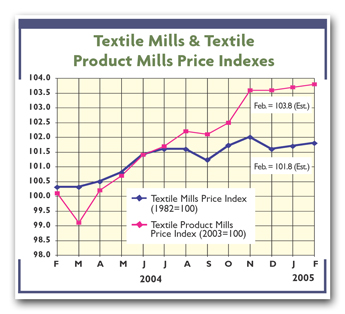
Statistical Note

Thanks to new government data, the Textile Mill Products Price Index is being revised by
splitting it into two subsectors. One reflects trends in basic textile mill prices. The other
traces price performance in the more highly fabricated textile product mills sector. This permits
comparison with similar breakdowns that were made available in other such textile areas as
employment, earnings, sales and inventories. While both new price measures show little upward
movement over the past year, performance has generally been a bit more robust in the textile
product mills sector, where foreign competitive pressures haven’t been quite as severe.


March 2005

Termodyeing

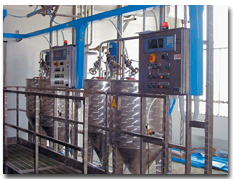
Termoelettronica offers the Termodye-M semi-automatic dissolving system.


I
n identifying priorities within the dyehouse, Italy-based Termoelettronica S.p.A.
emphasizes recipe repeatability and reduced number of lots rejected due to offshading, the unequal
tonality of color from dyeing to dyeing. Termoelettronica has demonstrated this emphasis through
its dyeing solutions. Without making large investments in automatic dosing systems, it is possible
to reach such objectives as recipe repeatability and a reduced number of rejected dye lots through
the monitored weighing of dyestuffs using the company’s Termodye-M semi-automatic dissolving
system, according to Termoelettronica. Dissolving the dyestuff can easily be managed in a
centralized area in order to eliminate the problems related to the transporting of dyestuff near
individual machines, which can lead to contamination and above all, misdosing the possibility of
dosing the recipe in a machine for which it is not intended. The system essentially consists of a
series of dissolving tanks, equipped and prepared for dissolving the dyestuffs, the number of which
is determined by the number of dyeing machines to be fed.


Choosing The Most Suitable Installation

To help determine which plant installation best fits a companys needs, Termoelettronica offers
several suggestions.

An installation might be considered that focuses on dyeing machines with only a preparation tank
without a supervision system with an average load capacity of 600 kilograms. In this case,
Termoelettronica would suggest a single dissolving tank for every five to six machines in order to
save time and avoid delay of dyeing operations. Obviously, if there is a supervision system in
place that allows the preplanned applications of various dosings, the number of machines that could
be fed can be increased. However, it is important to consider that the latest-generation dyeing
machines, such as the MULTIFLOW® from Italy-based MCS, have significantly reduced the dyeing times
so that they take less than half of the time of earlier dyeing cycles. So, even with modern and
fast machines, a company should consider installing a dissolving tank for every five to six
machines.

The dissolving system is managed by microprocessors linked by a barcode reader to
additional dyehouse supervision system safety devices.

Regarding the capacity of the single dissolving tank, Termoelettronica typically supplies
several tanks, one of 300 liters and the other of 500 liters, to allow flexibility of options.
(Consider that the dissolution and/or the dispersion of a dyestuff is effected, if not in
particular cases, with a liquor ratio that varies in the range of 1:5 and 1:10.)The particular
design of these dissolving tanks allows one to dissolve minimal dyestuff quantities in 20 to 30
liters of water. Nevertheless, the distance the dye must travel must be considered. A food
electrocleaned type pipeline with an external diameter of 28 millimeters (mm) and a thickness of
1.55 mm is used to distribute dye to the various machines. Termoelettronica uses air to reduce the
volume of water necessary to wash the line, so a minimum amount of water is required to clean the
tanks.


Hot Water

Consideration of the water temperature might seem a little trivial, but it is of notable
importance in the dissolving process of powdered dyestuffs. To obtain the best dissolution, it
would be ideal to use demineralized water, but sweetened water of various degrees of purification
certainly is acceptable. Termoelettronica recommends using warm water at the correct temperature
linked to the class of dyestuffs that must be dissolved. The method proposed by Termoelettronica
enables the monitored mixing, managed by a microprocessor, of two water flows constantly maintained
at two temperatures of 40°C and 90°C (using indirect steam). In this way, an appropriate volume of
water immediately is available at the desired temperature. This procedure allows a rapid
dissolution of the dyestuffs and allows the solution to be fed to different machines using a single
dissolving tank.

Different size dissolving tanks are equipped with a mixer, three level probes,
indiredt/direct steam water and safety proximity devices.

March 2005

Chinese Export Duties Don’t Mean Much


I
nternational trade experts don’t expect the Chinese government’s plan to levy duties on
its exports of textiles and apparel to have much, if any, effect on what is anticipated by many as
a surge in Chinese exports to the United States and other developed countries. As quotas on textile
and apparel imports were being removed last month, the Chinese government announced it would
levy export duties on textiles and apparel in an effort to allay fears of importing nations,
particularly the United States, that China would quickly dominate world trade in textiles. Many
feel the duties are simply a gesture on the part of the Chinese to discourage the US government
from taking more forceful actions – including reimposition of quotas – to stem the growth of
Chinese imports.

China said initial duties will amount to 3 to 8 cents on 148 varieties of textile items
in six product categories that include outerwear, dresses, pants, knitted and non-knitted blouses,
and underwear. Duties will be levied on an item basis rather than on the value of the goods, which
would encourage the exportation of more high-end products. While importing nations dismissed the
impact of the surcharges, some Chinese government trade officials said the duties are “a good
beginning” and that they could be increased in future trade negotiations.

Cass Johnson, president, National Council of Textile Organizations (NCTO), Washington, said
the duties are “inconsequential,” as they are far too small to have any real effect on trade. He
believes the duties would have to be some 30 to 50 percent of the value of products in order to
make any impact, and he seriously doubts China would be willing to go that far.

Eric Autor, vice president and international trade council, National Retail Federation,
Washington, does not see any major impact of the duties, except that they might encourage China to
put more emphasis on high-end goods and possibly leave the lower-end commodities to less developed
countries. That could be important in connection with the ongoing trade liberalization negotiations
at the World Trade Organization (WTO), he said, as China would be sending a signal that it is
willing to control its exports. Autor does not think the action will deter domestic
manufacturers from filing anti-dumping cases and pursuing the safeguard mechanism route to new
import quotas.

Following a series of meetings with Chinese officials in Beijing, outgoing Secretary of
Commerce Donald Evans said he did not think the Chinese tariffs would make any difference. “I
just don’t think the steps of putting a few cents tax on exports, or a few of the other steps, are
going to have any meaningful kind of impact on the ultimate structure of the textile
industry.”


Importers Want Vietnam’s Import Quotas Removed


Domestic importers of textiles and apparel are urging the US government to remove quotas on
imports from Vietnam. In letters to the US Trade Representative and the Secretary of Commerce,
the United States Association of Importers of Textiles and Apparel (USAITA), New York City, said
continuing the quotas “undermines the ability of American firms to do business in Vietnam
competitively and limits the choices available to American consumers.”

Pointing out the European Union (EU) and Canada recently abolished their quotas, USAITA said
continuation of quotas would restrict sourcing opportunities for importers. The association also
noted continuing quotas would run the risk that when Vietnam makes decisions regarding investments
and market opening, the EU and Canada would be perceived as closer allies than the United States.

Vietnam, which is not a member of the WTO, did not benefit from the abolishment of quotas at
the end of 2004 by all WTO members. At present, Vietnam is not a major exporter to the United
States, as its total shipments of textiles and apparel in the past 12 months accounted for just
under 2 percent of US imports. However, Vietnam is of interest to importers as an alternative to
becoming too dependent on trade with China.


Research Focuses On Competitiveness


As textile manufacturers face a changing and increasingly competitive world, some $12.9
million of government-funded research is focusing on product innovations and new manufacturing
techniques designed to help the US industry compete.

During the coming year, the Department of Commerce will grant some $10 million for a variety
of projects at the National Textile Center, a consortium of eight textile colleges and universities
that are heavily involved in developing some pretty exciting new products and manufacturing
techniques. One promising area is the development of a super repellent for fabric that far exceeds
anything seen up until now. Another project in the works is developing methods for maintaining
the integrity of colors as they move through various stages of production. Innovations in ink-jet
printing hold out the promise of more economical, high-speed printing that can result in smaller
inventories and the ability to respond more quickly to fashion and product changes.

An intriguing new area is the development of biomedical bandages that combine fabric
and chemicals to promote more rapid healing. An important initial application is for burn victims,
but researchers feel biochemical textiles will have a great future with a wider variety of
applications. Also in the works are improved personal protection products for first responders
such as police officers, firefighters and people dealing with hazardous materials.

At the Textile/Clothing Technology Corp. ([TC]2), Cary, N.C., a $2.9 million grant is
supporting research into new product development and techniques to make manufacturing more
competitive by shortening the production cycle. Of particular interest, in view of the textile
industry’s emphasis on hemispheric trade, is a major effort to help companies put together full
packages with allied companies in other countries. Work is being done on ways to help apparel
manufacturers move easily from 3-D body scanning to 2-D patterns. The goal is to generate new
patterns with shorter cycles in order to get products to market sooner. [TC]2 also has
introduced a new low-cost body scanner that will reduce space requirements and costs in the
increasingly important made-to-measure business.

bodyscanner_Copy
Textile/Clothing Technology Corp.’s [TC]2’s new low-cost body scanner is reduced in size to
45 square feet.

Photo courtesy of [TC]2

With the federal funding, the organization also has totally updated its digital
demonstration center in order to facilitate demonstrations of innovative products and processes.

While these efforts are a step in the right direction, they cannot offset the impact of
growing imports in today’s quota-free world.


US Approves Egypt Free Trade Zones


Israel and Egypt have signed an agreement with the US government establishing three
Qualified Industrial Zones (QIZs) whose products, including textiles and apparel, can enter the
United States duty-free.

The QIZs are part of a program to promote peace in the Middle East by encouraging economic
cooperation between Israel and other nations in the area.

US textile manufacturers have been opposed to the QIZs because they use a 35-percent
value-added formula to determine the country of origin for goods eligible to benefit from the
duty-free program.

They feel such a formula causes Customs evaluation problems and could lead to an influx of
transshipments from non-participating countries.

According to Egyptian government officials, the QIZs are the first step toward a broader
free trade agreement with the United States.

In the most recent 12 months for which data are available, Egyptian exports of textiles and
apparel to the United States amounted to about $530 million.


February 2005

Rohm And Haas Sets Up Turkish Office, Names Distributor

Rohm And Haas Sets Up Turkish Office,
Names Distributor Philadelphia-based Rohm and Haas Co. — a producer of specialty materials for the
textile, paper, nonwovens, and paint and coatings industries — has opened Rohm and Haas Kimyasal
Ürünler Dagitim ve Ticaret A.S. near Istanbul, Turkey. Through the new office, the company markets
and sells its products, and provides service solutions to customers in the surrounding region.

“This office will serve the growing needs of the Central Asia and Middle East markets,” said
Haluk Ersen, COO. “Our proximity to these important markets will enable us to respond better to
their specific dynamics and requirements. Identifying and pursuing growth opportunities with our
customers is a key priority.”

In other company news, Rohm and Haas Powder Coatings has named Tikkurila Coatings Oy,
Finland, its exclusive distributor in Finland, Norway, Sweden, Estonia, Latvia, Lithuania and the
Commonwealth of Independent States including Russia.


February 2005


Acme-Hardesty To Represent VVF, Palm-Oleo In US

Acme-Hardesty Co., Blue Bell, Pa.,
has been named exclusive US distributor for mid-cut and long-chain vegetable-based fatty alcohols
produced by India-based VVF Ltd., and for bulk and packaged palm-oil-based fatty acids and
glycerine produced by Palm-Oleo SDN BHD, Malaysia.


February 2005

Intertek Labtest Purchases SDL Atlas DigiEye System

Intertek Labtest, an Indonesia-based
fabric-testing company, has purchased a DigiEye non-contact digital imaging system from
England-based textile-testing equipment supplier SDL Atlas.

DigiEye is used to grade colorfastness in fabric samples. SDL Atlas reports the unit
provides automated color evaluation down to a single pixel level.

“Intertek is a leading force in textile testing throughout Indonesia and the world,” said
Chris Lawler, sales manager, SDL Atlas. “Their investment in DigiEye grading technology
demonstrates Intertek’s ongoing commitment to utilizing the most advanced testing tools available
in the market today.”


February 2005

Temco Unveils Jet Inserts For LD 24 And LD 32 Air Jets

Air JetsTemco Textilmaschinenkomponenten GmbH, Germany, has introduced new combination jet
inserts for its LD 24 and LD 32 air-jet models for the processing of medium- to high-count
yarns.

The LD 24 is used to process continuous filament and bulk continuous filament (BCF) yarns, and
covers a wide application area ranging from 22 decitex (dtex) to 5,000 dtex using a single jet
design. An optional BCF insert change set is available.The LD 32 is used to process BCF yarns, and
covers an application area of from 600 dtex to 15,000 dtex using a single jet design.

Using the new inserts, feed yarn changes within critical application ranges do not require
machine modification on either model.

February 2005

Textile Import Sanctions Tied Up In Legal Maneuvering

It now appears a decision on the textile industry’s efforts to use a threat of market disruption
to have import quotas imposed on Chinese imports will be tied up in the courts at least until
May.

Last week, the Justice Department filed an appeal in the Federal Circuit Court of Appeals in
Washington to overturn an injunction issued last December enjoining the inter-agency Committee for
the Implementation of Textile Agreements (CITA) from considering safeguard petitions based on a
threat of market disruption. The court has given the United States Association of Importers of
Textiles and Apparel (USAITA) until March 15 to respond to the appeal, but oral arguments are not
scheduled until May.

USAITA contends that CITA violated its own procedures in agreeing to consider threat-based
petitions and is seeking to block consideration of petitions based on a threat of market
disruption.

US textile manufacturers and labor have filed nine threat-based petitions involving about $1.9
billion that are now being held up by the legal maneuvering. Meanwhile, domestic manufacturers are
continuing to pursue safeguards based on actual market disruption, and they have filed petitions
seeking a one-year extension of quotas imposed on brassieres, knit fabric and robes and dressing
gowns in 2002. They also are pressing the Department of Commerce to release import data on a more
timely basis, which would help pave the way for even more market disruptionbased petitions.

February 2005

Sponsors