WL Ross-Led Group Seeks To Acquire WestPoint Stevens

An investor group led by New York City-based WL Ross & Co. LLC has agreed to purchase the
assets of West Point, Ga.-based home textiles manufacturer WestPoint Stevens Inc. The group also
includes holders of a majority of the company’s senior credit facility.

WestPoint Stevens filed for Chapter 11 bankruptcy protection in June 2003, and filed a
reorganization plan with the bankruptcy court in January 2005. It now also has filed an asset
purchase agreement as an alternative to that plan, according to Lorraine D. Miller, senior vice
president, finance and external communications, WestPoint Stevens. The agreement calls for
distribution of equity in the new company to holders of outstanding senior secured debt and a
rights offering to raise $207.5 million of equity capital. Among other details, the companys’
common stock would be cancelled with no payment, and the company would emerge from bankruptcy
debt-free.

The agreement also sets a closing date of no later than July 31, 2005. Ross’s group is
positioned as the stalking horse in an open bidding process that must be approved by the bankruptcy
court. A $5 million breakup fee will be payable to the group if a higher bidder prevails. The
WestPoint Stevens acquisition would be WL Ross’s third textile acquisition in the United States,
following purchases in late 2003 and early 2004 of Greensboro, N.C.-based Burlington Industries
Inc. and Cone Mills Corp., which were consolidated into the International Textile Group (ITG).

WestPoint Stevens’ history mirrors the story of today’s textile industry, in which
consolidation, acquisitions and mergers, and refocused manufacturing strategies have become
necessary in order to compete successfully in the current global market. The present company is
itself the product of mergers and acquisitions involving textile giants West Point Manufacturing
Co., Pepperell Manufacturing Co. and J.P. Stevens & Co. Inc. While West Point was formed in the
South just after the Civil War to bring economic opportunities to the region and foster competition
with Northern manufacturers, both Pepperell and J.P. Stevens were founded some years earlier in New
England and later built mills in the South, which offered lower labor and other costs. This
situation can be likened to the present-day shifting of manufacturing operations to and product
sourcing from lower-wage countries.

“We expect that WestPoint would expand its business and would supplement its highly efficient US
manufacturing with manufacturing in other lower-wage-cost countries,” said Wilbur L. Ross,
chairman, WL Ross, commenting on his vision for the company’s future. Asked whether the company
might one day be consolidated with ITG, he added, “[T]heres no obvious synergy between the two.
Each is a large enough company to be independent.”

April 2005

American & Efird Acquires Ludlow Textiles Assets

American & Efird Inc. (A & E), a Mount Holly, N.C.-based manufacturer of industrial
and consumer sewing thread, has purchased certain assets of Ludlow, Mass.-based Ludlow Textiles Co.
Inc.’s thread and specialty yarn business for an undisclosed purchase price.

Founded in 1868, Ludlow had sales in 2004 totaling approximately $13 million and employs more
than 100 people. The sale of assets to A & E comes in conjunction with Ludlow’s
announcement that it will cease all operations over the next year. Operations acquired by
A & E will be transitioned into its own manufacturing operations over the same period.
“Our number-one priority is to support the many Ludlow customers that we will gain as a result of
this transaction,” said Fred A. Jackson, president, A & E. We will continue to offer the
products they are currently buying and provide the customer services they require.”

Ludlow’s product line includes threads, yarns, cords, twines and tapes used primarily by
non-apparel industries.

April 2005

EcoSqueeze Reduces Crease And Selvage Marks

Germany-based Lindauer Dornier GmbH has introduced the EcoSqueeze® circular squeezing machine
for use with tubular-knit fabrics. The machine features two squeezing units that each consist of
one outer pressure roller and two inner counter rollers. The units are driven around the fabric
tube in a circular motion via a drive rim, while they squeeze the fabric tube from the inside and
outside at the same time.

According to Dornier, the machine achieves the highest dewatering effects, eliminating as much
as 40 percent of residual moisture content. Other features include the reduction of crease and
selvage marks and mesh distortion; adjustability of a defined spreading and squeezing force on the
circular expander; and fully reproducible squeezing results due to computerized process parameters.
The machine can process tubular-knit goods ranging from 250 to 1,000 millimeters (mm) in width.

April 2005

Visuality Visual Design Tool Enhances Collaboration

Visuality on-line collaboration software from Global Apparel Network, New York City, enables
producers, retailers, brands, agents and suppliers to collaborate on product designs using graphics
and pictures. Users may create folios, slide show presentations or storyboards that may include
captions, notes and personal comments. They may share their work by sending a Visuality V-mail,
which allows collaborators to view products, add comments and engage in running dialogue in a
secure on-line environment, even if they don’t have Visuality software. The program records who and
when each person has reviewed, commented on or approved a project.

April 2005

TMI Introduces Lab Master Z-Directional Tensile Tester

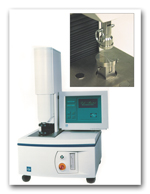
Testing Machines Inc. (TMI), Ronkonkoma, N.Y., reports its Lab Master® Z-Directional Tensile
Tester determines internal bond strength to 113 kilograms with 4.5-gram resolution and
approximately 0.02-percent accuracy, and measures and controls position with 0.1-micron resolution
and 0.2-micron repeatability.

A materials peak force is measured by applying a Z-directional force until ply separation
occurs. The test, which conforms to TAPPI T 541 and exceeds ISO 7500-1 Class 0.5 Tension or
Compression requirements, also provides insight into the materials properties.

Lab Master® Tensile Tester with Z-Directional fixture (inset) from Testing Machines Inc.

April 2005


Everlast Enters Licensing Agreement With Globus Trading

Everlast Worldwide Inc., manufacturer, marketer and licensor of sporting goods and apparel under
the Everlast brand name, today announced that it entered into an extensive licensing agreement with
Globus Trading Group GmbH, based in Nuremberg, Germany. Under the terms of the agreement, the
following products will be introduced: men’s and women’s underwear in all of Europe except the
U.K., Republic of Ireland, Italy and Turkey; men’s and women’s socks in all countries with the
exception of Italy and Turkey; boxing equipment, handheld exercise equipment, aerobic
equipment (treadmills, etc) and weight lifting equipment in all of Europe with the exception of the
U.K. and Republic of Ireland; men’s, women’s and children’s apparel in Chechnya, Belarus, Slovakia,
Serbia and Montenegro, Bosnia and Herzegovina, Croatia, Macedonia, Estonia, Lithuania, Ukraine,
Armenia, Azerbaijan, Uzbekistan, Tajikistan, and Georgia.

The new Everlast products produced by Globus Trading Group GmbH will be ready for shipment late
in the third quarter of this year and will be distributed through sporting goods retailers and
better department stores. George Q Horowitz, chairman and CEO of Everlast Worldwide Inc., said, “As
a result of this agreement, the Everlast brand has taken a giant step forward in its international
expansion program as we will now be in 101 countries. Our licensing program continues to gather
momentum due to the increased consumer awareness generated by our involvement with NBC’s ‘The
Contender’ reality-based television series as well as the appreciation for the uniquely American
character of the Everlast brand. In addition, through this agreement Everlast is now in a position
to offer an extensive array of products almost identical to those currently available in the U.S.
We will continue to explore additional international opportunities for new licensing agreements.”

Press Release Courtesy of PR Newswire

April 2005

Technical Textiles Sector Adds Jobs In Virginia

Investments in technical textiles facilities in Virginia will add 77 new jobs to local
payrolls.

Pulaski, Va.-based BondCote Corp. will invest $2.7 million to expand production of its
high-performance coated and laminated fabrics, increasing production capacity by 20 percent and
creating 27 new jobs. Lindstrand USA Inc., a subsidiary of Lindstrand Technologies Ltd. – an
England-based inflatable structures manufacturer – will invest $2.5 million to open its first
US-based aeronautical fabric engineering and production plant in South Boston, Va. The facility
will employ 50 people.

April 2005

Closing The Carpet Loop

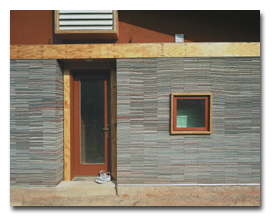
Interface supplied carpet tiles made from recycled materials for interior and exterior
walls of the Lucy House – part of the Rural Studio Project Photography courtesy of Timothy
Hursley.


W
e all like the feel of soft carpet under our feet. It is a feeling of comfort, warmth and
luxury. But next time you rip up your old rugs to lay down new carpet, spare a thought for the fate
of your old floor covering.

Most used carpet ends up in a landfill. While it represents less than 3 percent of the overall
volume of waste landfilled each year, more than 4.5 billion pounds of carpet were discarded in the
United States in 2004, according to estimates from the Dalton, Ga.-based Carpet and Rug Institute
(CRI).

Given the growing scarcity of landfill space and the acceptance that recycling and sustainable
manufacturing processes can actually make business as well as environmental sense, a large number
of carpet manufacturers signed a Memorandum of Understanding for Carpet Stewardship (MOU) in 2002.
Its main goal is lofty a landfill diversion rate of 40 percent by 2012. This target is viewed as a
step towards a long-term commitment by the carpet industry for the eventual elimination of not only
disposal in a landfill, but also incineration and incineration with energy recovery
(waste-to-energy) of waste carpet.

So how is the effort shaping up? It certainly got off to a bad start when, in 2002, Evergreen
Nylon Recycling LLC – a joint venture between DSM Chemicals North America Inc., Augusta, Ga., and
Honeywell International Inc., Morris Township, N.J. – closed its carpet recycling facility in
Augusta. This closure was followed by the bankruptcy of the Germany-based Polyamid 2000 plant in
2003.

These plants used the latest technologies to recycle the nylon content of old carpets. Evergreen
used selective pyrolysis to produce caprolactam from nylon 6 carpet fibers. Caprolactam is the main
chemical building block of nylon 6, so Evergreen’s process offered closed-loop recycling for nylon
6 carpets. Polyamid 2000 was able to recycle nylon 6,6 carpets using a proprietary process. Energy
was recovered from the non-recyclable, organic portion and used to power the plant.

But the economics just didn’t add up, as several European research projects could have
predicted. According to Edmund Vankann, managing director of GUT – a Germany-based consortium of
European carpet manufacturers focused on promoting environmentally friendly practices – polyamide 6
is the only polymer that can be recycled into a product of real economic value. Theoretical
research shows only about 4.5 percent of an incoming carpet waste stream in Europe is polyamide 6
– about half the amount necessary to make the process worthwhile financially. Unsurprisingly,
by 2004, nylon carpet recycling was almost non-existent.

Nevertheless, Bob Peoples, director of sustainability, CRI; and executive director, Carpet
America Recovery Effort (CARE), an affiliate of CRI, remains upbeat. “This is not a dying but
nascent industry, but the timing in the economic cycle is not right. Still, what has become clear
to me over the past few years is that the free enterprise approach is the right way to solve this
challenging problem and that, ultimately, society must bear the cost of sustainability.”


Recycling Initiatives

Carpet manufacturers are leading the way with recycling initiatives. INVISTA Inc., Wilmington,
Del., operates the oldest planned carpet recycling program, accepting carpet regardless of fiber
type, manufacturer or backing type. Post-consumer carpet products recycled include carpet cushion,
automotive parts, natural turf-based roofing tiles, furniture, pallets, filtration pipes and
boards.

Some companies such as Interface Inc., Atlanta; and Milliken Carpet, LaGrange, Ga. have reuse
programs. They take back old carpet tiles, and clean and refurbish them, even adding new color and
patterns. But reuse accounts for only a tiny portion of carpet diverted from landfills. “While
reuse provides an interesting story, reuse will never offer significant diversion of carpet from
disposal,” said Dobbin Callahan, general manager, government markets, Tandus US Inc., parent
company of a number of floor covering businesses, including Dalton, Ga.-based Collins & Aikman
Floorcoverings Inc. (C & A). “I think it is fair to say that reuse by all companies
involved does not account for one-tenth as much recycling as we alone are doing!”

Recycling of material is much more important, and most carpet manufacturers now include recycled
content in their carpet ranges, especially in the backing polymers. C & A takes polyvinyl
chloride (PVC)-backed carpet and recycles it into backing for new carpet.
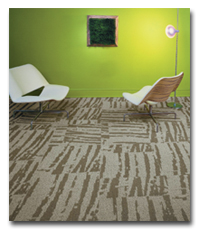
Shaw Industry’s A Walk In The Garden Collection of carpet tile, which contains Ecoworx®
polyethylene carpet backing, is designed for convenient recycling.

“We take the old material, chop and grind it, pulverize it and pelletize it and then extrude it
to produce new, 100-percent recycled-content backings,” Callahan said. “We are recycling 10 million
pounds of carpet per year this way. PVC recycling is economically viable for sure. Today, it is
cheaper for us to make a tile with recycled PVC than to use virgin material.”

Manufacturers also are beginning to consider recycling in the design of their carpets. Dalton,
Ga.-based Shaw Industry Inc.’s EcoWorx® polyethylene backing – just one end product created from
its many recycling and sustainability efforts – is designed specifically for easy recycling. The
company also has a cradle-to-cradle design protocol to assess each individual material used in a
product to determine whether it is safe for the ecosystem.

Callahan believes the market for carpet recycling will grow substantially. The change will come
about when the main purchasers of carpet begin to demand recycling and products with recycled
content. It is not a major issue for the education or health care sectors yet, but in government
and in corporations, sustainability is beginning to get higher up on the agenda. Corporations need
to maintain an image of environmental concern, and government needs to lead the way in diverting
waste from landfills. Most of the market is driven by how new carpets are specified – there are no
mandates yet, but plenty of initiative to encourage recycled content.

Peoples looks to entrepreneurs to take up the carpet recycling challenge. “CARE is keen to work
with the little guys,” he said. “There’s no way we have the technology today to put 2 billion
pounds of post-consumer carpet back into carpet,” Peoples said. “We have to find other outlets. It
is like a great mosaic, putting in many pieces to achieve the overall goal. Creation of demand for
such products will be a critical key to the success of CARE.

TieTek has developed railroad ties that incorporate a mixture of carpet materials,
plastics, rubber from recycled tires, other waste materials, chemical additives and various fillers
and reinforcement agents.

Peoples highlighted several innovative materials and products he thinks epitomize the direction
carpet recycling should take. Atlanta-based Nycore Inc., for example, has seen considerable growth
in its business. Post-consumer carpet is sorted, separated and mixed with other components before
being extruded into a board. It is an ideal substitute for wood and plastic building materials. The
company’s products include Nycore, a 100-percent post-consumer-carpet thermoplastic tile
backerboard; and Ny-Slate, a 100-percent post-consumer-carpet roofing tile.

TieTek LLC, Houston, is developing railroad ties that incorporate carpet materials. The novel
composite tie is composed of a proprietary mixture of plastics, rubber from recycled tires, waste
materials, chemical additives and various fillers and reinforcement agents. In extensive field
tests, they have proven to be superior to wooden crossties, lasting up to 50 years, according to
the company. They also are fully recyclable at the end of their useful life. Fifteen million
railroad ties are used each year, and they require creosote a human carcinogen as a preservative.
“These composite ties tell a hugely compelling environmental story,” Peoples said.

Old carpet also may find its way into plastic lumber or specialty products such as drain
sediment filters, which outlast natural hay.


Making It Work

GUTs Vankann is skeptical about whether this entrepreneurial model would work in Europe. He
noted that the main products developed so far are probably not appropriate in Europe, where timber
is rarely used in construction and railroad ties are made of concrete.

“In Europe, we have taken a technical approach,” he said. “We wanted to know the basic facts
first, whereas in America they are concentrating on making products and creating new markets. Our
research suggests the problem of separating and collecting has to be overcome first if we are to
recycle large quantities of carpet. Niche products are only part of the solution.”

For Europe, which has no carpet reclamation infrastructure, Vankann said recycling efforts will
have to start off looking at energy from waste. Research suggests carpet is a better fuel than
brown coal. Carpet is highly efficient and perfect for refuse-derived fuel, he explained. It should
be collected up with other high-calorific waste sources to produce refuse-derived fuel (RDF) waste
to energy. Once the RDF infrastructure is in place, it may then be possible to look at separating
materials from this waste stream for chemical or other recycling. The RDF solution is best for
those products made 10 years ago, when nobody thought about designing carpets for easy
recycling.

Peoples is keen to explore every possible opportunity available in order to reach the recycling
targets. “There needs to be a variety of outlets and uses,” he said. There is also a role for
cement kilns and energy recovery in our overall plan, but by creating many product outlets for old
carpet as a raw material, it will be easier to accomplish our aggressive goals. The key to success
will be creating demand for products that contain post-consumer recycled content from carpet. I
believe a good portion of our challenge is to get the word out, communicate and share the story of
the new industry we are creating a new industry based on sustainable design.”

April 2005

Konarka Partners With Swiss University To Develop Photovoltaic Fabric

Konarka Technologies Inc., a Lowell, Mass.-based developer of polymer photovoltaic products
using nanotechnology, is collaborating with the Ecole Polytechnique Federale de Lausanne (EPFL),
Switzerland, to develop photovoltaic fabric in which solar power-generating properties are woven
into the fabric rather than applied to the fabric surface. The Photovoltaic Fibers and Textiles
Based on Nanotechnology program will build on work already begun by Konarka in developing
photovoltaic fiber, with additional input by EPFL researchers, led by Jan-Anders Manson, Ph.D.,
director of the schools Laboratory of Composite and Polymer Technology.

“Photovoltaic textiles could positively increase the number of applications available to solar
technology by extending integration to objects made from fabrics, such as garments, tents or
coverings,” said Daniel Patrick McGahn, executive vice president and chief marketing officer,
Konarka. “New application possibilities include wearable power generation for mobile
electronics.”

The project, which is funded by the Swiss Commission for Technology and Innovation, will entail
the optimization of the photovoltaic fibers electrical performance, strength and thickness; and
maximization of the fabrics performance while maintaining the integrity of the fibers.

 
April 2005

Trade Representative Cites Concerns Over China

President Bush’s choice as his new trade representative says he will conduct a top to bottom
review of the government’s trade policies with China, as he believes China does not always play by
the rules. Promising to pursue an aggressive trade agenda, Rob Portman told members of the Senate
Finance Committee considering his nomination he plans to consider a fresh perspective on the entire
range of enforcement tools available. There was no specific mention of textile issues during the
hearing except that Portman referred to the fact that the administration had self-initiated some
safeguard petitions to address a surge in Chinese imports.

Portman said he plans to travel to Asia soon to deliver a strong message in person to Chinese
trade officials. While Portman, a seven-term member of Congress from Ohio, was given a generally
warm reception, committee members expressed their concern over the administration’s failure to
enforce trade agreements. Portman said it is his intention to aggressively enforce trade agreements
and seek more overseas market opportunities for US goods.

April 2005

Sponsors