
Claiming that the Dominican Republic-Central American Free Trade Agreement (DR-CAFTA) will help US
and regional textile and apparel manufacturers adjust to the new competitive environment of the
post-quota world, the head of the National Retail Federation (NRF) is urging the US Trade
Representative and Congress to move swiftly and approve the agreement. Under procedures for trade
agreements, the USTR must submit specific language implementing the agreement that must be voted up
or down and cannot be amended by Congress. The Senate Finance Committee is expected to meet June 14
to work out details of implementing legislation, and the House Ways and Means Committee is expected
to do the same shortly thereafter. Tracy Mullin, president of the National Retail Federation, said
the Central American agreement will help reduce prices for US consumers and create opportunities
for US retailers to open stores in the Dominican Republic and Central America. She said it also
will help build partnerships between US and regional textile and apparel manufacturers.She said the
pact would help eliminate some problems retailers see with the strict textile rules of origin now
in effect in much of the area. An NRF statement noted that under current trade law, apparel from
the region can qualify for duty-free treatment to the United States only if it is made of US fabric
woven from US yarn. DR-CAFTA would expand duty-free treatment to cover a wider range of products
and would allow those products to be made of fabric produced in the region along with fabric from
Canada and Mexico.
June 2005
Retailers Voice Strong Support For Central American Pact
June 2005
Gerber Technology, Tolland, Conn., has named
Holly Beum
director of software product management.

Beum
Kellwood Co., St. Louis, has appointed
Scott D. Felder
president, Kellwood Menswear; and
Paul A. Robb
CEO, Sag Harbor.
Wolverine World Wide Inc., Rockford, Mich., has appointed
Shirley D. Peterson
to its Board of Directors.
Li & Fung USA, New York City, has named
Robert P. Fleischer
vice president, merchandising, Royal Velvet brand.
New York City-based
Warnaco Group Inc. has appointed
Dwight Meyer
president, Global Sourcing.
Piedmont Logistics, Gainesville, Ga., has made the following appointments:
David Dubose
, operations manager;
Jessica Rouleau
, translator, data entry and accounting assistant; and
Michael Weismantel
, team leader, recruiter and marketing consultant.
Germany-based
Lanxess AG has appointed
Rolf Stomberg
chairman and
Ralf Deitz
vice chairman of its Supervisory Board.
Fort Worth, Texas-based
Resin Technology Inc. has named
John Denzer
managing partner.

Denzer
Rick Embry
has joined
Precision Roll Grinders, Allentown, Pa., as account manager, Tennessee, Alabama
and Mississippi.
The
American Association of Textile Chemists and Colorists, Research Triangle Park,
N.C., has announced the winners of the 2005 Concept 2 Consumer Design Competition:
Melissa Popovich
, Bowling Green University, first place, technical design;
Connie Chen
, Cornell University, second place, technical design;
Clarisse Sjoquist
, Kansas State University, first place, aesthetic design;
Joe Hynek
, Iowa State University, second place, aesthetic design;
Shameron Eggers
and
Ana Forillo
, Dominican University, first place, textile design; and
Jessica Weisen
and
Enid Williams
, University of Wisconsin-Madison, second place, textile design.
Wilmington, Del.-based
DuPont’s Bio-Based Materials business has appointed
Dawson Winch
product and marketing manager for DuPont™ Sorona®.

Winch
SATO Corp., Tokyo, has named
Sebastiano Stella
country manager, Italy.
Rock Hill, S.C.-based
Springs Industries Inc. has named
Tommy “Louie” Rutledge
its Rewards and Recognition Corporate Associate of the Year.

Rutledge
At the
International Wool Textile Organization (IWTO) Annual Congress, the Brussels-based
IWTO awarded the first World Wool Awards to:
Hannah Shaddick
— Fashion and Design;
Heinrich Oberrauch
— Marketing and Promotion; and
Deborah Loxam-Kohl
— Concept, Innovation and Extension.
Omnova Solutions Inc., Fairlawn, Ohio, has appointed
John Wei
vice president, Performance Chemicals Asia; and has promoted
Frank D. Nataro
to business director, Specialty Chemicals.
Avondale Mills Inc., Monroe, Ga., recently promoted
Marcus K. Tapley
to executive vice president, operations.
SML Maschinengesellschaft mbH, Austria, has appointed
Christian Malzner
chief representative in the SML Far East Regional Office.
The Cary, N.C.-based
Association of the Nonwoven Fabrics Industry has named
Gonzalo Castro
, Cardinal Health, and
David Ford
, BBA Fiberweb™, co-chairs of its International Trade Advisory Board.
At the recent 13th Annual
National Textile Center (NTC) Forum, Raleigh, N.C.-based NTC awarded Joe Cunning
Graduate Student Research Presentation Contest prizes to:
Marilyn Minus
, Georgia Tech, first place;
Dongyeon Lee
, Auburn University, second place; and
Ashish Garg
, Philadelphia University,
Dahlia Haynes
, Clemson University,
Shawn Hutchinson
, North Carolina State University,
Skander Limen
, University of Massachusetts Dartmouth,
Anne Sandstrom
, University of California Davis, and
Kuitian Tan
, Cornell University, third place.
June 2005
Freudenberg Debuts Several Air Filter Products
Germany-based Freudenberg Nonwovens Filtration Division, Hopkinsville, Ky., has introduced several
new automotive air filter products. MicronAir® cabin air filters clean particulates such as pollen,
dust and other allergens from air entering a vehicles HVAC system. Combination filters, new for
North America, feature an activated carbon layer to reduce odors, certain noxious gases and vapors,
and particulates from a vehicles interior. Automotive engine intake air filters made using INDEX
Award-winning nonwoven cartridges reduce noise, require less space, and offer longer life and
better filtration than traditional paper filters, the company reports.
June 2005
Kuraray Acquires Vectran
New York City-based Kuraray America Inc., a subsidiary of Japan-based Kuraray Co. Ltd., has
acquired the Vectran business of Fort Mill, S.C.-based Celanese Advanced Materials Inc., an
affiliate of Dallas-based Celanese Corp. Kuraray now is the exclusive manufacturer of Vectran®
high-performance polyarylate fiber, used in aerospace, marine exploration and development, safety
materials, high-pressure inflatables, industrial and other applications.
Kuraray expects the acquisition to enable it to create market synergies through US and
European sales systems, and integrate its global research and development operations, thereby
strengthening its industrial fiber business applications.
June 2005
Quality Fabric Of The Month: Rx Copper
New technology that uses cupric oxide to fight microbial infection and promote healing now is available from Cupron Inc., Greensboro, N.C., for a broad range of textile applications including health care and food handling. The company reports Cupron® is effective against a broad spectrum of microbes, deactivating viruses such as SARS, HIV, avian flu and West Nile; and eliminating fungi, yeasts, dust mites and bacteria.
“It is our intention to put Cupron into bedding, drapes, uniforms, masks, bandages — every textile used in the hospital environment,” said O. Lee Gordon Jr., president, North and South America. “We are positioning the brand with that kind of image so that it trickles down to other products, and we are establishing exclusive licensing relationships in each sector — gloves, socks, underwear and so forth — to offer this technology.”
Cupron is incorporated into the polymer melt of polyester, nylon and polypropylene; and plated onto cellulosic fibers such as cotton and Tencel®, according to Jeffrey Gabbay, CEO. Unlike silver, it does not oxidize, and the protection is permanent, he said, noting it has been tested through 50 industrial launderings.
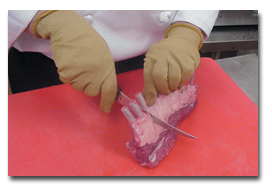
Polygenex International Inc. knits cut-resistant gloves containing Cupron® for use in the
meat, fish and poultry processing industry.
The technology interrupts a microbe’s ability to duplicate or reproduce, causing it to die naturally and preventing creation of resistant strains. It also promotes healing of sores and wounds because it binds amino acids and helps create
collagen.
“There are no toxicity issues because the body metabolizes copper very well, but it does not metabolize silver,” Gabbay said.
Not only does the technology pose no threat to human health, but the company recycles 100 percent of its process water and chemicals. Cupron’s product claims are now being evaluated by the Food and Drug Administration and the Environmental Protection Agency.
Cupron and Polygenex International Inc., Cary, N.C., a manufacturer of specialty gloves, have partnered to develop the first gloves utilizing the technology, including cut-resistant knitted gloves used in the meat, fish and poultry processing industry. Other gloves and liners will be worn by livestock and produce handlers, and for health care and cosmetic purposes. The technology also can be applied to latex and nitrile gloves.
Polygenex previously manufactured bacteriostatic gloves using silver-based technology. “The Cupron technology is far superior and solves problems for some very pressing issues, such as avian flu,” said Joseph D. McGarry, president and CEO, Polygenex, adding that gloves containing Cupron “ feel so good.”
Cupron also has licensed the technology to a major sock manufacturer for anti fungal socks that Gabbay said will cure athlete’s foot.
Gabbay is enthusiastic about Cupron’s potential. “We can take textiles and change people’s lives,” he said. “By eliminating microbes at the source, we will reduce greatly the incidence of microbial infection.”
For more information about Cupron, contact O. Lee Gordon Jr. (336) 339-8561,
lee@cupron.com.
For more information about Polygenex, contact Joseph D. McGarry (919) 380-8100, joe@polygenex.com
June 2005
Monforts Unveils New Process, Installs Ranges
Monforts Textilmaschinen GmbH & Co. KG, Germany, has introduced the MXL-process® for moist
cross-linking. Designed to run on a hotflue, it is available as a continuous process and is
primarily suited for bedsheet and shirt fabrics, especially those with non-iron properties,
according to Monforts. The process line consists of a padder, stretching field (only for liquid
ammonia-treated fabrics) and Thermex hotflue treatment chamber.
In other company news, Monforts recently has completed delivery of tenters and dyeing ranges
to several companies worldwide. Wool fabric producer Paramount Téxteis, Brazil, has received a
Montex tenter capable of processing 30,000 meters of fabric per day.
Ariteks Örme San, Turkey – a supplier of yarn and fabric for ready-made garment exports – has
taken delivery of a second Montex tenter and DynAir 5000 relaxation line.
Utexbel, Belgium, has taken delivery of a Thermex 6500 hotflue continuous dyeing range at its
broadwoven fabric mill – the first such delivery in Belgium.
June 2005
Recognizing The Power Of Resilience
A
t first blush, you ask yourself what could be different about Glen Raven Inc. – what sets
it apart from its peers? Why are these people energized in an industry full of upheaval? What is
this attitude that permeates the organization, from CEO to research and development and throughout
operations? Inside a company celebrating its 125th year in business, with a strong family legacy
and a strong sense of place – these things, while extremely important, are not at the heart of what
makes Glen Raven tick.
After interviewing many involved with various aspects of Glen Raven’s day-to-day operations,
the overriding impression is of a lack of entitlement, a lack of ego that says, “We know the right
way,” and a lack of fear at a time when the textile industry is full of concern. When Allen E. Gant
Jr., CEO, said to
Textile World
, “Don’t talk to me, talk to them [Glen Raven’s associates] – they make Glen Raven
successful,” one has to wonder, is that a proud CEO or someone who really is pointing you to the
true story?
The people of Glen Raven are definitely the true story, and their success is in their ability
to work in an organization stripped bare of the politics and obstacles that have burdened so many
great companies. Gone are the barrier between makers and sellers, the struggle for control of
assets, and the conflict between information marketers bring into the company and the agenda of the
status quo.
Gant tipped his hand when he pointed to a Harvard Business Review article titled “The Quest
for Resilience,” by Gary Hamel and Liisa Välikangas, and the impact Hamel had as a consultant to
the company. In short, Hamel promotes the idea of building an organization that is resilient, an
organization that prospers based on its ability to constantly readjust to turbulent times. Hamel’s
research points to a shift in business strategy – one that can no longer rely on the momentum of
sheer corporation size, a strategy that is constantly anticipating and adjusting to “secular trends
that can permanently impair the earning power of a core business.”
The catch is to embrace the culture of change with what Hamel calls “zero trauma.” In short,
Hamel writes, “The goal is a strategy that is forever morphing, forever conforming itself to
emerging opportunities and incipient trends.” He speaks of a company making its future rather than
defending its past. Zero trauma comes into play with the idea that “the goal is a company where
revolutionary change happens in lightning-quick, evolutionary steps – with no calamitous surprises,
no convulsive reorganizations, no colossal write-offs, and no indiscriminate, across-the-board
layoffs. In a truly resilient organization, there is plenty of excitement, but there is no trauma.”
Maybe that’s why Glen Raven’s associates have such positive attitudes.

Glen Raven Inc. began operations in 1880 as Altamahaw Mills, with management staying in
dormitory-like quarters during the week and traveling by horse and carriage to spend weekends with
their families.
The Four Challenges
Hamel writes in “The Quest for Resilience” that there are four challenges to becoming
resilient:
• Cognitive Challenge: A company must become entirely free of denial, nostalgia and
arrogance. It must be deeply conscious of what’s changing and perpetually willing to consider how
those changes are likely to affect its current success.
• Strategic Challenge: Resilience requires alternatives, as well as awareness – the ability
to create a plethora of new options as compelling alternatives to strategies that are dying out.
• Political Challenge: An organization must be able to divert resources from yesterday’s
products and programs to tomorrow’s. This doesn’t mean funding flights of fancy; it means building
an ability to support a broad portfolio of breakout experiments with necessary capital and talent.
• Ideological Challenge: Few organizations challenge the doctrine of optimization. But
optimizing a business model that is slowly becoming irrelevant can’t secure a company’s future. If
renewal is to become continuous and opportunity-driven, rather than episodic and crisis-driven,
companies will need to embrace a creed that extends beyond operational excellence and flawless
execution.
Hamel closes the article by writing: “Any company that can make sense of its environment,
generate strategic options, and realign its resources faster than its rivals will enjoy a decisive
advantage. This is the essence of resilience. And it will prove to be the ultimate competitive
advantage in the age of turbulence – when companies are being challenged to change more profoundly,
and more rapidly, than ever before.”

Left to right: Leib Oehmig, director of the GlenOvation program; Dave Swers, Wendy Miller,
Hal Hunnicutt, Patti Bates and Steve Hundgen, winners; and CEO Allen E. Gant Jr.
GlenOvation
“We were so taken with the idea that we hired Gary Hamel to come to Glen Raven and spend a
long time with us. Gary Hamel is chairman of the [Woodside, Calif.-based] Woodside Institute, where
they research innovation,” Gant said.
This investment started a new openness at Glen Raven that prioritizes and rewards innovation
throughout the company.
“We brought 400 of our best brains into one room with Gary Hamel. Then we narrowed that down
to our general managers group of about 20. Then we narrowed that down to our executive group. And
by the way, on that first day, we asked people, if they had $25,000, how would they spend it to
improve the company? And to start that day off, I called on five people – they didn’t know it [in
advance] – they didn’t know who was going to get called on; they didn’t even know I was going to do
it,” Gant continued. “And so to start the meeting off, I asked, ‘Hal Hunnicutt, if you had $25,000,
what would you do?’ He stood up and said, ‘I would ….’ I wrote a check for $25,000 and handed it
to him. I did that with five people. And we invested $125,000 that day, that morning.”
That was the beginning of Glen Raven’s GlenOvation program – an internal program designed to
involve every associate in the innovation process. Early in its launch, the Glen Raven GlenOvation
program received more than 80 submissions.
“What it did was open people’s eyes to the fact that we are serious,” Gant said. “People
would ask, ‘What is innovation?’ Innovation is the ability for people to open their brains and
unshackle them. You don’t have a P&L statement to worry about; you don’t have this to worry
about; you don’t have anything to worry about except what is the best idea that I can come up with
that will improve this company. And when you do that, people start to open up.”
Removing The Filters
John Coates, director of research and development, Glen Raven Custom Fabrics LLC, was in on
the development of GlenOvation. “I believe it is absolutely critical – it’s wonderful,” Coates
said. “We need to pull ideas from everyone in this company. Every one of our employees has had an
idea at some point about how to make something better. I don’t care if that is a product or process
– we want those ideas. Ideas normally get filtered. Part of GlenOvation is removing those filters.
You submit ideas to the review team, made up of members from across the globe. That group decides,
‘Hey, this could be something.’ That group has a budget. If they think you need $5,000 or $50,000
to get started, that group makes the decision and we are off and running. It is that easy.”
“Considering the response that we have had from our associates, we are confident that Glen
Raven’s vision for furthering an innovative spirit is well underway,” said Leib Oehmig, vice
president, industrial sales and logistics; assistant general manager, Custom Fabrics; and director
of the GlenOvation program. “We have seen tremendous commitment from our associates around the
world, and we are now funding several new ideas that have great potential in their intended
markets. As we continue to nurture these ideas and have market success, we feel the momentum will
continue to grow in support of GlenOvation.
“Glen Raven has always been leery of adopting the latest business and engineering program of
the day,” Oehmig said. “I feel that Glen Raven has established a great deal of credibility with its
associates, and coupled with the commitment that is being demonstrated by Glen Raven’s leadership,
it appears that Glen Raven has avoided this perception. Of course, Glen Raven must continue to
demonstrate its commitment in order to maintain a high level of credibility with its associates. I
think GlenOvation is creating an environment in which Glen Raven associates are looking deeper into
markets where we may be able to add value in ways that have not been pursued in the past.
“Some of the most intriguing ideas that have been generated through GlenOvation have nothing
to do with creating new products; instead [they involve] taking a very different view of adding
value,” Oehmig added. “One of Mr. Gant’s challenges to Glen Raven associates has been to think much
broader than our current core markets, and much deeper than our current products and services.”
“In the end, all we’ve got is brainpower,” Gant said. “Our executive job is to open those
brains up.”
“Understand that we have not discovered the Holy Grail, but instead have unlocked yet another
powerful process that will help us to be successful in this turbulent world we live in,” Gant
added. “If we work hard enough and make innovation a way of life as a culture, the future may be
brighter.
“We must always be fearful in knowing that poor judgment, slow performance and missed steps
will foul even the best of opportunities. This world is less forgiving today and has a habit of
keeping you humble.”
June 2005
US And Europe Address Chinese Import Surge
T
o address the problem of rapidly growing Chinese textile and apparel imports, government
officials in the United States and Europe are employing the safeguard mechanism that China agreed
to as a condition of its admission to the World Trade Organization (WTO).
China strongly opposes what is happening, and textile industry leaders see the safeguards, at
best, as stopgap measures. The safeguard mechanism provides for temporary import quotas if it can
be demonstrated that imports are disrupting or threatening to disrupt markets. No less than 25
safeguard petitions are in various stages of consideration by the US Committee for the
Implementation of Textile Agreements, and the European Union is considering petitions for
safeguards on nine product categories. Under the safeguard provisions, import quotas may be
considered on a year-to-year basis until 2008.
While US textile manufacturers are pleased with the progress of the safeguard effort, they do
not view safeguards as a satisfactory long-term solution to what they see as an ultimate takeover
of US import markets by China, and maybe two or three other nations.
They do not like the idea of continuing to petition year-to-year, and product
category-by-product category, to limit imports from China. The textile industry’s ultimate goal
would be the negotiation of a longer-term comprehensive agreement, but that idea is not likely to
fly with textile and apparel importers or the US government – at least at this time.
Chinese trade officials have shown little support for either the safeguard approach or
anything of a more comprehensive nature, although there has been some evidence that US importers
are holding back orders with China because of the uncertainty created by the safeguards. The
Chinese contend that imposition of new quotas, temporary or otherwise, would run counter to the
WTO’s efforts to promote free trade.
“The reason the WTO members removed the quotas on January 1 was so that trade can be free,
and to go back and put more restrictions on trade is going against the free trade that everyone
wants,” a spokesman for the China National Textile Council was recently quoted as saying. The
spokesman added that new quotas should not be considered just months after lifting them, and he
argued the removal of quotas was in the best interests of textile and apparel consumers. He added
that because China’s products offer a “good value,” they should have free access to the world’s
markets.

Manufacturing Industries Outline Trade Agenda
As a number of textile-related international trade issues come to the forefront with Congress
and government agencies both here and abroad, a coalition of manufacturing industries has issued a
wish list of actions it would like to see the US government take.
The coalition — made up of textile and apparel, tool and die, chemical, furniture, metal
products, packaging, lumber, luggage and other manufacturers — reports its agenda seeks to
establish trade policies and other measures that would “stabilize the US industrial base and create
American manufacturing jobs.” The proposals being promoted by the Washington-based American
Manufacturing Trade Action Coalition (AMTAC) call for a major overhaul of US trade policies and how
they are being carried out.
The ambitious agenda calls for taking a relatively new tack in an area where the US
government has paid little attention. The coalition suggests the government should focus on trade
agreements with countries whose consumers have the standard of living that permits them to purchase
US goods rather than concentrating on countries in Asia, Africa and the Americas that have a low
standard of living and little buying power.
The coalition is strongly opposed to free trade agreements that permit non-participating
countries to benefit from the tariff-free treatment of their goods, as has been the case with free
trade agreements negotiated by the United States in recent years.
The manufacturers advocate changing existing regulations to make non-market economies,
particularly China, subject to anti-dumping and countervailing duty penalties.
The coalition charges that by granting administration trade officials trade promotion
authority — whereby trade agreements cannot be amended — and giving China normal trade relations
status, Congress has given up its historic duty to regulate foreign trade.
Finally, the coalition calls on Congress to conduct an independent trade-impact study prior
to approving trade agreements and major trade bills.
According to AMTAC, enacting these procedures would be the best way to attack the US trade
deficit, which has grown to $4 trillion since 1990.
Legislation Targets Chinese Currency Imbalance
Pressure is growing from Congress and the Bush administration for China to do something about
its artificially pegged currency, which US manufacturing industries say amounts to as much as a
40-percent subsidy for China’s exports and higher prices for US goods in export markets.

Representative Duncan Hunter, R-Calif.
Since 1995, China’s currency – the yuan – has been pegged at 8.28 yuan to the
dollar. Despite textile and other manufacturing industries’ long-standing calls for action, the
administration has pretty much kept its hands off the issue. However, President Bush recently said
the time has come for China to take some initial steps to bring its yuan into line with other
currencies. Treasury Secretary John Snow told a congressional committee that reform of China’s
currency is “one of the highest priorities for our international economic policy.”
Meantime, members of Congress are taking a much stronger stance. The Senate has taken a
preliminary vote, by a substantial margin of 67 to 33, on a measure that would impose a
27.5-percent surcharge on Chinese imports to the United States. Sponsors of the legislation have
been promised a final Senate vote before the August congressional recess. Similar legislation is
pending in the House.
One of the drawbacks of that approach is that it would result in higher costs to consumers of
imported goods such as apparel, and that is not likely to be popular.

Representative Tim Ryan, D-Ohio
In addition, Reps. Duncan Hunter, R-Calif., and Tim Ryan, D-Ohio, have introduced legislation
that would address the issue in a different way.
Their bill would create a definition for “exchange-rate manipulation” so foreign governments’
undervaluation of currencies would be considered a “prohibited export subsidy.” It also would set
guidelines for the US International Trade Commission (ITC) to follow in determining whether
manipulation has occurred and what its impact is on US industry. The Hunter-Ryan bill also would
establish guidelines for procurement of products considered essential for national defense.
The bill states that if the ITC concludes market disruption has occurred, and the secretary
of defense determines the domestic industry’s articles are critical to the US defense industrial
base, the Defense Department may not procure the Chinese imports in question.
Even if none of this legislation is ultimately enacted, it sends a strong message to China and
gives the administration a stronger hand in dealing with the issue.
June 2005
ApparelMagic™ Software Offers E-Commerce Tool
Murphy & Associates, Glendale, Calif., has integrated an e-commerce solution into its suite of
ApparelMagic™ software.
“Unique to the industry, ApparelMagic provides companies with the power to sell to a
worldwide buying audience; link e-commerce with inventory, production and accounting; and
facilitate orders on the retail and wholesale levels – all in one simple, integrated solution,”
said John Murphy, president.
The tool enables users to create on-line showrooms that may be integrated into a company’s
website; and verify and make e-commerce transactions using shopping cart technology, on-line credit
card verification, and secure payment processing.
June 2005
China Captures Large Share Of Textile Trade
Textile and apparel imports from all sources showed a 10-percent growth in the first three months
after quotas were removed in January, with India and China capturing a big share of that growth.
Mexico, which at one time was the largest exporter to the United States, has fallen far behind
China which now is the largest exporter of textiles and apparel to the United States.
According to US Department of Commerce data, combined textile and apparel imports from China
in the first three months of this year were up by 48 percent from the previous year; and apparel
imports alone increased by 102 percent. There were triple digit increases in a number of product
categories, and in the case of cotton shirts and trousers they soared up by 1,000 percent. India
also has shown significant gains with a 24-percent increase in combined textiles and apparel and 30
percent in apparel alone.
Meanwhile, imports from Mexico, Canada, Hong Kong, South Korea and Sub-Sahara Africa were
among areas showing declines. However, there were some modest gains, around 8 percent, in trade
with the Caribbean Basin nations and Central America.The data seem to confirm fears by US textile
manufacturers and importers of textiles and apparel that China and perhaps one or two other
countries are likely to dominate trade in a quota free world.
By James A. Morrissey, Washington Correspondent
June 1, 2005



