China’s Currency Modification Will Have Little Impact

Despite China’s announced plans to permit its currency to float, textile and other manufacturers
don’t see much of an impact on what they see as a major international trade subsidy as a result of
China’s currency manipulation. Even Chinese government officials have warned the action will not
have much of an effect on trade. China’s central bank issued a statement saying, Certain foreign
media have misled the public and even wrongly speculated that the revaluation by two percent was
only the first step in a series of adjustments. The action does not in the least imply an initial
move which warrants further actions in the future.

Although conceding that the move was a step in the right direction, South Carolina Rep. John
Spratt, the assistant House Democratic leader and ranking member of the House Budget Committee,
said the small percentage change is not enough to affect the US $162 billion trade deficit with
China. Spratt is one of the sponsors of legislation that would levy tariffs of 27.5 percent on
goods from China if the Chinese government does not allow its currency to float on the open market.
He said China’s currency is undervalued at between 15 and 40 percent, and as a result, China’s
exports to the United States area cheaper and US exports to China are more expensive. The result,
he said, is that We do not have a level playing field for our manufacturing firms and we are going
to lose the manufacturing sector and some of the best jobs in our economy. On the other hand,
retailers said they hoped the move would ease concerns in Congress over the currency discrepancy.
Eric Autor, vice president of the National Retail Federation, said: To the extent that this
alleviates concerns on Capitol Hill, retailers may feel more comfortable about ordering merchandise
from China. A number of major retailers have limited orders in recent months because of the
unpredictability brought by safeguards cases, pending legislation and other moves to restrict trade
with China. Retailers are looking for stability and predictability. Knowing that a major order wont
be blocked by political decisions is more important than minor fluctuations in price brought by
currency revaluation.


July 2005
SML Garners Order For Wide-Web Coextrusion Line

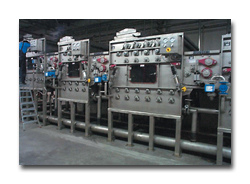
SML, Austria, has received a contract from a Korea-based company to build a wide-web coextrusion
coating and laminating line for its operation in China. The 4,400-millimeter-wide line, billed by
SML as the most advanced such line worldwide, will feature an overhead mounted coextrusion unit;
fully automated, shaftless unwinding and rewinding stations with high-speed splicing capabilities;
automated profile-controlled die with motorized deckles; automated thickness control with multiple
gauge frames for differential measurement; and customized Corona treatment stations; among other
features.

The line, expected to be installed by the end of 2005, has been designed to allow upgrading
to a second-phase tandem version. It will be used in the manufacture of wide tarpaulins with shiny,
dull or embossed surface patterns; and sandwich laminates having up to five layers.

July 2005

Second UCMTF-Students Forum Covered French Manufacturers And Globalization

The second Forum organized by UCMTF, the French Textile Machinery Manufacturers’ Association, was
an opportunity to further enhance relations with the students of the four colleges which train
engineers for the textile-related industries, to address their concerns about the geographical
changes in this sector, and to review the careers offered by the textile machinery industry.

More than 250 manufacturers, teachers and students were gathered at UCMTF’s invitation in the
new facilities of ITECH (Lyon Textile and Chemical Institute) on the Lyon university campus.
ITECH’s students had been joined by those from ENSAIT in Roubaix, ENSITM in Mulhouse and ESTIT in
Lille. The great number of questions that were asked showed that this year’s theme, “French
Manufacturers and Globalization”, was a crucial issue.

The French manufacturers’ dynamism is obvious. The forty or so companies in membership of
UCMTF achieve a turnover of nearly 1 billion, ranking fifth in the world. They employ more than
4,000 people and over 90 percent of their sales are exported to more than a hundred countries all
over the world. When giving these figures, Bruno Ameline, President of UCMTF, stressed that the
textile machinery market was dominated by the European manufacturers for historical reasons of
course, and also mainly because of their commitment to those customers who formulate the most
requirements both for the development of new products and in terms of reliability, productivity and
versatility. To meet these requirements and provide services beyond the mere sale of machines is
the best way to cater closely for the market needs and, as a result, to maintain positions of world
leaders.

Gildas Minvielle of IFM (French Fashion Institute) put in perspective textile globalization
and the shift of manufacturing to Asia, and was asked a great number of questions by the students.
They expressed their realism about challenges, and their hopes for new products, in particular
industrial fabrics, for the opening of Asian markets to upmarket products, and for the Paneuromed
area, a credible alternative to faraway production.

Four panel discussions, led by Michel Sotton, the former Director-general of IFTH (French
Textile-Clothing Institute), and including students for the first time to pass questions on, were
then organized on the various textile technologies :

– Combing-Spinning-Yarn processing Companies represented: Laroche (Jean-Christophe Morel),
NSC Fibre to Yarn (Alain Etancelin), ECC Platt (Paul Verbecke), Rieter FYT (Marc Desrayaud,
Jean-Yves Dussaud), Fil control (Jean-Marc Balois).

After presenting their companies, the speakers answered questions and showed how they were
able to achieve global business development by setting up service centres in a first stage, then
commercial companies, before succeeding in producing locally. It was necessary to hire young
graduates at each stage of this process.

– Technical Textiles and Nonwovens Companies represented: NSC Nonwoven (Benoit Gallais),
Laroche (Jean-Christophe Morel, Benoit Rombaut), ECC Platt (Paul Verbecke), Rieter Perfojet (Cic
Laurent).

For nonwovens, the speakers highlighted the high commitment to producers of finished products
and the need to offer “turnkey” solutions, and therefore the need to develop close partnerships
with manufacturers of complementary machines to propose complete lines.

– Weaving-Printing-Cutting Companies represented: Stli (Max Michel and JoJu), Ateliers de
Belmont (Gregory Calandry), Lectra ( M. Costa).

Beyond technological questions, the major challenge is to help customers resolve their own
challenges, and in this respect consultancy and training are now essential services. They offer
real opportunities for students and the possibility of making a career via different jobs within
the same company.

– Finishing and nanotechnologies Companies represented: Alliance (Jean-Paul Bkian), Superba
(Jean-Pierre Ummenhover), Rousselet (Luc Buisson), ITECH ( Fabien Roland).

In this sector, commitment to customers is all the more necessary because, besides the
development of specific machinery and processes whereby the machine becomes a key factor of product
innovation, the buying decision is now taken on the basis of an economic analysis, hence long and
extensive studies requiring total mutual trust.

Bruno Ameline concluded the event by thanking Jean-Pierre Gallet, Director-general of ITECH,
for hosting the Forum; he announced another edition, and pointed out four major qualities to make a
successful career in the textile machinery industry, i.e. to have a taste for industry (factories,
men), for international business (languages and travels), for (long-lasting) service, and for
continuous creativity.

Press release courtesy of UCMTF

July 2005

HighRoller Fashions Teams Up With First2Print To Decrease Time-To-Market

HighRoller Fashions, a New York City-based manufacturer of lifestyle and gambling-theme shirts,
selected New York City-based digital fabric printer First2Print Inc. to aid the company in
decreasing time to market of its 2006 product line.First2Print used pretreated silk fabric,
large-format color printers, custom software and specially formulated inks to make the HighRoller
shirts.With First2Prints textile print services, we get beautiful, crisp, clear fabrics in less
than a week, said Brian Smith, CEO, HighRoller Fashions. That gives us a competitive edge.
Otherwise, this sampling process would take 30 to 45 days or longer.The final sample goods are
large-format, digitally printed, dye-based, non-washable prototype fabrications that are suitable
for showroom and retail sales development.

July 2005

Summertime Blues


S
pinners appear to be seeing demand slack off a bit this summer. One multisystem spinner
admitted his capacity is not completely sold up, but his company’s plants are still running five
and six days a week.

“I’ve got yarn to sell,” he said. “Business is not any weaker than it has been. We’ve just
haven’t been able to put it together.”

Multiple sources agree the man-made yarn segment of the business is not as strong as cotton
or cotton blends. Weaving is considered to be weaker than knitting right now, although there is
considerable variability among weavers, depending on the market served. Upholstery is hot and cold.
Home furnishings appear to have slowed a bit.


Hosiery Heats Up


Spinners expect the hosiery business to pick up this summer. China reached its hosiery quota
in mid-May and cannot import more until late October, due to imposed safeguards for hosiery. This
could be an opportunity for domestic spinners to gain some volume, particularly for specialty yarns
designed to give superior wicking performance.

“I’m not expecting our business to weaken over the summer months as it has a tendency to do,”
said a spinner. “[T]here may be enough [Chinese socks] still in warehouses to take retailers all
the way to the first back-to-school round. It may be July or August when we see increased hosiery
business.”


Fiber And Yarn Prices Stable


Spinners expect the hosiery business to pick up this summer. China reached its hosiery quota
in mid-May and cannot import more until late October, due to imposed safeguards for hosiery. This
could be an opportunity for domestic spinners to gain some volume, particularly for specialty yarns
designed to give superior wicking performance.

“I’m not expecting our business to weaken over the summer months as it has a tendency to do,”
said a spinner. “[T]here may be enough [Chinese socks] still in warehouses to take retailers all
the way to the first back-to-school round. It may be July or August when we see increased hosiery
business.”


Burlington HQ Imploded


Recently, 200 pounds of explosives reduced the former Burlington Industries Inc. headquarters
in Greensboro, N.C., to rubble in about 10 seconds. The 430,000-square-foot building opened in 1971
and won several design awards. More than 1,000 people once worked there. Spinners took note of its
demolition with some sadness.

“[T]he building that used to be the headquarters of what was once the largest textile company
in the world was torn down to build a shopping center and some condos,” one spinner said. “To some
degree, we all followed on the coattails of Burlington because they had money, size and public
awareness of their brands. Whether you were one of their customers or suppliers, I don’t think you
could have seen [the broadcast of the implosion] without thinking that a piece of textile history
imploded with it.”

“In the old days, when you got out of school, you went to work for Burlington, J.P. Stevens
or Milliken,” said a former Burlington manager. “Now, only Milliken is still in place, but it’s
very different. Looking back on my experiences [at Burlington], what I got out of it was an
appreciation of the people in the mills and what they did. I got a great learning experience about
the machinery and the processes.”


July/August 2005

Thomson Develops New Antimicrobial Treatment

Thomson Research Associates Inc., Toronto, has developed Ultra-Fresh® Silpure, the latest in its
line of antimicrobial Ultra-Fresh products. According to the company, Silpure provides superior
resistance to fiber degradation and odor through the use of metallic silver.

Silpure uses proprietary nanotechnology manufacturing processes for the metallic silver, and
is applied to textiles at the finishing stage. Using typical application processes on 100-percent
polyester fabrics, plant trials have shown bacterial survival is less than 0.1 percent after 50
washings.

“Previous cost barriers to the wider use of silver have been overcome,” said Laval Yau,
Ph.D., president. “Now, silver antimicrobials are no longer confined to niche markets. They can be
used effectively and profitably through the broadest range of consumer products.

July/August 2005

Küsters Supplies Equipment To Turkish Textile Companies

Eduard Küsters Maschinenfabrik GmbH and Co. KG, Germany, has delivered a continuous washing range,
a CPB dyeing center and a continuous open-width dyeing range to companies in Turkey.

In order to transition to continuous finishing, contract knit finisher Ariteks Boyacilik has
installed a continuous washing range for knits and a CPB dyeing center. With the new washing range,
which includes Elanit open-width washing machines, Ariteks is able to handle a wide range of
fabrics, from light, flat articles to heavy pile knitwear, in weights ranging between 150 and 250
grams per square meter (g/m2).

Oztek has received a continuous open-width dyeing range capable of treating cotton fabrics in
weights ranging from 140 to 300 g/m2. Despite being seven years old, the range was considered to be
brand-new. Delivered by Küsters to a Russian company in 1997, the range had never been unpacked and
assembled. Küsters service engineers were able, however, to assemble and commission the range. It
will run at production speeds of up to 50 meters per minute.

kusters_Copy_3
Küsters washing unit, part of a pad-steam dyeing range, during assembly at Oztek

July/August 2005

Zimmer Commissions Plant In China For Fujian Jinlun

Zimmer AG, a Frankfurt-based engineering and construction company, has commissioned a polyester
staple fiber plant in China for Fujian Jinlun Petrochemical Fiber Industry Co. Ltd. The plant,
which represents a 30 million-euro investment, has been designed to have a production capacity of
400 tons per day. It comprises two lines that use state-of-the-art spinning and staple fiber
production technology.

zimmer_Copy_1
Fiber line installed by Zimmer at Fujian Jinlun’s new plant in China

Germany-based Fleissner GmbH, a Zimmer affiliate, designed the staple fiber production lines,
which are equipped with the worlds largest crimper. Zimmer provided the technology, engineering and
key equipment; and supervised the construction and start-up of the facility.

July/August 2005

Uster Bestows USTERIZED® Quality Certificates In China

Uster Technologies AG, Switzerland, recently bestowed the first USTERIZED® certificate of quality
on a customer in China. The certificate serves as a seal of quality for yarns tested, inspected and
cleared using Uster products.

Esquel Textile Co. Ltd. CEO Lim Cho Chui received the certificate at a ceremony held during
the recent ShanghaiTex exhibition. Esquel spinning mills Xinjiang Esquel Textile Co. Ltd. and
Turpan Esquel Textile Co. Ltd. both received certification.

July 2005

Industry Opposes Change In Competitiveness Program

Cotton textile manufacturers, farmers and merchants are strongly opposed to the Bush
administration’s plans immediately to eliminate subsidy payments that have been a key element in
the US governments cotton competitiveness program. Under that program’s so-called step two, textile
mills and merchants are paid the difference between the domestic price for cotton and the world
price when the world price is lower than the domestic price. By law, US textile manufacturers are
virtually prohibited from importing cotton under a long-standing program designed to help support a
domestic cotton industry.

The Bush administration announced last week it needs to eliminate the subsidy in order to
comply with a World Trade Organization (WTO) ruling that the subsidies are illegal.

US Agriculture Secretary Mike Johanns said implementing the proposed changes will make the
United States in compliance with WTO trade rules, something he said is essential to a successful
Doha Round of trade liberalization negotiations.

The US cotton industry from farmers to textile mills are opposed to the immediate
implementation of the changes and will seek modification of the proposal when it is considered by
Congress. National Cotton Council Chairman Woods Eastland said the approach being suggested by the
administration would change the terms and conditions of the cotton program in the middle of the
marketing season. The administration’s approach would alter a fundamental piece of the sales and
marketing structure for cotton in the United States in mid-stream, harming many US cotton merchants
and textile manufacturers, he said.

Conceding that the elimination of the payments likely is a done deal, W. Duke Kimbrell, whose
Parkdale Mills is the nation’s largest spinner of cotton yarn, said the action will make US textile
manufacturers even less competitive and likely result in further job losses and mill closings.
While emphasizing the immediate elimination of the subsidies would be extremely harmful, he
expressed the hope they could be continued until 2006 when the current farm bill expires.

Legislation eliminating the subsidies must be approved by Congress, and the mills and cotton
growers and merchants will be seeking what they say will be a fair and appropriate response to the
WTO decision.


July 2005

Sponsors