Reinventing Twitchell


S
taying on top of the manufacturing game often requires being the first to introduce a new
idea or product, making forays into new markets, and/or expanding in order to serve customers in
new locations. Following such a model, Dothan, Ala.-based Twitchell Corp. started out offering an
innovative product, expanded its product line to serve new markets and also expanded overseas to
serve customers that moved operations offshore. As it has grown, it has succeeded by identifying
high-growth market niches; developing innovative solutions in terms of performance, design and
environmental responsibility; and having a high degree of flexibility to provide well-designed,
durable products for a multitude of applications.

Today — with manufacturing bases in the United States and Asia and a global workforce of more
than 400 employees, and exporting 30 percent of its product to 35 countries worldwide — it boasts
$55 million in annual revenues. Its customers include global manufacturers of roller shades, pool
and patio furniture, awnings and screens, contract interior products, geotextiles, safety products,
automotive interiors and disposable operating room supplies; as well as the US military.

“Twitchell has a decades-long history of being a successful innovator in the field of outdoor
fabrics, textiles and yarns; and we’ve taken that and developed now into a real kind of product
development house,” said Jon Nash, CEO. “That’s where a lot of our future lies.”

Founded in 1922 by Earl Wagner Twitchell in Unionville, Conn., the company originally
manufactured woven paper products — the first in a string of industry firsts. The original product
line, Kanekraft™, today plays only a small part in its repertory.

 
TwitEarth
Twitchell’s Earthtex fully recyclable thermoplastic olefin yarn is used in Long Island
City, N.Y.-based MechoShade Systems Inc.’s EcoVeil solar shade cloth.

Twitchell Corp. moved to Dothan in 1954 and eventually made a transition to manufacturing its
current dominant product lines, beginning in 1968 with Textilene™ polyvinyl chloride (PVC)-coated
yarn products — another first for the industry.

“Twitchell has a history of reinventing itself as new markets develop,” said Jeff Register,
vice president, sales and marketing. “We began producing PVC-coated products during the 1960s and
became a major player in the outdoor furniture market, producing yarn and fabric for sling seating
and pool and patio furniture. In general, this was our major focus in the ‘90s and the early ‘00s.

“Textilene is our umbrella trade name for PVC-coated yarns,” Register said. “The yarns are
predominantly polyester, but the company is experimenting also with exotic core yarns such as
Vectran®, Spectra® and Kevlar®.”

The company also manufactures PVC extrusion-coated nylon, olefin and fiberglass yarns and
fabrics; hot-melt-coated fabrics using olefin-based resins; and thermoplastic olefin (TPO) yarns
and fabrics.


Expansion Into China

Creates Opportunities Back Home


As Twitchell’s customer base of pool and patio furniture manufacturers began to move to Asia to
take advantage of cost benefits, the company also moved to Asia to serve these customers. In 2001,
it set up a wholly owned subsidiary in Kaiping, China, to manufacture extruded wicker yarn and flat
strap that is handwoven onto chair frames.

As part of what Nash described as a three-pronged strategy, Twitchell also has set up joint
ventures and contracts with several leading manufacturers in Taiwan and China to produce fabrics
that are sold predominantly to outdoor furniture accounts. These relationships are beginning to
supplement the company’s specialty fabric sales. Twitchell continues to do all design work for
these fabrics in Dothan.

Today, 25 to 30 percent of Twitchell’s gross sales revenues come from products it makes in
Asia, Register said. “But, our move to Asia created capacity opportunities in Dothan, and we began
to reinvent ourselves again. Whereas in the ‘90s outdoor furniture was our major market, now it’s
contract interiors and specialty markets,” he explained, adding that these two markets now account
for more than 65 percent of sales.

In order to meet new product demands in these markets, the company has invested in new
equipment including wide-width weaving, beaming and extrusion machinery. It purchased 11 looms in
2005, and this year will install five more.

Nash noted the importance of innovation and product development to the continuation of
Twitchell’s domestic production.

“We’ve got to develop new, cutting-edge technologies that are appropriate for manufacture in
the United States. We watch the product life cycle very carefully as it goes from innovation and
our invention, to growth, to stability and ultimately to decline,” he said. “Some of the product
life cycles may be a couple of years long, and some may be several decades long, but we watch each
product as it goes through that life cycle and try to produce it in the appropriate place depending
on where it is in that life cycle.”


Earthtex

With the company’s growth in the contract market also came the development of Earthtex™ fully
recyclable, volatile-organic-compound-free TPO yarn and fabric, which has earned Charlottesville,
Va.-based McDonough Braungart Design Chemistry LLC’s Cradle to Cradle™ Silver-level certification
for eco-effective design and manufacture. The yarn is coated with the same olefin material as the
core, thereby allowing closed-loop recycling of the end-product at the end of its useful life into
new, virgin-quality product.

The first end-product made with Earthtex to reach the marketplace is Long Island City,
N.Y.-based MechoShade Systems Inc.’s EcoVeil™ solar shade cloth, introduced at NeoCon 2004. An
Earthtex wall covering has been developed in collaboration with Atlanta-based Interface Inc.’s
Interface Fabrics division and New York City-based Designtex. Register said that product will
receive a full launch at NeoCon 2006.

“Earthtex is a premium product and is priced competitively, but slightly higher than PVC
products. It is a very focused product for very specific applications. Companies like BP Oil and
Google have been among the first to grab it up,” Register said. Both companies installed EcoVeil
solar shade cloth at their corporate headquarters.

Register expects Earthtex will play an ever-larger role in Twitchell’s product strategy as
the company increases its involvement in the contract interiors market, where designers and
architects increasingly are specifying environmentally sustainable products. He also sees growth
opportunities in residential and consumer product segments.

“Our strategy is to partner with key players in key markets where Earthtex has significant
advantages,” Register said. In addition to the current solar shade and wall covering applications,
Twitchell is targeting floor covering, seating, panel fabric and automotive interior applications.


Specialty Markets

In the specialty arena, Twitchell manufactures upscale pool and patio products such as durable
wicker strap and yarns that look like natural fiber or leather. Other specialty areas include
outdoor screens, erosion-control products and super-strength hurricane screens.

“The rash of hurricanes, the change in intensity and the number of hurricane events has
really opened up a new marketplace, particularly on the Gulf Coast. We are developing several
products specifically for that new opportunity,” Register said. “The first is SuperScreen™, a
PVC-coated polyester screen that is approximately three times stronger than traditional fiberglass
screen. It has much better UV [ultraviolet] resistance and does not degrade in terms of strength
over time like fiberglass does. In some instances, trees have actually blown over on top of lanai
[pool enclosures], and the SuperScreen and lanai supported the tree. From both a strength and a
durability standpoint, it is vastly superior to the market norm. We provide a 10-year limited
warranty, while most fiberglass manufacturers provide at most one to two years if they provide
anything at all.”

 
TwitHurr
The CAT 5 Hurricane Netting System, offered by Frank L. Bennardo PE Inc., Boca Raton, Fla.,
protected this manufactured home on Hutchinson Island, Fla., when Hurricane Jeanne hit in 2004 with
winds exceeding 130 miles perhour. Only the exterior patio room sustained damage.

Twitchell products also are being sourced for beach restoration and levy reinforcement
projects along the Eastern Seaboard and the Gulf Coast. One product resembling a giant air mattress
filled with water and sand underlies the beach surface and prevents further erosion. Another
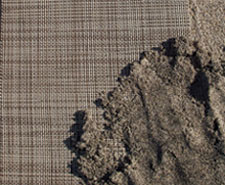
product, made with a bicolored Textilene mesh that blends with the sand color, forms a groin that
runs perpendicular to the shoreline into the water, preventing sand erosion parallel to the
shoreline.

Twitchell is collaborating with engineering firms to develop hurricane screens that have been
tested to withstand the impact of Category 5 winds and have passed Dade County, Fla., certification
for wind and projectile protection. It sees these screens as a viable soft alternative to aluminum
shutters.

Australia is a major market for Textilene for what Twitchell calls Awning with a View,
offered as Shadeview by Australia-based Imex Creative Products and as Vistaweave by Radins Agt Pty
Ltd., also based in Australia.

ldquo;Awnings there are different than what we think of here in the United States,” Register
explained, noting Australia’s drier climate, high UV intensity and skin cancer rates, and low angle
of the sun. “Awnings there are much lower to the ground and actually will cover up a large portion
of the window. A solid product would create a cave-like effect inside.

“Our Textilene product allows light to come through, and you can see out through it,” he
continued. “As long as it’s installed at an angle, 98 percent of the rain sheds off. But it also
allows a person inside to see out and allows some degree of light to come into the building,
creating a much more airy, open feel, while at the same time providing good shade. Most of these
products provide 90- to 98-percent UV protection.”

Register said Twitchell has modified the Awning with a View concept for a US Air Force
application.

“We worked with another company to create a solid PVC laminate on top of our awning material.
That laminate is extremely tough and durable and is used by the Air Force for fighter-jet
canopies,” he said. “Bases in the Florida Panhandle, New Orleans and Phoenix all use our product
exclusively. In a high wind, if a metal roof tears off, that could become a very hazardous
projectile. When a fabric tears off, its just a fabric and it rarely tears off. During Katrina last
year, the New Orleans base sustained 145-mile-per-hour winds. Less than 20 percent of the canopies
were damaged, and that damage was primarily due to flying debris.”

 
TwitOuter
TwitProTec
 
Advanced Coastal Technologies LLC, Dothan, Ala., uses Textilene fabric in its ProTecTube
beach restoration products. The outer-layer fabric is offered in colors to match the beach sand
within the project area.


Flexibility Serves Niche Markets

“Our niche orientation is not a feature of Coated Products alone, however,” Register added. “
We have our own olefin extrusion line, and we can produce a 50-pound or a 5,000-pound order of
olefin, which predominantly is consumed in-house. Most of our olefin products are sold into outdoor
furniture, and we have recently started working with consumer products including cut yardages for a
multitude of end-uses.”


Market Challenges

Nash spoke about the challenges
facing Twitchell, especially in the retail marketplace.

“One of the biggest challenges we face is the fact that the domestic retail market is driven
by such a ruthless sourcing model — which is not necessarily a bad thing, but it very definitely
drives you to different sorts of formulations in order to achieve the cost requirement for the
customer. So you’ve got to be very careful about exactly what you’re selling at any given time.”

While acknowledging the need to “stay on top of your game” when dealing with mass retailers,
Nash said, “We also work on how we can give a competitive advantage to the rest of the retail
marketplace — the market that is at the other end of the spectrum.” Speaking specifically about
outdoor furniture, Twitchell’s main retail market, he noted the “incredibly diverse market” in
which the mass retailer may sell a very inexpensive chair, while a smaller, specialty shop may
offer a much higher-priced chair.

“And the nice thing about that market is that it is so diverse and expanding,” Nash
concluded.


March/April 2006
Managing Expectations – Mills Are Wary


S
pinners describe running conditions all the way from full tilt to moderate and
strengthening. As usual, there is variation among the different end-use markets and spinning
technologies. A ring spinner notes he has been running full blast for a while.

A multisystem spinner has had to adjust capacity downward. “We scaled back our operations
somewhat last year,” he said. “We are running reasonably well with this new level of production.
One plant could use some more business, but it’s seasonably awkward for that plant to be full at
this time. We don’t want to bring the price down just to generate business.”

An open-end (OE) spinner is running at about 85-percent capacity versus running flat out this
time a year ago. A specialty ring spinner reports strengthening demand, and is adding capacity and
a new state-of-the-art Murata winder.


Pima In Demand

A ring spinner with significant Pima cotton production is enjoying excellent fiber quality and
powerful demand. “The cotton crop is probably the best I’ve seen in Pima,” he said. “The pricing is
probably below where we were a year ago, but it is starting to come back. Up until recently, no
retailer would even talk to you about increasing prices, but the yarn market is tight. We are
getting inquiries from people who haven’t called us in a long time.”

Another spinner is mildly optimistic. “We see enough business for us to make budget this
year, but that doesn’t mean it will be easy,” he said. “It will be a continual struggle on prices.
So we have to be circumspect about the market as we try to achieve our goals on pricing and product
simplification.”

A third spinner is seeing a slowdown in the upholstery fabric segment. “The housing market is
down; fewer homes are being bought and decorated,” he said. “Plus, consumers have to spend more on
their heating bills and gasoline. So, there is less money for apparel or towels.”


The Fiber Nickel And The Yarn Dime

Both man-made and cotton fiber prices are moving upward once more, putting the squeeze on
spinners. There appears to be no end to upward price pressure on the man-made side. Cotton has been
up and down — mostly up.

“The price of polyester is about to move up,” said one spinner. “Producers have been kind of
flaky in the last six months or so. They created a surcharge mechanism and adjusted it on a monthly
basis. Now they’re having a pure fiber price increase. We just lost a major acrylic producer —
Solutia. I see what is going on with the price of natural gas, oil and other inputs. I’m a little
concerned about inflation.”

“Cotton is up from 51 cents per pound three months ago to 56 cents now,” said the OE spinner.
“It’s another nickel, and we can’t pass it on either. It’s a lot of pressure. The other side is
that people are wondering why the demand is as weak as it is.”

On the other side of the equation — yarn prices — spinners report mixed success in passing
rising costs along to retail. “We moved our prices up over the past several months,” said the
multisystem spinner. “We are working on a partnership basis with our vendors and customers more
than ever before. We are trying to understand each other’s pricing levels.”

“Yarn prices, you can’t raise them,” said the specialty ring spinner. “The customers are
still not ready for a price increase. We are suffering with this cotton cost. I could overcome it
with better running conditions. I don’t want to scare people away with higher prices.”


Under Armour® Model

Perhaps there is a way to escape the crushing price pressure of the yarn market. One mill
executive lauded Baltimore-based apparel maker Under Armour® for its branding, performance and
marketing savvy, to say nothing of its impressive share of shelf space in almost every US sporting
goods store.

“[C]ertain innovative manufacturers are managing to separate themselves from the pack by
having a different brand identity, a different product-development cycle or a different mentality,”
he said. “They are companies like Under Armour that have a product with benefits they can translate
in a few talking points. The only way the industry can grow is by being incredibly innovative.
Perhaps we can get a little more juice out of this orange.”


March/April 2006


Cotton By The Numbers


C
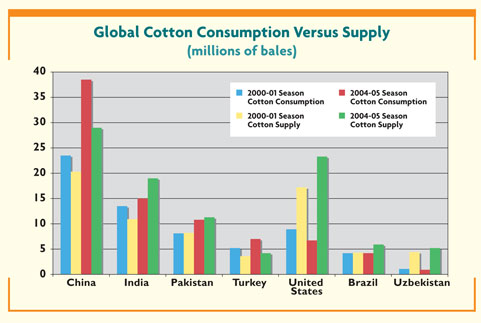
otton data, when analyzed over the five-year time series from the 2000-01 through 2004-05
marketing seasons, illustrate the global shifts in the development of cotton production and the
growth of the textile industry represented by cotton consumption. China, India, Pakistan, Turkey,
the United States and Brazil lead the world in both cotton production and consumption. But
significant markets for consumption, like Indonesia, Thailand, Mexico and Bangladesh, point to
growing usages not supported by domestic production.

In terms of exports, Uzbekistan is second to the United States in global cotton exports. The
Africa Franc Zone, Australia, Syria, Egypt, Turkmenistan, Tajikistan and Kazakhstan are not to be
ignored as significant suppliers some with the potential for developing a domestic consumption
base.

There is much more to the global cotton story than simply matching a country’s cotton
production with its cotton consumption. Cotton shipments span the globe, with cotton traded and
purchased to meet the quality and production needs of industry. Domestic production may not meet
the consumption criteria of a country, and imported cotton may be necessary to meet those demands.
However, growth rates of a country’s supply and consumption of cotton do shed some light on the
shift in both the global business of growing cotton and the global business of textiles.

Increasing consumption rates clearly illustrate the growth in the cotton sector of a
country’s textile industry. Increases in cotton production when there is a lack of domestic
consumption point to a country’s development as an exporter of cotton fiber.

Although some people may assume that a country’s economic development level may influence
whether the country is a cotton supplier or cotton consumer, this is an assumption not
substantiated by the data. Such an assumption is falsely based on the idea that agriculture and
manufacturing do not share at some level in the improvement associated with the development level
of the country. There are efficiencies in the consumption and production of cotton that dictate
activity levels in these separate yet linked industries.

A domestic supply of quality cotton is a competitive advantage for a domestic cotton textile
industry. The market factors facing this consumption, however, can negate that competitive
advantage. This is illustrated by the United States with falling consumption and a developed
country with rising production.

CotNumCot


The Top Four

China, India, Pakistan and Turkey collectively consumed 50.3 million 480-pound bales of cotton
in the 2000-01 marketing season, accounting for 54 percent of the total global consumption of 92.3
million bales for the season.

In 2004-05, with total global consumption rising to 108.7 million bales, these same four
countries represented 66 percent — a full two-thirds — of the global consumption of cotton.

On the supply side, China, India, Pakistan and Turkey collectively increased output from 48
percent, or 43 million bales, to 53 percent, or 63.5 million bales, of the total global cotton
supply during the measured period — from the 2000-01 season through the 2004-05 season.

Among these four countries, a roughly 20 million-bale growth in consumption was met with a
roughly equal 20 million-bale growth in supply.

cottonbynumbersjpeg


China, China, China…

US Department of Agriculture cotton data reinforce what one might expect about the growth of
China’s cotton consumption in the last five years. From the 2000-01 to the 2004-05 seasons, China’s
cotton consumption increased by 64 percent — from 23.5 million to 38.5 million bales.

In 2000-01, the country exceeded its domestic supply of cotton by 3.2 million bales. By the
end of the 2004-05 season, China out consumed its 29 million-bale domestic supply by 9.5 million
bales.

China is the world’s largest consumer and producer of cotton. Early figures for 2005-06 point
to continued expansion.


India Sees Increases In Consumption And Supply

India, like China, is another high-growth story, but with a twist. From the 2000-01 season
through the 2004-05 season, India increased its cotton consumption by 11 percent — from 13.5
million to 15 million bales.

In domestic supply, India made significant increases during the same five-year period,
increasing domestic supply of cotton by 8.1 million bales — from 10.9 million to 19 million bales —
a 74-percent increase in production.


Pakistan On The Move

Pakistan demonstrated even growth in the production and consumption of cotton. As the worlds
third-largest consumer of cotton, Pakistan increased cotton consumption by 33 percent from 8.1
million to 10.8 million bales from the 2000-01 season through the 2004-05 season.Over the same
period, Pakistan grew domestic production of cotton by 3.1 million bales, from 8.2 million to 11.3
million bales, or 38 percent.


Consumption And Supply Rise In Turkey

Expanding consumption of cotton by 35 percent, from 5.2 million to 7 million bales over the
measured period, Turkey is a net importer of cotton. Even though it increased domestic production
by 17 percent, from 3.6 million to 4.2 million bales, Turkey exceeded domestic supply by 1.6
million bales in 2000-01 and 2.8 million bales in 2004-05.


US Consumption Declines, Supply Increases

As the fifth-largest cotton consumer and the second-largest cotton producer, the United
States has a unique position in the world of cotton. US cotton consumption has fallen by 25
percent, from 8.9 million bales in 2000-01 to 6.7 million bales in 2004-05.

Cotton production in the United States is up over the same period by 35 percent, from 17.2
million bales to 23.3 million bales. Over the measured period, the United States has gone from a
consumption level that represents 52 percent of domestic production to 29 percent of domestic
production. The United States also has shifted from third place in global consumption to fifth,
after Pakistan and Turkey.


Brazil:

Level Consumption, Increasing Supply


Brazil has had level consumption over the measured period, using 4.2 million bales of cotton.
Domestic supply has increased from 4.3 million to 5.9 million bales, so while consumption is flat,
domestic supply has risen 37 percent.


The Future

As economies continue to develop, the rising appetite for consumer goods should bode well for
the future of cotton. Innovations related to both the growth and the consumption of cotton continue
to expand the possibilities for this ancient fiber. Textile manufacturing systems continue to
advance, creating the necessary flexibility to increase quality as well as yield. Textile finishes
show promise in providing consumers with durability, performance and aesthetics, which aid in the
marketing of cotton products and satisfy the demands of a growing marketplace.

March/April 2006

GTP Accessories Offers HybridPower 151

Weaving accessories supplier GTP
Accessories, part of Belgium-based Picanol NV, now offers Greenville-based Steel Heddle Inc.’s
HybridPower 151 harness frame for weaving machines.

The frame features a combination of lightweight aluminum profile and high-strength carbon
fiber, which makes it 50-percent stronger than previous designs, according to the company. A new
center support and reinforced third drive point offer further frame strengthening and allow
wide-width weaving at high speeds. In addition, high profile and side brace stress are reduced by
the R-Flex corner connection, which connects the frame’s braces.

The patented heddle rod is adhesive-bonded, eliminating fatigue breakage caused by riveting
and adding to the profile’s strength. The frame also comes equipped with heddle dampers.

The HybridPower 151, already a standard accessory for the Picanol OMNIplus 800 air-jet
weaving machine, now is available for all brands of new and older models of weaving
machines.


March/April 2006

Teijin Twaron Launches Sulfron® 3000 Granule


TechSulTeijin
Twaron BV, The Netherlands, reports its para-aramid Twaron® fiber derivative, the Sulfron® 3000
granule, substantially increases the lifetime and performance of sulfur vulcanized rubber
compounds, and is currently being studied by all major tire producers. According to the company,
Sulfron improves tire durability by at least 15 percent; rolling resistance by 20 percent, leading
to a 5-percent fuel consumption decrease; and cut, chip and chunk resistance.

In addition to use in the transportation sector, Sulfron may have other applications,
including conveyor belts, belt and carcass stocks and bridge bearings, according to Gert Frederiks,
commercial director, Teijin Twaron.


March/April 2006

Autobahn Introduces Textile Screen Printing Presses

Autobahn Inline Screen Printing Equipment (SPE) Inc., Temecula, Calif., has developed a new line of
automatic textile screen printing presses that feature a maximum 18- by 22-inch image area, print
speeds of up to 85 dozen screens per hour, electric printheads and print stroke capability ranging
from one to 10. Customers can choose to print between six and 56 colors.

Autobahn Inline SPE’s Inline Double Decker automatic textile screen printing press
Because the machines are rectangular and therefore take up 50 percent less space
than its competitors, the line of presses can fit in shops of all sizes, according to Autobahn. The
presses are 53.8 inches wide with varying lengths, according to the number of colors needed. They
are shipped fully assembled.
March/April 2006

Karl Mayer Launches GOM 8 Basic Sample Warper

Germany-based Karl Mayer
Textilmaschinenfabrik GmbH has introduced the GOM 8 basic sample warping machine — a simplified,
economical version of the GOM 16 sample warper. The company reports the GOM 8 — which costs
approximately 30 percent less than the GOM 16, while offering the same sample warping technology —
is a viable solution for standard operations typically performed in Asian mills and for newcomers
with limited investment capital and/or undetermined needs.

Suitable for producing shirting fabric and for processing short runs of cotton, silk or wool
in a variety of patterns, the GOM 8 offers half the number of package positions as the GOM 16 and
fewer options; but it still runs at 1,200 meters per minute, has a virtually unlimited pattern
range with one rotary creel and allows color changes at full speed. Warps of up to 420 meters may
be produced, and warp beams have a lease at both ends.


March/April 2006

Norcross Viscosity System Controls Up To Three Stations

Newton, Mass.-based Norcross Corp.’s
new Norcross VISC1000 Viscosity Control System can monitor and control one to three stations for
in-line or in-tank processes, including coating, adhesive and printing ink.

The system’s touch screen displays trend data and process parameters — such as set point,
alarms, automatic/manual mode and actual viscosity — for each station. The system’s software allows
users to change parameters at each station separately, and plot trends over one hour and up to
seven days.


March/April 2006

WestPoint Home Announces Plant Closures

Home fashions producer WestPoint Home Inc., West Point, Ga., reports it will close its sheet
weaving Calhoun Plant, Calhoun Falls, S.C., in May 2006, in an effort to consolidate domestic bed
products manufacturing. The Calhoun Falls closure follows the companys recent decision to close the
Clemson Greige, Finishing, Fabrication and Distribution operations, Clemson, S.C., in April
2006.

Some 300 Calhoun facility workers and about 290 Clemson Centre employees will be affected by the
closures, according to Elinor Crowder, assistant vice president, communications, WestPoint Home.
The company will maintain Clemson Centre offices for such functions as product development,
finance, information technology and customer service and planning.

Saying that the company appreciated the efforts of its associates throughout the years, John
Hurston, vice president, manufacturing, added that the Calhoun Falls closure is another necessary
step in the company’s strategy for realigning and streamlining our domestic manufacturing.

“To compete successfully in the global market, we must gain the most effective balance between
what we manufacture domestically and what we can best source,” Hurston said.

March/April 2006

AF&Y Adds Capacity, Jobs

Because of a doubling in demand for
its Marquesa® and Innova® high-performance yarn in the past two years, Chapel Hill, N.C.-based
American Fibers and Yarns Co. (AF&Y) is increasing its extrusion capacity by 30 percent and
texturing capacity by 25 percent. The increase is occurring mostly at its Bainbridge, Ga., plant,
which also houses the AF&Y Technology Center. In connection with the expansion, the company
expects to hire 25 to 30 new employees.

According to AF&Y, its yarns increasingly are replacing cotton, polyester and acrylic in
apparel, upholstery, mattress fabrics, and other home and contract textile applications. This
growth in demand, coupled with the doubling of the company’s export business every year for the
last three years, spurred the decision, AF&Y reported.

In other company news, AF&Y’s Marquesa® man-made yarn technology is now featured in
Cologne, N.J.-based Absecon Mills Inc.’s Cantara fabric collection, which features cotton’s look
and feel with yarn-inherent stain resistance, durability, colorfastness and bleach
cleanability.


March/April 2006

Sponsors