Executive Forum: James W. Chesnutt


R
obert Frost once said, “The best way out is always through.” For many years, the US
textile industry tried to go around, above and beneath to forge policies that were beneficial to
us. For many years, the industry also came up empty-handed or had policies thrown at us that were
detrimental to our companies and workers.

Finally, I think the industry has come to realize that if we are going to be successful, we
must go through Congress. And we must go through the administration and its myriad agencies if we
are going to forge policies that take our interests and the more than 600,000 workers we employ
into account.


In recognition of this new strategy,
the National Council of Textile Organizations (NCTO) was established almost 18 months ago in an
effort to mobilize the resources of our domestic textile industry more efficiently and
effectively.


Exec-Chesnutt
James W. Chesnutt is CEO of National Spinning Co. Inc., New York City, and chairman of the
Washington-based National Council of Textile Organizations.


NCTO represents the entire spectrum
of the US textile sector — from fiber to yarn to finished product — as well as suppliers in the
textile machinery, chemical and other such sectors that have a stake in the industry’s prosperity
and survival.

I’ve been in textiles for more than 30 years now, and I’ve seen enormous changes during this
time — including changes in manufacturing philosophies and technology; changes in the way we market
our products as more and more businesses turn to the Internet; and, most importantly, changes in
global trading rules, which brought with them a revolutionizing change in the way trade is managed
in our sector and China’s move to quickly monopolize our industry.

First and foremost on anyone’s mind in the textile industry these days is China, as well it
should be. In the United States, China is shipping us 440 million garments a month — yes, 440
million garments a month. And that’s with safeguards in place.

With a US population approaching 300 million people, that’s 1.5 garments per person — and
this is happening every month. Over the course of a year, China will send us around 5.2 billion
garments. [T]hat certainly leaves me wondering what is left for the rest of us who want to continue
doing business in this sector.

Do any of us have a chance against China? Can any of us compete with this manufacturing
giant? The answer, of course, is yes, but it will require this industry and our government to be
bold and courageous by demanding that China play by the same set of rules as the rest of us.

The US government has worked tirelessly through the invocation of safeguards to prevent
China from monopolizing the domestic market in this sector. We currently have safeguards in place
for 10 product categories, and [as of] Jan. 1, 2006, a new textile and apparel bilateral agreement
between the United States and China [has taken] effect. All told, 34 categories of textile and
apparel products from China [are] now … controlled.

Because of this agreement, the US industry knows with certainty that China will not be able
to flood the US market during the next three years. The industry also will not have to rely on an
uncertain safeguard process with no guarantees. To be perfectly honest, I am still trying to
understand why China even signed this agreement. Regardless of its reasons, we are all breathing a
short sigh of relief now that this agreement is in place.

Unfortunately, this bilateral agreement and the safeguards are only a temporary solution to
the China threat. Under China’s WTO [World Trade Organization] accession agreement, the current
textile safeguard can only be used through 2008. After 2008, there is currently no mechanism by
which the US textile industry can hope to restrain imports from China.

We can’t use other trade remedy statutes like countervailing duty and dumping because of the
“like or comparable product” threshold. We make components, yarns and fabrics that do not meet this
threshold test. So once the safeguards are gone, our market will be wide open, and there will be no
recourse for us.

So are these safeguards just an exercise in futility — are we just delaying the inevitable?
I don’t think so, but as mentioned earlier, it’s going to require bold and courageous steps by the
US government and other governments around the world whose textile and apparel industries are
similarly at risk.

How can we work together to accomplish this? There are a couple of ways.

We believe it is imperative that the
China safeguard be extended or a new safeguard be created in the Doha Round of WTO trade
negotiations to prevent China from monopolizing world textile and apparel markets beyond 2008.
Absent such action, China will quickly grab a 70- to 80-percent share of the US market and paralyze
our industry, as well as those in other countries with significant textile manufacturing capacity.
Worldwide, this could translate into as many as 30 million people out of work and thousands of
textile and apparel plants shutting their doors forever.

A second but equally important issue involves tariff cuts for textiles and apparel in the
Doha Round. We must work together to ensure US textile tariffs are not included in the formula
approach advocated by China, [which] has proposed that US textile tariffs be dropped to 5 percent
or less while developing countries be allowed to keep their textile tariffs at 30 percent. If this
happens, the textile and apparel industry in the United States, and for that matter the entire
Western Hemisphere, will be destroyed.

The first step of this strategy requires that textile issues in the Doha Round be put into a
Special Textile Sectoral (STS) … that will enable textile issues concerning tariffs, nontariff
barriers and safeguards to be negotiated in a comprehensive manner.

Under a STS, textile tariffs would no longer fall under the formula approach in the
nonagricultural market access talks that would be so devastating for our industries. It would also
allow for a new safeguard to be developed to protect [the US textile industry from disruption due
to a massive influx of Chinese textiles] once the current safeguard expires.

As the Doha Round of global trade talks continues, it is imperative that key countries rally
together to demand that textiles and apparel be put into [their] own [separate] sectoral. If
textiles and apparel remain grouped together with other industrial products, then a new safeguard
will not be possible, textile tariffs will be slashed, and China will put us all out of business
beginning in 2009.

The threat is real, and the ramifications for all of us could be devastating. The worldwide
textile and apparel trade is at a crossroads, and it is up to us to ensure that the right road is
taken. A sectoral negotiation for textiles and apparel, a China textile safeguard beyond 2008, and
limited reduction in US textile and apparel tariffs are paramount if we want to live to fight
another day.

By working together, we can pave a road to the future for our industries. If we fail, there
is no future and the only road will be a one-way ticket across the Pacific for Chinese goods. Let’s
ensure this doesn’t happen.


January/February 2006


SFT-250 System Suitable For Research, Pilot Projects

Supercritical Fluid Technologies
Inc., Newark, Del., has engineered its SFT-250 Supercritical Fluid Extractions and Reactions
Processing System for use in research and pilot projects. Designed to perform extractions and run
reactions in a supercritical fluid media, the system features a stainless steel vessel that can
hold supercritical fluids at pressures of up to 10,000 pounds per square inch. Pressure vessels may
measure up to 4 liters in size. Proportional-integral-derivative controllers manage mixing,
pressures, pumping rates, safety interlocks and temperature zones.


January/February 2006

Quality Fabric Of The Month: Indoor Aesthetics For The Outdoors

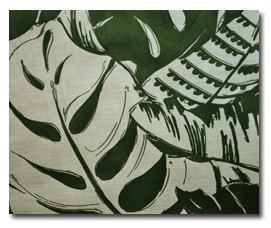
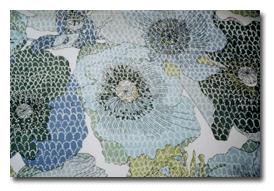
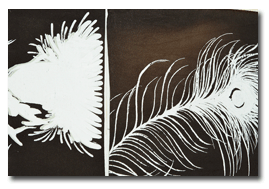
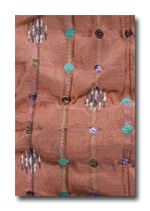
Weave  Corporation, a Hackensack, N.J.-based upholstery fabric manufacturer that prides itself on its design and technology expertise, has introduced Weatherwize®, a line of jacquard-woven enhanced polyester fabrics designed to bring the aesthetics associated with fine
interior upholstery to the patio, sunroom and other outdoor settings, including boats and recreational vehicles. The yarn-dyed fabrics feature finely woven designs with a multitude of color possibilities in addition to outdoor performance attributes such as water repellency, ultraviolet
(UV) resistance, and antimicrobial and antifungal protection. They are available in a standard line of fabrics and also in small, custom runs.Roger Berkley, president and great grandson of company founder Louis Cohen, said Weatherwize offers cutting-edge, fashion-forward, value-added casual decor options to customers who want a more refined look than what typically is available with acrylic outdoor fabrics. In addition to its sophisticated designs and soft hand, the fabric is more pill-resistant than acrylic, and it also can be given a fire-resistant finish — a benefit not available for acrylic fabrics. Also, acrylic yarn has a relatively bulky size per denier that limits its use for more refined applications, he
said.

“We’re using much finer yarns and weaving fabrics with much higher picks per inch than acrylic fabrics. Therefore, Weatherwize fabrics have more intricate designs and weaves,” Berkley explained, noting the fabrics are elegant and comfortable enough to use indoors as well.

QFWeaNEW


Weatherwize® jacquard-woven enhanced polyesterupholstery fabrics add a refined touch to
casual outdoor settings.

UV resistance is incorporated into the yarn during dyeing, and antimicrobial properties and water repellency are added during the finishing process. The fabric is highly water-repellent, Berkley said, so it will stand up to a sudden rainstorm.

Because the fabrics are yarn-dyed, the company can dye smaller quantities of yarn in a greater range of colors than is possible with solution-dyed yarn, which typically is used when UV resistance is needed and requires large minimum lots to be economically feasible, he noted.

Weatherwize is sold primarily through high-end fabric wholesalers to interior designers, but a range of standard fabrics is available to consumers through retail fabric and furniture stores.
The company also offers Weatherwize trim in more than 140 colorways to complement the fabrics. In terms of characteristics and structures, the fabrics sold to the trade and in the retail market are comparable, Berkley said.

He added that the company, which produces Weatherwize at its plant in Denver, Pa., is able to produce custom runs as short as 25 yards and deliver them in one to three weeks. Orders of standard fabrics on a cut-length basis can be shipped within 24 hours.

Weave offers a three-year limited warranty on the performance of Weatherwize, provided the fabric has been properly cared for. It is easily cleaned using warm water and a mild detergent.


For additional information about Weatherwize®, contact Glenn Dragone (212) 921-8757, info@weatherwize.com.


January/February 2006

TYAA Plans Name Change As Signal Of New Direction

The Textured Yarn Association of
America (TYAA), Gastonia, N.C., plans to implement several changes to take it in a new direction in
response to the changing face of the textile industry.

Daniel McRae, vice president, membership, said TYAA plans to enlarge its focus both
vertically and laterally, and invite other textile industry segments to participate in the
association. As a signal of this evolving focus, the association will change its name to Synthetic
Yarn & Fiber Association (SYFA).

“The past few years have been difficult for everyone in the US textile industry,” McRae
said. “Textured yarn is a very specific segment of the industry, and we want to expand our
association to be more inclusive of other textile companies. We will be inviting the whole man-made
yarn and fiber industry, and also will include our downstream customers, as well as lateral
segments such as carpet and industrial fibers.”

McRae said TYAA’s Winter Conference — scheduled for March 21 at the Speedway Club at Lowe’s
Motor Speedway in Concord, N.C. — will feature a look back at the history of the association and
the industry by Norman Cohen, TYAA’s founder and first president. The program also will include an
address by Mike Hubbard, vice president, NCTO; and a look toward the future by Chas Scott, TYAA’s
current president.

The organization’s Summer Conference and 2006 Annual Meeting is expected to be the first to
be held under the SYFA name. That event will take place July 26-29 at the Marriott Grand Dunes
Resort in Myrtle Beach, S.C.

January/February 2006

Ferrari Introduces Facade Covering, Marine Fabrics

The Ferrari Group, a France-based
composite textiles manufacturer, and its Pompano Beach, Fla.-based subsidiary, Ferrari Textiles
Corp., now offer Stamisol FT 371 membrane for building façade coverings, three Stamoid® Marine
fabrics for boating applications and Soltis® 86 translucent cover fabric.

Lightweight, flexible Stamisol FT 371 can be made into panels to fit a façade’s shapes and
curves. The composite comprises a woven polyester scrim controlled during coating to provide
dimensional stability in both warp and weft directions. The membrane features a dark interior
facing to enhance transparency and improve visibility toward the outside, and provides insulation
from the cold and protection from the sun.


Flexible, easy-to-maintain Stamoid
Top and Stamoid Tweed boat roofing fabrics are designed to withstand severe weather and excessive
heat and cold. Stamoid Open is a stronger fabric designed for permanent tops and curtains for large
or high-speed boats.

Soltis 86 for cockpit covers, sun screens, awnings, windbreaks, windscreens and sail shades
provides protection from the sun, diffusing light and affording improved visibility from inside to
outside. The fabric features Précontraint Ferrari® prestressing technology, which ensures
dimensional stability.

All products are recyclable using Ferrari’s Texyloop™ process, which is based on the
Vinyloop® polyvinylchloride composite recycling process developed by Brussels-based Solvay S.A. in
collaboration with Ferrari.


January/February 2006

Lenzing, Zimmer Sign Lyocell Agreement

Austria-based Lenzing AG and
Germany-based Zimmer AG have put an end to their differences about lyocell fiber technology patent
issues by completing a licensing agreement whereby Zimmer may use some of Lenzing’s key patents for
the construction of lyocell plants.

Both Lenzing and Zimmer own patents on their production processes for lyocell fibers, which
are made from the raw material cellulose. Lenzing currently markets lyocell under the TENCEL®
brand. Zimmer has developed its lyocell technology in a pilot plant in Germany.


January/February 2006

Levis Introduces IPod-Compatible Jeans

San Francisco-based apparel marketer
Levi Strauss & Co. has debuted its Levi’s® RedWire™ DLX Jeans for men and women. The new jeans,
which will be available worldwide this fall, feature a special joystick in the watch pocket for
easy operation of most iPod® systems.

Other design features include an iPod docking cradle built into the jeans and discreetly
housed within a side pocket, and a built-in retractable headphone unit. The jean’s aesthetics, such
as the white leather patch and joystick, and minimalist buttons and rivets, pay homage to the iPod’s
design, according to the company.

The jean is machine washable once the iPod is removed.


January 1, 2006

Importers Pleased To See Antidumping Action

Importers of textiles and apparel are hailing Congress’ repeal of the so-called Byrd Amendment
that made payments to companies involved in import antidumping cases. The importers maintain it a
was costly and unfair subsidy that encouraged companies to make greater use of antidumping
statutes. While domestic textile manufacturers would like to have seen the statute continued, it
has been of only marginal importance to them, since fabric manufacturers do not have standing in
apparel antidumping cases where most of the problems exist. They also have problems with the
overall antidumping statute, since it does not apply to state-owned economies like China and
Vietnam, and antidumping and countervailing duty cases are and expensive to pursue.

Eric Autor, vice president and international trade counsel for the National Retail
Federation, said the Byrd Amendment “represented an egregious example of corporate welfare that has
given hundreds of millions of dollars in no-strings-attached government subsidies to a handful of
companies at the expense of national security, natural disaster recovery and a host of critical
spending priorities.”

Kevin Burke, CEO of the American Apparel and Footwear Association, said the law was “an
abomination that should never have been enacted in the first place.”

The Government Accountability Office recently reported that nearly $1 billion has been paid
to companies under the Byrd amendment. In addition, the World Trade Organization has ruled the
subsidies are illegal, and several countries had begun taking retaliatory measures.


January 1, 2006

January/February 2006


Supima
, Phoenix, now offers an electronic version of the Federal Trade Commission Bureau of
Consumer Protection Office of Consumer & Business Education’s Facts for Business pamphlet
titled “Calling it Cotton: Labeling & Advertising Cotton Products.” The document is available
under the Supima Textile Products or Supima Licensing links at
www.supima.com.


Pantone Inc.
, Carlstadt, N.J., has made available the summer 2007 edition of the Pantone® View Colour
Planner.


Rapra Technology Ltd.
, England, has published a handbook titled “Chemistry and Technology of Polyols for
Polyurethanes.”


The Dow Chemical Co.
s Dow Latex business, Midland, Mich.,
has launched a website at
www.dowcarpetlatex.com.

Effective January 1, Florham Park, N.J.-based

Troy Corp.
has increased by up to 10 percent the price of its Troykyd® defoamers, Troysol™ and
Troysperse™ surfactants and dispersants, and Troythix™ rehology modifiers.

At the beginning of the first quarter of this year, the

Lenzing Group
, Austria, increased textile and nonwoven fiber prices by at least 5 percent.


International Textile Market Association (ITMA)
, High Point, N.C., is seeking companies to host student internships for summer 2006.
Financial assistance is available for interested companies. For more information, contact ITMA
(336) 885-6842; www.itma-showtime.com.


Meese Orbitron Dunne Co.
, Saddle Brook, N.J., features a powder-coated steel recessed safety tow hitch on its
100P bulk linen truck.


Yaskawa Electric America Inc.
s Drives Division, New Berlin,
Wis., has released E7 Harmonic Estimating Tool software, which enables users to estimate and
calculate voltage and current harmonic distortion produced by the company’s E7 Variable Frequency
Drives on electrical systems at the point of common coupling and/or at the drive input terminals.


The Astrup Co.
, Cleveland, has redesigned its website,
www.astrup.com, to
feature greater detail about product lines.

The 2006

American Association of Textile Chemists and Colorists
Technical Manual is now available in print and CD-ROM formats from the Research Triangle
Park, N.C.-based association.


MonoSol LLC
has relocated its headquarters to: 707 E 80th Place, Suite 301, Merrillville, Ind. 46410;
(219) 762-3165; fax (219) 764-4785.

The

Carpet & Rug Institute (CRI)
, Dalton, Ga., is now accepting paper topic, presenter and session theme ideas for the
2006 Annual Carpet America Recovery Effort Conference, to be held at Callaway Gardens, Pine
Mountain, Ga., May 1-4, 2006. To submit ideas, contact Robert Peoples (706) 847-1442;
www.carpetrecovery.org. In addition, CRI’s street address has changed to 730 College Drive. The
company’s post office box is unchanged.


Kaeser Compressors Inc.
, Fredericksburg, Va., has released a 20-page, four-color catalog detailing its line of
premium rotary screw compressors from 3 to 600 horsepower.

Spartanburg-based

Apex Chemical Corp.
of South Carolina Inc. has changed its name to Apexical Inc. Its website is now located
at
www.apexical.com and
its new e-mail address is info@apexical.com.

Effective January 1,

DAK Americas LLC
, Charlotte, has increased polyester staple fiber prices by 4 cents per pound for all
products sold to carpet, home furnishings, apparel, industrial and fiberfill markets.


Tajima America Corp.
s new national headquarters are located
at: 19925 S. Susana Road, Rancho Dominguez, Calif. 90221; (800) 869-9776, (310) 604-8200; fax (310)
604-8260.

Effective January 1, Fort Mill, S.C.-based

Wellman Inc.
has revised the pricing structure for Fortrel® polyester staple fiber.

Lakewood, N.J.-based

Newson Gale Inc.
has published a 24-page technical data and applications bulletin containing information
on controlling static electricity in hazardous areas.


January/February 2006

Streat Instruments Develops New Tumble Dryer Controller

Streat Instruments Ltd., New Zealand,
now offers its Streat Tumble Dryer Controller, which measures garment moisture in the exhaust ducts
of tumble dryers. A non-contact moisture sensor installed in the duct replaces the direct-contact
sensor traditionally used in Streat’s Drycom system.

The controller — which can be incorporated into existing dryers — detects when drying
conditions have reached the optimum, preset level, and then automatically switches the cycle from
drying to cooling, ensuring that garments are not overdried. Because the system relies on the
condition of the load as opposed to the timer used in previous systems, operators can expect energy
savings and consistent product quality, Streat reports.

The product has been installed in some Scottish cashmere and fine wool knitters’ finishing
departments.


January/February 2006

Sponsors