CAFTA-DR Fixes Open More Market Opportunities


E
nactment of legislation correcting some problems that resulted in connection with the
Central America-Dominican Republic Free Trade Agreement (CAFTA-DR) should open some additional
market opportunities for textile manufacturers, retailers and other importers of textiles and
apparel. When CAFTA-DR was enacted last year, it was viewed as a way to compete against a flood of
imports from China, because of the proximity of Central America to the US market and the duty-free
treatment of goods. Participating countries — the United States, Costa Rica, the Dominican
Republic, El Salvador, Guatemala, Honduras and Nicaragua — agreed on a target date of Jan. 1, 2006,
for entry into force. However, a number of countries failed to ratify the pact, and a rolling
implementation developed. The delay in implementation meant those countries that came on board
could not benefit from the duty-free treatment, and they lost their rights under the Caribbean
Basin Trade Promotion Agreement.

The legislation fixing the problems allows retailers and other importers to apply for
retroactive refunds of duties they have been paying as a result of the rolling implementation. It
also gives US Customs and Border Protection power to enforce tariff preference levels (TPLs), and
it changes the rule of origin for pocketing fabrics to require apparel to contain pocketing fabric
made in the United States or CAFTA-DR countries. The law also changes the TPL with Nicaragua to
implement a commitment from Nicaragua to increase its purchases of US trouser fabric to match
quantities of such fabric sourced outside the region.

The CAFTA-DR region is the second-largest market for US yarns and fabric with textile and
apparel exports totaling $3.6 billion.


More On FTAs On Bush Agenda

Although the Bush administration continues aggressively to pursue a free trade agreement (FTA)
agenda, it is likely to be some time before most of the FTAs become a reality. The administration
already has negotiated 25 FTAs, and at least five more are in various stages of negotiation or are
under consideration by Congress. Only one — with Peru — is likely to be acted upon before Congress
adjourns for the year in November. Negotiations on FTAs have been completed with Peru and Colombia;
and others are under consideration with South Korea, Malaysia and Thailand.

With the Doha Round of trade negotiations in serious trouble, the administration plans to put
more emphasis on regional and bilateral trade agreements. US Trade Representative Susan C. Schwab
said, “We have a very ambitious agenda in terms of bilaterals and regional negotiations, and we
will have to see how that plays out.”


Textile Mills Can Import Raw Cotton

Although Congress has eliminated the direct payments to textile companies and cotton merchants
under the Cotton Competitiveness Program, textile mills still are permitted to import a limited
amount of raw cotton when the US price is higher than world prices. After the World Trade
Organization ruled the cotton subsidies paid to mills under the so-called Step 2 of the
competitiveness program amounted to an illegal subsidy, Congress repealed the step. However, Step 3
remains intact. Under Step 3, when the Friday-through-Thursday weekly average US price for Northern
Europe delivery exceeds the Northern Europe price by more than 1.25 cents per pound for any four
consecutive weeks, a special import quota is triggered. That has happened recently, and a series of
import quotas based on roughly one week’s mill use of upland cotton has been opened. US mills are
free to import cotton up to the level of the quota.

Prior to enactment of the competitiveness program in 1991, US mills were strictly prohibited
from importing raw cotton under a law passed in the 1930s to encourage development of a strong US
cotton industry. The competitiveness program helped mills compete against low-cost overseas textile
and apparel manufacturers. They reportedly received more than $2 billion in payments. While Step 3
was available from the outset, mills and merchants preferred the direct payments. As a result of
elimination of the direct payments, imports will play a more important role in the future.


September/October 2006

ITM In Istanbul


T
urkish, Iranian and Syrian visitors dominated among attendees at ITM 2006, a textile
machinery exhibition organized by Teknik Fuarcilik ve Yayincilik Ltd. and held at the CNR
International Fair and Congress Center in Istanbul, Turkey. Some 400 Turkish technology
manufacturers and 800 international firms exhibited the latest in textile technology.

Traffic at the show increased with each passing day, and the six-day event concluded with
48,907 total registered guests. International visitors from 72 countries made up 16 percent of the
attendees, while 84 percent were from Turkey. Twenty-four percent of the international visitors
were from Iran, 21 percent from Syria and 8 percent from Egypt.

Exhibitors’ opinions ranged from “disappointed” to “extremely pleased,” with show traffic
building from a slow start. Recent Turkish lira fluctuations were cited by many as a threat and an
opportunity for the industry.

 
itmopen
Visitors registor for the ITM 2006 textile machinery exhbition in Istanbul, Turkey.


Changing Market

“Turkey is feeling pressure,” said Haluk Erbel of Istanbul-based Erbel Mümessillik, a service
company and representative of Switzerland-based Rieter Textile Systems since 1974. “Companies are
vertical — yarn to garment. Fashion changes once a month. You have to be creative and produce
quickly in the fashion sector — this is the future of Turkey. Today, our clients are more concerned
with quality. It used to be quantity, but now it is higher and higher quality. China’s exports were
large [affecting Turkey] because the Turkish lira was strong. Just in the past several weeks, the
Turkish lira has fallen 20 to 24 percent in value. So this has changed things.

“Textiles are the main industry in Turkey,” Erbel said. “With Rieter, we offer a full range
of equipment from bale opening through spinning. There is a growing awareness of compact yarn and
its advantages. We have good technology, and we can provide turnkey operations with full support —
from installation forward.”

 
smit_Copy_1
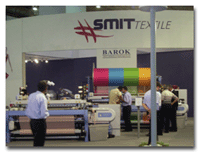
SMIT S.p.A., Italy, exhibited the GS900 and JS900 weaving machines at ITM 2006.

Italy-based Savio Macchine Tessili S.p.A. also has recognized the challenges the region faces
and sees premium compact yarn, fine-count yarn and specials like compact with Lycra® as a possible
solution. Mauro Rizzo, area sales manager, Savio; and Selim L. Sarfati, Turkey-based Alfredo
Modiano — Savio’s representative in Turkey, spoke of Savio’s expertise supplying automatic winders
with computer-aided package technology. “Orion winders produce a quality package — a quality
package necessary for quality yarns,” he said. Savio highlighted a list of field installations
throughout the region that are manufacturing compact yarns and using Savio winding technology.

Pablo Canora, sales director, textiles, Switzerland-based Santex Group, said the company had
good results and saw clients from Egypt, Iran and Syria. “The Turkish region and Uzbekistan have
been present,” Canora said. “The business is stable, but I hope with the change in the exchange
rate, that this will be a relief for Turkish exporters and a signal that something is happening for
Turkey. This will also help our clients continue to invest in the industry.”

Massimo Soffriti, general manager, Italy-based Loptex S.r.l., agreed the Turkish market is
changing. “Turkey is turning more toward quality,” he said. “If the process needs higher quality,
we have a place in this market. We may not see big new installations, but rather replacement of
older machines or upgrading for quality.”

 
acimit
(Left to right) Aldo Tempesti, director, Milan-based Tex Club Tec; ACIMIT Chairman Paolo
Banfi; and ACIMIT Director Dott. Federico Pellegata

Germany-based Trützschler GmbH & Co. KG drew interest with its TC 03 card and TD 03 draw
frame. The company reported being quite satisfied with the show and had serious discussions with
Turkish, Syrian and Iranian customers.

Switzerland-based Stäubli AG introduced two new electronic jacquard machines, the LX 1602 and
LX 3202. Both models are designed for weaving flat and terry fabrics at high speeds and were
developed from predecessor machines LX 1600 and LX 3201.

According to the company, depending on the format chosen, the LX 1602 and LX 3202 deliver up
to 30-percent greater load capacity and approximately 10-percent greater maximum speed. The new
models feature the M6 module for driving the hooks. The new machines are built on a reinforced
chassis and have undergone several mechanical optimizations to absorb the higher load and improve
reliability, as well as minimize maintenance. The overhead space requirement and machine width have
been reduced.

The LX 1602 is available in a format range of 1,408 to 5,120 hooks; and the LX 3202, in a
range from 6,144 to 14,336 hooks. Both machines are controlled by the color-touch-screen-equipped
jacquard controller type JC6.

“Turkey is a main market, and it fluctuates,” said Eduard Strebel, manager, marketing
services, Switzerland-based Jakob Müller AG, Frick. “We have continuity in Turkey, with
relationships with many companies. They use very modern technology. The exchange rate has made
machines expensive. With the Turkish interest in lace, our 24-bar MDR 42 knitting machine is very
strong in this market.”

 
muller
Eduard Strebel (left), Switzerland-based Jakob Muller AG; with M. Galip Bilol,
Istanbul-based representative Bilol Tekstil

Italy-based Itema Weaving featured Somet and Vamatex weaving machines. “The up-to-date
technology is here and is more about versatility than mass production,” said PierMarco Arnoldi,
commercial and technical manager, sales department. “This means increasing the quality of
production. Jacquard sales have improved. The new Silver Dyno Terry is on display here for the
first time. The main interests of Turkish clients are the rapier Silver and Alpha. The market is
stable and is moving from dobby to jacquard, just as it used to compete with Asia and now competes
with Europe. Turkish clients are very knowledgeable and continue to invest in up-to-date
technology.”

Fritz Legler, vice president and head of technical service at Switzerland-based Sultex Ltd.,
a member of Itema Weaving, spoke of the interest in special applications. “Turkish denim producers
are interested in double-wide projectile machines,” Legler said. “Over the last 12 months, we have
delivered several P7300 HPs for denim, with one installation in excess of 400 machines, and clearly
outrunning air jet in this field of application. It is also interesting to see the market accept
and develop technical products.”

 
fongs
Fong’s Industries Co. Ltd. executives celebrated 30 years working with its Xorella
representative, Sarteks Tekstil.


“Last year was a panic for Turkey because of China, but now we see confidence,” said Erwin
Devloo, marketing communications manager, Picanol NV, Belgium. “We have seen technical textiles
establish a foothold, and emerging businesses are important at fairs like this one. We believe in
Turkey, and it is one of the main markets along with China, India, Pakistan and Brazil. Together
they are 80 percent of the market in numbers of machines,” Devloo continued. “As for the show,
first-day problems with air conditioning and power were solved quickly, and the rest has been very
professional. You don’t have a lot of red tape to get things done.”

Michele Zampieri of the technology department of Italy-based Cimi S.p.A. explained the
changes available in dyeing and finishing technology. “We are here to explain to the market the
move in recent years to be both economical and environmentally friendly,” he said. “Over the past
five years we have reduced water consumption by 50 percent, chemical consumption by 50 percent,
power consumption by 50 percent; and reduced the space necessary for the machine by 30 percent.

“We have also made the machinery versatile — from wool processing to cotton and synthetics,”
Zampieri said.


September/October 2006

Beijing Hosts CITME


O
nce again, China’s capital city, Beijing, will host the China International Textile
Machinery Exhibition (CITME) Oct. 17-21, 2006, at the China International Exhibition Center.
Visitors to the show can expect to view a comprehensive lineup of the latest in textile technology
from spinning and weaving machinery to testing equipment.

Now in its 10th edition, the show is organized by The Sub-Council of Textile Industry, China
Council for the Promotion of International Trade (CCPIT-Tex); China International Exhibition Center
Group Corp. (CIEC); and China Textile Machinery & Accessories Association (CTMA); and assistant
organizers Hongkong Expositions Ltd. and China Textile Machinery & Technology Import and Export
Corp. CITME also holds the honor of being the only textile machinery show in China endorsed by the
Union of International Fairs.

 
citme
CITME will be held at the China International Exhibition Centre in Beijing.


Growing Exhibition In A Growing Economy

Since its inception in 1988, CITME has grown in size — both in number of exhibitors and
visitors, and in exhibition space — at each biennial edition. The 2004 show recorded 1,100
exhibitors from 25 countries and regions, displaying their wares in some 62,000 square meters of
exhibit space, while some 35,585 registered trade visitors came from 63 countries and regions, and
130,000 visitors overall attended the show. Both exhibitor and visitor numbers are expected to
exceed 2004 numbers at the upcoming show.

CITME 2006 visitors will find exhibitors spanning the many sectors of the textile industry.
Exhibits will include spinning and weaving equipment; knitting equipment; dyeing, printing and
finishing equipment; equipment and processing systems for technical textiles and nonwovens; and
textile testing and measuring equipment; among other offerings.

According to show organizers, CITME plays an important role for those who want to understand
and enter China’s expanding textile market. The show functions as a platform for business
cooperation and information exchange among industry leaders in China, Asia and abroad, show
organizers report.

In that spirit, the CITME 2006 Summit Forum on International Textile Machinery Manufacture
will occur concurrently with the exhibition on October 18 from 9 a.m. to 2 p.m. at the Beijing Kun
Lun Hotel. Touted as a networking opportunity for textile machinery senior managers, experts and
scholars from around the world, the forum will focus on present and future cooperation and
development in the textile machinery manufacturing industry. Representatives from all industry
sectors are invited to participate in the forum. Sponsors are the China National Textile &
Apparel Council and the European Committee of Textile Machinery Manufacturers (CEMATEX); organizers
include CTMA, CCPIT-Tex and CIEC. The Beijing Textile International Exhibition Co. Ltd. will act as
a cooperator.


Changes For Future Editions

It was recently announced that CEMATEX — organizer of ITMA Asia; CTMA; CCPIT-Tex; and CIEC have
signed a cooperation agreement. Starting in 2008, the CITME and ITMA Asia exhibitions will be
combined into one textile show — ITMA Asia + CITME 2008, to be held in Shanghai. It is expected the
combined show will be held every two years and will be organized by Beijing Textile Machinery
International Co. Ltd. and co-organized by Meeting Planners International Pte. Ltd., Singapore.

“I am very pleased that we shall hold this first combined show in Shanghai, and we and our
partners are delighted to welcome ITMA Asia to China,” said Gao Yong, president, CTMA. “We strongly
believe that our initiative will benefit the whole of the textile industry as well as the healthy
development of the textile machinery industry.”


September/October 2006

Diverging Price Trends


L
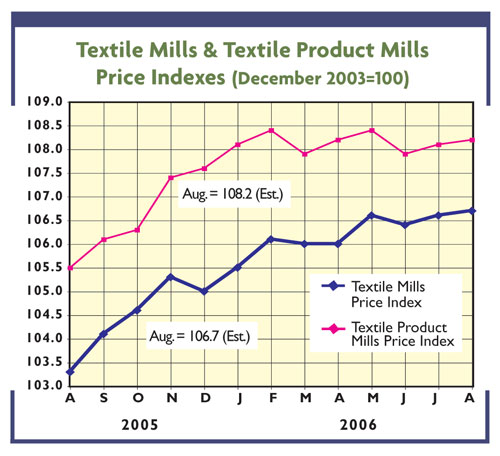
atest government price data indicate domestic and import price trends may be heading in
somewhat different directions. Since the end of last year, domestic quotes for both basic textiles
and more highly fabricated mill products have remained pretty much unchanged. Not so, however, in
the import sector, where new price indexes introduced this past year indicate incoming prices for
basic textiles and textile mill products have increased 3.5 percent and 1.5 percent, respectively,
since last December. More importantly, these trends are expected to persist through the remainder
of the year. If nothing else, this suggests the US-foreign textile price gap isn’t getting any
worse and even may be narrowing a bit. Moreover, it’s another sign the American textile industry is
still globally competitive.


Demand Trends Are Mixed, Too


The basically uneven activity pattern of the first half of the year also is continuing as
the current quarter draws to a close. Based on the latest available numbers, more highly fabricated
textile mill products like carpets, home furnishings and industrial products are still pretty much
holding their own — with year-to-date figures showing dollar shipments running better than 3
percent ahead of comparable 2005 levels. That’s a pretty encouraging sign, given today’s
competition from China and other foreign suppliers. However, the situation for more basic textile
products like yarns and fabrics is a lot less upbeat. Year-to-date dollar shipments in this sector
are down by more than 10 percent when compared to a year earlier. And if you factor in the
scattered price increases that occurred in late 2005, volume declines could be a bit more
precipitous.

BFchartSeptOct06


The Impact On Employment


These changing demand trends are also affecting overall domestic textile industry job
totals. Employment in the more highly fabricated textile product sector hasn’t been doing all that
badly. The number of domestic workers employed here is down by only a small 2 percent when compared
to one year ago.

On the other hand, losses in the basic mill sector have been far more troublesome — with the
workforce in this sector declining by more than 10 percent over the past 12 months. Combine these
two key textile sectors, and employment totals are off by about 6.5 percent over the same 12-month
period. Again, that’s not all that bad, given that industry productivity has increased by about 3
percent over the same period. If nothing else, it reinforces the contention that textiles are still
an important component of the US economy.

New National Council of Textile Organization (NCTO) figures would seem to back this up —
with the Washington-based group estimating there still are nearly 1 million workers employed in
textiles and related fields. NCTO further adds the industry still contributes $60 billion to US
gross domestic product and $16 billion to overall US export totals.


Trade Developments


Another piece of upbeat news — this time on the import front: Washington lawmakers have
okayed a bill that would increase the use of American trouser and pocket fabrics going into apparel
made in the Central America-Dominican Republic Free Trade Agreement (CAFTA-DR) region. To be sure,
this is hardly earthshaking news. On the other hand, it’s a move in the right direction. More
importantly, it suggests the administration and Congress are finally working to make CAFTA-DR a
success.

And this can’t be underestimated, for the CAFTA-DR region is the second-largest market for
US yarns and fabrics — with the US textile industry exporting more than $4 billion in textiles and
apparel to Central America. Also, apparel imported into the United States from CAFTA-DR countries
has on average more than 70-percent US content. That’s in sharp contrast to apparel imported from
China, where the US fabric content is less than 1 percent. Another encouraging trade sign is the
lack of any big increase in overall US textile and apparel imports, which for the year to date
continues to run only 2 percent above comparable 2005 levels — a big improvement over 2005’s hefty
10-percent jump.

September/October 2006

Industrial Engraving Offers Unwinds For Delicate Webs

The new surface-driven unwinds from Pulaski, Wis.-based Industrial Engraving Corp. are designed
for use with delicate tissue, nonwoven, towel and textile webs as well as substrates requiring
light-tension unwinding.

The unwinds – available in widths of up to 120 inches and roll diameters of up to 90 inches –
feature one, two or three belts on pneumatically-positioned arms, depending on working and
web-width conditions.

September/October 2006

The Art Of Textiles And Weaving Machines


R
ubelli S.p.A., a family-owned company established in Venice, Italy, in 1858, manufactures
high-end furnishing fabrics including brocades, damasks, velvets, silks and lampases. Lisio, Bises,
Dominique Kieffer and Donghia are just some of the brands that Rubelli supplies. Rubelli fabrics
can be found in internationally known theatres, castles and museums throughout Europe and abroad.
Recent projects include the reproduction of all the original fabrics decorating the Albertina
Museum in Vienna, Austria, and fabrics used in the Apollinee rehearsal room in Venice’s La Fenice
Theatre and the La Scala Theatre and Museum, Milan.

In order to create fabrics for its customers, Rubelli takes the time to accurately reproduce
styles during the design phase. The company’s historical archive is a priceless resource containing
ancient fabrics from all over the world. The archive plays a key role in the creative process as a
useful source of ideas, styles and decorations. Each new fabric created by Rubelli is a blend of
past and present, and of craft and industry.

Rubelli invests money in research and resources, and uses only fine natural fibers silk,
linen, cotton, wool and viscose to guarantee the high aesthetic value and quality of its products.
Fire-retardant fabrics, featuring Trevira CS, also are available.

rubelli
Rubelli S.p.A. created fabrics for Lisio’s 2006 collection.


Using Modern

Machinery To Make Historic Fabrics

According to Luciano Corain, president, Smit S.p.A., Italy, fabrics such as those
manufactured by Rubelli often are associated with ancient weaving techniques and skilled craftsmen
with nimble hands. But today’s latest-generation weaving machines are suitable for reproducing
artistic, complicated old-style weaves. Multiple functions and loom controls offer the weaver
versatility. In particular, Corain noted, the Smit Textile GS900 rapier machine offers low tension
and minimum warp-thread friction, making it suitable for high-end fabric production. The company’s
weaving machines can reproduce elaborate fabrics including brocades, damasks, Venetian lampas,
taffeta and liseratins using a wide variety of yarn types.

Rubelli operates 28 latest-generation electronic jacquard weaving machines at its production
facility. The company produces approximately 500,000 meters of fabric per year and employs 64
people working in three shifts. Advances in weaving technology including the development of
shuttleless looms, and the introduction of Smit’s rapier machines in 1958, help companies like
Rubelli stay true to ancient fabric styles, while using the latest, most efficient modern weaving
machinery.

September/October 2006

Berkshire Hathaway Subsidiary Completes Russell Acquisition

Fruit of the Loom Inc., Bowling
Green, Ky., a subsidiary of Omaha, Neb.-based conglomerate Berkshire Hathaway Inc., has completed
its acquisition of Atlanta-based athletic and sporting goods manufacturer Russell Corp. The
acquisition, valued at $18 per share of common stock, or nearly $600 million, was approved August 1
by Russell’s stockholders.

Russell will operate as a freestanding subsidiary of Fruit of the Loom, retaining its
corporate name. John Holland, CEO of Fruit of the Loom, also will serve as CEO of Russell,
replacing Jack Ward, who has retired.

September/October 2006

Gold Toe, Moretz To Merge Hosiery Businesses

Sockwear manufacturers and marketers
Gold Toe Investment Corp., Burlington, N.C., and Moretz Inc., Newton, N.C., will combine their
businesses, resulting in one of the largest sock companies worldwide. The Blackstone Group, a New
York City-based global private investment and advisory firm that is acquiring Gold Toe, is
financially backing and facilitating the merger. The transaction price was not disclosed.

The merged company, Gold Toe/Moretz Inc., will focus on supplying department and specialty
sporting goods stores and the mass market, in addition to operating its outlet and online stores.
The new company’s combined financial and management resources may foster product line and
distribution expansion, the companies report.

The Blackstone Group will be the majority owner of the company, with John Moretz, CEO,
Moretz, as the second-largest shareholder. New York City-based Vestar Capital Partners, Gold Toe’s
current owner, also will own a minority stake. Gold Toe’s and Moretz’s senior management will
become part of the new company.

“The combined strengths of our new company are perfect complements,” said Jim Williams,
president, Gold Toe. “Our diversified portfolio of premium brands will target multiple price points
and distribution channels across a broad customer base. The company will be uniquely positioned to
capitalize on future strategic opportunities.”


September/October 2006

No Safe Harbor For US Textiles


T
he headline reads, “India to become leading technical textiles exporter.” India-based
newspaper The Hindu recently published a story featuring India’s Minister of State for Textiles, E.
V. K. S. Elangovan, who set up an Expert Committee on Technical Textiles and inaugurated a two-day
Technical Textile Summit. One suggestion to gain share in the sector was to institute a Credit
Linked Capital Subsidy for technical textile machinery to encourage investment.

The Hindu also reported, “Further establishment of theme-based technical textile parks,
introduction of a separate stream for technical textiles in engineering colleges and technical
institutes for textiles, and setting up centers of excellence for quality R&D [research and
development] work would greatly help the industry in accelerating growth.”

The piece projected a 3.3-percent compounded annual growth rate for the global technical
textile products market from 2005 through 2010 and an 11.25-percent compounded annual growth rate
for those same products within India.

“With greater investments, focused [R&D] efforts and creation of state-of-the-art common
testing facilities, we can emerge as a leading technical textile manufacturer and exporter,”
Elangovan stated in the article.

India’s The Financial Express newspaper reported, “The committee will suggest a regulatory
framework to promote the use of technical textiles, covering the use of geosynthetics in
infrastructure projects, fire-retardant textiles in public places, textiles in landfill sites, use
of nonwoven disposables in hospitals and protection gear for industrial workers.”

It sure sounds like a plan.

As the consequences of globalization expand, American business needs to learn that global
business plays by a different set of rules. Foreign governments play a key leadership role, one
that few in the States are used to seeing.

China has the efficiency and speed of a planned economy. India, the world’s largest
democracy, though often suggested as slow and bureaucratic, has the ability to identify markets,
target and support its domestic growth, and even encourage a product’s adoption in the marketplace.
It is hard to imagine such support or involvement by the US government, let alone an interest in
the textile sector.

For some time now, many textile market observers have pointed to technical textiles as the
future of the US textile industry. The sector does have some great domestic resources, such as the
Nonwovens Cooperative Research Center at North Carolina State University. The sector is vibrant and
seething with innovation — new products, new applications and new markets. Messe Frankfurt’s
Techtextil, IFAI’s Expo and INDA’s IDEA 07 all share a freshness that is contagious.

There is no safe harbor for US textiles, but the interest of the Indian government in
promoting the development of the technical textiles sector is a positive signal for those who have
placed their bets in that sector. However, bear in mind you aren’t alone, and soon you will be
competing with India Inc. If that’s the case, you can also count on China Inc. coming soon.

The US industry’s ability to innovate and market is key to success.


September/October 2006

Huntsman Adds Czech Exhaust Processing Center

Salt Lake City-based chemical
producer and marketer Huntsman Corp.’s Switzerland-based Textile Effects business has established a
Center of Excellence (CoE) for Exhaust Processing in the Czech Republic. The CoE will provide
customer service and development support at all processing stages.

“The [CoE] for Exhaust Processing will allow us to bring together our comprehensive know-how
in exhaust application technology and provide our customers with strong and efficient technical
backing, particularly expertise in integrating dyes and chemicals,” said Michael Effing, head of
Textile Effects, Region Europe.


September/October 2006

Sponsors