Erhardt + Leimer Offers ELCOUNT Pick- And Course-counter

Germany-based Erhardt + Leimer GmbH
reports its newly developed ELCOUNT automatic pick- and course-counter provides contact-free,
reliable pick and course density control owing to a newly designed charged-couple device (CCD)
matrix camera with built-in circular illumination, and closed loop control owing to a newly
designed feed-forward/feed-back control algorithm.

According to the company, the new device offers single-sided detection and the largest
detection area possible, does not require a speed reference for measurement, can provide static
measurement and instant calculation, and adjusts automatically for brightness. The system functions
in conjunction with the Windows® XP operating system, and offers an easy-to-use operator interface
and Ethernet communication between the camera and the computer. The company also offers its
customers a global technical support network.

October 31, 2006

Rieter Supplies Largest Pelletizing System

Germany-based Rieter Automatik GmbH,
a unit of Rieter Textile Systems, recently completed delivery of a M-USG automatic underwater
strand pelletizing system that features a 1,200 millimeter operating width for up to 152
3-millimeter-width strands, throughputs up to 20,000 kilograms per hour and a cooling length of 7
meters, making it the largest such system ever built, according to the company.

The system includes a SG 1200 strand die head with automatic start-up wiper; M-USG 1200 H
pelletizer with stand-by cutting head, diverting pellet conveyor line with double pumps for the
pellet water slurry; two CENTRO 2200 centrifugal pellet dryers; a set of spare parts; and system
control.

October 31, 2006

Negotiations On United States-South Korea Trade Pact Break Down

Negotiations on a United States/South
Korea free trade agreement (FTA) have broken down primarily because of differences over trade in
textiles and apparel, and farm commodities. The suspension of talks and the wide differences that
still exist on what the agreement should encompass make it extremely unlikely the two governments
can reach an agreement in time to meet a year-end target. That target is important, since President
George W. Bush’s authority to negotiate agreements under procedures that require only an up or down
vote in Congress expires in July.

South Korea is strongly opposed to increasing imports of rice and other agriculture
commodities, and it complains the United States is unwilling to open its markets for textiles and
apparel free from a strict rule of origin that would prohibit inputs from non-participating
countries.

Going into the four days of negotiations, Assistant US Trade Representative Wendy Cutler
said the United States, in “a clear desire to make progress,” had offered a set of improved tariffs
covering textiles and apparel, industrial goods and farm products. Cutler said the offer places
more than $1.3 billion in a shorter time frame for tariff reductions.

US textile manufacturers have expressed considerable concern about a United States/South
Korea FTA in view of Korea’s highly developed textile industry. They would not like to see an
agreement at all, but if one is negotiated, they will press for a tight rule of origin. Textile and
apparel importers, on the other hand, see a Korea FTA as an opportunity to develop a network
between Korea and other countries that have FTAs with the United States, and those linkages could
result in greatly expanded trade.

At this point, it will require a good bit of give and take by both countries before an
agreement can be reached that will satisfy the legislatures of both countries.


October 31, 2006

Fi-Tech To Represent Gerold Fleissner Nonwovens

Fi-Tech Inc., Richmond, Va., has
announced it will represent Gerold Fleissner Nonwovens GmbH & Co. KG, a Germany-based
manufacturer of equipment for the filtration and high-loft nonwoven industries. The company’s
product line includes horizontal ovens, longitudinal in-line slitters, cross-cutting systems,
winding and stacking machines, and components for finishing processes.

Don Gillespie will serve as primary contact for capital equipment machinery sales and
technical service.


October 31, 2006

Interface To Offer Common Stock

Interface Inc., Atlanta, has
announced plans to sell 5 million shares of its Class A common stock in an underwritten public
offering. The underwriters also will be granted an option to buy an additional 750,000 shares of
the stock to cover any over-allotments.

The shares will be issued under the company’s current shelf registration statement filed
with the Securities and Exchange Commission.

Proceeds from the offering will be used to repay outstanding debts and possibly for general
corporate purposes.

October 31, 2006

Invista Looks To Expand Nylon 6,6 Production Worldwide

In response to increasing demand in
Asia for adiponitrile (ADN), hexamethylene diamine (HMD) and nylon 6,6 polymer, Invista, Wichita,
Kan., has begun engineering activities as it prepares to build an Asia-based nylon 6,6 facility
that will utilize its proprietary butadiene-based ADN technology. The new technology will enhance
the company’s competitive, low-cost position in that region, Invista reports.

The company has not finalized a location for the facility — which is expected to start up by
2011 — and is consulting key customers and suppliers in the region. “We are evaluating several
sites, but our current preferred option is to build in China, based on the continued growth
potential of that market and the needs of Chinese customers,” said Warren Primeaux, vice president,
ADN/HMD.

In addition, Invista’s ADN and HMD facilities in Victoria and Orange, Texas, are in the
process of expanding capacity by 100 kilotons per year, with completion expected by 2008. Those
expansions — along with improvements underway at intermediate chemical production facilities in
Wilton, England, and Sakra, Singapore — are part of an effort to improve and add to the company’s
existing network of facilities in the United States, Canada, Singapore and Europe.

October 24, 2006

Newson Gale Introduces Cenelectrex Clamps Cables

The latest Cenelectrex® clamps and
cables from Lakewood, N.J.-based Newson Gale Inc. may be used to dissipate static electricity when
using portable and mobile plant equipment and containers in hazardous areas. The Factory
Mutual-approved and ATEX-compliant stainless-steel static grounding and bonding clamps and
self-retracting Cen-Stat™ cables are available as separate items or as complete assemblies.

According to the company, the clamps meet standards for clamping force, vibration,
mechanical strength and electrical resistance; and feature sharp, hardened contact tips to
penetrate insulating layers such as paint, resins and rust. The chemical- and abrasion-resistant
coated cables are available in lengths of 10, 16, 32 and 48 feet; and are designed to maintain
their shape after 20,000 extensions.

When constant static grounding and bonding monitoring is needed or for safety-critical
applications, Newson Gale offers Bond-Rite Intrinsically Safe Self Testing Clamps and Earth-Rite
Static Ground Monitoring and Interlock systems.

October 24, 2006

Nordson VersaBlue Adhesive Melters Offer Versatility

Westlake, Ohio-based Nordson Corp.’s
VersaBlue® XN Series adhesive melters enable users to dispense up to 200 liters of up to two
different hot melt adhesives for nonwoven disposable feminine hygiene, adult incontinence and
infant applications; as well as to coat and laminate textiles, paper, films and other wide-web
materials.

The melters, available with 50-, 100- and 200-liter holding capacities, may be used in
combination with up to eight dual- or single-stream metering spur-gear pumps, which can dispense up
to 118.7 cubic centimeters of adhesive per revolution, and either the Siemens® S7 or Allen-Bradley®
ControlLogix® programmable logic controllers. The company reports the XN series also features
graphical touch-screen panels and a single-point management system that consolidates auxiliary
temperature, motor and pressure controls; the ability to control remote applicators and metering
stations; variable-speed alternating-current motors; and a grid and reservoir tank that are
designed to reduce adhesive degradation and ensure maximum throughput.

According to Nordson, easy installation, setup and servicing are made possible with
quick-disconnect hose/gun power, input/output connectors, and open access to hydraulic and
electrical sections. Because of the XN melters’ modular design, users may upgrade and retrofit
onsite and use common parts compatible with other VersaBlue melters.

October 24, 2006

Quality Fabric Of The Month: Climate Change – An Open And Shut Case

Shape memory technology is the basis for Switzerland-based Schoeller Textil AG’s new “smart” c_change™ bionic, flexible, adaptive membrane for sport and leisure apparel applications. Shape memory refers to the ability of a polymer’s molecular structure to change shape according to variables imposed upon it and to return to its original shape under set conditions.

Taking its cue from nature – more specifically, from the behavior of a fir, spruce or pine cone, c_change opens or closes in response to changes in external temperature and humidity as well as to changing body heat and perspiration levels. No matter what its state or the conditions
affecting it, the hydrophilic membrane is breathable – or moisture-vapor-permeable – relative to the specific condition, as well as windproof, waterproof, elastic and durable, according to Schoeller.

The membrane is set to a specific temperature range and humidity level, with the original closed, rigid state of the polymer structure occurring at the lower end of the range to hold in body heat during times of inactivity or colder external temperatures. In this state – which
Schoeller compares to the closed state of a pine cone in damp conditions – the reduced moisture vapor permeability allows retention of body heat, creating a comfortable microclimate inside the garment.
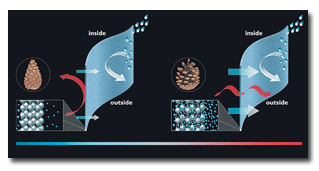
qfom_Copy_1

C_change™ functions similarly to a pine, spruce or fir cone. Left: In cool temperatures
and/or periods of low activity, the polymer structure is closed and allows very limited moisture
vapor transport. The membrane holds in body heat while remaining breathable. Right: In warm
temperatures and/or periods of high activity, the structure opens up, allowing significantly more
moisture vapor to pass through and releasing body heat. In all conditions, the membrane remains
wind- and waterproof.

The company notes that tests show the membrane’s moisture-vapor permeability increases by 55 percent as the temperature rises from 10°C to 20°C. In addition, tests comparing c_change to hydrophobic membrane systems show c_change allows wicking away of 25-percent more moisture to the outside within the same time period than do the hydrophobic systems.

According to Tom Weinbender, president of Seattle-based Schoeller Textil USA, the company’s US subsidiary, c_change is the first membrane technology in the market that adjusts its function to
environmental conditions. “In most membranes, the moisture-vapor transmission rate remains constant no matter what the temperature, but c_change works with the body, like a second skin,” he said. “Our whole intention is to make the body more comfortable, and that’s where c_change begins to take on some possibilities.” He said response to the new membrane has been very positive and noted interest for such applications as golf, sailing, other outdoor activities and even fashion.

Schoeller offers c_change in both two-layer and three-layer fabric constructions – both stretch and non-stretch styles – and in combination with its patented finishes including quick-drying, water-repellent, moisture-wicking 3XDRY®; water-, oil- and dirt-repellent NanoSphere®; and its standard durable water repellent that also is stain-repellent.

In a two-layer construction, the membrane is laminated to the underside of the fabric – including polyester, nylon, wool, cotton and blends of these fibers – using a new method whereby dots of polyurethane are applied between the fabric and the film. In a three-layer construction, c_change is laminated between the face-fabric layer and an under-layer that typically is a knit, fleece, charmeuse, tricot or jersey.

“The adhesive is critical,” Weinbender explained, noting that not only is the polyurethane vapor-permeable, but the space between the dots also allows vapor transport. “We’ve developed the dot adhesive so there is the same function throughout. Other adhesives are not vapor-permeable like ours. This is an added benefit to the c_change technology.”

C_change conforms to the bluesign® standard for environmentally responsible materials and processes using best available technologies, utilizing resources in the most efficient manner possible, and avoiding the use of harmful substances and processes in making the end product.


For more information about c_change™, contact Schoeller Textil USA, (206) 283-6991.


October 17, 2006

DuPont, Glory Team To Produce Bio-Based DuPont™ Sorona®

DuPont, Wilmington, Del., has
partnered with China-based Zhangjiagang Glory Chemical Industry Co. Ltd. to establish the first
production and distribution operation in Asia for bio-based DuPont™ Sorona® polymer.

Glory, formed earlier this year, is building a continuous polymerization facility expressly
to manufacture Sorona polymer using technology licensed from DuPont and Bio-PDO™ — 1,3 propanediol
derived from corn sugar — from Loudon, Tenn.-based DuPont Tate & Lyle BioProducts. The Jiangsu
province-based, 66 million-pound-capacity facility is expected to begin production before the end
of this year, with the first commercial product available in the second quarter of 2007.

“After screening over a dozen firms, we found that [Han Bin, president, Glory] and his team
were best positioned to be a strategic partner with DuPont, based on their impressive operating
experience, attention to quality and desire to be involved in every step of product
commercialization,” said Peter Hemken, vice president and general manager, DuPont Bio-Based
Materials – Sorona and Bio-PDO. “We believe our partnership with Glory will help us expand our
business on a global level and incorporate new thinking and experience into the Sorona brand. There
currently is a very strong supply chain in Asia, and this partnership will help us shorten the time
to market by having polymer, fiber, fabric and garments all created in one region.”

October 17, 2006

Sponsors



