Partners In Quality


T
he move in recent years by US and European textile and apparel companies to outsource
production to lower-cost countries has influenced a growing cadre of manufacturers in those
countries to commit to playing by quality, environmental and social accountability rules that are
the norm for operations in the more developed countries. They must make such commitments in order
to meet the expectations of socially and environmentally aware customers as well as to comply with
trade regulations instituted by forward-thinking governments and in free trade agreements; and they
expect their suppliers also to conform to the expected standards. Some offshore manufacturers also
are realizing the importance of branding in the marketing game, and thus are taking advantage of
opportunities offered by upstream suppliers whose own branding campaigns create awareness of the
benefits of their raw materials and/or auxiliaries.
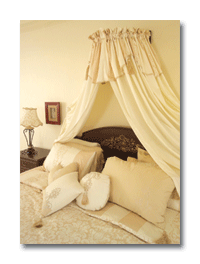
bed 


Chenab Ltd. is a fully vertical manufacturer of
apparel and home fashion textiles including a full range of bedding products.


Chenab Puts Quality First


Pakistan-based Chenab Ltd., founded
in 1975 by current Chief Executive Mian Muhammad Latif, is a fully vertical textile and apparel
manufacturer and exporter that touts itself as a technology-oriented manufacturer that puts quality
first at every step of the process. As one of the country’s largest textile processors, with annual
revenues totaling approximately $110 million, Chenab maintains nine facilities that house
operations including ginning, spinning, weaving, bleaching, printing, dyeing, finishing, stitching,
designing/engraving, and quality testing. Its most recent investments include latest-generation
pretreatment, finishing and stitching machinery.

The company considers its state-of-the-art machinery and dedicated workforce of more than
10,000 employees to be its key strengths, and its wider-width vertical setup to be central to its
success. This structure and its recent investments have helped it gain such competitive advantages
as improved quality; increased production; innovative, value-added product; and timely deliveries.

Chenab has an annual production capacity of more than 70 million meters of fabric for home
fashion textiles including sheets, duvets, pillows, curtains, kitchen textiles; and men’s, women’s
and children’s apparel. It manufactures all of its product for export; and its primary customers
include such retailing giants as Wal-Mart, Target, JCPenney, Sears, IKEA and Federated Department
Stores Inc.; apparel manufacturers and brands including Kellwood Co. and Tommy Hilfiger; and other
well-known textile and apparel brands worldwide. As it looks toward the future, Chenab anticipates
growth in the areas of formal and specialty worked garments and value-added home textiles.

The company places a high priority on employing environmentally and socially responsible
practices, as well as on maintaining high quality standards, stating: “Our policy is ‘Customer
Satisfaction,’ which we ensure through proper planning; continual improvement; employee
satisfaction; environmentally friendly production; prevention of environmental pollution; effective
occupational health and safety; resource conservation; and implementation of relevant national and
international environmental, social, cultural, and health and safety norms/laws.”

As evidence of its commitment in these areas, Chenab has achieved certification under such
standards as ISO (International Organization for Standardization) 9001 quality management and 14001
environmental management, SA (Social Accountability) 8000, WRAP (Worldwide Responsible Apparel
Production), and OHSAS (Occupational Health and Safety Assessment Series) 18001. It also has
received numerous export performance awards from the Federation of Pakistan Chambers of Commerce
and Industry (FPCCI), and Mian has received five Businessman of the Year awards — also from
FPCCI.
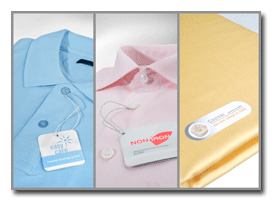
basflabels


BASF’s customers may use its Easy Care, Non Iron and Cosinel quality labels to help educate
downstream customers and consumers about the benefits provided by BASF textile finishes.


Branding Strategy To Promote Quality


According to Mian Muhammad Naeem,
director of marketing and planning, as part of Chenab’s effort to promote the high quality of its
products, the company is taking advantage of branding efforts by Germany-based BASF AG, its
longtime finishing auxiliaries supplier. BASF has created three quality labels that its customers
may use to help educate downstream customers and end-product consumers about the benefits provided
by its textile finishes. BASF also serves as a facilitator between manufacturers that use its
finishes and trading companies and brands.

Chenab tags its easy-care, no-iron bed linens with BASF’s Cosinel quality label to advise
customers and consumers of the special benefits imparted by the BASF resin finish and enhanced
softeners it uses in processing the linens. Chenab and BASF also participate in joint trade-fair
activities and advertising to promote the Cosinel brand.

BASF created the name Cosinel to connote such qualities as comfort, softness and coziness.
The brand is used in connection with a fiber protection system comprising BASF finishing products
including Fixapret® crosslinking easy-care resin finishes and Softeners Universe products. The
Cosinel tag pictures a morning glory to represent freshness and lightness. An accompanying brochure
describes how the system works to provide no-iron and shape-retention properties to the sheets.

BASF offers its other two quality labels, Easy Care and Non Iron, to apparel manufacturers
that use its textile chemicals. According to the company, the BASF chemicals that impart the
attributes covered under all three labels all comply with Oeko-Tex 100 Standard Class II, which
evaluates the safety of substances present in apparel, linens and other textiles intended for
consumer contact.

According to Betty Yam, marketing specialist, BASF, the company is particular about with
whom it will partner in its branding efforts. BASF, with its long-standing reputation as a
manufacturer of high-quality products, expects its partners to agree with its concept of quality,
and comply with quality criteria and relevant standards.

Chenab’s aforementioned commitment to such standards and its longtime stance as a customer
of BASF puts it in good stead vis-à-vis BASF’s expectations and contributes to a relationship of
mutual trust. Nevertheless, BASF conducts occasional spot checks of product tagged with the Cosinel
label to ensure the asserted quality is being delivered.

“Ultimately, the consumer must be able to rely on Cosinel,” Yam said. “Only this will ensure
sales and confidence in Cosinel.”


November/December 2006

FiberVisions Heralds CoolVisions™ Developments

FiberVisions Corp., with production
facilities located in Covington, Ga., has announced plans to expand its offering of CoolVisions™
dyeable polypropylene staple fiber for ring- and air-jet-spun apparel applications. The company
currently is developing finer-denier staple and filament products, and performance enhancements
such as antimicrobial properties.

According to the company, CoolVisions offers all the inherent attributes of traditional
polypropylene fibers — light weight, comfort, moisture management, durability, thermal insulation
and stain resistance — with the addition of its dyeability using disperse dyes and a soft hand
owing to its unique design. The company also reports the fiber processes similarly to current
pigmented polypropylene, enabling efficient yarn spinning, knitting and weaving using current
textile equipment.

To augment its production in Covington, FiberVisions also has begun CoolVisions
manufacturing operations in Asia.


November/December 2006

Beyond Transportation


A
s a signal to customers that it does more than move goods from point A to point B in a
timely manner, Glen Raven Transportation Inc. — a subsidiary of Glen Raven, N.C.-based performance
fabric manufacturer Glen Raven Inc. — has changed its name to Glen Raven Logistics. The company’s
services will include shipment consolidation, staging, warehousing and supply chain management in
addition to its less-than-truckload carrier offerings.

A recently refurbished facility in Altamahaw, N.C., which includes a 150,000-square-foot
warehouse adjacent to its parent company’s birthplace, has become the launching pad for Glen Raven
Logistics’ expanded focus. According to Charlie Edgerton, president, Glen Raven Logistics, the
company has renovated the former manufacturing plant, adding loading docks and converting
manufacturing areas into warehouse space, after outgrowing a nearby transportation terminal.

“We needed additional warehouse space and additional office space and yard space to park
equipment, and we wanted to complement our existing transportation/trucking operation to become
more of a full-service provider that would include warehouse distribution, order fulfillment –
things of that nature,” he noted.

Edgerton said the name change – which he hopes will communicate the company’s dynamic nature
– was the result of recognizing trends such as to and from where businesses ship goods, as well as
increases in imports and just-in-time inventory. “As imports continue to increase in the States,
theres going to be a bigger demand for doing warehouse distribution and order fulfillment – and
then theres the pure trucking side of it – of getting it from point A to point B,” he said.

“”It takes six weeks to get product across the water, Edgerton added. “Maybe [customers]
need to create a buffer inventory in our warehouse, so that when the plant is ready for it, they
can call us and we can have it there the next day instead of having to start from, say, South
Carolina, bringing something from China and [risking] delays that can possibly cause interruption.”


charlie

Charlie Edgerton, president Glen Raven Logistics


Glen Raven Transportation began as a
raw material and finished goods transportation provider for Glen Raven Inc. manufacturing plants,
and in 1995 expanded its services to other companies. Taking advantage of opportunities resulting
from the North America Free Trade Agreement, the company soon offered carrier services into Mexico,
opening a shipping terminal in Laredo, Texas, and a sales office in Mexico City. Through assisting
customers with meeting governmental regulations regarding trade with Mexico, the company gained a
greater understanding of the need for logistics support, Edgerton explained.

In addition to transporting textiles, apparel, electronics and other goods in and out of
Mexico, the company operates Northeast, Midwest and West Coast shipping routes; and has a growing
subspecialty in automotive component shipping from the South to Detroit. Glen Raven Logistics has
25 tractors and 160 trailers, and contracts with 25 contracted owner-operators who primarily serve
the company’s West Coast customers.


The company expects to maximize its niche position in the transportation and logistics market
– which is experiencing growing demand resulting from declining supply – and a strong economy and
its strategic location in North Carolina’s Triad region.

“Our customers select us for their less-than-truckload needs because they know we are very
nimble and service-oriented. We can fulfill needs at competitive rates that larger truckers
cannot,” Edgerton said. “Now, as a logistics company, our customers can also rely on us for
numerous other value-added services.”


November/December 2006

BASF, Arch Form Alliance For Freshness Enhancers

In an effort to enter new market sectors such as home textiles and apparel, the Performance
Chemicals for Textiles business of BASF AG, Germany, and Arch Chemicals Inc., Norwalk, Conn., have
teamed to market Arch’s Reputex™ 20 antimicrobial treatment for cellulosic textiles and its
Purista® label for finished consumer products.

As part of the partnership, the companies will combine BASF’s global textile network and
technical expertise with Arch’s Purista branding efforts and freshness-enhancing technology as they
assist manufacturers that are incorporating Reputex 20 into their production processes.

“The benefits and strong position of the Purista brand open up new market sectors, and bring
BASF closer to the retailer and brand, as well as consumers,” said Michael Schmitt, Ph.D., head,
Innovation Textiles, BASF.


November/December 2006

Speed And Specialty


T
his month, Yarn Market asked spinners to highlight the past year’s business trends. In
other words, who and what are driving the yarn market today? The answers to increasingly complex
and price-driven markets appear to include: performance, product development and speed — especially
for export markets. The challenges continue to be fiber and yarn pricing, and industry and customer
consolidation.

Specialty knitters are searching for unique, value-added components — such as performance
characteristics or eco-friendliness — that enable product differentiation. This includes
performance yarns with wicking properties and eco-friendly yarns such as bamboo.

“They want to hang this tag of performance onto their product like the Nike Dri-Fit,” said a
specialty ring spinner. “Another recent trend is the high-end fashion T-shirt market seeking a
unique vintage look and creating market opportunities for specialty cotton yarns.”


The Export Equation

As exports become an increasingly
significant share of spinners’ business, lead time and pricing are key to gaining this business.

“It’s a moving target. In my opinion, lead time may be more important than price, at least
in the specialty area,” a specialty ring spinner said.

One spinner mentioned that some Asian companies are making fabric at home and having their
cut-and-sew work done in Central America. Their prices can’t be beaten by domestic spinners, but
some business can be had for time-sensitive products, as Asian manufacturers sometimes need quick
changes.

“Our open-end business is experiencing year-end spot orders,” said a multisystem spinner. “
Much of this is fill-in business that cannot be imported in a timely fashion. It’s part [Caribbean
Basin Trade Partnership Act] business and part fashion-driven.”


The Environment

As more organizations recognize the
value of social responsibility, this environmental focus is creating demand for more eco-friendly
textile products, such as organic cotton and other more sustainable raw materials.

“We are hearing more emphasis on eco-friendly products — for example, Wal-Mart’s move toward
increased consumption of organic cotton,” said a ring spinner. “Nike has also committed to
increasing organic cotton as a component of its 100 percent cotton products.”


Year-End Outlook

One spinner allowed that “our
business continues 24/7, although we anticipate weakening demand later in the fourth quarter. We
anticipate the first half of 2007 to mirror this current year, which was very positive.”

An industrial spinner reported his operations were “running steady,” with three shifts on a
five-day schedule.

“I expect from now to the end of the year to be soft,” he said. “Things generally pick up
right after the first of the year.”

“Many of our customers feel their business will be as strong or stronger next year,” said a
multisystem spinner. “This is a good sign. Yet, we are concerned about man-made fiber supply having
recently seen the exit or restructuring of some domestic fiber producers.”


Fiber, Yarn Pricing


More and more spinners expect
polyester prices to begin coming back down sooner rather than later.

“That’s a positive because you can’t get your yarn prices up based on the polyester prices,”
said a specialty multisystem spinner. “We are relying more on offshore fiber manufacturers in our
sourcing out of necessity.”

“I have trouble understanding how Asian fiber producers can undercut domestic producers,” he
continued. “[Asian producers] have managed to hold their prices down long after the US producers
raised theirs.”

Probably the most ominous trend some spinners have reported is an erosion of their customer
base because of ever-growing finished fabrics imports. Finding a way over, under or around this
trend may be the greatest challenge facing US spinners today.

“Domestic business as a whole is relatively soft,” said a multisystem specialty spinner. “We
continue to see a consolidation of our customer base and continued diminishment of domestic
manufacturers as they close their doors or sell out.”


November/December 2006

Shed Forming And Preparation System Innovations Continue


S
täubli Corp.’s open house – held recently at the company’s US headquarters in Duncan,
S.C. – was well-attended. The company exhibited its latest warp-preparation systems including the
Opal automatic warp leasing machine, Delta 110 automatic warp drawing-in machine and Topmatic
automatic warp tying-in machine; and shedding-motion systems including Rotary Dobby 2881 and
jacquard machines DX 110, LX 3202, and Unival 100. The DX 110 and LX 3202 are equipped with a new,
improved patented M6 module and a new JC6 electronic controller. The Unival 100 also is equipped
with a JC6 controller.

.

opal
Depending on the application, Stäubli’s Opal automatic lease warping machine operates at
speeds of up to 100,000 threads over an eight-hour period.


Warp Leasing

The leasing process prepares the warp yarns with a desired sequence and maintains that
sequence for the automatic drawing-in or tying-in process. The Opal automatic warp-leasing machine
– introduced at ITMA ’03 in Birmingham, England – processes up to eight single- or multiple-color
warp sheets usually prepared by direct warping process into a single leased sheet. The Opal,
capable of handling single or plied spun yarns and flat or twisted continuous filament yarns, can
lease warps up to 230 centimeters wide.

One operator is required to set the warp on the Opal’s frame, program the required warp
color sequence and yarn type for each color, and run the machine to start leasing. Then the
automatic leasing begins, and operator presence is not required until that process is completed.
Observing the programming of the Opal through a user interface via a color screen indicated easy
operation and full user color identification control. The machine displays a magnified color image
of good resolution for individual yarns so the user can recognize color and yarn type. The user
identifies a yarn color to the machine by touching one of up to 10 different colors available on
the user-defined panel.

The machine is equipped with two cameras to check for double yarn and color. The foremost
yarn in the warp is picked up by an air suction nozzle. The color recognition ensures correct
desired sequence of the yarns in the lease. If a yarn with a different color than that programmed
is picked, the yarn will not be leased, and the machine continues the leasing process until the
yarn of such color is required in the sequence. Depending on the application, the leasing speed of
the Opal is up to 100,000 threads per eight hours. If the warp contains single and plied yarns, and
thus yarn type recognition is required, the leasing speed range is 30,000 to 60,000 threads in
eight hours. The highest speed of 100,000 threads per eight hours can be achieved when leasing a
single-sheet warp. The range of yarn linear density that the machine can handle is 10 to 50 tex.

The Opal enables weavers employing direct warpers to produce striped warps as easily as
those using sectional warpers. Other recognized advantages of the Opal are the significant
reduction in labor cost; removal of a bottleneck in warp preparation, as it replaces the manual or
semi-automated warp leasing systems; capability of manufacturing intricate woven fabric designs;
and response in quick mode to short orders and frequent style changes.


Jacquard Machines

Stlis new DX 110 and LX 3202 jacquard machines are equipped with the M6 module and JC6
controller. The DX 110 also features a capacity of 1,408 or 2,688 hooks, easy access to centralized
lubrication points, and vacuum cleaning of the fan filter without the need for disassembly. The LX
3202 is available in a broad range of capacities 6,144, 8,192, 10,240, 12,288 and 14,336 hooks. The
filter and fans in the LX 3202 are mounted vertically to avoid lint accumulation, and the
maintenance program is automatically managed by the JC6 controller.


M6 Module

Stäubli’s new DX 110 and LX 3202 jacquard machines are equipped with the M6 module and JC6
controller. The DX 110 also features a capacity of 1,408 or 2,688 hooks, easy access to centralized
lubrication points, and vacuum cleaning of the fan filter without the need for disassembly. The LX
3202 is available in a broad range of capacities – 6,144, 8,192, 10,240, 12,288 and 14,336 hooks.
The filter and fans in the LX 3202 are mounted vertically to avoid lint accumulation, and the
maintenance program is automatically managed by the JC6 controller.


JC6 Controller

The new jacquard machines are provided with an improved, more compact JC6 controller. The
user interface is accomplished via a color touch screen. The JC6 is provided with a flash disk as
opposed to the hard drive used with previous controllers. It allows pattern loading via universal
serial bus, external drive, and/or networking for compatibility with the latest computer file
communications and storage. The realized advantages for networking include weaving-room management
locally or remotely from anywhere via Internet access.

unival

The use of Jactuators to individually control the harness cords allows Stäubli’s Unival 100
to reach never-before-seen jacquard weaving machine speeds.


The Unival 100

A prototype of the Unival 100 jacquard machine was unveiled at ITMA ’99 in Paris. The
machine was shown at ITMA ’03 in commercial form, and several machines have been sold since then.
In 2003, the Unival 100 was demonstrated running on a Picanol Omniplus-6-J 250 weaving machine
producing mattress ticking and table cloth fabrics at a filling insertion rate of 2,460 meters per
minute – the highest speed in jacquard weaving history. The reason behind such a high speed is the
control of each harness cord by a stepping motor, termed Jactuator, which eliminates the
electromagnets, movable and retaining hooks, and pulleys. The Jactuator raises or lowers a harness
cord, or warp end, by rotating its pulley. The module in the Unival is the assembly of 16
Jactuators.

The Unival design permits easy-to-set features including formation of different sheds –
symmetrical, asymmetrical, shifted, venturi and multiple – and shed height. All settings can be
conducted electronically through a user interface with the JC6 controller. Another significant
feature of the Unival is its independence from the weaving machine drive because it has its own
drive without mechanical coupling to the weaving machine. The Unival modular construction enables a
jacquard capacity range from 6,144 to 20,480 hooks.

The new developments in shed-formation and warp-preparation systems enable weavers to
explore new opportunities, weave industrial and intricate designs at the speed of commodity
fabrics, respond quickly to style change and produce short runs economically. These innovations
also set the stage for weaving machine manufacturers to increase weaving speed to new levels..


Editor’s Note: Abdel-Fattah M. Seyam is a professor in the department of textiles and apparel,
technology and management at North Carolina State University’s (NCSU’s) College of Textiles,
Raleigh, N.C.

DuPont To Expand Nomex® Capacity

DuPont, Wilmington, Del., plans to
invest more than $100 million in a three-part global capacity expansion of DuPont™ Nomex®. The
company expects to roll out the expansion in phases before the end of 2006.

The expansion projects include: DuPont Chemical Solutions’ construction of a new facility in
Asturias, Spain, to produce isophthaloyl chloride, a key Nomex ingredient; and the addition of new
equipment at the existing Nomex plant in Asturias, which will boost manufacturing capacity by more
than 30 percent. DuPont, in conjunction with its joint venture DuPont Teijin Advanced Papers, also
plans to double Nomex paper production capacity in Japan.

The new Asturias plant also will enable additional ingredient production for DuPont Kevlar®
and follows several investments in that high-performance, high-strength fiber in recent years.

“As demonstrated by our Kevlar expansions and today’s Nomex announcement, we continue to
aggressively invest in our high-performance fibers business,” said William J. Harvey, vice
president and general manager, DuPont Advanced Fiber Systems.


November/December 2006

Fashion Thinks Global: The Pat Riley Effect


W
hile in Bangkok on business this spring, I visited an Indian tailor to have some shirts
made. As I was describing the type of collar I wanted, which has a certain curve, the tailor
interjected, “Oh, you want the Pat Riley!”

Pat Riley is, of course, the successful National Basketball Association coach. He may be a
household name among sports fans in America, but among traditionally dressed Indian tailors in
Bangkok?

Globalization has indeed made the
world a smaller place. This is especially true in the fashion industry, in which the design centers
of Milan, Paris, London and New York City are linked more tightly than ever before with the
production centers of the Far East and Central America. For the aggressive fashion manufacturer or
retailer, never has the potential for profit from building international brands been greater. After
all, malls in Dayton, Ohio, and Singapore all carry the same Ralph Lauren Polo shirt these days.

To cope with the ever-changing demands of the global market, it is imperative that today’s
retailers efficiently move trendsetting designs from the studio to the store floor as quickly as
possible. As a result, the ability to manage a finely tuned supply chain becomes a key enabler of
success.

dhlplanes


Globalization And Logistics

Every day, manufacturers and
retailers face daunting logistics challenges. As with other industries, government and customs
regulations are always at the forefront. Hot shipments and samples in many instances need to be in
the hands of merchandisers and production staff overnight without fail. Any late delivery or
delayed production at origin, air transit delays, or customs issues at destination can have a
dramatic impact on a merchandiser’s ability to present and move product. Time to market is
critical, but time to showroom is often make-or-break for the garment center community. The
industry recognizes that better control of supply chains is the key to being able to meet changing
customer demand at the lowest possible cost, helping companies achieve the overall performance that
will take them to the next level.

Industry members aspiring to global leadership expect their logistics partners to add
significant value, and the bar is constantly rising. To begin with, they recognize the advantages
of having a single entity take responsibility on a global basis for moving goods efficiently from
design to production centers to stores. They seek rapid replenishment, vendor management and other
strategies that will squeeze supply chain costs without jeopardizing delivery commitments. They
seek greater shipment visibility with the assurance that no item on any pallet, or the pallet
itself, is ever simply “missing.”

Further, they expect continual innovation so as to maintain and enhance their competitive
positions. Can the vendor conduct consolidation sweeps in which multiple shipments from multiple
factories are consolidated into a reduced number of consignments? How about onsite sample room
management in which the vendor provides all receiving, invoice verification, sorting,
consolidating, documentation and forwarding services? And does the vendor employ multiple
air-transport options, even direct-service aircraft in some cases, designed to move shipments to
market in the most timely and cost-effective manner?

But above all else, the industry expects from its logistics partners flexibility in
responding to everyday issues that can hobble global operations. Needed are quick and imaginative
responses to unforeseen events such as natural disasters, war, or the discovery of wrong addresses
or the wrong number of packages, at either the point of origin or the destination.


Customized Logistics

For Optimized Supply Chain


The trend toward offshore sourcing
can only intensify. Today, China is the world’s factory floor, although apparel manufacturing in
India, and to a lesser extent in Vietnam, is on a significant upswing. Also, the passage of the
Central America-Dominican Republic Free Trade Agreement should stimulate activity for certain stock
keeping units manufactured in that region.

Longer supply chains mean more borders to cross and additional complexity. So for the
apparel manufacturer or retailer with global aspirations, particularly those focused on the $250
billion US market, optimizing the supply chain becomes more important than ever. These days, best
logistics practices call for vendors, working collaboratively with their clients, to build their
services around customer needs, not their own systems. Telling clients that exceptions to standard
operating procedures can’t be made is no longer considered acceptable, if indeed it ever was.

Winning has always demanded putting the right team on the field. For the truth of that, just
ask Pat Riley.


Editor’s Note: Thomas E. Hickey is vice president, Fashion and Retail, DHL.


ITG, SCI Complete Merger

I
nternational Textile Group Inc.
(ITG), Greensboro, N.C., and Safety Components International Inc. (SCI), Greenville, have completed
their merger, with the resulting company known as International Textile Group Inc. SCI — a
low-cost, global supplier of automotive air-bag fabric and cushions, and a manufacturer of
value-added man-made fabrics for various niche commercial and industrial applications — now
operates as ITG’s Safety Textiles International business unit, joining Cone Denim, Burlington
WorldWide apparel fabrics, Burlington House interior fabrics and Carlisle Finishing units under the
ITG umbrella. Wilbur L. Ross Jr. and Joseph L. Gorga continue in their roles as chairman, and
president and CEO, respectively, of ITG; while SCI’s president, Stephen B. Duerk, now serves as
president of the new business unit.

“SCI’s automotive safety and specialty niche engineered fabrics, along with globally
fabricated airbag cushions, bring strong product diversification to ITG,” Gorga said. “We expect to
be able to benefit from many synergies in our [research and development] initiatives, manufacturing
processes, purchasing strategies and international expansions.”

Stock in the combined company is trading on the over-the-counter bulletin board, initially
under SCI’s symbol, SAFY.

DSM Invests In Additional Dyneema® Capacity

The Netherlands-based Royal DSM NV
has announced additional investment in new production capacity for Dyneema® high-performance
polyethylene fiber at the company’s facility in Greenville, N.C.

The multi-million-dollar investment will bring the company’s total number of fiber lines to
10. Construction of the new facility will start by the end of 2006. It is expected to be
operational in early 2008.


November/December 2006

Sponsors