DyStar Launches New Dianix® Dyes

In an effort to help sportswear brands and retailers meet environmental and performance demands,
DyStar Textilfarben GmbH & Co. Deutschland KG, Germany, has added four new dyes to its Dianix®
line of disperse dyes.

Dianix Golden Yellow SF and Dianix Blue SF feature high levels of fastness when used in
ternary combinations. Dianix Navy XF-AR and Dianix Black XF-AR also have superior wetfastness
characteristics and stability in the dye bath, according to DyStar.

“These new colors will not only meet fastness requirements of the major brands, but will also
improve the productivity of their suppliers,” said Steve Barron, head of DyStar’s colors for
synthetics business. “Furthermore, considering recent changes to some Restricted Substance Lists,
these products will offer a solution and thereby help brands maintain their integrity and
differentiate their offer.”

May/June 2008

Clariant, Zhejiang Baihe To Expand Joint Venture

Clariant International Ltd., Switzerland, and Zhejiang Baihe Chemical Holding Group, China —
partners in the joint venture Hangzhou Baihe Clariant Pigments Co. Ltd. — have announced they will
expand the joint venture for the production of quinacridone specialty organic pigments. The
pigments are increasingly found in high-performance coatings used in printing, architectural,
automotive, plastics and industrial applications.

“The partnership between Baihe Chemical and Clariant has been proven very successful,” said
Chen Li Rong, chairman of Zhejiang Baihe Chemical’s Board of Directors. “So both parties have
agreed to expand our cooperation from high-performance azo organic pigments to quinacridone and
other high-performance organic pigments. At the same time, Clariant will be responsible for
marketing quinacridone and other pigments on a worldwide basis.”

The new facility will be built at Hangzhou Baihe Clariant Pigment’s current location in Hang
Zhou City, Zhejiang Province. Construction and equipment installation will begin in the fourth
quarter of this year. Production is expected to commence by the end of 2009.

May/June 2008

Monforts Offers Web-Based Service Portal

Germany-based A. Monforts Textilmaschinen GmbH & Co. KG now provides an Internet-based service
portal for all new machine models featuring the Qualitex 540 and 750 PLC control systems. The new
portal, which replaces the existing telephone modem service package, uses secure Internet links
with state-of-the-art software reverse proxy technology.

A Web cam option and headphones included in the new service package enable two-way
communication between the machine operator and the Monforts engineer through firewalls, allowing
the operator to point out the problem at its location and receive a diagnosis.

Test-run setup and installation are accelerated by the voice-over Internet protocol system,
and software updates can be downloaded easily, according to Monforts. Manuals are included in the
service package, and spare parts may be ordered directly from the keyboard.

May/June 2008

Thies Unveils New Dispensing System

Germany-based Thies GmbH & Co. KG reports its new MPS Colourmatic dyestuff dispensing system
offers precise weighing, “right-first-time” benefits and reduced manpower needs.

The new system automatically transfers an empty pan to be filled upon receiving a signal to
prepare the powder dyes. The correct dye is identified using a bar code system and then is manually
or automatically weighed in a pan that holds up to 40 liters of dye. The pre-weighed pans are then
transferred robotically to a storage station until it is time to transfer them to the fully
automatic MPS-D dissolving system, after which the empty pans are cleaned, dried and returned for
use in the next weighing cycle.

May/June 2008

Lowering Energy Costs Through Innovation


T
he issue of energy savings is currently a big topic worldwide. The discussion is also
very much in vogue in the textile industry. The energy cost factor has always played a significant
role in the production of textiles. Globalization under fierce competition has resulted in low
market prices for yarns, thus lowering margins. By contrast, energy costs have experienced an
increase of approximately 50 percent over the past 10 years.

Consequences today: Those who ignore energy-efficient production will not survive in the mass
market. Concerning the future, the following applies: Energy costs will continue to climb because
fossil fuel quantities are finite. Even though new supplies continue to be discovered, development
and extraction are becoming increasingly expensive. Alternative energies, such as sun, wind, water
or regenerative sources are not yet competitive without subsidies. Their time will come, at the
latest after current energy costs have doubled. Specialists predict such a price level by the year
2020.


Energy = Costs

This simple formula allows an introduction of the topic by means of a cost analysis. When
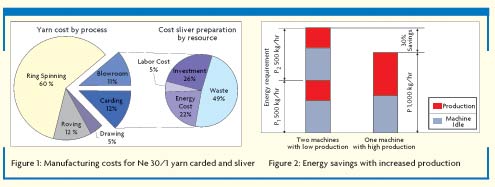
looking at the structure of manufacturing costs for a carded yarn in the spinning mill, it soon
becomes obvious that 72 percent of the manufacturing cost is found in the spinning process
(See Figure 1). Only 28 percent of the total manufacturing cost is needed for spinning
preparation. A breakdown of the cost structures according to resources produced in the blow room
and carding, illustrated in the second chart shown in Figure 1, quickly shows the point at which
suitable energy and cost savings are the most efficient.

Page42a

Particularly in spinning preparation for cotton, the hidden energy waste must be considered
in addition to the pure energy costs. Often, part of the waste is refed, creating further energy
consumption for waste fibers. Reduced waste quantities increase the output and consequently improve
the relationship between energy input and production. Energy savings can be divided into three
areas:

•    production increase per production unit;

•    reduction of waste portion without quality loss; and

•    general innovative, energy-saving concepts.


Production Increase Per Production Unit

The simplest formula for saving energy and overall costs is the production increase per
production unit. To date, spinning preparation machines work mainly on the basis of mechanically
active principles — for example, gravity, friction, positive locking and centrifugal force. Such
machines have high idle losses. What are idle losses? When operating a textile machine without
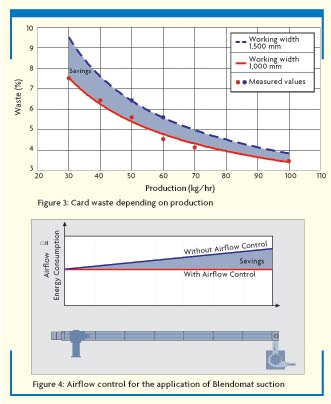
production, the average incurred energy costs are already 60 percent, as compared to full
production capacity utilization. Increasing production definitely saves energy. For example: On two
production units, there is a 2 x 60-kilowatt (kW) no-load output plus a 2 x 40-kW pure production
output, which results in 200 kW total consumed output. If production is doubled to 1,000 kg/hr on
one unit, there is a 1 x 60-kW no-load output plus a 1 x 80-kW pure production output for a total
consumed output of 140 kW. In this case, energy savings of 30 percent are achieved
(See Figure 2). This simple formula is well-known by machinery and textile manufacturers;
nevertheless, it is not a great innovation. The enormous challenge lies in the development of
methods to increase production without losing quality and energy efficiency.


Reduction Of Waste

Portion Without Quality Loss

With regard to the data shown in Figure 1 and the distribution of costs for resources in
spinning preparation, it quickly becomes evident that the resource waste becomes more and more
important, and thus accounts for a significant share of the manufacturing costs. To prevent a loss
of quality, cleaning elements are intensified, particularly by increasing production. Germany-based
Trützschler GmbH & Co. KG has applied intelligent solutions to its products to help reduce
energy waste while maintaining quality.

Waste control in the blow room: For the roll cleaners CL-C1, CL-C3 and CL-C4, Trützschler
offers Wastecontrol for the blow room. A sensor checks the waste quality and automatically decides
the setting of the separation point. Depending on material and production size, the amount of
separated waste is only as much as necessary for efficient cleaning. In practice, Wastecontrol
quickly results in savings of $50,000 per cleaning unit per year without any loss of quality.

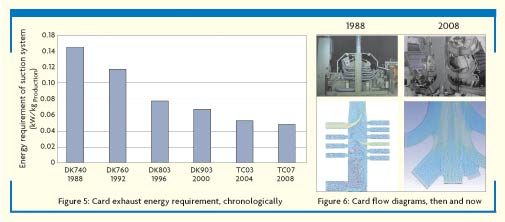
Waste control at the card: The card offers the highest degree of cleaning in the cotton
spinning process. Intensive cleaning results in high amounts of wasted energy. Every specialist
knows that a decrease in production causes an increase in relative waste
(See Figure 3). The reason for this is the approximately constant absolute waste quantity,
independent of production. To conserve energy, a large working width is considered critical. If a
production gain is achieved corresponding to working width, then the relative waste quantity
remains constant. If the production gain is less, more relative waste is separated.

Carding concepts in the market have 1- or 1.5-meter working widths and are operated in
spinning mills with similar outputs per production unit. Principally, on a machine with 1-meter
width, fewer good fibers are separated because of the higher production ratio per meter; therefore,
this concept offers higher resource conservation.

Page43


General Innovative, Energy-Saving Concepts

Innovative concepts and intelligent components can reduce energy consumption, independent of
production size.

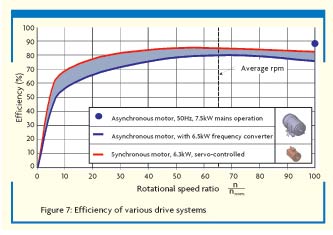
Only as much air as actually needed in the blow room: Trützschler’s Airflow Control is
already state-of-the-art. In the bale breaker process, air quantities are kept constant during
continuously changing suction lengths, thus lowering the average transport air quantity and
reducing the costs for disposal of dust-laden air
(See Figure 4).

Waste suction: When looking at cards and comparing a 20-year-old model to a current model, it
becomes evident that between 1988 and 2008, the energy consumption of just the disposal air
quantity alone has been reduced by more than 50 percent
(See Figure 5). In this case, the customer benefits from the increased productivity as
well, though also from intelligent individual measures. All air-carrying elements on a Trützschler
machine are optimized
(See Figure 6). By adjusting the cross sections of flow by means of finite element
calculation for example, it has been possible to reduce the negative suction pressure within the
last 20 years from 1,200 to 700 Pascals.

Page44a

Drive Technology: Direct current technology is definitely a thing of the past for
market-leading machine manufacturers. Today, modern machines with speed-constant parts are driven
by asynchronous technology; and machines with speed-changing drives, alternately by synchronous
servo technology or asynchronous frequency control.

When comparing these technologies in reference to energy consumption, the following must be
stated: The supplier’s information concerning energy efficiency of drive systems always is in
relation to nominal loads at nominal speeds. When values drop below these levels, each drive system
loses efficiency and, in turn, energy efficiency to a greater or lesser extent. This means
operating a drive system at full load saves energy. But this also means that the popular approach
of integrating safety and power reserves in a drive concept uses only unnecessary energy. The ratio
of installed output to actual input, therefore, should be as close as possible. The efficiency of
the alternating current drive in particular is on a significant lower level compared to an A/S
synchronous drive
(See Figure 7).

Page44b

Thus, for speed-changing drives, Trützschler decided more than 15 years ago in favor of servo
technology, which offers good efficiency at varying maximum speeds. Even though today’s
developments, for reasons of comfort and control, often use a frequency converter to enable a speed
change by means of control input, and not by exchange of a belt pulley, it must be noted that this
comfort is at the expense of additional energy. This, among other things, is made clear by the fact
that in addition to the actual asynchronous motor, which should be driven in a speed-changing
manner, a control unit corresponding to the output must be installed. On this control unit, the
additional energy consumption is only noticeable in the form of heat generation.


The future belongs to those textile manufacturers that currently intensively deal with the
energy cost factor. The same applies to the machine manufacturer who is expected to develop
energy-efficient technologies and make them available to the market.


Editor’s Note: This article was written by Armin Leder, Trützschler GmbH & Co. KG.

May/June 2008

SCITC Offers Full Agenda In Charleston


T
he


Textile World
2007 Ports Survey
, produced in conjunction with PIERS Global Intelligence Solutions, a
division of East Windsor, N.J.-based Commonwealth Business Media Inc., confirmed the significant
textile products traffic flowing through US seaports. The study’s best estimate is that 2.54
million 20-foot-equivalent units (TEUs) — a standard quantity measure used in international
shipping — of total textile-related imports and exports moved through US seaports in 2006. These
shipments had an estimated value of $182.3 billion.

As one might guess, apparel traffic led the way, representing 62.7 percent of the total
estimated value of textile traffic. Fabric scored second, followed by home furnishings, fiber and
yarn, followed closely by floor covering.

scitc
Completed in 1879, Charleston’s United States Custom House is one of the most recognized
landmarks in the city and a testament to the city’s long history with seaport-based trade. The
building continues to function as originally intended even with a new Federal building established
in the 1960s.

The good news for the domestic textile industry is that fabric as well as fiber and yarn were
net exports in terms of TEUs. Imports dominated the apparel, home furnishings and floor covering
categories, while textile machinery and parts was also a net import category, by more than two to
one in both TEUs and dollars.


With economic conditions led by a weakening US dollar, the recent reports of container
shortages bogging down US exports is an impediment the US textile industry doesn’t need. The 35th
Annual South Carolina International Trade Conference (SCITC) — to be held Tuesday, May 27, through
Thursday May 29, at Charleston Place, Charleston, S.C. — will present some interesting
opportunities to get the inside track from a cross-section of shipping and logistics professionals
about this and other issues facing the industry.


Best Practices

Ron Reighter, vice president, global trade solutions, SunTrust Bank, will moderate education
sessions featuring international trade best practices. Topics include technology for international
process improvement, international financial transactions, managing global shipping risk and
marketing in a global economy.

William Armbruster, editor, Shipping Digest, will moderate sessions on Foreign Investment in
Trade Facilities, including one titled “The Impact of Infrastructure on Container Port Operations.”

Commissioner Harold J. Creel Jr., Federal Maritime Commission, will present the keynote
address. A transportation forum will feature Jeff Heller, Norfolk Southern Intermodal; Greg
Plemmons, vice president OD Global, Old Dominion Freight Lines; Rick Wen, vice president, business
development, Orient Overseas Container Line Ltd., Ocean Carrier; and Scott Szwast, director of
marketing, International Freight, UPS.

For a full agenda and additional information, visit
www.scitc.org.

May/June 2008

INDEX Awards Announced

Awards were presented for innovation in five categories during the INDEX 08 nonwovens exhibition
sponsored by Brussels-based EDANA, the International Association Serving the Nonwovens and Related
Industries, and held last month in Geneva.

Finland-based Ahlstrom Corp. won the nonwoven roll goods award for its Ahlstrom Disruptor™
Technology for nanofiber-based filter media acting through the combination of electrokinetics and
mechanical entrapment. The award for finished products made from or incorporating nonwovens went to
Germany-based Johnson & Johnson GmbH for Johnson’s Baby Extracare cleansing and moisturizing
wipes. The award for marketing achievement for the most original marketing campaign for a product
made from or incorporating nonwovens was presented to Germany-based J.H. Ziegler GmbH & Co. KG
for the Zinno campaign, which included an animated short movie that combined the company logo with
product features and also presented the company philosophy. ExxonMobil Chemical, Houston, won the
raw materials or component innovations award for its Vistamaxx™ 2125 melt-spinnable elastomer,
which exhibits high elasticity and can be processed using conventional machinery. Andritz Küsters
GmbH, Germany, received the award for innovation in machinery of special relevance to the nonwovens
industry for its neXdetect measuring system for detecting invisible chemical applications on
nonwovens.

May/June 2008

Oerlikon Neumag Reports Sales

Germany-based Oerlikon Neumag recently sold machinery to two US-based plants.

Ahlstrom Corp., Finland, selected a carded needlepunch line for its Bethune, S.C., facility.
The line includes a fiber-opening and -blending line, F.O.R. carding machine, Autefa crosslapper
with WebMax technology and Fehrer needlepunching machine; and is operated and controlled by
Oerlikon Neumag software. Ahlstrom plans to use the line, expected to come online this summer, to
produce technical felts for filtration and other applications.

Polymer Group Inc., Charlotte, has installed an M&J Airlaid web-forming system as part of
a project to retrofit and expand a nonwovens production line in Benson, N.C. The system includes
web-forming, auxiliary equipment for raw material preparation, process air handling equipment and a
process control system.

May/June 2008

Zimmer Reps Full Nonwovens Machinery Range

Zimmer Machinery Corp., Spartanburg, has added a complete range of nonwovens machinery to its
offerings for the US textile industry.

Founded in 1985 by Roland J.P. Zimmer as a subsidiary of Austria-based textile printing
machinery manufacturer J. Zimmer Maschinenbau GmbH, the company has its own production facility for
jigger dyeing and flocking machinery; and also is a distributor and offers spare parts and service
for its parent company’s machinery as well as coating, laminating, color-dispensing and other
machinery from several other manufacturers serving the dyeing and printing industry.

At Techtextil North America 2008, the company debuted nonwovens machinery from Italy-based
Bonino S.r.l., Sicam S.r.l., Technoplants S.r.l. and Tectex S.r.l. — companies heretofore not
present in the US market. Machinery includes bale- and fiber-opening, blending and carding
machines; crosslappers, feeding systems, pre-needle- and needlelooms, calenders and ovens for
thermo-bonding; continuous finishing lines for bonding drylaid, wetlaid, spunbonded and glass-fiber
webs; and ancillary machinery.

With the laminating, coating and flocking machinery, Zimmer already was reaching into the
nonwovens sector. “We’ve been in the laminating, coating, hotmelt lamination and flocking
technologies for several years, so we’ve been working slowly into the nonwovens market,” Zimmer
said. “This is our first web-forming involvement.”

May/June 2008

Italian Commitment To Technical Textiles


I
nterest in the technical textile and nonwovens segments of the US textile industry
continues to gain traction around the world. Recently, the Italian Trade Commission (ICE) and The
Association of Italian Textile Machinery Manufacturers (ACIMIT) invited

Textile World
and a contingent of educators and researchers from North Carolina State University’s (NCSU’s)
College of Textiles, Raleigh, N.C., to participate in an information exchange in Italy. ACIMIT
President Paolo Banfi, who also is CEO of Comez S.p.A., in the company of a group of Italian
machinery producers, welcomed the US delegation. Alessandro Mussa, assistant trade commissioner
from ICE’s Atlanta office, then explained the mission of the exchange was to present the trends in
the US industry and highlight some of the many research projects underway at NCSU. Additionally, a
tour of Italian textile machinery manufacturers was arranged to observe the latest developments
supporting technical textiles and nonwovens production.
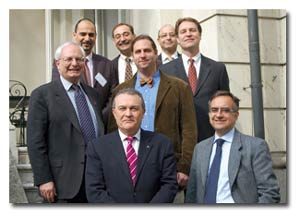
acimitmen
Front row: Paolo Banfi (left); and Federico Pellegata, ACIMIT director; Middle row: Dr. A.
Blanton Godfrey (left) and Dr. Russell Gorga; Back row (left to right): Francesco D’Oria, ICE Rome;
Alessandro Mussa; Dr. Behnam Pourdeyhimi; and Dr. Gregory Parsons


Presentations

Each member of the US delegation delivered a presentation to the assembled ACIMIT members.

TW
led off with a report detailing the transition of the US textile industry and highlights of
US companies that have embraced change and innovation to survive and thrive during the challenges
of the last 10 years.

Dr. A. Blanton Godfrey, dean and Joseph D. Moore Professor, NCSU College of Textiles,
drilled down in his presentation to illustrate the size and vibrancy of the textile and nonwovens
industries active in North Carolina. Godfrey also explained the depth of programs and research
underway at the college, which has more than 1,000 textile-focused undergraduate, graduate and
doctoral students.

Dr. Behnam Pourdeyhimi, NCSU College of Textiles associate dean for industry research and
extension, William A. Klopman Distinguished Chaired Professor, and director, The Nonwovens
Institute, focused on the possibilities and trends in nonwovens — from fiber and polymer through
process and post-process technology and end-use. Additionally, as director of the Nonwovens
Cooperative Research Center, a facility established in 1991 as a partnership between NCSU and the
nonwovens industry, Pourdeyhimi was able to share the current trends in research throughout various
nonwovens industry sectors.
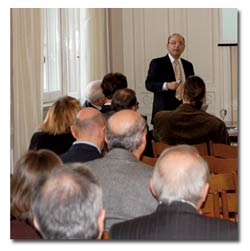
behnam
Dr. Behnam Pourdeyhimi (standing, center) presented his observations on the future of
nonwovens.

Dr. Gregory N. Parsons, professor, NCSU Department of Chemical & Biomolecular
Engineering, shared information about the Parsons Research Group’s work on atomic layer deposition
and its implications for surface modification of functional textiles.

Dr. Russell Gorga, assistant professor, Fiber and Polymer Science Program, NCSU Department
of Textile Engineering, Chemistry and Science, presented his work on developing polymer
nanocomposites and nanofibers with improved properties. Applications include filtration and tissue
scaffolds.

Following the presentations, one-on-one bilateral meetings took place between ACIMIT members
and the US delegation. These meetings provided an opportunity for all to investigate the
possibilities for cooperation in promoting Italian participation in US technical textiles and
nonwovens developments.


Corporate Visits

Chiara Bonino with
Bonino Carding Machines S.r.l. introduced the delegation to the Bonino product
line, which has its roots in producing cards to support the wool industry in the Biella region.
After World War II, the company pursued development of nonwovens in support of the blanket and
carpet businesses. Having expanded from an Italy-centric supplier to a European marketer, the
company in the 1980s pursued development of a short-fiber cotton card, which, as the open-end
spinning market declined, was applied to the bleached cotton business of sanitary napkins. More
recent developments, after having added fiber preparation machines to its line, include the
commercialization of a Turbo airlaid card that produces 40-gram-per-square-meter (g/m2) and heavier
products. The Turbo’s gentle carding action keeps short fibers in the product — the opposite result
from many traditional carding systems. Bonino systems are standard structures and concepts, but
according to the company, typical orders are 20- to 25-percent custom.

Brothers Ezio and Marco Aletti with
Aletti Giovanni & Figli S.r.l. — makers of buffing and sueding machinery for a
broad range of textile, tannery and rubber applications — also welcomed the delegation to their
facility. The process provides classic surfaces such as leveling, peach pile, nubuck and others,
but by utilizing an embossed roll similar to a flexographic engraved roll, a pattern effect can be
achieved by abrading the surface of the fabric when forced forward by raised parts of the engraving
while not affecting the fabric surface where the fabric can fall away into the recessed areas of
the engraved roll. The machine has a high level of precision and calibration, which aids in product
reproducibility.
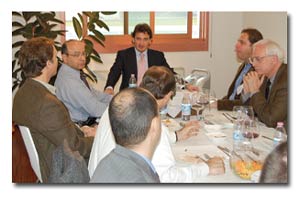
dini
Sales and Marketing Director Paolo Dini (center) welcomed the US delegation to A.Celli
Nonwovens.

Well-known paper and nonwovens industry supplier
A.Celli Nonwovens S.p.A. offered an overview of its two independent divisions.
Sales and Marketing Director Paolo Dini explained the development of A.Celli’s business for
customized winders and slitter-rewinders, which are used for processing nonwovens fabrics. He
explained the long-term relationship the nonwovens industry demands and the significant market
share A.Celli has been able to earn. The company has also developed Wingformer, an airlaid forming
technology; as well as an integrated winding, slitting and roll-packaging process called
Slittopack.

Lorenzo Marsiglio with
Tecnorama S.r.l. showed the delegation through the facilities of the well-known
dispensing systems manufacturer. Founded in 1984, the company launched the patented Dosarama system
at the 1987 ITMA in Paris. Tecnorama has evolved the technology in terms of accuracy; ability to
dispense powders; automated dissolving; movement from weight-based systems to volumetric, fully
automatic sample and small production machines; and the incorporation of online spectroscopy. Most
recent developments include the addition of an automatic system for analyzing the curves of a
dyestuff exhaustion model to the DOS&DYE® system creating the DOS&DYE®Spectrodye. Later,
both transmission and reflectance data were combined into one automated system to create the
Spectrorama® system.

With all of the recent interest in recycling textiles, the delegation visited
Dell’Orco & Villani S.r.l., a firm with a long history in the field. Giovanni
Dell’Orco and Silvano Villani came together in the 1960s to manufacture innovative tearing machines
that were particularly suited for reclaiming man-made fibers. Dell’Orco & Villani entered fiber
opening and blending for spun yarn manufacturing as well as for nonwovens used for insulation
panels in automotive and building products. Recent sales include placement of recycling lines at
major US carpet manufacturers. According to Dell’Orco & Villani Associate Frank J. Levy of
Quogue, N.Y.-based PCC Processing Technologies LLC, interest continues to grow.
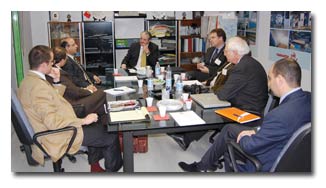
cormatex
Cormatex President Riccardo Querci meets with the US delegation at Cormatex’s Prato
office.

Cormatex S.r.l. President Riccardo Querci, representing the second of three
generations in the family business, explained his company’s current position in the woolen spinning
and nonwovens machinery businesses. The company opened in 1938 and developed an expertise in the
carding and spinning of woolen yarn including cashmere, angora, camel hair and blends with fine
wool. Cormatex’s nonwovens lines include opening and blending machines, fine openers, card feeders,
high-production cards, lap formers, and cutting and winding systems. The delegation was able to
observe the lap fomair, an airlaid nonwovens section that uses a new aerodynamic fiber-batt
formation system to create a highly uniform batt for subsequent needling or thermobonding. With a
production capacity of more than 1,500 kilograms per hour (kg/hr) and a product weight range of 150
to 3,000 g/m2, the system shows promise for applications in both fibrous and non-fibrous products.

Giovanni Bettarini, sales director of
Bettarini & Serafini S.r.l. – bematic®, spoke of the challenges associated
with supplying turnkey lines and the success the company has had in the United States with seven
installed airlaid nonwovens lines. Bematic’s direct felt line has at its heart the Bemaformer, a
batt-forming machine that uses a new air-forming technology to produce a randomly oriented
high-volume, low-density felt. The product is then ready for bonding by oven, needleloom or
quilting machine. Bematic also produces computerized nonwoven cards in widths of 2,000 to 3,500
millimeters and with production up to 1,500 kg/hr. All supporting opening and feeding equipment is
also supplied by Bematic.
biancalaniparsons
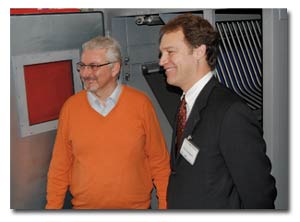
Biancalani President Rosanno Biancalani (left) with

Dr. Gregory Parsons after a demonstration of the new Airo® 24

Well-known traditional textile finishing machinery manufacturer
Biancalani S.p.A. hosted the delegation at its facility in Prato. With 50 years’
experience in improving the hand of textiles, Biancalani President Rosanno Biancalani made it clear
the company is dedicated to applying its technologies in the nonwoven and technical textile
segments. The recently developed Airo® 24 achieves a continuous process with many of the effects
possible in the batch-oriented Airo machines. As fabric enters and exits the machine at a speed of
up to 40 meters per minute, a reserve of fabric in the machine is accelerated to a high speed and
impacts a treatment grid while remaining in an open width. As the fabric continues to enter and
exit the machine, the process is reversed, accelerating the fabric to the back of the machine and
impacting the rear grid. This back-and-forth impact continues as new, untreated fabric enters the
machine and softened, bulked fabric exits. The Airo 24 can process up to 600 kg/hr at a maximum
temperature of 200°C. A variety of finishing effects can be achieved including permanent soft touch
and drape, softening without chemicals, resin polymerization and increased pliability.

One quick look at the reference list from
OMMI S.p.A., and a global base of world-class customers is quickly apparent. OMMI
shares a similar history with many producers in the region, having focused on wool processing from
opening, cleaning, blending and semi-worsted spinning. Later, the company expanded on those
technologies, entering nonwovens and systems for fibers other than wool. It developed technologies
to deal with the special circumstances presented in opening and blending fibers such as glass,
carbon and cellulose. At a nearby facility, OMMI presented an operating blending facility with
chute-fed cards. The company offers an extensive catalogue with the ability to customize production
lines for clients interested in processes from spinning to nonwovens, and automotive applications
to waste reclamation.


Continued Cooperation

There is little doubt that Italian machinery companies are committed to those manufacturers
seeking technologies to enter or extend their presence in the nonwovens and technical-textiles
marketplace. One observation, in looking at the history of the companies visited, was of their
commitment to adapting and developing their businesses to fill the needs of changing times.
Throughout the history of their local and global markets, they successfully adapt, improve and
reinvent their product lines to offer the textile industry new opportunities to compete and win.

May/June 2008

Sponsors