Sustainable Is Attainable


T
he Gastonia, N.C.-based Synthetic Yarn and Fiber Association (SYFA) will continue the
theme of sustainability at its upcoming summer meeting to be held July 31-August 2 in Myrtle Beach,
S.C. The conference, titled, “Sustainable is Attainable: Opportunities for Textiles,” follows the
successful Winter SYFA meeting.

According SYFA, it is a non-profit organization comprised of individuals affiliated with the
man-made yarn and fiber industry. Members include fiber producers, texturizers, knitters, weavers,
and dyeing and finishing personnel. Raw material suppliers, equipment manufacturers, and service
providers associated with the industry also are considered valuable contributors to the
organization.

sustainable
Ulrik Frodermann, Oerlikon Barmag, and outgoing SYFA president, addresses attendees at
SYFA’s Winter 2008 meeting.


Conference Continues

SYFA hosts two major conferences each year – a winter conference in late February and a
summer conference in late July. The Winter 2008 conference, held in Charlotte, had record-breaking
attendance for the organization, and because of the popularity of the sustainability topic, the
summer meeting will continue to highlight this very timely theme.

SYFA has a slate of speakers committed from: Wal-Mart, Coca-Cola, Toyota Automotive, Unifi
Inc., Nan Ya Plastics, O’Mara Inc., Automotive Textile Solutions, Environmental Protection Agency,
ERM – the world leader in providing environmental consulting – Santee Cooper power company, and PCI
Fibres.

According to the association, the primary goal of the conference is to exchange “information
on the sustainable programs at major industry customers such as Wal-Mart and Toyota; the
sustainable fiber developments from Unifi, O’Mara, and Nan Ya; the opportunities for greater energy
efficiencies; and raw materials perspectives and how they may be impacted by the growth in
sustainable awareness.”

Sponsors of the event include Accotex, DyStar, ERM, Goulstan Technologies Inc., Measured
Solutions Inc., Mezger Inc., Nan Ya Plastics, NatureWorks Inc., Nilit Ltd., Oerlikon Saurer, Omtex,
PolySpinTex Inc., Pulcra Chemicals, Strategic Textile Solutions Inc. and

Textile World
.

In other SYFA news, the association has announced that Pat Murray, Unifi Inc., is the first
female to be in line for the presidency of SYFA. Murray is in line to be elected the first female
president of SYFA in its 36-year history. She will succeed Ulrik Frodermann, Oerlikon Barmag.
Frodermann is acknowledged for his dedicated service to the association.


For more information about the event or organization membership, contact SYFA Managing Direcor
Kim Pettit, 704-824-3522;
kpettit@thesyfa.org.

July/August 2008

Performance Options With Fiber And Yarn


T
extile development today is seeing a growing demand for performance – performance that
starts with fiber. Whether it is for high-technology products or better-performing traditional
textiles, fiber can make all the difference. A recent survey of leading fiber producers revealed a
common trend of delivering value and performance alternatives for fabric and product developers.

runner
DAK America’s HydroPur™ fiber is incorporated

into a range of activewear.


Flame Fighting

William Younts, vice president, business development, Basofil Fibers LLC, Enka, N.C., stated
that Basofil® melamine fiber for thermal insulation and fire resistance has been in full production
for more than 10 years. Recent breakthroughs have come in dyeability. “It is unique,” Younts said.
“It is complementary by stabilizing meta-aramid-containing fabrics, reducing the shrinkage in
blends with modified acrylic. It has a higher thermal insulating value when compared to
meta-aramid, para-aramid, wool or [Polybenzimidazole].” According to the company, as a fiber blend
component in fire-retardant apparel fabrics and bedding, the fiber offers high thermal insulation,
char stabilization, no melt or drip, very low shrinkage and high inherent fire retardance.
Currently, Basofil is used in industrial workwear, military and filtration end-products; and allows
for the manufacture of fire-retardant apparel that does not contain California Proposition
65-listed additives.


Also on the flame-retardant front, Lenzing Group, Austria, plans to expand capacity at its
Lenzing-based fiber-manufacturing facility for the production of Lenzing FR® flame-resistant (FR)
cellulosic fiber. The expansion will enable the company to supply increased volumes of the fiber to
TenCate Protective Fabrics, Union City, Ga., in its Defender™ M Lenzing FR/para-aramid-blend
fabrics to be used for US armed forces military combat uniforms (See ”
Quality Fabric Of The Month: Saving Our Troops,” September/October 2007).

A special amendment to the US National Defense Authorization Act for Fiscal Year 2008
exempts FR rayon fiber for five years from requirements that it be manufactured in the United
States in order to be used in garments supplied to the US armed forces. Lenzing FR is produced only
at the Lenzing facility, which devotes about 50 percent of its capacity to the production of
specialty fibers. TenCate’s Defender M fabric, specified by the US Army and Marine Corps to replace
the nylon/cotton uniform fabric used currently, offers inherent FR properties in addition to
moisture management and breathability.

Pyron Products Account Manager Mark Davidson of St. Louis-based Zoltek Technical Fibers
represents Pyron® oxidized polyacrylonitrile (PAN) fibers, which often are used in the manufacture
of woven and nonwoven textiles and garments for fire and thermal insulation. Pyron is easily
processed on conventional textile equipment and can be made into nonwovens, staple fiber, yarns,
wovens and knits to offer inherent FR properties with no additives. “Industrial applications
requiring high protection levels like high-performance garments and products in areas such as auto
racing, firefighting or industrial metalworking and smelting are common applications,” Davidson
said. Benefits include little or no toxic gas generated, very good resistance to acids, as well as
competitive price and good availability. New products include strataTek two-layer fabrics with
Pyron that open the door to combining the high fire-blocking performance of Pyron with bright
colors and/or high abrasion resistance. “The strataTek with Pyron is an exciting development,”
Davidson said. “Now applications requiring the high protection levels delivered by Pyron, but also
needing color and abrasion resistance, can have both!”

soldiers
Lenzing Group supplies Lenzing FR® fiber to TenCate Protective Fabrics for its Defender™ M
Lenzing FR/para-aramid-blend fabrics to be used in US armed forces military combat uniforms.
Photograph by Staff Sgt. Curt Cashour, MNC-I Public Affairs.


Adding Value

Performance takes many forms, and Ricky Lane, communications manager, Charlotte, N.C.-based
DAK Americas LLC, said the company’s HydroPur™ antimicrobial and moisture-management polyester
staple fiber provides a dual function. HydroPur combines the moisture management of Delcron®
Hydrotec Fiber and the antimicrobial properties of SteriPur® AM. Both of these properties are
integrated into the fiber during the polymer stage and are permanent. “Our antimicrobial component
contains Antimicrobial AlphaSan® from Milliken, which is silver-based,” Lane said. “Silver is a
naturally occurring element and is safe for human contact. It also inhibits the growth of a wide
variety of microorganisms. The silver is added to the fiber in the polymer stage, making it
permanent – it cannot be washed out.” According to the company, HydroPur has been commercially
available for several years, with continued growth in the markets it enters. “Primary uses of
HydroPur are in performance apparel, where the permanence of its dual functionality of moisture
management and antimicrobial properties are best put to use,” Lane said.

Putting a twist on stretch, Kim Henley Hall, marketing manager, Gastonia, N.C.-based
RadiciSpandex Corp., cites growing interest in Radici’s collection of colored spandex fibers
including SRB black spandex; and S-17 Green, S-17 Pink and S-17 Blue. “We launched SRB (Spandex
Radici Black) in 2006 in response to inquiries from our fabric mill customers for a fiber that
results in a cleaner shade of black,” Hall said. “SRB is meeting with good response from fabric
companies serving the swimwear, activewear and ready-to-wear apparel markets. Knitters find the
fiber has tremendous potential as a design element for intimate apparel.

“Last fall, we placed renewed focus on the nonwovens trade and initiated customized product
programs that provided added value to our customers, especially in the baby diaper market. Our S17
fiber for nonwovens can be colored to add a decorative touch to baby diaper elastics and narrow
fabrics and also can be used as a design element in other apparel. To date we have spun green,
pink, and blue fiber, but have the capability to spin any color for which the pigment can be
purchased.”

Wichita, Kan.-based Invista recently announced that the demand is significant for black
elastane fiber. According to the company, its T400® Black fiber is permanently made black at the
fiber spinning stage, and when incorporated into denim fabrics, it offers benefits such as darker,
richer colors; elimination of grin-through or glitter; and improved color retention after wear.
“The T400 Black fiber allows designers to create garments that offer comfort, style and fit as well
as a long-lasting color,” said Jean Hegedus, Invista’s global marketing director for denim. “A
number of mills [showcased] their fabrics with T400 Black fiber at Denim by Première Vision and we
look forward to adoptions by some of the world’s most prestigious denim brands.”

“With T400 fiber we can design jeans that maintain their performance after washing and even
after several months of wear,” said Antonio Zatti of Italy-based denim brand Diesel. They do not
lose their shape or bag out at the knees and waist, plus they retain their original color and have
a rich, cottony touch.”

South Korea-based Hyosung Corp., well-known in the United States for its creora® brand of
spandex, recently developed an ultrastrong polyester (PET) yarn for industrial use that won the
IR52 Jang Young-Shil Award from the Ministry of Science and Technology. According to Hyosung, it
developed an ultrastrong PET yarn for industrial use that is much superior to competitors’ products
in terms of physical properties, counting on its advanced technology in order to effectively
compete on price with Chinese firms and also with high-quality products from advanced countries.
The yarn has 10- to 15-percent higher strength than conventional PET yarns for common industrial
uses, according to the company. Hyosung announced that the new product came out of a 26-month
research effort. The technology could possibly be applied to other products for similar purposes as
a result of progress in yarn production technology, and has contributed to improved industrial yarn
production technology. The company cites extensive applications in ropes, fabric-reinforced
compound materials and fiber optic cables.

premieredancer
Premiere Fibers specializes in nylon 6 and nylon 6,6

solution-dyed yarns.


Green’s Growing Importance

Tracey Campbell, manager, market development, at Chapel Hill, N.C.-based American Fibers and
Yarns Co. (AF&Y), reports progress with the company’s Innova® polypropylene fiber. The fiber’s
primary markets are in athletic and outdoor apparel, mattress ticking, blankets, residential
upholstery, and indoor and outdoor upholstery – particularly where inherent performance, low
environmental footprint and a recycling program resonate. The fiber has a McDonough Braungart
Design Chemistry (MBDC) Cradle to Cradle (C2C) certification. Architect William McDonough and Dr.
Michael Braungart founded MBDC, Charlottesville, Va., in 1995 to promote and shape what they call
the “Next Industrial Revolution” through the introduction of a new design paradigm called C2C
Design and the implementation of eco-effective design principles. AF&Y’s certification followed
an assessment for all raw components that make up its polypropylene yarns, and the evaluation
included a comprehensive analysis of resin, pigment and additive concentrate formulations, as well
as all finish ingredients.

Greensboro, N.C.-based Unifi Inc. also is focused on green. According to Roger Berrier,
executive vice president, Repreve® polyester was introduced at the Outdoor Retailer (OR) Summer
Market 2006 and has been in production for almost two years. Unifi will be launching Repreve nylon
this August at the OR Summer Market.

Repreve nylon, like Repreve polyester, is a first-quality yarn made from 100-percent
recycled materials.  Repreve nylon fabrics will be available through partnerships with
Greensboro-based International Textile Group Inc. and Cleveland, Tenn.-based United Knitting during
the OR Show (See ”
Textile World News,” this issue). “The primary benefit of developing
eco-friendly products like Repreve is to the environment,” Berrier said. “The production of
100-percent recycled Repreve yarns reduces energy consumption and conserves petroleum resources by
offsetting the need to produce virgin polyester and nylon yarns. From crude oil refining to yarn
texturing, a significant amount of energy is used during the production process. On average, every
pound of Repreve manufactured conserves the equivalent of a half gallon of gasoline. This year
alone, Repreve is estimated to conserve the equivalent of 6 million gallons of gasoline.”

Susan McGreal, global sales and marketing manager of Duluth, Ga.-based FiberVisions Inc.,
reports CoolVisions® dyeable polypropylene staple fiber is currently manufactured in Covington,
Ga., with future plans to make the product at the FiberVisions Suzhou, China, plant. She adds there
are no concerns about production capacity.

McGreal pointed out that CoolVisions is dyeable, unlike most polypropylene. “Any customer
desiring all-in-one fiber/fabric performance would benefit from CoolVisions dyeable polypropylene,”
she said. “CoolVisions offers manufacturers lean production, faster cycle times and better margins.
A wider range of colors including seasonal fashion colors are now available without having to
purchase the large minimums required for specialty colors in solution-dyed product. Dyeable greige
goods will facilitate significant improvement in production times and speed to market. The cost
associated with inventory for low-volume, slow-moving and obsolete solution-dyed colors is
eliminated.”

Premiere Fibers, Ansonville, N.C., manufactures nylon 6 and nylon 6,6 solution-dyed
partially oriented and fully drawn yarns. President John Amirtharaj spoke of the company’s
advantage in green processing compared to non-solution-dyed products. “Melt pigmented yarns do not
create any effluent,” Amirtharaj said. “Additional chemicals such as carriers, leveling agents and
wetting agents can be totally avoided. Fastness with reference to lightfastness and washfastness
can be better. Premiere Fibers also offers amazing color capabilities. We customize our fibers
through a unique solution-dyeing process. With Premiere Fibers, the color is literally part of the
fiber – it is not added after the fact. This process ensures the color is stronger and lasts much
longer.” Amirtharaj also said antimicrobial benefits can be added during the process. He listed
target customers including performance apparel, performance hosiery, industrial and the military.

“We are doing what we can do to make sure our products and processes operate using low
energy and are not harmful to the environment,” Amirtharaj said. “We continue to work on being
environmental stewards, and our commitment to that end will remain.”

Bristol, Va.-based Universal Fibers Inc. has expanded its post-consumer recycled nylon 6,6
fiber color palette to include 27 new colors. Universal first produced nylon 6,6 from recycled
carpet last year – the first company in the industry to do so.

“We started with just black in post-consumer, then within a few months, we were able to
offer six core colors,” said Bill Goodman, vice president of sales and marketing. “Now we are able
to offer 27 solution-dyed colors for post-consumer fiber. It’s very exciting.” The company stated
that it has made technological advances that offer lot-to-lot consistency.

Jeremy Ford, vice president, business development, Brownsville, Texas-based JBM Fibers Inc.,
reports JBM’s ValueFiber Series of polyester/cotton shoddy fiber products is being used in multiple
industrial applications including automotive, acoustical, filtration, padding, furniture and other
applications primarily by nonwovens manufacturers with applications that can be supported by shoddy
fiber products. “Key sourcing access to raw materials because of our close proximity to cut-and-sew
operations in Mexico allows JBM to operate under a lower cost structure and thus allows us to pass
along savings to our customers,” Ford said. “In addition, state-of-the-art upgrades to our
production facilities, including metal detection, dust extraction and inventory management systems,
give us a superior efficiency and quality control.” According to the company, current production
capacity is more than 4 million pounds per month.


Technical And Flexible

Sumter, SC-based EMS-Chemie (North America) Inc. has been producing polyamide (PA) and PA
bonding fibers for more than 30 years. End-uses include paper machine clothing, filtration and
battery separators.

Vice President/Business Leader Sid Outlaw told

Textile World
that EMS Fibers include Grilon® TM 5040, a high-viscosity PA fiber; Grilon BA 140, a
bicomponent PA fiber with a PA 6 core and a low melt sheath that melts at 140°C; Grilon BA 115, a
bicomponent PA fiber with a PA 6 core and a low melt sheath that melts at 115°C; Grilon KA 140, a
monocomponent PA fiber with a melting point of 140°C; and Grilon TM 5100, a PA 6 flat fiber.
According to Outlaw, fibers are tailored to fit the specific application, and special production
runs are possible.


High-Strength Polyester

Fort Mill, S.C.-based Kuraray America Inc.’s Vectran® high-tenacity aromatic polyester has
targeted industrial applications in which Vectran can offer solutions through its unique
properties. The fiber is marketed around the world in 50 segments. The company targets customers
that consider a fiber’s longevity and durability in the cost-performance analysis. With the
expansion of its fiber manufacturing facility in Japan, Kuraray increased capacity for Vectran by
40 percent to 1,000 metric tons per year. The company also plans to add capacity in Fort Mill.
Primary markets include ropes, cables/umbilicals, industrial fabrics and cut protection.

“Vectran fiber is ideally suited to technical applications requiring high strength, high
modulus and dimensional stability,” said Dr. Forrest E. Sloan, manager, international marketing.
“Vectran fiber’s key benefits are negligible moisture uptake, extremely low creep, high abrasion
and cutting resistance, and flex fatigue resistance.

“Aramids are nylon-based and, as such, have a high equilibrium moisture content. Vectran
fiber is polyester-based and shows little to no moisture uptake. Vectran is up to 20 percent
stronger than aramids and offers 10 to 100 times better flex fatigue resistance,” Sloan said.
Vectran HT now is offered in solution-dyed colors, such as blue, green and orange.

Robert Grueneberg, global marketing director, sewing thread, Richmond, Va.-based Performance
Fibers, explained that his company’s high-tenacity multifilament polyester yarn is used for core
yarns and continuous filament yarns used in high-quality sewing thread, embroidery yarn and other
specialty applications. Other competitive offerings include standard yarns, core yarns, filament
yarns and other polymer-based yarns, such as PA. “Performance Fibers brings a long history of
expertise in manufacturing sewing thread yarns that dates back more than 25 years from the former
Invista Resins & Fibers GmbH’s Germany-based polyester yarn business that it acquired in 2006,”
Grueneberg said. “The yarns are produced in Europe and the United States to meet global demand.
Performance Fibers offers a wide range of low-shrink products in all deniers. Other benefits
include its good dyeability and abrasion resistance as well as high strength and tenacity.” Recent
developments include a new spun-dyed yarn for sewing thread that is high-strength, colorfast and
fade-resistant.


Cost Challenges

Today’s fibers and yarns offer a vast variety of design options for creating innovative
products – but challenges still remain. Rising energy and petrochemical costs are shocking the
entire supply chain. One bright spot is that neither performance fibers nor the products created
from them are commodities, and maybe there is more room to absorb and even pass through some of the
cost hikes. In textiles, it may just be one of the few areas where performance, price and value can
endure the current drastic changes in the marketplace and provide opportunities for success.

July/August 2008

NCTO Annual Meeting


W
hen leaders of the National Council of Textile Organizations (NCTO) met in Washington for
their annual overview of the industry, they saw some encouraging developments have occurred in the
past year, but they also face a number of major challenges – the most daunting of which is a
five-letter word – C-H-I-N-A.

NCTO Chairman D. Harding Stowe, R.L. Stowe Mills Inc., characterized the meeting as
“generally upbeat,” as industry executives discussed a wide range of issues and some of the
problems that lie ahead. Certainly, the most serious challenge is how to deal with the impact of
the elimination at year’s end of the safeguard quotas on 31 categories of textile and apparel
imports from China. On the plus side, NCTO officials see the textile economic assistance subsidies
contained in the new Five-Year Farm Bill as something that should improve the competitiveness of at
least some segments of the industry. They also are pleased that recently negotiated free trade
agreements (FTAs) appear to have established a pattern for effective rules of origin that require
the use of US yarn and fabric in products that receive preferential trade treatment, and they see
some signs that Congress and the Bush administration are facing up to the realities of free trade
versus fair trade.

NCTO officials were pleased with some progress in combating what they see as a wide range of
unfair trade practices by China. As a result of pressure from textile manufacturers and other
industries, the Bush administration took some key steps toward combating illegal trade practices.
It reversed a 20-year practice whereby the US government refused to allow anti-subsidy cases to be
filed against non-market economies, something textile manufacturers have been advocating for years.
Two other key developments were approval of a countervailing duty case against Chinese paper
products and initiation of a countervailing duty against steel imports. Both of these cases present
the possibility of similar actions against apparel imports. And the administration has been
successful with intellectual property violation cases brought before the World Trade Organization
(WTO).

mattpriest
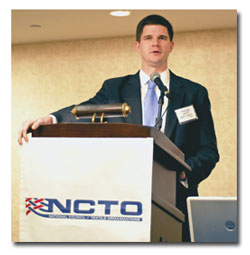
At NCTO’s annual meeting, R. Matthew Priest, deputy assistant secretary for textiles and
apparel at the Department of Commerce, reported on the Bush administration’s trade initiatives.


Competitiveness Program

The $307-billion Five-Year Farm Bill had become everything but a “farm bill” by the time it
reached the full House and Senate. It was loaded with a number of pet projects for members of
Congress, including a textile competitiveness program, that made it so politically popular that
Congress succeeded in overriding a veto by President George W. Bush.


Under the textile economic assistance program, mills will receive payments of 4 cents per
pound for every bale of cotton they open during the first four years of the program and 3 cents per
pound in the final year. It is estimated that these payments could amount to $75 million or more a
year. The payments will have to be invested in plant and equipment modernization to help make US
manufacturers competitive.


Currency Issue

NCTO has been actively pursuing government policies to help offset what they see as a huge
competitiveness advantage resulting from China’s refusal to permit its currency to float against
the dollar and other currencies. Among other measures, it has been backing the Ryan-Hunter Fair
Currency Act, which incorporates both anti-dumping and countervailing duty remedies to address
currency misalignment. Although Congress has not acted on the bill, and it likely will not this
year in view of opposition from President Bush, the NCTO leadership believes they have built a
solid base of support for the next Congress. They say they helped supply one-quarter of the
co-sponsors of the current bill in the House.

In a pointed presentation, Dr. Peter Morici, a professor of international business at the
University of Maryland and a highly regarded authority on international trade, demonstrated how
China’s refusal to let its currency appreciate is upsetting world trade and how it is contributing
to the soaring US-China trade deficit and wiping out manufacturing jobs. Morici summed up the
problem by saying, “When trade barriers are removed, the benefits of free trade are upset by
currency manipulation.” Noting that the WTO is supposed to foster reciprocal trade, he said it is
difficult to achieve that goal unless everyone abides by the same rules. “If we really had free
trade with China,” he said, “the textile industry would be OK.

“When we removed trade barriers, as we did in the case of China, we have an imbalance in
trade, and exchange rates are supposed to adjust when barriers are removed. When that does not
happen, you get an avalanche of imports, which is just what is happening today.”

While Morici believes the Chinese currency issue presents a major problem for US
manufacturing industries, he warned that he does not see any quick fixes, although he believes a
countervailing duty law that recognizes currency manipulation as an unfair trade practice would be
helpful. He does not foresee any major turnaround, because powerful multi-national companies are
influencing US policies, and since they have a stake in doing business with China, they are not
likely to do anything that might upset the Chinese. In order to force a change in US trade
policies, Morici said, import-impacted industries such as textiles and apparel need to “get tough
with elected officials.”

In that regard, Stowe said the organization is making a major effort to beef up its political
action committee in the midst of what he called “an historic election.” He urged members to “not
only consider what these elections mean to each of us individually but also what this means for our
businesses and the workers we employ.”

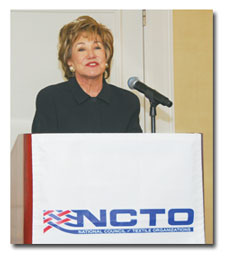
lizdole
Sen. Elizabeth Dole, R-N.C., addressed meeting attendees.


Customs Enforcement

NCTO Vice President Mike Hubbard gave an upbeat report on the association’s customs fraud
reporting operation initiated this past year in cooperation with US Customs and Border Protection.
An online system enables textile companies to report what appear to be customs violations they
encounter in the marketplace and pass the information on to Customs through NCTO. Hubbard said a
number of shipments have been held up in the past year, and $600,000 in back duties have been
assessed. “We knew there was cheating going on, and this system has enabled companies to make
confidential reports that can help streamline Customs enforcement,” Hubbard said.

He reported that a Government Procurement Committee is working on ways to streamline textile
and apparel purchases by the military and to strengthen and expand the so-called Berry Amendment
that requires the military to buy American whenever products are available from the domestic
industry. NCTO is working with members of Congress to expand the Berry Amendment principle to
Department of Homeland Security agencies.


Looking Ahead

In order to address ongoing issues – particularly with the removal of the safeguard quotas on
China’s imports – NCTO’s Trade & Economic Policy Committee under the chairmanship of Allen E.
Gant Jr., Glen Raven Inc., will deal with a number of approaches to improving the textile trade
picture. These include finding ways for textile manufacturers to have standing in countervailing
duty cases involving apparel, because textile manufacturers are impacted by unfair trade practices
in apparel trade. NCTO is promoting the idea of worldwide “801” trade agreements where duties on
imported garments would be levied only on the value added in the exporting country if they use US
yarn or fabric, and the organization will continue to press for FTAs that have rules of origin
favorable to US manufacturers.

The organization also is spurring a stepped-up effort to gain approval of the Ryan-Hunter
currency reform bill in the next Congress as one way to deal with unfair trade from China.

“We want to make sure we have the tools we need to promote fair trade and to seek out
opportunities to expand business,” Gant told

Textile World
. “We believe there are opportunities out there, and we will be working on ways to take
advantage of them.”

July/August 2008

Mid-Year Surprisingly Busy For Some


S
ome open-end specialty spinners are reporting surprisingly good business at mid-year.
“It’s been great,” said one spinner of heathers. “We’ve been running well all year, better than
expected.”

Despite this, however, he holds no optimism for the second half of the year. “Quite
honestly, I don’t know why our business has been so good. It’s not what we expected, and we don’t
really know where it’s coming from. With retail flat, we really expected to be struggling a little.
If I could point to three or four factors I think have generated our orders so far, I could be a
little more positive about the prospects for the rest of the year. But for now, it’s an unknown, so
I am not expecting much.”

Another spinner noted his ring-spun business has been struggling, but open-end has continued
to run well. “We’ve been about where we expected to be so far this year. It’s not booming, but it’s
been very solid. But the second half looks a little iffy at the moment. We’re beginning to see less
of a backlog on the specialty side of the business. On the commodities side of our business, orders
have been slow in coming. And with increasing consumer concerns about the economy, we are not
optimistic it will pick up.”

Yet another spinner noted that a downward spiral in retail sales has not yet affected his
business. “I guess we know it’s coming. But we’ve been fortunate in being able to offer products
that allow our customers to differentiate themselves somewhat. In retail today, everyone wants a
unique product offering. Target wants to be different from Wal-Mart. Macy’s wants to be different
from Dillard’s. Our apparel customers realize this and are trying to help retailers provide a hook
that’s unique. Our challenge is to be able to provide some exotic products at a price competitive
with Asia. In many cases, they can produce yarn cheaper than we can buy the materials.”

Added another spinner: “We’ve been able to keep busy by continuing to diversify our customer
base. Many of our old-time customers no longer exist, so we’ve had to focus our efforts on finding
new ones. We’re fortunate in that we have been able to establish a very strong presence in Central
America. There are some signs, though, that business is slowing. Some of that can be attributed to
seasonal changes, and some of it might be because of inventory buildup in the pipeline.


The Political Factor

Part of the reason spinners are somewhat pessimistic about the last half of the year is the
upcoming general election in November. “It’s not unusual to see things slow down in the months
before a presidential election, especially when a lame duck is in office,” said one industry
observer. “Consumers become concerned about the direction of the economy under a new administration
and begin trying to protect their pocketbook. With housing prices falling drastically, unemployment
rising and general uncertainty about the economy, consumers don’t know whether a new president’s
policies will be a blessing or a curse. Often, the more heated things become – like the clashes
between senators Clinton and Obama earlier this year – the more tentative people become. They begin
holding on to those few discretionary dollars they have.”

Added a North Carolina spinner: “I’m sure it has some effect. I know there is some caution
out there among retailers. Plus, the impact of higher prices at the pump is affecting every aspect
of our lives and is causing the cost of everything to go up. Consumers are scared, and I believe
they are justified.”


No Gloom And Doom Here

Not every spinner, however, is expecting the bottom to fall out by year’s end. “We’re
selling everything we can make,” said a well-known specialty spinner. “We expect business to
continue to be strong through the rest of the year. “The keys for us are innovation, communication
and delivery. We make a unique product, and we stay in touch with our customers so that we can
anticipate and meet their needs. A critical part of our success is lead time. We know we have to
get our product to our customer faster than anyone else can. If we fail, someone else can step in.
It used to be we talked about quotes and turnarounds in weeks. Now we talk in days. If you are a
yarn spinner in the United States, you have to be better than anyone else in the world, not to get
the order, but just to be considered.”

July/August 2008

Presidential Candidates Differ On Textile Issues


A
s the presidential candidates zero in on the economy as one of the central themes of the
2008 campaign, international trade and job creation are high on their agendas. While it is early in
the campaign and the candidates will fine-tune and modify their positions – depending on what
audience they are talking to at the time – they already have taken some positions of particular
interest to the US textile industry. Sens. John McCain and Barack Obama have significant
differences in their approaches to dealing with international trade and job preservation issues.
Virtually every political candidate, whether running for the presidency or Congress, espouses “free
and fair trade,” but those terms mean different things to different people.

Sen. McCain is more of a free trader than Sen. Obama, and McCain has labeled Obama “the most
protectionist candidate that the Democratic party has ever fielded.”

McCain voted for the North America Free Trade Agreement (NAFTA); permanent normal trade
relations for China that led to China’s accession to the World Trade Organization (WTO); most
favored nation treatment of Vietnam; the Andean Trade Preference Act with Peru, Colombia, Ecuador
and Bolivia; the Central America-Dominican Republic Free Trade Agreement (CAFTA-DR); and
legislation giving the president the “fast track” negotiating authority that was the key to some 25
free trade agreements the Bush administration has negotiated. While Obama was not in Congress when
NAFTA was approved, he has called for it to be renegotiated, as he believes the benefits of the
accord were oversold.

When NAFTA was being debated in Congress, it had the general support of US textile
manufacturers, but there were some dissenters. Textile industry officials now believe NAFTA has
been successful in promoting increased hemispheric trade, but they say its full potential has not
been reached because of competition from Chinese and other Far Eastern manufacturers.

mccainobama

Obama has promised to get together with the leaders of Mexico and Canada in an effort to
work out an agreement that would be favorable to American workers. However, renegotiation is easier
said than done in view of the many companies that have invested heavily in Mexico to take advantage
of the NAFTA provisions. US textile manufacturers for the most part still support the agreement,
and retailers also like it. On the other hand, organized labor sees it as a bust that has cost
hundreds of thousands of American jobs.

McCain is a staunch defender of NAFTA, and he recently said, “Demanding unilateral changes
and threatening to abrogate an agreement that has increased trade and prosperity is nothing more
than retreating behind protectionist walls.”

When it comes to new trade initiatives, both candidates support free trade agreements, but
each sees them in a different light. McCain points out that 95 percent of the world’s customers are
outside the United States, and says globalization is an opportunity for American workers now and in
the future.

“We need to be at the table when rules of access are negotiated in order to protect American
interests,” McCain said. He promises to support bilateral, multilateral and regional trade
agreements to reduce trade barriers and create markets for US goods. He does not believe trade
agreements should include environmental and worker rights provisions.

On the other hand, Obama believes labor and environmental standards are important elements
in international trade agreements. For that reason, he voted against CAFTA-DR because he does not
think it meets his criteria to spread good labor and environmental standards around the world. He
supports the WTO, but believes it must do more to enforce trade agreements and stop countries from
using unfair government subsidies to promote their exports.


Job Protection

When it comes to protecting US jobs, both candidates believe strongly in retraining and
education. Obama says he will work to update adjustment assistance to workers who lose their jobs
to import competition by extending the assistance to service industries. He also would create
flexible education accounts to help retrain workers and anticipate problems by providing retraining
assistance for workers before they lose their jobs in sectors of the economy that are vulnerable to
economic dislocation. He also supports increasing the minimum wage.

McCain also stresses the importance of education and retraining to make US workers
competitive in the global economy. In addition, he supports flexible training accounts to help
workers learn new skills. He would strengthen community college and other training programs for
displaced workers.


China Trade

The candidates have been notably quiet about trade with China despite a $256 billion
US-China trade deficit. Although they have expressed their concerns about “countries that illegally
subsidize their exports, manipulate their currency and protect their home markets,” China is rarely
singled out.

Obama has endorsed legislation that would use anti-dumping and countervailing duty laws to
impose punitive tariffs on countries that manipulate their currencies – an issue of major concern
to US textile manufacturers – and he says “it is long past the time for the United States to
confront the issue of unfair trade with China.” McCain is not a cosponsor of the currency
legislation.

Beyond that, there has been little mention of problems with China trade, which is
understandable in a political campaign. Many large multinational corporations have made substantial
investments in China, and because candidates rely on some of those companies for major campaign
contributions, they are not very likely to do anything to alienate China. In addition, major US
retailers are among the largest importers of goods from China, including textiles and apparel, and
they don’t want to rock the boat.

Obama says he will pressure the WTO to take measures to enforce trade agreements and stop
countries from continuing unfair government subsidies to their exporting industries, and continue
to maintain non-tariff barriers to imports. McCain also sees a need for the WTO to do a better job
of enforcing trade agreements.

Major problems continue to plague the Doha Round of trade liberalization negotiations at the
WTO. While some of the major participants, including the United States, still say it is possible to
successfully conclude the talks by the end-of-the-year target, the chances of that happening are
slim. The developed and developing countries remain poles apart on the questions of how and when to
cut tariffs, and they continue to fret over government subsidies, particularly those for
agriculture products. A five-year US Farm Bill passed by Congress this year has created additional
problems, as a number of countries have stated that it runs counter to the goals of the Doha Round.
The European Union’s top trade official, Peter Mandelson, recently said “the cracks have become
chasms.”

Nonetheless, Deputy US Trade Representative Peter Allgeier, while noting that negotiations
have reached a “critical stage,” said the United States plans to continue working to achieve a
successful outcome. He believes the Doha Round can generate “meaningful trade flows and new
economic opportunities for citizens throughout the world.” 

Following a recent round of bilateral Strategic Economic Dialogue discussions in Annapolis,
Md., officials from both China and the United States said they have renewed their commitment to
work for a successful Doha Round.


The Doha Round Remains Bogged Down

Major problems continue to plague the Doha Round of trade liberalization negotiations at the
WTO. While some of the major participants, including the United States, still say it is possible to
successfully conclude the talks by the end-of-the-year target, the chances of that happening are
slim. The developed and developing countries remain poles apart on the questions of how and when to
cut tariffs, and they continue to fret over government subsidies, particularly those for
agriculture products. A five-year US Farm Bill passed by Congress this year has created additional
problems, as a number of countries have stated that it runs counter to the goals of the Doha Round.
The European Union’s top trade official, Peter Mandelson, recently said “the cracks have become
chasms.”

Nonetheless, Deputy US Trade Representative Peter Allgeier, while noting that negotiations
have reached a “critical stage,” said the United States plans to continue working to achieve a
successful outcome. He believes the Doha Round can generate “meaningful trade flows and new
economic opportunities for citizens throughout the world.”  Following a recent round of
bilateral Strategic Economic Dialogue discussions in Annapolis, Md., officials from both China and
the United States said they have renewed their commitment to work for a successful Doha Round.

July/August 2008

Unifi Partners With ITG, United Knitting In Repreve® Nylon Launch

Textured yarn producer Unifi Inc., Greensboro, N.C., has partnered with Greensboro-based
International Textile Group Inc. (ITG) and Cleveland, Tenn.-based United Knitting to introduce
woven and knitted fabrics made with its new Repreve® recycled nylon 6,6 yarns.  The companies
will launch their new products at the Outdoor Retailer (OR) Summer Market, to take place August 8–1
1 in Salt Lake City.


Unifi first debuted its Repreve brand in 2006 with a line of 90-percent
post-industrial/10-percent post-consumer polyester yarns, later increasing the post-consumer
content to 20 percent. In introducing Repreve nylon, made from 100-percent post-industrial fiber
waste, the company has built on the success of the first yarns and fine-tuned the production
process, said Bett Anderson, marketing manager, Unifi.

“We saw a market need for recycled nylon yarns for nonindustrial denier type applications,”
Anderson said. “The Repreve nylon launch will be focused on apparel, and we are looking to expand
it to other applications.

“In choosing ITG and United Knitting as development partners, we were looking for leaders in
innovation that also could diversify in their product offerings,” she added.

ITG’s Burlington WorldWide (BWW) apparel fabrics business will include woven fabrics made
with Repreve nylon in its eco-friendly Generations collection to debut at OR, said Nelson Bebo,
vice president of sales, Burlington Labs, BWW’s research and development division. “We’re targeting
technical sportswear and activewear markets,” he said.

Bebo also noted that the two companies’ global manufacturing platforms provide mutual
advantages in terms of global markets.

United Knitting will show about eight Repreve nylon fabrics, most containing Lycra® and
representing a range of weights and constructions geared to tops and bottoms for performance
outdoor, athletic and other niche markets.

“We sell a lot of nylon into the market, and Repreve nylon allows us to round out our
offerings of sustainable products,” said Walter Tkach, United Knitting’s director of sales.


July/August 2008

Customs Finds Illegal Chinese Apparel Shipments

US Customs and Border Protection (CBP) has identified more than 1,000 cargo containers of Chinese
apparel that it says were illegally transshipped into the United States, and it will charge the
shipments against Chinese import quotas. The containers, entering the United States in 2006 and
2007, contained more than 4 million dozens of apparel items labeled as coming from countries other
than China, but in fact, according to CBP, they were Chinese goods.

In announcing the action, CBP Commissioner Ralph Basham said: “US Customs and Border
Protection is committed to strongly enforcing our trade agreements, and we will continue to work
with members of the trade community and other federal agencies to pursue importers who make false
declarations in order to circumvent import quotas.”

CBP maintains a trade enforcement program to ensure compliance with laws and regulations
governing all imports. CBP says because there is a high risk that traders of textiles and apparel
products will attempt to avoid quota restrictions, it has designated textiles and apparel as a “
priority trade issue.”

In the current case, CBP said 11 different countries were incorrectly declared as the country
of origin for the Chinese apparel, which is valued at more than $80 million. The products were in
10 different product categories including large quantities of cotton knit shirts and cotton
trousers.

The US Association of Importers of Textiles and Apparel (USAITA) took issue with the customs
action, saying it was “politically motivated.” Laura E. Jones, USAITA executive director, said, “
This is politics pure and simple. With the quotas due to end in less than six months, the CBP has
to justify the resources it has dedicated to rummaging through foreign factories and then detaining
and seizing apparel shipments since 2006.”

Saying that the shipments involved are “insignificant,” Jones said the CBP is under pressure
from the US textile industry to prove that it is protecting them.

July 15, 2008

Warwick Mills Wins Export Achievement Award

In recognition of its success in exporting the textiles it produces, New Ipswich, N.H.-based
Warwick Mills has received an Export Achievement certificate from the US Department of Commerce. US
Deputy Assistant Secretary of Commerce Matt Priest presented the certificate during a visit to the
company this week.

Warwick Mills was established in 1870 as a manufacturer of cotton-based textiles. More
recently, the company has shifted its focus to materials engineering and protective fabrics using
its core technical textiles, adhesives and performance coatings technologies. Its TurtleSkin®
branded products are used in a range of applications from body armor and ballistic, puncture and
snake bite protection to inflatable structures and chemical-biological protective structures, among
other applications. TurtleSkin protective gloves are worn by some 15,000 US Marines in Iraq; and
the company exports its products to countries such as Brazil, Germany, Mexico and South Korea.

July 15, 2008

Clariant Acquires RiteSystems, Ricon Colors

Switzerland-based global specialty chemicals provider Clariant has acquired liquid and solid
masterbatch suppliers Rite Systems Inc. and Ricon Colors Inc., sister companies based in West
Chicago, Ill., with operations in North Carolina, California and Austria. The terms of the
acquisition were not disclosed.

 “Rite Systems/Ricon Colors is an excellent partner to expand our product and service
offering in North America, especially for our customers in the packaging and consumer goods market
segments,” said Dominik von Bertrab, head, Clariant Masterbatches. “Further, Rite’s outstanding
reputation in liquid color will allow us to leverage this new competence into other regions where
Clariant enjoys strong market positions such as Europe, Asia and Latin America.”

July 15, 2008

Cognis To Sell Pulcra Chemicals Business

Germany-based Cognis Deutschland GmbH & Co. KG — a global supplier of specialty chemicals and
nutritional ingredients — has agreed to sell its Pulcra Chemicals GmbH subsidiary to Germany-based
Fashion Chemicals GmbH & Co. KG. The sale is part of Cognis’ strategy to emphasize its wellness
and sustainability trends-driven core businesses.

Cognis spun off Pulcra Chemicals — formerly its Process Chemicals Strategic business unit —
as an independent company in July 2007 in a move to improve competitiveness as well as product and
service quality. Pulcra manufactures process chemicals for the textile and leather industries; and
has production facilities and service centers in Brazil, China, Germany, India, Indonesia, Italy,
Mexico, Spain, Turkey and the United States. The company realized sales totaling 246 million euros
in 2007.

Fashion Chemicals is an investor funded primarily by Turkey-based DSD Deri San. DS Tic. A.S.,
a company with stakeholders in the leather goods industry. The transaction is expected to be
completed in October 2008.

July 15, 2008

Sponsors