Orient Adds Atlas Copco Compressors

Orient Textile Mills Ltd. – a Pakistan-based textile manufacturer that specializes in greige
fabrics production – has installed three oil-free centrifugal compressors from Atlas Copco, Sweden
– a provider of industrial productivity solutions.

The Atlas Copco ZH 7000-5 compressors operate around the clock, with increased airpower and
10-percent reduction in energy and maintenance costs compared with the previously used compressors.

July/August 2008

2008 Stretch To The Future Design Competition


T
hree juniors at The Fashion School of Kent State University, Kent, Ohio, were awarded
prizes at this year’s RadiciSpandex “Stretch to the Future” Design Competition. Fashion designer
Marc Bouwer was this year’s honorary judge.

Established nine years ago, the Radici competition was created to educate students about
designing apparel using fabrics containing spandex.

The awards ceremony was held at the Italian Trade Commission’s town house in New York City.
Luciano Radici, regional director, Americas, for the Italy-based Radici Group, the parent company
of Gastonia, N.C.-based RadiciSpandex Corp., presented the crystal Stretch to the Future Award to
Bouwer.

radicigroup
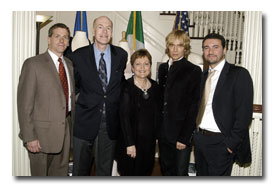
Left to right: Marty Moran, Barry Ross, Dr. Elizabeth Rhodes, Marc Bouwer and Luciano
Radici

Marty Moran, RadiciSpandex  CEO, gave awards to the three student winners. Jenni Smas,
who designed a floor-length evening gown molded and draped in fabrics provided by Spartanburg-based
Milliken & Company, took the Grand Prize along with the Eveningwear Award. Andrew Spargo
received the Swimwear Award for a black one-piece swimsuit and cover-up designed in fabrics
provided by Darlington Fabrics and Sextet Fabrics. The Lingerie Award went to Sydney Sustarsic, who
used fabrics from Milliken and Startex. The Underfashion Club co-sponsored the lingerie prize.

Dr. Elizabeth Rhodes, director of The Fashion School at Kent State, noted that this year, 18
students entered the Radici Stretch to the Future Design Competition. In addition to its Ohio
campus, The Fashion School has outpost studios in Florence, Italy, and in New York City. The New
York studio is located in the garment district. Design students have the opportunity to study for
one semester at either location.

Along with fabrics from Milliken, Darlington, Sextet and Startex, fabrics containing Radici
spandex fibers were donated for the competition by Brookwood Cos., Charbert Fabrics, Guilford
Performance Textiles, McMurray Fabrics and Symphony Fabrics. All are US-based companies.

Judging was held earlier this year at the school’s New York location. In addition to Bouwer,
the judging panel included Kim Hall, marketing manager for Fashion Apparel, RadiciSpandex Corp.;
Deborah Batcha, vice president, merchandising, Lunaire; Virginia Borland,

Textile World
‘s New York correspondent; David Burnett, vice president, merchandising, InGear Swimwear;
Howard Ellis, vice president, Symphony Fabrics; Kristen Kramer, senior vice president, bra launch
and product development, Victoria’s Secret; Camila Perez, swimwear designer, Leonisa; Danielle
Potito, associate fashion editor, Life & Style Weekly; Norman Szychter, raw materials manager,
The Limited; Claudia Velasquez Olarte, lingerie designer, Leonisa; and David Wolfe, creative
director, The Doneger Group.

July/August 2008

Dow Fiber Solutions Forecasts Trends For Fall/Winter 2009-10

Global politics, economics and ecology impact color, fabric and fashion directions for Fall/Winter
2009-10, according to Bengt Jacobsson, Paris-based trend forecaster for Dow Fiber Solutions –
Midland-Mich.-based producer of Dow XLA™ stretch fibers. Intellectual, Industrial and Inspirational
are themes for his seasonal presentation. More than 70 new conceptual fabrics were shown, made by
Dow fabric partners in Europe and Asia. All focused on the benefits of XLA, including comfort, fit,
performance, functionality and forward fashion. Knitted and woven fabrics range from ultrasheer,
soft-touch and drape; to felted, thick and bulky.

Intellectual, Jacobsson’s first trend, shows new ways with tailoring. Jacobsson calls it
“nerd chic.” The traditional gray flannel suit is updated in an ultrasoft, light, slightly lustrous
comfort-stretch flannel. Other fabrics include pin stripes, club stripes, herringbones and tweeds.
All look and feel new, and are woven in rescaled patterns and in wool blended with silk, bamboo and
XLA. There are white-on-white patterned shirtings in this group. Novelty cords, sateens,
lightweight velvets and loose knits are some of the casual fabrics. France-based de Vaudricourt,
India-based Raymond Ltd. and India-based Greuter are among the mill partners. There are patinated
colors that have an antique book-leather look and dusty pastel shades, along with black and white.
Patterns are neat and precise.

Construction and function are key in the Industrial category, with high-tech and innovation
going to the limits to create contemporary sportswear fabrics that move. Linear effects, fancy
cords and stripes, bonded and quilted fabrics, felted looks, mesh and net, technical surfaces, and
sturdy denims reflect a mechanical and industrial mood. Gutsy canvas; rip-stop; exaggerated
diagonal weaves; and thick, wooly fleece reversing to smooth cotton are other developments. There
are shirtings with metallic glimmer and a look of cold steel that have a soft, slick hand; and
knits that contour the body for comfort and fit. Italy-based Loro Piana S.p.A., Japan-based Kurabo
Industries Ltd. and France-based Carreman are some of the resources. Colors have an industrial
quality with shades of bronze, khaki, petrol and brick accented with cobalt blue, orange and lime.

The Inspirational range has a global ethnic feel. Bohemian luxe or Asian opulence is modern,
natural and eco-friendly. There are jacquards, slubbed shantungs, taffetas, satins and discrete
patterns. Other fabrics are rustic burlap; compact, thick wool; irregular and uneven weaves;
pleated, opaque/sheer or rice-paper-like. Silk, bamboo, viscose and Modal® are blended with XLA.
Fabrics are woven and knitted by India-based Arvind Ltd., France-based Bugis and China-based
Youngor-Sunrise. Mid-tone and half-bright shades of indigo, turquoise, saffron, clay, pink, coral
and plum are plucked from nature.

July/August 2008

Outlast Technologies Goes To Bed

Outlast Technologies Inc., Boulder, Colo., has taken its temperature-regulating technologies into
home textile products. Originally developing the technology for NASA astronauts to help them
maintain a comfortable body temperature in outer space, Outlast discovered a need for this
technology in down-to-earth consumer products.

“The timing is right, the consumer is more educated,” said Guy Eckert, executive vice
president of business development, Home Market. “The demand for high-performance fabrics is
growing. Once consumers have tried Outlast, they will look for it again.”

Eckert explained that Outlast technology responds to changes in body temperature.
Micro-encapsulated Thermocules™ absorb excess body heat, store it and then release it when the body
is cold, thereby maintaining body temperature at a comfortable level. It can be delivered in a
fiber or via finishing. There are three designations: Bronze is achievable via finishing; Silver
works through finish or fabric; and Gold through fabric only.

Hosiery is one market where Outlast technology is in demand. Gold Toe, Wigwam and Harley
Davidson are some of the sock resources. In footwear, it is used by Nike, New Balance, The North
Face and Arnold Palmer golf shoes. Men’s suits with Outlast technology are sold at Jos. A Bank.
Marks & Spencer is selling underwear featuring Outlast.

Recently, Outlast was introduced into bedding products including pillows, mattress-ticking
fabrics, mattress pads, woven blankets and duvet covers.

According to sleep experts, 65 to 68°F is the ideal room temperature for sleeping. Under the
covers, it is difficult to maintain the ideal temperature. As we sleep, our temperature goes up, so
we toss and turn and throw off the covers. After considerable in-depth testing, it was proven that
Outlast technology prevents discomfort and keeps the body comfortable in bed at night, according to
the company.

As a result of this testing, Outlast is licensing companies to create and sell collections of
sleepwear and bedding products. Kohl’s, Dillard’s, JCPenney, Sears, Belk, Bon Ton and Avon are
among them. Recently, Dillard’s introduced “Just Right” sleepwear under its Clarity™ brand. Pajamas
and nightshirts are on sale in a blend of Outlast viscose/cotton.

Minneapolis-based bed retailer Select Comfort Corp. has launched the Enhanced Sleep Number
7000 Bed. The 12-inch-thick mattress is covered with a new fabric in a blend of Outlast
viscose/polypropylene/silk that is softened with aloe vera. The company also is selling mattress
pads and pillows featuring Outlast temperature regulation.

Eckert said that approximately 37 percent of Americans have trouble falling asleep because
they are too hot. Add to that our aging population with menopausal women whose temperature can
shift 6°F. The company claims Outlast technology in bedding reduces overheating and provides a
balanced, comfortable climate, so two people can sleep comfortably together.

July/August 2008

Spiegel Expands Use Of Yunique Software

Spiegel Brands Inc., New York City — a specialty retailer and direct marketer of women’s apparel,
footwear, accessories, and home products — has expanded its use of New York City-based Yunique
Solutions product lifecycle management (PLM) Software to support increased product innovation,
operational transparency, and a more efficient and proactive supply chain. Spiegel will utilize the
collaboration and process management aspects of the software to create regional product teams
comprised of independent vendors. These teams will work closely with the Asian production
facilities, fulfilling all responsibilities from design through production development.

“We needed a system built on a modern, open platform that provided for global collaboration,”
said Jose Sanez, director of technical design systems, processes and calendars, Spiegel. “We can
manage our apparel, footwear, home and accessory lines with this single solution.”

July/August 2008

Huntsman Opens Facilities In Turkey

Switzerland-based Huntsman Materials and Effects Europe has opened a 5,000-square-meter
multipurpose Tuzla site in Istanbul, Turkey, to house a Textile Effects Formulation and
Distribution Center, and a Technical Center to serve the European textile market; and an Advanced
Materials production plant.

According to Huntsman, both businesses have operated in Turkey since the 1960s through
various channels. The new Textile Effects facilities are expected to bolster the business’s Turkish
operations as well as its global network. The Advanced Materials plant replaces an older facility
and features environmental, health and safety improvements as well as improved service to
customers.

“The opening of the Materials and Effects plant in Tuzla represents a further milestone in
the history of the Materials and Effects division. Combining production and lab facilities into one
new site will further leverage synergies,” said Paul Hulme, president, Materials and Effects. “This
is an exciting and strategically beneficial step towards an even stronger presence for Huntsman in
Turkey.”


July/August 2008

Cotton Incorporated Supports Fashion Design At Pratt Institute


T
he 2008 Pratt Institute Fashion Show, held recently in New York City, was supported by
the Importer Support Program of the Cotton Board and Cary, N.C.-based Cotton Incorporated. A jury
of fashion industry leaders pre-selected the more than 100 designs – representing the best work of
Pratt’s 23 graduating seniors – to appear on the runway. Three fashion design students were named
winners in a year-long eveningwear and bridal design competition, also sponsored by Cotton
Incorporated. Industry leaders presented individual awards in the categories of sportswear, costume
design, eveningwear, and bridal.


More than 12 fashion design students participated in the Cotton Incorporated competition.
Requirements were to design eveningwear in fabrics containing at least 98-percent cotton. Jessie
Leigh Voris of Fredon, N.J., was the first-place winner. She was awarded the $5,000 prize for a
cotton cream-colored muslin and sateen A-line gown with a handcrafted overlay. Voris also received
the Caitlin Ward Costume Award. Second-place winner, Adrianne Waite of Dallas, received a prize of
$1,500 for a green cotton organza pleated, drop-waist dress. The third-place prize of $1,000 went
to Niki Marcheggiani, Knoxville, Tenn., for a purple strapless, box-pleated dress of spray-painted
cotton muslin. She also won the Hiroko Suzuki Individual Eveningwear Award.

prattdress
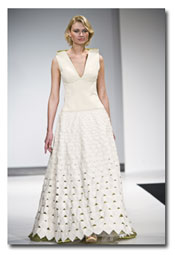
Jessie Leigh Voris’ cream-colored A-line gown received the  first-place award at the
2008 Pratt Institute Fashion Show.

For the first time, a Best of Show award of $5,000 – funded by Merrick and Lillian Pratt –
was given to support the careers of promising fashion designers graduating from Pratt. Yamel
Mendoza of Paterson, N.J., was the winner. Mendoza also was recipient of the Renee Hunter Evening
Award and the Debbie Jones Bridal Award. Her dramatic eveningwear was a favorite of the 70 members
of the critic’s panel. She named her collection “Evora.” Brightly colored, slim silk charmuese and
crepe satin gowns were designed with contrast edging, pleated tops and feathers. Her award-winning
bridal gown was created in cotton sateen and twill with eyelet embroidery.

Seventh Avenue designer Carmen Marc Valvo was given the Pratt Institute Fashion Icon Award,
which is awarded annually to a noted designer in recognition of his or her positive influence and
ability to inspire young people interested in fashion. Valvo has dressed notables including
Beyoncé, Katie Couric, Oprah Winfrey, Kate Winslet and Queen Latifah.

Pratt Institute, founded in 1887, today is one of the largest independent colleges of art and
design in the United States. “By the early 1940s, the Institute had become the first school in the
United States to offer a degree in fashion,” said Thomas F. Schutte, president. “Our seniors will
soon depart for the exhilarating world of fashion, but we are sure to see their names again as they
progress in their careers.”

July/August 2008

Executive Forum


F
lexibility and energy conservation are the megatrends of the textile future, but these
trends must not result in the machinery becoming more expensive.” These are the words of Dr.
Carsten Voigtländer, CEO, Oerlikon Textile GmbH & Co. KG, Germany. In a very open interview,

Textile World
learned how Voigtländer imagines the future.

Over the past few years, Oerlikon’s Textile Division has permanently grown. Voigtländer is a
fourth-generation textile industry employee. His ancestors were weavers and cloth masters. As a
14-year-old schoolboy, he had a summer job with his father; and at 19, he had a traineeship in the
textile machinery industry and first came into contact with Neumag. He studied mechanical
engineering and process engineering, earned a doctorate and began working for Neumag in 1994. Two
years later, he became an authorized officer, and four years later was promoted to a management
position. He began as a development engineer, and eventually built up the engineering department.
From 2000 on, nonwovens were part of this division.

carsten
Dr. Carsten Voigtländer


TW
: Your background means the nonwovens activities at Neumag are your own baby?

Voigtländer: Yes, I have represented everything in front of the Administrative
Board so that it came into being. I have carried out all acquisitions and, of course, it’s part of
my job now to handle consolidation. As it’s well-known, Neumag was taken over by Saurer and then by
the Oerlikon Group. I have been in management since 1998, first with Neumag and with Saurer as of
2000, and as CEO of Oerlikon Textile since 2006.


TW
: What convinced you to accept this job?

Voigtländer: This is an interesting question. I find forming things appealing, and
Oerlikon Textile operates in different textile markets – there are many chances to develop further
projects.


TW
: What is your personal challenge?

Voigtländer: The challenge is the fact that the complete textile production moved
to Asia. It is a real challenge as a European enterprise to withstand worldwide competition with
production sites in Europe and Asia. The various business fields and the production in Europe and
Asia are a multifaceted task and require an enormous personal engagement. The shareholders want to
make money, employees want a decent job, customers want outstanding machinery for little money, and
suppliers have to be paid. The attractive part of this story is to form with all these parts one
unique, sound entity.

Page52


Complete Supplier


TW:
What was the idea behind establishing the group as it is presented today
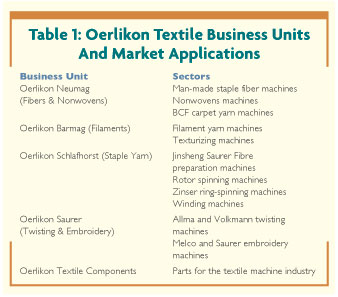
(See Table 1)? Is it to be a complete supplier primarily?

Voigtländer: Yes, the basic idea is to cover the textile value-added chain. We
cover natural and man-made fibers – either the classic spinning mill with natural fibers or
polymerization and filament production for man-made fibers. Then we have fabric forming with wovens
or knitwear in a multi-stage process, or the direct production of the fabric in a one-step process
to manufacture nonwovens. Barmag stands for man-made fibers, Schlafhorst for cotton and Neumag for
nonwovens. Barmag and Schlafhorst are in yarn formation; and Saurer works in niches such as
twisting and embroidery. We are particularly proud of our fifth area, the component business.


TW
: Have you ever considered completing your product portfolio with a manufacturer of weaving
or knitting machines?

Voigtländer: Of course, it is conceivable to become active in this area. However,
there are areas that are closer to us – for example, fiber preparation or hydroentanglement. But,
if there is an opportunity, in finishing, for example, we might get involved.


TW:
What were the difficulties in establishing the group as it exists today?

Voigtländer: It was the task to unite 10 business units and reduce them to five.
Different cultures had to be brought under one hat. It’s a rethinking in the people’s head. Today
we are selling complete lines and not components of lines only. This organization was favored by
the fact that we achieved a terrific result last year. It is also important that we have maintained
the strong brands like Barmag, Neumag, Schlafhorst and Saurer.
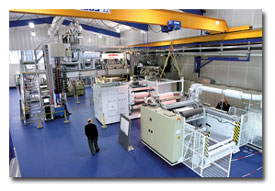
oerlikoncenter
The Oerlikon Neumag nonwovens center


The New Owners


TW:
Have the new Administrative Board or top management had any impact on your work?

Voigtländer: Before the new major shareholders invested, they spent a day with us
in the Textile Division to see what we do. After the management council meeting, a strong
commitment to the group’s structure was communicated to the entire management group. It also was
made clear to us that one thinks not in short terms, but very strategically in long terms.


TW
: These are strong words.

Voigtländer: Right, and this also was heard positively by the employees. We
achieved about 50 percent of the turnover of about 2.7 billion Swiss francs last year in the
textile division. This shows clearly its importance. We have about 8,000 employees out of 19,000
for the group.


TW
: Over and over, there are rumors concerning takeovers. How do you comment on that?

Voigtländer: Oh well, these are rumors. Such rumors arise again and again in times
of change. There is nothing more to say about it. And as I said, the new owners invest in our group
because they want to earn money with it.


Clear And Simple Structures


TW
: How does one manage such a large group?


Voigtländer
: On the one hand, we have very clear and simple structures – that’s why we have the five
business units. We have a matrix organization that includes a CFO who works for all business units
and a technology manager who cares about synergies in the development area. The employees who
report directly to me, the managers of the five business units, form the management team. This team
meets every four to six weeks. The one thing that shouldn’t be forgotten is commitment to the
company. We have many long-term employees who contribute their share to our success.


Oerlikon Neumag


TW

: Can you comment on the focusing of the single business units? Let’s start with Oerlikon
Neumag.

Voigtländer: The focus is clear – we want to be a complete supplier to the
nonwovens industry. With the acquisition of more or less all technologies, we can practically offer
almost every possible combination of technologies. This strategy has stood for five years, and we
have put together all the components at this time. It is motivation and confirmation for us at the
same time that our competitors pursue the same strategy today. In the future, another consolidation
still follows in the machinery manufacturing for nonwovens. This consolidation already has partly
started or has already been made.

In the carpet sector, Neumag is the market leader with a 70- to 80-percent market share. Our
new machinery in the bulk continuous filament area enjoyed great success at the last ITMA and
already is highly accepted by the customers.


Oerlikon Barmag


TW
: Let’s discuss Barmag. You have eliminated the recycling area of the portfolio?

Voigtländer: This is correct. We concentrate on the textile business. The most
important areas are POY,  FDY and fibrillated tapes. We have introduced a new winder that has
already sold 1,000 units. This is the future of Barmag – we want to put a similar product on the
market also for FDY. We are strong in Asia and offer total solutions. Ten years ago, enterprises
like Barmag and Neumag delivered the components to the engineering companies, today we do
everything ourselves. The interface between engineering and mechanical engineering has been dropped
out.
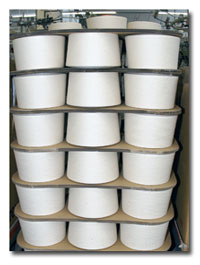
spools
In the mid-range segment, Oerlikon Schlafhorst offers ring- and rotor-spinning machinery
produced predominantly in China.


Oerlikon Schlafhorst, Saurer


TW
: Tell me about Oerlikon Schlafhorst, Oerlikon Saurer and Oerlikon Textile Components.

Voigtländer: At Oerlikon Schlafhorst, we have the complete textile chain to a
large extent. First of all, in cooperation with Trützschler GmbH & Co. KG, we offer a
combination that works excellently. This cooperation mixes fiber preparation from Trützschler, and
all follow-up production stages come from Oerlikon. We offer products in the middle segment in the
area of ring and rotor spinning, which we predominantly produce in China. Our competitors don’t
supply either one or the other component; therefore, we are also very strong in the area of staple
fibers. We already have sold a complete fiber line in Dubai and a whole production line in
Uzbekistan with Trützschler. Many customers are happy today if they can buy a complete line and
don’t have to search for individual components.

Oerlikon Saurer is an unchallenged world market leader in shuttle embroidery. We are at the
forefront of laser cutting and sequin application. Melco, a supplier of single-head embroidery
machines, also is doing well; the decisive step was the move into international markets. We expect
growth in Asia and also in Europe to further increase.

Twisting at Volkmann and Allma is mainly for technical applications such as yarns, tire cord
and other industrial applications. We are world market leaders also in this area. With Volkmann, we
record successes in the carpet sector, but also in the cotton industry. In the whole Saurer
division we are working in niches only, but in almost all the niches, we are market leaders.

The growth at Oerlikon Textile Components has doubled within the past few years. With
acquisitions, it extends not only to the natural fiber area, but also to man-made fibers. We have
turnover of about 300 million Swiss francs in the area of components today. With a high in-house
manufacturing depth, this area is very much a stabilizing factor for us. However, every single
business unit has a spare parts business of its own. Customers also can order parts using the
Internet today. With our own SECOS system via the Internet, we generate about 100 million Swiss
francs.


Research And Development


TW
: What does research and development mean for Oerlikon?

Voigtländer: This is virtually essential. Research and development are the core of
our activity; more than 600 employees are active here. If we thought only about costs and not about
new developments, we would not have any chance in the marketplace. We are a certain size and want
to set trends and be the first that comes onto the market with innovations. Of course, we talk
about cost reduction: However, this is only one side of the coin; new products with the right costs
are in the foreground. The most important projects are the ones through which we bring a new
revolutionary technology to the market. Every business unit is autonomous and has its own research
and development because those employees work directly with the customers and incorporate the latest
requirements into research and development. We have more than 4,000 active patents, with 330 new
registrations last year. Our development budget amounts to more than 100 million Swiss francs per
year.


Market Situation


TW
: How successful was the past year for Oerlikon Textile?

Voigtländer: 2007 was the best year in the company’s history. Turnover amounted to
2.7 billion Swiss francs. We are now experiencing a downturn after the upswing of the recent years
in all markets. In the first quarter of 2008, we had an incoming order drop of about 35 percent.
There are machinery manufacturers with incoming order drops of up to 90 percent. This leads to
violent drops in turnover. But everybody has known for decades that the textile industry always
works in cycles. The crash is simply very extreme this time.


TW
: Why do you think this happened in such a big way this time? Is it the financial crisis in
the United States?

Voigtländer: Well, this is connected to that fact only a little bit. You can’t put
the blame on this situation only – that would be too simple. If one has a look at Asia, great
overcapacities were built up in China within the last few years. Gross national product growth was
gigantic, with 11.4-percent growth in 2007. The government wants to slow down the growth to 8
percent now and is doing it. We see clear difficulties at the financing of our customers’ projects.
We then have high oil and cotton prices; this means our customers no longer earn so much money. The
losses were appropriately large. And what are you doing if you have losses? One does not invest any
more. And this has an extreme effect on investment goods. It is not that no money is there – the
projects are just delayed.

Of course, another problem is the exchange rate with the US dollar. Then, we have a
tremendous social reversal in China underway: Environmental protection and factories acts have been
established. Chinese workers are entitled to a contract of employment and to have a vacation now,
too. All these measures and circumstances enormously increase the expenses of our customers.
Through this, production becomes less attractive; the exports decline and make the problems even
bigger.

The boom in Turkey with rotor spinning is over, too. We see extreme investment restraint also
in India. This means that all three large markets – China, India and Turkey – have slowed. The sum
of all influences simply hits everybody. Of course, there are niches here and there, but nothing
that strong.


TW
: And how long do you think this situation will last?

Voigtländer: We are rather sure that we will have similar low volumes in 2009.
However, we assume that it will get better as of 2010, but of course, everything is now looking
into the crystal ball. There are still some companies that invest counter-cyclically, and this
always results in some changes somewhere. Such a downturn, however, is a chance for strong
enterprises. On the one hand, another consolidation of the market is occurring; and on the other
hand, the suppliers of cheap machinery have great problems – for example, in China. Customers don’t
want cheap machinery anymore. They want to produce the best product. We are convinced that certain
suppliers that produce, pardon the expression, bad machinery, will be in big trouble. And now, we
are at the start again: In difficult times you watch even more carefully expenses, flexibility and
quality. In this direction exactly, Oerlikon has moved for years, and we think that we can improve
our performance further in turnover and market share.


Megatrends


TW:

And in the near future, how do you see the development of textile machinery production?

Voigtländer: It is certain that the textile world market will further increase.
The population increases, and, thus, also the need for textiles. And, if one has a look at
countries like China and India, the domestic need is massive.


TW

: What is at the forefront of development?

Voigtländer: At first, flexibility and energy savings. Of course, one must not
forget the development of the costs. We hope to stay on the level with costs, but to increase
quality and productivity and reduce energy consumption.


TW

: Do you see the same chances in the future for all business units in the group?

Voigtländer: Of course, the markets are different, and so are the chances. Some
develop faster, and others must gain market share. Let’s take natural and man-made fibers: Cotton,
for example, is in competition with food; therefore, acreages are restricted. Food will always be
the first priority; clothing is next. Therefore, we do not expect cotton acreage to climb. The need
for clothing is here, so the need for man-made fibers will further grow. That’s why we are further
active in the group in both natural and man-made fibers. Apart from that, the direct production of
one textile substrate, nonwovens, will further develop strongly. The future belongs to nonwovens.


TW
: If you compare the requirements of the market with those of five years ago, where do you
see the greatest differences?

Voigtländer: The cost spiral always moves down further, and the requirements
increase at the same time. Every year, prices drop about 2 percent. This means we have to drop
permanently on the expenditure side in development and purchase to compensate for these prices.
Cost management is of outstanding importance. We say textile management is cost management. Whoever
does not have its costs under control will not survive. The market will further change. At the end
of the day, only big groups will survive and some highly specialized niche suppliers, whether these
are Europeans or Asians. There are already Asian enterprises that have bought companies in Europe –
in the machine tool area, for example. In conclusion, just a few companies will be left to play an
important role in the textile machinery market, and we will certainly be one of them.

July/August 2008

ITMF Meeting Heads To Mauritius


F
rom Oct. 11 to 14, 2008, the ITMF Annual Conference – the global textile industry summit
organized by the Switzerland-based International Textile Manufacturers Federation (ITMF) – will
take place on the beautiful island of Mauritius. Mauritius is well-known for its exquisite
surroundings for holidays. But who knew that more than 55,000 people work in its textile industry?

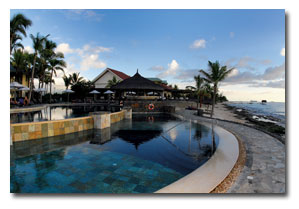
The Hotel Le Meridien will host the conference. The hotel offers 265 ocean- and
mountain-fronted rooms and suites, all with a private balcony or patio.

meridien
The next global summit of the entire textile industry will be on the beautiful island of
Mauritius at the Hotel Le Meridien.


ITMF Conference

The general theme of the conference will be “Challenges for a Greener and More Sustainable
Textile Industry.” In this new environment, the conference will provide the opportunity to analyze
global developments in the textile and clothing industry in terms of investment, activity and
trade. The presentations and discussions during the various sessions of the conference will enable
the delegates to better understand the new era for a global textile and clothing sector at the
crossroads. The Mauritius Export Association (MEXA) is the conference’s host association.

mauritius
Chamarel, or the Seven Coloured Earth, is a famous site on the island of
Mauritius.


Favorable Strategic Position

The Republic of Mauritius is an island nation off the coast of the African continent in the
southwest Indian Ocean, some 900 kilometers east of Madagascar. Mauritius includes the islands of
St. Brandon, Rodrigues and the Agalega Islands, and has been in the spotlight for centuries thanks
to its strategic position. First came the Portuguese, then the Dutch, and after that the French and
eventually the British, who stayed for more than 150 years. Mauritius obtained its independence in
1968, and the country became a republic within the Commonwealth in 1992.


Mauritius offers a great deal to the world of textiles: the island is a beautiful place and
a true melting pot for different cultures. The people are used to dealing with different cultures,
and most speak at least two languages, English and French in addition to Creole. The textile
industry is known for its quality work, reliability and punctuality. The companies and their
proprietors pay a lot of attention to their employees and have a great sense of social and
corporate responsibility, supported by modern labor laws. Education is top priority. Every child
goes to school up to the age of 16, school is free of charge for everybody, and there is even free
transportation available for the schoolchildren if necessary.

jeetahismail
Dr. The Hon. Rajesh Jeetah, minister of industry, small and medium enterprises, commerce
& cooperatives (left) and Salim Ismail, chairman and CEO, textile activities, Groupe
Socota


Stable Democracy

Mauritius is a stable democracy with regular free elections and a positive human rights
record. The country is a parliamentary democracy with a president as the chief of state. The
president is elected for a five-year term by the Mauritian parliament, the National Assembly, with
its 62 members. The government is headed by the prime minister and a Council of Ministers, elected
on a five-year basis. The most recent general elections took place on July 3, 2005. Dr. The Hon.
Rajesh Jeetah, minister of industry, small and medium enterprises, commerce & cooperatives, has
a textile background and wrote his thesis in textile technology at the University of Manchester,
England. It is ideal for the local textile industry to have a man at the top of the ministry who
speaks the same language.

The island, with its textile industries, is competing strongly with other markets. The main
reasons given by Jeetah to invest in Mauritius and not elsewhere include political stability with a
growing gross domestic product (GDP) over the past 25 years. “Mauritius enjoys a reputation of a
multicultural environment with a multitude of languages,” Jeetah said. “We understand the world,
and through our history, we have the same cultural background as most of the Western countries. I
am convinced that ‘Made in Mauritius’ will be a premium label shortly. Our goal is to play in the
top 10 league of the most preferred locations for business. This is possible because we provide
non-bureaucratic business conditions.”

According to statistics, 35,000 global companies have either their headquarters or
subsidiaries in Mauritius, with assets valued at $35 billion.

wongdarga
MEXA Director Danielle Wong (left) and Enterprise Mauritius Chairman L. Amédée
Darga


Important Textile Industry

According to Jeetah, textiles and clothing are the biggest industry sectors on the island.
Sugar still plays a significant role; however, textiles are far more important. More than 55,000
people work in the textile industry, and not only in garment manufacturing. The turnover of the
Mauritian textile industry is more than 1 billion euros. Today, the production of woven and knitted
fabrics is increasing, due to an ongoing verticalization of the textile industry in this country.

The textile industry is very important for Mauritian GDP. Textiles are one of the
cornerstones of the country. The population, numbering 1.2 million, represents a domestic market
worth $143 million. The industry’s employees produce $1.5 billion in export revenues. In 2006,
textiles represented 49 percent of all manufactured exports. These days, all sectors of the textile
industry have the same level of importance. The 20 largest textile companies are producing 100
percent for export. Fifty medium-sized enterprises have a 50:50 domestic/export turnover ratio, and
the 125 small businesses produce only for the domestic market.

The most important export markets for the Mauritian textile industry reflect the
multilingual country, with its English and French languages. Great Britain, 34 percent; France,
19.5 percent; the United States, 13 percent; and Italy, 5.4 percent, are at the top of the list,
followed by South Africa. Mauritius was not directly hurt by the global financial problems, but, of
course, each and every country is affected. Prices on the world markets will drop if the purchasing
power of the people is falling. That is the reason for diversification – to balance the risks in a
better way. For example, exports to South Africa rose by 300 percent in the last 18 months,
representing a value of $100 million. The next target is India, to sell “Made in Mauritius”
lingerie and swimwear to Indian women.


Salim Ismail

Salim Ismail is considered to be the inventor of the idea to bring the ITMF conference to
Mauritius. He is chevalier of the French Legion of Honour, and from 2002 to 2005 was the vice
president of the African Industrial Association (AIA). He is a member of the ITMF Advisory Board
and chairman of the Organizing Committee of the ITMF Annual Conference 2008 in Mauritius. Ismail
joined his family’s company, Groupe Socota, in 1964, entering its main subsidiary in Madagascar: La
Cotonnière d’Antsirabe COTONA. In 1967, he was appointed director of the spinning department,
became technical director in 1969 and CEO in 1980. In 1989, he took over as chairman and CEO, with
responsibility for all textile activities of Groupe Socota.


MEXA: Supporting

The Mauritian Export Industry

The basic role of MEXA is to promote and support the industry of Mauritius, providing all
kinds of logistics and data related to the industry sectors. “In earlier days, MEXA was only
supporting textiles,” said Director Danielle Wong. “Today, MEXA is also lobbying for its industries
in government bodies. The aim of MEXA is to be the preferred export association of Mauritian
industry.”

MEXA is a private body with no financial support from the government; members pay an annual
fee to run the association. “We are an important and influential organization and are very
well-incorporated in this country,” Wong said.

To become a member of MEXA, a company’s export quota must reach at least 85 percent. The
main export destination countries for the member companies today are Great Britain, France and the
United States, reflecting old threads from the past.

At the moment, the Mauritian rupee is the big problem. In the last six months, the currency
has appreciated 15 percent against the US dollar.

Mauritius is a small country, and was not hurt that much by the international financial
crisis, according to Wong. “The rupee is a very interesting currency: For a three-month
fixed-deposit, the current interest rate is 7 percent, which is pretty high,” she said. “So we have
a lot of currency speculation in this country, and we have to observe the market very carefully.
However, the textile industry shows a different picture: It has been very much affected. Exports
have dropped sharply since September 2007. Early in January, the exchange rate with the US dollar
was 28 rupees; now it is only 25.”


Enterprise Mauritius

Enterprise Mauritius is a public company, composed of private companies and the government,
to support the export industry and related services with the exceptions of finance and tourism.

Enterprise Mauritius is led by Chairman L. Amédée Darga. The association has a public
commitment to promote export businesses and related services, except financial and tourism
industries, and competitiveness and provision of information to global players; and to support
manufacturing sites and development of new product lines, sectors and subsectors. Enterprise
Mauritius was founded in 2004, and began its activities in mid-2005. The association’s philosophy
reflects a market-oriented approach to support the related industry, which represents 25 percent of
the national GDP, and make it more competitive.

Darga is a member of the National Innovations Committee, and a former member of the
parliament and minister.


Changing Structure

In the late 1990s, particularly 1997, manufacturers from Hong Kong came to Mauritius and
invested a lot of money to produce quota-free garments. This development allowed the local textile
industry to improve its infrastructure and become more competitive. Eventually, the Hong Kong
manufacturers left Mauritius, moving their production facilities to China. This was a big challenge
for the local textile industry.

Up until the last seven to eight years, Mauritius was basically a sewing country. This has
changed a lot more recently. Spinning is catching up in the production processes, and knitting is
the primary technology for fabric formation. Weaving is still not very common. The spinning sector
is big enough to fulfill all requirements of the local market. The factories produce more than 90
percent of all required yarns, mainly cotton. There is a strong need for more man-made fibers; this
is another project for the near future, especially with respect to technical textiles. Today, the
industry is still mostly in the up-market segment of garment manufacturing. However, because of the
ongoing verticalization of the industry, some big companies have spinning, knitting, finishing and
garment-manufacturing divisions.


Excellent Opportunities

It’s very easy to invest in Mauritius. The infrastructure is favorable to foreign
investments, there is enough energy and water, ever-so-important bilingual people, and the free
flow of financial transactions. “We are not producing commodities,” Darga said, “We manufacture
high-value competitive products. Enterprise Mauritius has high expectations for the future. To meet
these requirements, it is necessary to diversify the textile products in apparel, high-quality
lingerie, swim- and seawear and technical textiles. Mauritius is not a low-cost country; however,
it has a high level of productivity with excellent products, backed up by sophisticated business
services.”

“The opportunities are excellent,” Jeetah said. “We are in the process of rebranding
Mauritius; and, with the existing free economic zone, it’s much easier to work here. Compared to
competitor markets, the Mauritian textile industry is very flexible. Producers also accept small
orders. The main products today are T-shirts; shirts; trousers; shorts; pullovers; and, more and
more, lingerie and swimwear. The market is also actively studying the technical textiles sector.
Thanks to the structure of the industry with its capacity for small and medium production lots,
technical textiles will be an important area in the future.”


July/August 2008

IFAI Advanced Textiles Conference Well Received

The Advanced Textiles Conference 2008, organized by the Roseville, Minn.-based Industrial Fabrics
Association International (IFAI) and held recently in Berlin, brought together close to 100
attendees from 14 countries for what IFAI described as a “lively international forum.” Networking
was encouraged as attendees took the opportunity to explore new cooperative and strategic
entrepreneurial possibilities; and speakers, seminars and exhibits covered a range of topics
including nanotechnology, sustainability, architectural and lightweight structures, smart textiles,
and trade. Attendees from companies large and small all shared information about technologies and
innovations in spirited exchanges with one another.

A survey of the attendees indicated a high degree of satisfaction with conference topics and
quality, according to Stephen Warner, IFAI president. “We appreciate the positive response from the
audience and the supporting associations. They have endorsed holding this meeting forum on a
regular basis and developing it further,” he said.

“IFAI will announce its plans for the Advanced Textiles Conference 2009 in the coming
months,” Warner continued, noting that possible venues include Frankfurt, among other potential
sites in Europe, North America and Asia.

July/August 2008

Sponsors