VeriVide Upgrades DigiGrade System

England-based VeriVide Ltd. — a developer and manufacturer of highly specialized viewing assessment
equipment — has improved its DigiGrade system for more efficient and accurate measuring of Blue
Wool samples for determining lightfastness. Users can now view, measure and record samples as part
of the test. The new system also produces a digital grading value for each sample, to facilitate
comparison and assessment.

November/December 2008

SPG Acquires Perma-Flex Roller

The principals of Greer, S.C.-based Southern Paper Group (SPG) — a provider of products, services
and supplies to the paper and pulp industry — have acquired Salisbury, N.C.-based Perma-Flex Roller
Technology Inc., a manufacturer of rolls and roll coverings for a variety of industries. According
to SPG, the two companies’ combined facilities, applications, engineering, sales and service
resources will allow it to improve its customer service.

November/December 2008

Welker Offers 10-Year Guarantee

Germany-based textile machinery manufacturer Welker Spintech GmbH now provides the Welker 10 Years
Autoclave Vessel Guarantee on its conditioning, steaming, vacuum drying and sterilizing equipment.
The guarantee is unique to the market, according to Welker, and is applicable to the following
machines, with no additional price increases: the Condibox and Minibox, for yarn and fabric
conditioning; the Vapomat, for yarn heat-setting; the Towmaster, for tow preshrinking of man-made
fibers; the Condibox G, for glass-fiber yarn moisturizing; and the Sterimaster, for textile-fabric
sterilization.

November/December 2008

Service From The Source


A
vailability, performance consistency and productivity of capital equipment are pivotal
factors for the success of most manufacturing enterprises. It certainly holds true for the textile
industry, particularly for spinning mills. Hence, competitive productivity and after-sales service
are one package; they are a direct function of each other.


Rieter spinning machines figure in countless value-added production chains around the globe.
Opening and carding machines, draw frames, combers, rotor- and ring-spinning machines from the
oldest to the latest manufacturing operations produce high-quality yarns that are used in a number
of applications, such as apparel, fashion, carpets, home textiles, furnishings and a myriad of
others.


Textile World
contacted Spartanburg-based Rieter Corp. to learn more of the ins and outs of providing
after-sales service. The company is proud of its reputation for being one of the best after-sales
service providers in the industry. André Fréderic, head of spare parts sales and logistics for
Rieter Spartanburg, shared with

TW
the challenges Rieter faces as an original equipment manufacturer (OEM), as well as the
company’s commitment to satisfy its customers. Rieter still occupies a substantial position in the
US textile machinery marketplace. Many of its machines have been in operation for a quarter century
or more, and some with the latest manufacturing operations. The company believes it is crucial to
provide a flawless parts supply to the customers to ensure their machines remain in tip-top shape
so they will continue to perform up to expectations year after year.

andre
André Fréderic is Rieter Corp’shead of parts sales & logistics, USA


TW
: With regard to spare parts, what is your commitment to customers?

Fréderic: We believe the phrase “excellent service” is more than just words; it
means actions. Our commitment to fulfill our actions means a smartly stocked and well-maintained
inventory, and a 24/7 answering and logistics system, in addition to well-trained associates who
are technically savvy and speak the language of the region. Another advantage we offer is that our
employees live in the same or bordering time zone as our customers do. We serve the entire
NAFTA/CAFTA-DR region; all relevant languages are spoken in our Spartanburg facility. As part of
our all-encompassing commitment, we emphasize good communication skills. To word it differently: We
demonstrate our commitment with an inventory worth millions of dollars, a near-perfect logistics
arrangement, as well as technical and communication training for our employees. It goes without
saying that all this comes along with an IT system that provides all necessary information at the
user’s fingertips.


TW:
What is your take on companies that offer aftermarket parts? Don’t they offer the same
quality, but for substantially less?

Fréderic: Machine investments are the crucial tools for our customers to make a
living, to succeed, to excel. When buying production machines, customers buy not only the machines
but also the company that stands behind it. Besides other things, the quality of spare parts is
crucial to maintain the original and intended performance of the investment. Quality is always a
matter of attention to the details – details that depend on the exact knowledge of the
functionality of a part and the environment it has to fit. Our experience has shown that
aftermarket parts initially work to some degree, but they may cause a performance deterioration of
the machine down the road. And sometimes, aftermarket parts do not even work initially. As a matter
of fact, we have seen aftermarket parts that became a serious safety hazard because of inferior
materials or deficient details. Remember, the customer made an investment, often putting his
livelihood on the line. The vast majority of our customers recognize the risk and the agony that
comes with time due to inferior spare parts.
lopez
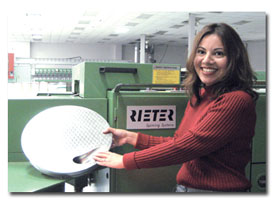
Mirna Lopez, Rieter Corp. customer service representative, shows Rieter’s CLEANCoil coiler
plate.

To answer your question more directly: Aftermarket parts may cost less, but using them may
result in deterioration of the initial investment. Additionally, aftermarket parts may break
prematurely or have an adverse impact on yarn quality. Ultimately, in the long term, the least
expensive spare parts are the parts from the OEM, in our case, from Rieter. This should not come as
a surprise – after all, the OEM designed the parts and understands why a part is designed a certain
way, how the part has to interface with its environment and what the exact function of such a part
is. Exact material specifications, consistent and defined finishing processes, and many other
design and manufacturing factors are decisive. As said: Quality involves attention to details; to
all details that is. Rieter, as the OEM, can guarantee this, whereas aftermarket parts are often
based on guesswork.


TW:
In the final analysis, are you saying that it is less expensive to buy original parts?

Fréderic: Yes, I am convinced that this is very true in many ways.  Just keep
in mind that companies offering aftermarket spare parts have a pick-and-choose concept. They make
some parts but may not have the capability or knowledge to duplicate many other parts. In contrast,
Rieter, with Rieter Spartanburg serving the NAFTA/CAFTA-DR region, is a one-stop shop for our
customers. What a time and, therefore, cost savings for our customers!

In this context, we are proud that we always send the right part the first time.
Furthermore, the part will fit and will do its job. There is no guessing, no trial and error.
Imagine what this means in terms of money saved for the customer when a machine is down.

November/December 2008

Invista, Klopman Unveil Klopman Vantage Fabric

Wichita, Kan.-based integrated fibers and polymers manufacturer Invista has partnered with
England-based polyester/cotton blended fabric manufacturer Klopman International to create Klopman
Vantage workwear fabric featuring Cordura® brand technology.

Klopman Vantage twill fabric with Cordura — developed to meet a demand in the European
workwear market for increased comfort in a durable, abrasion-resistant fabric that can be used for
a complete garment — is made with an intimate blend comprising 50-percent Invista™ T420 Nylon 6,6
fiber and 50-percent combed cotton, and weighs 250 grams per square meter. According to the
companies, the fabric has been tested by independent laboratories and has met the highest color
retention and performance standards, withstanding 250,000 Martindale rubs without failure.

The fabric, which will be used to make trousers, coveralls and other apparel, will be
available in khaki and black, with additional colors to be added later to the range.

November/December 2008

WFXOnDemand Offers Flexible Reporting Tools

WFXOnDemand.com — a New York City-based provider of
fashion and apparel product development software — has added a configurable tool to its Web Product
Lifecycle Management (PLM) software that allows users to choose their viewing format or reports
created using the application. The flexible reports have multiparameter selection capabilities that
enable users to create and configure their own reports with specified data, store the reports, and
then later view them in a specified format without reconfiguration.

All reports in the flexible reporting format are available to WFX customers free of charge
as part of their subscription to
WFXOnDemand.com.

November/December 2008

SETeMA Unveils Porta-Wash Modular Washing Line

SETeMa BV, the Netherlands, has introduced the Porta-Wash roll-to-roll modular washing line that
provides a long dwell time with minimal water content, minimal fresh water usage and moderate
mechanical impact in line with the requirements of the diffusion wash process.

Each module is equipped with an adjustable vacuum system that can remove polluted water
containing dyestuff and thickener residue from the cloth. Energy-efficient features include a
counter-flow heat exchanger; airflow circulation at the vacuum system; and thermally isolated
walls. A programmable logic controller controls washing speed, water temperature and vacuum per
cloth type in each module.

Porta-Wash comes in three cloth widths; has a full-color, touch-screen interface; and offers
options such as scroll rollers, tension control bars, two types of drying systems, and winding and
unwinding systems.

November/December 2008

Nilit® Aquarius Featured In Nux Seamless Activewear

Israel-based nylon 6,6 fiber manufacturer Nilit Ltd. will provide its Aquarius moisture-management
nylon 6,6 to Los Angeles-based Nux USA for the Nux seamless women’s activewear line including
tanks, racers, camis, leggings and shorts.

“We selected Nilit Aquarius yarn for Nux for several reasons,”said Lourdes Lozano, sales
manager, Nux. “The moisture management mechanism is built into the yarn itself so we could avoid
using chemical finishes, which athletic purists may resist. Plus, Nilit Aquarius delivers a
luxurious hand, which is so important to women, and the yarns hold color well, resulting in
beautiful, vibrant garments.”

Nilit Aquarius incorporates three tiers of moisture management: a permanently embedded
moisture-management additive; cross-section shaped fibers to maximize wicking surface area; and
moisture-wicking micro-channels.

November/December 2008

NCSU Installs Atmospheric Plasma System For Textile Finishing R&D

North Carolina State University (NCSU), Raleigh, N.C., has opened a development center for a new
atmospheric plasma system that provides economical, eco-friendly application of performance
properties to textiles and apparel. NCSU says garments so finished may stay clean longer and have
higher comfort levels than those finished using traditional processes.

Other project participants are APJeT Inc., Santa Fe, N.M., exclusive licensee of Atmospheric
Pressure Plasma Jet technology; Air Products and Chemicals Inc., Allentown, Pa., a provider of
atmospheric, process and specialty gases; and textile dyeing and finishing machinery producer
Morrison Textile Machinery Co., Fort Lawn, S.C.

apjet
Morrison Textile Machinery’s atmospheric plasma machine with technology invented by Gary
Selwyn, APJeT Inc.

The facility will test the system and rate its efficacy on a range of materials. Textile
chemistry and polymer science students will receive training on the equipment and help laboratory
and APJeT staff test the system and develop processes and products. Companies will be able to test
the system for finishing wovens, nonwovens and knits.

“The goal is to not only replace conventional application of finishes, but to develop novel
methods and original products you would not be able to get with conventional systems,” said Dr.
Peter Hauser, professor and director of graduate programs, NCSU College of Textiles.

The system uses ionized gas to apply a nanolayer coating to fabric to provide water and stain
repellency and moisture management, eliminating use of water for chemical wet treatments and the
need to treat wastewater, as well as the need to heat-cure and dry the treated fabric. The fabric
also can offer repellency on one side and moisture management on the other.


November/December 2008

Lenzing Launches ProModal® Blended Fiber

Austria-based cellulosic fiber manufacturer Lenzing AG has introduced ProModal®, a blend of Lenzing
Modal® and Tencel® fibers that combines Modal’s soft hand with Tencel’s moisture absorption,
skin-sensitive properties and strength.

ProModal is blended using a specific blending ratio of the two fibers developed for this
particular application. According to Lenzing, textiles made with the blended fiber exhibit enhanced
tear strength and bursting pressure, and a soft hand with increased fullness. ProModal can be used
alone in knitwear and also can be blended with cotton.

To assist manufacturers licensed to market fabrics using the ProModal brand, Lenzing has
established the ProModal Club, through which it offers technical support services related to fabric
production as well as marketing and processing advice. According to the company, members also can
optimize their supply chain management, and retailers and brands can receive sourcing support.

Lenzing also is promoting the sustainability of ProModal, which is extracted from wood. The
company points out that the fiber blend has a yield approximately six times higher than that of
cotton, and its production consumes 10 to 20 times less water.

November/December 2008

Sponsors