April 2009

Richmond, Va.-based
Performance Fibers has redesigned its website, located at
www.performancefibers.com.

The Italy-based
Lazzari Cultural Association has launched the third edition of the Textile Design
Contest, open to fashion and interior designers ages 18 to 35. The deadline for applications is
June 15. For more information, contact +39-0422 598564 or
associazioneculturale@lazzariweb.it.

Research and Markets Ltd., Ireland, has released the following publications:
“Recycling in Textiles,” the “Smart and Interactive Textiles Report,” and “Trends in World Textile
and Clothing Trade.”

Laser Research Optics, Providence, R.I., has updated its website, located at
www.laserresearchoptics.net. The site features a
wide range of carbon dioxide (CO2) laser optics for original equipment manufacturers and industrial
and medical laser systems users.

bb
Laser Research Optics’ website’s new offering of CO2 laser optics

Anovotek LLC, Greenville, has launched its new website, located at
www.anovotek.com.

The
ABB Group has relocated its North American headquarters to 12040 Regency Pkwy,
Suite 200, Cary, N.C., 27518, (203) 750-2200; fax (203) 750-2263.

Israel-based
OptiTex Ltd. now offers expanded online access to features of its computer-aided
design and manufacturing solutions. For more information, visit
www.optitex.com.

The
American Apparel & Footwear Association (AAFA), Arlington, Va., has released
the fourth edition of the global AAFA Restricted Substances List covering home textiles, apparel
and footwear. The list is available free of charge at AAFA’s website, located at
www.apparelandfootwear.org.

Supercritical Fluid Technologies Inc. (SFT), Newark, Del., has introduced the
SFT-250 Supercritical Fluid Extractor (SFE) for performing extractions in supercritical fluid or
for small-scale pilot processing.

sft
The SFT-250 SFE System

Pinpoint Laser Systems Inc., Peabody, Mass., has released the Microgage Roll
Alignment kit for use in paper and textile mills; converting, coating, and plastic bag lines;
printing presses; and other roller and web-related applications.

ASTM International, West Conshohocken, Pa., now offers the sixth edition of 
“ASTM Standards on Precision and Bias for Various Applications.” To order the online-only
publication, contact (610) 832-9585 or
service@astm.org.

Cognex Corp., Natick, Mass., has released VisionPro™ 5.2 software, featuring
SearchMax™ and Color Extractor™ color tools; a simpler version of PatMax® technology; and muticore
support for PatMax PatInspect™ and image filtering tools.

The
Association of the Nonwoven Fabrics Industry (INDA), Cary, N.C., has published a
special online issue of the Journal of Engineered Fibers and Fabrics that focuses on nonwovens and
engineered fabrics modeling. The journal can be accessed free of charge at
www.jeffjournal.org.

Alexandria, Va.-based
Color Marketing Group will offer its annual Color Direction® forecast in a digital
format using Grand Rapids, Mich.-based X-Rite Inc.’s ColorMunki Design spectrophotometer.

April 21, 2009

April 2009

Diversified Systems Inc., Greenville, has added
Harold Yoder and
Gary Cooper to its staff.

The Switzerland-based
International Organization for Standardization (ISO) has appointed
Rob Steele secretary general.


Solvay Chemicals Inc.
, Houston, has promoted
Paul Jones to business manager, Sulfite and Trona markets.

jones
Jones

Paris-based
Lectra has appointed
Hakan Dadaglioglu managing director, Lectra Turkey. The company also has named
Simon Poulton vice president, sales, strategic fashion and product lifecycle
management, North America.

DWI at RWTH Aachen University, Germany, has appointed
Dr. Alexander Böker deputy director and head of the Macromolecular Materials and
Surfaces department.

alexander
Böker

The Netherlands-based
Royal DSM NV has appointed
Luca Rosetto corporate vice president, Safety, Health, Environment and
Manufacturing;
Stefan Doboczky business group director, DSM Anti-Infectives;
Hans Van Suijdam compliance officer and director, Corporate Operational Audit; and
Gerard de Reuver director, Strategic Projects.

Greensboro, N.C.-based
VF Corp. has promoted
Steve Rendle to president, Outdoor Americas coalition;
Stephen Murray to president, Action Sports Americas coalition; and
Martino Scabbia Guerrini to president, Sportswear and Contemporary Brands EMEA
coalition.
Juliana Chugg has been elected to the Board of Directors.

Bushman Equipment Inc., Milwaukee, has named
Peter Kerrick executive vice president and
Ken Lewis chief engineer. The company also has promoted
John Brammer to managing director, Avon Engineering.

YKK Corp. of America has named
Michael Blunt Fastening Business leader, North and Central America region; and
president, YKK USA and Tape Craft Corp.

blunt
Blunt

Research Triangle Park, N.C.-based
Entegrion has appointed
Dr. Peter C. Johnson executive vice president and chief business officer.

The Los Angeles-based
Textile Association of Los Angeles (TALA) has named
Robert Seaman, STC/QST, member of the year; and
Richard Clareman, Self Esteem, Friend of TALA.

The
World Carpet and Rug Council has named
Simon Van de Vrande European Carpet and Rug Association, president; and
Werner Braun, Carpet and Rug Institute, vice president.

Spain-based
Lorpen has appointed
Bruce Barrows US sales manager.

New York City-based
Jones Apparel Group Inc. has elected
Robert L. Mettler and
Margaret H. Georgiadis to its Board of Directors.

The
American Association of Textile Chemists & Colorists (AATCC) has named
John R. Provost and
Wim Prinsen recipients of the Henry E. Millson Award for Invention. AATCC has
presented The J. William Weaver Paper of the Year Awards to:
Carol Tomasino Revels, “Describing Color Differences,” and
Philip J. Brown,
Kristofer D. Sinclair and
Charles Kenneth (Ken) Webb, “Capillary Channel Polymer Fibers as Structural
Templates for Ligament Regeneration.” AATCC also has named the following as winners of the 2009
C2C/CITDA Design Competition: For Fabric Design, first place,
Miranda Shilati; second place,
Eleanor Hoffman; for Product Design, first place,
Erika Neumayer; second place,
Wesley Kathryn Woods.

prinsenjohn
Prinsen (left) and Provost

Ahlstrom Corp., Finland, has named
Seppo Parvi CFO and member of the Corporate Executive Team (CET); and
Paula Aarnio senior vice president, human resources, and member of the CET.

Clariant, Switzerland, has appointed
Peter Lindner president, Asia Pacific region;
Brad McClanahan director, Archroma Global Services; and
Mathias Lütgendorf a member of the Executive Committee.

Delta Apparel Inc., Duluth, Ga., has appointed
Robert E. “Bob” Staton to its Board of Directors.

Stylesight, New York City, has named
Christophe Vanackere senior vice president of sales, for Europe, the Middle East
and Africa.

Australian Wool Innovation (AWI) has named
Brenda McGahan chief executive.

Celanese Corp., Dallas, has named
Sandy Beach Lin corporate executive vice president, Consumer Specialties segment;
and
Doug Madden corporate executive vice president, Acetyl Intermediates segment.

Portland, Ore.-based
Naturally Advanced Technologies Inc. has named
Jeremy K. Jones to its Advisory Board.

ASTM International, West Conshohocken, Pa., has appointed
Jayakumar Gopalakrishnan consultant, India.

Switzerland-based
Sanitized AG has appointed
Darrell Burnette business development manager, North America.

darrell
Burnette

Austria-based
Asamer Basaltic Fibers GmbH has named
Dr. Wolfgang Hermann manager;
Simon Riepler quality manager;
Arne Feldmann product manager; and
Brigitte Stöhr customer service and management support.

Maidenform Brands Inc., Iselin, N.J., has appointed
Patricia J. Royak senior vice president and managing director, International.

Atlanta-based
AMC Inc. has named
Lori Kisner senior vice president, AmericasMart Apparel.

Cuyahoga Falls, Ohio-based
Americhem Inc. has appointed
Michael Frisch technology manager, European Fibres.

frisch
Frisch

Boulder, Colo.-based
Outlast Technologies Inc. has promoted
Heather Listoe to sales and marketing director, Outlast North America;
Ashley Tilman to Web and inside sales manager;
Heidi Allen to marketing assistant; and
Jeannie Timberman to account manager, North America.

Haggar Clothing Co., Dallas, has named
Paul Buxbaum CEO.

Delano, Minn.-based
EasiWay Systems Inc. has named
Steve Nelson regional sales manager and
Sara Schluter project manager.

Hildebran, N.C.-based
International Legwear Group‘s Board of Directors has named
Kathy Willis CEO.

Duquesne, Pa.-based
American Textile Co. has appointed
Jeff Brown to its Board of Directors.

Pasadena, Calif.-based
Avery Dennison Corp. has named
John M. Sallay senior vice president, new growth platforms.

Decorator Industries Inc., Pembroke Pines, Fla., has appointed
William A. Johnson a director.

Dr. Seshadri Ramkumar, Texas Tech University, has received the 2009 Scientist of
the Year Award from the Lubbock, Texas, chapter of the
Achievement Rewards for College Scientists.

Rancho Cucamonga, Calif.-based
Colorep Inc. has appointed
David Gelbaum to its Board of Directors.

April 2009

Industries Seek Changes On Consumer Safety Regulations

A wide-ranging group of industries, including textile and apparel manufacturers, is mounting an
effort to bring about changes in a new consumer product safety law, which they feel is resulting in
chaos in the marketplace.

The recently enacted Consumer Product Safety Improvement Act, designed to address problems
with unsafe toys, has been interpreted to cover products ranging from toys and other products used
by children to include textiles and clothing. Kevin Burke, president and CEO of the American
Apparel and Footwear Association, says that while his members support the “good intentions” of the
legislation, its coverage and deadlines are a threat to the apparel industry. He charges that the
legislation has “unrealistic timelines, rigid statutory language, no-risk-based safety approaches
and unclear guidance for the Consumer Product Safety Commission [CPSC].”

Burke has outlined four key issues that he believes need to be addressed including:

•    elimination of retroactive application of product safety standards;

•    the need for the commission to move quickly to make pending
determinations on textiles and other products that do not contain lead, and for Congress to grant
the CPSC authority to make “commonsense determinations” to ease the testing burden;

•    the need for CPSC and Congress need to accredit more testing agencies and
revise testing mandates that currently are redundant and costly; and

•    the need to delay effective dates for the new standards and requirements
until full regulations are developed and guidelines published.

Burke says that at this time, manufacturers and retailers are having to develop their own
guidelines and guessing as to what the regulations actually are.

Following a recent Washington rally of interested parties and members of Congress, Rep. Joe
Barton, R-Texas, and 16 co-sponsors introduced legislation designed to address these issues. Among
other things, it would establish third-party testing requirements and make the rules covering lead
in products prospective rather than retroactive. It would exclude products for which there clearly
is no problem with lead content, which textile and apparel manufacturers contend is the case with
their products. It also would grant CPSC authority to waive tracking and labeling of products that
are not considered dangerous.

April 14, 2009

Textile And Sewn Products Industry Week 2010 Selected For IBP

The Department of Commerce’s (DOC’s) US Commercial Services Unit has chosen Textile and Sewn
Products Industry Week 2010 — featuring the co-located ATME-I/Megatex, SPESA Expo and Techtextil
North America trade shows — to participate in its International Buyers Program (IBP). The event is
one of only 35 trade events in 2010 selected for IBP.

Exhibitors and attendees of Textile and Sewn Products Industry Week, to be held May 18-20,
2010, at the Georgia World Congress Center in Atlanta, will have expanded opportunities to meet and
network with international buyers, sales representatives and strategic partners. In addition,
exhibitors’ products and services will be promoted through the Export Interest Directory.
Exhibitors also will have access to international industry-specific trade leads, as well as export
counseling, marketing analysis and matchmaking services.

The US Commercial Services Unit — the trade promotion arm of the DOC’s International Trade
Administration — runs IBP to assist US companies in finding international business opportunities by
recruiting more than 125,000 foreign buyers, trade representatives and distributors worldwide to 35
US trade shows per year.

April 14, 2009

QuestaWeb Obtains ACE ABI Certification

Westfield, N.J.-based QuestaWeb Inc., a provider of Web-based integrated global trade management
(GTM) solutions, has been certified on the Automated Broker Interface (ABI) for the US Customs and
Border Protection’s (CBP) new Automated Commercial Environment (ACE). QuestaWeb is the first vendor
to receive ACE ABI certification, which enables the company to transmit and receive data on
imported merchandise through a direct electronic interface with CBP.

Currently, only customs brokers and importers using QuestaWeb’s TradeMasterQW GTM solution
can benefit from the new compliance system’s benefits, which include improved organized entry
summary filing and response guides; ability to query and electronically override Census warnings; a
new entry summary status notification messaging process; and two-way communication capabilities
between the filer and CBP.

“QuestaWeb is committed to maintaining its position as a leader in the global trade
management field,” said Leon Turetsky, CEO, QuestaWeb. “We were among the first companies to obtain
ABI certification, so it is not at all surprising that we would be the first to achieve ACE ABI
certification. While the testing process was demanding, certification brings untold business
benefits to our customers and was well worth the effort. By being on the leading edge of GTM
technology, QuestaWeb continues to a deliver distinct business advantage to its customers.”

April 14, 2009

EasiWay Launches EasiStrip Supra™ Reclaimer

Delano, Minn.-based chemical manufacturer EasiWay Systems Inc. has added a one-step screen
wash/emulsion reclaimer to its product line. EasiStrip Supra™ One Step Ink Cleaner and Emulsion
Remover is a low-odor, nonflammable, biodegradable, non-hazardous product that, according to
EasiWay, exceeds the performance and efficiency of existing one-step reclaimers in dip tanks and
automatic machinery, and in manual textile screen reclaimation. The company also reports that Supra
is less expensive and easier to use than similar conventional products. Supra is packaged in
quarts, gallons, 5-gallon pails and 55-gallon drums, and is designed to be mixed with water in a
dip tank in a ratio of 1 part chemical to 6 parts water.

April 14, 2009

Optimer Offers Non-Museled Dri-release® Wool, Receives REACH Certification

Wilmington, Del.-based Optimer Brands has completed testing and certification of non-museled wool
sources for use in its Dri-release® wool yarns featuring FreshGuard® moisture-management and
odor-eliminating technology. Museling — an invasive and reportedly painful procedure performed on
merino sheep in parts of Australia to prevent insect infestations — has become a subject of public
debate concerning humane practices in raising sheep.


“A lot of wool is purchased through co-ops or comes from various origins that cannot be
certified,” said Karen Deniz, director of marketing, Dri-release. “Though limited so far, we have
been able to identify the chain of sourcing through our spinners in order to offer the alternative
of non-museled wool.”

In other company news, Luxemburg-based Chemservice S.A. — an independent regulatory affairs
service — has certified Optimer’s Dri-release with FreshGuard to be compliant with Registration,
Evaluation, Authorization and Restriction of Chemicals (REACH), a European community regulation
covering chemicals and their safe use.

“We knew Dri-release and FreshGuard were safe, but wanted to go the extra mile and have it
checked so our customers that market in the European Union could be assured of REACH compliance,”
Deniz said.

April 14, 2009

No Near-Term Pickup


A
still-sliding economy continues to take its toll on textiles and other major US
industries. Especially disturbing: The reluctance on the part of consumers to spend the money they
do have. Personal savings (the percent of disposable income not spent), for example, is now running
near 5 percent. That’s the highest level for this key business indicator in some four years – and a
significant shift from just a year or two ago, when a negative savings rate prevailed, with people
spending more than they earned. Much of this penny pinching, of course, can be attributed to the
huge drop in net worth occasioned by the housing and stock market meltdowns. In any case, consumer
spending has slipped significantly – falling at about a 4-percent annual rate since last summer,
after more than a quarter century of steady growth. About the only consolation – if you can call it
that – is that declines in big-ticket consumer durables like cars, personal computers and TVs have
been far more precipitous than those reported by the textile and apparel industries. Year-to-date
figures, for example, show auto sales trailing comparable 2008 figures by 40 percent (and by close
to 50 percent in the case of Detroit’s “Big Three”). That’s far more than the modest slippage noted
by both apparel and home furnishing retailers. Nor is any dramatic change in this pattern expected
anytime soon. Most business analysts see further, though decelerating, gross domestic product (GDP)
declines through summer. And the picture seems to be much the same as far as textiles and apparel
are concerned.

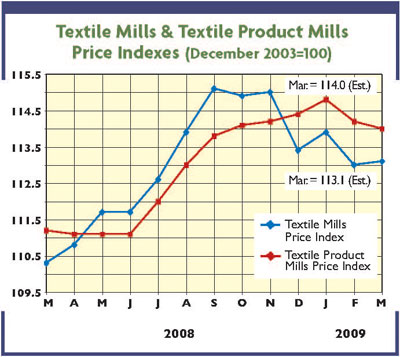
april09bfchart


The Impact On Profits


The above near-term outlook can also be expected to keep industry earnings and margins under
downward pressure. Net profit for basic textile products like yarns and fabrics, for example, are
projected to show another decline this year – with totals for the year dropping 5 to 6 percent
below 2008 levels. And a similar picture is seen for more highly fabricated mill products like
carpets and home furnishings, where the earning slippage is put somewhere around the same
magnitude. Apparel companies won’t escape unscathed either – though the latest estimates here
suggest a bit more modest 3-percent drop-off in the industry’s 2009 after-tax earnings. In all
cases, these declines are larger than those projected as recently as last fall before the extent of
the current business meltdown became apparent. On a somewhat rosy note, however, all these
textile/apparel subgroups should remain profitable – at least on an overall industry-wide basis.
And clearly, there will be no repeat of the negative numbers that were reported as recently as
2000. Also worth noting: These new 2009 profit projections are also a lot better than those being
made for many other consumer-oriented durable goods industries. This absence of any really big
drop-off in mill and apparel manufacturers profits can probably be attributed to three factors: The
above-mentioned more moderate fall-offs in consumer demand; reduced raw materials production costs;
and rising worker productivity – which, when combined with only very modest hourly pay raises, has
helped keep unit labor costs on a relatively even keel.


A Longer Look Ahead


The really big question mark, however, is what happens next year when things hopefully begin
to turn around. Unfortunately, any quick bounceback seems highly unlikely. Right now, most
economists and business analysts are betting on only a very modest 1- to 2-percent increase in the
nation’s GDP for 2010. The problem is that this won’ t be nearly sufficient to generate enough
purchasing power for any textile and apparel gains. Global Insight, for example, anticipates
further domestic sales deterioration for these industries in 2010 – with declines that year put at
3.5 percent, 6.5 percent and 7.5 percent for basic textiles, textile mill products, and apparel,
respectively. If any positive spin can be put on these numbers, it’s the fact that analysts at this
prestigious economic consulting and forecasting firm feel these shipment declines will be far less
than the 15-percent-or-so drops anticipated for all three of these categories over the current
year. Global Insight’s profit forecasts also provide some reassurance of better days ahead. The
firm’s rough approximation of this key indicator representing sales less labor and material costs
should actually begin to move up again next year in the textile sectors. If correct, it would
follow four consecutive years of textile earnings shrinkage. Bottom line: The industry, while
clearly a lot less smaller than it was a few years back, will still be a major world player as we
move into the second decade of the 21st century.

April 14, 2009

Organic Exchange Report Shows Global Organic Cotton Market Hits New High

According to the Organic Cotton Market Report 2007-2008 released by Lubbock, Texas-based non-profit
organization Organic Exchange (OE), global retail sales of organic cotton apparel and home textile
products reached an estimated $3.2 billion in 2008, a 63-percent increase over the $1.9-billion
market in 2007. Organic production is based on a farming system that maintains and replenishes soil
fertility without using toxic and persistent pesticides and fertilizers or genetically modified
seeds.

The top 10 organic cotton-using brands and retailers globally were: Bentonville, Ark.-based
Wal-Mart Stores Inc.; Belgium-based C&A; Beaverton, Ore.-based Nike Inc.; England-based
H&M; Spain-based Zara; New York City-based Anvil Knitwear Inc.; Switzerland-based Coop Group;
San Francisco-based Pottery Barn; Renton, Wash.-based Greensource Organic; and Germany-based Hess
Natur.

Despite the current economic downturn, most brands and retailers selling organic cotton
products are continuing their sustainability measures, with plans to expand product lines 24
percent and 33 percent in 2009 and 2010, respectively, to create an estimated $4 billion market in
2009 and a $5.3 billion market in 2010.

“It is a sign of the times that despite ominous financial forecasts, brands and retailers
are standing fast to their commitment to making their product lines more sustainable by ever
increasing their use of organic cotton and other organic fibers such as wool, linen, and silk,”
said LaRhea Pepper, senior director, OE.

According to OE’s Organic Cotton Farm and Fiber Report 2008, the amount of organic cotton
grown by farmers globally in 2007/08 increased by 152 percent. The organization also noted that
during 2008, certified organic cotton fiber suppliers increased by 95 percent – compared with
annual growth rates of 45 percent in 2006 and 53 percent in 2007.


April 7, 2009

Gneuss Launches Measurement Technology In North America

Matthews, N.C.-based Gneuss Inc. – the North American subsidiary of Germany-based Gneuss
Kunststofftechnik GmbH, a manufacturer of filtration, measurement and processing technologies for
plastic melts – is now offering Gneuss measurement technology in North America. The technology
consists of a complete line of melt pressure and temperature sensors, including instrumentation,
for plastics extrusion applications. 

Gneuss’ latest technological development is the NTX™ non-mercury series of melt pressure
transducers and transmitters, which, according to the company, offers premium performance and
increased life compared to conventional mercury, sodium potassium and other alternative
fill-mediums. The NTX sensors are environmentally safe and rated for temperatures up to 930ºF.
Sensor enhancements include the new DAP series heated-tip option, which reduces the risk of
diaphragm damage during installation and removal; a special membrane design that enhances
longer-tip diaphragm life; and a flexible capillary design.

April 7, 2009

Sponsors