Hyosung Mipan® Regen™ Yarns Net GRS Certification

South Korea-based Hyosung Corp., manufacturer of creora® spandex, has received Global Recycle
Standard (GRS) certification from the Netherlands-based Control Union Certifications for its Mipan®
regen™ nylon and regen polyester recycled yarns.

Mipan regen nylon — a 50-percent recycled nylon made from 100-percent post-consumer materials
— is the first and only recycled nylon filament yarn constructed from post-consumer material for
textile applications, according to Hyosung. Mipan regen polyester is a 100-percent recycled
polyester manufactured from 100-percent post-consumer materials. Yarn production using recycled
materials significantly reduces carbon dioxide emissions and petroleum use.

Hyosung is the first man-made fiber manufacturer to meet GRS certification requirements.
Control Union audited the manufacturing process in Hyosung’s plants — from raw material collection
to spinning and texturing — to certify production as well as the resulting materials.

“We are very pleased to add more creditability to our recycled fibers with this third-party
certification,” said B.K. Cho, vice president, Hyosung. “Now our mill customers and
retailers/brands can use them with more confidence.”

May/June 2009

Fair Currency Bill Introduced In Congress

A bipartisan group of House and Senate members has introduced legislation designed to offset the
competitive advantage of countries that undervalue their currencies. The legislation, which has 40
co-sponsors, is one of the top priorities of US textile and apparel manufacturers as well as a wide
range of other manufacturing industries.

The Currency Reform for Fair Trade Act (CRFTA) would allow injured US manufacturing
industries to seek offsetting duties under countervailing duty or anti-dumping laws. Sponsors of
the legislation say it will not violate World Trade Organization (WTO) remedies that are available
to member countries. They point out that WTO rules treat currency undervaluation as a prohibited,
countervailable export subsidy.

The proposed law states that exchange rate misalignment occurs when a foreign government
engages in protracted, large-scale intervention in the exchange markets, with the result that its
currency is undervalued or overvalued on an inflation-adjusted, trade-weighted basis by at least 5
percent over an 18-month period.

 “China continues to illegally subsidize products by a third of the costs by
manipulating their currency to undercut American goods,” said Rep. Tim Murphy, R-Pa., one of the
measure’s initial sponsors. “The time has come for Congress to stand up for American workers and
not allow China to run roughshod over the American economy. With this legislation we will finally
force China to stop cheating and level the playing field for America’s manufacturers.”

The legislation was launched at a Capitol Hill news conference sponsored by the Fair Currency
Coalition, which includes the American Manufacturing Trade Action Coalition (AMTAC), the National
Council of Textile Organizations, the National Textile Association,  the US Industrial Fabrics
Institute (USIFI) and the American Cotton Shippers Association. It also is heavily weighted with
labor organizations including the American Federation of Labor/Congress of Industrial
Organizations.

Speaking at the news conference,  Rep. Tim Ryan, D-Ohio, said: “This is one of the most
broad-based coalitions I’ve ever had the pleasure to work with. Democrats and Republicans,
manufacturers and labor, and representatives from all over the country have come together on this
common-sense legislation, which only asks countries to live up to the standards they agreed to when
they joined the WTO.”

Auggie Tantillo, executive director of AMTAC, said the Obama administration has said it
stands for fair trade, and that “there is no better way to prove that they actually mean what they
say than to enact the currency reform legislation.”

Noting that the US technical textile community has “borne the brunt of currency exploitation
for some time, with a disastrous effect on employment,” Ruth Stephens, executive director of USIFI,
strongly endorsed the legislation, saying, “This effort will help our world have ethical and
logical currency principles.”

May 19, 2009

Rosink Launches Easy-To-Use Cot Grinder

Germany-based Rosink GmbH + Co. Maschinenfabrik took the occasion of the recent Saigon Tex trade
fair in Vietnam to introduce “Rosy by Rosink,” an economically priced, easy-to-operate cot grinder
that enables precision manual grinding of spinning cylinders.

According to the company, the new grinder can be used with nearly all conventional spinning
cylinders, including ring-spinning and flyer top rollers – as well as with open-end top rollers
when an optional Rosink auxiliary shaft is provided. The machine features a center arm, or lever,
for loading and another on the right for grinding and polishing. Rosink reports the machine can
process more than 240 top rollers per hour, and even up to 360 per hour.

Rosy is equipped with a dressing diamond for cleaning the grinding stone, a dust exhauster,
one holding attachment and an operation and instruction manual. An optional Rosink WT56 Measuring
Device enables measurement of the cylindricity and roundness of the ground cot, which is guaranteed
to have a maximum cylindricity deviation of 0.02 millimeters and a roundness of 0.

May 19, 2009

Conwed Introduces Padmate® Carpet Cushion Netting With Ecocycle™ Technology

Minneapolis-based Conwed Global Netting Solutions – a manufacturer of high-performance plastic
netting solutions used in consumer-packaged goods and building materials applications, and a part
of Conwed Plastics LLC – has introduced 100-percent degradable Padmate® netting for carpet cushion
padding. According to the company, though carpet pad recycling is one of the largest recycling
efforts in the United States, more than 2 million pounds of carpet cushion netting is not recycled.
Conwed uses its patented Ecocycle™ technology in the construction of the netting, which breaks down
faster than conventional plastics and costs similarly to conventional plastic netting, the company
reports.

May 19, 2009

Trevira Begins Restructuring

Germany-based Trevira GmbH – a company of the India-based Reliance Group and a manufacturer of
high-value branded polyester fibers and filament yarns for the apparel, home textiles and
automotive industries as well as hygiene and technical applications – has begun restructuring after
experiencing a severe decline in sales caused by the global economic crisis. Reliance Group has
appointed Elke Bäuerle managing director to head the restructuring.

“It is now our task to maintain Trevira’s sound and profitable core,” Bäuerle said. “Trevira
has good products and is fundamentally competitive.”

May 19, 2009

Unifi Launches Repreve® FR

Greensboro, N.C.-based Unifi Inc. – a producer of multifilament polyester and nylon textured yarns
– has launched Repreve® FR, the newest addition to its Repreve family of 100-percent recycled
fibers. Repreve FR, containing at least 2,000 parts per million phosphorus, is the first recycled
polyester fiber with inherent flame-retardant (FR) properties.

Momentum Textiles – a supplier of contract textiles and a division of the Irvine,
Calif.-based Momentum Group – will use Repreve FR in its new line of healthcare privacy curtains.

“The inherent performance of Repreve FR provides Momentum Textiles with an environmental
solution for our line of healthcare privacy curtains,” said Eddie Elizondo, marketing manager,
Momentum Group. “We are committed to expanding our environmentally sustainable product offering to
meet the market’s need for sustainable textiles.”

May 19, 2009

FesslerUSA Plant Renovation To Include Solar Power Generating System

A $1.6 million loan from the Pennsylvania Industrial Development Authority to
Orwigsburg, Pa.-based FesslerUSA, announced recently by the office of Gov. Edward G. Rendell, will
help fund construction of a $5.4 million 1-megawatt photovoltaic solar power generating system at
the company’s Deer Lake manufacturing plant.

The loan follows a $1 million grant the company received for the project in late 2008 from
the Pennsylvania Energy Development Authority. The project includes the addition of a new roof for
the plant and installation of photovoltaic solar panels to generate more than 1 million kilowatt
hours of electricity annually, with completion expected before the end of 2009.

The company initiated the project in a proactive effort to control costs at the plant, in
view of an expected 40-percent jump in industrial electricity rates when state caps on rates are
removed Jan. 1, 2010. “Since we use considerable electricity in our manufacturing process, and the
clock was ticking, we wanted to evaluate every option to help us maintain our competitiveness in
this globally competitive marketplace,” said Bonnie Meck, chief sustainability officer, FesslerUSA.

“We soon learned that we were trailblazers,” added CEO Walter Meck, referring to a lack of
infrastructure in Pennsylvania to support industrial-scale solar power generation. “Europe and a
number of states in the USA have made great progress, but Pennsylvania is just learning what it
takes to make solar work. A myriad of financial and regulatory challenges presented themselves at
every turn in the road.”

Meck credited support from state and federal lawmakers, including US 17th District Rep. Tim
Holden, D-Pa., and State Sen. Dave Argall, R-29, as well as the Governor’s Action Team. The
Schuylkill Economic Development Corp. also supported the project.

May 19, 2009

Cotton Incorporated Unveils Fabricast™ Collection, Sustainability Websites

Cary, N.C.-based Cotton Incorporated has introduced its Fabricast™ collection of fabric
developments to provide retailers and suppliers with technical solutions to minimize costs in
cotton fabric construction. The collection, called “Great Cotton Ideas During Tough Economic
Times,” offers detailed directions and fabric swatches for 11 classic knit and woven fabrics
comprising 100-percent cotton or high cotton blends made for apparel and home furnishings
applications.

“In a down market, brands are looking to cut costs and still maintain good quality of the
finished product, and these Fabricast fabric developments show them how to do just that,” said Jim
Grow, director, product development, Cotton Incorporated. “‘Great Cotton Ideas During Tough
Economic Times’ is a valuable resource for those brands and retailers looking to meet consumer
demand for cotton fabrics while keeping an eye on their bottom line.”

Fabricast developments include the “Denim to Weather the Storm” fabric card, which profiles
Cotton Incorporated’s Storm Denim™ water-repellent denim technology and suggests cost-cutting
alternatives such as single-cloth fabrics; and “Dressing Up in a Down Market,” which offers
instructions for a cotton-blend jacquard woven fabric and information on how to perform discharge,
digital and pigment pattern printing at a reduced cost while achieving the effects equivalent to
those resulting from higher-cost processing.

Cotton Incorporated also has introduced two sustainability-focused websites: Cotton Today,
located at
cottontoday.cottoninc.com, which records the cotton
industry’s ongoing research and environmental progress; and Cotton: From Blue to Green®, located at
www.cottonfrombluetogreen.org, which promotes
the company’s nationwide denim recycling program. 

“We are delighted to unveil these sites that demonstrate the cotton industry’s commitment to
sustainability at the trade and consumer levels,” said J. Berrye Worsham, president and CEO, Cotton
Incorporated.

May 19, 2009

Zimmer Introduces Two-Reactor Process

Lurgi Zimmer GmbH, Germany, has developed a two-reactor process, consisting of a vertical cascade
reactor and a disc ring reactor, for improving the melt process during polyethylene terephthalate
production.

According to Zimmer, the new process will provide reliability and flexibility and reduce
investment and production costs.

May/June 2009

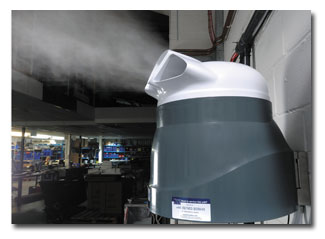
JS Humidifiers Unveils Mistifier Plus Humidifier

The Mistifier Plus is a new wall-mounted spray humidifier introduced recently by England-based JS
Humidifiers Plc – a designer and supplier of specialist textile humidification systems.

np

The company reports the humidifier is suitable for processing areas measuring up to 1,000
cubic meters. The system features directional outlets on the top of the humidifier to spray a
rapidly evaporating fine mist of water into the air to control humidity. The unit may be operated
in a simple on/off manner, or a humidistat may be used to maintain a set humidity. According to the
company, the unit features low-energy spinning disk technology that consumes 230 watts per hour
while spraying up to 6.5 liters of water.

The easy-to-maintain, hygienic humidifier also features a purge function and a siphon drain
that forces fresh water through the system; an auto drain system that flushes the system every four
hours when it is not in use to prevent development of stagnant water; an anti-scale cartridge on
the incoming water supply to reduce cleaning and maintenance; and a silver ion dosing system to
effectively manage more than 650 types of microbes.

May/June 2009

Sponsors