USTR Underscores Importance Of Enforcing Trade Agreements

In a major policy address, US Trade Representative (USTR) Ron Kirk announced a number of new trade
initiatives being undertaken by the Obama administration that will place considerable emphasis on
enforcing US trade remedy laws and world trade rules.

Kirk said Americans do not think the government has done enough to protect US trade rights,
and, for that reason, enforcement “cannot be an afterthought. It needs to be the centerpiece of
trade policy.”

While underscoring the importance of trade agreements, Kirk said, “We must do more than just
pursue new trade deals – we must insist on respect for our rights in the global trading system.”

Addressing some of the issues being pursued by US textile industry lobbyists, Kirk said he
believes one of the best ways to guarantee US trading rights is to “consistently monitor our
partners’ trade practices,” and he said the administration will continue to use anti-dumping and
anti-subsidy laws, which he believes are “vitally important tools.”

Kirk also called for renewed efforts to open overseas markets to US exports, saying that 95
percent of the world’s customers live outside of the United States. He said even in the existing
world trade climate, exports last year generated nearly $2 trillion in income for US farmers,
manufacturers and producers of goods and services and that manufactured goods exports currently
support 6 million jobs.

He said the said a new early warning system is being developed to identify barriers to trade
and help his office to “nip them in the bud.” He believes that can help save US jobs that might
otherwise be lost.

July 21, 2009

Loan Saves Textile Financial Services Supplier From Bankruptcy

CIT, a major provider of financial services for hundreds of textile and apparel manufacturers and
retailers, has received a $3 billion financial package from its major bondholders that will stave
off, at least for the time being, a threat of bankruptcy.

As one of the nation’s largest providers of financial services to small and medium-sized
manufacturers and retailers, CIT is a leading source of funds for factoring, a process by which
manufacturers can receive immediate payments for the goods they sell without facing what could be a
30- to 90-day delay if they were to rely on payments by their customers.

When CIT ran into financial difficulties last year, it received a $2.3 billion loan from the
Treasury Department, but when it recently applied for more stimulus funding, the request was turned
down by Treasury. That action sent shock waves throughout the textile, apparel and retailing
industries that depend on CIT for their cash flow.

The American Apparel and Footwear Association (AAFA) says as many as 60 percent of its
members have done business with CIT, and Cass Johnson, president of the National Council of Textile
Organizations (NCTO), said that many of his members have revolving accounts with CIT and have
established long-standing ties that cannot be replaced by other entities. Johnson said the failure
of CIT would force many otherwise healthy US textile companies and their suppliers to go out of
business.

AAFA, NCTO, the National Textile Association and the American Manufacturing Trade Action
Coalition joined some 30 other textile, apparel and retail associations in an effort to get
additional government funds for CIT. They wrote Treasury Secretary Timothy F. Geithner urging him
to reconsider his decision, pointing out that a CIT bankruptcy would have “severe ramifications for
more than one million small and medium-sized enterprises and their suppliers as well as most of the
significant retail operations in this country.” Retailers warned that their supply chains would be
disrupted and there likely would be bare shelves at Christmas time.

On July 20, CIT’s Board of Directors announced it has entered into a $3 billion loan
agreement with its major bondholders, and that it will begin a “comprehensive restructuring” to
provide additional liquidity and further strengthen its capital position. Board Chairman and CEO
Jeffrey M. Peek said that action will mean his company “is in a position to continue to serve our
valued small business and middle market customers.”

Tracy Mullin, president and CEO of the National Retail Federation, said the CIT action “comes
as a great relief to the many retailers who depend on this major lender for  financing. 
She said the news that CIT will be able to continue operations will be “one less uncertainty for
retailers about to embark on the all important back-to-school and holiday shopping season.”

July 21, 2009

First Half Sales Down, Optimism Up


N
ot surprisingly, spinners reported sales off, on average, 10 to 15 percent for the first
half of 2009, compared to the first six months of 2008. Some companies fared far worse, while a
very few weathered the darkest months of the recession with minimal impact.

“Overall, I would say 10 to 15 percent is about right,” commented one spinner. “It depends a
lot on the product, though. Our ring-spun operation has managed okay, but open-end is completely
hit and miss.”

“It has not been good, but it hasn’t been as bad as we had feared,” another spinner said.
“We are off about 10 percent, but business has been picking up. We haven’t seen an upward spike,
just a slow, but steady, increase in orders.”

Looking ahead to the next six months, many spinners anticipate gradual improvement. “It is
getting better. Orders are still shorter than we would like, but there is more business coming in.
Hopefully, this is not just a small uptick before another drop. Earlier in the year, we noticed
some positive developments one month, and then the following month was slower than ever. We have
our fingers crossed that, this time, the improvement will be more sustained.”

With most economic prognosticators forecasting an end to the global recession later this
year, there is room for some optimism, but few expect an immediate and substantial impact on sales.
“From what I am hearing now,” said a Southeastern executive, “the anticipated recovery is expected
to be mild, at least at the beginning. So I guess you could say we are guardedly optimistic about
the third and fourth quarters.”

According to one industry observer, manufacturers in all segments of the economy would do
well to take a conservative approach in the initial stages of recovery. “If anyone is expecting
consumer spending to return to pre-recessionary levels, I believe they may have to wait for quite
some time. The depth and scope of the current recession and the accompanying credit crisis revealed
the precarious financial position of many consumers. Belt tightening, which in the past might have
been a temporary measure to curb spending, is likely to become a way of life for many people for
quite a while. Fear of job loss, fear of foreclosure, fear of bankruptcy — all these have become
very real for a lot of people over the past year.”


Customer Focus


In any economic environment, focusing on customer value is a key to business success, a
manufacturing consultant noted, but it becomes absolutely essential when times are lean. “You have
to be able to provide to your customers a differentiating value proposition that sets you apart
from your competitors, especially when you can’t compete on price alone. True value is represented
by the combination of price, quality, delivery and service. For those companies that have a viable
value proposition, and are committed to executing it, recovering from depressed sales is inherently
easier. For US industry, for which competition on price alone is difficult, providing value is
based on matching product precisely with customer needs, quick turnaround of flawlessly
manufactured product, expedited delivery and post-sale follow-up. Those companies that can execute
against those elements will be in a good position to take advantage of any economic recovery.”

One specialty spinner agreed: “The way we’ve been able to get business is by providing
higher quality and faster service than our competitors in other parts of the world. We know we
can’t always be competitive on price, but we can make the commitment to have the best quality,
fastest delivery and best service.”

For those companies that haven’t yet felt any signs of recovery, the manufacturing
consultant offered this advice: “When sales are off and earnings are down, obviously you have to
look at where you can take out cost. However, one of the biggest mistakes many manufacturing
companies make is pulling in the reins completely. In difficult times, the priority should be on
generating sales, and that requires aggressively positioning your product relative to your
competition. And that means maintaining – or even increasing – your marketing program.”He went on
to say, “History is full of examples of people and companies that actually made their fortunes in
down times because of how they positioned themselves.”

July/August 2009

Import Trends


R
ecent incoming overseas shipment declines can be deceiving. True, the latest textile and
apparel import slippages are seemingly encouraging, and certainly a lot better than the disturbing
advances racked up over the past few years. But for the most part, this drop-off reflects shrinking
US demand for these products rather than any increase in the domestic market share.

While year-to-date incoming shipments, measured on a square-meters-equivalent basis, have
declined about 11 percent over the past 12 months, domestic mill sales of these same products are
off by more than 20 percent. Imports remain a major problem, and the reason is the still-growing
overseas price advantage. The US industry – while continuing to cut costs and streamline operations
– has been unable to close the import/domestic price gap. For example, quotes on domestically
produced textile lines have shown fractional increases over the past year, in marked contrast to
comparable import tags, which have been steady to a bit lower.

The inescapable conclusion: The foreign price advantage is as big as, or even larger than,
it was a year ago. Even more significantly, consumers have become increasingly price-conscious in
today’s recessionary economy. Indeed, prices have become today’s primary buying determinant. If
there’s any doubt on this score, look at recent domestic sales trends. They show outlets that
specialize in low-cost imported goods still managing to eke out gains in what is clearly a
still-declining overall market.

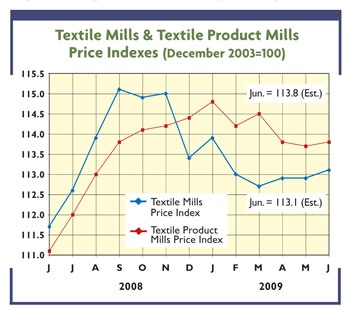
BFgraphjulaug09


Some Better News


On a rosier note, the economy continues to show signs of coming out of the biggest nosedive
since the Great Depression. True, some improvement after a year of decline might normally be
expected. But another factor could be Washington’s massive stimulus package, which is finally
beginning to kick in.

Consumer confidence is on the rise. Families are becoming more optimistic about the future
and are showing signs they’re ready to boost spending on textiles and apparel as well as other
goods. Helping prod recovery along is the huge reduction in business inventories, something that
should translate new orders into new production. And further assistance may come from stabilization
in the hard-hit housing sector and a slowly rising stock market – both of which should help recoup
some of the recent losses in family net worth.

Given all the above, gross domestic product (GDP) seems to be bottoming out, with maybe even
some fractional growth possible by late summer or fall. That would be a big swing from the huge
3.5-percent decline in this key yardstick over the past nine months. More importantly, most
economists and business analysts now see the recovery continuing into the next year. Indeed, the
betting is that if all goes according to plan, 2010 GDP could advance by as much as 2 to 2.5
percent.


Improving Profits


The anticipated economic bottoming-out and subsequent turnaround should also have some
positive implications for the industry’s bottom line. New projections by economic consulting firm
Global Insight now call for an earnings rise, both for the basic mill and fabricated textile
product sectors, next year. To be sure, the firm’s new estimates, defined as shipments less raw
material and labor costs, call for quite modest gains – nowhere near those needed to recoup the
huge declines of both 2008 and the current year, but they do represent a turnaround. And this
recovery is expected to continue into 2011 and 2012, when earnings increases are put in the 4- to
6-percent-per-year range.

Global Insight analysts also hold out hope for the apparel industry. While still expected to
be plagued by low-price imports, domestic apparel makers are expected to manage a flattening out in
earnings – hardly a recovery, but a lot better than the recent sharp tumbles.

Finally, a few comments on the role that cost containment will be playing in these modestly
upbeat bottom-line projections. Next year, combined labor and material costs for the overall
textile industry are expected to fall more than the projected slippage in comparable mill
production. The implication: falling unit costs, which over the long run should help narrow this
hard-pressed industry’s still-huge import/ domestic price gap.


July/August 2009

Quality Fabric Of The Month: Umbrella Power

Customers enjoying their lattes at an outdoor café or lounging by the hotel pool will soon be able to run their laptop computers or recharge their cell phones and other portable electronic devices via solar power generated by the umbrella overhead. SKYShades LLC, a Longwood, Fla.-based designer and manufacturer of tension-membrane shade structures, is integrating Lowell, Mass.-based Konarka Technologies Inc.’s Power Plastic® organic photovoltaic (OPV) thin-film technology into its SKYShades® retractable and fixed architectural membranes to create the Powerbrella™, with the first application being umbrellas and awnings that can provide remote power for such purposes.

QFOMpowerbrella

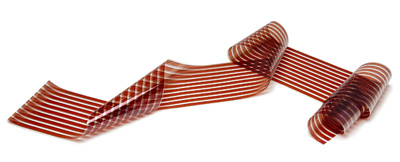
Power Plastic® strips enclosed in pockets welded
to the Powerbrella™’s surface provide solar energy

to run laptop computers or recharge other

portable electronic devices.


The marriage of architectural membrane and OPV technologies was envisioned by SKYShades President Barry Maranta, who initiated discussions with Konarka. “During an early trip to Konarka
to discuss the integration of the technologies, we saw a globe at the airport offering power for laptops and such,” said Joe McKenna, executive vice president. “That gave us the idea about how an
umbrella pole could provide charging access.”

Konarka’s OPV technology — based on a photo-reactive polymer material developed by Konarka Cofounder and Nobel laureate Dr. Alan Heeger — can be printed or coated onto a lightweight, flexible substrate using traditional roll-to-roll manufacturing. Power Plastic offers certain
advantages over traditional silicon-based solar technologies in that it collects energy up to 70° off axis both from the sun and from artificial light, and is tunable to absorb light from specific wavelengths to broad spectrum; in addition to being inexpensive and made using all recyclable materials. Konarka is working on improving the efficiency of its technology, but for now it is sufficient for the remote, off-grid applications SKYShades is developing, McKenna said. As that
efficiency increases, it will be possible to provide power for more substantial needs and even feed electricity back into the power grid.

QFOMpower-plastic

The Powerbrella’s waterproof polyvinyl chloride membrane has pockets welded onto it to hold and protect the Power Plastic strips, which are attached by electrical wiring to batteries built into the umbrella’s structure. The strips, which have a shorter life cycle than the membrane, can easily be removed and replaced as needed or as Konarka improves its technology. In field-testing, the Powerbrella has demonstrated its durability to harsh weather conditions, as well as its
capacity to generate sufficient electricity for its intended task.

Another application in development is covered airport, office and shopping center parking structures that could provide power for recharging hybrid electric cars and other such vehicles and/or for outdoor lighting. The Powerbrella also could be made available for private residential settings.


For more information about Powerbrella™, contact Joe McKenna +877-597-4233; joe@skyshades.comwww.skyshades.com.

July/August 2009

Oerlikon Opens Store In Turkey

Oerlikon Textile Components, Switzerland, has opened its first store in Istanbul, Turkey. The fully
equipped store offers Oerlikon’s product portfolio – including Accotex and Texparts components,
consumables and spare parts – to Turkey’s staple spinning industry. The store’s opening ceremony
was held at the International Textile Machinery Exhibition (ITM) 2009, held recently in
Istanbul.  

Kazim Erdogan will be the main contact person as well as the onsite distributor. A staff of
trained experts will be on hand to assist customers.

Oerlikon plans to open a second store in Kahramanmarafl, Turkey.


July/August 2009

July/August 2009

ASTM International, West Conshohocken, Pa., now offers the Journal of ASTM
International (JAI), a resource for the engineering and scientific community. Individual and
institutional subscriptions as well as individual papers are available.

The Research Triangle Park, N.C.-based
American Association of Textile Chemists & Colorists (AATCC) has issued a call
for papers and posters for its 2010 International Conference, to be held May 18-20 in Atlanta.
Details are available at
www.aatcc.org.

Germany-based
BASF SE has created a new website,
www.elastollan.com, dedicated to its line of Elastollan®
thermoplastic polyurethanes.

Midland, Mich.-based
Dow Corning Corp., has launched an online portal for its Xiameter® brand of
standard silicone products.  The portal, located at
www.xiameter.com, offers customers expanded options for
purchasing the materials.

Ansonville, N.C.-based
Premiere Fibers Inc. has unveiled a new logo, as well as its EcoInnovation™ nylon
6,6 fiber with recycled content and Earth-Color™ melt pigmented fiber brands. The company also has
launched its new website, located at
www.premierefibers.com.

BulletinPremierelogo

Raleigh, N.C.-based
KarmaKraft offers an online service via its website,
www.karmakraft.com, that allows users to design their own
custom fabrics and patterns, which KarmaKraft will print digitally on 58-inch fabric. The company
also offers cut-and-sew services and an online Designer Gallery.

Cotton Incorporated, Cary, N.C., has unveiled two sustainability-oriented
websites: Cotton Today, located at
http://cottontoday.cottoninc.com, which documents
the cotton industry’s research and environmental advances; and Cotton. From Blue to Green.®,
located at
www.cottonfrombluetogreen.org, dedicated to its
denim recycling program.

July/August 2009

Lenzing Instruments Offers FIBRE, Retech, Eco-Mess Equipment

Austria-based testing instrument producer Lenzing Instruments GmbH & Co. KG has assumed the
rights to produce and sell the NOS 200 system used to analyze fiber orientation in a nonwoven web.
The technology — developed by FIBRE, Faserinstitut Bremen at the University of Bremen,
Germany  — now is available to nonwovens manufacturers worldwide through Lenzing’s network of
nonwovens industry contacts and its distribution network.

Lenzing also has an exclusive global license to sell Switzerland-based Retech AG’s Prompt-ATQ
online sensor for monitoring yarn tension during air texturizing.

In addition, the company has assumed global sales and service rights for Germany-based
Eco-Mess’s GE-TE-FLOW water permeability tester for geotextiles.


July/August 2009

Mansco Delivers 200th TOV In China

Ivyland, Pa.-based Mansco Products Inc. has shipped its 200th Torsional Oscillatory Viscometer
(TOV) system for the Chinese market. The TOV continuously measures the viscosity of polymer resin,
fiber and filament processes.

The TOV initially was sold exclusively to DuPont and DuPont Engineered plants, but it has
been available to the general world market since 1999. Mansco offers the TOV in China through
direct sales and a number of original equipment manufacturing companies. The company also has
installed TOVs in several recent projects in India.

July/August 2009

Dow Fiber Solutions Sets Fall/Winter 2010-11 Trends

At a recent meeting at Dow Fiber Solutions’ New York City offices, Trend Forecaster Bengt Jacobsson
showed colors and fabrics for Fall/Winter 2010-11, presenting new developments containing Dow XLA™
comfort stretch and woven by commercial mills.

Casual, comfortable fabrics have a soft touch and a rustic appearance. Colors are muted and
have a washed look. Mid-range warm browns, reds and bronze are in this group, along with vanilla
and a soft lilac.

Casual shirting fabrics in cotton/XLA blends include oxfords, brushed end-on-ends,
lightweight flannel, ombre checks and striped dobbies. Bottomweights are soft, washed and dense.
There are heavy chinos, heathered and marled corduroys, velvet, moleskin and canvas. Some have a
washed or peach-skin finish. For casual jackets, there are supple tweeds and flannel in wool or
linen blended with XLA.

Another direction is elegant and sophisticated. Colors are rich and subdued, with an Art Deco
feel. There are what Jacobsson calls “In-Between” shades of grayed brown, amber, light beige, dusty
rose, and mauve-cast gray.

KADowXLAFabric

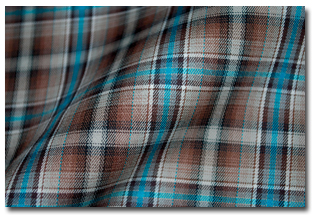
Dow Fiber Solutions’ Fall/Winter 2010-11

Dow XLA™ trend collection includes

this plaid shirting fabric from Arvind Ltd.


Sophisticated shirting fabrics with a silky touch are woven with long-staple cotton, Supima®,
silk or viscose blended with XLA. There are white-on-white effects, satin weaves, pointelles,
diamond patterns, microscopic black-and-white patterns and discretely textured stripes.
Bottomweights include flat gabardine, lustered surfaces, pinwhale corduroy and velvet. Suiting
fabrics are lightweight and drapey with a smooth surface. There are fancy pinstripes, satins and
fluid crepes with a grainy hand. Many of the fabrics shown are woven in blends of wool with silk,
mohair or cashmere and XLA.

The last trend is the most innovative. Colors are pale neutrals and what Jacobsson describes
as essential darks with a blue cast. They are sparingly accented with bright red, blue, yellow or
green.

Fabrics are structured and compact. “It’s actionwear versus activewear,” Jacobsson said. A
lot of the shirtings are woven with effect yarns for added shine or are foil-printed. Some have a
soft, tech hand. Bottomweights include twills and cords, some with rubbery or oily finishing
treatments. Two-way stretch, metallic shine and laminated surfaces are among the tailored fabrics
shown.


July/August 2009

Sponsors