Investment May Be Leading The Way

When Federal Reserve Chairman Ben Bernanke describes the economic outlook as “unusually uncertain,”
it is fair to say that having confidence in your company and willingness to invest in the future
takes real guts.

There’s not a lot of clarity or certainty about the underlying economy on a macro level, nor
about what the future holds for running a company in the United States, either.

Who would think that page 737 of the new healthcare bill, as Bloomberg Businessweek puts
it,  “requires companies to report to the IRS payments of more than $600 a year to any
vendor”  via form 1099? That could mean filing a 1099 for Staples, Verizon, and just about
every vendor you do business with — and what does that have to do with healthcare? It has also been
reported that the National Small Business Association estimates, on average, the number of 1099
filings per company will rise from 20 to 95 forms.

Running a business is a seriously stressful responsibility in these unusually uncertain
times. Employers and employees alike need to bolster a level of confidence about the future, and it
is unfortunate that this confidence is not being rallied by Washington.

Employers, on the one hand, seem to be waiting for the next curve ball, the next rule change
that affects how their business runs. If they are owner-operators, and possibly Subchapter S
corporations, taxes could impact their ability to invest in their company’s future.

On the other hand, textile manufacturing and manufacturing in general tend to lead the
economy on the way out of a recession, so investment could be entirely appropriate at this time.

The U.S. Department of Commerce Bureau of Economic Analysis recently released the results of
U.S. economic activity through the second quarter of 2010. Although consumer consumption was weaker
than expected, a point that got by many analysts was that  “real nonresidential fixed
investment increased 17.0 percent in the second quarter, compared with an increase of 7.8 percent
in the first. Nonresidential structures increased 5.2 percent, in contrast to a decrease of 17.8
percent. Equipment and software increased 21.9 percent, compared with an increase of 20.4 percent.”

That information could suggest the beginning of a major shift in the future economic
environment.The quarterly data series shows that gross private domestic investment has been
negative from fourth quarter 2006 through fourth quarter 2009.

The period from fourth quarter 2008 through third quarter 2009 saw the largest contraction,
with month-over-month double-digit shrinkage. The first two quarters of 2010 show double-digit
advances, a significant turnaround.

Textile capacity utilization figures, as compiled by the Federal Reserve Board and reported
in this issue of

Textile World
by Economics Editor Robert Reichard, show the industry moving in the right direction, from a
dreadful 57.3 percent one year ago, to 66.9 percent last month and 69.0

percent in the most recent month.

Will a wary consumer, eerie housing market and increasing national bureaucracy beset with
unintended consequences snuff out what could be a textbook turn to recovery? Time will tell.

September/October 2010

Textile Firms Seek Help With Exports


Editor’s note: James A. Morrissey Sr., 81, died peacefully in his sleep Saturday,
Sept. 4, 2010, at his home in Potomac Falls, Va. He is survived by his wife of 51 years, Constance
M. Morrissey; four children, James A. Morrissey Jr., Erin M. Ingrisano, Patrick E. Morrissey and
Michael C. Morrissey; 10 grandchildren; and sister, Marilyn Roberts. Morrissey was a long-time
contributor to
Textile World, holding the position of Washington correspondent following a
28-year career as director of communications for the American Textile Manufacturers Institute. He
also is a member of the Public Relations Society of America Hall of Fame.

Memorial contributions may be made to the Virginia Prostate Cancer Coalition 1-703-339-0508;
www.vapcacoalition.org. Morrissey was a prostate cancer
survivor and dedicated much time as a volunteer to provide support to other cancer patients.

Morrissey will be greatly missed by
TW staff and the readers of his bimonthly “Washington Outlook” column and his
weekly online reports from Washington. If you have remembrances of his contributions to the textile
industry that you would like to share with TW, please email your thoughts to
Morrissey@TextileWorld.com.


W
hile U.S. textile and apparel companies are setting their sights on increasing exports,
it has become clear they will not get very far without more support from governments here and
abroad. The Obama administration is committed to doubling U.S. exports over the next five years,
and while that goal is laudable, it is easier said than done. As textile and apparel imports
continue to rise, many companies see exports as the only route to survival.

With more than $12 billion in exports annually, the U.S. textile industry already is the
third-largest textile exporter globally. Because most textile and apparel manufacturers are
considered small to medium-sized companies, many lack resources to move in a big way into overseas
markets and significantly increase their exports. However, yarn and fabric makers have experienced
considerable success doing business in countries with which the United States has preferential
trade agreements, such as the North America Free Trade Agreement (NAFTA) and the Central
America-Dominican Republic Free Trade Agreement (CAFTA-DR). That arena is where future
opportunities lie.


Assistance Sought


U.S textile makers have urged the government to pave the way for more exportation. Measures
include: working with other nations to reduce trade barriers; calling on other governments to
eliminate subsidies, including currency manipulation, to their manufacturers; increasing Customs
enforcement, particularly with regard to preferential trade agreements; and making credit and other
financing available to companies that want to export their products. In addition to these steps,
U.S. apparel makers support ratification of the Panama, Colombia and South Korea free trade
agreements (FTAs), which they say would provide access to 100 million new customers. They also call
for successful conclusion of the Doha Round of trade liberalization negotiations and negotiation of
a Trans-Pacific Partnership.


Financial Support


Access to financing has become both an immediate and a long-range need for exporters. In a
letter to U.S. Trade Representative (USTR) Ron Kirk, Cass Johnson, president of the National
Council of Textile Organizations (NCTO), pointed out that U.S. textile makers “have experienced
tremendous difficulty” in securing financing through private lenders as well as from the
Export/Import Bank (Ex-Im Bank). He said the problem is compounded by the fact that many overseas
countries offer their exporting industries cheaper financing, giving them a competitive advantage.
As private financing is expensive or not available at all, manufacturers have turned to the Ex-Im
Bank, which provides credit guarantees, credit insurance and financing to U.S. exporters. This,
however, has turned out to be an exercise in futility in many cases.

The problem is with the Ex-Im Bank’s criteria for assessing risk. When offering credit
insurance, the bank affixes a risk based on the country receiving the exports, and the bulk of U.S.
textile exports go to NAFTA and CAFTA-DR nations — many of which are considered high-risk. This
results in costs associated with credit insurance or guarantees that are prohibitively high for
textile manufacturers.

Gail Strickler, assistant USTR for textiles, said the Office of the USTR is well aware of
this problem and is trying to resolve it. She told Textile World her office has been working to
have risk assessment based on the credit record of the ultimate U.S. customer or the U.S. exporter
rather than on the credit assessment of the importing country. While many of the NAFTA and CAFTA-DR
countries are considered credit risks, the ultimate consumers of textiles and clothing entering the
United States under preferential programs — such as Walmart, Sears, and JCPenney — pay their
bills and are not viewed as credit risks.

Strickler said the USTR has been working for months with the Ex-Im Bank and private factors
to urge them to reassess their risk criteria and make the financing of exports less expensive. She
noted that on a number of occasions, her office has been able to step in and help companies get
better financing, and while there has been some success, she said, “we still have a long way to
go.” U.S. textile manufacturers have seen little movement in this regard, but they consider
financing problems a major deterrent to exporting, and they feel more needs to be done. Strickler
is urging companies experiencing financing problems to contact her office to seek assistance.

Johnson told the USTR that if NCTO’s recommendations in connection with the National Export
Initiative are implemented, the goal of increasing exports from today’s $12 billion to $24 billion
“is within reach.”


Korea FTA Reopened


Because the two most powerful members of Congress in terms of trade issues have problems
with the United States/South Korea FTA (KORUS), the Obama administration has been forced to reopen
negotiations, and that is providing an opening for U.S. textile lobbyists to seek modifications in
the pact, which they say in its present form could have “a profound negative effect” on textile and
apparel jobs. The FTA was signed by the Bush administration in June 2007, but Congress has refused
to ratify it. Senate Finance Committee Chairman Max Baucus from the beef-producing state of Montana
and Sander Levin, House Ways and Means Committee chairman from Michigan, the heart of automobile
manufacturing, have problems with how the agreement treats U.S. beef exports and automobile imports
and market access.

Five textile industry associations and the Service Employees International Union have
written to Kirk calling for major changes in the tariff phase-out schedule, Customs enforcement and
the rule of origin. The Congressional Textile Caucus has raised the same issues, saying the current
agreement will place domestic manufacturers at “a distinct disadvantage.” Its members call for the
United States to revisit the agreement and revise the textile provisions, which they say could
“cause great harm to the domestic industry.”

Kirk said he hopes outstanding issues can be resolved by President Barack Obama’s scheduled
trip to South Korea in November, but he told a South Korean newspaper it is unlikely that any
sections of the agreement other than beef and autos will be reopened. That’s not likely to deter
textile manufacturers and their supporters in Congress from pressing for reforms in the textile
sections. While some issues may be resolved by Obama’s meetings in South Korea, legislation
enacting the agreement into law, from a practical standpoint, could not be passed until next year.


Possible Action On Currency Issue


As the November election draws closer and members of Congress are anxious to show they are
doing something to create jobs, there is an increasing possibility that Congress will act on
Chinese currency manipulation. Up to this point, currency reform legislation pending in Congress
has served to put pressure on the Obama administration and the Chinese government to permit the
Chinese renminbi to appreciate against other currencies, but the tentative steps taken by the
Chinese government to date have not impressed members of Congress. The legislation would declare
currency manipulation an unfair practice and permit use of anti-dumping and countervailing duty
laws to offset what the legislation’s supporters see as an illegal subsidy. The call for
congressional action was intensified by a Department of Commerce decision saying countervailing
duties could not be viewed as an illegal subsidy in an aluminum industry case.

September/October 2010

Fibers For Nonwovens


T
he nonwovens industry makes use of a wide range of textile fibers. Functional properties
may be inherent or engineered into both natural and man-made fibers to make them appropriate for
various applications. This article highlights a few well-established fibers as well as some newer
fiber entries into the nonwovens marketplace and mentions the manufacturing processes used.


Natural And Renewable Fibers


In consideration of the increasing demand for ever-more environmentally sustainable products
and processes, natural and biobased fibers are good choices for certain nonwoven products because
they are biodegradable and compostable as well as being produced from renewable resources. And
while recycling generally is a consideration related to the sustainability of man-made fibers,
natural- and renewable-fiber-based materials also can be recycled for certain nonwoven
applications.


Cotton


Cotton is used in nonwoven hygiene products including wipes, feminine hygiene products,
diapers and adult incontinence products. It is soft, comfortable, hypoallergenic and naturally
absorbent; and has greater wet strength than dry. Most hygiene products are spunlaced; but cotton
also may be needlepunched for wipes such as decontamination wipes, and also in its relatively
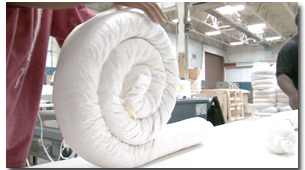
unprocessed raw state for oil absorption, such as cotton boom used in the recent Gulf of Mexico oil
spill cleanup efforts.

“With respect to nonwoven fibers, cotton is a recent trend and is continuing to grow at a
surprisingly healthy rate,” said Janet Regan, director of strategic initiatives, Cotton
Incorporated, Cary, N.C., a marketing and R&D company promoting upland cotton. She listed
several reasons including the aforementioned trend toward sustainability; the growth of the wipes
market over the last 10 years; the development and growth of spunlacing technology; pricing;
performance and consumer appeal; and health- and well-being-related features, especially for
hygiene applications.
cotton sellers boom

 Needlepunched cotton boom such as this manufactured by Milwaukee-based Sellars
Absorbent Materials Inc. — made from relatively unprocessed, naturally oleophilic and hydrophobic
raw cotton — has been used to soak up oil in the Gulf of Mexico following the explosion and
sinking of the BP Deepwater Horizon oil rig in April 2010.


Regan went on to talk about the needlepunched oil-absorbing cotton boom that played a role
in the Gulf cleanup. “This is a really cool newer direction,” she said. “Bleached and scoured
cotton took off for wipes and hygiene, but over past two years, we’ve also been working with raw
fiber that hasn’t been processed except for mechanical cleaning. That fiber is naturally oleophilic
and hydrophobic. It’s Mother Nature’s way of preventing the fiber from biodegrading in the field
while it’s growing because it has oils and pectins on it that protect it from the elements.”


Viscose And Lyocell


Regenerated cellulosic fibers such as viscose and lyocell also have nonwoven hygiene, wipes
and incontinence applications, for virtually the same reasons that make cotton suitable for those
uses, but also because their production conditions are not conducive for microbial growth — an
advantage as well for many other applications. Technical applications include electrical
insulation, automotive and filtration; as well as medical drapes, swabs and wound dressings.
Nonwoven processes used include spunlace, needlepunch and chemical bonding.

Austria-based Lenzing AG offers Lenzing Viscose® — whose production technology includes the
recycling or sale of the chemical and waste products produced in the process — and Tencel® and
Lenzing Lyocell® — both produced in a closed-loop process that uses no harmful chemicals — for
various nonwoven applications noted above. The company reports it can customize the fiber to suit a
particular application — for example, by adding a finish to facilitate high-speed carding,
improving the absorbency for a feminine hygiene product, or enhancing the purity of fiber used in
electrical insulation products.

Lenzing nonwovens pic

Lenzing Viscose®, Tencel® and Lenzing Lyocell® are 100-percent biodegradable as well as
soft, hypoallergenic and naturally absorbent, making them appropriate fibers for use in personal
care products such as the wet wipe shown above. Photograph courtesy of Lenzing AG/Marcus
Renner

In the filtration arena, Lenzing Viscose has long been used in food and beverage
applications; while Tencel, with its tendency to fibrillate, is being promoted for automotive fuel
and oil filters, cigarette filters, and industrial air and liquid process filters. Lenzing reports
Tencel’s properties include significantly increased wet strength and low linting in addition to the
absorbency, softness and breathability that are inherent in both Lenzing Viscose and Tencel. The
company also notes that its customized Tencel Short Cut fibers offer a flushable solution for
wipes, and its Tencel Tow can be cut and converted by downstream users for various specialty
products and applications.

Viscose, Tencel and lyocell are spunlaced for hygiene, wipes and other personal care
products, as well as for gauzes and face masks. They may be blended with polyamide or polyester
into spunlaced coating substrates, such as for artificial leather. Low-linting lyocell and Tencel
also can be used for clean room wipes. Needlepunched viscose, Tencel and lyocell, alone or in
blends, have applications in hygiene and medical products, wipes, coating substrates and artificial
leather. Chemical bonding applications include medical drape, food contact, interlining and
household wipes. Lenzing reports chemically bonded nonwovens made with Tencel and Lenzing Lyocell
can offer added strength or lighter weight; and when binder levels are reduced, they can offer
increased absorbency.


Polylactide


Polylactide (PLA) biopolymers offer a renewable and biodegradable or recyclable alternative
to petrochemical-based fibers. Applications include spunlaced wipes and hygiene products, in which
PLA may be blended with cotton or viscose; agricultural textiles that may be tilled under at the
end of a growing season; needlepunched carpet and automotive products; spunbond filtration and
geotextile products as well as teabags and other such products; and meltblown filtration products.

teabag

Finland-based Ahlstrom Corp. has designed this unique tea bag using spunbond Ingeo™
polylactide fiber.


NatureWorks LLC, Minnetonka, Minn., produces PLA under the Ingeo™ brand. According to Robert
Green, the company’s Americas director, Fibers and Nonwovens, the fiber offers opportunities to
meet market needs and is competitive price-wise with incumbent fibers.

“We think that, in general, the hygiene space is a very good fit for our materials. A lot of
wipes already have natural components, such as viscose and cotton, and Ingeo is a great complement.
Essentially, it offers a thermoplastic that has natural origins and very good environmental
credentials,” Green said, adding that using Ingeo in a blend with cotton or viscose allows
producers to improve the sustainability of their products.

PLA also has inherent flammability characteristics, Green noted. It is difficult to start
burning and generates little smoke, he said; and its self-extinguish time is significantly shorter
than polyester or cotton. It also is inherently ultraviolet-transparent, moisture-wicking and
hypoallergenic; and has low odor retention. These properties can be further improved using topical
treatments or additives.


Man-made Fibers


Man-made fibers are used in many of the same applications as natural and renewable fibers,
and sometimes are blended with those fibers to provide enhanced function in a product.


Polyester


Polyester staple fiber (PSF) has applications in spunlaced products including wipes and
hygiene as well as medical/surgical gowns, masks, drapes and such; needlepunched filtration,
automotive and industrial products; airlaid filtration products; and resin bond and thermal bond
products. There is also significant growth in spunbond applications using polyester resin. Specific
functionalities, such as antimicrobial properties for filtration applications or moisture
management for wipes, can be integrated into the polymer.

According to Wayne Proctor, senior manager of sales, nonwovens, for Charlotte-based PSF
manufacturer DAK Americas LLC, spunlace comprises the biggest part of the nonwovens market where
polyester is concerned. “DAK’s key to success in this market is that it is dedicated to fiber
design to deliver functionality,” he said. “For example, we design the proper crimp, finish or heat
set that delivers the functionality the customer desires, depending on the intended application.”
NonwovensFiber

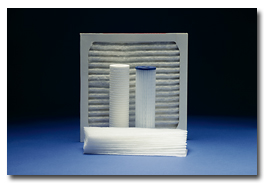
Filtration products may be may be made from a range of both petrochemical-based and biobased
fibers.


In addition, DAK Americas’ Steripur®AM silver-based antimicrobial fiber has filtration
applications, and Delcron® Hydrotec moisture-management fiber has applications in wipes and also
some filtration. These functionalities are integrated permanently into the fiber rather than
applied as topical treatments, said Ricky Lane, the company’s manager, public affairs, trade
relations and communications.


Polypropylene And Bicomponent Fibers


Polypropylene (PP) is used in diaper, baby wipe, filtration, automotive, geosynthetics,
furniture backing, construction, insulation and acoustics applications, among others. Because of
its low specific gravity, it may replace other fibers to reduce basis weight and system cost; but
modifying the fiber’s surface may also provide alternatives to replace other PP fibers in certain
applications, according to John Wolhar, hygiene sales manager, Americas, for Duluth, Ga.-based
polyolefin fiber manufacturer FiberVisions Corp. Nonwoven processes used include spunlace, carded
thermal bond, needlepunch and spunbond.

Wohlar said PP doesn’t necessarily compete with other fibers in the nonwovens arena. “We’re
competing with alternate technologies or other forms of PP, offering finer fibers, shapes or
modified surface characteristics like finish that allow people to use a staple-based nonwoven to
replace a spunbond nonwoven, for example,” he explained. The fibers can be treated to make them
hydrophilic or hydrophobic. Wohlar also mentioned botanical finishes — such as chamomile, green
tea and aloe — and vitamin E, noting they may offer benefits in certain applications.

FiberVisions recently has introduced fine-titer shaped polyolefin fibers for nonwovens
markets. The company reports these fibers can improve fabric uniformity, coverage and fabric
opacity; and also provide loft and enhanced softness.

Bicomponent fibers also may be used in nonwoven applications. FiberVisions’ sister company
ES FiberVisions manufactures bicomponent fibers for hygiene, cosmetics, filtration, medical,
industrial and agricultural applications. These might be biodegradable, or have a PP or polyester
core and a PP or polyethylene sheath; or they may be based on specialized polymers. They often are
used in low-level blends to bind other fibers. Processes include thermal bond, carded through air,
airlaid, wetlaid, carded needlepunch and carded spunlace. Teabags and wipes are two wetlaid
applications using short cut fibers. Airlaid nonwovens using bicomponent fibers are used primarily
for baby wet wipes, industrial oil absorbent pads and feminine hygiene product components. 


Recycled Fibers


Post-industrial and post-consumer recycled fiber also is used in nonwoven products and
provides the added advantage of giving textile waste another life instead of having it end up in a
landfill.

Leigh Fibers Inc., Wellford, S.C., reprocesses post-industrial fabric waste made with both
natural and man-made fibers into shoddy for use in a wide range of nonwoven and other
under-the-surface applications as well as for remelting and spinning applications. The company’s
SafeLeigh™ flame-retardant (FR) aramid fiber recycled from post-industrial clippings can provide
inherent FR properties for needlepunched and airlaid nonwoven furniture, mattress and automotive
applications, according to George Martin, the company’s executive vice president of sales and
marketing. Denim may be turned into carpet pads or insulation. Cotton, rayon, acetate, PP, acrylic
and other textile waste can be used in many under-the-surface applications as well as wet wipes.
Besides needlepunch, processes include airlaid, thermal bond, garnetting and other pad-making
processes.
2-SafeLeigh product

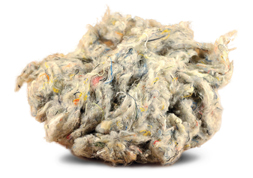
Leigh Fibers’ SafeLeigh™ FR aramid fiber offers inherent FR properties for needlepunched
and airlaid nonwoven furniture, mattress and automotive applications.


Cotton Incorporated’s Regan also mentioned initiatives for recycling post-industrial and
post-consumer cotton textiles. Strateline Industries LLC, Rogers, Ark., makes wet wipe substrates
from fiber recycled from fabric cuttings supplied by T-shirt factories in China. In another
project, Cotton Incorporated has partnered with Bonded Logic Inc., Chandler, Ariz., to collect blue
jeans for reprocessing into insulation that is donated for use in houses built by Habitat for
Humanity. The insulation and other building products made using reprocessed post-industrial cotton
and other cellulose materials also are available through retail channels.

Post-consumer recycled fibers such as PLA or polyester can be used in any application —
nonwoven or other — that uses virgin fiber.

While PLA is biodegradable and can be composted, it also can be recycled in a closed-loop
system, as was the needlepunched carpet made with Ingeo fibers that was installed at the site of
the United Nations Climate Change Conference, held in December 2009 in Copenhagen, Denmark.

“At the end of its useful life, PLA can be hydrolized back to lactic acid very easily and
economically,” NatureWorks’ Green said. “This chemical recycling potentially will alleviate issues
of cleaning and contamination.”

DAK Americas has partnered with Dalton, Ga.-based carpet manufacturer Shaw Industries Inc.
to establish a joint venture in Fayetteville, N.C. — Clear Path Recycling LLC — to recycle
post-consumer polyethylene terephthalate (PET) bottles into Recycled PET (RPET) flake of a high and
consistent quality that will be used by both companies to process into fiber.

“We now have the foundation to include recycled content in our product and will strive to
meet our customers’ requirements to incorporate the product into endstream uses,” DAK Americas’
Lane said. The fiber will be available for all applicable end-uses including nonwovens.

September/October 2010



2010 ITMF Annual Conference: Welcome From Aguinaldo Diniz Filho


T
he International Textile Manufacturers Federation (ITMF), Switzerland, will hold its 2010
Annual Conference in São Paulo, Brazil, October 17-19. Brazilian Textile and Apparel Industry
Association (ABIT) President Aguinaldo Diniz Filho welcomes the readers of

Textile World
to the congress, which will play a very important role for the Brazilian textile industry.

ITMF Brazil


TW: Mr. Diniz, what do you expect from the ITMF conference?


Diniz: It is a big moment for the Brazilian textile industry because it will be an
excellent opportunity to bring Brazilian producers and international producers together. It will be
an honor to receive so many representatives of the textile world and to show some of the potential
of the Brazilian textile sector. We also expect the conference to be extremely useful for everyone
working very hard on the issues together with the ITMF board.


TW: Why should the delegates come to São Paulo?


Diniz: Attending the ITMF Annual Conference is always an opportunity to increase
one’s network and stay up-to-date with global issues in the sector. Specifically in São Paulo,
delegates will have a conference with a touch of Brazilian DNA. In addition to including issues
about retail, sustainability and cases from Brazil and the world, we also hope to imprint the
Brazilian style of receiving illustrious visitors and important business partners.


TW: As ABIT president, what is your philosophy?


Diniz: My philosophy is transparency and dialogue, especially as we gather at the
same meeting all segments of the textile chain, from fiber, textiles, the apparel industry, and
even some clothing retailers. The sector’s philosophy is to generate jobs and income for Brazilians
by strengthening the sector.


TW: And what are your targets?


Diniz: We have “mantras,” or themes that are very important to further increase
our competitiveness – tax exoneration, more accessible lines of credit, exoneration of investments
and international agreements. Also very important are themes such as environment, labor laws,
social security and fair conditions.


TW: How do you see the market situation for Brazil’s textile industry?


Diniz: We have two realities in the textile sector: One is the huge domestic
market, our greatest asset. The market is heated up this year and will ensure the growth of many
industries, which means more jobs. On the other hand, we will break the record for our trade
balance deficit. It is impossible to reproduce in Brazil the conditions other producers have in
other parts of the world. We are looking to add value to our products and at the same time reduce
the impacts of the exchange rate, logistics, taxes and interest rates on these products. We don’t
want to produce only for our domestic market; we have the capacity to do much more. But we must
work with the government to reduce this disequilibrium with other international players.


TW: Do you see signs of economic recovery around the world?


Diniz: The United States is slowly beginning to recover, but there is still a lot
of unemployment. The European Union is still lagging behind, with some countries experiencing a
strong recession. But the faster the American recovery takes place, the sooner it will pull the
others towards a more promising scenario.


TW: What should people not miss when they come to São Paolo?


Diniz: Brazil has tremendous diversity. São Paulo is the largest city in South
America. Thus, like the other great cities in the world, São Paulo offers a very great variety of
restaurants, bars, museums, parks and neighborhoods characterized by different cultures and
economic and artistic segments.


TW: What is Brazil’s best?


Diniz: Our mix of races and cultures, developed in harmony in a continental-sized
country, resulted in our DNA. Brazil’s best is its people, with their joy and hospitality. That is
how we want to welcome the delegates to the 2010 ITMF Annual Conference.

September/October 2010

2010 ITMF Annual Conference: Brazil And Its Textile Industry


T
he Brazilian textile and apparel industry comprises more than 30,000 companies in the
textile and apparel sectors, generating some 14 million to 15 million jobs, both direct and
indirect. Brazil is among the top 10 textile industry markets worldwide and among the top five as
an apparel producer.

The Federative Republic of Brazil is the largest country in South America, and one of the
richest countries in terms of natural resources, environment and wildlife. The Federation is formed
by the union of the Federal District and 26 states.


Bright Future


Today, the Brazilian economy is the world’s eighth-largest by nominal gross domestic product
(GDP) and the 10th-largest by purchasing power. The country is one of the largest domestic markets
in the world and one of the fastest-growing economies today. That’s why it is a member of the G20,
but also a member of the United Nations and the Southern Common Market (MERCOSUR).

In the first half of 2010, more than 1.5 million jobs were created, a record high. During
the same period in 2009, the Brazilian economy generated only 299,000 jobs owing to the
international financial crisis. The government believes the Brazilian economy will create a total
of 2.5 million jobs in 2010.

The Organization for Economic Cooperation and Development (OECD) predicts an economic growth
rate of 6.5 percent in 2010 for Brazil – higher than the previous estimate of 4.8 percent. For
2011, the economy is expected to grow 4.5 percent. The effects of the international financial
crisis caused the economy to contract by 0.2 percent in 2009.

The OECD is not the only institution to predict a high growth rate for Brazil in 2010. In
the most recent Focus market survey, the Brazilian financial sector projected 6.46-percent growth
for this year. The Brazilian government’s most recent estimate is 5.5-percent growth. According to
the OECD, Russia, India and China – the other countries in the BRIC group – are undergoing a solid
expansion as well, and will register positive figures this year.

Brazilmap


Big Cotton And Textile Producer


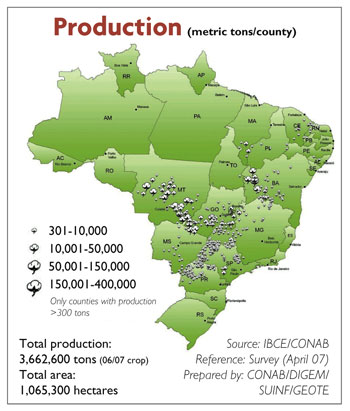
Brazil is the fifth-largest producer of cotton, after China, India, the United States and
Pakistan (See Table 1). The yield per hectare of cotton is rather high in Brazil, especially in the
state of Mato Grosso.

The Brazilian textile industry is constantly growing owing to the acquisition of modern
equipment and technical development applied to production, and also the promotion of its
professionals through training programs and increasing productivity. This development program has
already invested more than $8 billion. Its objective is to strengthen Brazil’s textile industry in
the globalized and competitive market.

Brazil has around 4 million ring spindles and 330,000 rotors in operation. It produces and
consumes 5 percent of the world’s total cotton crop. Producing approximately 1.2 million metric
tons of cotton annually, Brazil exports almost 400,000 metric tons to Indonesia, Pakistan, Japan
and Argentina.


ABIT


The Brazilian Textile and Apparel Industry Association (ABIT) represents the integration of
the Brazilian textile chain. Founded in the early 1960s, ABIT sponsors companies in every segment
in the textile industry, including cotton growing, synthetic raw materials, textile fibers,
spinning, weaving, knitwear, dyeing, printing and apparel. ABIT participates actively in the
evolution of the textile sector. A pioneer in the industrialization of Brazil, the textile sector
stands out within the domestic economy. ABIT also coordinates relevant initiatives in the social
and environmental arenas, besides sponsoring the sustainable growth of the industry.


TexBrasil


Created in 2001, the Brazilian Textile Chain Strategic Program (TexBrasil) – developed by
ABIT in partnership with Apex-Brasil, the country’s export promotion agency – states its mission is
to support and prepare sector companies to present, in an organized way, Brazilian products in
international markets. Using various tools and actions, it aims to increase the platform of
Brazilian export companies, encouraging their inclusion in the global market.

In 2009, the total turnover for the textile sector was $47 billion, and exports exceeded
$1.8 billion. During the same year, the sector generated a deficit of $1.5 billion and created more
than 66,000 job openings. In terms of consumption, Brazil holds fifth place after China, India,
Pakistan and Turkey.


Ambitious Targets


Intensely investing in the excellence of domestic production, the textile sector intends to
expand its operations. The domestic Brazilian market comprises 190 million consumers. In addition,
the textile sector aims to recover its 1-percent share of the world market, which is equivalent to
increasing the volume of exports to $4 billion per year. For 2010, the Brazilian textile industry
expects to grow beyond the GDP and predicts an increase in consumption of textiles in the order of
12 percent.

These are ambitious targets, but by paving the way with adequate planning, such goals are
surely compatible with the Brazilian reality. To achieve such aims, new investments in technology
will be essential. Moreover, the country relies on the required managerial maturity as well as the
creativity of its professionals. Within such a context, it is essential for the textile sector to
join efforts and multiply convergences and know-how. ABIT supports such missions and offers the
Brazilian textile market all the necessary support to meet the above-mentioned goals.


Fashionable Brazil


But Brazil plays a growing role not only with regard to cotton and apparel. To produce more
value-added products, many Brazilian apparel producers are heading toward more fashionable fabrics
and products. To support these activities, the second Première Brasil, a major Latin American
textile industry event, took place in July 2010 at the Transámerica Expo Center in São Paulo. The
show presented Fall/Winter 2011 collections of fabrics, yarns, fibers and accessories. It was
supported by TexBrasil, the Brazilian Association of Fashion Designers (ABEST) and Sinditêxtil-SP.
The event is a joint venture between Paris-based Première Vision S.A. and Brazil-based Fagga
Events.

The second edition gathered 67 exhibitors from eight countries, including Brazil, France,
Spain, Italy, Turkey, England, Germany and Uruguay. Compared to the first edition, there was a
49-percent increase in the number of exhibitors.

Jacques Brunel, managing director, Première Vision S.A., Paris, said the event provided to
Latin American countries an alignment with the international fashion calendar, presenting one year
in advance the range of colors and fabrics for future collections. He also said the first Brazilian
edition of the event helped reinforce the perception of strengthening the Latin American market and
textile sector, pointing to Brazil as a starting point for expansion.

September/October 2010

Georgia Carpet Producer, Nonwovens Manufacturer Invest In Aztec Machinery

Ivyland, Pa.-based Aztec Machinery Co. — a producer of dryers and ovens for nonwovens, technical
textiles and carpets — reports a north Georgia-based major manufacturer of nonwoven and tufted
carpets has purchased a thru-air drum dryer to dry and thermally bond needlepunched nonwovens. The
machine is a 4.6-meter-wide single-drum omega design with drum diameter exceeding 3 meters.

The company also reports it recently commissioned a thru-air drum dryer for a major tier-one
manufacturer of needlepunched automotive nonwovens. The dryer will be used in a thermal bonding
application.

The two machines are believed to be among the largest sold to U.S. nonwovens manufacturers,
according to Burnsville, N.C.-based Ford, Trimble & Associates Inc., sales and marketing agent
for Aztec Machinery.


September 7, 2010


Hyosung Debuts Creora® Highclo™, Mipan® Micro-Denier Nylon

South Korea-based Hyosung Corp., manufacturer of creora® spandex, has launched creora® highclo™
super-chlorine-resistant spandex/elastane for swimwear. According to the company, highclo offers
excellent compression and shaping qualities and retains its fit and shape after extended chlorine
exposure. Hyosung also reports it provides high quality, consistency, uniformity, knitting
efficiency and value. Partner mills producing creora highclo include Sofileta, France; Cherry Body,
Hong Kong; Hyunjin, Korea; Hungyen, Vietnam; and Huiyi, China.

Hyosung also has launched Mipan® microfine 20/34 and 30/68 micro-denier nylon suitable for
fine-gauge, super-lightweight, warp and circular knit intimate apparel fabrics.

September 7, 2010

Virginia Governor Bob McDonnell Applauds Universal Fibers For New Hires, Sustainable Technology

BRISTOL, Va., September 7, 2010 — Universal Fibers, Inc welcomed Virginia Governor Bob McDonnell
to its Washington County, Virginia headquarters for a plant tour this afternoon. Governor McDonnell
got a first hand look at the improvements, innovations and growing number of employees that have
helped ensure the company’s success.  To service increased customer demand, Universal Fibers
has expanded production capacity and hired more than 200 new employees.

In his remarks the Governor called Universal Fibers a Virginia success story. “I just wanted
to come by and say thanks for what you are doing here,” said Governor McDonnell. The Governor
continued, “A top priority for me is jobs and to foster economic development. You’ve got a good
model of how to do that and it’s something that needs to be duplicated.”

The company is undergoing a $13M expansion that is partly funded by a $150,000 grant from the
Governor’s Opportunity Fund.


Universal Fibers is a leading producer of solution-dyed fibers for the commercial flooring,
transportation, industrial fiber, and textile markets, and has been located in Washington County,
Virginia for forty years. The company also has operations in Thailand and China.

“We like to say we export products, not jobs,” remarked Universal Fibers CEO Marc Ammen.
“We’ve welcomed 200 new families here this year and we’ve done it by creating a sustainable product
that is in demand in markets around the world.

Universal Fibers is a pioneer in sustainable efforts in the fiber industry and was the first
in the industry to produce post-consumer solution-dyed nylon fiber in a broad color line.  The
Universal brand is called refresh fiber®, which is made from a sophisticated multi-step process
that takes post-consumer carpet fiber and turns it back into usable nylon fiber, maximizing the use
of an abundant resource that would otherwise end up in a landfill.  refresh fiber® has won
several environmental awards including the inaugural Bloom Award given by the American Society of
Interior Designers (ASID) in partnership with Interiors & Sources magazine.

Joining Governor McDonnell on the tour was Virginia Delegate Joe Johnson, Dulcie Mumpower,
the chair of the Washington County, Virginia Board of Supervisors, Russell Owens, the Chair of the
Industrial Development Authority of Washington County and Christy Parker, the Assistant County
Administrator.

About Universal: Universal Fibers® is headquartered in Virginia, USA with manufacturing
operations in Thailand and China. Universal Fibers® a multi-platform producer of solution-dyed
synthetic yarns for the commercial, residential, transportation and textile market and is ISO 14001
certified.  For more information, please call customer service at 800-457-4759 or visit our
website at www.universalfibers.com.

Posted on September 7, 2010

Press release courtesy of Universal Fibers Inc.

TenCate Introduces MiraSpec Design Solutions Software To Assist In Flexible Pavement Designs

PENDERGRASS, Ga., September 7, 2010 — TenCate Geosynthetics North America introduces internet
based MiraSpec Design Solutions Software, an easy to use software program that will assist
engineers in flexible pavement design while demonstrating the many benefits of using TenCate
Mirafi® RS580i woven reinforcement  stabilization geotextile in roadway structures. 

The new software program, MiraSpec Design Solutions Software, will allow pavement designers
to perform AASHTO (American Association of State Highway and Transportation Officials) flexible
pavement Structural Number (SN) design calculations, either with or without geosynthetics. In
addition, the designer will be able to calculate the cost savings and green savings the use of
TenCate Mirafi® RS580i will provide in the design.

About TenCate Geosynthetics North America, Royal Ten Cate

TenCate Geosynthetics develops and produces synthetics fabrics, nonwovens, wovens and
geogrids, and creates design solutions and systems for infrastructure and civil engineering.
TenCate Geosynthetics has plants in Europe, North America and Asia.

Royal Ten Cate (TenCate) is a multinational company which combines textile technology with
related chemical processes and material technology in the development and production of functional
materials with distinctive characteristics. Products of TenCate are sold worldwide.

Systems and materials from TenCate come under four areas of application: safety 
protection, space  aerospace, infrastructure  the environment, and sport 
recreation. TenCate occupies leading positions in protective fabrics, composites for space and
aerospace, antiballistics, geosynthetics and synthetic turf. TenCate is listed on the NYSE Euronext
(AMX).

Posted on September 7, 2010

Press release courtesy of TenCate Geosynthetics North America

The Rupp Report: Organic Production Yes, But …

There is no doubt about it: the world’s climate is changing. And at the same time, the world’s
population is growing, too. So, on the one hand, the consciousness about natural resources is
rising, and on the other hand, the world’s population needs food. This vicious circle occupies many
international organizations as well as nongovernmental organizations (NGOs) all over the world.

Another issue in the focus of people’s attention around the world is rural poverty. This
focus, along with increased awareness of climate change and sustainability, has led to a
proliferation of projects to improve agricultural practices as well as raise the level of social
and environmental responsibility. In the near future it might be impossible to sell products that
are produced not only under ecological standards, but also according to social standards.


Global Organic Textile Standard


As the Rupp Report has already reported, in the spot of monitoring are all chemical inputs
such as dyestuffs and auxiliaries, which must comply with certain environmental and toxicological
criteria, and the choice of accessory materials also is restricted. In this context, the Global
Organic Textile Standard (GOTS) is recognized worldwide as one of the top processing standards for
organic fiber-based textiles.

Currently, there are more than 2,000 companies around the world working according to GOTS
standards. The standard includes not only fiber production but also criteria related to dyeing and
finishing.


Finishing In The Center Of Attention …


For obvious reasons, the finishing sector especially demands to be certifed according to
GOTS. An increasing aspect is ecology and toxicology, on which basis dyestuffs and auxiliaries are
evaluated and approved. Desizing can cause problems if the applied enzymes are genetically
modified. Mercerizing is allowed only without the use of ammonia. Optical brighteners are very
problematic: They cause a lot of problems in wastewater treatment because of their poor
biodegradability and high toxicity levels, and they also can influence the human hormone system
through estrogen receptor cells. Fabrics finished with antibacterial treatments can affect the
natural behavior of human skin as well.

… But Social Standards Also Are Important

But not only environmental issues are part of the standard. GOTS also includes current
minimum social standards: no forced labor or child labor, a safe working environment, no
discrimination and the guarantee of payment that secures a living for the working people. This is
quite important. More and more Western companies are emphasizing social standards. Just a few weeks
ago, one of the world’s top retail chains had a public relations nightmare: The company was on the
front page of daily newspapers around the globe because some NGOs found out that in spite of
existing labor contracts and guaranteed minimum payments, the workers were underpaid.


Too Many Labels On The Market


As with every trend, many companies are jumping on the bandwagon. As a producer, retailer or
consumer, one must be careful to have all the certificates and the right papers sent along with the
goods so that the products can be traced back in a clear system. There are a lot of institutes that
have a “Bio” label on their letterhead. One of the most popular trends at the moment is certainly
to bear the Öko-Tex® 100 label. Without being cynical, one could say it may be somewhat
questionable when this label appears on a shirt with a value of just a few dollars.

If you would like to share your experience with these kinds of labels, write to
jrupp@textileworld.com.


August 31, 2010

Sponsors