AATCC Debuts Young Entrepreneur Award

RESEARCH TRIANGLE PARK, N.C. — October 19, 2010 — AATCC has created a new award focused on young
entrepreneurs in the Textile Industry.


Nominees for the Young Entrepreneur Award must be age 39 or younger at the end of 2010 and
should be engaged in business based on the Objects of the Association:

  • To increase knowledge of the application of colorants, chemicals and polymers in the Textile
    Industry.
  • To encourage in any practical way research work on textile design and coloration, chemical
    processes and materials of importance to the Textile Industry.
  • To establish for the members channels by which the interchange of professional knowledge among
    them may be increased.

An entrepreneur is defined as a person who has possession of a new enterprise, venture, or
idea, and assumes significant accountability for the inherent risks and outcomes of the creation.


The deadline for receipt of nominations is January 7, 2011. Any senior member of AATCC may
submit a nomination. The award is not limited to AATCC members.


Names and supporting documentation may be submitted by letter. Send nominations to:


John Y. Daniels, AATCC

PO Box 12215

Research Triangle Park, NC 27709-2215

USA

phone +1 919 549 3522

fax +1 919 549 8933

danielsj@aatcc.org


The recipient will be selected by committee in early 2011. The award will be presented at the
AATCC International Conference being held March 22-24, 2011, in Charleston, S.C., USA. The winner
will receive a plaque and an award of US$500.

Posted on October 19, 2010

Source: AATCC

Boiler Powers Up Production At MW Canada Fabrics Plant


C
ambridge, Ont.-based MW Canada is a company rich in history. Formerly known as Montreal
Woollens, MW Canada has been in the Berger family for three generations. Today, the company creates
high-quality textiles for the window-covering, home-decorative, and technical-materials industries.
It works with top brands to develop exclusive designs, colors and materials to meet ever-changing
consumer demands.

With the goal of bringing new and creative products to market, MW Canada offers specialty
materials such as roman-shade, roller-shade, pleated-shade, drapery, narrow tape, vertical-blind,
cubicle, blanket, and filter-media. Its products can be found at well-known retailers such as
Sears, Costco, Lowe’s, Home Depot, JCPenney, and Blinds to Go. MW Canada meets the specialized
needs of customers by maximizing its in-house warping, weaving, knitting, dyeing and finishing,
pleating, printing, and laminating capabilities.

MWcanada1

Bob Berger has been president and CEO of MW Canada for 15 years.

Robert Berger took over as MW Canada president and CEO 15 years ago. His father and
grandfather founded the company under the name Montreal Woollens in 1963. The company relocated
from its original home in Montréal, Quebec, to Cambridge in 1976. With a dedicated staff of 66
employees, MW Canada has been able to remain ahead of the competition through its continuous
research and development of new products and processes.

“We design and manufacture unique materials that are engineered to solve very specific
problems,” Berger said. “Along with the aesthetics of our products, there are the features that we
build in. Be it light control, reflection control, breathability, or harnessing energy, the
value-added features are very important. We have to work two to three years ahead of the retail
market. We supply a growing number of major customers in North America and around the world.

“When we put our products in front of our clients, we want them to say that they have never
seen anything like it before,” he added. “It’s all about value. We do what China doesn’t. China is
copying items that we developed two or three years ago. We just have to keep coming up with new
ideas and updating our processes.”
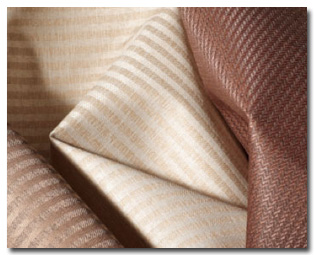
MWCanada8

These MW Canada fabrics are woven using blended yarns and are ready for chemical
coating.


Producing Safe Fabrics


Oeko-Tex® Standard 100 certification of MW Canada fabrics ensures that they meet the highest
standards for use in homes and offices. The International Oeko-Tex Association comprises a global
group of independent testing institutes that developed and perform tests based on uniform standards
for harmful substances on textiles. Oeko-Tex Standard 100 focuses on the health and well-being of
the consumer.

The long list of substances tested includes formaldehyde, heavy metals, pesticides,
allergenic dyes, chemical residues, flame retardants, volatile organic compound emissions and other
banned substances. “The certification is an important accreditation to have, for our customers and
for MW Canada,” Berger said. “And today, retail consumers are extremely intelligent and
environmentally conscious. The certification sends an important message to our clients and the
retail public about our commitment to help save our planet.”

MWCanada 9

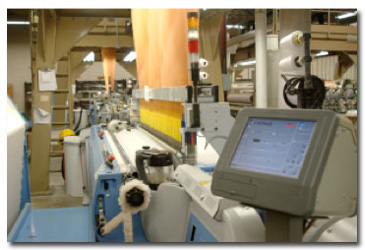
The company weaves fabrics for the window-covering industry using a high-speed gripper
loom.

With Canada’s manufacturing sector facing a shortage of skilled workers, MW Canada has made
employee training and skills a top priority. As part of an industry-wide initiative to develop
onsite learning facilities, MW Canada started its own Skills & Learning Centre, also called the
ER Education Room, where employees receive classroom and Web-based training. The center offers
general education development, math, language, and technical skills to all employees. Upgrading of
skills becomes part of every employee’s job description. In 2007, the company won a national award
from the Canadian Council on Learning for its efforts to bring learning opportunities into the
workplace.

“It has become essential that we upgrade the knowledge and skills of our employees.
Innovative processes and active participation in the workplace are the direct result of making
training available onsite,” Berger said. “As older workers retire, we lose 20, 30 or 40 years of
experience that you cannot replace. For very specialized skills, it takes a long time to become
proficient. On a regular basis, we bring in the top trainers from all our machinery manufacturers
to give refresher courses to our staff.”

According to Berger, 85 percent of the company’s business is exported outside of Canada. He
says MW Canada has managed to come through the recent economic recession in good shape. “There will
always be a need for medium-sized manufacturers that are close to the market, able to deliver niche
market products quickly and efficiently. We are shipping to China, India, Mexico, South America,
while the United States remains our largest market.” Berger said. “Canada has a name for quality
around the world. In these foreign markets, it is all about finding the right distributor to carry
a higher-end line.”

MWCanada3


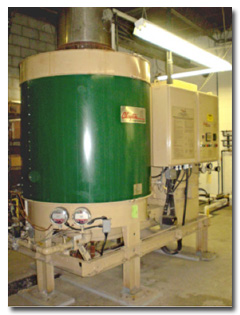
The new Clayton boiler delivers reliable and energy-efficient performance, offering rapid
response to fluctuating load demands and eliminating hazardous steam explosions. It also has low
maintenance requirements.


Gaining Boiler Edge


Going back to the days of the old Montreal Woollens plant, MW Canada has had a long-standing
partnership with Brampton, Ont.-based Clayton Sales & Service Ltd. In the 1970s, MW Canada
installed a steam generator boiler in the Cambridge manufacturing plant, and it worked steadfastly
until it was replaced a few years ago with a new Clayton 250-horsepower boiler. MW Canada’s
maintenance department still uses the previous steam generator as a back-up system.

In any manufacturing plant, the loss of production affects the bottom line. Customers expect
product on time, and to specification, every time. If it is not, there are always ramifications.

“We realized the old steam generator boiler was coming to the end of its life after 30 years
of loyal service. So, we put in a new Clayton boiler,” Berger said. “We require steam for our
dyehouse, where we are dyeing yarns and fabrics 24 hours a day, as well as for our finishing lines.
The dye vessels are all steam-fired. This is how we heat our water. The dye process requires
consistent, controllable water temperatures. With product in a three-hour dye cycle, a loss of
steam can ruin a large quantity of material. Rework can be very costly.

“MW Canada has been a Clayton customer for many years,” he continued. “The new Clayton steam
generator is smaller, better and more efficient. We have been very happy with our boilers and the
customer support service.”
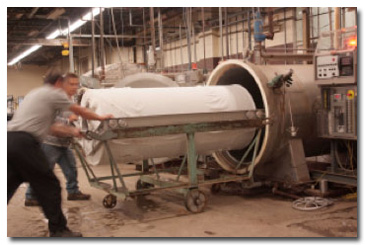
MWCanada10

Workers prepare to load up bundled fabric to be dyed in the dye kettle.

With the new boiler, the unique counter-flow design provides higher fuel-to-steam efficiency
than traditional boilers. The boiler also offers rapid response to fluctuating load demands and
eliminates hazardous steam explosions. It also provides high-quality steam; and features advanced
controls and full output from cold start within 10 minutes, without thermal stress. The boiler
design typically occupies one-third the floor space required by a traditional boiler and is 75
percent lighter; and industry-leading low nitrogen oxide burners are available for added
environmental protection.

Berger especially likes the energy efficiency, instant-on capability, dependability and low
maintenance of the new boiler. “You know you have a problem when maintenance spends too much time
with your boiler,” he remarked.

Brian Hutchings, MW Canada’s maintenance manager knows the new boiler better than anyone
else at the company. He says the steam generator delivers reliable and efficient performance.
“Automation and startup are big things for us, and the new boiler is really a hands-free system,”
he said. “We can also test things a lot easier and save fuel.”

What is MW Canada’s key to success? According to Berger, it is about having good people,
knowing your markets and offering high-quality production. “I am lucky to have a very smart group
of people who understand the critical issues involved in manufacturing. My job is to chart our path
to the future. The decisions of today affect where we will be three to five years from now.” he
said. “You have to focus on the top line, bottom line and everything in between. Then people will
call you lucky.”


Editor’s note: Glenn Adgey is general manager of Clayton Sales & Service
Ltd.


October 19, 2010

October 2010

Australia-based
Australian Wool Innovation Ltd.‘s WoolNet – a netted base layer garment made of
Merino wool – has won the Scandinavian Outdoor Award for Summer 2010.

Atlas Material Testing Technology GmbH, Germany, has launched a website dedicated
to its lightfastness testing solutions. The website is located at
www.textiles.atlas-mts.com.

Celanese Emersion Polymers, Dallas, has signed a distribution agreement with
Belgium-based Univar in which Univar will distribute Celanese Emulsion products in the Baltic
region.


Hyde Industrial Blade Solutions
, Southbridge, Mass., now offers the Industrial Hand
Knives and Blades catalog, a 12-page reference guide detailing Hyde’s extensive range of blades.
The brochure is available at
www.hydeblades.com/literature/pdf/hand-knives-catalog.pdf.

BBwebpic

Hyde’s Industrial Hand Knives and Blades catalog

The
American National Standards Institute (ANSI), Grand Rapids, Mich., has approved
the 2010 edition of ANSI/BIFMA X5.6 Panel Systems – Tests standard. Copies of the new edition may
be ordered from The Business and Institutional Furniture Manufacturer’s Association (BIFMA)
International, Grand Rapids, Mich., at
https://bifma.org/secure/orderform.html.

Germany-based
Deutsche Messe is accepting applications for the 2011 Carpet Design Awards, which
will be presented at the Domotex Hannover 2011 trade fair for the flooring sector, to be held Jan.
15-18, 2011. This year, the competition also is open to manufacturers not exhibiting at the event.
Application forms are available at
www.domotex.de/cda_e. Deadline for submissions is
November 5.

Manchester, Tenn.-based
Ravago Manufacturing Americas LLC‘s Enviramid™ post-consumer nylon compounding
feedstocks have been certified by UL Environment Inc., Northbrook, Ill., to meet all criteria as a
100-percent post-consumer nylon product.

The Association of the Nonwoven Fabrics Industry (INDA), Cary, N.C., has released
the “Stretchable Nonwovens Report” prepared by Smith, Johnson & Associates, Draper, Utah. The
report examines the top five enabling technologies related to stretchable nonwovens, as well as
business opportunities.

ASTM International, West Conshohocken, Pa., has released its latest ASTM
International Standards Catalog. Customers may browse and order directly from the interactive
catalog at
www.astm.org

London-based
Worth Global Style Network (WGSN) has launched WGSN Fontis, a multi-channel
digital platform utilizing cloud computing technology that has restructured WGSN’s 600,000 pages of
content to facilitate searches by users.

London-based
Intertek Group Plc has launched two iPhone® mobile digital device applications,
the Textile Compliance Guide EU and US Consumer Product Safety Improvement Act. The application may
be downloaded at no cost at the online Apple® application store.

Bozeman, Mont.-based
TEXbase Inc. has redesigned its website, located at www.texbase.com, and has
launched a blog at
www.texbase.com/blog/. The company also has added lab
data management for both Trim and Product to Texbase Quality, its laboratory information management
system for textile professionals; and has expanded Texbase Connect, its collaborative software
solution for suppliers, to collect trim and product test data and has added related widgets to the
dashboards.

Germany-based
Pikeur Reitmoden has won the Spoga Horse Innovation Award 2010 for its riding
pants featuring the Barrier by HeiQ water- and stain-repellent textile treatment by
HeiQ Materials AG, Switzerland.

New York City-based
Texstyle/Jamie Stern has launched a custom rug collection featuring designs
derived from paintings by artist Mikel Patrik. The collection includes three designs — Stitch,
Strata and Pixel — taken from Patrik’s paintings, and is available in three colorways.


Fabric Innovations
has relocated its headquarters to at 2665 South Bayshore Dr.,
Ste. 712, Miami, Fla., 33133; +305-860-5757.

Nikke – The Japan Wool Textile Co. Ltd., Japan, has received Australian Wool
Innovation Ltd.’s inaugural Special Woolmark Award 2010. The award was presented at the recent
Première Vision in Paris.


Easiway Systems Inc.
, Delano, Minn., has launched a new website, located at
www.easiway.com, to provide tools, support, distributor information and e-commerce.

Summer Rayne Oakes, an eco-model and authority on sustainable design practices in
the fashion and textile industry, has launched Source4Style, a business-to-business online
marketplace that allows designers to search, compare and purchase sustainable materials from more
than 25 suppliers in 12 countries. The site also helps sustainable suppliers promote their brands
through targeted marketing packages.

New York City-based
Jones Apparel Group has been renamed The Jones Group Inc.


Pantone LLC
, Carlstadt, N.J., has released the Spring/Summer 2012 edition of the
Pantone® View Colour Planner, its multi-discipline color forecaster.

Mt. Holly, N.C.-based
American & Efird Inc.‘s sewing threads, embroidery yarns and technical
textiels have received Oeko-Tex® Standard 100 certification.

United Kingdom-based
LGC Standards has collaborated with the European Commission’s Joint Research
Centre – Institute for Health and Consumer Protection (IHCP) to launch a range of reference
nanomaterials to aid research and testing into the applications and impacts of nanotechnology.

Iselin, N.J.-based
Maidenform Brands Inc. has granted Toronto-based Coconut Grove Intimates an
exclusive worldwide license to manufacture, market, sell and distribute bra accessories under the
Maidenform®, Self Expressions®, Sweet Nothings®, Inspirations®, Luleh® and Bodymates® brands.

The
American Apparel and Footwear Association (AAFA), Arlington, Va., has published
the seventh edition of the AAFA Restricted Substances List covering apparel, footwear and home
textiles. The list may be downloaded free of charge at
www.apparelandfootwear.org.

Israel-based
Kornit Digital Ltd. has debuted the DecoNetwork Solo Plus program for Kornit
customers. The program enables Kornit users to integrate a complete online direct-to-garment shop
into their business so they are able to accept custom orders at any time and perform a fast and
easy production process for customized and personalized artwork applications.

England-based
Mudpie Ltd. has released its latest Trendbooks for the Spring/Summer 2012 season.
The six books are available in hard copy and as ebooks via
www.mpdclick.com.

The Brussels-based
International Wool Textile Organisation (IWTO) has released the 2010 edition of
“IWTO Market Information,” containing relevant data on the international wool and textile industry,
including new information and statistics, and expanded information about animal fibers.

Using 3-D Software To Streamline The Sample Development Process

Technology advancements have allowed companies in virtually every industry to streamline their
product development processes, and the apparel industry is no exception. Processes such as pattern
making, pattern grading, and marker making have all been automated using computer-aided design
(CAD) software. But what about sample development — one of the most time-consuming and costly
components of product development? Well, now 3-D technology offers the apparel industry several
opportunities to streamline sample processes. By producing 3-D samples, apparel companies can save
time and money, better meet buyer demands and more quickly respond to consumer trends. 

tukatech1

Using 3-D sample-making software, images and movie files can be used as a background for
rendering.


First, let’s talk about what the current production cycle looks like. It’s no secret that the
majority of apparel manufacturing happens outside of the United States. And while apparel companies
save production costs by sourcing to overseas manufacturers, they lose quite a bit of time in the
product development process. The iterative sample approval process can involve weeks, sometimes
even months, of sending physical samples back and forth from manufacturer to buyer. This process
can restrict a company from getting a particular style in stores at the peak of demand for that
particular trend. In this era of fast fashion, it’s very important for apparel companies to be able
to design and develop new production-ready styles as fast as possible.

But, of course, apparel companies cannot simply stop producing samples. Whether they are
building an airplane engine, a circuit board or a building, all designers and engineers go through
a similar process of design, prototype development, final approval and then production. But how did
Ford manage to build competitive transmissions faster and cheaper, and how does Intel manage to
constantly develop new products to meet software demands? The answer lies in 3-D software.

tukatech2

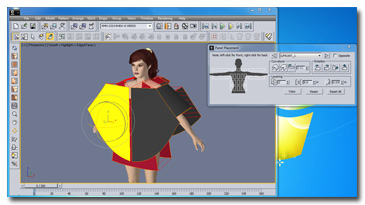
Pattern pieces are arranged on a virtual model using a silhouette placement tool.

The entire engineering world has been using 3-D software for more than a decade to design 3-D
prototypes of everything from cars to computer chips. Now that 3-D software has emerged as a real
solution in the apparel industry, more and more companies are building fewer physical samples from
real fabric and shipping them to the design houses. Rather, manufacturers and designers are working
and communicating in a more digital way to make and approve a 3-D virtual or digital sample of the
garment. But how does it work? Drafted CAD pattern pieces, modeled to behave as fabric using
sophisticated cloth simulation physics, are placed around an avatar and sewn together inside of the
3-D software. The cloth simulation is applied to realistically reproduce the proper drape and fit.
Then, the software user can save the 3-D sample as an image or movie from any perspective, and with
or without animation of a virtual model “wearing” the virtual sample. The sample can be emailed,
providing designers, fit technicians, and executives the ability to evaluate a sample long before
it would have been cut and sewn into a real sample.

Eliminating physical samples saves apparel companies not only time, but also money. Many
times, the sample garment will need additional corrections or adjustments, and the buyer will
request the vendor to make those adjustments, and then cut, sew and ship a revised sample. 
Moreover, many of these samples never make it to production for reasons that have nothing to do
with fit or construction, but rather with the natural selection process design houses go through in
creating a collection for a line. However, by utilizing 3-D samples, the software user can make any
necessary changes to the garment before it is ever sewn, saving on sample fabric costs, shipping
costs, fit model costs and, of course, speeding up the entire process. 

tukatech3

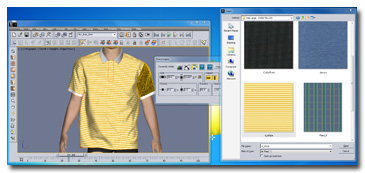
Prints, logos and other visual effects can be applied to any part of a 3-D garment.

Once the 3-D sample is approved, the value of the data still remains. Companies are using 3-D
samples in their sales processes with buyers. Because 3-D samples can be created in an infinite
number of colors and prints, buyers can be presented with a number of options without manufacturers
having to invest in a physical sample that might never even make it into production. Companies like
Velvet Heart, Green Apple, and others are displaying virtual samples on flat screens on the
showroom floor or at trade shows, such as the recent Magic Marketplace in Las Vegas. Advanced 3-D
systems also offer virtual animation, allowing users and collaborators to evaluate the sample in
any pose and with any kind of movement. For example, buyers can watch a soccer jersey sample’s
fabric and fit perform as a virtual model kicks a ball.

As you can see, 3-D sample-making software can be used in various ways in the supply chain to
reduce lead times, increase quality, and dramatically lower costs. Vendors for brands such as Maggy
London, Tesco, Phillip Van Heusen, Abercrombie & Fitch and Jones New York Intimates use 3-D
sample-making software, and even more industry-leading brands are expected to adopt the technology
in the near future.


Editor’s note:
Ram Sareen is CEO-founder of Tukatech Inc., a Los Angeles-based
provider of apparel industry software, including the TUKA3D virtual sample-making system;
pattern-making, grading and marker-making software; Web-based product development services; product
data management/product lifecycle management systems; and manufacturing equipment supported by
brick-and-mortar centers strategically located in garment hubs worldwide. 


October 19, 2010


Anti-Counterfeiting Trade Agreement Nears Finalization

The United States, European Union (EU) member states and nine other countries recently met in Tokyo
and have produced a draft text of an Anti-Counterfeiting Trade Agreement (ACTA) that, according to
the Office of the United States Trade Representative (USTR), “establishes a state-of-the-art
international framework that provides a model for effectively combating global proliferation of
commercial-scale counterfeiting and piracy in the 21st century.” The draft pact is the result of a
series of negotiation sessions that have been conducted over the last three years.

The participating countries are parties to more than half of global trade activities and
include Australia, Canada, Japan, Korea, Mexico, Morocco, New Zealand, Singapore and Switzerland in
addition to the United States and EU member countries. The U.S. negotiating team includes Deputy
USTR Miriam Sapiro, Assistant USTR for Intellectual Property & Innovation Stanford McCoy, and
Chief Negotiator for Intellectual Property Enforcement Kira Alvarez.

“This text reflects tremendous progress in the fight against counterfeiting and piracy — a
global crime wave that robs workers in the United States and around the world of good-paying jobs
and exposes consumers to dangerous products,” said USTR Ron Kirk. “The leadership shown by our ACTA
partners in reaching solutions on tough issues should send a strong message to pirates and
counterfeiters that they have no place in the channels of legitimate trade. We must now work
quickly with our partners to finalize the results achieved in Tokyo. This work represents a
significant victory for those who care about protecting and enforcing intellectual property
rights.”

The legal framework of the agreement includes the following provisions:

•    general obligations by the parties to provide effective enforcement
methods;

•    civil enforcement provisions to cover damage awards, injunctions against
further violations, recovery of legal and other costs, and destruction of contravening goods;

•    customs and other border procedures to handle import and export
shipments;

•    criminal enforcement provisions including remediation related to
commercial-scale copyright piracy, remediation related to the use or importation of packaging
labels for counterfeit goods, and commitments regarding confiscation and destruction of counterfeit
goods and confiscation of equipment and materials used to manufacture them as well as criminal
proceeds, among other provisions; and

•    intellectual property rights enforcement in the digital environment
including provision of legal systems to handle circumvention of digital security features, among
other measures.

The agreement also includes provisions to strengthen international cooperation and promote
effective enforcement practices.

Upon resolution of a few issues that require further review by the individual countries, the
draft text will be finalized and released for final review.

October 12, 2010

The Rupp Report: Again, It’s Communication That Matters

On August 31, 2010, the Rupp Report,
“Organic
Production Yes, But…”
mentioned some critical issues about organic production and the
increased global awareness about rural poverty. “This focus,” the report stated, “along with
increased awareness of climate change and sustainability, has led to a proliferation of projects to
improve agricultural practices as well as raise the level of social and environmental
responsibility. In the near future it might be impossible to sell products that are produced not
only under ecological standards, but also according to social standards.”

The ICAC

But now, the winds have changed. As the Rupp Report has been informed, in September 2010, the
69th Plenary Meeting of the International Cotton Advisory Committee (ICAC) was held in Texas and
attended by some 400 participants from around the world. The theme of the meeting was “Cotton
Industry Growth through Global Unity,” and Mozambique was welcomed as a new committee member.

It’s not an exaggeration to say the ICAC is one of the most important cotton organizations in
the world. The association, based in Washington, represents more than 40 governments of
cotton-producing, -consuming or -trading countries.

Cotton, The Global Crop — And Fiber

And cotton needs a global association. According to data from the ICAC, cotton fibers are
grown in more than 100 countries on approximately 33 million hectares — some 2.5 percent of the
world’s arable land. This means that cotton is one of the most significant crops in terms of land.
ICAC estimates indicate that if family labor, hired farm labor and workers in ancillary services
such as transportation, ginning, baling and storage are considered, a total of more than 250
million people are involved in the cotton sector.

And the facts and figures are impressive: In the 2009-10 year, the estimated value of 22
million tons of world cotton production at an average world price of 78 cents per pound of lint, or
$1.72 per kilogram, totaled approximately $37 billion.

Cotton — Still Under Fire

For years, as it seems to the public eye, cotton producers didn’t care much about the
environment. In many school books around the world, there are still obscure pictures of children
working in dirty spinning mills. A typical example given to show how “bad” cotton was is the drying
up of the Aral Sea as a result of the massive irrigation of cotton based on very old Soviet plans
to cultivate this fiber. But times have changed. On the one hand, the consciousness about natural
resources is rising; and, on the other hand, the world’s population needs food. This vicious circle
occupies many international organizations as well as nongovernmental organizations (NGOs) all over
the world, basically in a fight against the cotton-growing industry. It seems that these stories
have now reached the ICAC, too.


A New Approach


During the introductory session of the ICAC Plenary Meeting, Executive Director Dr. Terry
Townsend pointed out that, regardless of cotton’s positive impacts and the benefits gained by
consumers and also regardless of current research data, cotton has received sharp criticism for
having negative environmental impacts and for social abuses. Criticism of the cotton industry and
cotton production comes not only from commercial competitors or from NGOs outside the cotton
sector, but also from government publications.

Townsend suggested cotton advocates should listen to the criticism and respond using
appropriate strategies, to enhance cotton’s performance as well as to confront egregious
misinformation campaigns. They must also be aggressive in telling the true story. And there is a
lot to say.

For example, Townsend said, the allegation that cotton accounts for 25 percent of all
pesticide use globally is completely false. In 2009, cotton accounted for 6.2 percent of global
pesticide sales. Water conservation is another big issue for the future. Cotton is alleged to be a
water-intensive crop, but it uses between 2 and 3 percent of world agricultural water, equal in
proportion to cotton-cultivated acreage.

Water Savings

U.S. cotton cultivation requires 45-percent less water today than 25 years ago, and
conservation tillage has reduced soil erosion significantly, it was reported. Insecticide
applications have been declining since 1996, owing to the use of biotechnology as well as other
modern technologies. In Texas, some 25,000 people are employed directly in the cotton industry, and
supporting industries and trades employ many more.

A Lot To Tell

There is still a big job to do to tell consumers, and even more to the NGOs, that the cotton
industry has improved considerably over the years. For example, it was reported, farm prices,
production costs and retail demand are constraining the economic sustainability of cotton
production. Furthermore, while biotechnology has improved yields and qualities, further
improvements to the economic sustainability of cotton production will be realized through advances
in drought and salt tolerance varieties and in nutrient absorption.


October 12, 2010

DyStar Acquires Texanlab; DyStar Colours, Coatema Collaborate

India-based DyStar has finalized its acquisition of India-based accredited third-party quality
control testing services company Texanlab Laboratories Pvt. Ltd. The company joins Color Solutions
International, Expert Solutions and Ecology Solutions as a member of the DyStar Textile Services
team. Ullhas Nimkar has been named ambassador emeritus and advisor of Texanlab.

“With the newly relocated and upgraded flagship laboratory in Navi Mumbai, we are confident
that we are better positioned to service international retailers and brands who are sourcing for
top quality and ecologically friendly garments in India,” said Simon Collinson, director of DyStar
Textile Services. “Moreover, we are glad to announce that Mr. Nimkar will continue his service with
us, and I am sure his experience and wealth of knowledge in the field of textile testing will
support and help the development of our future expansion plans.”

In other company news, Germany-based DyStar Colours Deutschland GmbH has signed an agreement
with Germany-based Coatema Coating Machinery GmbH — a manufacturer of coating, printing and
laminating technology. Under the agreement, the two companies will collaborate to develop denim
application technologies for DyStar’s Indigo Vat 40% Solution. They also will cooperate on minimal
application technologies for prereduced indigo, indigo and vat dyes; and other effects chemicals
for yarns, fabrics and other substrates.

“With DyStar and Coatema, the technology leaders for indigo and coating machines have got
together,” said Günther Widler, head of denim technology, DyStar. “This offers the unique
opportunity to create new, never-before-seen denim effects.”

October 12, 2010

The Carpet Recyclers Opens Carpet Recycling Facilities

The Carpet Recyclers — a division of Fullerton, Calif.-based GF Industries, a company that
recycles and reuses industrial waste in ways that reduce costs and environmental impact — recently
opened two facilities — one in Oakland, Calif., and one in La Mirada, Calif. — to recycle
residential and commercial carpet. Products that can be manufactured from the recycled carpet
include new carpet, carpet padding, a variety of building products and high-energy fuel.

The Carpet Recyclers’ facilities, which obtained exclusive rights in the Western United
States to state-of-the-art carpet recovery equipment, have the capacity to process 400,000 pounds
of carpet each day. According to the Carpet America Recovery Effort™ (CARE) — a nonprofit
organization that comprises manufacturers, recycling entrepreneurs and government agencies; and
works to find market-based solutions for recycling carpet and diverting it from landfills —
400,000 pounds of carpet is equivalent to 932 barrels of oil. The Carpet Recyclers reports that 3.2
percent of all waste entering California landfills is old carpet — totaling some 1.3 billion
pounds.

“Since 1992, GF Industries has been turning waste into resources through our innovative waste
recovery, beneficial reuse and recycling solutions that reduce costs for our customers and help the
environment,” said Larry Fink, president, GF Industries. “We are excited to add our expertise to
carpet recycling with the opening of our first two ‘The Carpet Recyclers’ facilities and creating
50 green jobs.”

October 12, 2010

TenCate Introduces Improved Defender™ M FR Fabric

Union City, Ga.-based TenCate Protective Fabrics USA — a manufacturer of inherently
flame-resistant (FR) fabrics, and a division of the Netherlands-based Royal Ten Cate — has
developed an improved version of its Defender™ M FR fabric that is more durable and offers better
protection while retaining its FR and comfort features. The U.S. Marine Corps has approved the new
fabric to be used to make its FR Organization Gear (FROG) uniform, which TenCate will deliver to
the Marines in the fourth quarter of 2010.

TenCate originally developed Defender M fabric — made using a proprietary blend of fibers
including Lenzing® FR fiber from Austria-based Lenzing AG — to protect U.S. military troops in
Iraq and Afghanistan from burns caused by improvised explosive devices. The company has since
expanded the line, which offers a variety of styles and has been used in many U.S. Army and Marine
Corps garments.

“Troops report that uniforms [made with Defender M] are saving lives and reducing burn
injuries, and an Army spokesman said that TenCate Defender M has ‘consistently exceeded our
expectation,'” said Nick Pence, military market manager, TenCate.

October 12, 2010

Gildan Begins Relocation To Charleston, Adds 87 Jobs

Montreal-based branded basic apparel manufacturer Gildan Activewear Inc. has begun relocating its
retail management and administrative functions to its new, state-of-the-art distribution center and
office building in Charleston, S.C., and is expecting to add 87 new jobs.

This follows the company’s announcement last year that it would close its Fort Payne, Ala.,
and Martinsville, Va., retail distribution centers and consolidate those operations to a facility
that would house its retail operations — including sales and administrative functions — and
transfer 250 jobs to the new site
(See ”
Gildan
To Consolidate Retail Distribution Operations In Charleston, SC
,” Dec. 22, 2009)
. Gildan
started hiring and inaugurated the distribution center in May. The company now has begun hiring for
the additional 87 jobs, which it expects to fill by the end of this year.

“As announced in May at the inauguration of our distribution centre, Gildan’s facility in
Charleston will serve as the office location for our operations servicing the retail market,” said
Paul Parker, vice president of operations, Gildan Activewear in Charleston. “The area has provided
us with an excellent business environment and we are pleased to grow our operations in South
Carolina. We look forward to our continued growth here and appreciate all the support we have
received from state and local officials.”

October 12, 2010

Sponsors