From The Editor: Yes, Textiles Are Made In The USA, In 18,783 Locations

By Jim Borneman, Editor In Chief

There is an unfortunate tendency today to accept generalities as fact and to assume that those facts are correct. This is not necessarily the case. Take textiles, for example. Yes, there have been sweeping changes in the industry — plants have closed, textile employment doesn’t quite have the numbers it once had. But the assumptions that textiles are no longer made in the United States, that there are no domestic apparel producers — those assumptions are simply wrong.

On National Public Radio the other evening during drive time, there was a piece that was attacking the tariff system. Toward the end of the story, a trade lawyer quipped,  “You know, there are almost no producers of apparel left in the United States.” And, referring to tariffs on imported goods, he said, “These are vestiges of an older time when in fact we had those jobs.”  That statement was unchallenged by the interviewer — a case of assumed generality accepted as fact.

Textile World 
is often asked to describe the textile industry to non-industry parties — journalists dabbling with half a fact, analysts trying to understand the scope of the industry — and one of the best ways to do that is to turn to government-gathered data and observe your tax dollars at work.

The North American Industry Classification System (NAICS) defines textiles with three separate codes: NAICS 313, textile mills; NAICS 314, textile product mills; and NAICS 315, apparel
manufacturing. The U.S. Department of Labor’s Bureau of Labor Statistics reports a Quarterly Census of Employment and Wages according to NAICS code.

For NAICS 313, textile mills, as of the end of the second quarter of 2010, the preliminary data show there were 3,255 private establishments defined as textile mills. This number compares to 5,637 reported in 2001 and has been fairly stable since 2007, when 3,828 textile mills were reported.

For NAICS 314, textile product mills, as of the end of the second quarter of 2010, the preliminary data show there were 7,581 private establishments. This compares to 8,505 reported in 2001, and the number of mills was more than 8,000 as recently as 2008.

And for NAICS 315, apparel manufacturing, as of the end of the second quarter of 2010, the preliminary data show there were 7,947 private apparel manufacturing establishments in the United States. This compares to a hefty 15,478 reported in 2001 and does show a dramatic drop in facilities — with a loss of roughly 1,000 facilities a year until 2007, when the drop halved to approximately 500 facilities a year.

The number of establishments does show a negative trend, but the yearly series also reflects a slowing of closures.

With a total of 18,783 private establishments reported across textiles’ three NAICS codes, at least the government acknowledges the existence of the industry and the jobs it sustains.

Are 18,783 textile establishments significant? Probably really significant if you work at one of them, but maybe not so much if you are a trade lawyer who doesn’t see the value of the tariff
system, particularly because —  “These are vestiges of an older time when in fact we had those jobs.”

January/February 2011

Quality Fabric Of The Month: Channeling Power

Burlington Worldwide (BWW), a business unit of International Textile Group Inc. (ITG), Greensboro, N.C., has launched the Cooltec™ line of woven moisture-management, quick-drying polyester fabrics featuring performance that is engineered into the fiber. Burlington Labs, the
company’s research and development division, developed the fabrics for apparel uses including men’s dress casual, golf and other activewear pants and shirts, as well as uniforms.The proprietary yarn is made with filaments that have an x-shaped cross section with concave “conducting slots” that create a siphoning effect. The yarn quickly channels the moisture away from the body and diffuses it through the fabric to evaporate very quickly as well, leaving the wearer cool and comfortable. The engineered performance, including both vertical wicking and absorption, is permanently built into the fabric. Other performance properties, such as odor control, soil
release and ultraviolet protection, can be applied to the fabric without affecting the inherent properties.

QFOM

The x-shaped cross section of Cooltec™ filaments enables the yarn to quickly channel
moisture away from the body and diffuse it through the fabric.

“We could blend Cooltec with different technologies to create a smorgasbord of technology in a single fabric,” said Peter M. Baumann, senior vice president Merchandising, BWW. “The technologies could be yarn-related or chemistry-related.”

Bauman said the fabrics are targeted to brands and private-label retailers that want to offer high-performance apparel that has a lower price point than the top-of-the-line goods as well as superior performance compared with apparel featuring a moisture-management finish. The fabric is produced in China and finished at BWW’s Jiaxing Burlington Textile Co. Ltd. dyeing and finishing plant, and supplied to downstream apparel and careerwear manufacturers in Asia, many of which supply the U.S. market.

“We have developed several different styles for the Spring 2012 season and are able to replicate anything else in our line, including heather colors,” Baumann said. The fabrics are constructed using Cooltec in either the warp or the filling and another polyester yarn in the other
direction. That proportion of Cooltec is sufficient to provide the performance and helps to keep the cost of the fabric within the desired range, Baumann explained. It also allows BWW to blend Cooltec with a range of other yarns in the various styles.

Cooltec’s very quick-drying property can also help reduce energy usage during the drying cycle when it is laundered. “This could be especially relevant for commercial laundering of a load of uniforms,” Baumann said. Theoretically, a garment “powered by Cooltec” also could help shorten drying time in a mixed load because of the way it performs.


For more information about Cooltec™, contact +336-379-2855.


January/February 2011

Demand Strong; Availability Uncertain

Orders for yarn continued to be strong in early January across virtually every segment. Open-end
(OE) yarns are moving well, and the demand for ring-spun yarns is such that buyers are struggling
to locate product.

“Ring-spun yarns are just not to be found right now,” said one spinner. “And it’s not just
yarns from this hemisphere, either. Ring-spun is in short supply all over the world. If you don’t
already have a position with a manufacturer, it’s going to be almost impossible for you to get yarn
anytime soon.”

Cotton yarns of all types continue to be in high demand but short supply. The 2010 cotton
crop sold out early, and there was some hope that cotton availability would increase and prices
would decrease as the 2011 crop came to market. However, after a short dip in early January, prices
began moving back near the record levels recorded in late 2010, due in large part to extensive crop
losses in Australia.

For the week ending January 13, quotations for the base quality of cotton in the seven
designated U.S. Department of Agriculture markets averaged 137.85 cents per pound. Cotton futures
for March delivery rose by the Intercontinental Exchange (ICE) Futures Exchange limit of 2.8
percent (4 cents) to 147.25 cents per pound, the biggest gain since Dec. 21, 2010, when futures
reached the record price of 159.12 cents.


Weather Impacts Could Be Far-reaching


Much of the recent jump can be attributed to the worst floods in more than a century in
Australia. As of mid-January, the Australian Cotton Shippers Association estimates that more than
300,000 bales of cotton crop have been destroyed, accounting for nearly 10 percent of the estimated
2011 crop yield in Australia. Losses could continue to escalate if wet weather continues.

While the floods that have devastated parts of Australia have caused immediate short-term
impact to the world cotton market, spinners and industry observers warn the effects could be
far-reaching.

“You have to consider that cotton is not the only crop to suffer damage in Australia,” said
one yarn exporter. “There has been damage to the wheat crop as well. It becomes a pretty clear-cut
decision when the choice is between growing cotton and feeding people, so I would not be surprised
if some cotton plantings were replaced by wheat. The Australian flooding, coupled with droughts in
Russia, has caused global concern that wheat demand may outstrip supply in 2011.”

He continued: “Further, farmers know the old adage, ‘what goes up, must come down,’ and they
are well-aware that higher cotton prices won’t last forever. So, when faced with choices in
planting for the next harvest, they may look to what they see as potentially more profitable
crops.”


Price, Fiber Shortages Create Concern


“Price is going to be an issue for everyone, particularly as we get into the third quarter,”
said one spinner.

“The most pressing issue I see as I look forward to the rest of 2011 is availability,” said
another. “A lot of spinners were able to cover for the first half, thinking that by the second half
it would be okay. But looking at the way things stand right now, I think the second half is going
to be worse. For those people who covered for the first half but then have to go to market price
for the second half – the question is, how are they going to do it? Will retail accept the price
increases? Will they stop buying? It’s anybody’s guess at the moment. Retail has accepted some
price increases to date, but they are fiercely fighting over each one.”

Said yet another spinner: “The availability of fiber continues to be an issue, and it is
likely to get worse as the year goes on. As we look at the year, I think the biggest concerns over
the first half are going to be pricing and the availability of fiber. But as we go to the second
half, availability of fiber is going to be the biggest issue. And if you can’t find fiber, it won’t
matter how much money you’ve got to spend. And this is a global problem, not just a U.S. problem.”

January/February 2011

Oeko-Tex Updates Test Criteria

The International Oeko-Tex Association, Switzerland, has updated its criteria and limit values for
testing textiles for harmful substances in accordance with the Oeko-Tex® Standard 100 certification
process.

Short chain (C10 to C13) chlorinated paraffins and tris (2-chloroethyl) phosphate will be
included explicitly in the list of banned flame-retardant substances and also will be listed with
the other banned residual chemicals in the list of criteria. Both substances are sometimes used for
other applications.

The association has set a standard limit value of 90 parts per million (ppm) for total lead
content across all four Oeko-Tex product classes. This limit is considerably lower than the U.S.
Consumer Products Safety Improvement Act’s current limit of 300 ppm or the 100-ppm limit as of
August 2011 for babies’ and children’s articles. Testing for extractable heavy metals using a
controlled sweat solution will continue to be the most important requirement of Oeko-Tex Standard
100 because that test method is more relevant with regard to potential health risks from
undesirable heavy metals in textile products than is testing for total lead content, Oeko-Tex
reports.

Oeko-Tex will continue its planned universal onsite visits, which were introduced at the
beginning of 2010 as a component of Oeko-Tex certification.

January/February 2011

Spring/Summer 2012 Will Be Bright


A
long with new colors, textures, patterns, finishes and technologies, global sourcing and
the economy were topics of discussion at the recent Première Vision Preview in New York City, where
preregistration was up 30 percent.

“With buyers looking for smaller quantities and more frequent and faster deliveries,
manufacturing is moving closer to home,” said Philippe Pasquet, CEO, Première Vision S.A.

Exhibitors reinforced these ideas. Ron Sheridan, agent for Turkish printer Confetti Tekstil,
said a lot of apparel is coming out of Egypt, Israel and Jordan — duty-free countries near Turkey
whose companies are equipped to work with small manufacturers. “Apparel companies are balking less
at the higher prices of digital printing because they can get smaller quantities and faster
deliveries,” he said, noting that Confetti provides minimums as low as 100 yards.

Direction by Indigo and Printsource, surface design shows that ran concurrently with Première
Vision Preview, were crowded. Massimo Iacoboni, CEO and producer, Printsource, said American
designers are looking for new inspiration. “We are part of their machine for creativity. They come
here to see what will be next.”

KA1

At Première Vision Preview, KBC showed intricate, colorful digital prints on silk chiffon,
charmeuse and cotton voile.


Casual And Active At Première Vision Preview


Spring/Summer 2012 will be bright and romantic, with ultralight, high-performance fabrics
that feel good. New finishing techniques provide dry, slick or crisp touches, generally with a
supple hand. Prints and jacquards tend to be ultra-large; blouse and shirting styles are small in
scale.

For active- and outerwear, ultralightweight fabrics with performance are in demand.
Italy-based Frizza S.p.A.’s new FXL division showed trendy, high-tech fabrics. Transparent
23-grams-per-square-meter (g/m2) nylons are lustrous, drape well, and are wind- and waterproof.
Soft cottons have a washed effect. Lightweight bonded fabrics reverse color and stretch in all
directions. Wax finishes are easy-care.

Olmetex, S.p.A., Italy, introduced seven new fabrics. The most popular is an 80-g/m2
silk/cotton blend that has a crisp hand. There are sheer linen/nylon reversible fabrics, yarn-dyed
cottons that have a touch of metal for subtle sheen, shiny/dull jacquards and lightweight
micro-nylons that have a supple hand.


C.O.T.O., Japan, has a range that goes from ultralight and open lacy knits to dry-hand woven
canvas. Fabrics are knitted and woven of paper blended with cotton. Abca paper yarns are
chemical-free, biodegradable, smooth and ultralight; and have a cool, dry touch.

BTD Tekstil, Turkey, has new satin-touch, dry-hand finishes on pant- and jacketweight
fabrics. There are twills and poplins, sharkskins, hopsacks, denim looks and subtle textures woven
in linen/viscose blends.

Shirting fabrics at AB Créations by Fabien Doligez, France, include ultralight cottons with a
washed finish, lustrous 100-percent cupro shirtings and linen/Lycra® blends. Along with fine
stripes, there are shiny/dull woven linen/cotton jacquards.

Knits at Deveaux, France, go from day to evening. Best sellers are woven with acetate for a
satin surface and patterned to coordinate with crinkled textures, lustered crepes and crochet
knits.  


Luxe


Reynaud Rexo, France, describes its line as fancy, sophisticated and elegant. There is luster
and sheen for day. Some jacquards are touched with Lurex®; others are subtly textured or have
enormous patterns. Flowers can be bold and bright or subtle and tonal.

Jacquard specialist Carlo Pozzi, Italy, showed an innovative collection of 100-percent silk
and blends with cotton or linen for day and evening. Looks include snake patterns, long-stem
abstract flowers, panel designs with faded effects and silver roses.

Denis et Fils, France, showed silk/viscose/polyester jacquards.  Some are woven with
dazzling metal and hand-painted. Other fabrics are warp-printed for a soft, romantic look.

Color and metal are selling at lace specialist Solstiss, France. There are ribbon
re-embroidered laces and functional stretch laces that are going into lingerie and swimwear.


Prints


Prints are popular, especially florals. They are enormous, bold and colorful, tropical,
romantic, elongated, abstract and ethnic. Paisleys and skins continue.

At KBC, Germany, digital prints on silk chiffon, charmeuse and cotton voile are intricate and
colorful. There are sweeping linear designs with blurred edges, marbled patterns, melting irregular
stripes, snakeskins, abstract geometrics and bold flowers.

Sprintex S.a.s., France, has digital prints on silk, linen, cotton or polyester chiffon,
crepon, voile, jersey and satins. Many coordinate with matching stripes or dots. Pretty, romantic
and tropical flowers turn up with birds or animal skins. Most are giant in scale. Some are bright
and blotched, and others are tonal and in patch patterns.

At Miroglio Textile S.r.l., Italy, digital prints are big and bright. Flowers run the gamut
from tropical or melting to abstract. They are combined with stripes, mixed with lace and in pale
to bright borders. Abstracts are dimensional and colorful, and paisleys turn up in engineered scarf
designs.

Confetti showed prints on rayon/ spandex jersey and silk or polyester voile. There are
dimensional abstract designs, blurred tie-dye effects and brightly colored tropical flowers.

KA3


Lewis Orchard exhibited its fabric collection at PrintSource.


Direction By Indigo And Printsource

Some studios showed at both Direction and Printsource. Bernini Studio Designs, Italy;
Creations Robert Vernet, France; and Gather No Moss, London, all cited Direction for fashion and
Printsource for interior design, with some overlapping.

Bernini showed animal/flower mixes on printed lace grounds, romantic flowers, and ethnic
patchwork combinations of paisleys with geometrics. Traditional flowers, patchwork flowers and
Missoni-styled stripes were pointed out at Robert Vernet, where corals and pinks are color
favorites. Gather No Moss prints are hand-rendered and often of vintage quality. For swimwear,
there are African tribal patterns; logos and labels were shown for T-shirts. Flowers at Whiston
& Wright, United Kingdom (U.K.), range from botanical designs to Asian. Geometrics are clean
and graphic.

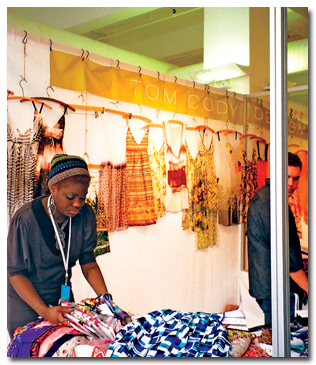
At Direction, Tom Cody, New York City and London, showed 1970s-inspired foulard geometrics,
Missoni-styled zig-zag stripes and ethnic ikats. Florals are pretty and romantic, watery, scratchy,
and Asia-inspired. Indistinct animals and geometrics have a no-print look. Milkprint, New York
City, showed feminine and graphic paisleys and geometrics, abstract Asian florals, floral/stripe
mixes and small retro conversationals.
KA2

Tom Cody’s exhibit at Direction included fabrics made up into apparel.


Best sellers at Fortier Price Textile Design Archive, Paris, are romantic florals. Fresh
pastel plaids, black and white monotone abstracts, sophisticated conversationals, ethnic paisleys
and small foulard-styled geometrics were also pointed out. Paris-based Antoinette et Freddy showed
bright tropical flowers and geometrics for swimwear.

Asian flowers are soft and muted at Baxter Fawcett, London. Another idea is 1970s-inspired
geometrics. Patterns show animal-skin textural designs, graphic flowers, paisleys mixed with ditsy
patterns and tropicals. The Collection, London, showed nautical conversationals, palm tree
tropicals, Asian florals, fractured stripes and abstract faded skin prints.

At PrintSource, Artwork Design, U.K., showed updated traditional prints for draperies,
upholstery and bedding. Linear paisleys, large-scale tropicals, leaves and soft florals are some
ideas. BG 2770 Design, Portland, Maine, was looking to license its computer-generated designs for
shower curtains, bedsheets and spreads. Elongated abstract linear patterns were shown in a wide
range of colors.

Large, happy and active is how Peagreen, London, describes its collection. Stylized animals,
motor cars and sunburst flowers are brightly colored. Avi Iny, Israel, designs for activewear,
sleepwear and lingerie. Ethnic Russian, Hawaiian tropical and small all-over geometric designs were
pointed out.

At Creativo Surface Design Studio, New York City, prints are ornate. There are melting Aztec
stripes and patchworks, blurred and blotchy flowers and ethnic paisleys. New York City-based
European Textile Collections showed abstract prints inspired by nature, no-print prints such as a
corkboard look, leopard and zebra skins, floral/lace combos, paisleys, and bold black-and-whites.

January/February 2011

CEMATEX, EURATEX Sign MoU

The European Committee of Textile Machinery Manufacturers (CEMATEX) and the European Apparel and
Textile Federation (EURATEX) have signed a memorandum of understanding (MoU) for closer
collaboration in research, technological development, innovation and industry promotion. MoU
signatories, CEMATEX President Steve Combes and EURATEX President Dr. Peter Pfneisl, noted the
growing importance of research and technological innovation to the European textile, apparel and
machinery industries in maintaining a global competitive advantage. They also announced upcoming
joint activities, including a European Textile Research Pavilion in September at ITMA 2011 in
Barcelona, Spain, where the organizations will host a European Commission delegation, among other
visitors. CEMATEX also will offer a 60th anniversary grant to ITMA exhibitors from research and
education institutions.

“[T]he European textile and clothing industry will not stop in its relentless efforts to
innovate in its products and processes to always remain one step ahead of our global competition,”
Pfneisl said. “These innovations are unthinkable without the right machines and equipment with the
right functionalities and capacities, available at the right time. We don’t see anybody better
placed to provide us with these innovation tools than our colleagues from the European textile
machinery industry and we look forward to fill this collaboration agreement at European level with
a wealth of mutually beneficial activities for many years to come.”

“We believe that EURATEX and CEMATEX, pooling our talents and abilities towards a common
purpose, will accomplish more than continuing to work independently,” Combes said. “A united
textile-making and textile machinery cluster will consolidate our position in the global market,
and help increase our market share.”

January/February 2011

Apparel Sourcing Show 2011: Recovery In Sight


T
he 2011 edition of the well-known Apparel Sourcing Show will take place Tuesday through
Thursday, March 22-24, at the Grand Tikal Futura Hotel Convention Center in Guatemala City,
Guatemala.

The show is held annually and is considered to be the most important textile and apparel fair
produced in the Central America, Caribbean and U.S. region, especially for the countries served by
the Central America-Dominican Republic Free Trade Agreement (CAFTA-DR).

Other countries, including Mexico, Colombia and Panama, also will participate in this year’s
event, which will be its 20th edition, and which is organized and hosted by the Guatemalan Textile
and Apparel Industry Commission (VESTEX). The show also is endorsed by the United States
Association of Importers of Textiles and Apparel.

APSS1

Guatemala City at dusk

VESTEX reports the Apparel Sourcing Show is the only fair that gathers the entire range
of CAFTA-DR textile and apparel manufacturers and service providers under a single roof. Last
year’s event drew more than 4,000 participants from 11 countries. Business transactions conducted
during the show had a total value of more than $200 million.

This year’s show, presented under the theme, “The Right Time, The Right Place for Sourcing
Today!” will reunite the key participants in the CAFTA-DR apparel supply chain at one venue to
present the dynamics of an industry that is committed to being a speed-to-market and high-quality
fashion garment provider.

The Apparel Sourcing Show has grown each year by 30 precent in terms of exhibition area, in
order to offer more companies the opportunity to integrate their full-package programs, as well as
to allow increased participation by machinery manufacturers and technology providers.

Other participants will include manufacturers of textile materials, embroidery, trims,
accessories and fabrics.


Industry Recovery


The focus of this year’s show will be the recovery of the regional textile and apparel
industries. According to show organizers, dynamic growth in the CAFTA-DR countries is creating
exciting new business opportunities in that sector.

New customers are taking advantage of the CAFTA-DR region’s close proximity to the U.S.
market, which offers trade preferences to exporters of products made in the region. On the other
hand, former customers hit by the downturn are returning to the region, with its booming economic
activity.

VESTEX notes the countries of the CAFTA-DR region have a well-deserved reputation for
flexibility in volume production and also designs. That flexibility, the commission says, offers
the ideal solution for today’s market demands.

APSS2

Dr. José Rafael Espada, vice president of Guatemala, inspects goods shown at the 2010 edition
of the Apparel Sourcing Show.


Opportunities


During the Apparel Sourcing Show 2011, both exhibitors and visitors will be be able to avail
themselves of the following advantages and opportunities:

  • Survey the huge exhibition floor showcasing products and services from hundreds of exhibitors
    from the CAFTA-DR region as well as from Mexico, Colombia, and other countries.
  • Participate in the Leaders’ Forum, an academic program presenting executives and managers, and
    focusing on sustainability.
  • Catch up on the latest industry developments and know-how from leading experts and government
    officials.
  • Tour and visit regional plants to find the perfect production site for the elaboration of
    textile and apparel products.

At the Apparel Sourcing Show 2011, the countries of the CAFTA-DR region will offer numerous
opportunities to visitors in search of the latest advancements in the fields of trims, fabrics,
assembly operations, and full-package solutions.


For more information about Apparel Sourcing Show 2011, contact
apparelexpo@apparel.com.gt.


January/February 2011

Tatham Introduces TS System

United Kingdom-based Tatham Ltd. — a global supplier of drive and control equipment for woolen and
nonwovens processing — recently launched the TS System, a variable machinery drive system that
reduces energy consumption by up to 50 percent. According to Tatham, the system eliminates current
spikes that occur during acceleration and torque surges, which decreases the wear on mechanical
system components as well as stress on the complete drive mechanical transmission line.

The TS System range includes TS and TSe weight control technology and crosslappers. TS
variable speed drives are suitable for most applications and are used in carding machines,
crosslappers, needlelooms, and spinning and twisting frames. Tatham reports it is able to upgrade
any carding machine with drives and weight control and can tailor specifications to meet customers’
requirements.

“A TS drive system will directly replace any mechatronic DC drive or standard DC drive, with
the latest AC variable speed drives offering the most practical solution both technically and
economically,” said Jim Kelly, senior electrical engineer, Tatham. “The drives are completely
synchronised and do not require feedback devices, allowing finite control of the machine at all
speeds.”

Tatham reports it has installed numerous TS Systems globally, including on a Hergeth
crosslapper in Malaysia, a medical textile line and several woolen carding lines in the U.K., and a
carbon fiber line in the United States.

January 25, 2011

Luigi Omodeo Zorini, Comez Founder And President

Luigi Omodeo Zorini, founder and president of Italy-based Costruzioni Meccaniche Zorini Comez, died
Dec. 24, 2010, at the age of 86.

Zorini was born May 25, 1924. In 1953, in partnership with his brother Mario, he founded
Comez as a producer of crochet machinery. Under his leadership, the company received more than 50
patents for innovative machinery to meet the demands of the market.

Zorini

Luigi Omodeo Zorini

He received several awards from the Pavia Chamber of Commerce, recognizing his achievements
in foreign trade, his commitment to employment and economic progress, innovation, and excellence.
In 1976, Zorini was made a Commander of the Order of Merit of the Italian Republic, by Decree of
the President of the Republic. Other awards included Rotary International’s Paul Harris Fellow
award; and, in recognition for his patents, an honorary degree in mechanical engineering from the
Universitas Internationalis Studiorum Superiorum Pro Deo, New York City.

Health problems had recently caused Zorini to limit his activities, and he appointed Dr.
Paolo Banfi to lead Comez as his successor.

January 25, 2011

James H. Heal To Supply TTi With Elmatear2 Tear Strength Tester

United Kingdom-based James H. Heal & Co. Ltd. — a manufacturer of fabric and colorfastness
testing instruments — has signed an agreement with Pakistan-based Textile Testing International
(Tti) — a provider of testing services to the apparel and textile industry — under which Heal will
supply Tti with its Elmatear2 digital tear strength tester. The instrument features a capacity of
128 newtons, automatic pendulum weight detection and automatic zeroing, and advanced controls that
enable quick, simplified routine tear testing. Tti is adding the Elmatear2 as part of a laboratory
expansion project.

“James Heal has always played a major role in providing world class instruments, consumables
and service to Tti,” said Hamed K. Lateef, CEO, Tti. “Consequently, our latest laboratory expansion
and technology upgrade is attributed to our close liaison with James Heal; with the help of a
Technology Partner like them, we are always ‘one step ahead’ in adding value to our customer’s
products.”

January 25, 2011

Sponsors