Sustainable Dyeing And Finishing


Q
uality, economic efficiency and, more and more, ecological methods are the prerequisites
for up-to-date production in the dyehouse. Color shade and depth must be attainable, and there
should be adequate levelness and accurate fastness properties. Appropriate mechanical and chemical
processing is necessary to suit customer requirements as well as to create the required fabric hand
and surface characteristics.

Economical and ecological efficiency involves minimization of costs and maximum profit as
well as reproducible quality with minimal environmental damage. Therefore, process optimization is
a must to fulfill all parameters and requirements for right-first-time production. Western
wet-finishing costs are more and more apparent in various Asian countries as well, and can be
divided into the following approximate cost proportions:

  • 42-percent labor;
  • 29-percent dyestuffs and chemicals;
  • 6-percent water;
  • 12-percent energy;
  • 6-percent environment and safety measures; and
  • 5-percent maintenance.
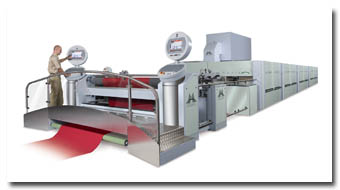
DPFmonforts

Monfort’s Montex 6500 tenters feature heat recovery systems that can reduce energy usage by up
to 30 percent.


Requirements


The catalog of modern, up-to-date dyestuffs and dyeing and finishing equipment offers a
blend of modern technology and chemistry. Major requirements are as follows:

  • reduced water consumption;
  • varying load capacity;
  • time savings;
  • comparable economy and ecology;
  • highly optimized rinsing processes;
  • controller units;
  • downstream processing advantages;
  • wet finishing process;
  • economical finishing; and
  • monitoring and controlling.


Cornerstone Research And Development


“Sustainability is one of the companies’ three topics in R&D, besides ecology and best
quality output,” states Germany-based Fong’s Europe GmbH, formerly Then Maschinen GmbH and Goller
Textilmaschinen GmbH. “As the inventor of the short liquor ratio technology, the company ever since
put a lot of emphasis on sustainability.”

At Thies GmbH & Co. KG, Germany, the main emphasis is on the efficiency and
sustainability of its products and proceedings, according to the motto, “Go green with Thies.” All
of the company’s yarn- and piece-dyeing machines reduce process times and energy as well as other
resource usage. Thies reports its iMaster H20 presents pioneering innovations including versatility
and adaptability, and offers the dyer product flexibility, which Thies says has never been obtained
before now.

For Fong’s Europe, the most successful model is still the Then-Airflow® Synergy, whose
latest version is model SYN 600 G2. The main reason for this success, the company reports, is the
Airflow technology itself. “The technology is unrivaled in batch dyeing with its unbeatable dyeing
economy and dyeing ecology, resulting in huge savings and typically offering one batch more per
day, not to mention the wide range of fabrics,” Fong’s Europe explains, noting that the comparison
with a model from some five to 10 years ago shows some significant improvements: Because of the
30-percent-greater batch size and technical machine design improvements — including new nozzle
section, wheel and flexible chamber device, and the power rinse system — overall water, energy and
chemicals consumption could be further reduced by around 15 to 20 percent.

On the other hand, Thies remarks that the liquor ratio doesn’t play as important a role as
in the past. The importance today relates more to consumption in liters of water per kilogram of
goods (l/kg). Today, the influence of the product on water consumption is greater than the
influence of the system. The fleet relationship detail only tells how much water per treatment bath
is used; it does not give the number of required baths. The detail of water consumption in l/kg,
however, gives information about system efficiency.


Sustainable Dyestuffs


Huntsman Textile Effects, Singapore, mentions that the textile industry is notorious for
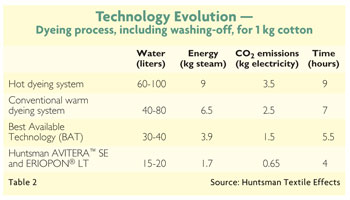
consuming vast amounts of water, especially during dyeing and finishing. Up to 100 liters of water
are used to dye 1 kg of cotton fabric. The company has been able to improve dyeing technology
considerably with the development of a new chemistry for dyeing of cellulosic fibers. AVITERA™ SE
is a new tri-reactive dye range for exhaust application on cellulosic fibers.

Only 15 to 20 liters of water are required to dye 1 kg of material. Avitera SE dyes and
ERIOPON® LT clearing additive comply with new environmental sustainability standards and give
top-quality results, achieved in time, Huntsman reports, adding that the process also saves time
and energy and reduces carbon dioxide (CO2) emissions; and that with the new dyeing technology, 1.3
liters of fresh water per person per day potentially could be saved in textile-processing countries
such as China, India or Bangladesh.

Most reactive dye molecules have one or two reactive groups that bond with the fiber and
remain permanently fixed. Dye that fails to bond is hydrolyzed and cannot be fixed on the fiber. In
conventional dyeing, 20 to 40 percent of the dye molecules typically are hydrolyzed. To achieve
highly colorfast fabrics, unfixed dye needs to be fully removed — a long, hot, expensive, water-
and energy-intensive process.
DPFtable2

Best Available Technology (BAT) improves conventional warm dyeing systems, and already
consumes less water during the washing-off process. When using Avitera SE and Eriopon LT, the
dyeing and washing-off processes require temperatures no higher than 60°C, and the number of
rinsing baths needed to obtain the required colorfastness is greatly reduced, Huntsman reports.


Tentering


Tentering is virtually the most important process after dyeing to give a fabric the required
properties. A. Monforts Textilmaschinen GmbH & Co. KG, Germany, a leader in the global tenter
market, says that rising cost pressure remains a major issue in the textile industry, especially
for textile finishing. Reasons include steadily rising energy, water and effluent treatment costs;
consumer demand for green and responsibly made garments; and the need for textile finishing to be
very innovative. Therefore, modern textile finishing equipment must fulfill requirements such as
responsible use of natural resources, cost-effectiveness and high flexibility.

Monfort’s Montex 6500 tenters feature heat recovery systems, which are available for all
Montex tenters. The systems can reduce energy usage by up to 30 percent, saving both natural
resources and production costs. Even on existing machines, heat recovery systems can be added. The
Energy Tower 7000 is a universal stand-alone system providing the same performance as a built-in
system. Depending on the exhaust airflow and temperature, up to 30 percent of the heat generated
can be recovered. According to Monforts, very good access to the heat exchange modules and a large
condensed water tank make the Energy Tower very maintenance-friendly, with consistent performance
between maintenance cycles.

In the area of continuous dyeing processes on cotton, Monforts offers the Econtrol® process.
In contrast with pad-dry-thermofix or pad-dry-pad-steam processes, Econtrol dyeing using a Thermex
6500 Hotflue does not need a separate fixing process. According to Monforts, the Econtrol climate
inside the Thermex chamber ensures a perfect dyeing result during the drying process.

For dyeing of polyester/cotton blends, Monforts has now developed a single-bath process that
uses the Econtrol technique without intermediate reduction clearing. The process does not use
separate baths, and reduction clearing is not necessary, saving significant amounts of chemicals,
water and energy, as well as production costs.


Positive Future


For the near future, Fong’s Europe mentions more easy-to-handle machines that have the
lowest water and energy consumption, give best-quality results, and are reasonably priced. Thies
foresees a similar direction: Future developments will be directed by economics, but the
environment also will be taken into account. Suitable aftertreatments will be developed with the
target of recycling dyeworks effluent, and other developments will be aimed at emissions
reductions. There will be much movement in this area in the future.

March/April 2011
Texprocess Debuts In Frankfurt


M
esse Frankfurt GmbH has added another trade show brand to its portfolio of events serving
the global textile industry. This year, the Frankfurt-based producer and organizer of expositions —
including Techtextil, Texworld, Heimtextil and numerous others, both textile- and
non-textile-related, around the world — is launching Texprocess, a trade show focused on the
processing of textile and flexible materials. The inaugural Texprocess will colocate with
Techtextil 2011 in Frankfurt, May 24-27. Going forward, the European version of the show will be
held biennially in conjunction with Techtextil at the Messe Frankfurt fairgrounds, and its U.S.
version, Texprocess Americas, will debut April 24-26, 2012, also as a biennial show, colocating
with Techtextil North America’s East Coast edition held in Atlanta in even-numbered years.

Texprocess Frankfurt organizers are expecting 500 exhibitors to showcase innovative
products, technologies and services for the textile and flexible material processing supply chain —
including design, pattern production, cutting, making-up, finishing, logistics, information
technologies (IT) and technical accessories — to some 25,000 visitors from the apparel industry,
textile and flexible materials processing industries, retail and service sectors, skilled trades,
and science and education institutes. The expo will cover some 50,000 square meters of exhibition
space in Halls 4, 5 and 6 at Messe Frankfurt.

Sector leaders are hailing the debut of Texprocess as a venue for presenting processing
innovations and bringing together all parts of the sector.

“Processing textiles using highly productive and efficient methods represents a challenge
for the future of the textile-processing sector in Europe,” said Dr.-Ing. Thomas Gries, a professor
at the Institut für Textiltechnik of RWTH Aachen, Germany. “Automation, reproducibility and quality
assurance are just as important for this development as resources/energy efficiency of the machines
and processes. With its wide range of machinery manufacturers, research institutes and end users,
Texprocess is the ideal platform for innovations and new developments in this sector.”

Texprocess

Texprocess’s Source-it! platform will help apparel brands find contract manufacturers who
can provide the required sourcing and production capabilities to meet their
needs.  


The event’s conceptual partner is the German Engineering Federation (VDMA) Garment and
Leather Technology Association. The show also has garnered the support of the European Apparel and
Textile Confederation (EURATEX), Brussels, and the International Apparel Federation (IAF),
Amsterdam. Both associations will have booths on the exhibition floor, and will hold meetings on
the premises during Texprocess. Scheduled EURATEX meetings include the Technical Clothing Group on
May 25 and the European Technology Platform on May 26. IAF has scheduled its Board meeting and
General Assembly May 23-24.

Other organizations supporting Texprocess include the Sewn Products Equipment &
Suppliers of the Americas, Raleigh, N.C.; China Sewing Machinery Association; GermanFashion —
Modeverband Deutschland e.V.; and Dialog Textil-Bekleidung, Germany.


Sourcing Platform


Source-it! — Texprocess’s international sourcing platform — will give suppliers an
opportunity to show their capabilities and their production facilities. For apparel brands seeking
an efficient, cost-effective supply chain, this platform offers important advantages: At a time
when small lots and short turnaround times are preferred to allow brands to respond to the fashion
demands of the moment, it is important to be able to source goods from areas in which the supply
chain is well-integrated and manufacturers have the flexibility to change styles quickly without
disrupting other links in the chain. Source-it! will enable fashion brands to meet with
international contract manufacturers and their services, and get an overall picture of the
production chain in particular countries and regions without having to travel around the globe to
find the best fit for their needs.


Other Events


The Texprocess program also includes several other events. Outstanding product innovations
and solutions will receive Innovation Awards and have their own special exhibit within Texprocess.
Network@Texprocess will present IT trends for the textile processing and apparel sector and will
include software, service and automation solutions for various management systems as well as IT
solutions for logistics processes.

The Texprocess Forum will cover topics such as sustainability, environmental protection,
traceability, automation and supply chain management. The Texprocess Campus, a collaboration with
fashion and design educational institutions, will present training and professional development
opportunities in the fashion industry.


For more information about Texprocess, visit
www.texprocess.messefrankfurt.com.


March/April 2011

INDEX 11: Spotlighting Nonwovens Innovation


I
NDEX 11 — the 10th edition of the triennial nonwovens exhibition sponsored by
Brussels-based EDANA, the International Association Serving the Nonwovens and Related Industries —
will return to the Geneva Palexpo Exhibition & Congress Centre in Geneva April 12-15, 2011.
Dubbed “The World’s Leading Nonwovens Exhibition,” the show encompasses all sectors of the
nonwovens industry.

This year, more than 500 exhibitors in 52,000 square meters of exhibition space are expected
to showcase the latest innovations in technological and product development, process enhancement
and applications. 

INDEX 08 hosted a record 520 exhibitors from 36 countries and nearly 12,500 visitors from
more than 100 countries, of which more than half were first-time visitors. That show saw
significant increases in the number of exhibitors and visitors from the Middle and Far East,
Eastern Europe and South America. According to Palexpo S.A., event organizer, 80 nonwovens
developments were introduced at the show.

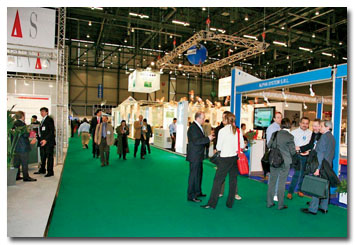
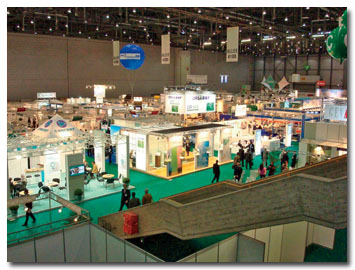
Index2

INDEX 08 saw record numbers of exhibitors and visitors at the Geneva Palexpo Exhibition
& Congress Centre.


A Myriad Of Sectors


Nonwovens sectors to be represented at INDEX 11 include:

  • nonwoven roll goods, including airlaid structures, drylaid, wetlaid, meltblown,
    composites, fibrillated or perforated film, spunlaid, spunlace/hydroentangled, and other
    structures;
  • nonwoven applications and materials for transport/vehicle construction, building,
    wipes and cleaning, civil engineering/geotextiles, agriculture/horticulture, clothing/interlinings
    and wadding materials, shoes/leather goods, food, packaging, electronics, home furnishings,
    household, medical, hygiene/bodycare, safety technology, protective clothing, filtration,
    substrates, and others;
  • raw materials for nonwovens and ancillaries, including adhesives and binders,
    chemical, fibers and filaments, films/membranes, fluff pulp, scrims for reinforcement,
    superabsorbents, surface treatments, tapes and mechanical fastenings, tissue and papers, and
    others;
  • machinery for nonwovens, including nonwovens machinery, converting machinery,
    auxiliary manufacturing equipment and waste-handling equipment; and
  • services, including publications, research institutes and laboratories, trade
    associations, and others.
index1


Special Events


Nonwovens are widely used in absorbent hygiene products, but their uses extend to a wide
range of other applications. At INDEX 11, three sectors in which nonwovens have an expanding role
will be highlighted.

Dr. George Kellie, Microflex Technologies LLC, Anaheim, Calif., will conduct a workshop on
the role of nonwovens in packaging.

“Whilst currently only accounting for about 2-3 percent of all the nonwovens produced in
Europe, packaging is certainly one of the fastest growing applications for their use,” Kellie said.
“New solutions include the incorporation of active components into food packs, for example, which
can play a vital part in extending the shelf life of food without the use of additives. These
processes are also playing an important part in dealing with food waste.” Kellie also will discuss
how durable, nonwoven shopping bags are replacing disposable plastic shopping bags.

Other areas of emphasis include automotive and filtration applications. According to EDANA,
the average vehicle contains approximately 40 different nonwoven products, offering benefits
including weight savings, insulation, filtration or added protection. Nonwovens are also used as
essential separators in batteries that power hybrid and electric vehicles. EDANA reports that China
is planning to produce 500,000 such vehicles this year.

Nonwoven filter media are used to improve indoor and outdoor air quality, remove viruses and
bacteria, and improve water quality, offering enhanced performance characteristics and cost savings
compared to filter media made of other materials.

“The challenge for producers of nonwovens in the filtration sector is to balance stricter
regulations, sustainability requirements and increasing costs, with improved performance and
longer-lasting products,” said Pierre Wiertz, general manager, EDANA.

Innovation will be the focus of two events. At a special awards ceremony on Tuesday, April
12, EDANA will present the INDEX 11 Awards, which recognize innovation and sustainability in the
nonwovens and related industries. In addition to the five established awards categories focusing on
specific points along the nonwovens supply chain, there are two new categories recognizing the most
significant sustainable product and the best-developed sustainable process or management practice.

The Management Workshop on Innovation, to be held on Wednesday, April 13, will offer
practical techniques managers can use when overseeing innovation within their companies. Led by Dr.
Karl-Michael Schumann, a former research and development director at Procter & Gamble and
currently a future business development and innovation coach, the workshop is offered free of
charge to registered visitors and exhibitors, but is limited to three participants per company.

INDEX also will offer a series of nonwovens training courses organized by EDANA, as well as
product presentations by exhibitors.


For more information about INDEX 11, visit
www.index11.org.


March/April 2011

Eastex Products Introduces Waterproof, Breathable Medical Fabrics

Holbrook, Mass.-based Eastex Products Inc. — a supplier of textile products and solutions for
healthcare and other markets — has introduced a line of waterproof, breathable fabrics for original
equipment and contract manufacturers of healthcare products such as wheelchair cushions, mattresses
and orthopedic braces.

Eastex Medical Fabrics are made of 100-percent polyester or polyester/nylon blends; are
offered in several stretch and non-stretch versions; and may be customized with antimicrobial,
flame-retardant and other coatings to meet product specifications. Thickness, weight, tensile
strength, tear strength and other properties will differ depending on customization. The fabrics
are airtight, making them suitable for manufacturing inflatable products, and may be sewn and then
welded using sonic or radio frequency techniques. 

March 8, 2011

The Rupp Report: INDEX, The Nonwovens Industry Summit

This year’s INDEX 11 — the 10th edition of the triennial nonwovens exposition — will take place at
Geneva Palexpo Exhibition & Congress Centre in Geneva April 12-15, 2011. Innovation and
sustainability are the drivers at this year’s event. The global meeting point of the nonwovens
industry reports that already more than 500 exhibitors have confirmed their participation, and for
the first time, the exhibition covers more than 52,000 square meters of floor space. The organizers
expect more than 12,500 visitors from more than 100 countries to attend this leading international
showcase, which takes place in Geneva every three years.

Tailor-made Products

Nonwovens are tailor-made products that are used in a wide variety of applications —
traditionally in the medical, hygiene and personal care products industries and increasingly in
applications within the automotive, construction, home furnishings, filtration and packaging
industries. They may be a limited-life, single-use fabric or a durable fabric, providing specific
functions such as absorbency, liquid repellency, resilience, stretch, softness, strength,
flame-retardancy, washability, cushioning, filtering, bacterial barrier and sterility.

Sustainability Report

Brussels-based show sponsor EDANA, the International Association Serving the Nonwovens and
Related Industries, will release its new sustainability report on the opening day. Building on the
association’s mission to create an environment beneficial to sustainable and profitable growth of
the industry participants through the active promotion of sustainable development, consumer
interests and transparency, the report examines how players throughout the supply chain work
together to achieve a more sustainable final product. A multitude of nonwoven applications will be
covered in the report.

Special Events

INDEX 11 will also host a series of special events that provide an additional platform to
share knowledge and to network with business contacts from around the world. Speakers from all over
the world, among them some leaders of the industry, will take part in the free educational and
promotional activities. Helen Rushton, product development manager of Geneva Palexpo S.A., event
organizer, told the Rupp Report: “The INDEX is truly the global showcase for nonwovens with a broad
spectrum of what is possible today with nonwovens. However, some sectors, such as innovation and
packaging, various workshops, EDANA’s vision of the future and, last but not least, sustainable
products will be highlighted.” Rushton also said in a recent interview that a few weeks before the
start of the event, the exhibition space was extended to be able to welcome more exhibitors. “The
number of visitors is more or less the same but everybody wants for floor space,” she added.

Also from the visitors’ side, there is a trend toward true globalization of the nonwovens
industry. “We see a growing interest from visitors from the Middle and Far East,” Rushton said.
“Also these people see the advantages of nonwovens for modern industrial applications.”

Interactive Workshop

A workshop dedicated to innovation will be available free-of-charge to all registered
visitors and exhibitors during INDEX 11. The “Management Workshop on Innovation” will help managers
to judge the strong and weak points of innovation in their companies. Attendees learn how to build
and sustain superior innovation capabilities. Advance registration for this valuable event should
be made online.

Product Presentations

Under the theme “Solutions for Tomorrow,” presentations from exhibitors will show the latest
innovations and the most up-to-date developments in the application of nonwovens. Visitors will
have free access in a special auditorium within the exhibition halls, and there will be around 30
presentations covering the whole range of the exhibition program, starting on the afternoon of
April 12.

Packaging Workshop

Packaging is becoming more and more important in today’s world. Economical but also
ecological solutions are very much in the focus of a special packaging workshop. The utilization of
nonwovens is growing rapidly in the packaging field in a very broad range of applications from tea
bags to fashion shopping bags. The session will also highlight revolutionary high-profile
applications and offer a networking area with displays of new packaging products.

INDEX 11 Awards

The INDEX 11 Awards are designed to encourage and acknowledge innovation and new ideas in
nonwovens, their raw materials and the machinery used in making or converting nonwovens. The
winners of the prestigious INDEX Awards will be announced April 12 at the EDANA stand. The INDEX
Awards are certainly the highest honor for the best examples of excellence in the nonwovens
industry and highlight some of the most outstanding innovations. The interest in the awards is
always strong and the entries are assessed on creative ideas, new technology and innovative
products.

Vision 2020 Launch

EDANA will publicly launch its joint study on the future of the nonwovens and related
industry in a program titled Vision 2020. Aimed at supporting member companies in identifying the
challenges and opportunities in the coming 10 years, the program was developed with support from
futurists and market experts. Information about the program will be shared with attending media on
the opening day of INDEX 11, while EDANA members will receive the information and reports the week
before. “During the crisis in the last few years, we have seen a trend towards more applications
for nonwovens in different areas,” Rushton said. “Traditional fabrics used to be the first choice
to apply, but more and more, users [are seeing the] advantages of tailor-made nonwovens products.
We’re looking forward to a successful INDEX 11.”

More information is available in the next issue of

Textile World
and

Textiles Panamericanos
, and is currently online at

www.
TextileWorldAsia.com

. For questions about the show, contact
index@geneva-palexpo.ch.


Textile World
and its sister magazines

Textiles Panamericanos
and

Textile World Asia
will be present at the show in booth 4294. We’re looking forward to seeing you in Geneva!

March 8, 2011

Shaw Plant Named 2010 Facility Of The Year By CWEA

Dalton, Ga.-based carpet manufacturer and floor covering provider Shaw Industries Group Inc., a
subsidiary of Berkshire Hathaway Inc., reports its Tuftex carpet manufacturing plant in Santa Fe
Springs, Calif., has been named the 2010 Facility of the Year by the California Water Environment
Association (CWEA) in recognition of the plant’s innovative wastewater, stormwater and air quality
conservation efforts and waste management practices. Shaw was presented the award last month at
CWEA’s 38th annual P3S Training Conference & Exhibition.

Sustainability initiatives at the plant include diverting residual waste from landfills to a
waste-to-energy facility in Commerce, Calif.; recycling its entire carpet production waste into
pre-consumer recycled content; and using low mono-nitrogen oxides burners on two ship-scale boilers
to reduce nitrogen oxides emissions into the air. The facility has received CalRecycle’s Waste
Reduction Awards Program award for six years running, as well as the Central Basin Municipal Water
District’s Visionary Stewardship Award.

“As a local manufacturer, it was important to Shaw to implement environmentally responsible
practices, especially those that drastically conserve water at the facility, being that the
Colorado River — which provides water for our county — has remained in a drought for the past 11
years,” said Bill Woyshner, Shaw’sTuftex Divisional Environmental/Safety Manager.

“Shaw’s Santa Fe Springs facility stands out in California for its commitment to
environmentally conscious practices across all aspects of its operations,” said Paul D.
Schmidtbauer, CWEA P3S Awards Committee Chair – South. “From recycling and saving millions of
gallons of water to its ‘Zero Waste to Landfill’ status, the facility is a model of best
environmental practices for our state.”

March 8, 2011

Hohenstein Institute Study Affirms Safety Of Antibacterial Apparel

Researchers at the Hohenstein Institute, a Germany-based textile research and testing laboratory,
have completed a field study financed by the Federal Ministry of Economics and Technology through
the Federation of Industrial Research Associations on the effect of antibacterial apparel on skin
flora and microclimate.

The study involved 60 healthy volunteers who wore special T-shirts — treated on one side with
an antibacterial treatment, with no such treatment on the other side — for at least eight hours
each day for four weeks. Researchers studied the effect of an antibacterial spinning additive as
well as an antibacterial finishing treatment, both containing silver. Antibacterial activity in the
samples was tested in the laboratory using test bacteria before the survey began.

Each week during the survey, researchers investigated various parameters for the skin flora
and microclimate and had test sites on skin dermatologically assessed. At the beginning of the
trial, and during and after a series of tests, researchers identified the types of skin bacteria on
each of the volunteers’ natural skin flora. They also studied three aspects of the skin’s
microclimate: vapor loss through the skin, skin moisture levels and the pH value.

Upon completion of the study, researchers determined that antibacterial apparel provides the
intended protection against bacteria that may enter via perspiration, but it does not affect skin
flora or the microclimate of healthy skin; therefore, antibacterial apparel textiles may be
classified as safe.

March 8, 2011

Royal DSM To Acquire Majority Shareholding In China-based ICD

The Netherlands-based life and material sciences company Royal DSM NV has entered into an agreement
to become the majority shareholder in China-based Shandong ICD High Performance Fibre Co. Ltd.
(ICD), a manufacturer of ultra-high-molecular-weight polyethylene (UHMWPE) fiber. According to DSM,
ICD is a strong player in the high-performance fiber market in China, and the acquisition will
strengthen DSM’s position in that market, bringing complementary technologies and manufacturing
resources.

“China is a key market for DSM and we will continue to grow our long term commitment to it,”
said Nico Gerardu, DSM Managing Board member responsible for DSM’s Performance Materials cluster.
“We have invested significant time and effort to identify the right partner to ally with for this
acquisition and we are extremely excited about the prospect of bringing ICD into the DSM
portfolio.”

“This is an exciting development for everyone at ICD and I believe it will help to secure our
future growth and success in the Chinese UHMWPE fiber market,” said Ren Yi, general manager, ICD.

March 8, 2011

Xerium Technologies Unveils Advanced Rolls Product Series

RALEIGH, N.C. — Mar 7, 2011 — Xerium Technologies, Inc., a leading global manufacturer of
industrial textiles and rolls used primarily in the paper production process, today announced full
commercial availability of a technologically advanced new series of roll cover products designed
for improved machine performance, better wear and longer, more efficient product life. The latest
range of roll cover products are designed to reduce operational costs and maximize the output of
existing equipment, while enhancing product customization capabilities for each individual
customer.

Roll covers, which are used to coat the large machine cylinders that transport raw paper
along the lengthy belts while the paper is formed, pressed, and dried, are critical to the quality
of paper as it is produced. With this latest series of advanced technology roll covers, Xerium
continues to work with its paper manufacturing customers to maximize output and reduce operational
costs.

“We continue to work very closely with our customers to advance the technology of paper
manufacturing by enabling greater efficiency, leaner inventories, and lower costs,” said Stephen R.
Light, President, Chief Executive Officer and Chairman. “The high-ROI class of products that we’re
developing is in direct response to manufacturers’ demands for higher performance at lower costs.”

Developed by Stowe Woodward’s global research and product engineering team, the latest family
of roll cover products from Xerium include:

Quantum R and Aquarius R: Quantum R and Aquarius R covers incorporate high release
additives into high performance polyurethane covers. Utilizing these special formulas, Stowe
Woodward has taken polyurethane roll covers to new performance levels in sheet release and
non-stick applications. Combined with Stowe Woodward’s SMART(R) Technology, Quantum R and Aquarius
R provide the ultimate value to machine operations giving on-the-run nip profile data for maximum
papermaking efficiency. Designed for paper machine pressing applications, Quantum R provides
superior release performance in soft press, smoothing press, and calendar positions. The unique
surface properties of Quantum R can release the sheet when other polyurethane or high release
rubber covers fail to perform. Aquarius R provides the ultimate cover release surface for
Lumpbreakers and other extra soft sheet release cover applications. Combining high release
additives to the natural superior release characteristics of Aquarius polyurethane, Aquarius R
covers are a level above all others.

Embrace: Embrace polyurethane roll covers deliver superior performance in tissue
embossing, paper converting, laminating, film, textile and other industrial applications. Embrace
is manufactured with the most advanced manufacturing methods and material science. This cool
running high-strength cover will run in the toughest high speed applications. When additional
insurance is required against abuse and failure, Embrace can be supplied with Stowe Woodward’s
superior Lifegard bonding system.

Posted on March 8, 2011

Source: Xerium Technologies Inc.

Kornit Digital And Fruit Of The Loom Form Strategic Partnership

ROSH-HA’AYIN, Israel — March 8, 2011 — Kornit Digital, the world leader of industrial &
commercial digital printing for the garment decorating industry and Fruit of the Loom, the leading
international, vertically integrated basic apparel company, recently exhibited at the Imprinted
Sportswear show and invited attendees to experience the world of on-demand printing by enabling
them to create their own shirt design via an interactive kiosk and then watch the live printing
demonstration utilizing Fruit of the Loom’s T-Shirt and Kornit’s printers.

Printers today are looking for faster, more profitable solutions for cost-effective
production and the entire industry is witnessing how the Direct-On-Garment market is growing. This
partnership enables the printers to achieve their goals by combining the highest technology of
Kornit’s machines, their printing capabilities, patent ink and the quality of Fruit of the Loom’s
new Garment Dyed T-Shirt.

The ISS attendees enjoyed the experience and the revolution Kornit and Fruit of the Loom have
created with the interactive Direct-On-Garment printing demonstration, showcasing how even
photo-realistic designs can be printed easily and affordably.

Fruit of the Loom’s new Garment Dyed T-Shirt is made with a fine-gauge yarn and tight stitch
density that produces an exceptional print surface and super soft touch — an ideal surface for
digital printing.

Posted on March 8, 2011

Source: Kornit Digital Ltd.

Sponsors