Tuscarora Relocates China Grove Plant

Mount Pleasant, N.C.-based Tuscarora Yarns Inc. plans to invest $6.3 million to relocate its China
Grove, N.C., plant to a larger, more modern facility and increase the workforce at that operation
from 57 people to 181.

“Our China Grove location has served well for the past 25 years,” said Martin B. Foil Jr.,
CEO, Tuscarora Yarns. “Increasing our investment through new equipment, machinery along with new
jobs will allow exciting opportunities at this new location.”

March/April 2011

ATME-I® To Continue With Techtextil North America In Atlanta

Messe Frankfurt USA, Atlanta-based organizer of Techtextil North America, and the American Textile
Machinery Association (ATMA®), Falls Church, Va.-based sponsor of the American Textile Machinery
Exhibition – International® (ATME-I®) have agreed that ATME-I will be included with Techtextil
North America’s East Coast edition in Atlanta in even-numbered years beginning in 2012. The two
shows first colocated in Atlanta in 2010.

ATME-I — which will present textile machinery and equipment, products and services targeted
to the overall textile and apparel industry — traces its origins to the International Cotton
Machinery Exposition, which debuted in Atlanta in 1881. Other textile machinery expos followed,
organized primarily by New England-based manufacturers. ATMA, which was founded in 1933, became
involved with the expo and moved it to Greenville, where it was held at the Palmetto Expo Center
from 1969 through 2004, traditionally as a quadrennial event. Recognized as the largest textile
machinery exposition in the Western Hemisphere, the show moved back to Atlanta for its 2006 edition
and has been held biennially at the Georgia World Congress Center (GWCC) since then.

Techtextil North America has been held biennially in even-numbered years in Atlanta since
2000, and in 2009 added a West Coast edition to be held in alternate years. Techtextil moved its
location to the GWCC in May 2010 to colocate with ATME-I and SPESA Expo — organized by Raleigh,
N.C.-based Sewn Products Equipment & Suppliers of the Americas (SPESA) — as part of Textile and
Sewn Products Industry Week. The exposition includes a trade show and symposium and presents the
full vertical spectrum of the technical textile/nonwovens sector of the textile industry.Techtextil
North America 2012, including ATME-I, will colocate with Messe Frankfurt’s inaugural Texprocess
Americas expo incorporating SPESA Expo and presenting machinery; plant, processing and information
technology systems; and services for the textile and textile product making-up sector.


March/April 2011

Guilford/NNG JV To Produce Automotive Textiles

Guilford Performance Textiles Inc., Wilmington, N.C., and NNG, a subsidiary of automotive interior
manufacturer YanFeng Inc., China, have formed Anhui Guilford Automotive Interiors Co. Ltd., a joint
venture (JV) to manufacture textile seating products for Chinese automotive manufacturers including
Chery Automobile, JAC Motors, Shanghai Volkswagen and others.


“China’s automotive industry is experiencing explosive growth,” said Shannon White, CEO,
Guilford Performance Textiles. “With this joint venture, Guilford is now ideally located to offer
our fabrics and engineered products to Chinese manufacturers. Following a comprehensive review of
expansion opportunities in China, we are pleased to have found an extraordinary business partner in
NNG that we expect will offer long-term growth opportunities in China. This is the first step in
what we anticipate will become a significant expansion into the Asian market for Guilford.”

March/April 2011

CAFTA-DR Partners Agree To Fix Technical Flaws In Agreement

The Dominican Republic-Central America-United States (CAFTA-DR) Free Trade Commission has approved
several changes to CAFTA-DR rules of origin that are expected to benefit the Western Hemisphere
textile/apparel supply chain. The changes include, among others, a correction to the definition of
sewing thread that adds single multifilament yarns used as sewing thread to the category — a move
supported by both the National Textile Association (NTA) and the American Manufacturing Trade
Action Coalition (AMTAC) — and an increase in cumulation limits that the commission says will
“encourage greater integration of regional production through limited reciprocal duty-free access
with Mexico and Canada to be used in Central American and Dominican Republic apparel.”

“Today’s fix is a job-creating win-win for U.S. sewing thread producers and their DR-CAFTA
counterparts,” said Auggie Tantillo, executive director, AMTAC. “With the closing of this
unintended loophole, we believe that U.S. thread producers can begin to recapture market share in
the important DR-CAFTA market, leading to more jobs.”Under the original agreement, regionally
produced sewing thread must be used for all products, including apparel and home furnishings, that
would qualify for duty-free treatment. However, under the original definition of sewing thread,
single multifilament yarns used as sewing thread are not included in that requirement, allowing
such yarns to be sourced from thread suppliers from outside the CAFTA-DR region.

The U.S. Trade Representative reports that in 2010, U.S. textile and apparel exports to the
CAFTA-DR region rose by 25 percent, surpassing export growth to the world of 19 percent, and
represented $3 billion or 16 percent of total U.S. textile and apparel exports. The region ranks
third, after Mexico and Canada, in export market size for U.S. textile and apparel products. U.S.
textile and apparel imports from the CAFTA-DR region totaled $7 billion in 2010, a 14-percent
increase over 2009. The region ranks second after China as a textiles and apparel supplier to the
United States.

March/April 2011

Providência USA Opens Facility, Announces Expansion

Providência USA Inc., the U.S. subsidiary of nonwovens manufacturer Companhia Providência Indústria
e Comércio, Brazil, recently celebrated the opening of its $80 million manufacturing facility in
Statesville, N.C., and announced it would invest an additional $60 million on a facility expansion.
The combined investments represent the largest manufacturing investment announced in Statesville in
nearly 25 years.

“This marks a new era in the company’s history: the international expansion of its
operations, will initially serve US clients currently exporting from Brazil,” said Providência
President Hermínio de Freitas. “This will account for approximately 50 percent of the new plant’s
production capacity. Furthermore, we will have the ability to supply new customers in the
disposable hygienic segment and focus in the healthcare segment. Not to mention we will supply
other regions in which we were not competitive, such as Mexico.” 

In phase one of the project, Providência built a 90,000-square-foot state-of-the-art facility
and installed a Reicofil spunbond line to manufacture nonwoven fabrics for use in disposable
hygiene products such as diapers, sanitary pads and medical/surgical drapes and gowns. The plant
currently employs 53 workers, with three more to be hired imminently, has an annual production
capacity of 20,000 tons and already has a backlog of orders. In phase two, slated for completion in
the second half of 2012, the company will install a second spunbond line, add 28 more employees and
double production capacity to 40,000 tons.

March/April 2011

Quality Fabric Of The Month: Textile Cosmetics

Tencel® lyocell fiber, whose closed-loop direct solvent process was patented in 1987, came on the market in 1992 as a branded fiber. Cellulose fiber producer Lenzing AG, Austria, one of the basic patent holders, acquired the brand in 2004 and has expanded production significantly to meet demand for a growing range of applications. The smooth-surfaced, hydrophilic fiber, extracted from wood, offers superior moisture management and natural cooling, inhibits bacterial growth, and is chemical-free and non-irritating to sensitive skin. It is available in the standard fibrillating variant as well as two non-fibrillating crosslinked variants.

Lenzing recently launched Tencel C, comprising Tencel fiber soaked with chitosan, made of chitin extracted from crab shells. Chitosan, the second most available natural polymer after cellulose, has long been used in cosmetics and pharmaceuticals, and is said to relieve itching,
regulate cells and protect the skin, in addition to having an antibacterial effect. Lenzing reports it adds skin-soothing cosmetic benefits to Tencel, and in a scientific wear study, stockings made with Tencel C were shown to protect the skin, allow it to retain more moisture, improve skin
elasticity and stimulate skin cell regeneration. Lenzing is promoting the fiber for use in apparel worn next to the skin and in home furnishings such as bed sheets. There also are potential wound-healing applications.

QFOM

Tencel® C applications include bedding as well as next-to-skin apparel such as underwear,
leggings, nightwear and other apparel items.

“Our research team worked on Tencel C for almost ten years,” said Alexandra Steger, project manager marketing apparel, Textile Fibers, Lenzing AG. “We have attached the chitosan so that it can’t wash off or be stripped off. The fiber is spun, and the chitosan solution penetrates into its porous structure. The fiber is then finished. Cellulose and chitosan are very similar, so we can combine the botanic and oceanic stories,” she said, pointing out cellulose’s botanic source and chitosan’s oceanic source. “The molecules differ only at one point where chitosan has an amino group.

“Lenzing produces the fiber at its Heiligenkreuz, Austria, plant, and now makes a 1.3-decitex (dtex) fibrillating fiber. It plans also to offer a 0.9-dtex microfiber and a low-fibrillating crosslinked fiber.

QFOMillustration

Lenzing’s yin-yang graphic illustrates the complement formed by Tencel® C’s botanically
sourced cellulose and oceanically sourced chitosan.

To ensure end-product quality, Lenzing partners with the customers. “We will take care of all process steps and are in close contact with the spinning mills and dyehouses,” Steger said. “Dyeing and finishing are quite sensitive, and the dyestuffs and processing are selected very
carefully.”

Tejidos Royo, Spain, is using Tencel C on the reverse side of its Wellness & Skin Care Denim fabrics. Huber Tricot GmbH, Austria, will introduce lingerie made with the fiber in its 2012-13 Bodywear collection. Other apparel companies as well as home textiles manufacturers are sampling the fiber. Lenzing will launch Tencel C in the United States at the upcoming Los Angeles International Textile Show and Texworld USA.


For more information about Tencel® C, contact Christina Kreuzwieser +43-7672-701-2331; c.kreuzwieser@lenzing.com.


March/April 2011

The Troubling Cotton Picture

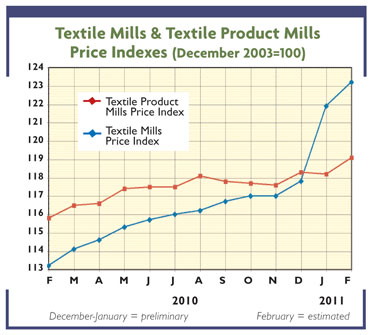
Soaring cotton costs — now more than double year-ago levels — continue to plague the U.S. textile
and apparel industries, with still no definitive answer as to when the price bubble will burst.
Clearly, no immediate relief seems in the offing as today’s big supply-demand imbalance drops
domestic inventories down to 1.9 million bales — some 35 percent under levels prevailing four years
ago. On the other hand, there’s a good chance for some price easing as the year draws to a close,
primarily because sky-high quotes are resulting in significantly higher 2011 plantings. The
National Cotton Council sees a 14-percent increase in domestic acreage this year, probably enough
to yield about a 19.2 million-bale crop — some 900,000 bales more than last year. Equally
important, all signs point to similar upbeat harvest trends in other cotton-producing nations.
Given average growing conditions, this would suggest close to a 7-percent increase in global output
— enough to make for a somewhat improved supply-demand situation.

BFgraph


Speculative Factor


Speculation also has to be blamed for some of today’s cotton woes. But, here too, there are
signs of better days as the year wears on. The Intercontinental Exchange Inc. is finally increasing
its monitoring of big positive positions and demanding evidence that major market participants
prove they have an economic need for the fiber. Hopefully, this will moderate overall demand and
eventually nudge prices lower. Meantime, hoarding has been rampant in China, where that nation’s
farmers are said to be holding onto as much as 9 percent of the world cotton supply in hopes of
getting a higher price for the fiber. But this kind of strategy also has its limitations, because
sooner or later, this cotton will have to come back on the market. Finally, there’s a third kind of
speculation worth noting — namely, an increasing buildup of cotton-containing products. Many
producers and distributors of these items are increasing their inventories as a hedge against
further procurement cost increases. And here, too, the buildup will eventually be reversed. And
when it is, it should also help bring cotton down to more realistic levels.


Downstream Price Pressures


But until the cotton bubble actually bursts, it’s going to be rough going for most textile
and apparel firms — a lot worse than over the past few quarters, when most fabric and garment firms
were able to rely on fiber previously committed for at well under $1 per pound. Hence, a growing
number of new price increases are currently being announced. To be sure, they’re not nearly as
large as those posted for cotton. But that’s not just because cotton accounts for only part of a
textile product’s cost, but also because of increasing substitution of man-made fibers for cotton
and strong buyer resistance. Nevertheless, current and anticipated price boosts still are likely to
be quite substantial, with

Textile World
now projecting anywhere from a 5- to an 8-percent increase in overall textile and apparel
tags for the current year — close to double the advance predicted at the beginning of the year and
well above the nation’s expected 1- to 2-percent overall inflation rate.


Impact On Imports And Profits


There are also likely to be other fallouts from today’s sky-high cotton tabs. U.S. imports of
Chinese textile and apparel products could be affected — primarily because that nation’s producers
may be forced to raise prices even more than their competitors. Such hikes are needed to reflect
two other upward cost pressures — a slowly rising currency and intensifying Chinese internal
inflation. These additional costs could add as much as another 10 percent onto Chinese-made
products. Not surprisingly, Chinese asking prices have jumped to the point at which more and more
U.S. buyers are considering a shift in sourcing — away from Beijing and toward the now-cheaper
offerings of other developing countries. There’s already some evidence of this, with imports from
China beginning to show smaller year-to-year advances. Finally, a few words on cotton and its
impact on bottom lines:

TW
feels 2011 profits and margins may be a bit lower than previously anticipated, reflecting
less-than-full-cost pass-throughs and consumer resistance to higher prices. There will be more
about this next month when updated earnings projections become available.

 March/April 2011

From The Editor: Sell Stability And Certainty

By Jim Borneman, Editor In Chief
If you’ve drafted a budget or tried your hand at business forecasting, the comforting Latin phrase ceteris parabus — “all other things being equal or held constant” — has made it easy to confidently rationalize your conclusions. It’s difficult to remember a time when so little could be held constant or remain the same. Slow-moving, relatively predictable business factors now change at a blistering pace. Today, volatility is normal and expected in a growing number of categories.

U.S. companies are coming to grips with the uncertainty of healthcare and benefit costs.Increasing commodity prices of cotton and petroleum-based inputs have taken hold, while volatile energy costs affect plant operations and transportation costs. Finding opportunity amid the volatility is what creative companies have embraced.

In recent days, it has been fair to argue that the world might not be as flat as Thomas Friedman pronounced it was. In fact, one could argue that international textile supply chains have rarely presented such risk. Although geopolitical risks are in the headlines, the trickle-down risks are rampant and occur in the context of a fragile economic recovery.

What opportunity could possibly exist in a time of high volatility? Become a purveyor of stability and certainty. How does doing business with your company reduce risk for your customer? How does your risk profile compare with that of your competition? Can you really reduce your customer’s risk exposure?

It sounds rather basic, but for a long time, it has been hard to sell U.S. manufacturing with a risk premium. Some have argued that companies whose products were decimated by imports also had capacity decimated by imports; hence, there is no alternative domestic production to return to. That may be so in some cases, but if demand is present and unstainable, U.S. textiles will come on-stream to fill the void. A bigger question is whether there is the possibility of a long-term
cyclical change occurring that will reinvigorate U.S. manufacturing.

A bright spot for U.S. manufacturers is apparent in the leading indicator from the Institute for Supply Management Report On Business. The March 1 release reports expansion of manufacturing sector economic activity for the last 19 consecutive months. Of the 18 manufacturing sectors tracked, 14 expanded — including apparel and textile mills.China’s trend of rising wages and inflation will be hard not to export along with their products. Combined with a renewed focus on increasing domestic consumption, there are strong signals that the Chinese are ready to embrace a new phase in their economic development. This may signal new competition in higher-value textiles — technical textiles — in which some U.S. producers have found refuge and profits. It may also point to the development of new low-wage locations to fill the China-price void — this time with a better understanding of the total cost of global sourcing.

In any event, beyond the headlines, it isn’t all gloom and doom. Challenges are ahead with higher gasoline prices — but U.S. consumers are less shocked this time. Let’s see how shocked their pocketbooks are.

March/April 2011

March/April 2011

The
Technical Association of the Pulp, Paper, Packaging and Converting Industries
(TAPPI)
, Norcross, Ga., will present the 2011 TAPPI Herman L. Joachim Distinguished
Service Award to
Peter Wallace on May 3, 2011.

American Textile Co., Duquesne, Pa., has named
Lance Ruttenberg president.

Ruttenberg
Ruttenberg

Shaw Industries Group Inc., Dalton, Ga., has named
Paul Murray vice president, Sustainability and Environmental Affairs.

Lectra, Paris, has appointed
Edouard Macquin worldwide sales director; and
Adriana Vono Papavero managing director, Lectra South America.

The
National Retail Federation, Washington, has promoted
Carleen Kohut to COO, and
Susan Newman to senior vice president, conferences; and has named Mike Gatti
senior vice president, member relations.

Unifi Inc., Greensboro, N.C., has appointed
William L. “Bill” Jasper chairman of the Board of Directors and
R. Roger Berrier Jr. president and CEO.

Pratt Institute, New York City, will present the 2011 Pratt Institute Fashion Icon
Award to
Hamish Bowles  on April 27, 2011. Pratt Institute fashion design student
Ruby Gertz has received a $25,000 YMA Fashion Scholarship Fund (FSF) Geoffrey
Beene National Scholarship Award.
Paola Ricardo and
Danielle Ryan, also fashion design students, have won $5,000 general FSF awards.

Cotton Council International (CCI), Memphis, Tenn., has elected
John Mitchell 2011 president.

Huntsman Corp., The Woodlands, Texas, has appointed
Stu Monteith president, Performance Products division.

Summerville, S.C.-based
Thrace-LINQ Inc. has named
James H. Brown quality assurance manager, process improvement. 

JamesBrown

Brown

Outlast Technologies Inc., Boulder, Colo., has promoted
Ashley Tilman to marketing manager.

Toronto-based
Thomson Research Associates has named
Glenn Runciman president.

March/April 2011

Architectural Textiles: Economical And Ecological Roofing


M
ore and more, producers of standard textiles are looking for alternatives. Technical
textiles, including industrial fabrics, are virtually the key to any new application. One of the
most interesting end-uses is fabrics for building — so-called roofing membranes installed instead
of gravel, bitumen sheets or concrete. However, the key to success lies not in the production of
the membrane, but in communication about its advantages.

Since the mid-1960s, industrial fabrics have made rapid advances. The use of fabrics, knits
or nonwovens instead of classic building materials is steadily increasing. The greatest market
suppliers in this area are already organized on the basis of separate business areas. In Germany,
technical textiles’ share of total textile sales currently stands at more than 40 percent.

Suppliers of industrial fabrics are looking to purchase not upstream machinery, but product
solutions. Consequently, a decisive change has occurred in buying behavior. With the steady
improvement in textile systems, the appetite of the users also has grown. Accordingly, in certain
cases, market pressure has already exceeded the development speed of new, mature technologies and
products.

architecturalfab1

The Nelson Mandela Bay Stadium, built in the Eastern Cape Province of South Africa for the 2010
FIFA World Cup™, features a membrane roofing system designed and built by Birdair Inc. Photo
courtesy of Birdair Inc.


Information Flow


Construction using textiles is one of the oldest architectonic forms in human history.
Today, because of their outstanding economic and ecological advantages, textile constructions are
an indispensable element of modern architecture. The physical principles involved in the
development of architectural fabrics concern the resistance of the fabric to external weather
forces such as wind and snow, and call for the lowest possible tension, expansion and resulting
membrane curvature in the finished structure. For this reason, textile roofing design represents a
very large and special challenge to engineers, and, as a consequence, membrane constructions
represent an innovative opportunity not only in modern architecture but also for the related
textile production sectors.

It is particularly important, therefore, to communicate in terms of the end product and not
in terms of machinery used. As an example of collaborating to produce a modern membrane roof for a
sports stadium, the involved parties are the fiber producer, yarn producer, weaver, finisher,
fabricator, contractor and stadium owner.

A successful job can be achieved only if the owner and the architect know that a membrane,
and not concrete, is the ideal material for the roof covering. The challenge is to inform all
participating parties of the possibilities of industrial fabrics.

The technologies and techniques for producing fibers, yarns and fabrics, and their further
processing into industrial fabrics must be communicated. The biggest obstacle in all production
stages is the enormous variety of application fields, which must be communicated. How should the
stadium proprietor or the general contractor know that there are textile producers, rather than
suppliers of bricks or concrete, that could be the right partners?


Simple, But Efficient Construction


Making-up, or fabrication, is a very important part of the production chain. Only
first-class work is acceptable for the job. The sewing machine is just one possible tool. Today,
more and more products that are exposed to sunshine and weather are bonded using ultrasonic
technology, assuring a 100-percent waterproof seam on the final roof or membrane.

“Simplify your life.” This megatrend of the future can also offer a major opportunity for
the textile industry. There is much more flexibility in the design, construction and shape of a
stadium or other roof when using a textile product instead of heavy concrete and steel. There are
endless possibilities for membranes, including carports; covers for public areas such as garages,
gas stations or airports; sport stadiums; buildings; signs and displays; and shopping centers;
among other possibilities.


Innovative Membrane Roofing


A roof membrane that is installed over flat and shingled roofs provides added protection,
insulation, and sound-deadening features. Thermoset, thermoplastic, or modified bitumen membrane
roofing materials are suitable for such an application.

Thermoset membranes are chemically crosslinked. Thermoplastic membranes are similar to
thermosets, but instead of chemical crosslinking or even vulcanization, the seams are welded
together with solvents or heat.

Membranes made with man-made materials such as polyvinylchloride (PVC) or glass fibers are
most commonly used. In the United States, of all membrane roofing materials, the PVC roof membrane
has the longest history of use, and today is estimated to account for some 10 percent of all
membrane roofing. PVC products are highly resistant to punctures and impacts; and offer flame
resistance, leak prevention, durability, ultraviolet (UV) reflection, and flexibility at low
temperatures as well as high-temperature tolerance. They are also very popular thanks to their
attractive look and appeal.
architecturalfab2

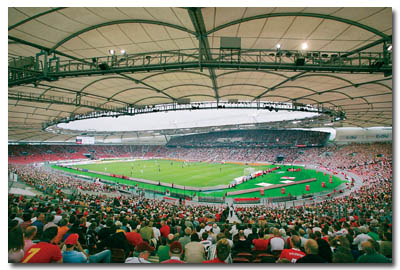
The roof of the Mercedes-Benz Arena in Stuttgart, Germany, is formed by membrane sections
attached to a steel frame.


Advantages


The advantages of using membranes instead of other building materials are self-evident:
Membrane roofing replaces gravel; and the roofs have extreme tensile strength and are easy to
handle on account of their light weight and flexibility. Even airports, such as the Hong Kong
International Airport, are covered with membrane roofs, despite threats from typhoons or other
adverse weather. As with every new application, the ingenuity of the construction engineers is
quite necessary. If damage ever occurs, these roofs are easy to repair or even replace, which is
not the case with traditional roofs.

One of the first stadiums in Europe to be covered with roof membranes is the Mercedes-Benz
Arena in Stuttgart, Germany. The stadium was originally built in 1933, and the membrane roof was
added in the early 1990s.

Another famous stadium is the 50,000-seat Nelson Mandela Bay Stadium in the Eastern Cape
Province of South Africa, built for the Fédération Internationale de Football Association’s
(FIFA’s) 2010 FIFA World Cup™. Amherst, N.Y.-based Birdair Inc., a contractor of lightweight
long-span roofing systems and tensile structures, built the roof for this and two other World Cup
stadiums in South Africa. The Nelson Mandela Bay stadium roof contains some 230,000 square feet of
polytetrafluoroethylene (PTFE)-coated fiberglass fabric membrane. The roof’s cable system forms
what Birdair describes as “valleys” that help drain rainwater from the roof as well as protect
spectators from the elements. In addition, 36 aluminum-clad cantilevering trusses measuring 150
feet in length and weighing 60 metric tons each support the edges of the membrane panels.


Finishing


Architectural fabric finishers must have extremely good knowledge of the material to be
processed. How does it react to sunshine, wind and rain? What bonding method or materials, such as
sealing strips or other materials, can be used? Appropriate finishing can make a fairly simply
manufactured fabric into a high-performance product. Finishing also incorporates coating and
lamination. Knowledge of the finishing processes employed is extremely important to downstream
production, as finishing generally has a direct link to the properties of the finished article,
especially for roof membranes.

Textiles can also protect against UV rays and electrosmog. Such products also include
steam-permeable textiles and water-repellent textiles.

Another promising possibility for architectural textiles exists in the form of coatings with
inorganic oxides such as silicon dioxide. Inorganic oxide layers can be transferred from the gas
phase to textiles using a variety of vacuum technology processes. A possible alternative is also
provided by sol-gel technology.

March/April 2011

Sponsors