CAFTA-DR Partners Agree To Fix Technical Flaws In Agreement

The Dominican Republic-Central America-United States (CAFTA-DR) Free Trade Commission has approved
several changes to CAFTA-DR rules of origin that are expected to benefit the Western Hemisphere
textile/apparel supply chain. The changes include, among others, a correction to the definition of
sewing thread that adds single multifilament yarns used as sewing thread to the category — a move
supported by both the National Textile Association (NTA) and the American Manufacturing Trade
Action Coalition (AMTAC) — and an increase in cumulation limits that the commission says will
“encourage greater integration of regional production through limited reciprocal duty-free access
with Mexico and Canada to be used in Central American and Dominican Republic apparel.”

“Today’s fix is a job-creating win-win for U.S. sewing thread producers and their DR-CAFTA
counterparts,” said Auggie Tantillo, executive director, AMTAC. “With the closing of this
unintended loophole, we believe that U.S. thread producers can begin to recapture market share in
the important DR-CAFTA market, leading to more jobs.”Under the original agreement, regionally
produced sewing thread must be used for all products, including apparel and home furnishings, that
would qualify for duty-free treatment. However, under the original definition of sewing thread,
single multifilament yarns used as sewing thread are not included in that requirement, allowing
such yarns to be sourced from thread suppliers from outside the CAFTA-DR region.

The U.S. Trade Representative reports that in 2010, U.S. textile and apparel exports to the
CAFTA-DR region rose by 25 percent, surpassing export growth to the world of 19 percent, and
represented $3 billion or 16 percent of total U.S. textile and apparel exports. The region ranks
third, after Mexico and Canada, in export market size for U.S. textile and apparel products. U.S.
textile and apparel imports from the CAFTA-DR region totaled $7 billion in 2010, a 14-percent
increase over 2009. The region ranks second after China as a textiles and apparel supplier to the
United States.

March/April 2011

Providência USA Opens Facility, Announces Expansion

Providência USA Inc., the U.S. subsidiary of nonwovens manufacturer Companhia Providência Indústria
e Comércio, Brazil, recently celebrated the opening of its $80 million manufacturing facility in
Statesville, N.C., and announced it would invest an additional $60 million on a facility expansion.
The combined investments represent the largest manufacturing investment announced in Statesville in
nearly 25 years.

“This marks a new era in the company’s history: the international expansion of its
operations, will initially serve US clients currently exporting from Brazil,” said Providência
President Hermínio de Freitas. “This will account for approximately 50 percent of the new plant’s
production capacity. Furthermore, we will have the ability to supply new customers in the
disposable hygienic segment and focus in the healthcare segment. Not to mention we will supply
other regions in which we were not competitive, such as Mexico.” 

In phase one of the project, Providência built a 90,000-square-foot state-of-the-art facility
and installed a Reicofil spunbond line to manufacture nonwoven fabrics for use in disposable
hygiene products such as diapers, sanitary pads and medical/surgical drapes and gowns. The plant
currently employs 53 workers, with three more to be hired imminently, has an annual production
capacity of 20,000 tons and already has a backlog of orders. In phase two, slated for completion in
the second half of 2012, the company will install a second spunbond line, add 28 more employees and
double production capacity to 40,000 tons.

March/April 2011

Against The Odds

 There’s an old story that tells of a very small, very poor nation in some remote part of the
world where leaders were desperately trying to formulate a plan for economic vitality. After
intense, heated debate, the nation’s governors decided to declare war on the United States — the
rationale being that they would be quickly and overwhelmingly defeated. The U.S. government would
then pour billions of dollars into the devastated nation to build a modern economic infrastructure,
and the nation’s citizens would prosper. They were all set to go until a meek voice in the back of
the room interjected, “But what if we should win?”

History and literature are full of stories in which the “little guy” prevails. But logic
would argue that in today’s world of free-flowing information and predictive modeling, the odds are
more stacked than ever against the underdog.

Just try to tell that to one spinner nestled in the mountains of Virginia. In an economic
environment that has claimed some of the industry’s most venerable companies, this “little guy” has
bucked the odds and started a small yarn mill. 

“I’ve raised sheep for most of my life,” he said, “and I spent a great deal of time
traveling across the country to various markets to sell my wool.” He then discovered he could
generate more profit by contracting with yarn mills to spin the wool and provide him with yarn to
sell. But he found that yarn spinning can be a fickle business, and many of his suppliers succumbed
to adverse economic conditions.

“So I decided to start my own yarn mill,” he said. “To say I didn’t get any financing
support would be the understatement of the century. I went to the local bank and they told me to
run, not walk, to the nearest mental hospital before my illness got any worse.” Without financing,
he began to buy equipment piece by piece from mills that were shutting down. “It took awhile, but I
finally got everything in place to spin my own yarn, and began operations several years ago.”

Business has been brisk, he said. He has a small niche of loyal customers who, he says, rave
about the quality of his products. And he has been in contact with global yarn brokers to expand
his distribution.

“It was very simple,” he said. “I had a dream and, despite the fact that everyone told me I
was crazy, I went ahead and made it happen. Business is good and growing.”


Demand Strong, Costs Increase


Demand for yarns of almost all types remained brisk through early March. Ring-spun yarn
remains in short supply, and open-end and man-made-fiber yarns are moving well. In a bit of painful
irony for many spinners, cotton prices dipped ever so slightly in early March from an all-time high
posted a month earlier — just in time for a dramatic increase in oil prices.

“Managing costs seems to be a never-ending struggle at the moment,” said one spinner. “We’ve
been fortunate in that we’ve been able to pass some costs along, but we have to fight
tooth-and-nail every time we try to do so. As good as business has been from the demand side, it’s
not so great when it comes to margins.”

Delivery schedules are still pushing out farther than most spinners — and customers — would
like. “We are doing the best we can to get yarn to our customers in a timely manner, but the
pipeline is full,” one spinner said. “We are six to eight weeks out on some products.”


Cotton Trading Slow


Cotton trading was inactive to light in the last week of February for all but one of the
major U.S. cotton markets. “Domestic mill buyers inquired for a moderate volume of color 31, leaf 3
and staple 34 and longer for April through June delivery,” the U.S. Department of Agriculture
reported. “No sales were reported. Finished product demand remained strong and most mills continued
to operate at capacity. Reports indicated most mills have covered their immediate-to-nearby needs,
but some concern could develop over raw cotton availability in the fall, if operating schedules
continue at maximum levels.”

Some mills are already placing 2011 cotton crop orders for first-quarter 2012 delivery.

March/April 2011

Quality Fabric Of The Month: Textile Cosmetics

Tencel® lyocell fiber, whose closed-loop direct solvent process was patented in 1987, came on the market in 1992 as a branded fiber. Cellulose fiber producer Lenzing AG, Austria, one of the basic patent holders, acquired the brand in 2004 and has expanded production significantly to meet demand for a growing range of applications. The smooth-surfaced, hydrophilic fiber, extracted from wood, offers superior moisture management and natural cooling, inhibits bacterial growth, and is chemical-free and non-irritating to sensitive skin. It is available in the standard fibrillating variant as well as two non-fibrillating crosslinked variants.

Lenzing recently launched Tencel C, comprising Tencel fiber soaked with chitosan, made of chitin extracted from crab shells. Chitosan, the second most available natural polymer after cellulose, has long been used in cosmetics and pharmaceuticals, and is said to relieve itching,
regulate cells and protect the skin, in addition to having an antibacterial effect. Lenzing reports it adds skin-soothing cosmetic benefits to Tencel, and in a scientific wear study, stockings made with Tencel C were shown to protect the skin, allow it to retain more moisture, improve skin
elasticity and stimulate skin cell regeneration. Lenzing is promoting the fiber for use in apparel worn next to the skin and in home furnishings such as bed sheets. There also are potential wound-healing applications.

QFOM

Tencel® C applications include bedding as well as next-to-skin apparel such as underwear,
leggings, nightwear and other apparel items.

“Our research team worked on Tencel C for almost ten years,” said Alexandra Steger, project manager marketing apparel, Textile Fibers, Lenzing AG. “We have attached the chitosan so that it can’t wash off or be stripped off. The fiber is spun, and the chitosan solution penetrates into its porous structure. The fiber is then finished. Cellulose and chitosan are very similar, so we can combine the botanic and oceanic stories,” she said, pointing out cellulose’s botanic source and chitosan’s oceanic source. “The molecules differ only at one point where chitosan has an amino group.

“Lenzing produces the fiber at its Heiligenkreuz, Austria, plant, and now makes a 1.3-decitex (dtex) fibrillating fiber. It plans also to offer a 0.9-dtex microfiber and a low-fibrillating crosslinked fiber.

QFOMillustration

Lenzing’s yin-yang graphic illustrates the complement formed by Tencel® C’s botanically
sourced cellulose and oceanically sourced chitosan.

To ensure end-product quality, Lenzing partners with the customers. “We will take care of all process steps and are in close contact with the spinning mills and dyehouses,” Steger said. “Dyeing and finishing are quite sensitive, and the dyestuffs and processing are selected very
carefully.”

Tejidos Royo, Spain, is using Tencel C on the reverse side of its Wellness & Skin Care Denim fabrics. Huber Tricot GmbH, Austria, will introduce lingerie made with the fiber in its 2012-13 Bodywear collection. Other apparel companies as well as home textiles manufacturers are sampling the fiber. Lenzing will launch Tencel C in the United States at the upcoming Los Angeles International Textile Show and Texworld USA.


For more information about Tencel® C, contact Christina Kreuzwieser +43-7672-701-2331; c.kreuzwieser@lenzing.com.


March/April 2011

The Troubling Cotton Picture

Soaring cotton costs — now more than double year-ago levels — continue to plague the U.S. textile
and apparel industries, with still no definitive answer as to when the price bubble will burst.
Clearly, no immediate relief seems in the offing as today’s big supply-demand imbalance drops
domestic inventories down to 1.9 million bales — some 35 percent under levels prevailing four years
ago. On the other hand, there’s a good chance for some price easing as the year draws to a close,
primarily because sky-high quotes are resulting in significantly higher 2011 plantings. The
National Cotton Council sees a 14-percent increase in domestic acreage this year, probably enough
to yield about a 19.2 million-bale crop — some 900,000 bales more than last year. Equally
important, all signs point to similar upbeat harvest trends in other cotton-producing nations.
Given average growing conditions, this would suggest close to a 7-percent increase in global output
— enough to make for a somewhat improved supply-demand situation.

BFgraph


Speculative Factor


Speculation also has to be blamed for some of today’s cotton woes. But, here too, there are
signs of better days as the year wears on. The Intercontinental Exchange Inc. is finally increasing
its monitoring of big positive positions and demanding evidence that major market participants
prove they have an economic need for the fiber. Hopefully, this will moderate overall demand and
eventually nudge prices lower. Meantime, hoarding has been rampant in China, where that nation’s
farmers are said to be holding onto as much as 9 percent of the world cotton supply in hopes of
getting a higher price for the fiber. But this kind of strategy also has its limitations, because
sooner or later, this cotton will have to come back on the market. Finally, there’s a third kind of
speculation worth noting — namely, an increasing buildup of cotton-containing products. Many
producers and distributors of these items are increasing their inventories as a hedge against
further procurement cost increases. And here, too, the buildup will eventually be reversed. And
when it is, it should also help bring cotton down to more realistic levels.


Downstream Price Pressures


But until the cotton bubble actually bursts, it’s going to be rough going for most textile
and apparel firms — a lot worse than over the past few quarters, when most fabric and garment firms
were able to rely on fiber previously committed for at well under $1 per pound. Hence, a growing
number of new price increases are currently being announced. To be sure, they’re not nearly as
large as those posted for cotton. But that’s not just because cotton accounts for only part of a
textile product’s cost, but also because of increasing substitution of man-made fibers for cotton
and strong buyer resistance. Nevertheless, current and anticipated price boosts still are likely to
be quite substantial, with

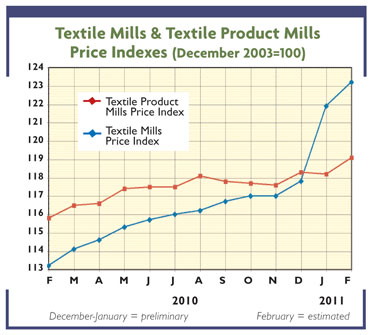
Textile World
now projecting anywhere from a 5- to an 8-percent increase in overall textile and apparel
tags for the current year — close to double the advance predicted at the beginning of the year and
well above the nation’s expected 1- to 2-percent overall inflation rate.


Impact On Imports And Profits


There are also likely to be other fallouts from today’s sky-high cotton tabs. U.S. imports of
Chinese textile and apparel products could be affected — primarily because that nation’s producers
may be forced to raise prices even more than their competitors. Such hikes are needed to reflect
two other upward cost pressures — a slowly rising currency and intensifying Chinese internal
inflation. These additional costs could add as much as another 10 percent onto Chinese-made
products. Not surprisingly, Chinese asking prices have jumped to the point at which more and more
U.S. buyers are considering a shift in sourcing — away from Beijing and toward the now-cheaper
offerings of other developing countries. There’s already some evidence of this, with imports from
China beginning to show smaller year-to-year advances. Finally, a few words on cotton and its
impact on bottom lines:

TW
feels 2011 profits and margins may be a bit lower than previously anticipated, reflecting
less-than-full-cost pass-throughs and consumer resistance to higher prices. There will be more
about this next month when updated earnings projections become available.

 March/April 2011

From The Editor: Sell Stability And Certainty

By Jim Borneman, Editor In Chief
If you’ve drafted a budget or tried your hand at business forecasting, the comforting Latin phrase ceteris parabus — “all other things being equal or held constant” — has made it easy to confidently rationalize your conclusions. It’s difficult to remember a time when so little could be held constant or remain the same. Slow-moving, relatively predictable business factors now change at a blistering pace. Today, volatility is normal and expected in a growing number of categories.

U.S. companies are coming to grips with the uncertainty of healthcare and benefit costs.Increasing commodity prices of cotton and petroleum-based inputs have taken hold, while volatile energy costs affect plant operations and transportation costs. Finding opportunity amid the volatility is what creative companies have embraced.

In recent days, it has been fair to argue that the world might not be as flat as Thomas Friedman pronounced it was. In fact, one could argue that international textile supply chains have rarely presented such risk. Although geopolitical risks are in the headlines, the trickle-down risks are rampant and occur in the context of a fragile economic recovery.

What opportunity could possibly exist in a time of high volatility? Become a purveyor of stability and certainty. How does doing business with your company reduce risk for your customer? How does your risk profile compare with that of your competition? Can you really reduce your customer’s risk exposure?

It sounds rather basic, but for a long time, it has been hard to sell U.S. manufacturing with a risk premium. Some have argued that companies whose products were decimated by imports also had capacity decimated by imports; hence, there is no alternative domestic production to return to. That may be so in some cases, but if demand is present and unstainable, U.S. textiles will come on-stream to fill the void. A bigger question is whether there is the possibility of a long-term
cyclical change occurring that will reinvigorate U.S. manufacturing.

A bright spot for U.S. manufacturers is apparent in the leading indicator from the Institute for Supply Management Report On Business. The March 1 release reports expansion of manufacturing sector economic activity for the last 19 consecutive months. Of the 18 manufacturing sectors tracked, 14 expanded — including apparel and textile mills.China’s trend of rising wages and inflation will be hard not to export along with their products. Combined with a renewed focus on increasing domestic consumption, there are strong signals that the Chinese are ready to embrace a new phase in their economic development. This may signal new competition in higher-value textiles — technical textiles — in which some U.S. producers have found refuge and profits. It may also point to the development of new low-wage locations to fill the China-price void — this time with a better understanding of the total cost of global sourcing.

In any event, beyond the headlines, it isn’t all gloom and doom. Challenges are ahead with higher gasoline prices — but U.S. consumers are less shocked this time. Let’s see how shocked their pocketbooks are.

March/April 2011

March/April 2011

The
Technical Association of the Pulp, Paper, Packaging and Converting Industries
(TAPPI)
, Norcross, Ga., will present the 2011 TAPPI Herman L. Joachim Distinguished
Service Award to
Peter Wallace on May 3, 2011.

American Textile Co., Duquesne, Pa., has named
Lance Ruttenberg president.

Ruttenberg
Ruttenberg

Shaw Industries Group Inc., Dalton, Ga., has named
Paul Murray vice president, Sustainability and Environmental Affairs.

Lectra, Paris, has appointed
Edouard Macquin worldwide sales director; and
Adriana Vono Papavero managing director, Lectra South America.

The
National Retail Federation, Washington, has promoted
Carleen Kohut to COO, and
Susan Newman to senior vice president, conferences; and has named Mike Gatti
senior vice president, member relations.

Unifi Inc., Greensboro, N.C., has appointed
William L. “Bill” Jasper chairman of the Board of Directors and
R. Roger Berrier Jr. president and CEO.

Pratt Institute, New York City, will present the 2011 Pratt Institute Fashion Icon
Award to
Hamish Bowles  on April 27, 2011. Pratt Institute fashion design student
Ruby Gertz has received a $25,000 YMA Fashion Scholarship Fund (FSF) Geoffrey
Beene National Scholarship Award.
Paola Ricardo and
Danielle Ryan, also fashion design students, have won $5,000 general FSF awards.

Cotton Council International (CCI), Memphis, Tenn., has elected
John Mitchell 2011 president.

Huntsman Corp., The Woodlands, Texas, has appointed
Stu Monteith president, Performance Products division.

Summerville, S.C.-based
Thrace-LINQ Inc. has named
James H. Brown quality assurance manager, process improvement. 

JamesBrown

Brown

Outlast Technologies Inc., Boulder, Colo., has promoted
Ashley Tilman to marketing manager.

Toronto-based
Thomson Research Associates has named
Glenn Runciman president.

March/April 2011

Architectural Textiles: Economical And Ecological Roofing


M
ore and more, producers of standard textiles are looking for alternatives. Technical
textiles, including industrial fabrics, are virtually the key to any new application. One of the
most interesting end-uses is fabrics for building — so-called roofing membranes installed instead
of gravel, bitumen sheets or concrete. However, the key to success lies not in the production of
the membrane, but in communication about its advantages.

Since the mid-1960s, industrial fabrics have made rapid advances. The use of fabrics, knits
or nonwovens instead of classic building materials is steadily increasing. The greatest market
suppliers in this area are already organized on the basis of separate business areas. In Germany,
technical textiles’ share of total textile sales currently stands at more than 40 percent.

Suppliers of industrial fabrics are looking to purchase not upstream machinery, but product
solutions. Consequently, a decisive change has occurred in buying behavior. With the steady
improvement in textile systems, the appetite of the users also has grown. Accordingly, in certain
cases, market pressure has already exceeded the development speed of new, mature technologies and
products.

architecturalfab1

The Nelson Mandela Bay Stadium, built in the Eastern Cape Province of South Africa for the 2010
FIFA World Cup™, features a membrane roofing system designed and built by Birdair Inc. Photo
courtesy of Birdair Inc.


Information Flow


Construction using textiles is one of the oldest architectonic forms in human history.
Today, because of their outstanding economic and ecological advantages, textile constructions are
an indispensable element of modern architecture. The physical principles involved in the
development of architectural fabrics concern the resistance of the fabric to external weather
forces such as wind and snow, and call for the lowest possible tension, expansion and resulting
membrane curvature in the finished structure. For this reason, textile roofing design represents a
very large and special challenge to engineers, and, as a consequence, membrane constructions
represent an innovative opportunity not only in modern architecture but also for the related
textile production sectors.

It is particularly important, therefore, to communicate in terms of the end product and not
in terms of machinery used. As an example of collaborating to produce a modern membrane roof for a
sports stadium, the involved parties are the fiber producer, yarn producer, weaver, finisher,
fabricator, contractor and stadium owner.

A successful job can be achieved only if the owner and the architect know that a membrane,
and not concrete, is the ideal material for the roof covering. The challenge is to inform all
participating parties of the possibilities of industrial fabrics.

The technologies and techniques for producing fibers, yarns and fabrics, and their further
processing into industrial fabrics must be communicated. The biggest obstacle in all production
stages is the enormous variety of application fields, which must be communicated. How should the
stadium proprietor or the general contractor know that there are textile producers, rather than
suppliers of bricks or concrete, that could be the right partners?


Simple, But Efficient Construction


Making-up, or fabrication, is a very important part of the production chain. Only
first-class work is acceptable for the job. The sewing machine is just one possible tool. Today,
more and more products that are exposed to sunshine and weather are bonded using ultrasonic
technology, assuring a 100-percent waterproof seam on the final roof or membrane.

“Simplify your life.” This megatrend of the future can also offer a major opportunity for
the textile industry. There is much more flexibility in the design, construction and shape of a
stadium or other roof when using a textile product instead of heavy concrete and steel. There are
endless possibilities for membranes, including carports; covers for public areas such as garages,
gas stations or airports; sport stadiums; buildings; signs and displays; and shopping centers;
among other possibilities.


Innovative Membrane Roofing


A roof membrane that is installed over flat and shingled roofs provides added protection,
insulation, and sound-deadening features. Thermoset, thermoplastic, or modified bitumen membrane
roofing materials are suitable for such an application.

Thermoset membranes are chemically crosslinked. Thermoplastic membranes are similar to
thermosets, but instead of chemical crosslinking or even vulcanization, the seams are welded
together with solvents or heat.

Membranes made with man-made materials such as polyvinylchloride (PVC) or glass fibers are
most commonly used. In the United States, of all membrane roofing materials, the PVC roof membrane
has the longest history of use, and today is estimated to account for some 10 percent of all
membrane roofing. PVC products are highly resistant to punctures and impacts; and offer flame
resistance, leak prevention, durability, ultraviolet (UV) reflection, and flexibility at low
temperatures as well as high-temperature tolerance. They are also very popular thanks to their
attractive look and appeal.
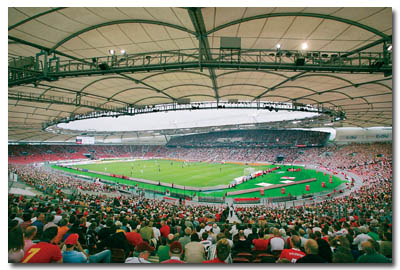
architecturalfab2

The roof of the Mercedes-Benz Arena in Stuttgart, Germany, is formed by membrane sections
attached to a steel frame.


Advantages


The advantages of using membranes instead of other building materials are self-evident:
Membrane roofing replaces gravel; and the roofs have extreme tensile strength and are easy to
handle on account of their light weight and flexibility. Even airports, such as the Hong Kong
International Airport, are covered with membrane roofs, despite threats from typhoons or other
adverse weather. As with every new application, the ingenuity of the construction engineers is
quite necessary. If damage ever occurs, these roofs are easy to repair or even replace, which is
not the case with traditional roofs.

One of the first stadiums in Europe to be covered with roof membranes is the Mercedes-Benz
Arena in Stuttgart, Germany. The stadium was originally built in 1933, and the membrane roof was
added in the early 1990s.

Another famous stadium is the 50,000-seat Nelson Mandela Bay Stadium in the Eastern Cape
Province of South Africa, built for the Fédération Internationale de Football Association’s
(FIFA’s) 2010 FIFA World Cup™. Amherst, N.Y.-based Birdair Inc., a contractor of lightweight
long-span roofing systems and tensile structures, built the roof for this and two other World Cup
stadiums in South Africa. The Nelson Mandela Bay stadium roof contains some 230,000 square feet of
polytetrafluoroethylene (PTFE)-coated fiberglass fabric membrane. The roof’s cable system forms
what Birdair describes as “valleys” that help drain rainwater from the roof as well as protect
spectators from the elements. In addition, 36 aluminum-clad cantilevering trusses measuring 150
feet in length and weighing 60 metric tons each support the edges of the membrane panels.


Finishing


Architectural fabric finishers must have extremely good knowledge of the material to be
processed. How does it react to sunshine, wind and rain? What bonding method or materials, such as
sealing strips or other materials, can be used? Appropriate finishing can make a fairly simply
manufactured fabric into a high-performance product. Finishing also incorporates coating and
lamination. Knowledge of the finishing processes employed is extremely important to downstream
production, as finishing generally has a direct link to the properties of the finished article,
especially for roof membranes.

Textiles can also protect against UV rays and electrosmog. Such products also include
steam-permeable textiles and water-repellent textiles.

Another promising possibility for architectural textiles exists in the form of coatings with
inorganic oxides such as silicon dioxide. Inorganic oxide layers can be transferred from the gas
phase to textiles using a variety of vacuum technology processes. A possible alternative is also
provided by sol-gel technology.

March/April 2011

Sustainable Dyeing And Finishing


Q
uality, economic efficiency and, more and more, ecological methods are the prerequisites
for up-to-date production in the dyehouse. Color shade and depth must be attainable, and there
should be adequate levelness and accurate fastness properties. Appropriate mechanical and chemical
processing is necessary to suit customer requirements as well as to create the required fabric hand
and surface characteristics.

Economical and ecological efficiency involves minimization of costs and maximum profit as
well as reproducible quality with minimal environmental damage. Therefore, process optimization is
a must to fulfill all parameters and requirements for right-first-time production. Western
wet-finishing costs are more and more apparent in various Asian countries as well, and can be
divided into the following approximate cost proportions:

  • 42-percent labor;
  • 29-percent dyestuffs and chemicals;
  • 6-percent water;
  • 12-percent energy;
  • 6-percent environment and safety measures; and
  • 5-percent maintenance.
DPFmonforts

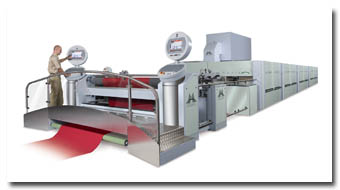
Monfort’s Montex 6500 tenters feature heat recovery systems that can reduce energy usage by up
to 30 percent.


Requirements


The catalog of modern, up-to-date dyestuffs and dyeing and finishing equipment offers a
blend of modern technology and chemistry. Major requirements are as follows:

  • reduced water consumption;
  • varying load capacity;
  • time savings;
  • comparable economy and ecology;
  • highly optimized rinsing processes;
  • controller units;
  • downstream processing advantages;
  • wet finishing process;
  • economical finishing; and
  • monitoring and controlling.


Cornerstone Research And Development


“Sustainability is one of the companies’ three topics in R&D, besides ecology and best
quality output,” states Germany-based Fong’s Europe GmbH, formerly Then Maschinen GmbH and Goller
Textilmaschinen GmbH. “As the inventor of the short liquor ratio technology, the company ever since
put a lot of emphasis on sustainability.”

At Thies GmbH & Co. KG, Germany, the main emphasis is on the efficiency and
sustainability of its products and proceedings, according to the motto, “Go green with Thies.” All
of the company’s yarn- and piece-dyeing machines reduce process times and energy as well as other
resource usage. Thies reports its iMaster H20 presents pioneering innovations including versatility
and adaptability, and offers the dyer product flexibility, which Thies says has never been obtained
before now.

For Fong’s Europe, the most successful model is still the Then-Airflow® Synergy, whose
latest version is model SYN 600 G2. The main reason for this success, the company reports, is the
Airflow technology itself. “The technology is unrivaled in batch dyeing with its unbeatable dyeing
economy and dyeing ecology, resulting in huge savings and typically offering one batch more per
day, not to mention the wide range of fabrics,” Fong’s Europe explains, noting that the comparison
with a model from some five to 10 years ago shows some significant improvements: Because of the
30-percent-greater batch size and technical machine design improvements — including new nozzle
section, wheel and flexible chamber device, and the power rinse system — overall water, energy and
chemicals consumption could be further reduced by around 15 to 20 percent.

On the other hand, Thies remarks that the liquor ratio doesn’t play as important a role as
in the past. The importance today relates more to consumption in liters of water per kilogram of
goods (l/kg). Today, the influence of the product on water consumption is greater than the
influence of the system. The fleet relationship detail only tells how much water per treatment bath
is used; it does not give the number of required baths. The detail of water consumption in l/kg,
however, gives information about system efficiency.


Sustainable Dyestuffs


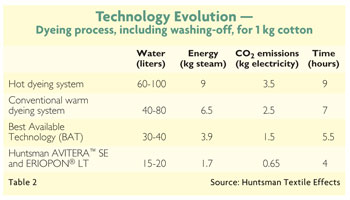
Huntsman Textile Effects, Singapore, mentions that the textile industry is notorious for
consuming vast amounts of water, especially during dyeing and finishing. Up to 100 liters of water
are used to dye 1 kg of cotton fabric. The company has been able to improve dyeing technology
considerably with the development of a new chemistry for dyeing of cellulosic fibers. AVITERA™ SE
is a new tri-reactive dye range for exhaust application on cellulosic fibers.

Only 15 to 20 liters of water are required to dye 1 kg of material. Avitera SE dyes and
ERIOPON® LT clearing additive comply with new environmental sustainability standards and give
top-quality results, achieved in time, Huntsman reports, adding that the process also saves time
and energy and reduces carbon dioxide (CO2) emissions; and that with the new dyeing technology, 1.3
liters of fresh water per person per day potentially could be saved in textile-processing countries
such as China, India or Bangladesh.

Most reactive dye molecules have one or two reactive groups that bond with the fiber and
remain permanently fixed. Dye that fails to bond is hydrolyzed and cannot be fixed on the fiber. In
conventional dyeing, 20 to 40 percent of the dye molecules typically are hydrolyzed. To achieve
highly colorfast fabrics, unfixed dye needs to be fully removed — a long, hot, expensive, water-
and energy-intensive process.

DPFtable2

Best Available Technology (BAT) improves conventional warm dyeing systems, and already
consumes less water during the washing-off process. When using Avitera SE and Eriopon LT, the
dyeing and washing-off processes require temperatures no higher than 60°C, and the number of
rinsing baths needed to obtain the required colorfastness is greatly reduced, Huntsman reports.


Tentering


Tentering is virtually the most important process after dyeing to give a fabric the required
properties. A. Monforts Textilmaschinen GmbH & Co. KG, Germany, a leader in the global tenter
market, says that rising cost pressure remains a major issue in the textile industry, especially
for textile finishing. Reasons include steadily rising energy, water and effluent treatment costs;
consumer demand for green and responsibly made garments; and the need for textile finishing to be
very innovative. Therefore, modern textile finishing equipment must fulfill requirements such as
responsible use of natural resources, cost-effectiveness and high flexibility.

Monfort’s Montex 6500 tenters feature heat recovery systems, which are available for all
Montex tenters. The systems can reduce energy usage by up to 30 percent, saving both natural
resources and production costs. Even on existing machines, heat recovery systems can be added. The
Energy Tower 7000 is a universal stand-alone system providing the same performance as a built-in
system. Depending on the exhaust airflow and temperature, up to 30 percent of the heat generated
can be recovered. According to Monforts, very good access to the heat exchange modules and a large
condensed water tank make the Energy Tower very maintenance-friendly, with consistent performance
between maintenance cycles.

In the area of continuous dyeing processes on cotton, Monforts offers the Econtrol® process.
In contrast with pad-dry-thermofix or pad-dry-pad-steam processes, Econtrol dyeing using a Thermex
6500 Hotflue does not need a separate fixing process. According to Monforts, the Econtrol climate
inside the Thermex chamber ensures a perfect dyeing result during the drying process.

For dyeing of polyester/cotton blends, Monforts has now developed a single-bath process that
uses the Econtrol technique without intermediate reduction clearing. The process does not use
separate baths, and reduction clearing is not necessary, saving significant amounts of chemicals,
water and energy, as well as production costs.


Positive Future


For the near future, Fong’s Europe mentions more easy-to-handle machines that have the
lowest water and energy consumption, give best-quality results, and are reasonably priced. Thies
foresees a similar direction: Future developments will be directed by economics, but the
environment also will be taken into account. Suitable aftertreatments will be developed with the
target of recycling dyeworks effluent, and other developments will be aimed at emissions
reductions. There will be much movement in this area in the future.

March/April 2011

Texprocess Debuts In Frankfurt


M
esse Frankfurt GmbH has added another trade show brand to its portfolio of events serving
the global textile industry. This year, the Frankfurt-based producer and organizer of expositions —
including Techtextil, Texworld, Heimtextil and numerous others, both textile- and
non-textile-related, around the world — is launching Texprocess, a trade show focused on the
processing of textile and flexible materials. The inaugural Texprocess will colocate with
Techtextil 2011 in Frankfurt, May 24-27. Going forward, the European version of the show will be
held biennially in conjunction with Techtextil at the Messe Frankfurt fairgrounds, and its U.S.
version, Texprocess Americas, will debut April 24-26, 2012, also as a biennial show, colocating
with Techtextil North America’s East Coast edition held in Atlanta in even-numbered years.

Texprocess Frankfurt organizers are expecting 500 exhibitors to showcase innovative
products, technologies and services for the textile and flexible material processing supply chain —
including design, pattern production, cutting, making-up, finishing, logistics, information
technologies (IT) and technical accessories — to some 25,000 visitors from the apparel industry,
textile and flexible materials processing industries, retail and service sectors, skilled trades,
and science and education institutes. The expo will cover some 50,000 square meters of exhibition
space in Halls 4, 5 and 6 at Messe Frankfurt.

Sector leaders are hailing the debut of Texprocess as a venue for presenting processing
innovations and bringing together all parts of the sector.

“Processing textiles using highly productive and efficient methods represents a challenge
for the future of the textile-processing sector in Europe,” said Dr.-Ing. Thomas Gries, a professor
at the Institut für Textiltechnik of RWTH Aachen, Germany. “Automation, reproducibility and quality
assurance are just as important for this development as resources/energy efficiency of the machines
and processes. With its wide range of machinery manufacturers, research institutes and end users,
Texprocess is the ideal platform for innovations and new developments in this sector.”

Texprocess

Texprocess’s Source-it! platform will help apparel brands find contract manufacturers who
can provide the required sourcing and production capabilities to meet their
needs.  


The event’s conceptual partner is the German Engineering Federation (VDMA) Garment and
Leather Technology Association. The show also has garnered the support of the European Apparel and
Textile Confederation (EURATEX), Brussels, and the International Apparel Federation (IAF),
Amsterdam. Both associations will have booths on the exhibition floor, and will hold meetings on
the premises during Texprocess. Scheduled EURATEX meetings include the Technical Clothing Group on
May 25 and the European Technology Platform on May 26. IAF has scheduled its Board meeting and
General Assembly May 23-24.

Other organizations supporting Texprocess include the Sewn Products Equipment &
Suppliers of the Americas, Raleigh, N.C.; China Sewing Machinery Association; GermanFashion —
Modeverband Deutschland e.V.; and Dialog Textil-Bekleidung, Germany.


Sourcing Platform


Source-it! — Texprocess’s international sourcing platform — will give suppliers an
opportunity to show their capabilities and their production facilities. For apparel brands seeking
an efficient, cost-effective supply chain, this platform offers important advantages: At a time
when small lots and short turnaround times are preferred to allow brands to respond to the fashion
demands of the moment, it is important to be able to source goods from areas in which the supply
chain is well-integrated and manufacturers have the flexibility to change styles quickly without
disrupting other links in the chain. Source-it! will enable fashion brands to meet with
international contract manufacturers and their services, and get an overall picture of the
production chain in particular countries and regions without having to travel around the globe to
find the best fit for their needs.


Other Events


The Texprocess program also includes several other events. Outstanding product innovations
and solutions will receive Innovation Awards and have their own special exhibit within Texprocess.
Network@Texprocess will present IT trends for the textile processing and apparel sector and will
include software, service and automation solutions for various management systems as well as IT
solutions for logistics processes.

The Texprocess Forum will cover topics such as sustainability, environmental protection,
traceability, automation and supply chain management. The Texprocess Campus, a collaboration with
fashion and design educational institutions, will present training and professional development
opportunities in the fashion industry.


For more information about Texprocess, visit
www.texprocess.messefrankfurt.com.


March/April 2011

Sponsors