“Sourcing In The Americas” Is Premier Focus Of August 2011 Sourcing At MAGIC Show

LOS ANGELES — June 27, 2011 — The U.S. Department of Commerce and MAGIC are hosting an Americas
Pavilion and Summit — “Sourcing in the Americas” — to highlight the United States and Western
Hemisphere supply chain network. “Sourcing in the Americas” will showcase apparel, footwear, fabric
and yarn mills, trims/component suppliers, and service providers, as well as promote business and
investment in the Western Hemisphere. This summit brings together the U.S. Department of Commerce’s
Office of Textiles and Apparel (OTEXA) and the Office of the U.S. Trade Representative (USTR),
along with endorsement and support from major U.S. and Western Hemisphere textile, apparel and
footwear associations. Exhibitors in the Pavilion will include Denima Trix, Buhler Yarns, Fessler,
Kaltex and more.

“Sourcing at MAGIC is the optimal platform to address the Western Hemisphere supply chain
and highlight the Americas as the emerging leader for sourcing opportunities,” said Chris DeMoulin,
MAGIC International President and Executive Vice President of Advanstar’s Fashion Group.

Obama Administration official Mr. Francisco Sanchez, Under Secretary for the International
Trade Administration, U.S. Department of Commerce will be a keynote speaker. Sanchez will address
the Western Hemisphere regional textile and apparel supply chain, and as part of the National
Export Initiative (NEI), will highlight export successes and potential opportunities for U.S.
fiber, yarn and fabric manufacturers. 

“I am pleased to participate in this dynamic collaboration between MAGIC, Commerce, USTR the
coalition of industry associations and the companies involved in the regional supply chain,” said
Sanchez. “Full sourcing in the Western Hemisphere underscores the key elements of quality, speed,
flexibility and availability which are cornerstones shaping the competitive advantages of sourcing
in the region.”

“Sourcing in the Americas” will feature exhibitors representing the entire America supply
chain and a series of seminars with top import suppliers and executives, as well as U.S. government
decision makers. Highlights include:

The New Western Hemisphere Supply Chain — Way Beyond the Basics Sourcing Summit
(Sunday, August 21 2:00 p.m. – 4:00 p.m.) — The Western Hemisphere Sourcing Summit will bring key
sourcing executives to hear from brands, manufacturers and experts regarding the new opportunities
for sourcing in the Western Hemisphere. Successful supply chain performers will present examples of
the “New Western Hemisphere Supply Chain” during a panel discussion and new data will be presented
to showcase the region’s competitive advantage. Whether it’s speed to market or a competitive cost
structure, the Western Hemisphere is an emerging leader for sourcing opportunities. Obama
Administration official Mr. Francisco Sanchez, Under Secretary for the International Trade
Administration, U.S. Department of Commerce will be a keynote speaker.

“National Export Initiative & Sourcing in the Americas” Seminar (Monday,
August 22 10:00 a.m. – 11:00 a.m.) — A special one hour seminar that highlights the U.S. National
Export Initiative (NEI) and the Western Hemisphere. The seminar is open to all MAGIC participants
and includes panel discussions with leading manufacturers and producers in the region, a new
analysis of Western Hemisphere supply chain costs and a roll-out of a DR-CAFTA sourcing database.

Posted on June 27, 2011

Source: MAGIC/PRNewswire
Production And Consumption Lowered

BIRKENHEAD, United Kingdom — June 23, 2011 — Cotlook has made significant changes to its estimates
of world production (notably for the United States and China) and consumption (mainly China and the
Indian subcontinent).

The adjustment to US 2011/12 crop production predictably reflects the continuing drought in
major cotton tracts (notably West Texas, but also Georgia), while the reductions for China are made
on the premise that recent estimates of output in Xinjiang have been overstated. Some loss of
production has been noted from the 2010/11 crop in Brazil, owing to yield uncertainties in the
principal growing state, Mato Grosso. Uzbek prospects for 2011/12 have been dimmed somewhat owing
to less abundant moisture. Our global production forecast for 2011/12 is now 26,733,000 tonnes,
down 751,000 from a month ago.

Reductions to our estimates of consumption are derived from a less optimistic view of the
outlook for global recovery in the foreseeable future, with mills still unable to work-off large
yarn inventories, and continued signs of cotton losing share to man made fibres.World consumption
next season is now forecast at 25,456,000 tonnes, down 890,000 tonnes on the month. Nevertheless,
the total would still represent an increase compared with the current season of close to five
percent (our previous forecast suggested eight percent).

The changes to our production and consumption numbers suggest a greater decline in world
stocks during the 2010/11 season and a larger increase in 2011/12.

Posted on June 27, 2011

Source: Cotlook Ltd.

The Rupp Report: The Ongoing Cotton Thriller

For many months now, the Rupp Report has informed its readers about the volatile development in the
global cotton markets and cotton prices. As everybody in the trade knows, these prices are causing
a lot of problems for many countries that have a strong dependence on cotton.

At several exhibitions and meetings over the past few months, subscribers and readers from
all over the world have expressed their wish to be informed frequently about the development of the
cotton markets and its prices, especially in these critical times. So here are the developments of
the past few weeks since the last Rupp Report about cotton in May 2011 (See ”
The
Rupp Report: Rollercoaster Cotton
,” www.
TextileWorld.com, May 10, 2011)
. As usual, these cotton reflections are based
on various sources, mainly from the British traders Plexus Cotton Ltd., but also from organizations
such as the International Cotton Advisory Committee (ICAC) in Washington and the Bremen Cotton
Exchange in Germany.

Two Different Markets

On May 26, Plexus reported: “NY futures closed again mixed this week, but this time it was
July that dropped 462 points to close at 151.03 cents, while December rallied 838 points to close
at 127.57 cents.

“After the July/Dec inversion grew from less than 21 cents to over 38 cents a week ago, it
has once again started to come in, closing today at less than 24 cents.”

As Plexus noted: “It seems as if we were dealing with two different markets at the moment! On
the one hand there is current crop …, with delays, cancellations and high-priced inventories ….
On the other hand there is new crop, which is getting a lot of support due to the uncertainty in
some key growing areas after a less than ideal start.

Furthermore, Plexus reported, US export cancellations of 62,300 running bales more than
offset new sales of 29,300 bales for current crop and 21,800 bales for next marketing year,
providing an impression that the markets are calming down. In addition, there was a slowdown in the
shipments of 285,700 running bales. So the question became apparent: “How many of the outstanding
3.1 million bales in commitments will ultimately be exported by the end of July [from the United
States]?”

Up Again And Export Problems

Then, on June 2 came this report: “NY futures moved sharply higher this week, with July
rallying 1321 points to close at 164.24 cents, while December gained 1266 points to close at 139.23
cents.” And in West Texas the weather was still very dry. Plexus reported: “It is difficult to
estimate where exactly the US crop stands today, because there is still time to rectify some of the
problems, but unless we see an immediate improvement we are afraid that the US crop won’t yield
much more than 16.5 million bales.”

This projection of a smaller US crop would certainly cause some export problems, Plexus
noted. “The US has already committed around 5.8 million statistical bales for export next season,
which compares to just 1.4 million bales of forward sales of the previous year. Combined with the
3.8 million bales in domestic mill use, the total number of bales owed is therefore approaching the
ten million mark or roughly 60% of potential production. This means that shippers will be forced to
step on the breaks in regards to additional sales ….

“However, judging from past experience, other cotton-growing countries are not quite able to
jump on the bandwagon in a very short time. They simply don’t have the same logistics capabilities
as the United States, which is able to export some 400,000 to 500,000 bales weekly. Therefore,
Plexus warned, buyers who still have to fill third and fourth quarter commitments should not wait
too long to place orders.

Food Is The Major Competitor

Based on the June 2 numbers, Plexus noted that many cotton traders still believe prices will
fall back to a longer-term average. This could be, but food crops offer strong competition: Growers
get US$7 for a bushel of corn and US$14 for soybeans. It seems to be a tough job for cotton to
remain competitive. As Plexus noted: “As long as food prices remain high, cotton will have to be
attractively priced as well. A growing world population and rising protein consumption combined
with the fact that more food is being used to produce energy and to feed livestock should all but
guarantee that corn and soybean prices will remain at elevated levels for years to come.”

The Change

But over the next two weeks, there was a sharp drop in New York futures, with July falling a
total of 1,828 points by June 16 to close at 145.96 cents, and December falling a total of 1,905
points to close at 120.18 cents. There are a few reasons outside the cotton trade that are
influencing this development: for example, the uncertainty with the euro, including the Greek debt
crisis. Probably other countries will follow, as has been mentioned in all important financial
newspapers.

However, according to Plexus, “demand in the physical [cotton] market has basically been
non-existent lately. Mills are still trying to digest high-priced inventories of cotton, yarn and
fabrics and with the huge price swings we have seen in recent months, there is a lot of confusion
as to where a sustainable price level for cotton really is.

“The latest US export sales report was actually a pleasant surprise after 11 consecutive
weeks of negative numbers in current crop. Net sales of Upland and Pima cotton amounted to 10,300
running bales for this season and 39,200 running bales for next marketing year. Shipments of
227,100 running bales reduced the outstanding balance for the current marketing year to just 2.2
million running bales (last year 3.4 million bales) and … at the current pace of shipment all the
inventory would be gone by September.”

Rebound Of Global Stocks Reported

Also, on June 1, ICAC was reporting a rebound of global cotton stocks in 2011/12, noting that
“This season started with a firm demand from spinning mills, which were looking to rebuild their
stocks depleted in 2009/10, but is ending with weaker demand, mainly due to high cotton prices.”
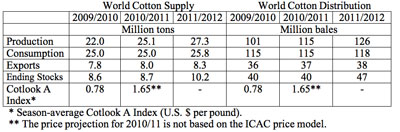
The following table showing world cotton supply and distribution, provided by ICAC, is
self-explanatory:

RuppReportTable

ICAC reported: “Global mill use is expected to resume increasing in 2011/12, driven by a
projected robust global economic growth and boosted by increased production, but moderated by
relatively high cotton prices and competition from chemical fibers. … The world ending
stocks-to-use ratio could rebound to 40% in 2011/12.

“The Secretariat believes that the season-average Cotlook A Index will decline significantly
in 2011/12, although it will probably remain above the ten-year average of $0.60 per pound.”

Tight Supplies

However, as Plexus noted on June 16, “remaining supplies in the US are very tight and may not
be enough to meet existing export commitments until October, plus the coming US crop is in trouble
and may yield several million bales less than what was expected just a month or two ago ….”

And what exactly is the annual demand: 119 million or 114 million bales? Again, the heat is
on.

June 21, 2011

DAK Americas To Acquire Wellman’s PET Resin Business

Charlotte-based DAK Americas LLC — a manufacturer of polyethylene terephthalate (PET) resin,
polyester staple fiber, terephthalic acid and purified terephthalic acid monomers, and specialty
polymers; and a subsidiary of Mexico-based conglomerate Alfa S.A.B. de C.V. — has agreed to acquire
the PET resin business of Wellman Inc., Bay St. Louis, Miss., for approximately $185 million
including cash and the assumption of certain liabilities. The acquisition includes Wellman’s PET
resin manufacturing facilities in Bay St. Louis, which produce some 950 million pounds of PET resin
annually and employ some 165 workers.

The Wellman transaction comes on the heals of DAK’s acquisition earlier this year of
Kingsport, Tenn.-based Eastman Chemical Co.’s PET and purified terephthalic acid (PTA) business and
the related Performance Polymers assets and technology
(See ”
DAK
Americas Completes Acquisition Of Eastman’s PET, PTA Business
,” www.
TextileWorld.com, February 9, 2011)
. That acquisition increased DAK’s PET
resin production capacity to more than 3.3 billion pounds annually from its PET operations in the
United States, Mexico and Argentina. The addition of the Bay St. Louis capacity will bring DAK’s
total annual PET resin capacity to about 4.3 billion pounds, and its share of capacity in the North
America Free Trade Agreement (NAFTA) region to some 37 to 39 percent — making DAK one of the
leading regional producers of PET resin, according to Ricky Lane, DAK’s director of corporate
communications.

DAK has begun the process with the appropriate regulatory agencies to receive approval for
the acquisition and expects to close the transaction in the second half of this year. The Bay St.
Louis plant produces PET resin for use in bottles and other container applications, and Lane said
DAK plans to continue the operation as is, with no plans for consolidation or other changes.

June 21, 2011

Kingwhale Develops Low Impact Dyeing Technology For Polyester Fabrics

Taiwan-based Kingwhale, a bluesign®- and Oeko-tex®-compliant vertically integrated manufacturer of
performance apparel fabrics and finished products, has developed Low Impact Technology (L.I.T.) to
reduce the use of energy, water and dyestuffs in its manufacturing and dyeing processes. According
to the company, the dyeing technology uses 22-percent less electricity for coloring and heating, 50
percent less thermal energy for steam creation, 60-percent less water and 15-percent less dyestuff
than traditional dyeing processes to achieve comparable results.

The technology is designed to conserve energy and raw materials from the start of
manufacturing and includes a process to modify the polyester molecules during fiber manufacturing
to enable the yarn to take up the dye more quickly than conventional polyester yarn, thereby
requiring less dyestuff to be used and cutting the amount of process energy and water needed as
well.

“Often recycling is looked at as the best way to control waste, but we all need to take it a
step further — to actually find a way to manufacture what we need while using less resources and
materials in the first place,” said James Huang, president, Kingwhale. Huang noted that although
the process itself may be more costly with regard to mechanics, time and man hours required, those
costs are mitigated by the reduced resource and material costs, so the fabrics processed using the
technology are competitive price-wise with comparable fabrics on the market.

Kingwhale’s fleece products will be the first to be dyed using the L.I.T. process, and the
company hopes eventually to use the process to dye all of its products.

June 21, 2011

Bonar And Natpet Select NSC Nonwoven Equipment

Bonar Technical Fabrics NV— a Belgium-based producer of woven and nonwoven fabrics for geotextile
and agrotextile applications, and a part of United Kingdom-based performance materials manufacturer
Low & Bonar Plc — and National Petrochemical Industrial Co. (Natpet) — a producer of
polypropylene (PP) resin, and a subsidiary of Saudi Arabia-based investment company Alujain Corp. —
have purchased a nonwoven production line from France-based NSC nonwoven for their joint venture
(JV) company in Saudi Arabia. The state-of-the-art line has a 6-meter working width and includes
the Asselin-Thibeau IsoProDyn® control system and the A.C.S. system for high-speed crosslapping,
among other carding and needling equipment. NSC nonwoven reports the line is the fourth Bonar has
purchased that is equipped with the Asselin-Thibeau ProDyn® system.

Bonar and Natpet’s JV will produce geotextile products for the fast-growing civil engineering
markets in the Middle East and the Indian subcontinent. The companies have built a new
manufacturing plant at a site located near Natpet’s PP production facility in western Saudi Arabia.
The NSC nonwoven line will be installed at the plant in early 2012 and production is expected to
commence in mid-2012.

June 21, 2011

FDA Publishes Draft Nanotechnology Guidelines, Invites Feedback

The U.S. Food and Drug Administration (FDA) has published “Draft Guidance for Industry, Considering
Whether an FDA-Regulated Product Involves the Application of Nanotechnology,” and is asking for
feedback from the industrial and public sectors. The draft guidelines present a list of criteria —
including the size and properties of nanomaterials used — to help determine whether nanotechnology
is used in a FDA-regulated product.

The draft guidance is an outgrowth of recommendations made in 2007 by the FDA’s
Nanotechnology Task Force, formed in 2006 to identify potential effects of nanomaterials used in
FDA-regulated products and look into ways to evaluate those effects. The National Nanotechnology
Initiative — a federal research and development program that coordinates the nanotechnology-related
activities of a number of federal agencies — defines nanotechnology as “the understanding and
control of matter at dimensions of roughly 1 to 100 nanometers, where unique phenomena enable novel
applications.” 

“Our goal is to regulate these products using the best possible science,” said FDA
Commissioner Dr. Margaret A. Hamburg. “Understanding nanotechnology remains a top priority within
the agency’s regulatory science initiative and, in doing so, we will be prepared to usher science,
public health, and FDA into a new, more innovative era.”

“Nanotechnology is an emerging technology that has the potential to be used in a broad array
of FDA-regulated medical products, foods, and cosmetics,” said Dr. Carlos Peña, FDA’s director of
emerging technology programs. “But because materials in the nanoscale dimension may have different
chemical, physical, or biological properties from their larger counterparts, FDA is monitoring the
technology to assure such use is beneficial.”

Although FDA has not yet identified particular safety issues related to nanotechnology
applications in FDA-regulated products, it is keeping watch because certain nanomaterials are of
potential concern.

FDA-regulated products that might involve the application of nanomaterials on or in textile
materials include tissue engineering scaffolds and certain other implantable medical devices, and
antimicrobial materials, among other products.

The draft guideance and other related resources are available at
www.fda.gov/ScienceResearch/SpeciallTopics/Nanotechnology/ucm257926.htm.

June 21, 2011

Saint-Gobain Technical Fabrics Renamed Saint-Gobain ADFORS

Saint-Gobain Technial Fabrics — a manufacturer of industrial and construction reinforcement fabrics
using technologies including laid scrim, weaving, knitting, mat forming, lamination and coating;
and a division of the France-based Saint-Gobain Group — has renamed the company Saint-Gobain
ADFORS. The name is derived from two roots, with “ad” coming from the word “add”; and “fors”
derived from “force” or “reinforcement.”

“We look forward to building brand equity with the new name by offering best in class
service and excellent product innovation,” said Rudi Coetzee, general manager, Saint-Gobain ADFORS
America Inc., Grand Island, N.Y. “The new ADFORS name provides us the opportunity to really build a
strong brand backed by the globally recognized Saint-Gobain.”

June 21, 2011

June 2011

Marietta, Ga.-based
YKK Corp. of America‘s Board of Directors has elected the company’s President and
CEO
Alex Gregory to chairman of the Board.

AlexGregory

Gregory

The
American Association of Textile Chemists and Colorists (AATCC), Research Triangle
Park, N.C., has presented the 2010 J. William Weaver Paper of the Year Award to
Dr. Rachel McQueen,
Dr. Monika Maria Keelan and
Swapna Kannayiram, University of Alberta, Canada, for their paper titled
“Determination of Antimicrobial Efficacy for Textile Products Against Odor-Causing Bacteria.” AATCC
also has given the Technical Committee on Research (TCR) Service Award to
Roland Connelly for his work on AATCC UV Calibration Program and Evaluation
Procedure 11; and
Norma Keyes in recognition of her work on the Liquid Moisture Management Test
Method and the Moisture Management Technical Supplement; and the AATCC Young Entrepreneur Award to
Bryan Swarn, co-founder of Phenetix Urban Athletic Wear Co.

London-based
WGSN has named
Catriona Macnab chief creative officer; and has promoted
Sandra Halliday to editor-in-chief; and
Maria Janssen to creative director, Denimhead.com.

San Francisco-based
Levi Strauss & Co. has named
Walker MacWilliam vice president of men’s design, Levi’s® brand.

The
Carpet America Recovery Effort (CARE), Dalton, Ga., has named
Thomas Holland, Texas Carpet Recycling and Corporate Floors, and
Sheri Gorman, RD Weiss Cos., to its Board of Directors, and has re-elected
Ron Greitzer, Los Angeles Fiber and Reliance Carpet Cushion, and
Sean Ragiel, CarpetCycle, to the Board. The organization also has named
Eric Nelson, Interface Americas, CARE Person of the Year.


Carmel, Ind.-based
Top Value Fabrics has named
Dave Sailer business development manager.

DaveSailer

Sailer

Chattanooga, Tenn.-based
Propex Operating Co. LLC‘s Board of Managers has named
Michael Gorey president and CEO.

New York City-based
Capital Business Credit LLC has appointed
Robert Grbic COO,
Michael Fortino CFO, and
Charles Sharf executive vice president and New York factoring portfolio manager.

Bunting Magnetics Co., Newton, Kan., has named
Matt Anderson manufacturing engineer and
Kenton Stumps design engineer for the Material Handling product line; and
Simon Ayling production manager and
Steve Lacy technical sales executive for Bunting’s European manufacturing and
sales operation.

The
International Cotton Advisory Committee (ICAC), Washington, has named
Dr. Sukumar Saha, U.S. Department of Agriculture/Agricultural Research Service,
Genetics and Precision Agriculture Unit, Mississippi State University, the 2011 ICAC Cotton
Researcher of the Year.

The
National Textile Association, Washington, has awarded the Bronze Student’s Medal
to
John P. Lord, University of Massachusetts – Dartmouth.

Worldwide Responsible Accredited Production (WRAP), Arlington, Va., has elected
Stuart A. Webster vice president, training and education.

Lubbock, Texas-based
Textile Exchange has named
LaRhea Pepper global managing director.

Midland, Mich.-based
Dow Corning Corp. has elected
Mike Conway,
Linda Kennan,
Joseph Rinaldi and
Doug Schoettinger corporate vice presidents.

Louise Tiler, Leeds College of Art, United Kingdom, has been awarded the Grand
Prize in the SURTEX 2011
designext student design competition.

Loves Park, Ill.-based
Zenith Cutter Co. has named
Steve Kao sales director.

Delano, Minn.-based
Easiway Systems Inc. has named
Kevin Lewis general manager.

KevinLewis

Lewis

Winston-Salem, N.C.-based
Hanesbrands Inc. has named
Dale W. Boyles interim CFO, effective June 30.

The Atlanta-based
Georgia Association of Manufacturers (GAM) and
Manufacturers Education Foundation (MEF) have elected
Rick Sargent, Peach State Labs, chairman;
Monte Galbraith, Denim North America, vice chairman; and
Miles Wright, Mannington Commercial, treasurer. GAM and MEF also have elected
Burl Finkelstein, Kason Industries Inc., to serve a one-year term on both Boards
of Directors.
Lee Bryan, TenCate Geosynthetics;
Tom Deems, New Riverside Ochre; and
Trey Hodges, Swift Spinning LLC, will serve two-year terms on both Boards of
Directors.
David Morgan, Shaw Industries Group Inc.;
Jim Jones, Dixie Industrial Finishing;
Mike Anderson, TenCate Protective Fabrics;
George Boyd Jr., Goldens’ Foundry & Machine Co.;
Mike Kiepura, RockTenn; and
Brian Johnstone, Lockheed Martin Aeronautics Co., will serve three-year terms on
both Boards of Directors.

Aurora, Ill.-based
Aurora Specialty Textiles Group Inc. has named
Teresa Skinner marketing coordinator.

Clover, S.C.-based
Synthetic Yarn and Fiber Association (SYFA) has elected the following officers of
its 2011 Board of Directors:
Keith Adams, ITG/Burlington Worldwide, president;
Ernie Hundley, Nilit America Inc., first vice president; and
Mike Becker, Michael S. Becker Inc., second vice president. The association also
has elected the following directors:
Mac Beard, Strategic Textile Solutions;
Machell Apple, Valdese Weavers;
Roger Crossfield, Goulston Technologies Inc. (retired); and
Joel Cornelius, Unifi Inc. SYFA also has named
John Amirtharaj, Premiere Fibers, membership chairman;
Alasdair Carmichael, PCI Fibres, chairman of publicity; and
Jerry Eskew, Oerlikon Textile Parts, conference chairman.

Atlanta-based
InterfaceFLOR has named
Charley Knight vice president and
Brian Wilson director of design, Interface Hospitality.

Merrillville, Ind.-based
MonoSol LLC has named
Hanna Necel sales and technical support agent for Poland, Russia, Belarus, Latvia,
Lithuania, Estonia, Slovakia and Ukraine.

Spartanburg-based
Milliken & Company has named
Cresta Bledsoe global creative director, floor covering division.

CrestaBledsoe

Bledsoe

Cary, N.C.-based
Association of the Nonwoven Fabrics Industry (INDA) has named
Philip Pitt marketing director.

Street, Md.-based
H.P White Laboratory Inc. has appointed
John Cronin manager, global business development.

Switzerland-based
bluesign technologies AG has named
Dr. Yi Heng Cheng,
Jill Dumain,
Dr. Boqiang Lin and
Dr. E.U. von Weizsäcker to its Advisory Board.

New Haven, Mo.-based
MarChem CFI Inc. has appointed
Cameron Weldon upper Midwest regional sales representative.

CameronWeldon

Weldon

Edinburg, Texas-based
FibeRio Technology Corp. has named
Dr. Ron Larson to its Technical Advisory Board.

Business Falls Off At End Of Second Quarter


A
s the first half of the year draws to a close, yarn spinners find themselves in the
recently uncommon position of facing uncertainties and asking questions about deteriorating
business conditions.

For the past 18 months, the industry has seen a steady stream of business, often operating
at full capacity — especially in ring-spun yarns — and with a healthy backlog of orders. Then,
beginning about eight weeks ago, some spinners noticed the beginnings of a slowdown. And within the
past four to six weeks, orders have been off substantially.

“Right now, I’m not really sure what’s going on,” said one Southeastern spinner. “Orders are
definitely off a bit. Certainly, I would not classify business as bad, but it is not as brisk as it
has been. We’ve been on a roll for a long time, and this is the first indication we have seen that
it might be coming to an end.”

Multiple spinners speculate that the recent slowdown might be attributable to several
factors. “We saw from recent reports that economic growth in the past month or so has slowed
somewhat,” said one spinner. “Because of manufacturing and business cycles, many of the
dramatically higher prices we’ve seen over the past six months only recently hit at retail. We’re
thinking that at least some of the recent slowdown is a result of consumer sticker shock.”

Said another spinner: “Right now, I would say that business is off for multiple reasons.
Price, I believe, is a factor, both for our customers and consumers at retail. But also, we believe
that the supply pipeline is currently full. During the economic crisis, many retailers let their
stocks dwindle to almost nothing. And when they did place orders to restock, they only bought just
enough to replace what they had sold. What’s happening now is that the pipeline is full and
retailers have sufficient inventory — or even excess inventory — and have slowed down their
buying.”

Even further, some spinners speculate that a period of panic buying has come to an end. “We
had a period there for awhile when capacity was so tight that many customers were afraid that if
they did not place orders, they would be unable to get a position with a yarn manufacturer. So, to
hedge against not having product, they placed orders for more than they needed. As capacity has
become more available, they have reverted back to their normal practice of only buying enough
product to fill their orders.”


Third Quarter Uncertain


With the recent decrease in the volume and frequency of orders, yarn spinners are uncertain
of what the last half of the year will bring. “Right now, it’s anybody’s guess,” said one spinner.
“Is what we’ve seen over the past few weeks just a glitch, or is it an indicator of what we will
see through the end of the year?”

Another spinner said, “We still remain cautiously optimistic that business will be steady,
if not spectacular, over the remaining portion of the year. Right now, we think that as inventories
at various points in the supply chain began to shrink once again, we will see more robust
conditions.”


Price Pressures Remain


Yarn spinners remain under increasing pressure to reduce prices, especially in light of the
recent and rapid drop in cotton prices. “Price is always an issue, and it has become increasingly
so in the past few weeks,” said one spinner. “Customers see that raw material prices are dropping
and want an immediate and corresponding drop in yarn prices. But it doesn’t work that way. Spinners
are still making yarn from cotton they bought when prices were much, much higher.”

If there is any good news coming out of recent developments, it is that many spinners now
have ample capacity to accept new orders and turn them around in a relatively timely manner. “A few
months ago, we were struggling to deliver product as quickly as we had been able to do so
previously,” said one spinner. “We are certainly in a position now to accept orders and turn them.”

June 21, 2011

Sponsors