DAK Americas To Increase PSF Prices

CHARLOTTE — August 19, 2011 — Global paraxylene supply to the polyester industry is very tight,
with production struggling to meet demand from existing PTA plants. New PTA operations in Asia are
putting further pressure on an already strained paraxylene supply chain. Compounding these
challenges, a major Asian PX facility has been immediately shut down in response to social concerns
about its operation.

As a result, a significant increase in the global cost of paraxylene is working through the
polyester value chain.

Due to the increased cost of polyester raw materials, DAK Americas will increase prices for
all Polyester Staple Fiber (PSF) products.

Effective September 1, 2011; DAK Americas will increase PSF prices by $0.04 per pound.

DAK is committed to the polyester staple fibers business and will continue to supply quality
products, services and innovation to its customers.

Posted on August 22, 2011

Source: DAK Americas LLC

The Rupp Report: GITEC Grosse Back On Track

In anticipation of the forthcoming ITMA in Barcelona, Spain, the Rupp Report is taking a closer
look at some exhibitors that will take part in the exhibition in Catalonia’s capital city. Here is
the first story:

At ITMA 1999 in Paris, there was an exhibit in the booth of Germany-based Grosse Jac
Webereimaschinen GmbH that had never before been seen: a UniShed Jacquard machine that did not have
a harness. It was one of the very few sensations in Paris. After that, not much followed. Now the
company has come back to the surface under a new name. The Rupp Report interviewed Dr. Roberta
Boscoli, sales director of GITEC Grosse Internationale Technologie GmbH, about the future of the
company.

Grosse was founded 1878 in Greiz, in the eastern part of Germany. Over time, the company
became one of the leading producers of mechanical Jacquard machines, offered under the Unirapid
name. And, as mentioned above, the company introduced the UniShed harnessless Jacquard machine in
1999. However, after that event in Paris, the company somewhat disappeared from the markets.

Quite unnoticed by the public, Grosse was taken over in 2005 by China-based Hisun Group Co.
Ltd., which consequently led to the establishment of GITEC Grosse Internationale Technologie GmbH
in Ulm-Lehr in southern Germany, as a daughter company of the Hisun Group.

Same Expertise

Today, GITEC Grosse is in the same business as before: the company produces electronic
Jacquard machines in sizes ranging from 1,344 up to 12,000 hooks. Potential users are the
traditional weaving mills producing a broad range of products, including home textiles, as well as
producers of industrial fabrics. Ninety-five percent of all products are exported – at the moment,
mainly to China, India and Turkey. Furthermore, its product line includes the latest generation of
harnessless Jacquard machines, the UniShed 2 for the production of airbag fabrics. This optimized
model will be shown in Barcelona.

Boscoli said the company is working with a kind of cluster network in the global textile
regions, such as China, India and other regions. In the clusters, field representatives are in
constant contact with the customers, but also GITEC Grosse staff in the respective countries are
taking care of the customers, supported by the field personnel.

Markets

Boscoli mentioned that the current market is recovering after a time of recession. The
company is enjoying an increasing number of inquiries from Europe and North America for technical
fabrics applications.

However, the current bestseller in the program is the electronic Jacquard machine EJT-4,
which is especially suitable for terry fabrics. Thanks to some particular feature,s the machine
produces an even pile surface, which is claimed to deliver a very good terry fabric quality.

For standard products, there is a great deal of competition among producers, Boscoli said,
mainly with cheap products from China. In the high-level segments, she claims there are no
problems, thanks to GITEC Grosse’s unique products.

ITMA Barcelona

As GITEC Grosse is also an original equipment manufacturer, there will be a few products
seen in the booth of its China-based sister company Zhejiang Grosse Precision Machinery Co. Ltd.;
in Japan-based Tsudakoma Corp.’s booth, which will be showing a UniShed 2; and in the booth of
Italy-based Smit Textile S.p.A., which will display an EJP-4 on a rapier weaving machine.

The expectations of the new old company are high: to consolidate its market presence,
winning new customers, but also to confirm some trends relating to the new UniShed 2 for airbags.

The Future

Regarding developments in the near future, the clear vision is to gain more application
areas for the UniShed 2; mainly for industrial fabrics and top-level products. This goes in line
with the targets for the next few years: further increase in market share; market implementation of
the UniShed; and, on top of all, Boscoli said, re-establishment of the Grosse brand.

And how does Boscoli see the future? “I am certain that the Indian market will experience an
upgrade of the machinery technology for standard products. Europe and North America will slightly
assert their market lead in the segment of technical textiles – but these regions have to be aware
of China: That country will soon become an important player in this segment,” she said.

August 16, 2011

Hanes Geo Components To Acquire Price And Company

Winston Salem, N.C.-based Hanes Geo Components — a supplier of performance products for
construction, landscape, erosion control and turf applications, and a business segment of Hanes
Companies Inc. — has announced it will acquire Price and Company, a distributor of erosion control
products and systems for site civil improvement systems and surface water quality treatment. Price
and Company was founded in 1968 by John Price and has offices in Detroit and Grand Rapids, Mich.

“With their focus on distribution of geotextile, erosion control, and storm water products,
Price and Company is an excellent operational fit with Hanes Geo Components,” said John Dowdell,
president, Hanes Geo Components. “Price and Company’s outstanding reputation as an ethical and well
managed business team also makes them an excellent cultural fit to our organization.”

“We are excited to enter this next phase of development,” said John Price, president and CEO,
Price and Company. “By aligning with Hanes Geo Components, I am confident that the Price and
Company team will be well positioned to continue our leadership position for many years to come in
markets we service.”

Hanes Companies established the Hanes Geo Components business unit in 2005. Since that time,
Hanes Geo Components has acquired six companies including Price and Company. According to Hanes
Companies President Jerry Greene, Hanes Geo Components has been experiencing strong growth despite
the difficult economic environment. The company recently established operations in Miami and
Oklahoma City and expanded its operations in Salt Lake City, and has 29 locations throughout North
America. Continuing growth is expected not only within the business unit but also within the
markets serviced by Price and Company, and Dowdell expects the company will add jobs over time.


August 16, 2011

NC State Researchers Develop Technique To Scale Up Nanofiber Production

Researchers at North Carolina State University (NC State), Raleigh, N.C., have developed a
nanofiber production technique that will enable significantly increased output compared with the
traditional needle electrospinning (TNE) method and allow industrial-scale production of nanofibers
comparable in quality to those formed by needle electrospinning.

The research team includes Dr. Russell E. Gorga, associate professor, Textile Engineering,
Chemistry and Science, and program director of Textile Engineering; Dr. Laura I. Clarke, associate
professor, Physics; Dr. Jason Bochinski, research assistant professor, Physics; and Nagarajan
Thoppey Muthuraman, a graduate research assistant working with Gorga and Clarke. The team reported
their findings in a paper titled “Edge electrospinning for high throughput production of quality
nanofibers,” published last month in the journal “Nanotechnology.”

Nanofibers can be incorporated into nonwoven fabrics used in filtration, energy storage,
tissue regeneration and other applications. The TNE production method creates high-quality,
relatively inexpensive nanofibers, but the time-intensive process is somewhat inefficient. Other
technologies have been developed that provide a more efficient production method, but, according to
Gorga, there have been limitations associated with various methods, including inconsistencies in
the diameters of the nanofibers produced.

“We have been trying to come up with a process that is not really sensitive to the type of
solvent or polymer system used,” Gorga said, noting that any solution should be able to work using
the process developed by the NC State research team. In experiments conducted using equipment
designed and fabricated in-house, the team worked with two polymer types that had different
viscosities and solvent volatility.

The newly developed technique involves electrospinning from the edge of a bowl filled with a
polymer solution whose surface is hit with a short, very high-voltage burst that causes the
simultaneous formation of jets that then migrate to the edge of the bowl to approximately
equidistant positions and spin nanofibers onto a cylindrical collector surrounding the bowl. The
technique produced 40 times the number of nanofibers produced using TNE and demonstrated the
potential for even greater production volumes.

Gorga said the technique produced nanofibers ranging in diameter from 100 nanometers (nm) to
200 nm and added that the process can be tuned to produce a specified diameter. “One of the caveats
of high-throughput technologies is that some of the data show they’re not really producing fibers
at submicron diameters. We don’t want to compromise the nanofiber diameter because there’s a large
push to go even smaller — to 50 nm or even 10 nm.”

The research project received funding from the National Science Foundation and NC State’s
Faculty Research and Professional Development Fund.

August 16, 2011

Woolrich Introduces Shirts With Agion Active™ Technology

Woolrich, Pa.-based outdoor apparel manufacturer Woolrich Inc. is partnering with Wakefield,
Mass.-based Sciessent LLC — a provider of antimicrobial and odor-control technologies for textile,
medical and industrial applications — to introduce men’s and women’s shirts for Spring 2012
featuring Sciessent’s Agion Active™ dual-action anti-odor technology.

Agion Active is a textile treatment applied as a fabric finish that combines Agion® silver
ion-based antimicrobial technology with a proprietary mineral-based technology that pulls in and
eliminates ambient or absorbed odors not caused by bacteria. According to Sciessent, the technology
can eliminate odor from 14 sources. The odor-absorbing agent in Agion Active regenerates each time
the fabric is washed, and sustains its performance after more than 50 washes, the company reports.

The new shirts, which include men’s Destination, Territory and Tidal shirts and the women’s
Poly Merino Henley line, also feature side vents and comfort shoulders. Earlier this year, Woolrich
introduced a line of merino wool/polyester-blend base layers featuring Agion Active.

“We are excited to expand our partnership with Woolrich, one of the most authentic and
respected brands in the outdoor industry,” said Paul Ford, CEO, Sciessent. “We are thrilled to play
a part in Woolrich’s successful foray into high performance apparel.”

August 16, 2011

Savio: 100 Years And Counting

Savio Macchine Tessili S.p.A., manufacturer of winders, twisters and rotor-spinning frames, is
marking its centennial this year. The company traces its roots to 1911 in Pordenone, in the
Friuli-Venezia Giulia region in northeastern Italy, where Marcello Savio established a small
machine shop to serve the local textile industry, primarily by repairing looms. That small business
has evolved into a modern-day global enterprise with a turnover of 258 million euros, producing
state-of-the-art machinery for textile manufacturers worldwide, and today has a workforce of more
than 800 in Italy, India and China, and sales representatives in 60 countries.  

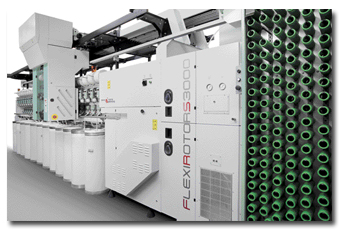
Savio

Savio’s FlexiRotorS 3000 automatic rotor-spinning frame, featuring a Suessen spinning unit
that has two independently controlled sides, builds packages up to 12 pounds in weight that can be
fed directly to weaving machines.

In the post-World War II period, Marcello’s son Luciano took over the business and
began to design and manufacture textile machinery, first for the local market and eventually for
export to other markets. By 1970, the company, with its 45 employees, had outgrown its location and
moved to its present facility, which now comprises 171,000 square meters (m2) including 69,000 m2
of covered area.

In the 1970s, the company was taken over by EGAM, a state-owned holding company, and then by
state-owned ENI Group, which invested in expanding and modernizing Savio’s production lines as well
as in R&D activities. That support enabled Savio to develop new machinery lines and expand its
market internationally, and primed it for acquisition by a group of private investors and company
managers in the 1990s. In its new life as a well-financed, well-managed private company, Savio
strengthened its market position overall and initiated joint ventures in China and India to help
give it an advantage in Asian markets.

In 1998, Italy-based RadiciGroup acquired Savio and added the company to its portfolio of
textile industry suppliers. As part of RadiciGroup — and, subsequently, Itema Group, a holding
company established in 2001 by RadiciGroup Owner Miro Radici — Savio has received considerable
support for further research and development of innovative machinery. As part of Itema Group, it
also has established wholly owned manufacturing operations in China and India — Savio (Shandong)
Textile Machinery Co. Ltd. and Savio India Ltd. — to serve those domestic markets.

Savio’s current range of machinery includes, among others, the Polar E automatic winder with
automatic bobbin feeding and package doffing; Polar I DLS automatic winder offering direct linkage
to the spinning frame so that bobbins are transferred without interruption from the ring frame to
the winder; the Sirius two-for-one twister, available as a standard mechanical model and as a
computer-driven ElectronicDriveSystem (EDS) model; and the FlexiRotorS 3000 automatic
rotor-spinning frame, designed to meet flexibility demands in open-end spinning and featuring a
Suessen spinning unit that has two separate, independently controlled sides. The company will be
displaying these machines this September at ITMA 2011 in Barcelona, Spain, where it will share its
centennial celebration with all ITMA participants.

July/August 2011

INDEX 11 Award Winners

Nonwoven Roll Goods

  • Freudenberg Nonwovens, Germany — Lutraflor® automotive carpet for cars, trucks and buses

Finished Products Made from or Incorporating Nonwovens

  • Polymer Group Inc. (PGI), Charlotte — SafeCover™ Insect Repellent Blanket

Marketing Achievement for the Most Original Marketing Campaign for a Product Made from or
Incorporating Nonwovens

  • Colquímica S.A., Portugal — “Creating Happy People” Campaign

Raw Materials or Component: Innovation in a Raw Material – for Example, Fiber, Binder – of
Special Relevance to the Nonwovens Industry

  • Dow Europe GmbH, Switzerland — PRIMAL™ ECONEXT™ 210 binder

Machinery: Innovation in Machinery of Special Relevance to the Nonwovens Industry

  • GDM S.p.A., Italy, and AccuSentry Inc., Marietta, Ga. -— Automated Inspection with
    Single-Diaper Culling Technology

Sustainable Product

The jury felt that entries for the Sustainability awards had very positive aspects and
improvements but that no individual submission showed decisive, breakthrough progress toward
sustainability understood in a comprehensive way. Several nominated products addressed one element
of Sustainability, but none creatively covered all three major Sustainability pillars –
environmental, economic and social. The jury recognized that given that many companies have now put
in place effective sustainable management practices, truly sustainable products will emerge in the
medium term and the jury will look for these in the next edition of the awards, with the benefit of
more explicit guidelines on substantiation, comparison with existing products and state of the art,
economic, social and environmental criteria and LCA perspective.

However, the INDEX 11 Awards Jury recognized the current achievements and decided to give
honorable mentions to the following companies:

  • Ahlstrom Corp., Filtration business unit, Finland — Disruptor® PAC filter media
  • Norafin Industries (Germany) GmbH — spunlaced nonwoven made of flax fiber
  • Procter & Gamble, Cincinnati — Pampers® New Baby and Pampers Active Fit with Dry Max
    diapers

Sustainable Process or Management Practice

  • Polymer Group Inc. (PGI), Charlotte — PGI Sustainability Process
  • 3M, St. Paul, Minn. — Pollution Prevention Pays (3P) Program
  • Tredegar Corp., Richmond, Va. — Flowertool™ method for measuring environmental impact

July/August 2011

Successful INDEX 11

INDEX 11 took place April 12-15 in Geneva at the Geneva Palexpo Exhibition & Congress Centre
under the theme “Innovation and Sustainability.” INDEX organizer, Palexpo S.A., and sponsor, EDANA,
the Brussels-based International Association Serving the Nonwovens and Related Industries, reported
record-breaking participation, with more than 12,600 visitors coming to Geneva to visit some 530
exhibitors from 43 countries.

Many frequent INDEX visitors said that hardly ever before has an INDEX had so many different
kinds of exhibitors, covering the whole range from fiber producers, machinery manufacturers and
converters up to end-product suppliers.

Index

Left to right:  EDANA officials Shelley Bonner, Chairman Jean-Marie Becker and General
Manager Pierre Wiertz; Asia Nonwoven Fabrics Association (ANFA) Chairman Hiroaki Kanai; China
Nonwovens Technical Association (CNTA) Chairman Wang Yanxi; and Association of the Nonwoven Fabrics
Industry (INDA) President Rory Holmes line up to cut the ribbon to open INDEX 11.


Success Stories


For this review, all interviewed exhibitors — most of whom are machinery manufacturers —
confirmed good results, and some reported having between 100 and 140 visits a day. Many exhibitors
reported considerable sales success. And not only exhibitors, but also visitors were impressed with
the broad spectrum of technology and products on view at INDEX 11.

Pierre Wiertz, general manager of EDANA, said he was very pleased with the outcome of the
show, confirming the growing importance of the nonwovens industry. “For an industry which has just
started to show signs of recovery — now finally rising to levels above those recorded before the
global financial crisis — we can be incredibly proud,” he said. “Companies are investing in
sustainable activities, which not only bring a positive effect to the world we live in, but also
secure the industry for the future.”

All interviewed exhibitors confirmed that their expectations were entirely fulfilled;
including the expectation of high-level visitors with ideas and visions for future nonwovens
products. Some even mentioned the word “phenomenal.” Jean-Philippe Dumon, sales and marketing
director of France-based NSC nonwoven, said he has never attended an exhibition that has exuded
such a good spirit. Christina Mallin, a marketing representative from Germany-based Oerlikon
Neumag, said INDEX is the most important event for the nonwovens industry.

Often, business people will say they know all their customers and don’t need any marketing
assistance, including from the trade press. However, Andreas Berthel, managing director of the
Saxon Textile Research Institute (STFI), Germany, said STFI made more than 100 new contacts at
INDEX.


Awards


A special INDEX 11 Awards ceremony was a highlight of the show. The awards were presented to
winning companies in recognition of their innovative achievements in seven categories throughout
the nonwovens supply chain, from product and process innovation to marketing originality and
sustainability. A list of award winners can be found
here.


Asia Is Coming


The most active nonwovens markets currently are China, the United States and Europe.
However, the whole world, including Brazil and India, is showing promising trends toward better
times. Not only did more visitors come from Asia, and from China in particular, compared to INDEX
08, but also many more Chinese companies exhibited at this year’s show.

On all days, most of the booths were packed with visitors from around the world. But besides
the show as such, there were special events and presentations focused on innovation, nonwovens in
packaging and product presentations, as well as lunchtime introductory tutorials.


Markets


INDEX was a very good show, everybody said. Of course, visits alone are not yet business;
but there is a great deal of optimism among the machinery manufacturers. The markets will further
grow, said Andreas Lukas, vice president, Nonwoven, for France-based Andritz Perfojet. His company
even reported signed and financed contracts.

The markets are improving every month. And it seems the nonwoven markets are in transition.
For years, everybody in the sector tried to produce and sell hygiene products — and wipes, wipes
and more wipes — which resulted in extremely competitive markets around the world. Today, not only
are the traditional textile producers searching for niche markets and new products, but also the
disposables producers are looking to diversify their product portfolios. And the time seems to be
right.


The Winds Of Change


For technology, or products, the winds seem to have changed in favor of specifically
nondisposable products. Staple-fiber products such as carded, airlaid and, consequently,
needlepunched or spunlaced goods are coming to the forefront. Johann Philipp Dilo, owner and
chairman of Germany-based DiloGroup, said web forming with cards is enjoying a kind of renaissance
owing to the increased feeding speed and evenness of the card. Isotropy — the perfect 1:1 machine
direction:cross direction (MD:CD) ratio — is still the target. And some machinery suppliers are
getting quite close to this goal.

Another trend is the move toward turnkey production lines. More and more companies are
acquiring other producers or looking for strategic alliances so they can offer a large portfolio of
machinery to fulfill the market’s needs. Robert Laroche, co-owner and president, Laroche S.A.,
France, mentioned that his company, which mainly produces recycling machinery, recently acted for
the first time as a kind of general contractor. “The customers know exactly what they want and what
kind of product they want to produce,” Laroche said. “Based on their requirements, we can design
and plan the whole production line exactly to meet their needs.”


Outlook


Even if the disposable nonwovens sector is a different world from that of conventional
textiles, it provides another indication that the entire industry is regaining ground, especially
textiles for industrial applications. To summarize the overall feedback at INDEX, the markets have
been recovering since the beginning of last year. Some exhibitors said they’ve already reattained
levels reached in 2008 before the financial crisis started.

July/August 2011

Process Control Debuts Guardian® Series 2 Complete Series

ATLANTA — August 1, 2011 — Process Control has completed the next member of the Guardian® Series 2
family — the 12kg model gravimetric batch blender. This model also introduces the brand new
see-through mixing chamber door that allows for an unobstructed view of material in the mixing
chamber.

The Guardian® Series 2 line of batch blenders is quickly establishing itself as the premier
mixer in the industry. Its unsurpassed accuracy, user-friendly design, and affordable price make it
the new standard in the field of auxiliary plastics equipment.

Process Control began shipping Guardian® Series 2 units in October of 2010 and has received a
huge spike in demand ever since.

FEATURES

The all-new design of Guardian® Series 2 provides precise batch-to-batch dispensing and
consistent homogenous blending. Standard features include off-the-shelf controls, color
touch-screen, removable cartridge V-gate metering, segmented material hoppers, integral drain
chute, and a “No Dead Zone” mixing chamber. Guardian® Series 2 may be configured with
four-to-twelve ingredient hoppers, with each hopper capable of running 0-100% of the recipe with
dispensing accuracy up to +/- 0.02%. Guardian® Series 2 is comprised of four models, including
1.25/2.5kg, 5kg, 12kg, and 18/25kg, with throughput rates to over 10,000PPH.

Established in 1967, PCC has an unending commitment to the design and engineering of advanced
auxiliary machinery for the plastics processing industry. Our goal is to provide the most accurate
equipment and exceptional customer service. We revolutionized processing with development of
Automatic Scrap Recycling for in-line processing of film scrap and the first continuous gravimetric
blending system. Process Control continues to lead the industry with advanced design and innovative
solutions for the global marketplace.

Posted on August 18, 2011

Source: Process Control

Manufacturer Creates Jobs For American Workers

ATHENS, Tenn. — Aug. 8, 2011 — Tuxedo manufacturer G. Alexander l.l.c. bets on consumers’ desire to
buy Made in the USA with their debut tuxedo collection. The G. Alexander Tuxedo Collection,
debuting August 9, 2011 at the International Formalwear Association Expo 30 in Las Vegas, is a
complete reversal of current industry thinking. Michael Priest, managing partner and director of
sales, had this to say: “Choosing to manufacture our tuxedos in the USA was an easy choice.
American workers are far and away the best in the world. Making tuxedos in America gives us the
ability to work side by side with the designers, seamstresses and everyone involved in the process,
while at the same time securing American jobs with every tuxedo made.”

The collection reflects classic styling with a dash of modern updating, displaying the finest
American craftsmanship, not seen in rental tuxedos since the industry-wide decisions to shutter
domestic production and seek offshore labor. The G. Alexander Tuxedo Collection boasts no paid
celebrity endorsers, choosing to put those funds into the product. “Labels are important to
consumers; they rely on them when choosing between products,” said Mr. Priest. “We feel the
strongest statement we can make about our brand, as well as our focus on delivering hands down the
finest tuxedos in the world, is the Made in the USA label.”

Immediately following the debut in Las Vegas the G. Alexander Tuxedo Collection will hit the
runway at the International Prom Association / Southern Independent Formalwear Association
(IPA/SIFA) show in Atlanta. Response from industry insiders who have taken part in the development
has been overwhelmingly positive. Mr. Priest said, “Everyone who has seen the collection has been
excited. Our entire team is ready to take the cover off and let the world see what an American
company can do.”

Samples will begin showing up in tuxedo rental stores and bridal shows across the country in
December 2011 and will be available for rental in February 2012.

Posted on August 16, 2011

Source: G. Alexander l.l.c./PRNewswire

Sponsors