Mount Vernon Mills Expands U.S. Capacity For Flame Resistant Fabrics

TRION, Ga. — May 21, 2012 — Mount Vernon Mills today announced that the company has more than
doubled its capacity to produce flame resistant (FR) fabrics in its manufacturing facilities
located in Trion, Georgia.  The expansion will enhance the company’s ability to meet increased
demand for flame resistant garments to protect workers against hazards associated with electrical
energy (NFPA 70E) and oil refining (NFPA 2112). 

“The increase in capacity is a demonstration of our commitment to producing FR fabrics in the
U.S. in our vertically integrated manufacturing facility, where we have in-house control of 25
major processes, including spinning, weaving, dyeing and FR finishing,” said Mike Woods, vice
president of flame resistant fabric sales for Mount Vernon Mills.  “We now have three ranges
producing FR fabrics, and we are the only U.S. producer to be using the latest technology in
softening equipment from Biancalani.”  

The company has invested more than $15 million in capital equipment to support its FR
programs.  The increased capacity will allow Mount Vernon Mills to continue to provide
consistent 6-8 week delivery of its flame resistant fabrics while also maintaining in-stock
inventory on core products and colors that will be available for immediate shipment.

At the core of every FR protective fabric is the company’s more than 165 years of experience
in the development and production of fabrics that work hard.  Blending history with
technology, Mount Vernon Mills uses more than 3,000 computer monitored control points and extensive
quality assurance testing to provide customers with the highest level of reliability, quality,
durability, color consistency and shrinkage control in every FR fabric.

“Our heritage began with sail cloth and canvas for tents, and has evolved into being a
leading producer of fabrics for career apparel and the military,” added Woods.  “We put our
experience to work in every flame resistant fabric, and we know what it takes to make durable and
dependable workwear fabrics that meet the safety, comfort and styling needs of today’s workforce.”

Mount Vernon Mills is also committed to protecting the environment.  All FR fabrics are
backed by the company’s Eco-Excellence™ program, providing flame resistant fabrics that are made
responsibly.  Flame resistant fabrics from Mount Vernon Mills comply with the following
standards for environmental excellence: Oeko-Tex, SONG Sustainability Initiative, REACH; Worldwide
Responsible Apparel Production (WRAP) Principles, Responsible Care (CMA) and the Environmental
Stewardship Program.

To learn more about the company’s collection of flame resistant fabrics, please visit booth
357 at the Safety 2012 Exposition, which will be held June 3-5 in the Colorado Convention Center in
Denver, Colo.  


Posted on May 22, 2012

Source: Mount Vernon Mills

Kuraray Co., Ltd. Acquires MonoSol, LLC

TOKYO — May 22, 2012 — Kuraray Co., Ltd. (Kuraray) and MonoSol, LLC announced today that Kuraray
has agreed to acquire MonoSol, LLC (MonoSol), a market-leading manufacturer of water-soluble
polyvinyl alcohol (PVA) films. This acquisition by Kuraray supports its strategy to expand its
Vinyl Acetate Chemical Chain Business. Terms of the transaction were not disclosed.

Through this acquisition, Kuraray will expand its product offering of PVA films into a wider
range of industrial applications, thereby enhancing its competitiveness. Kuraray currently supplies
“POVAL” PVA film for optical-uses including a polarizing film, which is an essential component of
liquid crystal displays.

“This merger will allow MonoSol to continue to grow and service its customer base while
providing additional R&D resources – capitalizing on the expertise of both groups. Utilizing
the Kuraray Acetyl Products expertise will allow MonoSol to reach our product development goals
faster and more efficiently. We are very excited about this combination and look forward to our
future with Kuraray,” said P. Scott Bening, President and CEO of MonoSol, LLC.

The transaction is subject to approvals by the appropriate regulatory authorities. The
business will be operated as an independent company under Kuraray Holdings U.S.A., Inc. and all
employees will be transferred to the new company.

Posted on May 22, 2012

Source: MonoSol LLC

PHPI To Open Plant In Scottsboro, Ala., Add 25 Jobs

Polyamide High Performance Inc. (PHPI), Scottsboro, Ala. — the North American business unit of
high-tenacity polyamide and polyester yarns and polymers manufacturer PHP, Germany — has partnered
with Toyobo Co. Ltd., Japan — a manufacturer of fibers, fabrics, films, resins and other products —
to establish an airbag fabric weaving and finishing business in Scottsboro that will operate under
the name SafeTweave Inc.

Toyobo will provide the technology and equipment for SafeTweave’s plant, which will be
located adjacent to PHPI’s nylon spinning plant. PHPI’s plant will supply nylon 6,6 to SafeTweave,
which will sell its airbag fabrics to Toyobo Industrial Materials America Inc. for use in U.S.-made
Japanese cars. SafeTweave is expected to begin production in December 2012 and create 25 jobs.

PHPI Sales Director Manuel Guerra noted the endeavor is part of the company’s effort to bring
insourcing and manufacturing back to the United States. “We have had issues over the last few years
due to earthquakes, the tsunami in Japan and flooding in Thailand,” he said. “There’s a big push
from Japanese original equipment manufacturers to make sure they have localized supply.”

May/June 2012

Kraig Labs To Open Research Lab, Expand Operations

Kraig Biocraft Laboratories Inc., Lansing, Mich., a developer of recombinant spider silk
technologies, has leased a new genetic engineering laboratory and is expanding its research and
development activities and production of its first product — Monster Silk, a hybrid silk produced
by transgenic silkworms.

“Up until now, all of our research has been conducted within university laboratories,” said
Kim K. Thompson, founder and CEO, Kraig Biocraft Laboratories. “We see the new laboratory as
providing the opportunity for a significant expansion of our capabilities.”

Thompson said the company has increased the caterpillar population for Monster Silk
production and ramped up production of transgenic silkworm eggs and fiber, and that the fiber being
produced now is stronger than the fiber originally documented in a peer-reviewed article published
earlier this year in “Proceedings of the National Academy of Sciences.” He also reported interest
from several large companies in Monster Silk’s potential for sportswear, fashion, defense and
military textile applications.

In addition, the company is ramping up development of its Generation II 100-percent
recombinant spider silk technology.

May/June 2012

Quality Fabric Of The Month: Comfortable FR Underneath It All

Polybenzimidazole (PBI), a flame-resistant (FR) fiber produced by PBI Performance Products Inc., Charlotte, has been utilized to protect astronauts, firefighters, first responders, military personnel, and petrochemical and utility workers for more than 40 years. Developed in the 1960s, the fiber is known as a high-performance, lightweight FR solution that doesn’t melt, drip, shrink or char significantly or break open under high heat and flame; and produces no off-gassing when a
flame is extinguished. It also is flexible and breathable, has the same moisture regain as cotton, and offers good moisture management — making it suitable for baselayer applications. PBI BaseGuard™, a recently developed blend with 20-percent PBI, 70-percent Lenzing FR® and 10-percent Tencel®, is garnering interest as a very comfortable baselayer solution that takes advantage of the additional FR characteristics of Lenzing FR and the soft hand of both cellulosic fibers.
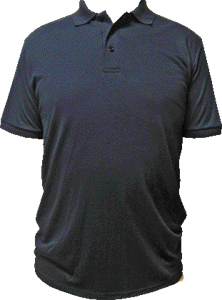
FesslerUSA, Orwigsburg, Pa., is knitting the yarns, spun by McAdenville, N.C.-based Pharr Yarns Inc., into fabrics and making them into T-shirts, baselayers and polo shirts branded FusaFR®.

QFOMFessler


FesslerUSA’s FusaFR® custom garments have been certified to be compliant with the National
Fire Protection Association’s NFPA 2112 and 70E, level 1 and 2, standards.

According to William Lawson, COO, PBI Performance Products, PBI BaseGuard was developed for the military as a low-cost PBI alternative that gives flash-fire protection and is quite comfortable to wear. “As we tested it, we found more and more places where it could be used, and
now we’re really pushing it for other markets, such as industrial and utility — it does very well in arc flash testing — and it’s very comfortable compared to other FR products that are out there,” he said.

PBI worked with Pharr Yarns to develop the yarn, which comprises an intimate blend of the three fibers. “Pharr Yarns knows and understands fiber,” said Jim Sells, group president of Pharr Yarns’ High Performance Yarn Division. “We have strong skills in blending fibers, and we make sure there’s the right amount of each fiber so the yarn always passes the test.”

Pharr Yarns winds the yarn on packages for FesslerUSA, which worked with PBI to overcome yarn-processing challenges. “The processing requires some very specific controls on knitting and finishing, and it was a challenge to make the fabric consistently with the shrinkage and pilling
performance needed,” said Brian Meck, vice president, sales and marketing, FesslerUSA. “PBI also wanted to work with a vertical mill and needed concept garments, and we can offer full-package and custom garment manufacturing.”

FesslerUSA adds a Microban® antimicrobial and an anti-pilling finish to the knitted fabric. Meck said the finishes are durable to 50 launderings. Knitted fabrics include a lightweight jersey suitable for baselayers and a heavier interlock suitable for polo shirts and station T-shirts. In addition to the military, first-responder, fire and industrial markets, Meck said there also is interest in the automobile racing market for the FusaFR products.


For more information about PBI BaseGuard™, contact Kim Henry +704-554-3106; kimhenry@pbiproducts.com.
For more information about FusaFR® garments, contact Brian Meck sales@fesslerusa.com


May/June 2012

Bulletin Board

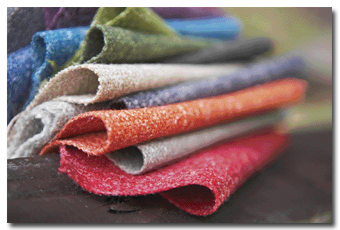
Camira Fabrics Ltd., United Kingdom, has introduced Hemp, a biodegradable,
fire-retardant hemp/wool-blend fabric.

BBcamira

Camira’s Hemp fabric

Research and Markets Ltd., Ireland, now offers Cientifica Ltd.’s report
“Nanotechnologies for the Textile Market”; and Global Industry Analysts Inc.’s “Textiles – Global
Outlook,” 2012 edition.

Cintas Corp., Cincinnati, has presented the inaugural Green Garment Award to Revel
Entertainment Group LLC; Health Management Associates Inc.; Avis Budget Car Rental LLC; and
Montefiore Medical Center.

EverStrand® and Wear-Dated® Revive™ carpets from Dalton, Ga.-based
Mohawk Industries Inc. have earned Environmental Claim Validation from UL
Environment, a business unit of Underwriters Laboratories Inc. (UL), Camas, Wash.

Vancouver, Canada-based
Naturally Advanced Technologies Inc.‘s CRAiLAR® Flax fiber has earned the U.S.
Department of Agriculture Certified Biobased Product Label.

Dalton-based
Shaw Industries Group Inc.‘s Shaw Floors business has debuted a Pinterest page at
pinterest.com/shawfloors.

The White House has selected the Boulder, Colo.-based
Outdoor Industry Association Sustainability Working Group as a Champion of Change
for Corporate Environmental Sustainability.

Manufacturers Chemicals LLC, Cleveland, Tenn., has launched “Solutions Corner,” a
Web-based helpline for chemicals, colorants and processes, available at
manufacturers.com.


Fruit of the Loom
, Bowling Green, Ky., has given its 2011 Supplier of the Year
Award to George C. Moore Co., Westerly, R.I.


Mutoh America Inc.
, Phoenix, now offers more than 90 new International Color
Consortium Profiles from SA International for use with select Mutoh printers and Flexi and
PhotoPRINT 10 software.

May/June 2012

Dell’Orco & Villani Offers Twin Carding Opener

Dell’Orco & Villani S.r.l., Italy — a maker of fiber blending equipment and machinery and
plants for recycling textile waste materials — now offers the Twin Carding Opener (TCO) fiber
carding and opening machine. The machine features two cylinders that work in tandem as well as a
number of peripheral working rollers; uses 20 percent of the power required for comparable
operations; offers high productivity; and has a low footprint.

The TCO comprises one section featuring two feed rollers with rigid wire clothing, a main
cylinder that can be clothed with rigid wire or supplied with lags and pins, and three working
rollers with rigid wire clothing; and a second featuring a main cylinder and five working rollers,
all with rigid wire clothing. The company reports the different combinations possible for wire
clothing choice, speed options and the distance setting between rollers and main cylinders enable
flexibility in the machine’s applications, allowing opening of a range of nonwovens production
waste. The TCO is available in a 1,500-millimeter (mm) or 1,000-mm working width, and can be fed
manually, or by a chute feed or regular hopper feeder.

May/June 2012

From The Editor: MFG Expansion 33 Months & Expanding

By Jim Borneman, Editor In Chief

With all of the doom and gloom in the news, textiles has had some bright spots recently. There was strong attendance, active participation and good energy at the Techtextil North America and Texprocess Americas shows. One exhibitor said he received more leads on the first day of the show than he had received in the last two years of participating. It was not what ATME-I® or the Bobbin Show used to be, and if you went there expecting their reincarnations, you’d have been disappointed. But what was there represented what the industry is today — smaller, less grand, but also innovative, creative and collaborative. There was one real opportunity in that the visitors were as interesting as the exhibitors — there to solve problems and look for opportunities. The symposium sessions had strong attendance, while not detracting from activity on the show floor.

In another instance, the American Apparel Producers’ Network recently held its annual meeting in Miami, attracting approximately 160 members of the apparel supply chain — “from the dirt to the shirt,” as they say — who gathered for networking and presentations. An interesting theme
was, simply, change. Retailing is changing, responsibilities in the apparel supply chain are changing, use of technology is changing, trade laws are changing, and the importance of green and sustainable solutions is changing. Presentation of the synthetic fiber-based apparel cluster in El Salvador — a complete synthetic apparel supply chain — highlighted new investment and smart development in the West. There was a strong sense of positive activity — business coming back to
the Western Hemisphere and some real innovations afoot in the pipeline.

Many notions about a slowly improving manufacturing sector are consistent with the economic indicators. Conventional wisdom seems to be that an indicator like unemployment is a proxy for growth. This is often a misguided idea, particularly when much of the investment in manufacturing is in automation. Economic sector health is not always employment-based, as the press would have you believe. Instead, have a look at the Institute for Supply Management’s Manufacturing ISM Report on Business® — the April report is a good read.

The report states: “Manufacturing continued its growth in April as the PMI [Purchasing Managers’ Index™] registered 54.8 percent, an increase of 1.4 percentage points when compared to March’s reading of 53.4 percent. A reading above 50 percent indicates that the manufacturing economy is generally expanding; below 50 percent indicates that it is generally contracting.

“A PMI in excess of 42.6 percent, over a period of time, generally indicates an expansion of the overall economy. Therefore, the PMI indicates growth for the 35th consecutive month in the overall economy, as well as expansion in the manufacturing sector for the 33rd consecutive month.”

An expanding manufacturing sector for nearly three years is not in the headlines. Toss in a little certainty on taxes, healthcare and energy policy — and manufacturing just might attract the investment it needs.

May/June 2012

Introduction To Nonwovens Technology


Editor’s note: Reprinted, with changes, from “Introduction To Nonwovens Technology,” by Subhash
K. Batra, Ph.D., and Behnam Pourdeyhimi, Ph.D., (Lancaster, Pa.: DEStech Publications Inc., 2012),
xvii-xxix, by permission of the authors and publisher.


With the exception of wool felts, fabric making has historically involved the conversion of
fibers into yarns and yarns into fabrics, primarily by weaving, knitting or lace making. The beauty
of these technologies lies in their ability to assemble thousands, indeed millions, of individual
fibers — themselves weak, difficult to handle and sometimes functionally useless — into integrated
products that are strong, foldable, absorbent, soft, and permeable. Most fascinating, the fabric is
often held together, in a highly ordered structural fashion, by frictional forces only. As such,
the woven, knit and lace fabrics on the one hand, and wool felts on the other, take the old dictum
“there is strength in numbers” a significant step further: “there is even more strength in ordered
numbers.”

Many of the physical/mechanical properties of woven, knit and lace fabrics are derived from
their unique hierarchy of structure: fiber, yarn (single or plied), and fabric. The history of the
fiber-based-product industry is replete with examples of proper selection of fibers, yarn structure
and fabric structure, followed by suitable after-treatments (dyeing, printing, finishing), leading
to unique combinations of characteristics such as strength, flexibility, draping, controlled
dimensional stability, and aesthetics in the final product.
NWTTtent


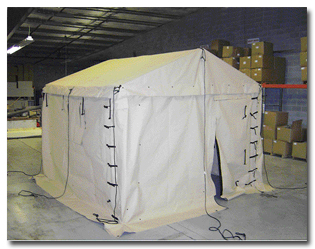
A coated nonwoven substrate of fibrillated islands-in-the-sea fibers is the material used
in this full-sized tent for military operations.

During the late nineteenth and early twentieth centuries three economic necessities led to
the development of the precursors of various fabric making technologies that gained momentum during
the latter half of the twentieth century. The three necessities and the response to them may be
summarized as follows:

  1. The need to reclaim acceptable quality fiber from clothing, scraps and other textiles,
    particularly those made from wool, and reuse it to make economically competitive clothing and other
    articles. This led to the development of fiber reprocessing machinery and a new industry dependent
    upon it.
  2. The need to convert coarse hair not suitable for yarn making or felting, and coarse fibers of
    vegetable origin, into economically viable products. This led to the development of the needle loom
    to accomplish fiber entanglement by barbed needle punching (bonding).
  3. The need to profitably utilize fiber waste, or fibers not suitable for yarn spinning, such as
    wood pulp, from the emerging manufactured- fibers industry. This led to the idea of converting
    fibers into fiberwebs, and then using adhesives or other means to give webs integrity to function
    as fabrics.
    1,2

In time, these three developments, in conjunction with many others, led to the revolutionary
idea that commercially acceptable, textile-like sheet structures could be made without first
converting fibers into yarns. That this could be done without weaving, knitting or lace making was
even more revolutionary.

Woodings
3 states “Heavyweight needlepunched ‘felts’ made from jute and sisal have been made
since the 1890s in both the UK and USA.” The earliest product using fiberwebs for commercial
purposes may well be the one embodied in a patent, USP 0,123,136, which was granted, in 1872, to
Milton D. Whipple, who stated:

What I claim, and desire to secure by Letters Patent, is –

  1. The series of needles or pins, slightly roughened or barbed, set in a suitable frame or holder,
    and made to traverse back and forth through a bat or web of cotton or other fibrous substance, for
    the purpose of interlacing and condensing the fibers, substantially as herein described.
  2. I also claim, as a new article of manufactre, a bat, web, or sheet made as hereinbefore
    described.

– Milton D. Whipple.

The seeds of the nonwovens industry may thus have been sown in the 1870s. The germination,
however, only began in earnest in the United States and in Europe during the 1920s,
4 1930s,
5 and 1940s.
6 The industry finally became commercially viable in the United States and in Europe
during the 1970s, and a bit later in Japan and elsewhere. Since then the growth of the industry and
the versatility of its products has been revolutionary, even chaotic – albeit a healthy one,
manifest in the problem of defining the nature of the products
(See Chapter 1: Definitions).


NWTTwingedfiber

NWTTwingedfiberCS


The Winged Fiber™, measuring 15 by 10 microns in the illustration, top, is shown in a cross
section of a nonwoven fabric, bottom.


Nonwovens Forerunners


The concept of “nonwovens,” as fibers in a network or web form, is not new. But to trace the
origins of the concept poses a challenging problem.
7
First, there are the forerunners we find in nature: the nests of many birds, mammals, and
invertebrates; the spunbond-like cocoon produced by the silk worm; spider webs; the root structures
of trees, shrubs and grasses, which serve as natural erosion control akin to modern geotextiles;
the fibrous skeletal structure of bark and leaf components of shrubs and trees; the extremely fine,
spunbond-like fibrous structure of the every day egg-shell; the paper-like hornet nest.

Second, according to a reference in Wikipedia, the art of felt making from wool was
developed by the early Sumerians around the fourth millennium B.C., just as the ancient Egyptians
were devising fibrous network structures from papyrus.
8 Beaten bark-cloth made from the inner bark of trees of the mulberry family — paper
mulberry, bread fruit, wild fig — has been in use in Oceania, Africa, Southeast Asia, and the
Americas from prehistoric times. Several layers of this cloth can be bonded together by moisture
and beating, which presumably release the inner resins
9 that provide the binding material.

Third, according to Gordon: “There are several similar recurring legends about the discovery
of felt. In one, Noah attempted to make his ark more comfortable by padding the floor with sheep’s
wool. By the time the journey of forty days and nights had passed, the loose wool had turned to a
matted fabric (felt) by the pressure and moisture the animals had subjected it to.” The author
cites further examples: “Another legend placed the discovery in France in the Middle Ages. A monk
who lived in the city of Caen decided to make a pilgrimage to a distant shrine. He set out wearing
a pair of new sandals and his feet soon became sore and tired. To make them more comfortable, he
picked some wool from the backs of the sheep and put it in his sandals. When he arrived at his
destination after fifteen days of walking, he found a strong soft cloth had been created by the
constant moisture and pressure of his feet … An almost identical story takes place in the Middle
East, where a tired, foot-sore camel driver took some of the soft hair from his camels and put it
in his sandals. By the time the caravan reached its destination, he, too, had discovered felt …
it is generally believed that it was the nomadic people of Central Asia who first learned to make
it … The oldest pieces of fabric to have been found date from about 1500-1000 B.C. Felt caps as
old as 3,500 years have been found in Scandinavia, and several items from the later Bronze Age
(1400-1200 B.C.) have been found in tombs in northern Germany and Siberia.”

Fourth, Ruiji and Ke’an
10 speculate that the invention of paper, which is in some sense a nonwoven, “during the
early Western Han Dynasty (206 B.C.-8 A.D.) was most probably introduced from silk floss making. To
make the silk floss, the ‘waste’ cocoons were beaten on a bamboo screen in water. After thorough
beating, there was a layer of silk fiberweb left on the screen. This web-form material might have
been culled and used as paper …” They also suggest that, according to recent archaeological
evidence, paper made from hemp was introduced in China as early as the second century B.C. More
reliable records in Han Shu (The History of the Han Dynasty) state that Cai Lun made great
improvements in paper making in 105 A.D. Other sources assert that Ts’ai Lun first introduced
paper: it could be made from “bark, hemp, fish net and rags.”
11 The art of Washi, paper making by hand, using hemp and fibers from mulberry or
certain deciduous trees, dates back to the sixth century A.D. in Japan.
12

Fifth, if a silk worm, ready to spin, drops to the floor, it will not stop spinning: the
result is a “flat cocoon,” or “cocoon paper,” akin to modern day spunbond web. The ancient Chinese
knew this. According to Ruiji and Ke’an, the earliest records of the technologic utilization of
this phenomenon date back to the Song Dynasty (960-1279 A.D.).

Sixth, the industrial process of papermaking was based on adaptation of a machine invented
by Nicholas-Louis Robert in 1798. “In 1801, Robert and his brother-in-law John Gamble patented the
machine in England. They divided the patent rights with their financial backers, Henry and Sealy
Fourdrinier.”
13 Similarly, as Gordon tells, the industrial process of wool-felt making was invented
by an American, named J. R. Williams, in 1820.

Seventh, Millman
14 suggests the invention of nonwovens can be traced to a British Letters Patent Number
114, granted in 1853 to Bellford, which detailed the use of carding machines, conveyor belting,
impregnating, mattresses, and cushions.

Eighth, Tyas
15 claims that the production of needle looms was established around 1870 by William
Bywater Ltd.; whereas Ward
16 asserts that “one of the first, if not the first, needle loom was built by …
Bywater … in 1878 and delivered to a Leeds woolen manufacturer, Hargreave & Mussey, for
making horse blankets.” Some put the date as early as 1860 and the location as both England and
Germany. It is interesting to note that an air-based entangling predecessor to the current
water-based entangling systems dates back to 1882.
17 Claim 2 of the patent states: “The herein-described method of making a fur bat in a
continuous flat sheet – that is to say, by depositing a layer of loose fur upon a traveling fabric
of substantially non-feltable fibrous material and attaching the fur to the fabric by means of an
air-current which passes through the fur and the fibrous material, substantially as set forth.”


Industry Development


Thus, while the antecedents of nonwovens technology and products can be traced to various
points in human history, most writers tend to place the beginning of the industry, as we know it
today, to the late 1920s or early 1930s. Nottebohm
18 cites a German patent, DRP Nr. 544324, dated August 26, 1928, which claimed the
production of a fleece in combination with a glued web to serve as a shoe reinforcing material:
KALFF Vliesstoffe GmbH is still in business today. Nottebohm also cites a Dutch Blaupotten Cate
process disclosure in 1930 for the manufacture of artificial leather backing from fiber fleece to
be glued with natural rubber. The earliest patent cited by Buresh
19 is dated March 12, 1929, or April 29, 1930, depending upon one’s interpretation of
their specific relevance to nonwovens technology.

According to Hays,
20 laboratory and pilot scale production of non- wovens started in the 1930s. Shearer
21 and Millman put the industrial production of “bonded-fiber nonwoven fabrics” in
commercial quantities (a few thousand pounds) around 1942. George M. Schroder, at the University of
Chattanooga, created the first disposable diaper using nonwoven fabric in 1947.
22 In 1948, Freudenberg introduced dry-laid resin bonded fabric for interlining.

The latter part of the twentieth century spawned several commercially viable new
technologies to make fabrics that could compete with wovens, knits and lace. Most of these have
been grouped under the umbrella of nonwovens technology. Today the nonwoven roll goods and related
industries yield highly engineered products for such applications as filters, diaper and sanitary
napkin cover-stock, tear resistant envelopes, needled carpets, wipes, medical use, protective
clothing, interlining in apparel, agricultural use, insulators for space shuttle heat shield,
furniture components, high loft products, and on and on.

Traditionally, the nonwoven industry (10-100 m/min; $10-$100 MM) has been compared to
weaving (1-2 m/min; $10-100 MM), knitting (2-5 m/min; $1-50 MM) and paper industry (100-1000 m/min;
$50-100 MM) in terms of line speeds or typical plant costs. While line speed comparisons make
nonwovens look impressive, they are meaningless; for it is the unit cost of production of a
comparable product that makes the difference in its competitive edge in the market place. The plant
costs give some idea of the capital required – a possible barrier to entry – to get into the
business. But far more important is to assess the performance versus the cost needed to develop the
market and to distribute the product reliably.

The success and growth of the nonwovens industry is due, in large measure, to expanding
markets which encourage continued developments in process technologies, raw materials and final
product design to meet the existing as well as future challenges in product performance at an
acceptable cost. In other words, the raw materials available, the technologies available, and the
creative abilities of the product designers can optimize the performance specifications required in
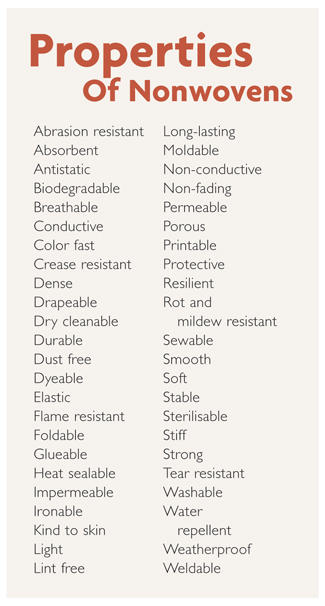
the final product at an acceptable cost to the consumer. Table 1, which is by no means exhaustive,
lists typical properties identified by EDANA, some of which must be met by a successful product at
an optimal performance level and price.


Properties Of Nonwovens

NWTTTable1


Source: EDANA

The nonwovens industry in 2008 produced 5.78 million tonnes of roll goods worth US $21.2
billion (and a growth rate in excess of 8%), comprising 28.6% in Europe, 25% in North America,
19.7% PRC, 10% in other Asia Pacific regions. These roll goods were used in numerous applications
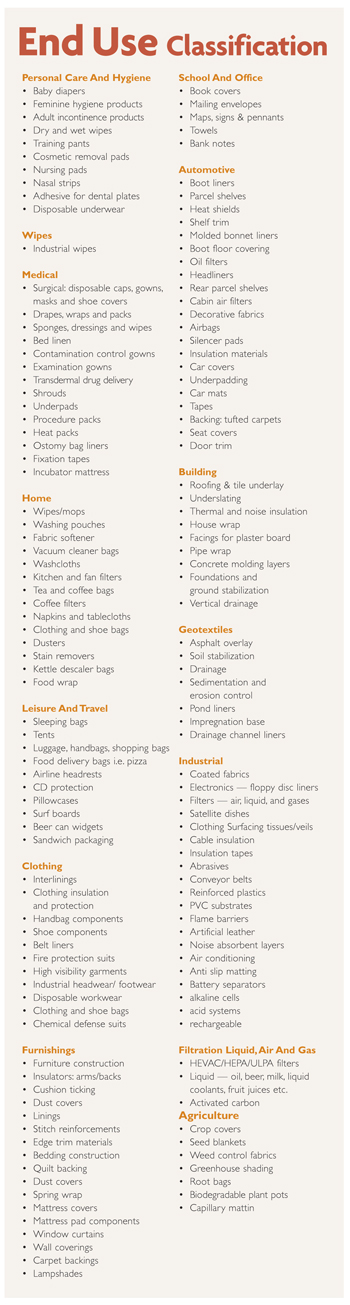
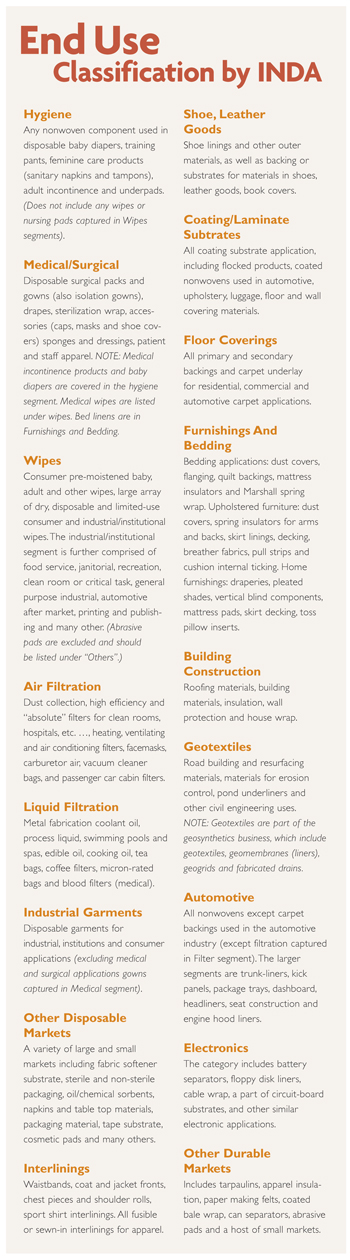
as illustrated by Tables 2 and 3. Table 2 presents the segmentation of end use markets classified
by EDANA, a trade organization in Europe, while Table 3 does the same for INDA, the nonwovens
industry trade organization in the United States. Neither is exhaustive, but they illustrate the
different ways end use markets can be classified based on the judgment of individuals or companies.


End Use Classification By EDANA (2004)

NWTTtable2


Source: EDANA


End Use Classification By INDA (2004)

NWTTtable3


Source: INDA

The nonwovens industry is organized differently and separately from the textile industry.
While both, along with the paper industry, share some common heritage, the nonwoven industry during
its evolution has integrated high-speed, low-cost, innovative, value-adding processes to produce a
broad array of engineered fiber and polymer based products. In doing so, it has adapted
technologies from the pulp and paper industry, the fiber/polymer extrusion industry, and the
traditional textile industry. The traditional textile industry is intimately linked to the apparel
and home furnishing industries. The nonwovens industry is not.

Depending on the local/regional markets and their economic constraints, segments of the
nonwovens industry today include raw material suppliers, roll goods producers,
converters/fabricators of end use products, supportive machinery industry, and auxiliary material
suppliers.


Portfolio Of Technologies


Finally, a few words about the framework for our study of nonwovens technology and the
characteristics of the products made from them. “Nonwovens Technology” is in fact a portfolio of
technologies. The available fiber, or polymer raw materials to be processed, have critically
influenced the development of the technologies. At the same time, the technologies available to
process them have equally influenced the development of new fibers and polymer raw materials. The
rich portfolio of technologies under consideration offers numerous options for processing paths to
attain desired end-product characteristics. There is, thus, no unique systematic, linear way to
teach or learn the technology and its products. To that extent, this book departs from what has
become a traditional path. The paradigm used here might be likened to an impressionistic painting:
up close it consists of bold brush strokes or dabs of different colors, which may or may not be
very pleasing by themselves, nor represent any recognizable form; but, seen from a distance, the
mind of the observer integrates them into a pleasing or provocative picture.

This first volume of the book is divided into five parts. Part I deals with some useful
preliminaries, such as the issue of definitions of the structures of interest, the concept of
structure and its description in the case of two dimensional fiberwebs, the distinction between
technology as it refers to a sub-process, and
Technology as it refers to the whole raw-material-preparation-to-roll-good system.

Part II deals with the preparation and web formation steps for staple fiber-based
Technologies, including opening, blending, carding and airlay processes for both
conventional fibers as well as pulp-focused. This prepares the ground for discussion of the broad
spectrum of bonding processes in Part III. These include needle punching, hydroentanglement,
thermal bonding (inclusive of ultrasonic bonding) and resin bonding. To give some depth to thermal
bonding, some relevant concepts of heat and heat transfer are reviewed briefly in a stand-alone
chapter.

In Part IV we introduce the (historically) integrated
Technologies, such as wetlay, spunbond and meltblown; the latter two involve polymer melt
extrusion. To make the spunbond, meltblown processes more intelligible, a stand-alone chapter
reviews some relevant concepts of polymer physics. The latter also supports the subsequent
discussion on split-film nonwovens and nano or near-nano scale webs obtained via flash spinning,
electrospinning and those obtained via bicomponent fibers.

In Part V we discuss processes and the idea of integration to produce heterogeneous
fiberwebs (second order structures, composites) and hybrid (higher order) structures, which combine
more than one level of structure to yield structures with enhanced performance attributes. Some of
the processes are those introduced previously, while others such as stitchbonding, co-forming, and
NAPCO technology are introduced for the first time.

The book’s aim is to provide a structured path for teaching the subject matter to
undergraduate as well as graduate students. That requires the instructors to selectively define
suitable paths for the two levels.

The structure of the book is also designed to assist self-learning by industrial
practitioners at different levels of experience and preparation. We hope it will deepen their
appreciation of the diverse technologies available to them and stimulate the flow of their creative
juices to design and produce products that benefit humankind.

Finally, we end with an appeal to teachers, students and other readers to send us any
comments and suggestions that will improve our textbook and help make it a truly useful one. Please
make up your own problems and exercises and share them with us. For such contributions and others,
we thank you in advance.

In anticipation,

Subhash K. Batra

(subhash_batra@ncsu.edu)

Behnam Pourdeyhimi

(behnam_pourdeyhimi@ncsu.edu)


Subhash K. Batra, Ph.D., is Charles A. Cannon Professor, Emeritus; and Director Emeritus,
Nonwovens Cooperative Research Center, North Carolina State University (NCSU).

Behnam Pourdeyhimi, Ph.D., is William A. Klopman Distinguished Professor; and Director,
Nonwovens Institute, NCSU.


Footnotes (Endnotes in this case):

1USP 2,825,389.

2Subsequently, the manufactured-fiber industry fueled the growth of the nonwoven roll
goods and related industries.

3Regenerated Cellulose Fibers, Edited by Calvin Woodings, CRC Press, 2000, Woodhead
Publishing, 2001.

4Joseph, Gatti, Wadding and bat; USP 1,695,805 (1928).

5N. H. Brewster, Sheet material and method of making the same , USP 1,978,620.

6Batra, S. K., S. P. Hersh, R. L. Barker, D. R. Buchanan, B. S. Gupta, T. W. George and
M. H. Mohamed, “Neither Woven Nor Knit: A New System for Classifying Textiles,” in
Principles of Nonwovens, INDA , Cary NC (1992).

7See the previous reference.

8http://www.mnsu.edu/emuseum/prehistory/egypt/dailylife/papyrus.html.

9Gordon, Beverly,
Feltmaking, Watson-Guptill Publications, New York (1980).

10Ruiji, Yang and Ke’an, Sheng, “The History and Prospect of Nonwovens in China,”
Journal of East China Institute of Textile Science and Technology, No. 1, 27-34 (1984).

11Langer, William L.,
An Encyclopedia of World History, Houghton & Mifflin Co., Boston (1952).

12Koda, M., “Washi,” in
Tajyo, special edition, Shikosha Publishing Co., Japan (1982).

13http://historywired.si.edu/detail.cfm?ID=397.

14Millman, George E., “The Expanding Market for Nonwovens,”
American Dyestuff Reporter, 58/7, 32-39, April (1969).

15Tyas, T., “The Design of Needle Looms,” in
Needle-Felted Fabrics, ed. P. Lennox-Kerr, The Textile Trade Press, Manchester, UK.
(1972).

16Ward, D., “A Hundred Years of Needle Looms,” in
Nonwovens Yearbook, Nonwovens Report International (1979).

17US Patent 253,162 (1882).

18Nottebohm, C. L., “Vliesstoffe auf trockenem Weg,”
Chemiefasern 9, 667-676 (1968).

19Buresh, Francis M., Nonwoven Fabrics, Reinhold Publishing Corporation, New York
(1962).

20Anonymous, “Nonwovens-Threat or Opportunity,”
American Dyestuff Reporter, 58/7, 40-41, April (1969).

21Shearer, Howard E., “Methods of Producing Bonded-Fiber Fabrics,”
American Dyestuff Reporter, 41, P874-P879, December 22 (1952).

22http://www.disposablediaper.net/content.asp?2.

May/June 2012

“Impossible” Doesn’t Exist For Geissbühler

For more than 300 years, finishing company Geissbühler & Co. AG has been located in Lützelflüh,
in the famous Emmental valley in Switzerland. With a clear conviction that nothing is impossible,
the company has established itself with perseverance and the right investment policy to be a
reliable and cutting-edge partner for the finishing of technical textiles.Geissbühler’s beginnings
go far back to the year 1673. Consequently, the company is one of the oldest existing finishing
mills in Switzerland. Over the centuries, the small bleaching and dyeing house developed
continuously, while investing heavily in research and development, mainly in finishing and coating
of textiles.

DPF1

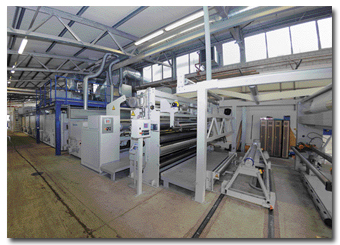
With the new Brückner finishing line, water-based as well as solvent-based coatings can be
applied.


Saving The Future


In 2007, Geissbühler was acquired by the Cilander Group, one of the prominent finishing
companies in Switzerland. “For Cilander, this acquisition was the next step to secure its position
as a competent partner for technical textiles; and for Geissbühler, to secure a sustainable
future,” explained Managing Director Kathrin Bohnenblust in an exclusive interview with

Textile World
.

Until 2007, the company was led by the eighth generation of the Geissbühler family. “Today,
we are an independent daughter company of the Cilander Group. We now have 21 people working in the
company and have invested 5.5 million Swiss francs in production and peripheral equipment,”
Bohnenblust said.

DPFheadshot

Kathrin Bohnenblust has served as Geissbühler’s managing director since 2007.


Large Product Program


Geissbühler finishes a broad variety of woven fabrics for various technical textiles
end-uses including upholstery fabrics for trains and buses, fabrics with flame-resistant finishes
for airplane seats, and Kevlar® mesh fabrics for sports car bodies; as well as glass fabrics for
architectural purposes, fire blankets and protective gloves. Other end-uses include protective
shells for buildings, tents, tarpaulins and awnings, roller aprons, sun protection, filter fabrics,
and also coated high-fashion apparel fabrics. For example, Geissbühler finishes fabrics for Indian
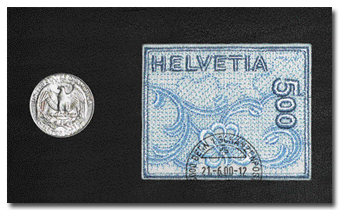
turbans. The list can be extended at will. In 2000, the company finished the first world’s first
textile postage stamp. “This product had to be treated like a bank note — it has a certain value,”
Bohnenblust explained with a smile.

DPF3

This Swiss postage stamp, the first textile postage stamp in the world, was finished by
Geissbühler.


Milestones


After 20 years with the company, Bohnenblust became managing director in 2007. In her own
words, she is a “career changer” and a person with many interests. She loves animals, her house and
the garden; and is also active in local politics. And what is the personal challenge in her work?
“Well, basically, the focus of my efforts is to secure jobs. Job security is the big challenge for
us all and is associated with the corporate philosophy: We never say ‘no’ in our job; we always try
to find a solution,” she said.


“I don’t think one should look too much into the past. However,” she continued, “there are
two events that were and are important for the long-term existence of Geissbühler: on the one hand,
the acquisition by the Cilander Group in 2007; and on the other, the purchase of a Brückner coating
line [from Germany-based Brückner Trockentechnik GmbH & Co. KG], which opened up completely new
application areas for our company.”


Market Situation


Geissbühler produces some 1.4 million linear meters per year. And these are real linear
meters — often, the fabric width goes up to 600 centimeters (cm). The year 2010 was very good for
the company, and its fortune lasted well until October 2011. Then, the market calmed down a little
bit. “But we are still at a good level,” Bohnenblust said. “Some 30 percent of all products are
exported to the European Union. Glass fabrics for architectural uses as well as fabrics for
aircraft seats are currently the top runners.”

In 2011, Geissbühler produced 224 new developments and brought them to the market. “This is
the result of our corporate philosophy,” Bohnenblust said. “In our laboratory, the word ‘no’
doesn’t exist. In the lab, we want to find solutions. Flexibility stands above all.” And what is
the minimum quantity for a new product development? “Not that much,” she added. “The average is
1,000 meters for a new product.”


Multifunctional System


Such a wide product range requires an extremely flexible production system concept. “That’s
why we decided in 2005 to go forward,” Bohnenblust said. Geissbühler is working according to a
Brückner plant concept. Some 10 years ago, Bohnenblust heard the name Brückner for the first time.
“At that time, we were still working with two lines. After the decision in 2005 to put in a new
flexible system, we created a well-defined system profile. The system concept should allow us to
work not only with paste coating, but also with wet and dry laminating. Moreover, Swiss
environmental standards must to be fulfilled.” After a comprehensive test procedure, Geissbühler
decided to buy a Brückner line.

“You know,” Bohnenblust said, “one of our strengths is the ability to coat. With the new
machine, water-based coatings as well as solvent-based coatings can be applied. This is thanks to
the web guide roll direct coating processes on textile fabrics and films, but reverse coating
processes on transfer paper also are possible.” Therefore, she said, there is great flexibility to
execute various production processes such as:

  • direct coating on textile fabrics and films;
  • reverse coatings on transfer paper;
  • impregnation and immersion coatings;
  • dry and wet laminations of membranes and fabrics, for example, films; and
  • independent production of membranes.


Environmentally Friendly


With the purchase of the Brückner plant, the annual production capacity of Geissbühler could
be doubled, and the throughput time in the two-shift production reduced. And what about the
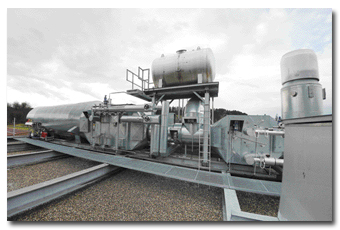
environmental impact, as the Swiss standards are quite high? “Yes,” Bohnenblust said, “the coating
line was completed by a thermal exhaust air cleaning system that is able to clear about 15,000
normal cubic meters (Nm3) clean air, relative to 0°C. In addition, the energy released by this
purification process can be used to heat the tenter frame dryer and the production hall.

“The exhaust air flow inside the tenter frame, particularly with solvent-based coating
systems, requires absolute precision, expertise and experience to meet the energy technical
requirements,” Bohnenblust continued. “With these criteria, a perfect energy concept was
implemented, which ensures an optimum utilization of energy. We can work on the plant up to 320-cm
working width, even with solvents, as they are eliminated completely in thermal afterburning, and
the air released into the atmosphere is absolutely inert.”

DPF4

The coating line is equipped with a thermal exhaust air cleaning system, mounted on the
roof of the production hall.


Fulfilled Requirements


Among other major criteria was that the temperature distribution had to be absolutely
uniform over the entire dryer length and width. According to Bohnenblust, this temperature accuracy
is a vital requirement for a high quality of the coatings during the drying and curing process.

Since November 2009, Geissbühler has been working with the new Brückner production system.
What is the experience up to now? “During the negotiations and the erection of the plant, we were
impressed by the willingness of the Brückner people to implement our wishes 100 percent,”
Bohnenblust said. “This is our first truly modern finishing line. Everything has gone smoothly, and
we’ve never faced any problems. And the benefits are enormous: economic efficiency, quality and
extreme flexibility of the system allow us to produce more articles than ever before.”


The Correct Decision


Bohnenblust sees the future of the company mainly in the technical textiles sector. “If one
compares the situation today with that of 10 years ago, there is an ever-increasing price pressure
for traditional products such as apparel fabrics. However, the pressure is much less for us,
because we are specialists. Therefore, our range has grown even further in the direction of
industrial applications.”

And have the expectations been met? “Definitely,” Bohnenblust said. “The Brückner equipment
allows us the opportunity to incorporate our own ideas, which gives us an important competitive
advantage. You can also see it this way: The new plant is the main reason for the continuing growth
of our company.” And what are Bohnenblust and her staff doing to be successful in the future?
“Well, we have proximity to the market, and we take the customer seriously. And, as I said before,
the word ‘no’ doesn’t exist in this company.”

May/June 2012

Sponsors