Quality Fabric Of The Month: Featherweight Filtration

Channeled fibers, with their increased capillarity, offer interesting possibilities for enhancing a textile’s performance. Morrisville, N.C.-based Allasso Industries Inc.’s Winged Fiber™, developed in collaboration with North Carolina State University’s (NCSU’s) Nonwovens Cooperative Research Center, is exhibiting remarkable filtration and cosmetic delivery performance; and has potential
applications in tissue scaffolds, hemostatic bandages, battery separators, insulation and apparel. The bicomponent fiber comprises a shaped core polymer and a sacrificial polymer that are coextruded
through a specially designed spinpack. The core features from eight to 32 deep channels between uniform, straight-edged wings. The sheath polymer fills the channels during fiber formation and is dissolved during finishing of the final product.

QFOMfiber

A typical 10- to 20-micron Winged Fiber is oblong. Its complex shape makes it much more flexible than a solid fiber, said Allasso Industries President Walter Chappas, Ph.D. The fiber can be tuned for a specific use by adjusting the width of the wings and the number of channels. It also can be made in a circular configuration, or even a Y configuration with each leg having its own wings.

The Winged Fiber is very lightweight and has the same total surface area as the equivalent volume of 300-nanometer nanofibers. “There has been a lot of interest in developing filtration materials using nanofibers, but there are problems,” Chappas said, noting high costs and fiber
compaction. “They filter beautifully, but the pressure drop goes way up, which prevents air or water, as well as particles, from going through.” The Winged Fiber, in contrast, holds its structure to allow air or liquid to flow through continuously. In filtration applications, dust or other particles first fill the channels, allowing air or water to pass through the spaces between the fibers for a longer time before the particles begin to fill those spaces. Therefore, pressure drop is minimized, and the filter functions effectively for an extended time.

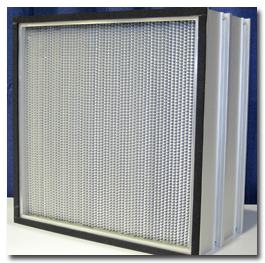
Nano Filtration Technologies LLC (NFT), Pittsburgh, manufactures media for high-efficiency particulate air (HEPA) filters using an electrostatically charged polypropylene Winged Fiber spunbond. The filters produced from this media, branded LEAF™ (Low Energy Air Filtration), are claimed to have 250-percent greater loading capacity than traditional HEPA filters; and offer more efficient air flow, lower energy consumption, a longer filter life and lower filter costs. The same material is going into facemasks for industrial and medical uses.

QFOMfiter

HEPA filters made from NFT’s electrostatically charged polyropylene Winged Fiber LEAF™ filter
media are claimed to have 250-percent greater loading capacity than traditional HEPA filters, among
other benefits.

Korea-based La Care’s facial mask made using a nylon Winged Fiber spunbond is loaded with moisturizing and rejuvenating essential oils and creams. The mask conforms to facial contours and holds in place.

QFOMmask

La Care’s cosmetic facial mask made using a nylon Winged Fiber™ spunbond is loaded with
essential moisturizing and rejuvenating oils and creams.

Researchers at the Joint Department of Biomedical Engineering, colocated at NCSU and the University of North Carolina at Chapel Hill, are growing stem cells on a Winged Fiber substrate to create bone tissue, and report promising results.

Allasso has demonstrated that continuous filaments of the fiber may be suitable for knitted and woven apparel applications. Also in the works are staple fibers of various lengths to suit a range of nonwoven and yarn spinning processes.


For more information about the Winged Fiber™, contact Walter Chappas +919-890-3803; wchappas@allassoindustries.com; allassoindustries.com. Go online to TextileWorld.com for archived Quality Fabric articles.


September/October 2012

Tradegood Sourcing Tool Unveiled

Tradegood, a business-to-business sourcing community created to connect apparel and footwear buyers
with suppliers across more than 100 countries, debuted recently at Sourcing at MAGIC in Las Vegas.

The tool, which employs the “business done right” verification process, rates suppliers
based on more than 50 criteria — including operational history, employee count, regulatory
compliance and environmental sustainability — to help buyers make efficient partnership decisions.

“The global supply chain is an area of vulnerability for many businesses,” said William
Quilindo, president, Tradegood. “The only way to ensure that your suppliers align with your
corporate values as well as with social, environmental, security, safety and quality standards is
to know that you are dealing with real companies, real people, with real products and services.”

Tradegood also introduced Trade Café, a physical area where buyers and suppliers may
convene. Other Trade Café locations will open in New York City and various locations in China, and
will include video conference facilities.

September/October 2012

PrintLat To Represent Catalina In Latin America

Catalina Graphic Films Inc., Calabasas Hills, Calif., has signed an agreement with PrintLat LLC,
Miramar, Fla., under which PrintLat will distribute Catalina Graphic Films’ product line in the
Latin American market.

September/October 2012

International Textile Trade Shows: Preview In New York

New York City has captured the first glance at what fabric companies have created for fashion
designers for Fall/Winter 2013-14. Première Vision Preview presented apparel fabric collections
from European and Asian firms. Texworld USA included apparel and home yarns and fabrics and
sourcing exhibitors. Kingpins and The Continuum focused on denim and sustainability.


Première Vision Preview


For exhibitors at Première Vision Preview, colors are dark with bright highlights. Fabrics
are light, soft, clean and bulky. Many lines are showing double-faced fabrics. Stretch is a given.
Woven patterns tend to be small and classic. Prints are digital, covered and very colorful.
Metallics, paisleys and animal skins are still offered, and don’t forget black-and-white.

In the woolen sector, Robert Noble, Scotland, is showing ultralight Merino suiting and coat
weights. Colors are dark olives, ochers and browns with bright touches of berry or rust. Patterns
are small herringbones, and glen and gun club checks. The touch is natural, and there is stretch.

At Nikke, Japan, there are meltons, gabardines, twills and double cloths that reverse from
check to twill or gauze to twill. A new chemical finish that gives fabrics a paper touch is
especially popular with wool denim.

Avelana S.N., France, has a modified polyester fiber called carbonium that can be dyed and
spun like wool and has a wool touch. Fabrics woven with carbonium can be wrinkle-free, and water-
and stain-resistant. Other fabrics include worsted wool flannel, bubble-textured wool stretch,
Donegal tweeds and wool-blend stretch glen checks and herringbones. Roudiere, Avelana’s menswear
counterpart, has a double-faced fabric that reverses from worsted to wool; tweeds with subtle
stretch; and small, clean designs.

At Gruppo GF S.r.l., Italy, woolen tweeds are thick, soft and fluffy. Italy-based Picchi
S.p.A. has woolen tweed bouclés; brushed Donegals; and bonded double cloths that reverse from plaid
to bright, black to colorful stripes, and herringbones to diagonal weaves.

BTD Tekstil, Turkey, is showing casual double cloths that reverse from piqué or check to
twill; power stretch twills and crepes; and wool-blend bouclés that resemble Chanel styles, some
containing Lurex®.

Velcorex since 1828, France, continues to reinterpret corduroy. For Fall 2013, it’s
ultralight, mini-rib or cordless, and jacquard-patterned. There is corduroy that looks like denim
and has been dyed using a new sustainable technique developed by Clariant. Philea, France, has new
jacquards with engineered patterns, tweeds, crepes, a lot of stretch and glitter.

KASolstiss

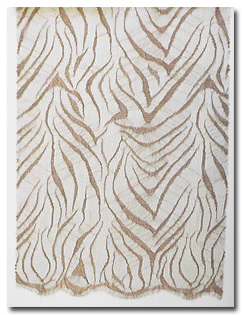
Laces shown by Solstiss at Première Vision Preview included this copper metallic
lace.

Henitex International, France, has double cloths that reverse from fleece to small
black-and-white designs, or stripes to chevrons. There are open textured knits, variegated stripes,
ombréd jacquards, and a lot of large prints.

For outerwear, two Italian firms, Frizza S.p.A. and Olmetex S.p.A., are presenting
lightweight, bonded fabrics that are waterproof, stretchy and breathable. At Frizza, there are
sheer over shine over fleece, a fabric that looks like elephant skin bonded to wool, 3-D prints and
new transparencies. Olmetex is showing waterproof bonded fabrics that have a lot of stretch;
neoprene, Teflon® or waxed surfaces; heather wool flannels; and polyester furs.

For dress-up, there is opulence. Carlo Pozzi & C., Italy, has color-reverse stretch
satin, sheer/opaque wool/nylon with crinkle and glitter, and colorful jacquards. Solstiss S.A.,
France, has sheer, abstract-patterned laces, heavy corded laces and copper metallics. Denis et
Fils, France, is showing silk jacquards and lamé.

Digital prints not mass-produced are hot sellers at Sprintex S.a.s., France; KBC, Germany;
Miroglio Textile S.r.l., Italy; and Confetti Fabrics, Turkey. There is complete ground coverage,
with countless colors, and no repeat designs. Sprintex has oversized, dramatic graphics; KBC is
showing kaleidoscopic and photographic florals; and Miroglio has large, bold abstracts. Skins and
paisleys continue everywhere, and are newly done.


Texworld USA


At Texworld USA, Austria-based fiber producer Lenzing AG is a major player. Its section
included nearly 50 worldwide customers, including 10 from the United States.

U.S. textile production using Lenzing’s cellulosic fibers has increased 65 percent, with a
lot of Modal® and Tencel® going into sheeting and top-of-bed products. Beantown Bedding, Hingham,
Mass., is showing compostable and biodegradable bed sheets made using Tencel. Beantown is selling
to schools and universities. Camps and hotels are looking at its products.

Paramount Textile Mills (P) Ltd., India, showing at Home Textiles Sourcing, sells bedding
fabrics, including sheets and pillowcases woven with Modal and Tencel. Other exhibitors are selling
fabrics for curtains, upholstery, rugs, bedding, and kitchen.

Buhler Quality Yarns Corp., Jefferson, Ga., is selling yarns to sheet and towel producers.
For apparel, MicroModal® heather yarns are popular.

Tuscarora Yarns Inc., Mount Pleasant, N.C., reports its new nub yarns are selling well,
especially black with natural nubs.

Texollini Inc., Long Beach, Calif., has jersey with Outlast® phase change technology,
fabrics knitted with spider silk, burn-outs and new knitted fabrics containing cashmere and alpaca.

FesslerUSA, Orwigsburg, Pa., is working with both Lenzing and The Woolmark Company,
Australia. There are three new wool fabrics, including 17.5-micron 3.5-ounce Merino jersey.

Textil Santandrina S.A., Spain, showed at Texworld and Kingpins. High-end Tencel/Lycra®
denim sells to Gap Inc., Lands’ End and Coldwater Creek. Colored denim and jacquards are popular.

KATexworld

Texworld USA officials and sponsors marked the opening of the show with a ribbon-cutting
ceremony.


Miroglio also shows at Première Vision. At Texworld, it focused on fabrics styled in Italy
and made in China.

International Apparel Sourcing Show exhibitor Panjiva, New York City, connects buyers with
suppliers in the global supply chain. Another exhibitor, Sterlingwear of Boston Inc., started
making peacoats in 1968 and today makes women’s, men’s and children’s apparel, as well as peacoats
for the U.S. Navy.


Kingpins And The Continuum


Kingpins and The Continuum are two growing shows with international exhibitors. Several
companies showed at both events.

At The Continuum, ColorZen LLC, New York City, introduced eco-friendly cotton dyeing
technology that eliminates water pollution and decreases water consumption by 90 percent and energy
usage by 75 percent (See “ColorZen Launches Water-, Energy-, Chemical- And Time-Saving Cotton
Dyeing Technology,” Dyeing Printing & Finishing News, this issue).

Bayer CropScience Inc.’s FiberMax® cotton, a Kingpins sponsor, is produced sustainably in
Texas for world consumption. It is the largest variety of exported cotton in the world and offers
superior spinability, reduced breakage, excellent strength and a wonderful hand.

At Cary, N.C.-based Cotton Incorporated’s stand, buyers reacted enthusiastically to the
company’s collaboration and innovation efforts. Of special interest were 3-D effects, washdown
treatments and photo-realistic printed looks.

Invista, Wichita, Kan., also a Kingpins sponsor, reports special interest in color-flecked,
very stretchy and laser-printed denims. Eco-friendly is high on the list, and TOUGH MAX™ Lycra
products are cited for their comfort and performance.

Tavex Corp., Spain, said Levi’s is buying denim with 8-percent stretch for men and
35-percent stretch for women. Coated denim and lighter weights are selling.

American Denimatrix fabrics are made in Littlefield, Texas, and garments, in Guatemala. New
are tie-dyed jeans, leather-look coated garments, shiny laser prints, batiks, and bleach effects.

Cone Denim, Greensboro, N.C., uses EarthSpun® yarns from Patrick Yarn Mills Inc., Kings
Mountain, N.C., for a colored denim collection. These yarns, used as weft, come from recycled
brown, green and blue plastic containers, and no dye is needed. One garment made with Tencel and
dyed with iron oxide has a crisp hand. Other denims contain recycled cotton.

September/October 2012

People

Mount Vernon Mills Inc., Mauldin, S.C., has named
Melanie Sumner development manager, Protective Specialty Fabrics;
Ernie Terrell FR technical specialist; and
Craig Tutterow technical director, FR Fabrics.


Riegel-Mount Vernon Mills Inc.
, Johnston, S.C., has named
Kathy Detwiler inside sales specialist.

Jennifer Mendez, vice president for government relations, The Carpet and Rug
Institute (CRI), Dalton, Ga., has been elected treasurer of the
State Government Affairs Council.

The
American Apparel and Footwear Association (AAFA), Arlington, Va., has appointed
Paula Zusi, Ann Inc., to the Executive Committee; and the following to the Board
of Directors:
Tim Lyons, Haggar Clothing Co.;
Michael Schulze, SAP America Inc.; and
Karen Kyllo, SGS Consumer Testing Services. AAFA also has presented the Friend of
the Apparel and Footwear Industry Award to
Sens. Mitch McConnell, R-Ky., and
Charles E. Schumer, D-N.Y.


Optitex Ltd.
, Israel, has appointed
Nick Wei regional sales director, Hong Kong.


Victor Group
, Quebec, has named
Machell Apple director, new development initiatives.

PeopleApple

Apple

Yale Cordage, Saco, Maine, has appointed
Bill Putnam president.


Textiles Intelligence
, United Kingdom, has named
Jessica Farricker to its editorial team.

Xennia Technology Ltd., United Kingdom, has appointed
Dave Knight managing director.

ColorZen LLC, New York City, has contracted
Nick Hahn to oversee its efforts to educate the cotton and textiles industries
about the benefits of its cotton-dyeing technology.


Dash Multi-Corp. Inc.
, Maryland Hights, Mo., has named
Alan Prelutsky vice president, Textile Group.

PeoplePrelutsky

Prelutsky

Rooster Products International Inc., San Antonio, has named
Ralph L. Valadez program manager, Rooster Manufacturing Services Group.

September/October 2012

ColorZen Offers Water-, Energy-, Chemical- And Time-Saving Cotton Dyeing Technology

ColorZen LLC, New York City, has launched technology that eliminates the use of environmentally
detrimental chemicals and significantly reduces the amount of water, energy and time needed to dye
cotton. ColorZen™ technology involves the pretreatment of cotton using a process that renders the
fiber more receptive to dye uptake, uses no salt or other chemicals to fix the dye, and enables the
desired color to be achieved using half the amount of dye, with a 97-percent exhaustion rate,
compared to traditional cotton dyeing technologies. The company reports the treated cotton can be
dyed using traditional dyeing machinery, but the dyeing process uses 90-percent less water than is
needed for conventional cotton because fewer rinses are required and the water is recycled. The
process also consumes 75-percent less energy because color is applied at lower temperatures and the
entire process is completed in one-third the time needed for conventional dyeing.

The ColorZen process alters the cotton fiber’s molecular structure to attract the dye
naturally and has some basis in cationic chemistry, which offers similar environmental benefits.
However, according to Tony Leonard, the company’s technical director, cationic chemistry has not
been successful outside of a laboratory setting for reasons related to cost effectiveness,
complexity of the treatment and difficulty achieving consistent results, among other factors. By
contrast, said Michael Harari, president, “ColorZen cotton can be produced on a mass scale at a
cost that is effective, and most of the cost can be offset by savings in water, energy, chemicals
and time.”

ColorZen’s manufacturing facility is located in China. “China is the most prolific textile
export country, and most of the negative environmental effects of textile production have occurred
there,” Harari said. In the future, the company plans to expand its operations to other locations.

Harari anticipates cotton products bearing the ColorZen hangtag will be available in stores
as early as next year. “We will now be able to offer brands, retailers, and manufacturers a
sustainable choice for cotton dyeing that will protect the fresh waterways and reduce energy
consumption,” he said.

September/October 2012

BASF Ups PolyTHF® Capacity

BASF SE, Germany, has invested more than 60 million euros to increase its global PolyTHF®
polytetramethylene ether glycol production capacity by 65,000 metric tons to a total of 250,000
metric tons.

BASF produces PolyTHF in Germany, South Korea, China, and Geismar, La. The chemical
intermediate is used mainly in spandex fiber production. It also is a basis for thermoplastic
polyurethanes, polyetheresters, polyetheramides and cast elastomers.

September/October 2012

Park Valley Dyers Installs Thies Equipment

Park Valley Dyers Ltd., United Kingdom, a joint venture between contract fabrics weaver Camira
Fabrics Ltd. and Holmfirth Dyers Ltd., has installed 10 dyeing machines and a horizontal pressure
dryer manufactured by Germany-based Thies GmbH & Co. KG. Thies also designed the layout and
auxiliary equipment specifications at the plant, a former dyeing facility that has been
recommissioned after serving for some years as a storage facility. The operation is the first
dedicated dyeing plant to be installed in the UK in more than 20 years and represents an investment
of 2 million British pounds, Camira reports.

The machinery at Park Valley Dyers dyes 25 tons of yarn weekly and is operated by six
employees. The plant features an energy-efficient hot water boiler with a recovery unit, and
recycles and reuses all water used. The drying machinery uses hot air instead of radio frequency.
In addition, the plant recycles all yarn delivery pallets and packaging.

Machinery installed includes an eco-bloc quattro lab sampling unit, and seven horizontal and
two vertical eco-bloc yarn-dyeing machines — including two 840-kilogram-capacity units that can be
linked and operated using one control unit. Park Valley also installed a pharmaceutical standard
recipe preparation booth that enables the company to achieve a 98-percent right-first-time rate,
according to Philip Brearley, managing director, Camira Fabrics.

September/October 2012

Quick-Med’s Stay Fresh® Nets Expanded EPA Approval

Quick-Med Technologies Inc., Gainesville, Fla., has received an amended U.S. Environmental
Protection Agency (EPA) registration for its hydrogen peroxide-based Stay Fresh® Antimicrobial — a
nontoxic, durable, cost-effective technology that retains its efficacy on textiles and other
materials under a range of laundering conditions, according to the company.

The amendment expands approval for use of the technology to 30 new sites, enabling its use in
products such as adhesives, aprons, backpacks, incontinence pads, lumber, luggage, shoe liners and
inserts, shower curtains, superabsorbent polymers, and wound dressings. It also addresses treatment
application levels based on an article’s intended use and provides for “ultimate” durability,
“standard” application and warehouse “inventory protection” rates.

In addition to military uniform, apparel and other consumer textile applications, Stay Fresh
has potential applications for products such as medical devices. Quick-Med has filed a 510(k)
Premarket Notification with the U.S. Food and Drug Administration for its Stay Fresh Skin Fold
Management Textile, a medical absorbent product designed to provide moisture management and
antimicrobial protection in order to prevent damage to skin from abrasion within skin folds.

September/October 2012

Verdezyne Granted Patent For Biobased Adipic Acid Process

Verdezyne Inc., Carlsbad, Calif., has been granted U.S. Patent No. 8,241,879 for its biobased
adipic acid production process, which uses yeast fermentation to convert non-food plant-based oils
into adipic acid, used in the production of renewably sourced nylon 6,6 (N 6,6), thermoplastic
resins and coatings.

In addition to environmental benefits, biobased adipic acid is expected to offer economic
advantages over traditional petroleum-based adipic acid.

E. William Radany, Ph.D., president and CEO, said Verdezyne has teamed with another company
to polymerize N 6,6 made with biobased adipic acid to produce carpet yarn, and also plans apparel
yarn trials. He said several N 6,6 producers are interested in incorporating biobased adipic acid
into a 50-percent renewable fiber, and noted that Verdezyne is developing a pathway to manufacture
hexamethylenediamine, which would enable production of 100-percent biobased N 6,6.

September/October 2012

Sponsors