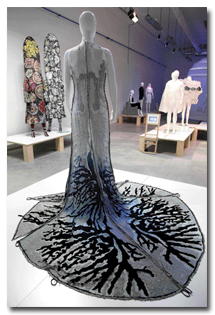
The Ecochic Design Award 2013 Finalists Announced

Hong Kong — September 16, 2013 — Today eight emerging fashion designers from Europe and Asia were
announced as finalists of The EcoChic Design Award 2013, the first international sustainable
fashion design competition uniting European and Asian emerging fashion designers with a shared
vision of a lower-impact fashion industry and catalyzing sustainable fashion among sustainable
stakeholders.

The EcoChic Design Award 2013, with major sponsorship from the HKSAR government, agency
Create Hong Kong, educates and enables emerging designers to create mainstream clothing with
minimal textile waste. With 30% of the fashion market’s growth thought to come from China in the
next five years1, the competition’s grand final taking place at HKTDC Hong Kong Fashion Week is a
significant mark to raise awareness around sustainability in this booming market.

This year’s high caliber of judges, representing design, manufacturing, retail and media
industries, demonstrates the competition influence, with judges being Orsola de Castro, Cofounder
of From Somewhere and Co-founder and Curator of Estethica, Johanna Ho, Fashion Designer, Margaret
Kutt, Project Manager Sustainability of Esprit, Gloria Lam, Editor-in-Chief of ELLE Hong Kong and
Anderson Lee, Vice Chairman of the Sustainable Fashion Business Consortium.

Judge, Anderson Lee said, ‘I am honoured to engage in the innovative and eye-opening process
of the future generations’ sustainable fashion designs. Together, both judges and competitors are
immersed in a learning and competitive environment, whilst traveling on the same journey to drive
systematic change towards sustainability in the fashion industry.’

Over the next two and a half months, all finalists are required to put their sustainable
designconcepts into reality with each making a six-piece sustainable collection to present at HKTDC
Hong Kong Fashion Week in January 2014, where the winners will be announced. All finalists will
come to Hong Kong to show their collections on the runway, battling it out for career changing
prizes and participating in sustainable fashion workshops at The Redress Forum.


The EcoChic Design Award 2013 Finalists:


Alex Law (Hong Kong)

Catherine Hudson (UK)

Xinyin Dai (Mainland China)

Louise de Testa (France)

Tsung-Chin Chiang (Taiwan)

Karen Jesse (Germany)

Phee Ng, Swee Yee (Singapore)

Clémentine Sandner (UK) *wildcard finalist


These eight finalists, who are all designers or students with less than three years’ industry
experience, impressed the judges with their creative use of the sustainable design techniques
zero-waste, up-cycling and reconstruction. They were amongst 20 semi-finalists who were shortlisted
by seven separate local judging panels across the competition’s newly expanded regions in Asia and
Europe.

‘The EcoChic Design Award is now in its fourth cycle and, as a judge for every cycle, I am
delighted to witness first-hand the increase in knowledge of sustainable design and the high level
of originality and skills from all the semi-finalists this year. Their innovation is quite an
inspiration for the development of sustainable fashion in the global mainstream fashion market,’
said Margaret Kutt, Project Manager Sustainability of Esprit and judge.

Another judge, who has also been with the competition from the onset, is Orsola de Castro,
Co-founder of From Somewhere and Co-founder and Curator of Estethica.

‘Watching The EcoChic Design Award grow to become an international platform has been amazing.
The award have really helped a new generation of designers to see sustainability in a different
light,’ she said.

Prizes foster future careers in sustainable fashion design

The first prize winner will design a recycled textile collection for Esprit for their global
retail,further demonstrating the competition’s substantial influence on the fashion industry and
retail sector.

The second prize winner will go on an educational trip to globally-leading sustainable
jewelry brand John Hardy’s design and production facilities in Bali, to experience first hand their
design, production and business philosophies.

The special prize winner will create a show-stopping sustainable outfit for artist Sandy Lam,
which will be featured in ELLE Hong Kong’s 2014 green edition to ‘redress’ consumers’ attitudes
towards sustainable fashion.

Posted September 17, 2013

Source: Redress
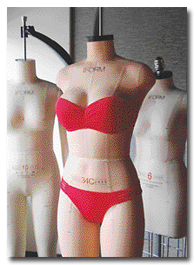
Alvanon Introduces Memory Foam Intimate/Swim Form

Alvanon Inc., New York City, reports its Intimate/Swim Form made using memory foam is 15-percent
softer than its standard soft mannequin and enables more realistic fitting of compression fabrics.

“Previous generations of mannequins were not as soft and did not accommodate the underwire
and bust fit very well,” said Ed Gribbin, president, Alvanon. “For that reason, designers could not
assess fit on a mannequin with a desired degree of accuracy.”

The new form may be used across the supply chain.

KAAlvanon

Alvanon’s newest Intimate/Swim Form

September/October 2013

Vapor Apparel Launches Made-In-USA Cut & Sew Line

Vapor Apparel, Charleston, S.C., is offering the customizable, U.S.-made Vapor Apparel Cut &
Sew apparel line.

“Digital sublimation is taking the decorated garment industry by storm,” said Christopher
Bernat, chief revenue officer, Vapor Apparel. “Our customers are demanding greater options for
fully customizable apparel. With our new cut and sew services, they’re able to meet this demand
while promoting domestic jobs, as all of our cut and sew garments are proudly ‘Made in the USA.'”

In the production process, a digital design is printed on a roll of fabric. Individual pieces
containing customized designs are then cut and sewn together. The cost-competitive solution doesn’t
require screen printers and design houses to invest in new machinery and equipment.

September/October 2013

Augustine Tantillo Takes Helm As NCTO President

The National Council of Textile Organizations (NCTO), Washington, has named Augustine “Auggie”
Tantillo president of the organization. Tantillo previously served as executive director of the
American Manufacturing Trade Action Coalition (AMTAC), which, along with the National Textile
Association (NTA), recently merged with NCTO in order to form a unified group to represent U.S.
textile industry interests in Washington, particularly with regards to the Trans-Pacific
Partnership (TPP) currently being negotiated among the United States and 11 other Pacific Rim
nations
(See ”
The
TPP — High Stakes For U.S. Textiles
,”
Textile World, May/June 2013)
.

Over the last 25 years, Tantillo also served in other capacities including chief-of-staff to
the late U.S. Sen. Strom Thurmond, R-S.C., and deputy assistant secretary of the U.S. Department of
Commerce for Textiles and Apparel.

Tantillo succeeds Cass Johnson, who served as NCTO’s president from its beginnings in 2004
and previously as president of NCTO’s predecessor, the American Textile Manufacturers Institute.

“We are incredibly pleased to welcome Auggie’s leadership and many years of experience to
NCTO at such an important juncture of Trans-Pacific Partnership negotiations,” said NCTO Chairman
William L. “Bill” Jasper. “In his new role as president, Auggie will continue NCTO’s unparalleled
commitment to fighting on behalf of American textile manufacturing and jobs at home and abroad.

“We certainly wish Cass the very best in his future endeavors and remain grateful for his
dedicated service over the years to our organization and the broader U.S. textile industry,” he
added.

“I come into this role at a critical time in the Trans-Pacific Partnership,” Tantillo said.
“I will work to help the U.S. textile industry navigate through the details of this historic free
trade agreement. This agreement has the ability to significantly impact the U.S. textile industry
and our Western Hemisphere trading partners. With over 1.5 million jobs at stake, NCTO is committed
to ensure that this agreement will be satisfactory for our members and the broader U.S. textile
industry in this hemisphere.”

NewsTantillo

Augustine Tantillo


September/October 2013

HanesBrands To Acquire Maidenform

HanesBrands Inc., Winston-Salem, N.C., will acquire intimate apparel marketer Maidenform Brands
Inc., Iselin, N.J., for approximately $575 million, with closing expected in the fourth quarter of
2013.

HanesBrands plans to leverage its low-cost supply chain, including its own global
manufacturing operations and third-party manufacturers, to enhance Maidenform’s value to retailers
and consumers. Maidenform now contracts with third-party manufacturers for all of its products.

HanesBrands notes the acquisition will combine the strengths and capabilities of the
companies’ respective portfolios, including Maidenform’s shapewear and average-figure bra
businesses, and HanesBrands’ panty and full-figure bra businesses. The acquisition also is expected
to create growth opportunities and enable new products to be launched across all brands.

September/October 2013

Shaw To Build Plant In Georgia, Add 500 Jobs

Shaw Industries Group Inc., Dalton, Ga., will invest $85 million to build a modular carpet tile
manufacturing facility in Adairsville, Ga., and add 500 jobs.

Construction on the 600,000- to 700,000-square-foot facility is scheduled to begin in 2014.
Shaw operates another carpet tile manufacturing facility in nearby Cartersville.

“We have expanded our existing Cartersville carpet tile facility to its maximum so the
Adairsville plant will allow for continued long-term growth in this important product segment,”
said Vance Bell, Shaw Industries Group chairman and CEO. “We will also soon open a new carpet tile
plant in China to service the Asia market.”

September/October 2013

Standard Textile To Expand Union, S.C., Operations, Add Jobs

Standard Textile Co. Inc., Cincinnati, will invest more than $2.5 million to expand its terry towel
manufacturing operations, including new technology for terry towel finishing, at its Union, S.C.,
plant. The expansion will create 15 jobs, and is expected to be completed by the end of September.

“We are excited about the opportunity to expand our existing operations in Union County,”
said Russ Ogle, plant manager, Standard Textile. “South Carolina has provided us with a skilled
workforce and an excellent environment in which to do business. We appreciate all the support we’ve
received from state and local officials.”

Standard Textile also has manufacturing centers in Enterprise, Ala., Augusta, Ga., and
Thomaston, Ga.; and seven distribution centers throughout the United States. The company serves the
healthcare, hospitality, industrial laundry and decorative products markets.

September/October 2013

A Look At Fall ’14

New looks for Fall 2014 are developed from old archives. Fabrics can be double-faced, ultralight,
soft and brushed; resist the elements; and are sustainable. There are knits that look and feel like
wovens, and wovens that resemble knits. Lacquered, waxed, bubbled, tweed, flocked or perforated
surfaces are selling. And denim – or the look of denim – is everywhere.

Creativity and imagination starred at Première Vision New York. At Texworld USA, knitted
fabrics designed and made in America were selling. Denim specialist Kingpins showed fabrics, fibers
and findings.


Première Vision New York


At Première Vision New York, suiting fabrics were lightweight and had a casual look. Robert
Noble, United Kingdom, was inspired by its archives from the 1850s. Recolored Shetland wool tweeds
are hairy, light and available in coordinating patterns. There are tartans; gun club, glen and
windowpane checks; and solids.

Picchi S.p.A., Italy, is selling bright-colored, textured woolen fabrics. Bouclés, heathers,
thick twills, felted fabrics and flannels coordinate with enormous yarn-dyed plaids, box textures,
camouflage prints, flocked patterns and perforations. Pink, yellow and hot blue are favorite
colors.

BTD, Turkey, has polyester/viscose blends that look and feel like wool. Some have a stretch
yarn. There are novelty weaves and new finishes for an antique, brushed, waxed or tie-dye look and
touch. One best seller is soft-touch denim in a blend of cotton, polyester, viscose and elastane.

Velcorex since 1828, France, has corduroy that looks like denim. Ultra-lightweight,
narrow-waled, printed, jacquard-patterned, embossed, coated and overdyed – a lot is happening with
corduroy and velvet.

Italy-based Profilo S.n.c.’s denim is woven of cotton/viscose. There are jacquard patterns,
shine, camouflage looks, velours and leather looks. Some are spotted, coated, or appliquéd with
metallic dots.

Alcantara, Italy, sells a sustainable line to Armani, Fendi and Ferragamo. Its core business
is automotive fabrics. Washed polyester/polyurethane suedes are printed, embossed, embroidered,
quilted, laser-engraved or pleated.

Knitted outerwear fabrics at A-girl’s Co. Ltd., Japan, look and feel like wovens. There are
reversible wool/cotton/nylon knits for peacoats, flat stretch cotton/polyester terry, lightweight
wool pile, and TENCEL®/cashmere/polyester tweed or herringbone digital prints for dresses.

Jacquard knits at Bel Maille, France, look and feel like neoprene. Other fabrics include
engineered stripes and printed knits for lingerie. New yarn mixes include silk/cotton/viscose or
wool/cashmere/nylon blends.

KA1

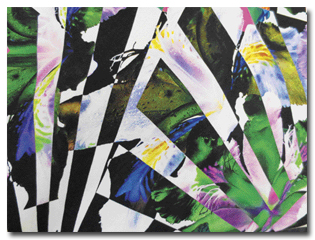
Miroglio Textile showed huge allover patterned fabrics at Première Vision New
York.

High performance is the specialty at Frizza S.p.A. and Olmetex S.p.A., two Italian firms
that sell outerwear fabrics. Double-faced, bonded and resistant to the elements are givens. At
Frizza, there are shiny/dull bubble and reflective jacquards, dimensional patterns, metallic
allovers, and coordinating fabrics. Olmetex has transparent silk water-repellent fabrics, wax-hand
cottons, matte/shine camouflage patterns and cotton/silk washed poplins.

Digitally printed fabrics are multicolored, huge and allover at Miroglio Textile S.p.A.,
Italy; Sprintex S.A.S., France; and KBC, Germany. There are landscapes, melted stripes, flowers,
geometrics, abstracts, paisleys and skins. Miroglio has printed velours. Flowers are sometimes
fractured and coordinate with checks. Sprintex is showing tapestry prints and florals on misted or
checked grounds. At KBC, paisleys combine with foulards, and animal prints are selling.

London-based Liberty Art Fabrics’ best seller is small, ditsy flowers. New base fabrics
include brushed or bonded Tana lawn, denim, water-repellent nylon for outerwear, cotton stretch
gabardine and Harris Tweed. And there is a new line of digital prints.

For evening, France-based Denis et fils and Solstiss S.A. showed dazzling lines. At Denis et
fils, coordinating jacquards and metallic patterns combine paisleys, stripes, and florals. Solstiss
has stretch laces combining flowers with geometrics, and a mix of modern with traditional.


Texworld USA


At Texworld USA, along with fabrics, there were areas devoted to apparel and home textiles
sourcing.

At Texworld and at Kingpins, the International Oeko-Tex Association presented its STeP By
Oeko-Tex® system for certifying sustainable production and working conditions in the entire textile
industry supply chain. STeP looks at chemicals, environmental protection and management, social
responsibility, quality management, health, and safety.

Lenzing AG, Austria, exhibited at Texworld and Kingpins. At Texworld, it centered a large
area of spinners, knitters and weavers that use Tencel and Lenzing Modal®. At its own booth, it
promoted denim, chambray and activewear. Tencel/cotton blends are strong. “People want more
crossover from day- to activewear,” said Tricia Carey, senior merchandising manager, Textile
Fibers.

Buhler Quality Yarns Corp., Jefferson, Ga.; and Tuscarora Yarns Inc., Mount Pleasant, N.C.,
showed Modal and Tencel. At Buhler, there are fine-count air-jet yarns that have excellent drape,
and soft-touch slub yarns. Tuscarora showed dope-dyed Modal, mock-twist yarns, slubs and nubs,
vintage-look denim yarns of cotton/Modal, and polyester/flax blends.

Buhler customer Design Knit Inc., Los Angeles, custom-develops fabrics – all U.S.-made –
with a focus on Tencel, MicroModal®, luxury Supima® and flax. Of special interest are stripes,
sheer to heavy tweeds, double-faced fabrics, pucker, slubs, heathers and tonal effects.

KA2

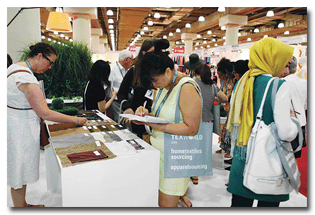
Attendees view fabric samples at Texworld USA

Laguna Fabrics, Los Angeles, has fast deliveries and a sample stock program. Single and
double knits weigh in at 4 to 12 ounces. Current favorites include heathers, piqués, French terries
and thermal knits.

Texollini Inc., Long Beach, Calif., has true indigo-washed knits. Scuba, a soft,
nylon/LYCRA® double-knit, has the look and feel of neoprene. Most fabrics are for activewear, and
all are knitted in the Americas.

Springs Creative Products Group LLC, Rock Hill, S.C., showed fabrics from its True Timbers
print division as well as brocades, organzas, sequined fabrics and activewear fabrics.

Thermore S.p.A., Italy, is selling thermal insulation to LL Bean, Eddie Bauer, Nautica,
Nike, Levi’s and Ralph Lauren. One new ultralight style is called Thermore Aria®.

At Parlamis Tekstil, Turkey, yarn dyes, prints and jacquards in blends of wool, silk, linen
and synthetics are selling. Crepe is a best seller.

Isil Tekstil, Turkey, has baroque prints and batiks on viscose jersey and lightweight
wovens.

Hemp Fortex Industries (Rushan) Ltd., China, spins, knits and weaves blends of organic and
recycled cotton, recycled polyester, silk and linen into mens- and womenswear fabrics.


Kingpins


Denim producers and fiber companies presented developments at Kingpins. Cotton Incorporated,
Cary, N.C., showed new types of printing including foil-printed denim, digital prints, and ozone
and laser prints.

Invista, Wichita, Kan., showed wovens with a knitted look and knits that look and feel like
wovens; four-way stretch with XFIT Lycra; and performance denims for menswear.

At Lenzing, there was an explosion of chambray and super-skinny jeans with stretch.

KA3
KA4

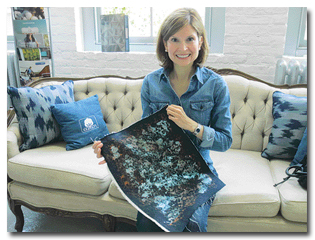
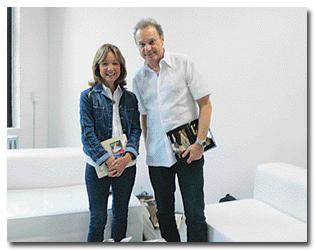
top to bottom: Teresa Zugay, Cotton Incorporated, shows a foil-printed denim concept at
Kingpins; Jean Hegedus, Invista, and Andrew Olah, Olah Inc. and Kingpins, take a break at Kingpins
to smile for the camera.


Bayer CropScience AG, Germany, introduced its e3 sustainable cotton program for its
Certified FiberMax® and Stoneville® cotton.

The Dow Chemical Company, Midland, Mich., exhibited its SILVADUR™ antimicrobial,
odor-control treatment, which was featured in India-based Arvind Ltd.’s denim line.

Arvind also showed organic cotton denim dyed with natural indigo; denim woven of 100-percent
linen or yarns from recycled coffee grounds; natural indigo overdyed in gray or brown; and
wax-finished denim.

Tavex, Spain, showed stretch for menswear. Coated denims are popular, especially with color.
Blue on gray and earth tones on indigo were noted.

Bests at Cone Denim, Greensboro, N.C., include sustainable selvage denims with an indigo
warp and weaves using CRAiLAR® Flax blends.

There is a lot of Tencel in Spain-based Textil Santanderina’s line. Fabrics include embossed
and brushed denim, coating on indigo dyes that can be washed down, waxed coatings and shiny looks.

September/October 2013

Quality Fabric Of The Month: A Sea Change For Microfibers

By Janet Bealer Rodie, Contributing Editor

Eastman Chemical Company, Kingsport, Tenn., has developed a new technology platform for manufacturing microfibers for wetlaid nonwovens applications including filtration, specialty papers and battery separators. Eastman Cyphrex™ microfibers, made using islands-in-the-sea bicomponent fiber technology and a water-dispersible sea polymer, can be produced in a variety of shapes and sizes using a range of synthetic fiber polymers. The manufacturing process yields high-surface-area microfibers measuring less than 5 microns in diameter that are highly uniform and are processed easily in a wetlaid system.
The first Cyphrex microfibers are round polyethylene terephthalate fibers, and other varieties are in development. “In the future, you could see a wedge-shaped fiber or a flat fiber, or perhaps something different,” said Fred L. Dulin, Eastman’s director, microfibers platform,
noting the different shaped fibers could be blended together to answer needs for various applications. Fibers made with other polymers are also in the works.

QFOM

Eastman Cyphrex™ microfiber pulp enables high-performance, high-value solutions in
nonwovens markets such as air, water or fuel filtration; specialty papers; and battery
separators.

The water-dispersible sea polymer is removed from the bicomponent fiber using hot water — a gentler process that does not impact the microfiber itself, compared to the harsh, caustic process
that is typically required to dissolve conventional sea polymers, and which impacts fiber uniformity. “With the water-dispersible sea, the microfibers are consistently round and within a
very narrow distribution of diameters,” Dulin explained, adding that a more uniform fiber enables more finely tuned-in properties, such as porosity or other characteristics desired in the end product.

“We really seem to be unlocking our customers’ ability to overcome trade-offs,” he said. “In a lot of filtration applications, for example, if you go for a higher level of particle capture, you give up capacity or filter life.” In contrast, Cyphrex can enable gains in both particle
capture and capacity.

Dulin said Cyphrex processes very much like a cellulosic fiber. “Traditional synthetic fibers can tend to disperse rather poorly, and there’s a hesitancy to use them for that reason,” he noted. “Our customers can easily blend Cyphrex with cellulose, glass and other fibers according to the overall performance they desire.”
Eastman also is working on a slightly larger version of the initial product. “A slightly larger fiber will be able to provide a more open sheet,” Dulin said. “It also can be blended with
smaller fibers to dial in a level of porosity based on the amounts of the two fibers in the blend.”

Ahlstrom Corp., Finland, is using Cyphrex in Ahlstrom Captimax™, a diesel filter media for use in vehicle applications, and potentially in hydraulic and fuel water separation applications. The company notes that with the media’s increased capacity, the filter can be reduced in size and yet provide the comparable capacity of a conventional larger filter, while also offering increased efficiency and improved fine-particle filtration.


For more information about Eastman Cyphrex™ microfibers, contact +800-EASTMAN; microfibers@eastman.com; eastmancyphrex.com.


September/October 2013

It’s A Textile Architecture World

At first blush, the provocative headline — “4 Smart Textiles You’ve Yet to See” — in a recent issue
of Popular Science seems out of place. The article predicts what it deems are the textiles to watch
for in the near future — self-repairing fabric, water-soluble fabric, environmentally responsive
fabric that shifts shape or changes color in response to temperature, and “bio-leather” — all meant
to inspire fashion designers. Indeed, high fashion is grabbing its share of headlines these days.

As Textile World has previously reported, designers of fashion and products for wellbeing are
being inspired by new textile developments, and many designers are taking advantage of new textile
capabilities and applying them to new medical and other end-use applications. Although architecture
tends to follow trends rather than lead, it is starting to adopt some of the advanced developments
in textiles first used by fashion designers.

ArchitecturalA

The Empire City Casino at Yonkers Raceway, designed by FTL Design Engineering Studio, is
sheltered by a single layer of ETFE. First developed as insulation for electronics
applications,  ETFE has been adapted successfully to architecture, inspiring new forms. Photo
courtesy of FTL Design Engineering Studio


Technology Transfer — Historic Antecedents


Most new material innovations in architectural construction come from outside the industry.
For example, the mid-20th century development of the now-ubiquitous glass curtain wall was
influenced by the automobile industry’s perfection of neoprene window seals for windshields. This
new technology found its modernist ideal in Eero Saarinen’s design of the General Motors Technical
Center — built in Warren, Mich., in 1955 -where he applied neoprene to the center’s glazing façade
system.

More recently, the adaptation of ethylene tetrafluoroethylene (ETFE) — first used as an
insulator for electronics applications — to architectural use has opened many new possibilities for
building design and function, most notably seen in the 2008 Beijing Olympics water sports venue.

Today, architecture is no less beholden to new technologies. In truth, they have always been
the drivers of both new design and better construction as improvements in material performance and
construction methods are made in response to economic as well as environmental demands, such as
increased sustainability and energy efficiency standards. New textiles are playing a growing role
in innovative architecture and construction.

There are several research areas in which textile innovation is beginning to influence
architectural design, including medical, military and fashion textiles. Another major influence is
not so much a research area, but a social trend — the increasingly mobile nature of business,
culture and daily activity.


Medical Textiles


Many developments in the medical device market have parallel developments in the construction
and architecture design markets, such as textiles that are able to sense and react to environmental
conditions (See “Medical Textiles: How Smart Do They Have To Be?,” TW, November/December 2012).
Architects are finding practical use of fabric coatings that help to fight bacteria or reduce
pollutants in the air — such as titanium dioxide (TiO2) — by applying them in healthcare facility
and clinic designs in which these specialized textiles are used to provide enclosures or
partitions. Healthcare worker apparel can be treated with the same antibacterial/antipollution
finish. Ongoing research in this area will yield many new possibilities, and it is expected to be
the most fertile field of interest for architecture and construction.


Military Research


Following a trend that began 150 years ago during the American Civil War — which saw the
production of lightweight, portable fabric camp furniture and tents — military research into
materials and performance characteristics continues to drive innovation on the architectural front.
A short list of recent innovations includes flexible photovoltaics (PV), low-pressure fabric
airbeams, and non-radiant fabrics that render military tents or deployable structures invisible to
an infrared heat signature.

The architects and fabric structure experts at New York City-based FTL Design Engineering
Studio have worked closely with the U.S. Army Natick Soldier Research, Development and Engineering
(RD&E) Center, Natick, Mass., on lightweight fabric airbeam-supported structures designed for
use in the Middle East. These deployable structures also incorporate flexible PV panels that help
to generate electricity for lighting the interiors.

ArchitecturalC

Research and collaboration between FTL Design Engineering Studio and the U.S. Army Natick
RD&E Center produced the innovative Large Area Night Maintenance Shelter deployable structure
supported by fabric airbeams and covered by laminated fabric. Photo courtesy of FTL Design
Engineering Studio


Fashion Drivers


New material developments regularly find a willing partner in couture, as the fashion media
are very adept at publicizing anything new, and designers are in constant need of fresh ideas. For
example, in recent years, fashionistas have embraced the use of “smart textiles,” including
textiles that can carry data as well as lumens — electrotextiles that display a message or colorful
pattern — or textiles that feature high-performance capabilities for combating specific biological
problems (See “French Technical Textiles Industry: Futurotextiles 3: Nexus Of Technology And Art,”
TextileWorld.com, March/April 2013).

ArchitecturalB

A coating of TiO2 on the fabric of the Herself Dress, created by British fashion designer
Helen Storey, works to break down pollution and freshen the air. Photo courtesy of Maxime
Dufour


Society On The Go


New mobility is driving the need for lighter-weight materials and the demand for more
data-metric information about the environments that people move through. New methods of collecting
and transmitting the data are coming online and will help both the designers of spaces as well as
the users of the spaces in ways that bring greater understanding. For example, the French company
Bodysens S.A.S. has developed a protective hood for firefighters with sensors in the lining that
measure heart rate and other vital signs of the user, and that allows hands-free communication via
digital radio transmission between user and colleagues. Another promising technology involves
chromographic textiles that change color in response to temperature changes. This textile
technology could very well be adapted to the design of medical facilities in which close monitoring
of the environment may be critical and a visual reference to fluctuations may assist doctors and
technicians with treatments.

Lighter, more mobile buildings will be necessary as rapidly shifting public gatherings and
dynamic groups like meetups, impromptu performances and such will require flexible, dynamic spaces.
Pop-up stores will be possible because of durable, lighter-weight materials that provide protection
and colorful, customized graphics.


Future Possibilities


Another area to watch would be composites. As with air and transportation applications,
composites are going to see increased importance in construction as designers seek greater
performance characteristics at lighter and lighter weights to reduce the building carbon footprint.
High performance and extreme light weight are, increasingly, qualities that can only be attained
with the use of textiles.


Editor’s note: Bruce N. Wright, AIA, is an architect/journalist living in Minneapolis.


September/October 2013

Sponsors