Yarn Market: Going Full Blast

By Jim Phillips, Yarn Market Editor

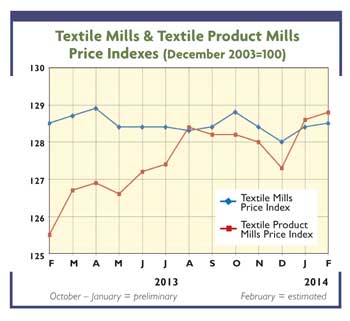
In early March, yarn spinners reported solid business conditions, with many operating near capacity. “We’re going flat out,” said one North Carolina spinner. “We had a slow start to the year, but business has picked up sharply.”

The strong performance continues a period of sustained prosperity that has lasted for the better part of the past 18 months. “We are not really sure where this is coming from,” said one spinner. “It has been
a period of — at least in recent times — unprecedented stability. Certainly, part of this is a result of increased consumer confidence in the U.S. economy. Consumers are loosening the purse strings a little for the first time since the recession and are spending more on discretionary items.”

For one specialty yarn maker, the current business in-house is just a portion of the potential that is out there. “Right now, most of our business comes from verticals, and we are running a full schedule to keep up with it. But that means there is plenty of other business out there that we can take advantage of. At this point, we see no reason to be anything other than optimistic about the next few months.”

Added another spinner: “We are seeing some programs come back that we haven’t seen in a long time. Part of this has to do with the increasing price of doing business in Asia. In China, for example, wages and costs are rapidly increasing, which is affecting the cost of exported product.”

Rising Costs In China
“The Chinese manufacturing cost advantage has eroded dramatically in the last few years,” Steve Maurer, managing director of consulting firm AlixPartners, said in a recent CNBC interview. “If you go back to 2005, it was pretty common for landed cost from China to be 25 to 30 percent less than the cost of manufacturing in the United States. Based on our analysis, two-thirds of that gap has closed.” A recent study by the firm predicted the cost of manufacturing in China will equal that in the United States by 2015.

Not only are labor costs escalating for Far Eastern manufacturers, but so are the costs of raw materials. While the price for upland cotton in the U.S. has remained relatively stable for the past year — hovering in the 70- to 80-cents-per-pound range — the cost of cotton in China has skyrocketed. Chinese manufacturers are currently paying in the $1.30 range for the same product.

With the high costs of raw material in China, a number of companies are beginning to see the value in exporting value-added cotton to China and other Asian nations. Even so, the bulk of U.S. textile exports are headed for Central America. Said a Carolinas spinner: “We’re running a full schedule, and demand is high. Exports make up a significant portion of our total business volume, and we expect demand for cotton to continue to be strong to the next quarter.”

Yet, for all the optimism, the specter of the Trans-Pacific Partnership (TPP) still looms over the industry. At issue is whether or not Vietnam will be allowed into the partnership without a yarn-forward rule. Industry observers are confident at this moment that such a rule is part of the agreement, but are concerned that ongoing negotiations could change that. Lack of a yarn-forward rule would allow Vietnam to flood the U.S. market with apparel made with yarn from China.

The last round of TPP negotiations broke down on February 22 as a result of disagreement over agricultural tariffs. “Without a yarn-forward rule, the TPP could be the most devastating thing ever to happen to the U.S. textile industry,” one spinner said.

U.S. Cotton Prices Remain Stable
Spot cotton quotations for the base quality of cotton in the seven designated markets measured by the U.S. Department of Agriculture averaged 82.93 cents per pound for the week ended Feb. 27, 2014, down slightly from 83.51 cents reported the previous week, but up from 77.37 cents reported the corresponding period a year ago. Spot transactions reported for the week ended February 27 totaled 22,359 bales. This compares to 28,588 bales the previous week and 18,900 bales from the same period a year ago. Total spot transactions for the season were 1,189,635 bales, compared to 1,491,740 bales the corresponding week a year ago. IntercontinentalExchange May settlement prices ended the week at 87.81 cents, compared to 87.65 cents the previous week.

March/April 2014

Business & Financial: Are 2014 Worries Warranted?

By Robert S. Reichard, Economics Editor

Most economists are now predicting solid business growth this year. But there are still a few doubters — with some contrarian pundits continuing to cite such concerns as rising interest rates, lingering tax and spending uncertainties, overseas economic problems, and — last but not least — the still-huge U.S. trade deficit. The big question: Are these concerns realistic? Textile World editors think not. Take the question of interest rates. True, the Federal Reserve Bank is in the process of ending its quantitative easing policy, which has kept borrowing costs at record low levels. But these same financial managers have also been making it amply clear that any near-term interest rate hikes will be quite small — primarily because the falling jobless rate being cited as evidence of a strong recovery is flawed. Reason: Much of the noted decline reflects the fact that many of the jobless have stopped looking for work and hence are no longer considered unemployed. Better, says the Fed, to focus on a more meaningful employment barometer, the labor participation rate — the number of people with jobs relative to the overall working-age population. Zero in on this more sensitive yardstick, and you find a disappointingly low reading — far under the levels of the last few decades. Upshot: The Fed is set to move cautiously. Best bet: Only fractional percentage-point boosts in interest rates — far too small to have any real braking impact on either housing or the purchases of textiles, apparel and other consumer goods.

GDP Question Marks
Nor are any new moves on the government spending and tax fronts likely to have serious negative impacts on domestic business activity. True, there’s going to be a lot of political posturing over the next few months as the mid-term elections approach. But, given the negative political fallout of last year’s congressional brawls, both political parties aren’t very likely to precipitate any 2014 crisis. Conclusion: No repeat of last year, when fiscal restraints managed to knock upwards of a full percentage point off gross domestic product (GDP) totals. In short, current projections calling for 3-percent or slightly higher economic growth look pretty solid for the current year.

Further bolstering this positive outlook is the current strength in the all-important auto market. Right now, the consensus is that some 16 million light vehicles will be sold this year — with strength coming from higher incomes plus the fact that so many consumers postponed the purchase of a new car during the recent recession. Still another currently voiced worry that needs some debunking is the fear that today’s emerging-country currency crisis will put a brake on the U.S. recovery. The point here is that these currency problems are limited to just a few poorly governed countries like Ukraine and Argentina. In any event, most economists see only a remote possibility of any major global business crisis developing over the next few quarters.

Lingering Trade Concerns
Another nagging problem is the still-huge U.S. import-export trade deficit. But here, too, fears seem to be grossly exaggerated. That’s primarily because two of the deficit’s major contributors — crude oil and textile/apparel products — seem to be becoming more manageable. On the petroleum front, domestic oil production, thanks to recent fracking breakthroughs, is showing significant increases. Not surprisingly, energy imports have begun to decline by substantial amounts. Turning next to the textile and apparel trade deficit: contributions to overall negative trade numbers seem to be plateauing out. Indeed, there is now evidence that this key portion of the U.S. trade imbalance may actually be ready to shrink a bit. Some of the factors behind this improving outlook would have to include a narrowing U.S.-foreign production cost differential; increasing interest in U.S.-made goods, rising shipping costs and more U.S. producer interest in reshoring. Summing up — smaller textile, apparel and petroleum trade imbalances would clearly seem to portend progress in narrowing the overall trade deficit — and with good reason. Well over half of the overall red-ink trade figure can be attributed to textiles/apparel and petroleum — 17 percent in the case of textiles/apparel, and near 40 percent when it comes to petroleum. Bottom line: A shrinking trade imbalance — not only for 2014, but also through the foreseeable future.

March/April 2014

U.S. Textiles: Investments Abound

Recent issues of Textile World and postings on TextileWorld.com have reported a significant number of investments in the U.S. textile industry. A partial summary follows. Not all of the investments noted have dollar amounts or job creation numbers attached to them. For those companies that have provided numbers, the investments total more than $4 billion, and jobs to be created total more than 6,000.

Fiber Sector
Solution-dyed filament-based fiber producer Universal Fibers Inc., Bristol, Va., has acquired the continuous filament bicomponent production assets of Fiber Innovation Technology Inc. (FIT), Johnson City, Tenn. “The addition of bi-component fiber technology supports our mission as innovative problem solvers, and enables us to expand into new markets including performance apparel, interior furnishings, filtration, technical/industrial, geotextile, and medical,” said Don Campbell, vice president, business and technical development, Universal Fiber Systems (UFS), parent company of Universal Fibers. Campbell noted synergies between the FIT assets and Universal Fibers’ existing assets in Bristol. The technology also is expected to have application in traditional markets for existing customers of Universal Fibers and UFS’s other business unit, Premiere Fibers Inc.

Specialty man-made staple fiber manufacturer Palmetto Synthetics LLC, Kingstree, S.C., is investing $1.1 million to add a second recycling line at its 250,000-square-foot (ft2) facility and build a 25,000-ft2 warehouse facility, and expects to add 20 employees. The company previously expanded its operations in 2008 and 2010.

Recycled polyester staple fiber products maker JN Fibers Inc., China, is investing $45 million to set up a facility in Richburg, S.C., to recycle used polyethylene terephthalate (PET) bottles into polyester staple fiber for use in automotive, furniture, home textiles and upholstery products. The project is expected to create 318 jobs. The company is upfitting and expanding an existing building, with startup expected in the third quarter of 2014. Its subsidiary Sun Fibers LLC will operate the facility and market the products manufactured there. Mark Bachner, senior vice president of operations, JN Fibers, noted that South Carolina offers an “excellent business environment and access to markets,” as well as a well-qualified workforce.  

Unifi Inc., Greensboro, N.C., has acquired the assets of Dillon Yarn Corp.’s American Drawtech division. Those assets, which comprise draw winding equipment, were relocated to Unifi’s Yadkinville, N.C., manufacturing plant last year as part of a commissioning agreement between the two companies. Unifi plans to introduce its REPREVE® recycled-content polyester and nylon and other premier value-added products into mid-tenacity flat yarn markets. The American Drawtech assets increase Unifi’s production capacity and enable it to expand its presence in certain industrial and thread markets.

Sappi Fine Paper North America, Boston, a subsidiary of wood pulp and paper producer Sappi Ltd., South Africa, has invested $170 million to convert its kraft pulp mill in Cloquet, Minn., to enable production of up to 330,000 metric tons annually of specialized cellulose for use in textile fibers as well as household, beauty and pharmaceutical products. Cloquet Mill produces pulp using batch cooking technology, which can be used for making both kraft pulp and specialized cellulose. “It is the newest pulp mill in America, close to its fiber basket and with a highly skilled and motivated workforce,” said Ralph Boettger, CEO, Sappi Ltd.


The tankfarm at Sappi’s Cloquet Mill enables production of specialized cellulose using a viscose continuous batch cooking process patented by Austria-based Lenzing Technik GmbH, which assisted with the mill’s conversion.
Photograph © Lenzing Technik

Spinning
Gildan Activewear Inc., Montreal, plans to build two yarn-spinning plants in North Carolina — one in Salisbury and another in Mocksville, and expand and renovate its Clarkton, N.C., spinning plant. The $250 million-plus investment is expected to support projected sales growth and bolster the company’s global low-cost manufacturer status.

Swift Spinning Inc., Columbus, Ga., has set up an employee stock ownership plan (ESOP), under which eligible employees will earn shares of the company’s stock. Management, client services, operations and business strategy continue as before. The 108-year-old company spins cotton ring-spun yarns for the hosiery, niche/specialty weaving and knitted apparel markets, and employs some 300 workers.

Parkdale Mills Inc., Gastonia, N.C., is investing $85 million to expand its spinning facility in Rabun Gap, Ga., and add 210 jobs. The 750,000-ft2 facility houses two plants that spin cotton yarn used in T-shirts and high-end activewear. The company will convert production in one plant to polyester/cotton blended yarn for use in performancewear, and expects the expansion to be completed by the end of 2014. Parkdale operates 25 plants in the United States, Colombia and Mexico.

Gulf Coast Spinning Co. LLC (GCS), a new venture undertaken by the management group of Lacassine, La.-based Zagis USA LLC, is investing $130 million to build a cotton spinning facility in Bunkie, La., and expects to add some 290 jobs. The facility is the second of two that Zagis USA has planned to build in Louisiana, with the first having come on-line in Lacassine in late 2009. The two facilities represent a combined investment of some $150 million and together are expected to generate 386 direct and 1,040 indirect jobs. The 600,000-ft2 Bunkie facility will comprise two mills — a ring-spinning mill equipped with 43,200 Zinser spindles that will be able to spin 450,000 pounds per week of value-added premium cotton and cotton/synthetic carded and combed yarns for knitted and woven apparel, and specialty denim yarns; and an open-end mill equipped with 17,280 rotors supplied by five blending lines and 52 cards, with a weekly capacity of 2.5 million pounds of cotton/synthetic and synthetic yarns. The Bunkie facility will be four times larger than the Lacassine mill, which produces cotton open-end yarns. GCS plans to export most of its yarn. Once the Bunkie facility comes on-line, the two facilities together will consume some 15 to 20 percent of Louisiana’s cotton crop.

Yarn spinner Keer Group, China, is investing $218 million to establish U.S. operations under the name Keer America Corp., in Indian Land, S.C. The company will build a 230,000-ft2 manufacturing facility and expects to create 501 jobs. Keer will produce industrial cotton yarn using cotton grown in the region, and will export the yarn to China via the Port of Charleston. Production is expected to begin in the first quarter of 2015. “We chose to locate our first U.S. facility in South Carolina for a number of reasons, which include the state’s workforce, proximity to cotton producers and access to the port,” said Zhu Shan Qing, chairman, Keer Group.

ShriVallabh Pittie Group, India,  whose textile business, Platinum Textiles Ltd., produces cotton, polyester and blended yarn in India, is investing $70 million to build a yarn spinning plant near Sylvania, Ga., and hire 250 employees. The plant will manufacture carded cotton yarn and offer flexible production to meet market demand. “We believe there is a significant market opportunity for yarn manufacturing in Georgia due to a skilled local workforce, proximity to high-quality cotton fiber, the economical supply and reliability of power and world-class infrastructure to international markets,” said Vinod Pittie, chairman, ShriVallabh Pittie.

Nonwovens
Nonwovens producer Polymer Group Inc. (PGI), Charlotte, has acquired Fiberweb Plc, London, and also has agreed to acquire a controlling interest in Brazil-based Companhia Providencia Industria e Comercio. Fiberweb’s portfolio of nonwoven filtration, building and construction, agriculture, healthcare, technical fabrics, geosynthetics and hygiene products; and Providencia’s portfolio of nonwoven hygiene, healthcare and industrial products complement PGI’s portfolio of nonwovens for the hygiene, wipes, medical and industrial markets. The acquisition of Fiberweb makes PGI the largest nonwovens producer in the world, with operations in 13 countries across North America, South America, Europe and the Asia-Pacific region, and some 4,000 employees. With its controlling interest in Providencia, it will expand its reach in South America. PGI also is investing $8 million to expand its Waynesboro, Va., production plant, upgrading machinery and R&D capabilities there and adding 20 employees. That expansion, which will help PGI develop synthetic composites for enhanced mechanical filtration applications, is expected to be completed by July 2014.

Fitesa Simpsonville Inc., Simpsonville, S.C. — a manufacturer of nonwoven fabrics for hygiene, medical, and industrial specialty applications — is investing $50 million to improve the infrastructure of its 190,000-ft2 Simpsonville plant and add equipment to increase production capacity for its spunmelt nonwoven hygiene fabrics; and expects to create at least 32 jobs. Fitesa currently employs 100 people in Simpsonville and expects to complete the expansion by November 2014. The company also has plants in Washington and Wisconsin as well as in Mexico, Peru, Brazil, Sweden, Germany, Italy and China.

Filter media, battery separator materials and industrial nonwovens provider Hollingsworth & Vose Co. (H&V), East Walpole, Mass., is investing $6.1 million to expand capacity at its Floyd, Va., plant, and add 17 jobs. H&V will add production capability for Technostat® and Technostat Plus electrostatic air filter media, which it currently manufactures only in Europe. “This strategic expansion of our Floyd site will provide capacity to support the increasing demand in North America for high performance synthetic filter media,” said Mike Clark, division president, High Efficiency and Specialty Filtration. The new production line is expected to start up by the fourth quarter of 2014. H&V has manufacturing sites and research centers in the United States, Mexico, Europe and Asia.

Custom Nonwoven Inc. — a producer of polyester nonwoven pads and rolls via a thermal bonding process, and a subsidiary of Korea-based polyester staple fiber producer Korea Synthetic Fiber — is investing more than $12.8 million to open a plant in Thomasville, N.C., and create 72 jobs. The facility will produce fire-retardant barrier and mattress pads for use in medical, military and institutional cushion seatings.

Glass fiber reinforcements and engineered materials producer Owens Corning, Toledo, Ohio, is investing $120 million to establish a manufacturing facility in Gastonia and create 110 jobs. The facility will include a state-of-the-art production line, coating capability and R&D resources; and is expected to be completed in 2015. The additional production will help the company expand its glass nonwovens business in North America. “Gastonia provides a great foundation for our new glass nonwoven facility with its location near the Charlotte and Research Triangle regions, where there are particular concentrations of skills needed for this business; its proximity to key customers; and its attractive business environment,” said Arnaud Genis, group president of Owens Corning’s Composite Solutions Business.

Spuntech Industries Inc. — the U.S. division of spunlaced fabrics manufacturer N.R. Spuntech Industries Ltd., Israel — is investing more than $35 million to expand its Roxboro, N.C., facility and add 60 jobs. The U.S. division manufactures viscose, polyester and polypropylene fabrics. Capacity at Roxboro totals some 12,000 to 14,000 tons annually.

Jacob Holm Industries (America) Inc., Candler, N.C. — a producer of spunlaced nonwovens for Western Hemisphere industrial, hygiene and wipes markets; and the U.S. subsidiary of Jacob Holm & Sons AG, Switzerland — is investing more than $49.5 million to add a production line and 66 jobs. The ultimate total investment could exceed $60 million once the expansion is completed. The facility currently employs 82 workers. The new line is expected to come on-line in early 2015.

Freudenberg Nonwovens, Germany, is upgrading one of three spunlaid production lines at its Durham, N.C., facility, adding advanced technology to produce filters, automotive carpeting and carpet tile backings featuring enhanced performance. “We are optimizing our manufacturing process and enhancing the performance of our production system with this investment,” said Raoul Farer, technical director at the Durham facility. The upgrade, expected to be completed in the fourth quarter of this year, is also expected to improve Freudenberg’s flexibility to supply global markets.

Composites
Toray Industries Inc., Tokyo, plans to acquire large-tow carbon fiber producer Zoltek Companies Inc., St. Louis, for some $584 million, and also plans to invest close to $1 billion over the next decade to set up a facility in Moore, S.C., to be the base of its U.S. advanced material business, including carbon fiber and prepreg production. Toray, a provider of regular-tow carbon fiber product for high-performance aerospace applications, foresees increasing demand for polyacrylonitrile-based carbon fibers and expanded applications for large-tow carbon fiber in commodity industrial areas including wind energy and automotive structural components. Zoltek’s fiber is used in particular for wind-energy-related applications. In announcing the investment in the South Carolina site, which is expected to employ 500 people, Toray noted developments in the U.S. shale gas/oil industry and the manufacturing revival that has ensued as positive indications that the United States is regaining its industrial competitiveness — thereby making the U.S. the key market for the company’s business expansion. The site will provide proximity not only to customers in South Carolina’s growing aerospace industry but also to customers in Latin America, including Mexico and Brazil.

Chomarat North America, Anderson, S.C. — the regional division of textiles and composites manufacturer Chomarat Group, France — is building an additional 58,500-ft2 plant in South Carolina, with startup expected in mid-2014. The facility will feature a LIBA Max5 100-inch variable-width machine that will be used to produce the company’s C-PLY™ spread-tow, unbalanced thin-ply biaxial carbon reinforcement non-crimp fabric made with unidirectional layers that are mechanically sewn together. Chomarat also is investing $10 million to expand manufacturing space and add equipment and 20 workers at its Anderson plant. The expansion is expected to enable the company to enter new industrial, automotive and aerospace markets, among other markets.

Advanced Composite Materials LLC (ACM), Greer, S.C., a producer of specialty silicon carbide products and composites containing silicon carbide, is investing $3 million to expand operations, and create six to 10 jobs. ACM established its headquarters, R&D lab, and manufacturing facility in 2007 to manufacture silicon carbide microfibers, also called whiskers, for industrial ceramic applications. With this expansion, ACM plans to introduce a new class of performance silicon carbide fibers branded SI-TUFF™, which are larger in size than the microfibers, and are targeted for ceramic matrix and metal matrix composites as well as high-performance polymer coatings to be used in energy sector, aerospace, and coated metals markets.

Materials Sciences Corp. (MSC), Horsham, Pa. — a producer of composite materials and structures for defense, commercial, energy and recreation applications — is investing $1 million to set up a 13,000-ft2 manufacturing operation in a former textile plant in Greenville and create 23 jobs. MSC provides research, design, analysis, testing and prototyping of composite materials, and it has developed specialty algorithms that simulate and predict composite performance. “Our mission is to continuously develop, test, improve and manufacture advanced materials that can be transferred into military and industrial applications of high value,” said President and CEO Tom Cassin.  

Technical Fabrics And More
Technical textiles manufacturer Highland Industries Inc., Kernersville, N.C., is investing $4.1 million to expand its Cheraw, S.C., facility and add 24 jobs. The company’s technical fabrics are used in automotive parts, military tents and backpacks, rockets and roofing, among other products. The Cheraw plant includes fabric forming and aqueous coating capabilities and is equipped with state-of-the-art weaving and knitting machinery. “We have long been committed to South Carolina. Continued investment in our manufacturing capabilities and our people here is the key to our future success,” said Scott Burkhart, director of manufacturing, Highland Industries. The company is owned by automotive safety systems manufacturer Takata Corp., Japan.

Martex Fiber Southern Corp., Spartanburg, has acquired the Charlotte-based Waste Services Division of Bollag International, a collector and marketer of textile wastes. The acquisition is part of a larger global expansion of JBM Fibers Inc. in Brownsville, Texas. “We have increased our global recycling capability to over 160 million pounds per year which provides a tremendous environmental benefit. This acquisition also ensures ongoing supply security for our ‘Made in USA’ fiber (shoddy) expansion, yarn production and global trading distribution,” said Martex Fiber President and Cofounder Jimmy Jarrett. Bollag and Martex have collaborated in a Central America joint venture for the last four years.

Louis Hornick and Co. Inc., New York City, has invested $2.5 million to relocate its operations to Allendale, S.C., where it has renovated a former textile plant to house its manufacturing operations and created 125 local jobs. The company supplies fabrics to dotcom, institutional, hospitality and commercial markets. It also supplies its fabrics to Walmart, supporting that company’s commitment to purchase $50 billion in U.S.-manufactured products over the next 10 years.

Sliver knitter Monterey Mills, Janesville, Wis., has acquired sliver knitter Glenoit Fabrics (TT) Corp. Inc., Tarboro, N.C., from its management group. Monterey plans to invest in Glenoit’s infrastructure, add employees and expand market share in the sliver-knitting segment. Glenoit, which employed 1,100 workers in Tarboro as late as 1997, was acquired by Haixin Group Co. Ltd., China, in 2002. In late 2005, Tarboro Textiles LLC, formed by former Glenoit Fabrics Plant Manager Jerry Howard and his staff, took over production at the plant under contract to Glenoit; and in 2009, it acquired the business. Glenoit produces faux fur, fleece and a range of other pile fabrics. Plant equipment includes computerized jacquard knitting machines. Monterey Mills was acquired in 2005 by Roller Fabrics, which took the name as its own. Today, Monterey produces paint roller fabric and pile fabrics, and claims an estimated 60-percent share of the market it serves.

Auburn Manufacturing Inc. (AMI), Auburn, Maine, recently expanded its Kitty Hawk Industrial Park facility by 75 percent. “We can now better serve our current customers’ needs with high-quality textiles delivered on time anywhere in the world,” said AMI President and CEO Kathie Leonard. “Our plan is to grow AMI by 30 percent in the next three years.” The company produces advanced textiles for extreme-temperature industrial/institutional applications. Future plans include a focus on innovation in the areas of blast protection, fire-retardant barriers for data centers, thermal breaks for equipment, and other emerging markets.

Trelleborg Coated Systems, Italy — a division of engineered polymer solutions provider Trelleborg AB, Sweden — is investing $10.6 million to expand the Rutherfordton, N.C., operations of Trelleborg Coated Systems US Inc., adding a production line and 76 jobs at that location. The company mainly supplies engineered fabrics for use in aircraft evacuation slides and life rafts. The U.S. subsidiary also has production plants and sales operations in Spartanburg and in Morristown, Tenn.

American Textile Co. (ATC), Duquesne, Pa., is adding more than 182,000 ft2 of space to its 218,000-ft2 manufacturing and distribution facility in Tifton, Ga., and expects to double its workforce there from 100 to 200. The facility, which produces and distributes millions of bed pillows annually, opened in 2011. ATC reports it has seen 15-percent annual growth in consumer demand for its specialty bedding products including AllerEase® allergen barrier and EvenTemp™ temperature regulation products. Noting the “positive business climate” in Tifton, ATC President and CEO Lance Ruttenberg added that “access to a skilled workforce and strong county support were key factors in choosing to expand here.”

CT Nassau, Alamance, N.C., is investing more than $4 million to expand its Burlington, N.C., mattress ticking plant. The company will add 37,500 ft2 to the 41,500-ft2 plant. It already has added some machinery and 10 employees, and expects to add additional equipment this year. The company also operates a 75,000-ft2 mattress tape plant in Alamance and currently employs 110 people at the two plants.

Floorcovering
The impressive turnaround in the carpet and rug sector in 2013 was the subject of TW’s floorcovering industry update that was published in its last issue (See ”Carpet Recovery,” TW, January/February 2014). Four companies in particular were highlighted including Engineered Floors LLC and Shaw Industries Inc., both based in Dalton, Ga.; Mohawk Industries Inc., Calhoun, Ga.; and Mattex, Dubai, which is building its U.S. headquarters in Eton, Ga. These companies together announced plant and equipment investments totaling $780 million and the generation of more than 3,200 new jobs in Georgia alone.

In addition, in South Carolina, Orian Rugs, Anderson, is investing  $13 million to expand its 550,000-ft2 plant and add 125 employees to its current workforce of more than 500 people. The family-owned company, founded in 1979, produces machine-woven area rugs. It also owns a tufted carpet manufacturer in Belgium, and area rugs manufacturers in Belgium and Turkey.

Chemistry
Spin finish and specialty chemicals formulator and producer Goulston Technologies Inc., Monroe, N.C., a subsidiary of Takemoto Oil & Fat Co. Ltd., Japan, is expanding its 250,000-ft2 manufacturing and warehouse facility and installing additional highly automated processing equipment, and creating seven to 10 jobs. Goulston President and COO Fred Edwards reports the $8 million expansion represents the first significant investment the company has made at the Monroe site in more than 20 years. He noted parallels in the wider U.S. textile and textile-related industries, as companies invest in reshoring manufacturing, stating, “We’re completely committed to manufacturing in the United States.” Production in the expanded area is projected to begin by November 2014.

Crypton, Bloomfield Hills, Mich., has acquired textile technology provider Nano-Tex, Oakland, Calif., from a group of private equity and venture capital investors including New York City-based majority stakeholder WL Ross & Co. LLC and four other investment firms. Nano-Tex’s nanotechnologies offer permanent stain and water repellency, moisture management, odor control, static elimination and wrinkle resistance. The company’s treatments are used primarily on branded apparel and outdoor gear. Crypton has developed its own stain-and water-repellent technologies as well as moisture-barrier and antimicrobial technologies for its fabrics for contract and residential upholstery, mattresses, home fashion accessories, pet beds, children’s furniture and car seats, as well as contract wall coverings and carpet.

Water-based inks producer Kiian Group, Italy, has opened a regional headquarters and production plant in Soddy Daisy, Tenn. Kiian USA will focus on expanding the company’s digital business in North America and supporting growth in Central and South American markets. “The next phase of growth for Kiian is to develop our innovative ink business in the key global textile and signage markets,” said Fabio Festorazzi, CEO, Kiian Group. “The establishment of a Kiian headquarters in Tennessee provides our business with a professional base in a strategically important market and one that will grow our business and improve the service that we provide to our customers.”

March/April 2014

Shanghai Highlights Innovations

The Shanghai New International Expo Centre (SNIEC) in Shanghai’s Pudong district will again host the biennial exhibition ITMA Asia + CITME, now in its fourth edition, June 16-20, 2014. Members of the textile industry are invited to view the latest innovations and technology available to the global textile industry.  

The event’s owners — the European Committee of Textile Machinery Manufacturers (CEMATEX); the Sub-Council of Textile Industry, China Council for the Promotion of International Trade (CCPIT-TEX); China Textile Machinery Association (CTMA); and China International Exhibition Center Group Corp. (CIEC) — have once again selected the Beijing Textile Machinery International Exhibition Co. Ltd. (BJITME) and co-organizer MP International Pte Ltd., Singapore, to choreograph the event. The Japan Textile Machinery Association (JTMA) also is a partner organization for the event.  


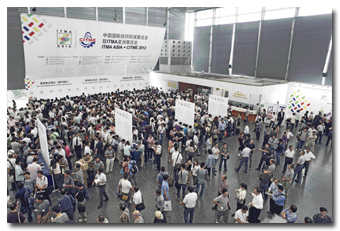
ITMA Asia + CITME 2012 hosted 1,298 exhibitors and around 92,000 visitors at the Shanghai New International Expo Centre.


“The opportunities presented by China’s huge market remain an attraction for machinery manufacturers from around the world,” said CEMATEX President Charles Beauduin. “With rapid technological advances in the textile machinery industry, the market is seeing the emergence of more efficient machines at competitive prices.

“Having held three successful presentations of the ITMA Asia + CITME combined show since its launch in 2008, we are confident that the upcoming showcase will be the most effective marketing and sourcing platform for both Chinese and international textile and textile machinery manufacturers.”

Exhibitors And Visitors
ITMA Asia + CITME 2012 welcomed 1,298 exhibitors from 28 countries and regions — with China, Italy, Germany, Taiwan and Japan as the top five participating economies. Total exhibition space grossed more than 130,000 square meters. Approximately 92,000 visitors from 107 countries and regions toured the show floor during the five-day exhibition. The greatest number of overseas visitors came from Japan, India, Taiwan, Indonesia and Korea. More than 25 percent of visitors were from overseas.


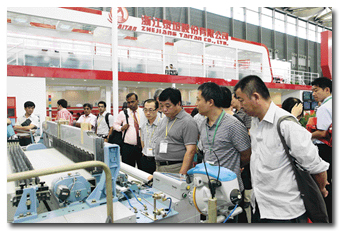
ITMA Asia + CITME attendees observe a demonstration of a weaving machine on display at the 2012 show.

Product Categories
Products will be arranged into 17 chapters as follows:

  • Chapter 1 — spinning preparation, man-made fiber production and spinning machinery; and auxiliary machinery and accessories;
  • Chapter 2 — winding, texturing and twisting machinery; and auxiliary machinery and accessories;
  • Chapter 3 — machinery for web formation, bonding and finishing of nonwovens and felting; and auxiliary machinery and accessories;
  • Chapter 4 — weaving preparation, weaving and tufting machinery; and auxiliary machinery and accessories;
  • Chapter 5 — knitting and hosiery machinery, auxiliary machinery and accessories;
  • Chapter 6 — embroidery machinery, auxiliary machinery and accessories;
  • Chapter 7 — braiding machinery and accessories;
  • Chapter 8 — washing, bleaching, dyeing, printing, drying, finishing, cutting, rolling and folding machinery; and auxiliary machinery and accessories;
  • Chapter 9 — garment-making machinery, other textile processing machinery, auxiliary machinery and accessories;
  • Chapter 10 — laboratory testing and measuring equipment and accessories;
  • Chapter 11 — transport, handling, logistics, storing and packing equipment and accessories;
  • Chapter 12 — equipment for recycling, waste reduction, and pollution prevention; and accessories;
  • Chapter 13 — software for design, data monitoring, processing and integrated production;
  • Chapter 14 — dyestuffs and chemical products for the textile industry;
  • Chapter 15 — equipment and products to ensure machinery and plant operations;
  • Chapter 16 — services for the textile industry; and
  • Chapter 17 — research and educational institutions.

ITMA Asia + CITME 2014 organizers affirm that intellectual property (IPR) infringements will not be tolerated, and stringent regulations will be enforced. The show again will operate an active IPR office onsite to assist exhibitors who have suspected patent issues. Exhibitors may photograph and film their own stands but are prohibited from photographing and filming other exhibitors’ stands.

Show organizers believe ITMA Asia + CITME’s successful track record will attract the best the textile industry has to offer and will pave the way for another successful event. “The combined show has been highly recognized by leading textile and textile machinery industry players as it offers them a reputable showcase in China for their products and services,” said Wang Shutian, president, CTMA. “With the stellar demand projection of Asia’s textile machinery and the steady growth of domestic demand for textile and garment, we are confident that the 2014 combined show will score another success.”


For more information about ITMA Asia + CITME 2014, visit itmaasia.com.


March/April 2014

Atlanta Hosts Textile Industry Trifecta

From Tuesday, May 13, through Thursday, May 15, 2014, the Georgia World Congress Center (GWCC) in Atlanta will host a comprehensive textile trade event gathering machinery and technology suppliers for the technical textiles and nonwovens as well as traditional textile sectors; sewn products equipment and services suppliers; and composites value chain. The event will comprise three shows: Techtextil North America 2014 — the 11th North American edition of the annual international trade show for the technical textiles and nonwovens industries; Texprocess Americas — the second edition of the biennial exhibition presenting equipment and technology for the development, sourcing, and production of sewn products; and the JEC Americas 2014 Composites Show & Conferences, the third U.S. edition of the annual show for the global composites value chain.

Techtextil North America, produced by Messe Frankfurt, Atlanta, incorporates the American Textile Machinery Exhibition-International (ATME-I®), which is sponsored by the American Textile Machinery Association (ATMA®), Falls Church, Va., and will present textile machinery and equipment, products and services targeted to the overall textile and apparel industry. Texprocess Americas, co-produced by Messe Frankfurt USA and Sewn Products Equipment & Suppliers of the Americas (SPESA), Raleigh, N.C., incorporates the SPESA Expo sewn products and equipment trade show and will present machinery, plant, processing, information technology systems and services for the textile and textile product making-up sector. The JEC Americas Composites Show & Conferences, organized by JEC Group, Paris, will present the entire composites value chain, from raw materials through manufacturing processes.

“We’ve experienced a very positive response from the industries we serve and are extremely excited about the synergy created through the colocation of our events with JEC Americas,” said Dennis Smith, president, Messe Frankfurt North America. “We now have a waiting list for our Techtextil North America event, and our Texprocess Americas space sales are significant. Together with our extensive educational symposiums of over 22 sessions featuring 120 speakers, we are well-positioned to be this year’s strongest B2B platform for the technical textiles, sewn products and composites industries in the Western Hemisphere.”

“We are pleased about the partnership with Messe Frankfurt,” said Frédérique Mutel, president and CEO, JEC Group. “Both organizations are fully committed to the industry. Both are experts of their sectors and produce high-value events. Together we will deliver a strategic event.”

Altogether, more than 800 exhibitors are expected to show their products and services to approximately 10,000 attendees at the three shows, which will be colocated in GWCC Hall A. Although visitors need register for only one show, they will have access to all three.

Techtextil North America
Techtextil North America is focused on the technical textile/nonwovens sector of the textile industry, and is touted as the only trade show in the Americas that covers the full vertical spectrum of that sector — including research and development, raw materials, production processes, conversion, further treatment and recycling.

To help attendees find providers of the products, services and technologies relevant to their needs and interests, Techtextil North America exhibitors are classified according to 12 application areas: Agrotech; Buildtech; Clothtech; Geotech; Hometech; Indutech; Medtech;  Mobiltech; Oekotech; Packtech; Protech; and Sporttech.

Product groups and services offered include: research, development, planning and consultation; technology, machinery and accessories; fibers and yarns; woven fabrics, laid webs, braiding and knitted fabrics; nonwovens; coated textiles; composites; bondtec; associations; and publications.

The fair also will feature five country pavilions showcasing companies from China, Italy, Germany, Belgium and France.


A visitor at Techtextil North America 2012 talks to a representative at Stedfast Inc., a Quebec-based supplier of laminated and coated textiles for military and other applications.

 
Techtextil Symposium
The 2014 Techtextil North America Symposium — a three-day educational forum held concurrently with the exhibition — will present recent developments in the technical textiles/nonwovens sector. The symposium lineup includes 11 sessions and 60 presentations by leading industry experts covering new fiber technology, protective and military textiles, medical textiles, automotive textiles, smart textiles, nonwovens, nanotechnology, and technical textiles for sports and outdoor applications. The symposium once again will feature a structured program to allow attendees more question-and-answer time with presenters during and after each session.

Texprocess Americas
Texprocess Americas will return to Atlanta following its 2012 debut alongside Techtextil North America. The show is touted as the largest North American trade show displaying equipment and technology for the development, sourcing and production of sewn products.

Product groups and services offered include: computer software and information technology; contract manufacturing and sourcing; cutting, spreading and ancillary equipment; digital, screen, transfer printing, and ancillary equipment; embroidery, monogramming and ancillary equipment; laundry, finishing and ancillary equipment; pressing, fusing, vacuum and ancillary equipment; product identification, labeling and ancillary equipment; sewing and ancillary equipment; other supplies and equipment; fabrics and materials; findings, trimmings, components and accessories; manufacturers; recycling and sustainability; services, associations, publications and academia; supplies; supply chain services; and warehousing, distribution and materials handling.

The fair will feature a new Technology Solutions Pavilion and Theater featuring booth displays and a continuously running series of vendor-sponsored educational presentations showcasing the latest information technology (IT), software solutions and technology-driven services including 2-D/3-D design, product lifecycle management (PLM), enterprise resource planning (ERP), costing, supply chain management and shop floor control, among other services.

Columbia, S.C.-based SEAMS, the National Association for the Sewn Products Industry, will present a “Supply Chain USA — Powered by SEAMS” pavilion covering approximately 2,700 square feet that will feature SEAMS member companies exhibiting their products and services.

Cary, N.C.-based [TC]2, a provider of technology development and supply chain improvement solutions for the apparel, sewn products and related soft goods industries, will organize the Cool Zone, an exhibit area featuring the latest technologies, products and processes in the sewn products industry.


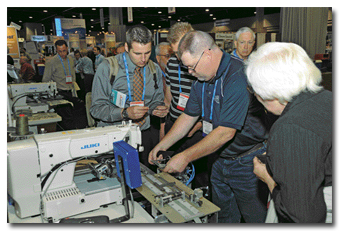
Sewing machinery will be among the range of products shown at Texprocess Americas.

Texprocess Symposium
The Texprocess Americas symposium — a three-day educational forum held concurrently with the exhibition — will present recent developments in the sewn products and equipment industry. The symposium lineup includes 11 sessions and 60 presentations by leading industry experts covering fit and sizing technology; smart textiles; PLM and ERP software; apparel construction; design and product development, automation, smart machines and robotics in apparel manufacturing; welding and stitch-free seam technologies; cut order planning; non-apparel sewn products manufacturing; and reshoring, nearshoring and startup manufacturing.

Student Poster Program
As part of the 2014 symposiums, Techtextil North America and Texprocess Americas together will present a student research poster program. The goal of the program is to provide a forum in which graduate students may present and discuss their work during its early stages, meet peers working in related areas, and meet veteran members in the field. A panel of industry experts will select five students who will present their research to interested technical textile suppliers and end-product manufacturers during the final symposium sessions.
 
Global Initiatives
The U.S. Department of Commerce (DOC) has designated both Techtextil North America and Texprocess Americas as participants in the International Buyer Program  (IBP) Select, which promotes U.S. exhibitions worldwide via U.S. Commercial Services and diplomatic missions. International trade specialists from the DOC will be on hand in the International Business Center on the show floor to offer assistance including complimentary exhibitor matchmaking services to connect exhibitors with international buyers; export counseling; and market analysis. IBP also will distribute to all international visitors a show directory of U.S. exporting exhibitors.

Messe Frankfurt USA and the DOC have identified Mexico, Colombia, Chile, Brazil, the Dominican Republic and India as the top countries to bring buyer delegations to Techtextil North America and Texprocess Americas via the IBP Select program.

JEC Americas
The JEC Americas Composites Show & Conferences will be held this spring in Atlanta for the first time. JEC Group — which also organizes a spring show and conference in Europe, fall show and conference in Asia, and fall conference in the United States — provides networking and information services for composites markets and is said to be the largest composites industry organization worldwide. The focus of the spring 2014 show and conference in Atlanta will be on composites materials and manufacturing.

Composite sector fields include processing and technologies; fibers and textiles; resins; fillers and additives; machines and equipment; software and services; universities and research centers; and consulting firms. End-user markets include aeronautics, automotive, wind energy, construction, marine, consumer goods, and medical, among other markets.

JEC’s Innovative Composites Summit Conferences (I.C.S.), a program of strategic, technical and end-user conferences, is a three-day event that will include presentations offering insights on the latest composites innovations, with forums on Tuesday focused on Materials; Wednesday, Application Sectors; and Thursday, Equipment & Process. The I.C.S. program will conclude with a technical poster session during which each speaker will present a poster with technical data for a specific product or industry.

The event also will include the JEC Americas Innovation Awards, which recognize new products, processes and applications in the composites industry.


For more information about Techtextil North America 2014 and Texprocess Americas, contact Kari Martin +770-984-8016 ext. 428; kari.martin@usa.messefrankfurt.com; techtextilna.com; texprocessamericas.com. Detailed symposium schedules may be found on each of the show’s websites. For more information about JEC Americas 2014 Composites Show & Conferences, contact Aaron Wood +413-448-2260 ext. 470; awood@ahminc.com; jeccomposites.com.


March/April 2014

From The Editor: Textile World’s Innovation Award & Forum

By Jim Borneman, Editor In Chief

The textile climate seems to be changing for the better. This year, for the first time in several years, Textile World will present the Textile World Innovation Award. As those of you who received the award know, the dedication of an issue of TW to highlight innovation within the honored company is a time-consuming but rewarding process — and the presentation luncheon is a terrific industry gathering. There are several qualified candidates this year, and an announcement will follow soon.

This year also, TW will launch the Textile World Innovation Forum 2014 as a two-day, high-level conference offering industry professionals unique insights into diverse areas of textile manufacturing such as fiber, spinning, knitting, weaving, nonwovens, dyeing, printing, finishing, apparel manufacturing, and special interest areas. This will be a single-track conference focused on the latest innovations across the textile-manufacturing spectrum and will culminate with the Innovation Award presentation and luncheon.

A career in textiles often starts with a broad textile education — for this textile engineer, the course exposure was directed to many facets of the industry. However, for many, the exposure narrows as a career progresses — a natural process as one becomes a sector-focused expert. The challenge often lies in staying up-to-date in areas in which your career is not particularly focused. Changes in these indirect areas often have a direct impact on an area of focus. An innovation in fiber can impact a dyer. An innovation in spinning technology can impact a finisher or apparel designer, and so on.

The idea of the Textile World Innovation Forum is to help high-level industry professionals who are short on time get a high-value dose of the latest and greatest developments across the full textile spectrum — the process technologies, the trends and short doses of hot topics. The inaugural conference will be held Sept. 15 and 16, 2014, at the Cobb Galleria Centre in Atlanta and will conclude with the presentation of the Textile World Innovation Award 2014 to a leading textile company in recognition of its outstanding efforts and accomplishments in product invention and innovation. TW‘s editors would like to thank the honored company in advance for providing time, access and support to tell the innovator’s story.

The Forum will have a cost associated with it, but please consider attending and/or using this opportunity for training of high-level staff in a pre-ITMA year, and celebrate innovation with industry leaders. TW’s editors are focused on enlisting neutral industry experts, academics and consultants to lead the proceedings so that the information will be balanced and inclusive across each industry segment. As more information becomes available, it will be posted on TextileWorld.com, published in the pages of Textile World magazine and highlighted in the weekly Textile World e-newsletter.

The climate has shifted positively for U.S. textiles, with surprising levels of investment being announced. Exploring innovation provides a great opportunity to prepare for growth and maximize the benefits of the latest in applied textile technology.

March/April 2014

Engineered Solutions Acquires Rocan

Textile research and consulting services provider Engineered Solutions PLLC, Charlottesville, Va., has purchased the intellectual and technical assets of Greensboro, N.C.-based consultancy and technology management services provider Rocan Inc. The acquisition includes a technical library containing a collection of reference files and publications relating to the flammability of textiles.

The two companies partnered in 2009 to expand research services and technical services related to textile product flammability. Retired Rocan Founder Clyde T. Cante will serve as an advisor to Engineered Solutions and its president, Hardy Poole.  

Engineered Solutions’ laboratory in Burlington, N.C., is equipped to perform microscopy and chemical analysis of textile materials as well as flammability testing in accordance with government and voluntary industry standards.

March/April 2014

Green Applications To Establish Manufacturing In Virginia

Secaucus, N.J.-based textile printer and distributor Green Applications LLC — a division of Green Distribution — is investing $9.75 million to set up manufacturing operations and create 323 jobs in Gordonsville, Va.
 
Established in 2009, Green Applications has grown from a small printing operation employing six people to one of the largest printers and distributors of textile merchandise and heat-applied graphics on the East Coast, with a current workforce totaling more than 450 people. Its 100,000-square-foot (ft2) Secaucus facility houses a screen-printing operation, and it has another operation elsewhere in the Northeast that manufactures heat-applied graphics. The company currently prints and distributes more than 50,000 shirts and garments daily, and its customers include well-known global brands.
 
The company is installing machinery and equipment in a 170,000-square-foot facility that formerly housed a printer of catalogs and special interest magazines that closed in 2011, putting more than 100 people out of work. The facility will house screen-printing and heat-applied graphics operations as well as a distribution operation, and is expected to open in mid- to late summer of this year. It is situated on a 33-acre site, and there is potential to expand as the need arises.
 
According to Green Applications Owner and CEO Robert Butters, manufacturing operations in the Northeast will continue, but some distribution activity will be consolidated at the Gordonsville site. “We’ve had a really successful couple of years, and we need more space and we need to grow our workforce. Geographically, it really makes sense to be in the middle of the East Coast, but we also need our Northeast presence.
 
Butters noted that from its new location in Virginia, the company will be able to ship product to any location on the East Coast within two days. “As the textile print and embellishment industry moves back to domestic production, being located in the center of the East Coast allows us to deliver quick-turn and strategic solutions to our customers,” he said, adding, “I am excited by the tremendous growth potential in the region.”
 
“It is a pleasure to welcome Green Applications to Virginia as the company further expands its footprint on the East Coast,” said Virginia Governor Terry McAuliffe, who has approved a $540,000 Governor’s Opportunity Fund grant to assist local governments with the project.
 
March 11, 2014

Fourth Presentation Of ITMA ASIA + CITME Sold Out Ahead Of Event

SINGAPORE — March, 14, 2014 — The fourth combined ITMA ASIA + CITME exhibition is gearing up for another mega showcase in Shanghai, China.

To be held from 16 to 20 June 2014 at the Shanghai New International Expo Centre, the show will gross 152,200 square metres in 13 halls, 15 per cent larger than the last edition in 2012. To-date, the event has attracted the participation of 1,351 textile machinery manufacturers from 27 countries and regions.

Taking up the largest exhibition area are Chinese exhibitors, booking slightly over 66 per cent. European manufacturers, taking over 22 per cent of the total exhibition space, are the next biggest contingent.

Mr Charles Beauduin, President of CEMATEX, said: “Textile machinery manufacturers are still buoyant about the Asian market, particularly China. Investments in cost-effective technology to help the textile and garment industry stay ahead of the competition are still strong. As such, our combined show will continue to be the unrivalled marketing platform for textile machinery manufacturers tapping into the vibrant China market.”

Mr Wang Shutian, President of China Textile Machinery Association (CTMA), added: “Interest in the combined show remains extremely strong, especially from Chinese textile machinery manufacturers. As China’s textile industry continues its transformation, the demand for advanced machinery and technology is on the rise. This is also reflected in the current uptrend in textile machinery trade.”

According to statistics from the General Administration of Customs, China’s exports of textiles and garments amounted to US$26 billion in 2013. This is an increase of 7 per cent over the same period last year.

China continues to focus on upgrading technology and skills to reach an international level for textile and other industry sectors, and this is one of the priorities under the government’s 12th Five-Year Plan period (2011-2015).

Extensive visitor promotion
ITMA ASIA + CITME 2014 is being promoted throughout Asia by means of numerous roadshows and visits to trade associations. Recent roadshows in India, Indonesia, Pakistan, Turkey and Vietnam have drawn very positive responses from the local industries, and delegations and groups of visitors from key textile manufacturing economies have indicated their intention to visit the showcase.

In China, an intensive roadshow covering Fujian, Guangdong, Shandong and Zhejiang provinces is currently underway.

Hassle-free online registration
Visitors are advised to plan their visit early. To avoid onsite queues, visitors can purchase their badges online at www.itmaasia.com and www.citme.com.cn to enjoy an attractive 40 per cent discount. For added convenience, visitors may print their badges after successful registration.

For more information on ITMA ASIA + CITME 2014, please visit www.itmaasia.com, or www.citme.com.cn.

Posted March 14, 2014

Source: CEMATEX, CCPIT-Tex, CTMA and CIEC

Aspland To Receive Olney Medal, AATCC’s Highest Award

RESEARCH TRIANGLE PARK, N.C. — March 13, 2014 — John Richard “Dick” Aspland is the 2013 recipient of the Olney Medal for outstanding achievement in the field of textile chemistry. The Olney Medal, the highest award presented by AATCC, is for outstanding lifetime achievement in a field of major importance to textile science.

Aspland’s research has included a wide range of textile chemistry interests including fluorescence of dyeings and laundered fabrics (bispectralspectrometry); fastness properties of dyeings on novel polymers; implementation of novel shade sorting software for color users from color-instrument manufacturers to apparel cutters; the influence of fiber, yarn, and fabric parameters on the physical properties of coated fabrics; synthesis of isotopic tracers for studying diffusion in nylon dyeing; the effect of color distribution on the color appearance of yarns, fibers, and fabrics (microspectrometry); and the interactions between pigment particles and polymers.

Aspland has been active in textile chemistry for more than 50 years as scientist, researcher, and educator in academia and industry. His book, Textile Dyeing and Coloration, published by AATCC in 1997, has been used as a “premier text on dyeing.” Aspland and his former student, Ann Laidlaw, together published the AATCC Color Guidebook in 2011. Aspland has published more than 145 articles in peer-reviewed journals and in conference proceedings, three peer-reviewed book chapters, and holds two patents.

A member of AATCC since 1971, Aspland received the AATCC Harold C. Chapin Award for service to AATCC in 1999. In 2005, he received the AATCC William J. Weaver Paper of the Year Award for his contributions to textile science literature. He also received the Award for Faculty Excellence in 2000 and 2002 from the Clemson University Board of Trustees, the J.J. Lyons Distinguished Teacher Award in 1995-96, and the College of Commerce and Industry Teacher of the Year Award for 1993-94. He was elected Fellow of the Textile Institute in 1988 and Fellow of the Society of Dyers and Colourists (C.Col.F.S.D.C.) in 1968. He has been a senior member, Fellow, and Examiner with the SDC since 1956, and a fellow of the Textile Institute since 1987. He is also a member of the Inter-Society Color Council and the Fiber Society. He has traveled extensively nationally and internationally, as invited speaker or as consultant/trainer, on programs of dyes, dyeing, finishing, and color and textile chemistry. Aspland’s outreach extends from the local community to the greater textile industry.

The award will be presented at the AATCC International Conference, which is being held April 1-3, 2014, at the Crowne Plaza Resort in Asheville, NC. USA. For additional information on IC 2014, go to the AATCC website.

Posted March 14, 2014

Source: AATCC

Sponsors