Yarn Market: U.S. Yarn Industry Improves Competitive Position

By Jim Phillips, Yarn Market Editor

The U.S. yarn industry currently enjoys the best competitive position it has had in many years. With its increased efficiencies, excellent customer service and a stellar record for fulfillment, spinning executives and industry observers are confident that, given a level playing field, the domestic industry can compete favorably with almost anyone.

“One of the key elements, of course, is for our government to make sure that our industry is not handicapped by the concept of free trade that is free for everyone but us,” said one industry insider.

TPP Update
In the arena of free trade, concern remains over the Trans-Pacific Partnership (TPP), a proposed free trade agreement (FTA) among the United States, Australia, Brunei Darussalam, Canada, Chile, Japan, Malaysia, Mexico, New Zealand, Peru, Singapore, and Vietnam.

Of particular interest to the U.S. industry is the desire of Vietnam, the world’s second-largest apparel manufacturer, to enter the agreement without a yarn-forward rule of origin, or, at the least, with a modified version of the rule.

“The yarn-forward rule of origin has been the standard textile rule in FTAs for the past 25 years and the rule that the Obama Administration has tabled in the TPP negotiations,” states a policy document from NCTO. “The rule requires that the yarns, fabrics and the final garment be produced within the FTA countries in order to get benefits under the FTA.”

NCTO continues: “To date, the U.S. government has proposed one major flexibility to the TPP rule of origin, a short supply list; however, it is possible that other flexibilities will eventually be raised for consideration. Alternatively, the government of Vietnam is pushing for a ‘weak rule of origin’ or ‘single transformation rule’ — a rule that merely requires that the cut and sew aspect of the production process be performed in a TPP country.” Ultimately that would mean that China, which is not a part of the proposed agreement, would be able to supply Vietnam with yarns and fabrics without having to meet the requirements or standards set forth for other TPP participants.

Said one yarn broker: “If Vietnam is allowed to enter the TPP without a yarn-forward rule, it would be devastating for the U.S. industry. It would give China almost unlimited access to the U.S. market — without China having to abide by any of the provisions of the TPP.”

The trade agreement was scheduled to be finalized in February in Singapore. However, enough disagreement remained among potential members that the negotiations adjourned with little progress. At this point, it looks unlikely any additional movement will occur before the mid-term U.S. elections, sources say.

Innovation And Speed
TPP aside, the U.S. yarn industry is enjoying a period of sustained prosperity. And spinners and experts point to several factors as primary contributors. For example, U.S. capacity is, at the moment, roughly equal to demand. However, over the past few years, demand has outstripped supply significantly on several occasions. Also, increasing costs in Asia are making U.S. prices more competitive.

But, as many spinners point out, a major factor in the resurgence of the industry has been innovation. “It’s important that we keep looking at the market to find where we can differentiate ourselves to create a competitive edge,” said one specialty spinner. “We try to fulfill unmet needs and make yarns that no one else either can or will. We are able to maintain good margins because our customers cannot get similar products from anyone else.”

A significant advantage exists for U.S. manufacturers in both quality and delivery. “To be successful in today’s climate requires a total commitment to quality and a total commitment to service,” said one spinner. “Yarn manufacturers have to be able to process and turn around orders faster than ever before. Quality and speed to market — those are the only two real differentiators these days unless you have a truly unique product.”

Added a specialty ring spinner: “Lead time is often the most important thing — more important in some instances than price. “We are rarely going to win on price, but we can compete favorably when lead times are critical.”

May/June 2014

Quality Fabric Of The Month: Bio-Stretch

By Janet Bealer Rodie, Contributing Editor

Wichita, Kan.-based Invista S.a.r.l. has announced the availability of a bio-derived LYCRA® fiber — the first spandex to join the growing list of biobased/bio-derived man-made textile materials.

The company is ramping up production of the fiber and expects it to be offered in Fall/Winter 2015-16 and Spring/Summer 2016 apparel collections worldwide.

Spandex is now featured in a very wide range of apparel products made with both man-made and natural fibers, and it is a popular addition because it enhances a garment’s comfort, fit and freedom of movement. According to Robert L. Kirkwood, Ph.D., Invista’s executive vice president technology & marketing, Apparel, bio-derived Lycra, made using corn dextrose, behaves like traditional Lycra vis-á-vis all performance attributes and can be processed using traditional manufacturing processes.


Bio-derived LYCRA® is expected to generate interest particularly in the sustainability-conscious denim and activewear sectors.

Kirkwood believes bio-derived Lycra will generate interest particularly among activewear and denim brands. “Those seem to be the market segments and brands that are most active in the sustainability area,” he said, also mentioning interest among the swimwear and lingerie segments.

This new Lycra product is 70-percent bio-derived, with the balance derived from petrochemical feedstock. As Kirkwood explained: “Using an enzymatic process, dextrose is converted into butanediol (BDO), a precursor of polytetramethylene ether glycol (PTMEG), which is the ‘soft segment’ of spandex and gives the fiber the ability to stretch. This segment is 100-percent biobased,” he said. “The other ingredient, methylene diphenyl diisocyanate (MDI) is the ‘hard segment.’ MDI prevents spandex from breaking and gives it some strength and allows it to recover. We haven’t found a biobased source for this compound, but over time, that will come.”

Bio-derived Lycra production generates lower carbon dioxide (CO2) emissions than traditional Lycra production. “For biobased BDO production, there is a 70-percent reduction in CO2 emissions compared with conventional BDO production. By the time it is turned into Lycra, there is a 25-percent total reduction considering all steps in the fiber’s production,” Kirkwood said.

Bio-derived Lycra is currently priced in the range of Invista’s normal specialty offerings, Kirkwood said. “Over time, if there’s enough interest, it will be the same price as standard Lycra,” he said, adding that demand will drive investments in large fermentation plants to make biobased BDO.

Kirkwood said customer interest in the new product is very encouraging. “We’ve talked to mills and brands in the United States and Europe, and 80 percent of them have expressed interest,” he said.


For more information about bio-derived LYCRA®, contact Denise Sakuma denise.sakuma@invista.com.


May/June 2014

Global Apparel Textile Trade Shows In New York

Texworld USA, whose Spring/ Summer 2015 edition was recently staged at the Javits Convention Center in New York City with 268 exhibitors from 18 countries, is the largest textile and apparel trade show in the city. Kingpins, held at The Tunnel on 11th Avenue, is the smallest, with less than 60 exhibitors, all focused on denim.   
 
Texworld USA
The 16th edition of Texworld USA, produced by Messe Frankfurt USA, Atlanta, was joined by the fifth International Apparel Sourcing Show, where buyers could locate global manufacturers of apparel and accessories for men, women and children. Most of the apparel sourcing exhibitors were from Asia and included formal and casual wear producers, as well as producers of gloves, scarves, hats and slippers.
 
Lenzing AG, Austria, showed new fabrics and innovations containing Lenzing Modal® and TENCEL® fibers. One new collaboration features a variety of novelty fabrics with cotton. Tencel/cotton fabrics include soft-hand shirting weights, knit-look wovens, transparencies, ultralight twills and sweater knits in blends with organic cotton. There are bottomweight chinos, plaids, and a lot of novelty. Other fabrics are blends with linen, alpaca, wool and LYCRA®. Most have a soft touch, subtle sheen and drape.

At Buhler Quality Yarns Corp., Jefferson, Ga., Supima® cotton, MicroModal® and MicroTencel are best sellers. The most common yarns are 30/1. “When using fine-count yarns, we must upgrade the quality of fibers we use,” said David Sasso, vice president, sales. “And with air-jet spinning, we do have an advantage. We’re working on concepts such as performance, including TransDRY® [moisture management].” Home areas Buhler is selling into include ultrafine sheets and coarse towels.


The fifth International Apparel Sourcing Show was held in conjunction with the 16th Texworld USA at the Javits Convention Center in New York City.

Tuscarora Yarns Inc., Mount Pleasant, N.C., the largest U.S. producer of ring-spun and open-end specialty yarns, showed novelties such as a slubbed yarn of polyester/cotton and a natural tri-blend. At the show, there was great interest in flax. EcoSure™ is a polyester/flax blend. A micro polyester/MicroModal blend was shown in a very soft, light jersey. “There is great demand for yarns made in the USA,” said Kim Williams, director of marketing, “and we’re known for making the fun stuff.”

Samil Spinning Co. Ltd., South Korea, sells to knitters and weavers. Ecosil is an air-jet spun, twisted eco-friendly yarn. DrySil® is fast-drying with moisture management. There is a lot of Modal, Tencel and high-tenacity rayon. Samil’s Lenzing FR® yarns are used in textiles for the South Korean army.       

Mansfield Textiles Inc., Vernon, Calif., has new jacquard machines that are knitting novelty stripes with surface interest such as bubbles and flecks. Of special interest are new stripes, French terries, small textures and eco-knits with Modal or Tencel. An ultralight, soft piqué was pointed out. “Our business is up over 25 percent,” said Warren Zaretsky, vice president, sales.     
 
Laguna Fabrics, Los Angeles, knits all of its fabrics in California. The range is enormous. A hairy, soft sherpa is knitted of Modal/polyester. There are slubbed linen jerseys, Tencel/flax sweater knits, soft-hand ribs with coordinates and a double-faced French terry that is a very good seller.  Textures are selling, and their business is up more than 15 percent.

Miroglio Group, Italy, also is an exhibitor at Première Vision. At Texworld, the company shows fabrics that are designed in Italy and made in Asia. Best sellers are coordinating heavy stretch striped and plain knits. There are mesh knits, open pin dots, large and small bubble textures, silver-coated double-faced leathers, metallic sheer animal skins, lustered and lacy iridescent sheers, and denims.

Mozartex Co. Ltd., China, has an extensive line of woven fabrics and prints. There is a lightweight denim for tops. Foil prints with stretch can be very shiny allovers or blotchy with semi-sheen. There are carbon coatings and wax coatings. Prints include misted florals, alligators, melted grounds and misted looks.

Everest Textile Co. Ltd., Taiwan, showed eco-friendly organic cotton/recycled polyester fabrics including fast-dry and “function with fashion,” which has a lot of stretch.

The next Texworld USA, which will include the International Apparel Sourcing Show and the Home Textiles Sourcing Expo, will be held July 22-24, showing fabrics for Fall/Winter 2015-16 (See “Texworld USA: A Sourcing Spectacle,” this issue).

Kingpins
Not only are major denim producers at Kingpins, but this show also features what goes into denim and what goes with it. Fiber producers and marketers include Invista, Wichita, Kan.; Cotton Incorporated, Cary, N.C.; and Lenzing. Invista is a sponsor. Kingpins started in 2004 with 25 exhibitors. “I want to keep it small and focused,” said Andrew Olah, the show’s producer.   

Invista has partnered with Lenzing to create denim that eliminates seam slippage and puckering, and has improved recovery. Tencel, with its soft hand, light weight, slippery touch and luster, is combined with Lycra T400® to create denim with great stretch and recovery that has all of the attributes in demand. Both stands featured tight jeans that fit well, and provide comfort and skin friendliness.


The Lenzing Innovation pavilion at Texworld USA showcased companies whose offerings feature Lenzing Modal® and TENCEL® fiber.
 

Cotton Incorporated showed new denim products it has developed including foil-coated denim, digital prints, splatter prints, double faces, iridescence, TransDry and knits. One jersey is knitted with ring-spun yarns, and is ultralight and soft.  

Cone Denim, Greensboro, N.C., has soft-touch denims with enhanced power stretch using SGENE® technology. The company is using Tencel to make lightweight soft-hand jeans fabrics, and linen for a dry hand; and it has created an ultralight, almost chambray-weight denim of 100-percent cotton. Another product is a light, soft denim that has a cationic coated weft yarn that provides different colors on each side of the fabric.  

Tavex Corp., Spain, noted that men now like stretch jeans. Standard is 30-percent stretch; super-stretch is 40-percent; and for absolute fit, there is 60-percent elasticity. Tavex is using Lycra T400 blended with cotton. Tencel denim is a work in progress.  

Siddiqsons, Pakistan, is a vertical company from spinning to garment manufacturing. Knitted denim has a woven look, and is soft to the touch and rope-dyed.  


Jean Hegedus, global marketing director — bottoms, Invista, shows a pair of denim jeans that contain Invista’s CoolMAX® technology.

Textil Santanderina, Spain, sells to Ralph Lauren, Guess, Abercrombie & Fitch and Lands’ End. There are compact cotton sateen jeans fabrics, cotton/Tencel shirtings and bottomweights. Fabrics of 100-percent Tencel are light, lustrous and indigo-dyed. Some wovens have a knitted look. Discharge prints on shirtings can be dyed black and bleached for a marbleized look. There is a lot of stretch.  

At American Denimatrix, fabrics are woven in Littlefield, Texas, and made into jeans in Guatemala. Novelty jeans include foil-coated garments. All jeans can be traced back to the farm that grew the cotton — including the Certified FiberMax® or Stoneville® cotton varieties, both developed by Kingpins exhibitor Bayer CropScience AG, Germany.

There was great interest in SILVADUR™ by Dow®, a sustainable, durable, protective, controlled-release antimicrobial process developed by Dow Microbial Control, a business unit of The Dow Chemical Company, Midland, Mich. Silver ions provide odor control by interacting with odor-causing microorganisms on the surface of treated fabrics, and a lesser amount of active ingredient is required compared with other antimicrobial ingredients including other silver-based ingredients. Levi’s is using Silvadur.

May/June 2014

Pulcra Chemicals Expands

Pulcra Chemicals LLC, Rock Hill, S.C. — the North American business of Fashion Chemicals GmbH & Co. KG, Germany — will invest $3.1 million to expand its Rock Hill operations and add 17 jobs.

Pulcra relocated in 2011 from Charlotte to its current 63,000-square-foot (ft2) facility, which houses its offices, laboratories, warehouse and manufacturing operations. The company will add 8,000 ft2 of warehouse and manufacturing space, and install reactors.

The expansion is expected to be completed in the first quarter of 2015.

May/June 2014

Bolger & O’Hearn Debuts Eco-friendly Altoma Binder

Fall River, Mass.-based specialty chemicals producer Bolger & O’Hearn Inc. has introduced Altoma Binder 10580, an eco-friendly formaldehyde-free and alkylphenol ethoxylate (APEO)-free print and finish binder for textile and nonwoven substrates. The company reports the product offers good fastness properties and mechanical stability while retaining a soft hand, enabling it to be used in printing, finishing and coatings.

May/June 2014

Looking Forward

The year 2013 was one of significant and positive change for NCTO and the U.S. textile industry overall. In April, NCTO successfully completed a merger with two other textile trade associations, the American Manufacturing Trade Action Coalition (AMTAC) and the National Textile Association (NTA). This merger expanded NCTO membership, strengthened the industry’s federal representation, and positioned NCTO as the unequivocal voice of domestic textile producers with both the legislative and executive branches of our government. Although NCTO, AMTAC and NTA previously collaborated closely on important policy issues, the united association has a stronger voice and a broader reach to members of Congress in every part of the country.  


NCTO Chairman James C. “Jay” Self III

Trade Issues
The year 2014 will be very critical for the U.S. textile industry. This year, it is important to ensure a positive conclusion to the TPP negotiations. TPP remains, by far, the most important policy issue for the U.S. textile industry. TPP continues to pose the largest challenge to the domestic industry in 20 years, with the objectives of negotiating partner Vietnam remaining a critical concern. Throughout the negotiations, the U.S. industry has remained united and engaged. It has stressed that a strong, reasonable rule of origin is essential to ensuring that only the TPP partner countries benefit from the agreement, and any additional flexibilities outside of the short supply list will be damaging to domestic textile manufacturing.

Because the industry has been able to demonstrate the tremendous value that strong rules of origin have for textile manufacturing jobs, investment, and exports, the U.S. government has remained steadfast in pursuit of a yarn-forward rule of origin in TPP. In addition, it is imperative that any agreement include protracted duty phaseouts on sensitive textile and apparel items, and strong customs enforcement provisions. At this point in the negotiations, it appears that each of these goals is achievable. As with previous trade agreements, though, many substantial and potentially damaging provisions could be reserved for the very end stages of the negotiations.


Incoming NCTO Chairman Jay Self, Greenwood Mills (left), presents outgoing Chairman Bill Jasper, Unifi Inc. (right), with a plaque expressing appreciation for Jasper’s service.

After the conclusion of TPP, the next big trade issue facing the U.S. industry is the Transatlantic Trade and Investment Partnership (TTIP), a free trade agreement between the U.S. and the European Union. If this agreement is structured properly, U.S. and European industries have the opportunity to grow trade and attract new investment. While this may seem to be a simpler overall agreement, there are challenges: The EU is insisting on a complicated “double transformation” rule that effectively cuts fiber and yarn producers out of the agreement. In many cases, that rule also cuts fabric producers out of the agreement. The EU is also pressing for access to U.S. military contracts. NCTO is already working with partners throughout the U.S. industry to communicate their position to the U.S. government and to their industry counterparts in Europe.

Berry Amendment
This year, NCTO is also focused on the need to preserve and enhance the Berry Amendment, which requires that all apparel and other goods made of textiles purchased by the U.S. military contain 100-percent U.S. fibers, yarns and fabrics; and are cut, sewn and assembled in the U.S. The Berry Amendment ensures that critical U.S. military needs are not dependent on foreign countries. Defense procurement has become an extremely important aspect of the U.S. textile industry’s overall portfolio, and will remain an issue of great interest.


Left to right: Jonathan Sadinoff, 1888 Mills, discusses Western Hemisphere strategies as Steven DiBlasi, Lanier Clothes, and Augustine Tantillo, NCTO, listen.
 

Industry Expansion
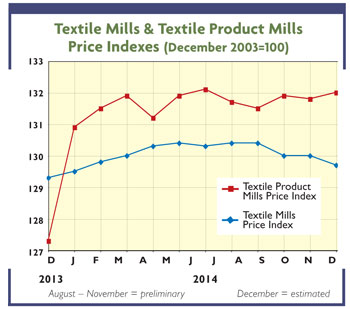
These policy developments and challenges come at a time when the industry is enjoying an impressive rebound. U.S. textile shipments topped $56 billion in 2013, up more than 5 percent from the previous year, and U.S. textile exports were $17.9 billion in 2013, up nearly 5 percent. Much of this export growth is due to the yarn-forward rule of origin in this country’s regional free trade agreements, and there is also growth to new markets and growth in new products. Additionally, the U.S. is enjoying an investment surge in new plants and equipment in the textile sector. The fact that companies from lower-wage countries are coming to the U.S. to manufacture textiles says a lot about the competitiveness of the U.S. industry.

After decades of downward pressure on this sector, the U.S. textile industry has not only stabilized, it is expanding in practically every key economic indicator, including investment, output, employment, and exports. NCTO is committed to shaping the discourse in Washington on textiles and apparel, and communicating the value of the industry’s contributions to the U.S. economy and the economies of its Western Hemisphere trading partners. In the coming year, NCTO looks forward to working with lawmakers and the Obama administration to create a stable and logical policy environment that fully recognizes the value of the U.S. textile industry and its workforce.


Please click to view chart larger

May/June 2014

From The Editor: U.S. Textiles: More Positive Signs?

By Jim Borneman, Editor In Chief

The recent Americas Apparel Producers’ Network (AAPN) meeting in Miami confirmed the continuing buzz that good things are occurring in the Western Hemisphere’s textile supply chain. As always, the apparel business continues to be pressured on price, but there seems to be a growing appreciation for what the chain can deliver, punctuated by speed and quality.

Investments in new technologies are speeding the delivery of  “from concept to sample” — everything from 2-D and 3-D design systems to printing fabrics at the apparel manufacturer using sublimation printing techniques — and those advances are changing the way business is done.

Another discussion dealt with the changes both in retail and in consumer shopping habits — not just the rise of e-commerce, but e-services that will shop for you, learn your preferences, and hone your wardrobe. The Trans-Pacific Partnership (TPP) was a hot topic, with some saying TPP is politically deadlocked and the yarn-forward rule is safe, and others saying  TPP is still quite possible and the yarn-forward rule is in jeopardy.

In other news, additional announcements of expansions, mergers, and acquisitions continue to show high levels of business activity throughout the industry. Whether it be $48 million in financing for Verdezyne — a biotechnology company focused on producing renewable chemicals — or India-based yarn spinner Shri Govindaraja Textiles Pvt Ltd.’s $40 million-plus investment to establish a manufacturing facility in Eden, N.C. — or Mount Holly, N.C.-based sewing thread manufacturer American & Efird’s agreement with Germany-based Gütermann Holding SE to acquire certain assets and subsidiaries that make up Gütermann’s entire industrial and consumer thread business — all this is great news for the industry.

Techtextil North America will have occurred by the time this issue of Textile World mails, but ahead of the show, there is great optimism, and many exhibitors and attendees look forward to making new contacts and reconnecting with old friends.

The Textile World Innovation Forum continues to come together as topics and experts are selected for the September 14-15 agenda. There has been a strong reception by some very high-level management who believe this will be a great, efficient training and education opportunity for key staff. The focused educational program is being designed to offer the latest process technology information presented by educators and consultants in a balanced nonpartisan approach. Also, TW editors continue to flesh out the story of the Textile World 2014 Innovation Award winner — Union City, Ga.-based TenCate Protective Fabrics of North America. TenCate’s rich history — it will celebrate 90 years in business come 2015 — is providing plenty of material.

The textile industry has changed drastically over the last decade, with many significant players long gone. Maybe that’s why observing increased U.S. and foreign investment, even in traditional parts of the industry, rings so clearly — and there is an abounding urge to say  “I told you so” to those who long counted the industry out.

May/June 2014

The Rupp Report: Will India Recover Now?

What’s wrong with India? With millions of cheap workers and a huge domestic market, the country should be as successful as China, but it is not. The industry is underdeveloped and unproductive, and it contributes only some 16 percent to the gross domestic product (GDP). Responsible for this misery are the excessive bureaucracy, endemic corruption, poor infrastructure, permanent energy shortages and excessive taxes as well as outdated property rights and restrictive labor laws.
 
India is no longer a land of masters and servants. There is a growing middle class of people who behave as self-confident and self-reliant citizens. According to a survey by the Pew Research Center, 70 percent of Indians are unhappy with the current situation in their country. High food prices, unemployment and inequality are seen as the biggest problems. The great corruption also worries a majority of the respondents.
 
Feudal And Caste Regime
Indian politics still operate as a feudal system. The state and the parties operate under a patronage or clientele system under which a few families and a clique have virtually unlimited power, but they “owe” on the other hand care and benefits to their followers and voters. So while some enrich themselves in the underbrush of nepotism and corruption, the others expect always greater gifts — for example, in the form of government nutrition and employment programs, or cheaper electricity. But many funds never reach the poor, and due to high liability, the state budget and many state-owned companies are close to bankruptcy. The system is no longer sustainable.
 
Weak Industry
At the beginning of the last legislative period, India recorded a nearly double-digit growth and its economic potential was often compared with that of the great rival China. In the fiscal year that ended in March 2014, the GDP grew by only an estimated 4.6 percent; for a developing country with a billion people, this increase is not enough. Economists assume that India should grow by some 8 percent a year to fight the widespread poverty and create enough new jobs. By 2030, an estimated 240 million new workers will enter the market: This is a ticking time bomb.
 
Because of the general slowdown, the industrial sector has declined in the last five quarters. In February, it shrank by 1.9 percent compared to the previous year. The manufacturing sector dropped by 3.7 percent. Under the retracement of production, exports and the service sector both suffered. According to Indian Chamber of Commerce and Industry estimates, the service sector grew by only 6 percent in 2013-14, while exports declined by 3.2 percent compared with the previous year.
 
Banks In Crisis
The banking sector is in a severe crisis. Between 2002 and 2007, many banks had taken advantage of the high liquidity to promote aggressive lending. However, because of the slowdown and the high interest rates, many borrowers are not able to pay back their loans. In order to control inflation, the Central Bank has raised the prime rate up to 8 percent. In the year between December 2012 and December 2013, consumer prices increased by 9.9 percent. Obviously, the high interest rates have slowed down growth and discouraged investors and consumers.
 
Last September, the new governor of the Reserve Bank of India (RBI), Raghuram Rajan, promised a liberalization of the banking system — with no success. Recently, the RBI submitted an action plan to bring the problem under control. First of all, there should be tougher controls on lending and the exchange of information among banks should be improved.
 
Only 11 percent of all industrial companies of India have more than 200 employees; in China, the number is more than 50 percent. In primary industries such as the automotive industry and its suppliers, as well as in the service sector, which accounts for 60 percent of GDP, only a few skilled workers are needed and absorbed. Therefore, India urgently needs to foster industries such as the textile industry, which provide jobs for the uneducated masses. To do so would require land reform, an overhauling of the tax system as well as labor market reform. Workers can hardly ever be fired. For this reason, many workers are only hired with short-term contracts, or work illegally.
 
Some Good News
However, there is good news: As imports in the last fiscal year fell by 8.1 percent, the trade deficit decreased from the equivalent of US$190 billion down to US$138 billion. The current account deficit has fallen from 4.8 percent to 2 percent of GDP. As long as the structural problems are not cleared up, it is unlikely that the government will be able to rehabilitate the budget sustainably. In 2013-14, the budget deficit could be reduced on paper to 4.6 percent of GDP. But the government held back substantial subsidy payments to improve the balance picture.
 
The System Is Close To Collapse
Now, the ruling Congress Party has suffered a bitter defeat. Narendra Modi, the clever man of power, has been elected prime minister by a large majority. The Indian voters hope that Modi, a member of the Bharatiya Janata Party (BJP), will deliver them from poverty. The defeat comes in the wake of of low growth and high inflation, missed reforms and countless corruption scandals. After ten years under technocrat Manmohan Singh, the Indians want a new leader who is full of energy. Entrepreneurs and investors have responded enthusiastically to the victory. The BJP is considered to be more business-friendly than the Congress party. For the first time since the 1980s, the prime minister does not depend on populist regional parties to form a coalition. The hope is that he can push through very necessary reforms alone. How he will achieve that is unknown. Nevertheless, the 67-year-old is a member of the established system with the known evils: corruption, bureaucracy, clientelism.
 
Tame Reforms
The Congress Party had won the 2004 elections with a promise to distribute India’s growing wealth in a fairer way. The unparalleled boom in the following years allowed it to improve the living conditions of the lower stratum of the population through poverty reduction programs and subsidies, which resulted in a growing middle class and a rising economy. In 2009, the Congress Party was reelected by a clear majority. However, Singh, who had directed the economic opening of the country as finance minister in 1991, was a disappointing prime minister in the last ten years with no will for true reforms.
 
There is a crucial need for reforms in the state bureaucracy, especially in the legal system. The Indian bureaucracy has a lousy reputation. The general complaint is that there are too many regulations and bans, high taxes, infinite official channels in intertwined corridors, but no service — unless you shmeer someone. In the extended black economy, there are no controls and no taxes, but also no legal certainty. Modi must act immediately, if he doesn’t want to lose his “advance credit.” Meanwhile, Standard & Poor’s has downgraded India’s creditworthiness to BBB-. There is no doubt that in the coming months, the new government’s reform initiatives and fiscal policy will be observed with a sharp eye.
 
No Alternative
There is no alternative to reforms. Industrial production declined by 0.5 percent in March, and inflation was at 8.6 percent in April. The RBI will therefore have no room for interest rate cuts, and a comprehensive stimulus package from the government is missing because of the high budget deficit. According to experts, to reduce poverty sustainably and create jobs for young people, the country must establish a million new jobs every month. Without a strong industry, this goal is simply unthinkable. Will India now recover?
 
May 20, 2014


Terrot Acquires Pilotelli

Germany-based Terrot GmbH has acquired Italy-based circular knitting machinery manufacturer Pilotelli Macchine Tessili S.r.l.
 
The acquisition will help Terrot fulfill its growth strategy, and also will help Pilotelli to save its business after becoming insolvent. Pilotelli is known in particular for its single-jersey technology expertise, and has a strong presence in Turkey and South America.
 
Pilotelli’s site in Cazzago San Martino, Italy, will continue production under the new organization, Terrot Italy S.r.l. The company will be managed by Terrot’s Peter Schüring and Andreas von Bismarck along with select members of Pilotelli’s management team.
 
“We expect noticeable benefits for our international customers in sales as well as after sales services,” said Andreas von Bismark, managing director, Terrot. “Having good expertise in both companies, we will surely complement each other.”
 
May 20, 2014
 

Coats And GSD Announce Partnership

Coats plc — an England-based global manufacturer of industrial sewing thread and consumer textile craft products — and GSD (Corporate) Ltd. — a United Kingdom-based supplier of management solutions to the sewn products sector — have entered into a strategic partnership through which the companies will work together to offer their respective management solutions that help maximize productivity and decrease costs in the manufacturing sector.
 
GSD will provide time-cost benchmarking, and Coats will provide consulting and technical production expertise — all for retailers, brands and their supply chain vendors. The companies will analyze working methods and manufacturing processes — including machinery and associated equipment requirements — to offer GSD-based Standard Minute Values (SMV), which help brands and manufacturers make fact-based decisions regarding production and also identify thread demand and point out possible productivity improvements.
 
“GSD is an innovative company and a world leader in its field of expertise,” said Paul Forman, group chief executive, Coats plc. “This strategic alliance further strengthens the position of Coats Global Services by providing a valuable addition to the portfolio of products and services we are able to offer our customers.”
 
“This is an important strategic step for GSD and we are delighted to be working with Coats, which is a recognized global leader,” said Paul Timson, managing director, GSD (Corporate) Ltd. “This alliance provides further recognition of our world leading management solutions and consolidates GSD’s position as the accepted international standard in work measurement and productivity improvement. The combination of GSD’s specialist technical knowledge, data integrity and industry experience married to the global reach, industry stature and consulting expertise of Coats, creates a unique and exciting offering.”
 
May 20, 2014


Sponsors