ITMA 2015 Technology: Staple-Fiber Spinning

Advances in spinning technology centered on machine refinements and the use of data to analyze and communicate.

By Dr. William Oxenham

There was no doubt that ITMA 2015 was bigger and busier than previous ITMAs, and it also was clear that attendees were truly international. In the areas covering spinning technologies, the booths were well attended. There were no radically new developments in processing technologies, and this was a show about consolidation and refinement of ideas and technologies.

Progressive improvements in sensors, drives, computer speed and access to massive data storage including cloud-based systems along with software advances in big data analytics, have been adopted by many textile machinery makers. When these various technology improvements are coupled together they are used to provide manufacturers with new tools to ensure optimized yarn production. This not only relates to maintaining and improving yarn quality, but achieving this economically, using minimum energy and fiber. This concept was adopted by the biggest machinery manufacturers who packaged it into a thematic approach to marketing their products and services. Thus while the general goals are “to produce high quality yarns efficiently and economically, with the optimum use of resources including fibers” these ideals were promoted slightly differently by different companies at ITMA. For example, Switzerland-based Rieter used the groupings “Economy, Quality and Flexibility” in its promotional materials, whereas the Switzerland-based Saurer Group adopted E3 — Energy, Economics and Ergonomics.

While many of the ideas promoted may not seem totally new, the huge amount of data acquired coupled with advanced analysis methods, can be used not only to analyze the impact of many parameters on yarn quality and productivity, but also to afford remote process control, and furthermore provide guidelines for machine maintenance and communicate warnings of impending component failures.

Opening, Cleaning And Blending

The blowroom was probably one of the first to benefit from data utilization in the optimization of bale laydowns from fiber data. Blowroom improvements have focused around efficient opening, cleaning and blending of fibers, while minimizing unwanted fiber loss and fiber damage. The use of online data collection from various sensors enables the optimization of different components to achieve these goals, such as with Germany-based Trützschler GmbH & Co. KG’s WasteControl system.

Based on the number of manufacturers offering foreign fiber detectors and eliminators, it is clear that contaminants in the raw material are a major issue. While machines have been available for a number of years to tackle this problem, they tended to have limitations in the type of contaminant that could be detected and ejected. Advances in sensor and lighting technology, particularly LEDs, have broadened the range of contaminants that can be removed.

The Centra from Italy-based Loptex S.r.l. is an optosonar system that combines sonar technology — using piezo emitters/detectors — with a series of 24 color cameras. The sonar system detects white polypropylene (PP) and plastics with the same color as the cotton processed, as well as hidden contaminants such as various plastics of different transparencies and fluorescence. The optical system detects and eliminates contaminants including colored and colorless.

The Trützschler T-Scan TS-T5 has added a G sensor for shiny foreign parts detection to the exsiting F module, which detects colored dark fibers; P module for transparent foreign parts; and UV module for fluorescent foreign parts. Additionally, the system now uses 1,072 LED lights for improved illumination with lower energy usage.

Switzerland-based Uster Technologies AG reports the Uster Jossi Vision Shield 2 provides improved foreign fiber detection by utilizing an imaging spectroscope that operates across a much greater wavelength. This enables the detection of contamination even within the invisible range of infrared and ultraviolet (UV) light. This includes light pastel colors, and particles of similar size to a fiber. Additionally, the spectroscope differentiates cotton from plastics such as PP because cotton tufts exhibit a halo effect under lighting, while plastics do not.

All of the above systems also incorporate sophisticated imaging software and systems to measure the speed of the impurities so that they may be accurately ejected.

Carding

The debate initiated at ITMA 2011 over which carding manufacturer offers the largest carding area, seemed to linger on, but was now directed at claims over the highest production per floor area. Maximum carding production levels, reported by the some of the major machinery makers include the C701 from Italy-based Marzoli Machines Textile S.r.l. with a production rate of 250 kilograms per hour (kg/h); Rieter’s C70 with a rate of 280 kg/h; and Trützschler’s TC 15 at 260 kg/h. Each manufacturer offered options to improve quality and efficiency. Rieter promoted its Integrated Grinding System (IGS) to ensure permanently sharp clothing that not only maintains high-quality card webs, but also potentially extends the life of the card wire. Trützschler demonstrated the T-CON carding information system that interacts with several other components to ensure that optimum settings are utilized. Trützschler also displayed the can filling station

T-MOVE, which essentially means that the sliver feeder is moved from full to empty can rather than the full can being replaced with an empty can under the coiler. This was coupled with the concept of jumbo cans 1.2 meters in diameter by 1.5 meters high, which are claimed to offer 43-percent more sliver per can. Advantages of jumbo cans include moving fewer cans, which yields labor savings; and also fewer piecings in the sliver.

Trützschler also showed the latest version of its IDF 2 linked drawframe with drafts of up to 2.0 and output speeds of 700 meters per minute (m/min). The addition of an autoleveling system makes the system an attractive approach for rotor spinning directly from the card.
SpinningTrutzIDF
Trützschler’s IDF 2 linked drawframe

Drawing And Combing

The newer developments in combing were largely associated with increased productivity, improved quality and reduced cost through greater automation. Rieter’s E 36 OMEGAlap can achieve production of 600 kg/h, which is claimed to be 50-percent higher than competitors. The orientation of fibers is optimized for better combing performance, and the use of a uniform pressure distribution and constant winding speed combine to give outstanding lap formation. The Trützschler-Toyoda TSL lap former claims production levels of 520 kg/h at speeds of 180 m/min. Both lapformers can use manual or automatic transport systems to the combers.

The major development in combing is the use of automatic lap change and piecing. This was shown by Rieter in its E86 comber with ROBOlap, and by Trützschler-Toyoda in the TCO 12 comb, which was also equipped with an autoleveling system on the final drafting unit. India-based Lakshmi Machine Works Ltd. (LMW) exhibited the LK 69 combing machine, which like the other combers, was reported to be capable of 600 combing cycles per minute.

While there is significant automation in preparatory machinery, the sophistication of a modern yarn production entity becomes really apparent when viewing the roving and spinning frame. The sight of an automatic roving frame with autodoffer and package transportation to the ring frame, which in turn may be fitted with autodoffing and link winding, is a strong visual message that the industry is a high-tech enterprise that can compete with any industry in terms of how it utilizes advances in manufacturing technology.

The roving frame used to be regarded as a necessary evil that was somewhat a bottleneck in yarn manufacturing. Advances in automation have certainly improved this situation and different levels of automation were available from the machinery manufacturers. For example China-based JingweiChina Texmatech Co. Ltd. (CTMTC) — or from auxiliary manufacturers such as Germany-based Sohler-Neuenhaser GmbH & Co. KG, Spain-based Electro-Jet S.A., and Italy-based Trascar S.p.A. — formerly known as U.T.I.T. — who offer customized doffing and package transport systems.

Marzoli showed its FT6 Roving frame with roving transfer and an integrated bobbin cleaner. This cleaned any remnants of roving from the packages that were returning from the ring frame as they were transferred back to the creel on the roving fame. The FT6 is offered with up to 224 positions and because of smaller headstock, the machine has a smaller footprint. An additional feature is that each position is equipped with a roving sensor, which stops the machine in the event of a breakage. It is claimed that the use of this device obviates the need for suction to remove drafted fibers in the event of an end break, which provides an energy saving of 4 kilowatt hours.

The Saurer Group showed the new ZinserSpeed 5A roving frame, which claims that optimum use of blowing and suction can result in 20-percent energy savings. This machine can be offered in a manual or automatic version because the roving bench moves out to facilitate the doffing cycle and the automatic version has a doffing time of less than 2 minutes. The system was linked via the RoWeLift transfer station to the roving bobbin transport system, which at the show linked to the ZinserImpact 72 ring frame.

Ring Spinning

As was the case at previous shows, the majority of ring frame manufacturers demonstrated various forms of compact spinning that offer distinct advantages in terms of yarn and fabric properties coupled with greater productivity. This technology does however require greater power for compaction during yarn manufacturing and also there are higher labor costs associated with the additional maintenance required on the compact system. The ZinserImpact 72, which uses a perforated top compacting apron, is claimed to be the world’s longest spinning frame with up to 2,016 positions. The advantage in utilizing the longer frame, from an example of 1,200 spindles, is 21-percent space savings and an 11-percent reduction in processing costs. Saurer reports this compact system’s use of twin fans not only maintains a more uniform suction but can save 50-percent in power costs. The compacting apron design also has been optimized so that the flexion and tension it experiences as it rotates render it self-cleaning.

Rieter showed its K 46 with its now familiar roller compacting system producing Com4® yarns in a machine with up to 1,824 spindles. This machine also incorporates a suction unit for each side of the machine. Additionally, Rieter claims its system only needs 25 percent of the compacting energy of other apron systems, and that the unit obviously does not need frequent apron replacement.

Marzoli showed the Mac3000 compact spinning system, with a perforated bottom roller that can be fitted to several Marzoli spinning machines or retrofitted to existing machines. LMW showed its new compact spinning system LRJ9, which has up to 1,824 spindles. This machine uses a newly developed compacting bottom apron system rather than the mechanical RoCoS type compacting unit that was exhibited at previous shows.
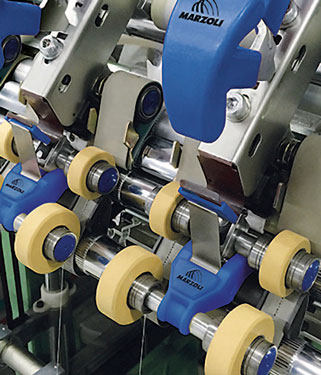
MarzoliMac3000
Marzoli’s Mac3000 compact spinning system

Almost all ring frames were available with automatic doffing and transport systems and most either use an in-house slubbing mechanism — such as Rieter’s Variospin for example — or systems such as those offered by Switzerland-based Amsler Tex AG or Italy-based Caipo Automazione Industriale. Additionally, there were several smaller companies showing attachments and modifications for fancy yarns, including Japan-based Toyota Industries Corp., that demonstrated the RX 300 compact spinning system with independent dual roving feed producing yarns with alternating colors along their length.

Rotor Spinning

The two market leaders, Rieter and Saurer Schlafhorst, showed the latest renditions of their technically advanced fully-automated spinning machines.

Schlafhorst’s Autocoro 9 featuring the Corobox SE 20 spinning units now is available with up to 720 positions per machine equipped with six doffing and cleaning robots. The machine is capable of commercial rotor speeds in the range of 160-180,000 revolutions per minute (rpm) and yarn production speeds of up to 300 m/min. Because the machine essentially consists of an assembly of individually driven spin boxes, there is the potential to spin up to five different lots at once and 24 spindles can piece at the same time, which has significant benefits for smaller lots. An added feature is the flexibility available in package build which ranges from packages that are 10-percent denser than typical packages, through to soft-wound dye-packages. Schlafhorst also showed the manual BD 6 which is based around Autocoro technology and is capable of speeds of up to 230 m/min.

Rieter’s R 66 rotor spinning machine is available with up to 700 positions, with the capability of spinning a different lot on each side of the machine. The new S 66 Spinbox contains several refinements aimed at improving process and product quality, which includes: easier navel change where the navel type is clearly visible; and the improved airflow system, originally developed by Suessen, which is used to optimize airflow around the rotor. The use of individual drives is a differentiating factor between the major machine makers, and Rieter contends that its system is more energy efficient with less power loss to heat.

Air-Jet/Vortex Spinning

Rieter’s J 26 automated air-jet spinning machine is available with up to 200 spin units and four robots. The machine is capable of processing different lots on each side and can run at speeds of up to 500 m/min. Rieter reports the double-sided configuration saves up to 60 percent in space and reduced mill operating costs. The P 26 polyester attachment, a water-based misting system that does not contain oil, ensures long production cycles when spinning 100-percent polyester. While this addition was designed the overcome issues associated with depositions created when running polyester, it also leads to beneficial increases in yarn strength while reducing yarn hairiness, according to the company. Rieter has also adapted their Q 10A clearer for the J 26 and this not only senses the usual defects, but can also monitor excess water and check the yarn for untwisted portions that may be present. While there is a fiber loss associated with this type of spinning system, Rieter has reduced this loss to 2-3 percent when processing cotton fiber.
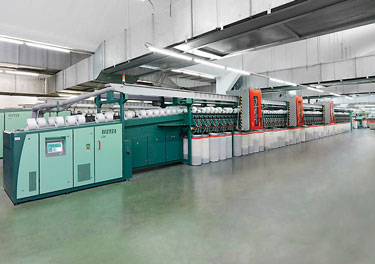
SpinningRieter
Rieter’s J 26 automated air-jet spinning machine

Japan-based Murata Machinery Ltd. reports the Vortex III 870 offers improved yarn quality, ease of use and performance. The single-sided machine can have up to 96 spinning positions running at speeds of up to 500 m/min. According to Murata, use of the STS — Spinning Tension Stability — system, which utilizes a friction roller rather than nip rollers to withdraw the yarn, provides longer term spinning stability at higher speeds. The machine was demonstrated at ITMA running Ne 40 polyester and a Ne 10 polyester/rayon blend on alternate days. Similar to the Rieter system, there are presently issues running 100-percent polyester and Murata’s solution is to use the Polymaster system which feeds “oil” and compressed air to counteract the problems of high friction and dust deposits inside the yarn formation nozzle. A spokesman for Murata indicated that its present goal is to extend the range of yarn counts that can be viably spun on the system.

Winding

In recent years, the manufacturers of air-jet/vortex and rotor spinning machines have made significant improvements in the quality of the yarn packages that they can make, and have formats to cater for various downstream processing. However ring spinning is still the dominant spinning process, and while the use of link winding — coupling ring frame to winder — is commonplace, there is still a big market for stand alone winders.

The trends in other areas of spinning, with respect to features such as improved efficiency and energy savings, were clearly also adopted in winding. Big players in staple-yarn processing include Savio, Saurer/Schlafhorst and Murata. Saurer reports the brand new Autoconer 6 from Schlafhorst consumes up to 20-percent less energy, is 6-percent more productive, and offers improvements in tension control and waxing plus improved splicing. Murata exhibited the QPRO Plus bobbin-tray winder and FPRO Plus link coner with claimed higher productivity, quality and energy efficiency. Italy-based Savio Macchine Tessili S.p.A. showed its fifth-generation winding machine the Eco PulsarS, which offers energy savings of up to 30 percent coupled with up to 10 percent increase in productivity, according to the company. The machine also includes new features such as the Controlled Cut System, Yarn Tension Control, Waste Collection and Separation System, and upgraded splicing solutions. Savio also presented the Polar Multicone technology, which uses drumless, digital yarn-layering technology to provide greater flexibility in formatting packages for subsequent processing such as dyeing, warping, weft, double twisting and knitting. In addition, Savio showed the latest rendition of its Volufil system, which essentially incudes thermal treatment — relaxation and/or setting — as part of a winding process.
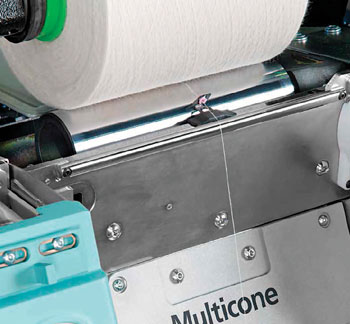
SpinningSavioMulticone
Savio’s Polar Multicone with drumless, digital yarn-layering technology

Data Systems

There were many data systems on display at ITMA, and while some were proprietary to the different machinery makers there also were several third parties offering retrofit systems and software. It was clear that the products shown at ITMA were much more sophisticated and capable systems that not only had the potential for more data inputs, but also were much more refined in what they did with the data and the communication with the user.

Uster exhibited the new USTER® Tester 6, which when simply viewed as a testing machine offers significant improvements over the previous versions, with the potential of performing certain tests at 800m/min. The base unit measures sliver, roving and yarn uniformity, plus registers atmospheric test conditions. Additional sensors are available to measure: overall hairiness; hairiness length distribution; yarn diameter, shape, density and variation; and yarn trash and dust. In addition, the use of the Knowledge Based System (KBS) enables the detection of periodicities and determines the source of these defects. It also is possible to analyze the various structural parameters associated with slub yarns. The Uster Tester 6, when linked to the Uster Quality Expert — which gathers online and offline data from the total manufacturing process — is able to display this information as dashboards and comparative reports. Additionally, the system — comprised of the Uster Tester 6, plus databanks and software — is capable of using the measured data and the huge data bank of Uster Statistics to predict features such weaving performance and fabric appearance. Indeed, when incorporating data on hairiness, the system also can make predictions about pilling characteristics. As with systems offered by other manufacturers, it is possible to remotely access the various reports from mobile devices, which is particularly useful when assessing the overall performance of various processes in the manufacturing line.
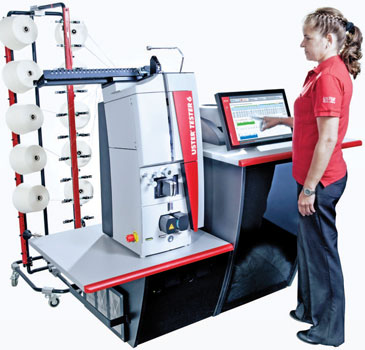
SpinningUster
USTER® Tester 6

Rieter’s latest version of its SPIDERweb Mill Control System offers several improvements plus access is now possible with mobile device and appropriate app. The sensors necessary for this system can be incorporated into new machines or retrofitted to certain existing machines. The system gathers data from several different modules — machine performance, quality of product, power consumption, temperature and humidity for example — which it then collates and analyses. It also incorporates historical data and then creates various reports which can be displayed in the mill as wallboards — efficiency of production, for example — or generate holistic views of the mill or perform very specific analyzes of say one particular spinning frame. Additionally, the self-perpetuating database can be queried and analyzed to determine the impact of factors such as temperature and humidity changes on product quality, processing efficiency and energy consumption.

Trützschler demonstrated its T-Data system that gathers and analyzes data from blowroom through to finisher. This includes data gathered from components integrated into Trützschler machines including trash and neps in carding. The system produces reports and enables queries and visual displays of single or multiple machines including variations in shift data. As with other systems, energy monitoring is an integral part of the system. T-Data can be accessed via smartphone through downloadable apps.

Marzoli showed its YarNet mill management software, which features status displays for each machine including running and doffing, plus providing details of processing conditions and efficiencies. Details of drive components and motors are collected together with information on energy consumption. This data is used not only to assess the processing, but also can be used to quantify the effects of any changes in processing conditions on the final product quality. Additionally, by using virtual board wrapping it is possible to use the data to display the effect of possible changes in slub parameters of final fabric appearance. Marzoli utilizes the data in a further way through its Marzoli Remote Maintenance (MRM) system, which is a joint development with Microsoft. The use of cloud computing and analytics takes selected mill data and uses this to create an optimized maintenance schedule for the mill. By monitoring changes in machine efficiency, energy usage and motor temperatures, it is possible to predict impending problems and plan repairs, including gathering necessary components and required labor so that repairs can be carried out efficiently.

Saurer Schlafhorst’s Plant Control System gathers data online and prepares different level reports for the mill, groups of machines or individual machines and/or spinning positions. Saurer reports the system is useful for optimizing productivity and quality, as well as giving rapid alerts on off standard process/product. Saurer also announced its new Service Unlimited (SUN) program to ensure maximum efficiency during the whole product life cycle. This program is the agglomeration of various installation and aftercare functions such as consulting, installation, technology transfer, original parts, maintenance, and repairs and upgrades, to ensure continued optimum performance of Saurer products.


Editor’s Note: Dr. William “Bill” Oxenham is the Abel C. Lineberger Professor and Associate Dean of Academic Programs at Raleigh, N.C.-based North Carolina State University’s College of Textiles, Department of Textile Engineering, Chemistry and Science.


January/February 2016
ACIMIT: Vietnam — Italian Textile Machinery Front Row Center At Saigontex

MILAN, Italy — February 2016 — Vietnam has by now become a major market for textile machinery manufacturers. Having emerged as an important manufacturing hub for the garments sector, thanks to low labour costs, the Country has now received a further boost for developing its textile industry, through the free trade agreements recently signed with the European Union and United States.

“In the face of these new scenarios,” explains Raffaella Carabelli, president of ACIMIT, the Association of Italian Textile Machinery Manufacturers, “we’re expecting over the medium term a strong boost in demand for textile machinery by Vietnamese textile manufacturers.”

Vietnam already ranks 8th among export markets for Italian textile machinery companies, with exports to Vietnam over the first nine months of 2015 reaching 31 million euros, a 53% increase compared to the same period for 2014. Among the products most in demand are finishing/ennobling and spinning machinery.

The true litmus test for the actual growth of the Vietnamese textile industry will be the upcoming Saigontex, to be held in Hochiminh City from 30 March to 2 April 2016. The common exhibition area organized by the Italian Trade Agency for the promotion abroad and internationalization of Italian businesses, and by ACIMIT, the Association of Italian Textile Machinery Manufacturers, will host the following 12 machinery manufacturers, all ACIMIT associated members: A. Piovan, Beta Machinery, Carù, Fadis, Ferraro, JK Group, Mei, Pozzi Leopoldo, Pugi Group, Ratti, Rollmac, Tonello.

Posted February 15, 2016

Source: ACIMIT

Mogul PET Product Tests Successfully To Flame Retardant Standards

GAZIANTEP, Turkey — February 15, 2016 —Mogul MOPET® TCS, a spunbond fabric made from mono-component trilobal filament, has proven itself flame resistant in accordance with BS5852-2 without fire retardant impregnation of the fabric.

The fabric was produced from a PET polymer chip containing a special fire retard component. The raw material additive enabled the resultant fabric to self extinguish a flame and also self extinguish any subsequent smouldering. The additive to the polymer chip does not contain any toxic fire retardants from the halogen group elements nor heavy metal flame retardant additives.

Home furnishings covered by a fire resistant fabric may allow for reduction in the overall amount of fire retardant materials injected into the furnishing’s padding and components since the fire source is generally external to the furnishing.  The aim is to reduce cost and the toxic gas generation associated with fire retardants in the event of fire.

The successful accreditation is part of Mogul’s drive to produce better performing fabrics for specialized and differentiated end use.

Mogul Spokesperson, CEO Serkan Gogus stated “the successful testing of this flame resistant fabric is one of the many steps we are taking to better serve customer demand for upgraded and special purpose nonwoven rolled goods. The critical requirement to ensure our communities benefit from safer clothing, furniture, automotive parts and construction components makes this a very satisfying result.”

Posted February 15, 2016

Source: Mogul Nonwovens & Composites

Duvaltex Acquires True Textiles Inc.

QUÉBEC, Canada — February 15, 2016 — Duvaltex Inc., a holding company specializing in textile innovation and development, announced today that the company has acquired True Textiles Inc. The acquisition includes all of the True Textiles business units — True, Guilford of Maine and Teknit. Duvaltex also currently owns Victor Textiles Inc., a North American textile manufacturer.

As a result of this acquisition, Duvaltex becomes the largest manufacturer of commercial or contract interior fabrics in the U.S. and Canada, serving the office furniture, institutional, healthcare and hospitality industries.

This acquisition will provide significant value to the customers of both Victor Textiles and True Textiles, which will continue to operate as independent business units. The companies will maintain the same commitment to quality, emphasis on unique products, and focus on customer service that have made them industry leaders. Duvaltex management expects the company as well as its customers to benefit from opportunities to create synergies and efficiencies across the organization. The company plans to improve each operation’s competitive positioning by leveraging the individual strengths of each business unit across the organization.

True Textiles is a leading textile mill providing high performance fabrics for applications such as panel, upholstery, acoustic and privacy curtains, to multiple market segments including corporate, healthcare, education, and hospitality. True Textiles is vertically integrated and has expertise in fabric design, yarn production, weaving, weft knitting, finishing and performance enhancements. The company offers an industry leading open line assortment through the Guilford of Maine collection, and unique weft knitted solutions through Teknit.

Victor Textiles is a leading North American-based textile company specializing in sustainable and innovative fabrics designed for the corporate, healthcare, apparel, and specialty markets. The company operates state-of-the-art mills in several Canadian locations, a design studio in New York City, and utilizes service-and-warehouse facilities in Grand Rapids, Michigan. Founded in 1947, family-owned Victor Textiles has a long history of servicing the North American textile and office furniture industries with environmentally responsible fabrics.

“This acquisition brings together two of the industry’s most established and successful companies, recognized for their dedication to innovative product design and commitment to sustainability,” stated Alain Duval, president of Duvaltex Inc. “The True Textiles brands are respected worldwide, and we are looking forward to continuing to maintain that reputation, while also exploring new opportunities for growth and diversification. We believe customers of all of the brands will see the benefits as we move forward to this exciting new chapter for both companies.”

Posted February 15, 2016

Source: Duvaltex Inc.

Watte Appointed Chairman Of Cotton Incorporated: Tulare Cotton Grower To Oversee Cotton Research And Promotion Program

CARY, N.C. — February 15, 2016 — Mark Watte, a Tulare, Calif.-based cotton producer, was elected chairman of Cotton Incorporated at the joint Cotton Board/Cotton Incorporated Board meeting in December, 2015. Watte, who succeeds outgoing chairman B.B. Griffin of North Carolina, has served as a director on the Cotton Incorporated Board of Directors for more than 20 years, and is active in many cotton organizations including the California Cotton Growers and Ginners Association.

“Mark’s experience as a cotton grower and as an officer in numerous cotton organizations gives him a keen understanding of the challenges and opportunities for cotton at this point in the industry’s history,” says J. Berrye Worsham, president and CEO of Cotton Incorporated.

Mark Watte is a partner in George Watte & Sons, a 3,000-acre mixed crop farm in Tulare, California. Since graduating from California Polytechnic State University San Luis Osispo with a degree in Agricultural Business in 1974, Watte has distinguished himself as a leader within the California agricultural community and the U.S. cotton industry.

Currently, Watte shares his knowledge and leadership through participation in local organizations, such as: the Consolidated Peoples Ditch Co; the Friant Water Authority; the Tulare Board of Public Utilities; and the Kaweah Delta Water Conservation District, on which he serves as Vice Chair.

Over the course of his career Watte has received numerous recognitions, including:  2000 Tulare Farmer of the Year (an award shared with his brother and business partner, Brian Watte); 2013 Tulare Man of the Year; Tulare County Agriculturist of the Year; and is a recipient of the 2015 High Cotton Award, presented by Delta Farm Press.

Mark Watte and his wife Joanne have been married for more than 42 years, have three daughters and ten grandchildren.

Watte will serve a two-year term as Cotton Incorporated Chairman.

Posted February 15, 2016

Source: Cotton Incorporated

ITMA 2016 Technology: Knitting

Many new knitting technologies at ITMA centered on energy efficiency and waste reduction, and shoe uppers offer an interesting new market for knitters.

By Dr. Andre West

Many new knitting technologies at ITMA centered on energy efficiency and waste reduction, and shoe uppers offer an interesting new market for knitters.

Sustainability was high on the agenda when the global textile machinery industry convened in Milan for ITMA 2015. With the theme, “Master the Art of Sustainable Innovation,” ITMA featured exhibits from the entire textile and garment making value-chain. Many of the recent developments from the industry’s knitting machine manufacturers have centered on increased energy efficiency and waste reduction. Knitting technology is always evolving, and improvements in machine manufacturing and graphic design software systems give technicians, designers and engineers more options to make technical, non-fashion related fabrics that were traditionally woven constructions.


Sustainability

According Germany-based Mayer & Cie. GmbH & Co. KG (MCT), all of its machines on show combine a further increase in productivity, improved process reliability and produce consistently high- and reliable-quality knits. An important new feature is significantly reduced fresh needle oil consumption, which is the result of MCT’s SENSOBlueRS recycling process.

According to the company, the patent-pending recycling process is based on cleaning and reusing needle oil that has already been used by the knitting machine in question. Used oil is cleansed of dirt particles in a filter unit housed within the machine, and then returned to the machine’s oil circuit. As a result, less fresh oil is required, and oil consumption can be reduced by up to 30 percent, depending on the machine.

Germany-based Groz Beckert KG has developed a new generation of Litespeed needles for high-performance circular-knitting machines that can contribute to sustainable textile production in the circular knitting sector. The Litespeed Plus needle weighs in at just 0.6 grams and is capable of significantly lowering carbon dioxide (CO2) emissions.

The company reports it has been extremely successful with the new generation Litespeed needles. The further improved shaft geometry reduces friction and wear substantially, which results in higher productivity, energy savings and a reduction in CO2 emissions.

When Litespeed Plus needles are used, it is possible to lower the machine’s temperature and energy consumption by up to 20 percent according to Groz-Beckert. With a single needle set consisting of 3,000 needles, knitting mills in China have recorded CO2 reductions of 1.4 tons per year. In India, this figure was found to be over 2.4 tons.

Warp Knitting: Tricot Machines

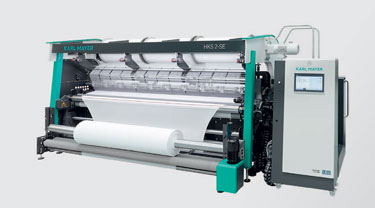
Germany-based Karl Mayer Textilmaschinenfabrik GmbH showed seven new warp-knitting machines, as well as new warp-knitted textiles and innovative warp preparation solutions, under the company’s motto of “We care about your future.” At ITMA, the HKS 2-SE, with a width of 130 inches and a gauge of E 36, was demonstrated knitting an elastic locknit charmeuse for sportswear. This new ergonomic machine design has a Low Energy Option (LEO) based on an improved interplay of drive technology, oil viscosity, heat-resistant machine components and operating temperature. According to the company, these features lower the energy consumption by up to 10-percent. It also features an LED lighting system and integrated camera system for complete fabric inspection provided as standard equipment.

KarlMayerHKS
Karl Mayer’s HKS 2-SE

The four-bar high-speed tricot machine HKS 4-M EL with N pattern drive is now 25-percent faster than its predecessor, but offers a high level of flexibility according to Karl Mayer. The EL configuration enables the patterns to be changed very quickly and easily by inputting data at the machine’s display unit. In this way, the machine can process even small batches efficiently, and can reduce the amount of time needed to develop new and innovative fabrics. Moreover, the EL feature opens up completely new design possibilities due to shog paths of 2 inches and almost unlimited repeat lengths.

Raschel Knitting

Karl Mayer also presented two new machines in the lace sector, the TL 79/1/36 Fashion and the MLF 46/24. The new TL 79/1/36 Fashion machine is able to produce innovative Textronic lingerie, which the company claims is almost ready-to-wear directly from the machine with fabrics previously unseen in the industry. These eye-catching products include lightweight fabrics based on jacquard constructions featuring relief-like patterns with a distinct 3-D look, which is the result of a new way of incorporating the heavy liners.

The TL 79/1/36 can make thick cord yarns look as if they have been sewn on, without any top cording. Moreover, the TL 79/1/36 Fashion can also be used as a fall plate raschel machine. All the standard Textronic patterns can be worked using the 76 pattern bars that are available without using the heavy cord option. The design of the TL 79/1/36 Fashion also makes it ideal for producing exclusive, high-end lace bands and panels for dresses, blouses and jackets.

The new MLF 46/24 has an exceptionally wide 242-inch multibar lace machine with fall plate without jacquard bars, offering a high level of productivity for a low investment. The concept of this new machine is based on considerably increasing its speed compared to its predecessor at a gauge of E 18. The MLF 46/24, can produce several lace panels side-by-side, all-over-patterned textile webs, as well as bordered fabrics with long repeats.

Karl Mayer also has improved and revamped the tried-and-tested concept of its Wefttronic® RS series and transferred it to the HKS MSUS. The result is the Wefttronic HKS. The weft-insertion system and the fabric take-up were at the heart of the steps taken to optimize this machine platform. The integration of the KAMCOS® 2 system and the implementation of the company’s own CFRP concept adds up to the new weft-insertion machine with an excellent performance ratio at speeds of up to 1,500 meters per minute.

This new machine is also equipped with the unique gauge of E 40, which gives much more room for maneuver when designing products producing a fine interlining fabric.

Circular Knitting: Spin-Knit

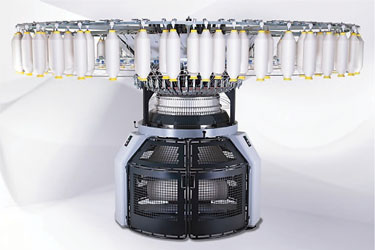
Three circular knitting companies presented spin-knit machines. The spin-knit machines spin yarn from rovings that are mounted close to the machine then subsequently knit the spun yarn. This can shorten the production process making separate ring spinning, cleaning and rewinding steps no longer required, which lowers production costs. This also leads to a significantly lower investment in machinery. The spin-knit machines also are similar in size to conventional knitting machines, which saves space and energy while also producing less CO2 and waste.

MCT relaunched a marketable and fully functional Spinitsystems® machine, called the Spinit 3.0. The company presented this technology as a prototype at ITMA 2011. The Spinitsystems can process a large variety of short cut and staple fibers such as 100-percent combed cotton or other natural and man-made fibers. According to MCT, Spinitsystems uses a third less energy than the conventional process. In addition, Spinitsystems has a lower CO2 emission level, because a spool thread from production is fed back into the production process, waste output is significantly reduced. Spinitsystems performs four steps: wring spin, clean, rewind and knit. “I am delighted that we can offer our customers and prospective customers so much more than just a few fabric patterns,” said Michael A. Tuschak, head of Spinknitsystems marketing and distribution. “Our customers are, after all, breaking entirely new ground with us and with spinitsystems.”

MayerSpinKnit
Mayer & Cie.’s Spinit 3.0 E

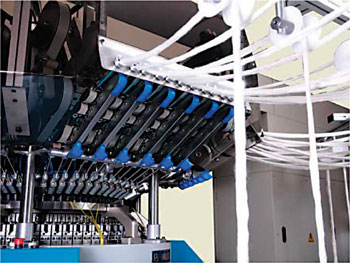
Germany-based Terrot GmbH unveiled a new machine that offers customers an opportunity to spin yarn and knit fabric on the same machine. The Terrot F132-AJ direct spin-knit process uses an air-jet spinning system. However, it does not mount the rovings, clearing or drafting units or the spinning nozzles on the knitting machine like other spin-knit machines. Instead, there is a creel type arrangement on three sides of the machine, which houses the complete roving to spinning process. The yarns are spun by the side of the machine and then fed in. The F132-AJ independent spinning unit can be fitted to all Terrot single-jersey and double-jersey machines. The direct spin-knit system even is suitable for high system densities and large diameters of up to 120 feeders, and can be used in gauges from E 20 to E 36. The modular spinning system can be fitted with 24, 32 or 40 spinning heads per unit; and has an integrated flyer, integrated fluff removal and integrated monitoring process. The fabrics have a high quality look and feel, soft handle and good dyeability with rich colors. Elastane plaiting is also possible with the new Terrot system. The F132-AJ has a speed factor of up to 600 — 20 rpm, 30 inches — and offers unfinished fabric output of up to 360 kilograms over 24 hours. According to the company, the new process requires 40-percent less space, up to 50-percent energy savings, up to 30-percent lower investment cost and up to 50-percent lower production costs.

Taiwan-based Pai Lung Machinery Mill Co. Inc.’s SPINIT system was the third machine on display that combines spinning and knitting. The process commences with a stream of parallel slivers that are fed through a drawing frame via a spinning unit into a single-jersey knitting machine. Three steps of roving frame, ring spindles and winding frame in the traditional spinning process have been replaced with this new Pai Lung development. A false twist is applied to spin the yarn. The manufacturer says that the absence of conventional coned yarns in knit feeding results in a final knitted fabric that is very soft with silky brightness. Additionally, the cost of knitted fabric produced using SPINIT is significantly lower than when using traditional processes. Pai Lung estimates a savings of up to 37 percent in equipment costs, power supply and labor costs.

PaiLung
Pai Lung’s SPINIT technology

Other Circular Knitting Innovations

With an increasing market demand for specialty machines, another twist on rovings is the Orizio PLE from Italy-based Orizio S.r.l. This is an electronic single-jersey machine for the production of high pile fabrics with multiple colors and large-dimension patterns targeted to niche markets. It is configured in a 24-inch diameter with 18 feeders, or a 38-inch diameter with 24 feeders. Gauges are 10, 12, 14 and 16. The PLE model is capable of up to six color reversible jacquards with one side incorporating the jacquard as a pile fabric. Piqué, fleece and honeycomb ground structures also are possible with double-sided fabric that includes jacquard pile on the other side.

At the Pai Lung booth, the company introduced its new circular knitting PL-KRN2.5CJ with 28-gauge dial and 14-gauge cylinder knitting platform under its new fabric name called Active mesh. Active mesh is a single-jersey with eyelet jacquard fabric made by a full jacquard rib-mesh machine. Different sizes of eyelet holes can be knitted using the machine’s pelerine needle system; even different densities of jacquard fabric can be presented. According to Pai Lung, the machine is able to produce a larger and more regular shape of mesh hole when compared to the holes made by normal transfer spring needles. The company reports its ventilation and moisture control properties make the fabric suitable for body mapping applications and activewear design.

Monarch Knitting Machinery Corp., Monroe, N.C., presented a brand new machine capable of knitting mattress-ticking fabrics featuring several woven product properties. Monarch’s M-LEC6DSI — a 38 inch, 28 gauge machine with 72 feeds — is its first 28 gauge dial selection machine for mattress-ticking fabrics. The machine can knit high-definition, multi-colored jacquard designs and the latest woven look fabrics with stretch and soft hand. The machine offers three-position needle selection — knit, tuck and miss — on the cylinder, and two-position on the dial — knit and miss — with SS actuators, which allows designers to create the latest generation of mattress ticking fabrics. According to Monarch, the size of its SS actuators makes the machine 20-percent more productive than its predecessor.

On this model, reliable needle selection is guaranteed by a newly designed needle jack connection system, which helps with the production of high-quality mattress ticking as the non-selected yarns are knitted to the back side. This gives a very clean appearance and allows the use of darker yarns without fear of grin through. It also ensures that the borders and outlines of jacquards are exact as the yarn tension is easily controlled.

The M-LEC6DSI is available on 36-inch-, 38-inch- and 42-inch-diameters and in gauges ranging from 12 to 28. It is also equipped with Monarch’s latest M frame, which lends itself to high-speed operation and a quick-change facility for cylinder and dial. As well as full double-sided jacquards, it can also produce double blister fabrics.

Terrot also introduced a mattress-ticking machine called the UCC594M. This powerful electronically controlled double-jersey machinery is unrivaled in its high yield, and has already become an integral part in the machinery of leading producers for mattress fabrics worldwide, according to Terrot. The model was displayed with high industrial frame C6/3.

Quarter Gauge Machine

Model M-9MEQG from Monarch is a double needle bed, quarter gauge machine, featuring 7 gauge on the cylinder and 28 on the dial, which enables the machine to produce fabrics with different gauges on the two faces suitable for a variety of end-uses from clothing to outerwear, as well as sporty and technical fabrics. The machine easily can be converted into a normal interlock machine and is equipped with the new base type M, optimized in size and technology.

Sinkerless

Sinkerless technology allows a stitch formation undisturbed by any mechanical movement to produce a fabric completely sinker line free.

Orizio exhibited sinkerless technology in a 20 to 80 gauge version with 90 feeds on 30-inch-diameter. The JFP model produces high quality jersey and jersey with spandex for sinkerless stitch structure fabrics. The machine is equipped with the Orizio LC open frame with electric cutter, pneumatic roll expulsion and a brand new control system with touch screen.

For the first time at ITMA 2015, Terrot Germany exhibited in a joint booth with Terrot Italy, the owner and manufacturer of the Pilotelli brand. The SL-4 version, the latest generation of Pilotelli’s sinkerless range, incorporates newly engineered technology patented by Terrot. With its proven ease of use and new qualitative influence by Terrot, model JVCE-4 3.0 SL-4 in open-width frame T.A.7 was showcased. The Pilotelli sinkerless technology guarantees high output and low maintenance, according to Terrot.

Weft Knitting

There have been many developments in weft-knitting machine technology in the four years since the last ITMA — machines have become more specialized and universal at the same time. Complete and integral garments, industrial, medical products and footwear have been a driving force for new developments. Technical features driving innovation include spacer fabrics, weft insertion, air splicing and inverse plating.

Inverse plating offers designs of special single-jersey jacquard technology, which used to be knitted by special handwork or high-value intarsia machines.

The yarn plating position changes during the carrier’s movement across the bed. The application of plating jacquard technology in jersey can replace some of simple color intarsias, finer gauge of double-jersey jacquard, links-links plating, and reduce certain after treatment like in some embroidery or printing processes.

Weft insertion allows woven-like fabric appearances and reinforcements. Inlay fabric production involves inlaying and patterning a weft into a knitted fabric base. This can be used for decorative purposes giving the effect of embroidery. Weft insertion can restrain the characteristics of the stretch of a knitted fabric; this facilitates the insertion of metallic, conductive, and monofilament yarns or other special materials.

Spacer fabrics or two-faced fabrics represent a class of knits comprised of two main layers connected by yarns transformed in tucks or loops. Electronic weft knitting machines with two needle beds have the ability to create individual layers of fabric, held together by loops or tucks, or by separate fabrics as connecting layers.

In 1995, Japan-based Shima Seiki Mfg. Ltd. introduced the world’s first WHOLEGARMENT® knitting machine, capable of producing a garment in its entirety with no seams. It was revolutionary technology, and Dr. Shima believes this is now an innovation coming of age. Just as a 20-year old, who comes of age assumes new responsibilities as an adult and begins contributing to society; Wholegarment is likewise expected to take on an instrumental role in mainstream production in the coming years. Although by its very nature, Wholegarment is considered one of the most sustainable forms of garment production with minimal dependence on labor, materials and other resources, Shima Seiki has proposed several novel ways to produce Wholegarment knitwear even more efficiently by exploiting 3-D shaping and tubular knitting characteristics.

Shima Seiki announced a new flagship machine, the MACH2XS, which features the company’s original SlideNeedle™ on four needle beds for high-quality Wholegarment production in all needles, quick carriage returns with R2CARRIAGE® combined with a maximum speed of 1.6 meter per second for high productivity, and i-DSCS+DTC® Digital Stitch Control System. The S series is equipped with a new spring-type moveable sinker system. Dimensional fabrics and fléchage can be knit with ease, expanding the range of knitting. For example, frills, gathers and other decorative elements that previously required sewing can now be knit integrally as part of the garment. Deeper necklines can be knit also, permitting more fashionable designs to be produced. This new machine can be equipped with the Air Splicer option for supporting multi-color knitting by splicing together yarns at high-speed. The 15L machine also features a large-hook SlideNeedle mounted in 15-gauge pitch for production of fabrics in the 10 to15 gauge range, and is equipped with a new inlay carrier option that enables insertion of weft yarns for producing brand new flat knitted fabrics with woven pattern effects with light weight, applied to such items as knit jackets and skirts known collectively as Airdrobe® — Air + Wardrobe — garments.

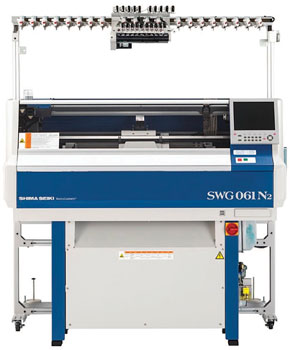
The SWG-Mini, Shima Seiki’s compact line of Wholegarment machines allows customers to participate in the Wholegarment market with minimal investment. The SWG061N2 in newly developed 13 gauge features a 24-inch knitting width, for such items as gloves, socks, hats, mufflers, neckties and other small accessory items, as well as for the production of 3-D knitted shoe uppers.

ShimaSeikiSWG
Shima Seiki’s SWG061N2 compact Wholegarment® machine

The Weft Insertion SRY183LP-SC features loop presser beds on a 72-inch knitting width developed to take advantage of inlay fabric patterns that have proven popular with circular knit manufacturers and even textile manufacturers, by supporting the standard 150-centimeter width of woven fabric bolts. Inlay fabrics knitted on SRY share characteristics with those of both knits and wovens, the fusion of which is described by Shima Seiki as KNEAVE® fabric.

To program the new machines, Shima Seiki developed the SDS-ONE APEX3 3D design system that provides comprehensive support for the entire knit supply chain from planning and design to production and sales promotion. With even more powerful graphics and functions, simulations of even higher quality are used to produce ultra-realistic virtual samples that cannot be distinguished from actual samples. With virtual sampling, the costly time-, energy- and resource-consuming sample making process can be minimized for quick and efficient evaluation and shortened lead times in manufacturing. Virtual samples can also be used in presale events to determine consumer demand before actual production begins for optimization of inventory.

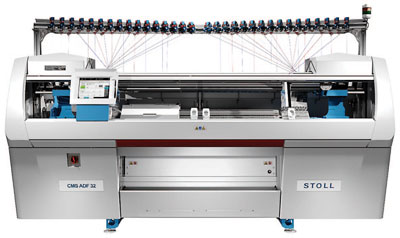
Germany-based H. Stoll AG & Co. KG presented four types of the newly engineered ADF — Autarkic Direct Feed — machines, which offer complete freedom in design and production. The yarn carriers are independent of the carriage and can move both horizontally and vertically. Thanks to this innovative yarn carrier technology and a variety of knitting techniques, this machine creates almost endless possibilities for pattern and color combinations.

The CMS ADF 16 machines enable a cost-efficient entry into ADF-technology with ADF- knitting in coarse gauges. All CMS ADF 16 machines are equipped with high ADF technology and can be distinguished from CMS ADF 32 models by the quantity and position of yarn carrier rails. The CMS ADF 32 BW emphasizes with the inlay presser foot with reverse plating in one system. The yarn carrier knits and weaves-in in one stroke. The most important benefit of this machine type is the reverse plating, which causes reduced runtime and thus provides a high level of productivity and enhanced economic efficiency.

StollCMSADF
Stoll’s CMS ADF 32 BW weft knitting machine

New pattern techniques such as knitting and weave optics are possible. One is the new patented knitting technique Stoll-ikat plating®. It is possible to knit inlay technique with all 32 yarn carriers. Another highlight with the ASCON® feed wheel controlled by yarn tension. This kind of machine is most suitable for weave-in fabrics because of its integrated weave-in device.

Stoll’s entry into the mini market is the CMS 202 HP B. It is a productive and space-saving machine with a working width of 24 inches intended for technical textiles as well as gloves, socks, hats, mufflers, neckties and other small accessory items

Stoll has expanded its gauge range further, adding gauge E 1.5 and gauge E 2.2 for the extra-bulky knits and extra-chunky yarns that previously demanded hand knitting. Gauge scalability now extends stitch optics from gauge E 1.5 to gauge E 5; yarns down to 0.7 Nm can be used. Moreover, the industrial knitting machine offers countless design options: jacquard, intarsia and structured knits — combined with shaping at tributes in Fully Fashion technique.

One of the largest machines was the CMS 822 HP with an enormous working width of 84 inches. The possibility of combining the carriages really makes this machine a highlight. The machine is equipped with the Ascon yarn length-measuring device. The stitch quality and size are monitored and adjusted automatically. Potential yarn fluctuations are equalized automatically reporting of actual yarn consumption.

Switzerland-based Steiger Participations Sa exhibited three new flat-knitting machines in a booth shared with its China-based partner CiXing. The Steiger C2.185.SCP uses the company’s recently developed compound needle feature and a new yarn feeder with both horizontal and vertical control. The new technology was shown in freegauge 2.5-2 knitting a coarse gauge hand knit look seamless sweater with all needles.

The Taurus 2.170XP also features the compound needle and a storage punch. It offers complete garment knitting, multilayer knitting and complex inlay and intarsia constructions. New features include the independent motorized clamps and 24 vertically and horizontally motorized yarn guides, which allow the creation of a range of new patterns such as intarsia, inlay and plating. The Taurus is available in gauge E12 and in a working width of 170 cm.

Also new is the Antares 3.130, which comes equipped with the open carriage system, direct threading that allows knitting with any type of yarn at high speeds, reduced tension and a smaller yarn path between the cone and the needle limiting friction. This model also is equipped with the patented friction take-down system, which allows a wide range of exclusive patterns with circular knitting effects as well as horizontal cable and incorporated elements. The Antares also features the vertical and horizontal motorized yarn guides and the Steiger Dynamic Sinker system. According to Steiger, these features, which cannot be produced with a traditional takedown system, offer improved productivity and fabric quality.

The Era Of Knitted Shoes

Many large sportswear companies are now producing integral shoe uppers on knitting machines. Machine makers are competing for this relatively new untapped market. In addition to the industry leaders, there were a few other companies venturing into this highly lucrative market in differing ways.

One of the more impressive machines for footwear on display was Japan-based Matsuya Industries’ Super-J 212 SC Professional Fully Fashion Shoe Cover Machine. The 48-inch needle bed machine uses a patented three-way sinker system and a melt yarn to enable a tight stitch appearance for a higher quality look.

Korea-based Keum Yong Textile Machinery has engineered a double-jersey, electronic full jacquard circular knitting machine with rib-mesh that can be used for the production of shoes. The KCMJD-169S features electronic individual needle selection and unlimited patterning, as well as needle selection in both the cylinder and the dial by means of a WAC actuator knitting in three technical ways — knit, tuck and miss — on the cylinder and two on the dial allowing the production of rib-mesh transfer jacquard knitting structures.

Italy-based Santoni S.p.A. had two machines. The MEC-MOR Variatex CMP was demonstrated knitting rolls of fabric with outlines of shoes knitted in — the fabric is then cut and sewn to make-up the shoe. The company also showed its SWD6/2J WARP knitting machine making shoe upper blanks.

KnittingSantoni
Santoni’s SWD6/2J compact warp knitting machine

The Santoni/Lonati Group had one of the biggest booths at ITMA with a total of 60 machines on display showing their complete range, which includes Santoni Seamless machines, large-diameter circular-knitting machines, circular-knitted garment-length Mec-Mor machines, warp-knitting double needle bar Raschel knitting machines, Santoni automatic sewing machines for hosiery, Tecnopea boarding and packaging machines, Lonati socks and pantyhose machines, Sangiacomo and Matec sock machines, and Dinema software. On the upper floor of the booth, the companies had collections of items that can be knitted on the machines.

Seamless Technology

Seamless knit technology provides highly elastic knit outerwear, underwear and elastic sportswear technology, in the neck, waist, buttocks and other areas where seams might be uncomfortable. In addition, seamless knit garments can shape and support the body.

Santoni’s MEC-MOR Variatex CMP Garment Length Circular Knitting Machine complete with rib border separation is a double-jersey circular machine with open variable panel — Variatex Technology — for the production of garments in weft knitting. The variable width of the fabric panel allows a set number of working needles for the required product, which in turn enables one single machine to produce all the sizes without waste. This 33-inch-diameter machine has gauges ranging from E 7 to E 20 with 12 feeds. It is designed with needle-to-needle selection on three technical ways both for the cylinder and for the dial. Each feed is equipped with a combined knitting/transfer system, therefore at every revolution of the cylinder the programming system can set each single feed either as a knit feed or as a “transfer feed,” achieving every knitting stitch composition with maximum productivity.

Santoni’s SM8 TOP2V machine is an electronic single-jersey circular machine with eight feeds and two selection points per feed. The machine is designed to efficiently produce seamless underwear, outerwear, beachwear, sportswear and sanitary wear. TOP2V consumes 15-percent less energy and offers 30-percent more productivity than the current model according to Santoni. This machine is ergonomically designed and equipped with new parts including yarn finger groups and sinker cap for natural yarn plating.

Hosiery

Hosiery machine specialist Lonati S.p.A., Italy, has developed a new machine for the production of one-piece pantyhose. The LB-OP on show had a 4.5-inch diameter with 448 needles in gauge 75. Essentially, knitting begins at one toe-end and moves up, across and then down, while leaving a hole at the top for the auto-sewing of the waistband further down the production process. With a production time of 4 minutes and 55 seconds, a key issue here was producing a pair of pantyhose with the necessary stretch properties. Lonati’s solution here is to offer the larger-diameter machine so that the hosiery can be both longer and wider providing the additional volume that was necessary.

From the knitting machine, the pantyhose are then transferred manually to the Santoni Flat-Lock machine for the addition of the pre-knitted waistband and then on to the TC Smart, which has been specifically designed for pre-assembled pantyhose or one-piece toe seaming. The TC Smart operates on both toes with a perfect round seaming fish-mouth as is demanded in high-quality hosiery.

Lonati also presented the latest addition to the toe-closing options, the DC88 2 feed model, which is capable of knitting both links and jacquard. This two-feed model builds on the launch of the DC 88 single-feed model launched in 2013 for the production of men’s and children’s socks and tights in plain fabric, derby, links and striped fabric with short yarn ends staying inside the sock.

Available in 3-inch, 3.5-inch and 4-inch-diameters; and in gauges 14 and 18, the DC88 has fewer parts than its predecessor. It has no bolt cams or picker, and electronic needle-by-needle selection takes place with a single actuator. It also has an electronically controlled stitch adjustment using a stepping motor mounted directly on the knitting cams.

With toe closing S by S an option, the second feeder on the DC88 is located between the cylinder and the toe-closer with stitch transfer and jacquard as well as links-links socks now possible, giving sock manufacturers a greater range to choose from.

Italy-based Busi Giovanni S.r.l. has added to its range of knitting machines for the medical sector with the launch of the Busi Medical Pantyhose and the Medical Terry Pantyhose machines.

The Medical Pantyhose machine is a high production single cylinder machine with latch needles in the dial for the production of true rib or plain stitch medical compression socks in compression classes 1, 2 and 3. The machine is equipped with full electronic control and features two feeds for plain and rib fabric, as well as for laid-in elastic fabric. The compression graduation is achieved both through the automatic stiffening that can be activated on all step motors and through the graduation of the covered elastic yarn feed.


Editor’s note: Dr. Andre West is an assistant professor at North Carolina State University’s College of Textiles, Department of Textiles and Apparel, Technology and Management, Raleigh, N.C.


January/February 2016

Cone Denim Launches White Oak® Shop

Greensboro, N.C.-based Cone Denim® recently opened the White Oak® Shop to offer certain premium selvage denim styles in smaller yardages to denim lovers and fledgling designers who previously were unable to purchase the denim because of the large quantities required. Cone uses American Draper X-3 fly shuttle looms to recreate the authentic, vintage selvage denim.

Located at whiteoakshop.com, the site offers online sales, as well as information about the unique features of authentic vintage denim, fabric specifications, guidelines for working with the cloth, and a history of Cone Denim and White Oak.

In 2015, White Oak celebrated 110 years of continuous denim operations, and Cone Denim turns 125 in April 2016.

“The White Oak Shop is very exciting and opens the opportunity for us to work directly with denim enthusiasts and aspiring designers via the Internet who were previously limited by minimum order quantities,” said Kara Nicholas, vice president, product design and marketing, Cone Denim. “Vintage constructions from American Draper fly shuttle looms are not available anywhere else in the world, fueling the natural passion and inspiration for denim designers and their connection to White Oak.”

January/February 2016

LifeThreads® Introduces Contego Medical Apparel

New York City-based LifeThreads® LLC has introduced the Contego Collection, a second-generation line of medical apparel treated with an active antimicrobial compound that protects the wearer from pathogens — including blood, urine, vomit and other bodily fluids found in medical environments. The collection features stretch tops, pants and cargo pants — made using a cotton/polyester/spandex blend fabric — in six different colors and sizes ranging from XS to 3XL. Three additional colors will be added to the line in March 2016.

January/February 2016

Coolcore Acquires Tempnology Assets

Coolcore LLC, Portsmouth, N.H., has acquired the assets and intellectual property of Tempnology Group, a developer and producer of temperature regulation fabrics that filed for bankruptcy in 2015. Coolcore employed all the Tempnology staff, and plans to hire additional personnel in 2016.

The purchase brings Coolcore partnerships with several global consumer brands including Brooks, Cabelas, Disney, Imperial Headwear and LL Bean. Coolcore will continue to distribute finished goods under the Coolcore® and Dr. Cool brand names.

“Today is an exciting day and new beginning for our industry-leading material innovation company,” said Mark Stebbins, Coolcore’s lead investor. “We’re thrilled to provide financial commitment that will propel Coolcore into its next phase of growth.”

“Mr. Stebbins and his investment group have provided crucial support for our growing company as we have established ourselves as a leader in the marketplace,” said Kevin McCarthy, president and CEO, Coolcore. “The future at Coolcore is very bright with our recent awards and patents and continuous development in the fast-growing thermoregulation apparel category.”

January/February 2016

ThermalTech Introduces Solar-Powered Smart Fabric

KAnews
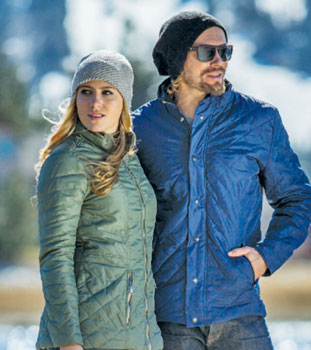
Thermaltech’s jackets feature a patented solar-powered smart fabric.

Los Angeles-based ThermalTech has patented a solar-powered smart fabric featuring a stainless steel yarn. According to the company, the fabric collects energy from the sun or an artificial light source and can keep a wearer warm with reduced bulk. The technology can generate up to 10°C of heat in two minutes even when it is cold outside. In order to commercialize the technology, ThermalTech has launched an Indiegogo campaign to raise funds.

The first product to feature the fabric is a jacket available in three styles — Street, Explorer and Extreme — and each style will be available for men or women in a choice of black or gray.

“We believe that by introducing this solar-absorbing fabric into the apparel marketplace, the next generation of outerwear will provide the consumer with even more of an optimal temperature & fit,” said Carlos Cortes, CEO of ThermalTech. “This will allow everyone from the snowboarder to the fashionista to be warmer in colder climates.”

January/February 2016

Sponsors