The Winter editions of Texworld USA and Apparel Sourcing USA recently wrapped at the Javits Center in New York City. According to show organizer, Atlanta-based Messe Frankfurt Inc., the events attracted the largest group of exhibitors and visitors for a January show with 371 and more than 4,000 respectively. Attendees — from designers to industry buyers — gathered to see the latest trends and offerings in textiles, trims, accessories, manufacturing and private label development services and finished apparel. The complimentary educational seminars, organized by Lenzing Fibers, also provided a networking and learning opportunity for visitors.
“As organizers, we recognize that our responsibilities extend far beyond providing a space for the industry to do business here in New York City,” said Jennifer Bacon, show director, Fashion & Apparel, Messe Frankfurt. “We believe in building a true industry event that unites the best talent from the industry with access to education and valuable resources, as well as a chance for our vibrant community to connect and exchange ideas.”
Germany-based H. Stoll AG & Co. KG has announced a collaboration with Toronto-based Myant Inc., an innovation company with a focus on designing, developing and producing connected textile-based products using printed technologies and fiber science. The partnership aims to populate functional computing textile manufacturing in the United States and Canada with 500 state-of-the-art Stoll knitting machines to advance the research, development and engineering of functional computing textiles.
“Our collaboration with Myant represents a completely new approach to smart textiles,” said Andreas Schellhammer, CEO, Stoll. “The demand for smart fabrics has never been higher as companies race to create garments, wearables, industrial, defense, healthcare and household items to connect humans to the Internet of Things. Myant is leading the creation of a new economy in functional computing textiles with Stoll machines. They have the vision and the right interdisciplinary team to make this a global revolution.”
“Myant and Stoll are taking a big step to democratize manufacturing and resuscitate a ‘making’ culture in Canada and the U.S.,” said Tony Chahine, CEO and founder, Myant. “Our goal is to reduce the barriers to entry in textile innovation and production and promote collaboration between scientists, doctors, engineers, designers, students, and anyone with a creative idea. I believe that true innovation is only possible when the inventor can actually make the invention. The Stoll machines will have a massive impact on commercialization in the smart textile industry, which is in need of disruption, and will help to speed up the prototyping to production cycle.”
LONDON — February 28, 2018 — Leading the charge for future emerging connected technology, exhibitors at this year’s Wearable Technology Show will be showcasing some of the hottest and most innovative new products and prototypes of the year.
One hundrede exhibitors from more than 20 countries will be on the show floor to unveil their latest innovations in smart technology, many of which will never have been seen before in Europe. Toshiba, WiTGrip and Thrive Wearables will all be exclusively be launching new launches and there will be over 20 others including:
AIO Sleeve by KOMODO Technologies. A revolutionary, all-in-one wearable solution. From in depth activity tracking, to monitoring one’s overall health and wellness by using something KOMODO calls Health Score. The AIO App monitors unique heart rate patters and generates a score based on a five star system, all inside the comfort of a smart compression sleeve.
ORA-C by Optinvent. The world’s first smart safety cap. A new type ofwearable for professionals that uses a cutting edge patented AR display technology. Running on Android, Optinvent disrupts the smart glass experience with this new offering, that allows users to have an improved hands free, ergonomic experience. The ORA-C uses the company’s patented see-through retinal display, includes a microprocessor and a complete set of sensors.
HearingFitness™ App by Oticon. The start of data-driven hearing care, the HearingFitness app gives insight into the daily use of the world’d first internet-connected hearing aids, Opn by Oticon. Using the app enables a more personalised hearing care than ever before, as it continually optimises a user’s solution to their specific, individual and changing needs and sound environments.
INA by Savor Health. Intelligent Nutrition Assistant is developed by a team of data-scientists and oncology-credentialed medical professionals specifically for cancer patients. Designed to improve clinical and quality of life outcomes and empowers patients to take control of their disease.
This year’s Wearable Technology Show will also boast a diverse 200-strong speaker conference programme with contributions from some of the biggest names in wearables, digital health, AVR and IoT, including Microsoft, Samsung, HTC, Sky, Toshiba, NHS, Hugo Boss and Stella McCartney plus many more.
“Attendees are always drawn to the show by the expanse of new innovation we have on the ground to announce and demonstrate. This year, that will be no exception. There will be a vast range of new products on show from a wide cross section of industry sectors; health to business, and lifestyle to leisure, there’ll be something for everybody.” commented COO John Weir.
He added: “The show is a great platform for brands big and small to exhibit the best that smart technology has to offer. From start ups to household names, we can expect some exciting products and prototypes to be here. Coupled with our speaker conference programme, delegates can expect to garner insight to some of the latest innovation and how that’s shaping the technology of tomorrow.”
Organizers are expecting 5,000 attendees at the Wearable Technology Show next month, which takes place on 13-14 March at ExCeL London and is co-located with the AVR 360 Show, IOT Connect and the Digital Health Technology Show, making it Europe’s biggest launch event for emerging connected technology.
BALTIMORE — February 28, 2018 — Under Armour Inc. today announced that Karl-Heinz (Charlie) Maurath will retire as its chief revenue officer effective March 31, 2018.
“We express our heartfelt thanks to Charlie who has played a pivotal role in establishing Under Armour as one of the world’s largest athletic brands,” said Kevin Plank, Under Armour Chairman and CEO. “Through proven and thoughtful leadership, Charlie’s contributions to building our world-class sales organization have positioned our brand for sustainable, long-term growth. On behalf of the entire organization, we wish him the very best in his well-earned retirement.”
Maurath joined Under Armour in September 2012 as President, International with responsibility for growing the company’s business overseas. He was named Chief Revenue Officer in November 2015, leading all global regions inclusive of North America, EMEA, Asia-Pacific and Latin America, as well as the global Direct-to-Consumer business. During his tenure, Under Armour successfully transitioned into a $5 billion global brand with revenue outside of North America growing at a 50% CAGR and reaching 22% of total revenue.
“Under Charlie’s direction, we have grown from an American company selling product in other countries to a successful international business of more than $1 billion in revenue,” said Patrik Frisk, Under Armour president and COO. “With an incredibly strong foundation, we look forward to building on his great work as this team continues to grow our global footprint, delivering the Under Armour experience to athletes around the world.”
The four regional leaders and the head of global retail will report directly to Patrik Frisk upon Maurath’s departure, while Paul Fipps, chief digital officer will have oversight of the company’s global ecommerce business.
Belgium-based Beaulieu Yarns has introduced the EqoBalance® family of biomass-balance nylon 6 yarns for carpet. The biomass balance method ensures that at the beginning of the supply chain, natural renewable raw materials can partially or even fully replace fossil resources in the process of turning polymers into yarns with the goal of reducing the use of fossil resources as well as reducing greenhouse gas emissions.
According to the company, the EqoBalance yarns reduce carbon dioxide equivalents per kilogram by up to 75 percent compared to its traditional fossil-based yarns, but do so without compromising on quality or performance of the end product. The yarns also meet the standards for TÜV SÜD certification standard CMS 71 — Certification of the use of renewable resources.”
“Carpet tufters are requesting more environmentally-compatible yarns to support their overall commitment to greater sustainability and more efficient resource use,” said Karena Cancilleri, vice president of Engineered Products, Beaulieu International Group.
“We see biomass balance as the fastest path forward and, through EqoBalance, are excited to pioneer this milestone for the contract market as part of our long-term strategy to give customers a fundamental new choice to step into sustainable products and contribute to a better world.”
WETZIKON, Switzerland— February 28, 2018 — Mélange yarns and color-effect yarns are a growing trend in the garment industry. In order to have an optimum mélange yarn, the fibers have to be mixed carefully in the right proportions at the beginning of the spinning process. Even small shade variations or color deviations of the yarns may result in poor quality of the fabric after knitting or weaving.
Another common reason for poor quality can arise during the winding process, where bobbins with similar looking color or shades are accidentally mixed up. Shade variations may be visible as disturbing stripes in the final product. Depending on the fabric and on the magnitude of the variation, the final quality might be so poor, that the fabric cannot be used at all. Even small variations in the shade of the yarn, which cannot be detected by the human eye when looking at the bobbin, can result in poor quality. Complaints about yarn quality can be expensive for the spinning mill. To guarantee high quality even in this difficult field Loepfe now offers a new optional feature in the yarn clearer YarnMaster ZENIT+. The OffColor detection is able to detect and eliminate very small color and shade variations in the yarn during the winding process. The new feature uses the F-Sensor, which is already integrated in the YarnMaster Zenit+. Therefore spinning mills, which already use the yarn clearer for quality control during winding, can update their devices with this new functionality.
The new OffColor detection has been extensively tested with a large number of bobbins with mélange yarn. The bobbins, which have been made available by a customer, had the same color, but small shade variations as the black portion of the mélange yarn varied slightly from dark to light grey. During the test runs, which have been conducted at Loepfe´s headquarter in Wetzikon, Switzerland, the YarnMaster ZENIT+ with the new optional OffColor feature was able to detect even the smallest shade variations very reliably. All other functions of the yarn clearer have been disabled during the tests. This is the ultimate proof that the new functionality works properly. The new feature does not depend on the color of the yarn. In addition to the tests conducted at Loepfe´s headquarter some clients have already tested the new functionality during normal operation in the spinning mill.
These clients confirm, that the OffColor feature works absolutely reliably and clear yarns of wrong colors or shades during the winding process. Between 10 % and 15 % of the spinning mills actually produce colored yarns or mélange yarns. “The new YarnMaster ZENIT+ with the OffColor feature is an absolute must for spinning mills, which are aiming for constantly high quality in the production of mélange yarns or colored yarns”, says Gianni Heusser, product manager at Loepfe. The new feature makes the YarnMaster ZENIT+ yarn clearer even more versatile. It is able to ensure high quality output at a spinning mill, by eliminating all yarn faults during the winding process.
Bangkok-based Indorama Ventures Public Co. Ltd. (IVL) has announced its intent to enter into a 50:50 joint venture with South Korea-based Huvis Corp. for the development, construction and operation of a low melting fiber (LMF) plant in the United States.
The companies are planning a 60,000 ton annual capacity, state-of-the-art facility in a location yet to be determined. The goal is to have the new facility operational in 2019.
Initial volumes produced are targeted to the U.S. market as a binder fiber in core-sheath constructions for use as bonding materials in the automotive and industrial high-value-added materials markets. Over time, the business will be expanded to supply Canada and Mexico.
“Our partnership will be a strategic step for both Indorama Ventures and Huvis to emerge as a regional leader and position us well to take advantage of the robust growth potential in the region,” said Aloke Lohia, IVL group CEO. “This is an exceptional opportunity for both companies to provide unique value for customers, and bring new exciting fibers and composites solutions to market.”
“We are so pleased to work with Indorama Ventures to build stronger market presence in North America, one of our core markets for LMF business,” said Shin, You Dong, Huvis CEO. “As one of leaders in LMF, we are pursuing ‘Glocalization strategy’ to better serve our key customers’ needs based on more efficient and cost-competitive platform. We will continue to collaborate and extend our relationship with Indorama Ventures to seek more synergies in other interesting polyester fiber markets with strong growth potential.”
The Netherlands-based Teijin Aramid has announced plans to increase capacity for its Twaron® para-aramid high-performance yarn by more than 25 percent within the next five years. The company has a goal of growing the aramid business at a rate of 8-percent per year to meet future market demand. Teijin Aramid reports it has successfully increased production capacity for Twaron by 130 percent since 1999.
“This new investment in increased capacity will help us, as market leader, to meet market demand, anyplace and anytime,” said Gert Frederiks, CEO and president, Teijin Aramid. “It’s our strategy to continuously invest in both optimizing our production facilities and in increasing our Twaron capacity. This will enable us to provide our customers with best-value products, in the right quantity, the right quality, and at the best price.”
Taiwan-based Far Eastern New Century Corp. (FENC) has acquired the former Mossi & Ghisolfi (M&G) polyethylene terephthalate (PET) plant in Apple Grove, W. Va., as well as a research facility in Ohio for approximately $33.5 million. M&G entered backruptcy in 2017, and motions were filed late last year to begin the sales process for some of its assets including the PET plant in Apple Grove, as well one in Corpus Christi, Texas.
FENC is one of the top five global PET producers in terms of capacity. The Apple Grove facility adds approximately 360,000 tons of annual capacity and is FENC’s first production site in the United States. The company’s decision to acquire a U.S. production facility was based on several factors including proximity to clients, increasing non-tariff barriers to trade for imports into the United States, lower energy costs and the appreciation of the Taiwan dollar against the U.S. dollar.
With plans already made to attend CAMX, the Composites and Advanced Materials Expo, Textile World asked me to provide coverage of the show, originally scheduled for last October in Orlando, Fla. Unfortunately, that original schedule also coincided with the arrival of Hurricane Irma, which put everyone’s plans into the spin cycle. For obvious reasons, CAMX organizers rescheduled the show and the new date was December 12-14.
The CAMX tradeshow focuses specifically on all aspects of the composites industry — raw materials and fabric manufacturers, molders, an assortment of other support companies along with a vast array of applications with markets ranging from sporting goods to wind energy, aerospace and various forms of transportation. Its focus and execution is governed by the collective efforts of the American Composites Manufacturers Association (ACMA) and Society for the Advancement of Material and Process Engineering (SAMPE). “CAMX is definitely the number one composites show for us in the Americas,” said Daniel Stumpp, global marketing manager, SAERTEX GmbH, a show exhibitor. “It’s just a shame that the hurricane caused the show to be rescheduled.”
Despite the mid-December date, the rescheduled CAMX saw a good crowd at the opening welcome reception.
Rescheduling a popular industry tradeshow is never an easy endeavor, but when the best option for new dates happens to be in mid-December, expectations definitely change. Typically, end-of-year activities create some of the busiest times for companies trying to close out the old year strong at the same time making preparations for the start of a new one, not to mention the personal challenges typically associated with the holiday season. CAMX organizers tried to put a positive spin on the situation and make the most of it, but most participants realized the show would see lower attendance levels than originally expected and the feel of the show would be very different.
Tradeshows Still Matter
In a discussion with a buddy at CAMX, the topic of tradeshows and the TW article and how best to write about the show came up. The friend thought about things for a moment, then said simply, “tradeshows still matter.”
I realized he was absolutely correct, and concluded that CAMX, even though it was rescheduled, was a fine example of why tradeshows in fact do still matter.
I have to admit — I like tradeshows and pretty much always have. I remember the first one I went to, long ago with my father. It was a sports industry show in Chicago and I was ecstatic to say the least. I was in my teens, so just traveling with my father when he was on business was great. But I couldn’t believe all the stuff at the show — not just the booths and sporting goods, but the knick-knacks and giveaways too. I was in heaven and remember returning home with two shopping bags stuffed full of handouts and what can best be described as a little bit of everything.
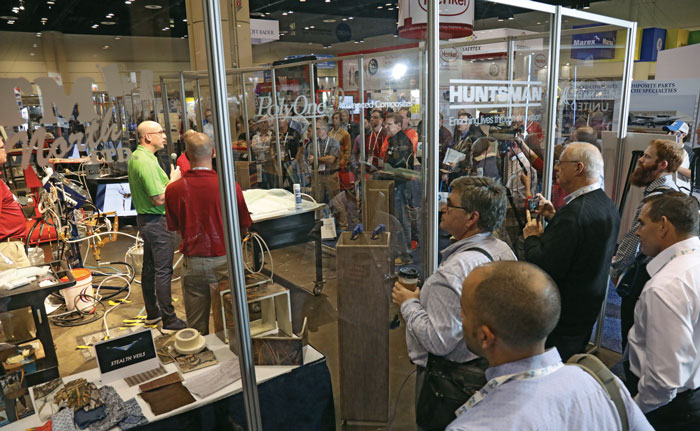
Attendees were able to watch live demonstrations at the Huntsman booth.
Changing With The Times
Of course, tradeshows have changed quite a bit in the years since my first experience at one, or maybe more appropriately, they have evolved with the times and must continue to do so. Originally, tradeshows were the place where all the exhibitors showed their newest, latest and greatest products — the best they had to offer — to all the prospective customers that might wander by the booth. Trade shows were the great industry gathering event. But trade shows began to change as more and more competitors from near and far came booths to take lots of pictures and make notes. This high-level of interest inevitably resulted in conspicuously similar products of questionable origin being offered by other companies, generally at lower prices. This practice, in turn, began the trend of companies limiting product offerings at shows and highlighting just enough interesting items to draw curiosity. Sections of the booth space seemed to evolve into restricted or private meeting areas. Potential customers were drawn in by the interesting items and then essentially vetted. Those deemed worthy were brought to the restricted areas to be shown the real new items. Skip to the present with our fast-paced culture with everything online, and given the advent of mobile phones with all kinds of apps and access to more intelligence at our fingertips than the computers that were used to put a man on the moon years ago, and the evolution continues. Tradeshows have taken on yet another purpose.
CAMX featured a poster session showcasing graduate student work.
An Atmosphere Of Conversation
A wise man once told me: “More business at tradeshows is conducted during meals, at the after-parties and in the bars, than on the show floor. It’s where the actual conversations take place.” From what I’ve seen over the years, he was obviously correct and tradeshow organizers have begun to acknowledge this as well. Recent incarnations of tradeshow floor layouts have incorporated more meeting spaces and communal areas for people to gather. This allows attendees — both exhibitors and those wandering the show floor — the opportunity to have genuine, bona-fide actual face-to-face conversations with one another without the need for a cell phone. “Of course, digital media becomes more and more important for our marketing activities, but it´s the special environment of tradeshows that you cannot find via the Internet,” offered Stumpp. “Tradeshows generate an atmosphere of conversation that becomes the basis for new ideas. Face-to-face conversations not only generate new contacts, they also help to improve the relationships we have with existing suppliers and customers.”
This year’s CAMX show proved to be a great example of conversations improving relationships. Several attendees appeared to relish the extra time available to simply talk with others in attendance, whether it be a new or current customers, suppliers and even possible competitors. “The show floor wasn’t overly busy given the approaching holidays and year end, but the people who were at the show were here for a reason,” stated Jeff Thompson, director of sales, basalt yarn producer Mafic North America, Shelby, N.C. “So, we had more time for real, more in-depth interactions with customers and potential customers that we hope become quite valuable. I prefer this to the more hit and run type of communications that inevitably happen when the show floor is very busy. You just gain so much more out of real conversations.”
You Just Never Know What You May Learn Or Who You May See
Another reason tradeshows are great, is they present an opportunity similar to that of going to a flea market or yard sale. One truly never really knows what one might find or whom you might run into. Maybe seeing one product or technology sparks an idea for a new product or better way of doing something. And there’s always the chance to run into old friends or colleagues you haven’t seen in years. At CAMX for example, I was able to talk to several different companies and gained ideas on new products and processing technologies that may lead to improvements in our productivity. I also ran into a colleague who I hadn’t seen in almost 20 years. It was a complete surprise for both of us, and really nice to catch up.
Everyone who exhibits or attends tradeshows has their own agenda and opinion of the show’s worth and will weigh the associated costs. However, some in the industry have said in recent years that tradeshows are no longer worth the cost or effort, and I respectfully disagree. Granted, tradeshows used to be the primary source for finding new products, but now with the advent of the Internet, new products are found everywhere. Today, tradeshows present an opportunity and atmosphere to forge relationships and renew personal connections, which may have been misplaced as a result of the fast-paced Internet, mobile phone, information overload world we all live in. It really does take only one enticing introduction, stimulating conversation or a new nugget or two of information to reinforce the belief that tradeshows really do still matter. The recent CAMX show certainly strengthened this belief for me.