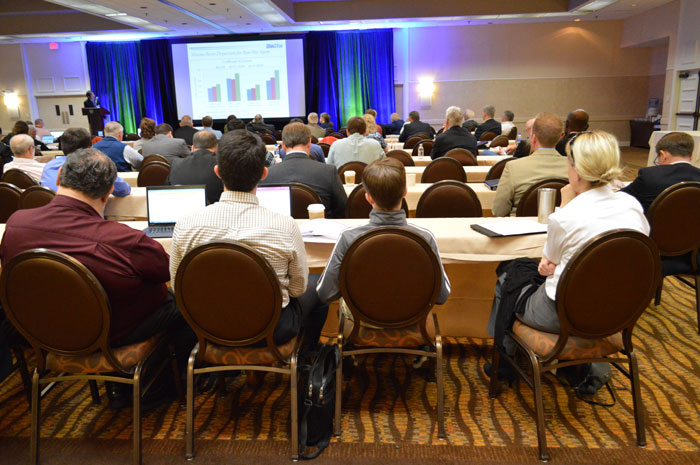
SYFA conference tackled the marine debris challenge and cyber security among other topics.
TW Special Report
The Synthetic Yarn And Fabric Association (SYFA) recently held its annual Spring Conference at the Sheraton Charlotte Airport Hotel in Charlotte, N.C. The conference’s “USA Textile Technologies: New Materials, Design and Applications” agenda featured speakers covering a wide variety of technology topics in addition to an economics update and review of the current climate for technical textiles.
Alasdair Carmichael, Carmichael International, addressed the hot topic of fibers as a contributor to marine debris; while Andrea Ferris, co-founder, Intrinsic Textiles Group LLC, discussed an innovative solution developed to prevent microfiber pollution and unrecycled man-made fiber textiles that are sent to the landfill. Intrinsic’s CiClo™ Technology — which is an easy to implement, upstream solution, according to the company — allows polyester to biodegrade more like natural fibers in wastewater treatment plants and landfill conditions.
Jim Hemsley, IS manager, Techmer PM LLC, also highlighted the importance of cyber security — that is protecting computer systems from theft and damage to hardware, software or information as well as service disruption — for textile companies. It’s an often-overlooked necessity, which is becoming more important than ever in the age of Industry 4.0 with internet-connected machinery.
Conference sponsors for the spring event included Gold Sponsor Premiere Fibers Inc.; Silver Sponsor Pulcra Chemicals LLC; Bronze Sponsors Burlington, DAK Americas LLC and PolySpinTex Inc; and Patrons & Exhibitors Sponsors 4M Plants S.r.l., Clariant Masterbatches, The Filament Factory LLC, Goulston Technologies Inc., Milliken & Company, National Council of Textile Organizations, Unifi Manufacturing Inc. and William Barnet & Son LLC.
The next SYFA Conference will be held November 29-30, 2018.
Click here to view a gallery of images from the event.
Dr. Donald J. Wagner II, Technical Marketing Manager, BIOSAFE, Gelest Inc.
TW Special Report
Dr. Donald J. Wagner II invented the patented silicon-based antimicrobial polymer known as BIOSAFE, and currently is technical marketing manager for Gelest Inc. Following an exclusive licensing agreement, in 2016, Gelest acquired the Biosafe technology outright from Biosafe Inc. In April 2017, HM4100 Antimicrobial — marketed as Biosafe — received full U.S. Environmental Protection Agency (EPA) registration for food contact substrates, and in July 2017 the product became certified under NSF 51 for food contact. Wagner graduated from Virginia Polytechnic and State University in 2001.
Textile World: What is currently happening in the antimicrobial market for medical textiles, and what are companies focused on?
Wagner: Fashion, function and controlling costs are probably the three biggest things. Scrubs have become fashionable and even a pseudo-status symbol for health care professionals such as nurses and doctors.
The medical textile function is important in that the textiles are barriers between healthcare workers and their patients. Not only are scrubs the uniform of the staff, making healthcare workers are easily identifiable to patients and family members, they are also the physical barrier.
Fluid barriers for medical textiles can be hydrophobic and oleophobic. Recent advancements in fluid barrier technology help scrubs shed water and other fluids that can contain disease-causing microbes. A textile’s ability to repel fluids is important in keeping the textile clean, but there are new technologies that deliver antimicrobial performance to the textile itself on a continuous and ongoing basis. Such technologies control microorganisms within the textile, keeping them from being a vector for the transmission of microorganisms associated with the healthcare environment.
TW: What characteristics or properties does the medical community require for medical textiles?
Wagner: The key is protection. The fluid barrier and antimicrobial chemistry add a unique level of protection that a standard textile lacks. The Journal of Hospital Infection in March 2015 pointed out that healthcare textiles, including uniforms and apparel, are vectors for transmission of microorganisms that cause infections and illness to healthcare workers, patients, and the community. The impact is underestimated because of the lack of point-source investigation of textiles during outbreaks.
TW: What factors must a manufacturer consider when launching a new antimicrobial textile in the marketplace?
Wagner: Price and performance. The medical textile that has excellent fluid barrier properties and antimicrobial performance is certainly valuable, but it may not warrant a price twice that of a standard medical textile. For context, imagine a medical textile containing an antimicrobial technology that prevents a $20,000 infection. Then, of course it’s worth the 100 percent premium. But from a clinical perspective, how would you find causation between the textile and preventing the infection?
It is very difficult. The industry should take a common-sense approach and use medical textiles that are cost-effective, but also have the technologies that could prevent the spread of infection.
TW: What are the regulatory requirements for medical textiles, and how does this affect marketing?
Wagner: Medical textiles fall under both EPA and U.S. Food & Drug Administration (FDA) jurisdiction. It’s a situation called dual jurisdiction. From a commercial textile point of view, this is an EPA issue. It falls under the Federal Insecticide, Fungicide, and Rodenticide Act (FIFRA) division of the EPA and its Pesticide Registration (PR) Notice 2000-1. But from a medical textile perspective, scrubs can be considered a medical device if delivering antimicrobial performance. Navigating the overlapping jurisdictions and governing rules with EPA and FDA can be a tough path. A company launching an antimicrobial medical textile must ensure that the active ingredient is EPA-approved for use on textiles, and additionally is acceptable as a modifier to medical devices under FDA guidance.
TW: How is Gelest BIOSAFE HM4100 antimicrobial different from other antimicrobials used in medical textiles? How does it work?
Wagner: There was an existing silane quat antimicrobial which was invented and commercialized in the 1970s. Unfortunately, it was flammable and poisonous. The company Biosafe worked with this material, and in the process invented a newer version.
We found our niche by polymerizing the existing monomer into a dry powder. This new HM4100 Antimicrobial dry powder could be compounded in plastics, dissolved into water, used as a surface treatment, or even spun into man-made fibers. The breadth of application of the existing technology was expanded greatly by the Biosafe antimicrobial powder’s ability to remove the volatile organic compounds, flammability and poisonous aspects of the older methanol-based solution.
BIOSAFE® protects materials used in a wide range of consumer and industrial applications where microorganisms can cause staining, pitting, deterioration or foul odors.
The Biosafe mode of action is to physically disrupt the cell membrane. By contrast, traditional biocides work by poisoning the cell from the inside out. Most old-school biocides are based on heavy metals or chlorinated phenols and leach out of textiles. They are metabolized by the microorganism. When enough of the poison builds up inside the microorganism, it causes lethal mutations to the DNA and cell lysis. Unfortunately, this mode of action also leads to adaptive organisms, or as they are known in the healthcare environment, superbugs. Because Biosafe is non-leaching and is not metabolized by the microorganism, nothing is transferred to the cell and the microbe has no chance to adapt to this mode of action.
TW: In what form is Biosafe antimicrobial available for textile production, and what benefits does it provide medical textile manufacturers?
Wagner: It is available as a dry powder or as a liquid in water or solvent. The Biosafe material can be spun into fiber directly, used in fiber finishing methods, or as a treatment to finished textiles. The hydrogen bonding and covalent bonding ability of the polymeric siloxane make it ideal for treating textiles.
To be competitive, medical textile manufacturers must address the ongoing concern about the role of healthcare apparel and other healthcare textiles in transmitting pathogens. Biosafe antimicrobial offers medical textile manufacturers the ability to address these concerns.
TW: What kind of toxicity testing is necessary to prove the safety of an antimicrobial, and how did Biosafe perform when tested according to these protocols?
Wagner: Before a textile company uses an active antimicrobial, the active must be approved through the U.S. EPA FIFRA for use on textiles and apparel. The antimicrobial must pass a series of six acute toxicity tests. Companies can go beyond this protocol and also conduct biocompatibility testing under ISO 10993.
Biosafe showed no negative effects in any of the acute toxicity tests. It also is considered biocompatible under ISO cytotoxicity, systemic toxicity, and intracutaneous toxicity. Further, Biosafe has been subjected to the 48 day repeat insult patch test (RIPT) and a mutagenicity test. There were no untoward effects, and the results are available upon request.
TW: What trends do you see shaping the future of medical textiles regarding antimicrobial properties and other key requirements?
Wagner: Medical textiles are considered personal protective equipment (PPE) and play a major role in protecting healthcare workers from transmissible pathogens. Recent literature1 clearly illustrates that healthcare textiles can be a vector for transmission of germs. The trends that will shape the future of the medical textile industry will be technologies than can enable textiles to reduce the acquisition, retention, and transmission of infectious microorganisms found in blood, bodily fluids, and the environment. Gelest’s Biosafe antimicrobial is a very small part of a medical textile. The market is large and the demands are for low-cost, high-performance products. If Gelest delivers powerful antimicrobial technologies at a competitive price, then we have done our job.
1 A. Mitchell et al. / Journal of Hospital Infection (2015) 1e8
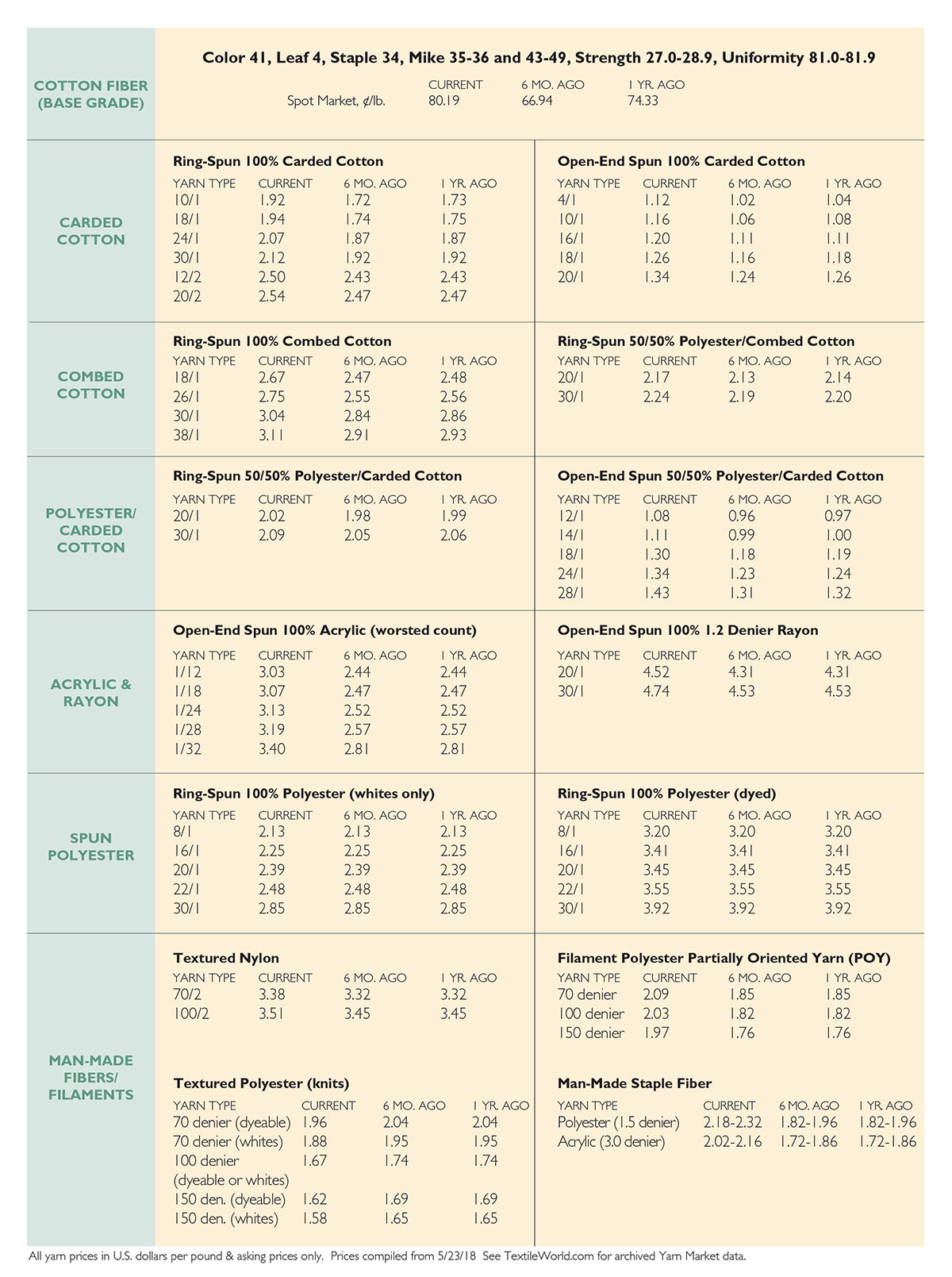
Yarn sales continued to be strong at the end of May for many companies. “We are doing really well,” said one specialty yarns manufacturer. “Business has been strong across the board.”
Added another spinner: “We are still seeing a lot of cotton orders, even though cotton prices have gone up a good bit this year. We are still moving some blends, as well.” Polyester yarns and fibers for nonwovens, industrial and specialty applications are also selling well, several executives report.
Overall, as mid-year approaches, spinners say the first half of 2018 has been solid. And they say they are optimistic about the remainder of the year. “I always say I am cautiously optimistic about the future,” said one spinner, “because no matter how well things go, there are always potential pitfalls that can come on suddenly. But, barring unforeseen events, we are confident in our position going forward.”
One of the reasons the U.S. industry has enjoyed such a dramatic comeback in recent years is the technology and efficiency with which products are manufactured. “We have the most modern textile industry in the world, from fiber to fabric,” noted one industry observer. “As a result, we have the most advanced products, with the highest degree of quality and consistency.” He noted, for example, that automation enabled one plant, with less than 150 employees, to produce more than 2 million pounds of yarn a week at the beginning of this decade — a quantity that, 40 years ago, would have taken thousands of employees.
Industry executives say millions of dollars are poured into research that enables the U.S. industry’s impressive technology and automation to produce some of the world’s most innovative products. Yet, these same leaders say, some of the industry’s most pioneering products are illegally reverse engineered by industries in other countries and sold at bargain-basement prices.
Industry Asks For Fiber, Yarn, Fabrics, Apparel To Be Included In China Sanctions
China, according to both government and industry leaders, has been the worst offender. As the U.S. government prepares to assess retaliatory tariff actions against China, textile leaders want their products protected. Fiber, yarn and textiles need to be included in China 301 tariffs, NCTO President Auggie Tantillo testified at a public hearing at the Office of the U.S. Trade Representative in May.
Section 301 of the U.S. Trade Act of 1974 authorizes the President to take all appropriate action, including retaliation, to obtain the removal of any act, policy, or practice of a foreign government that violates an international trade agreement or is unjustified, unreasonable, or discriminatory, and that burdens or restricts U.S. commerce.
“The U.S. textile industry urges the Trump administration to include textile and apparel end products in any Section 301 retaliatory tariff action against China,” Tantillo said. NCTO maintains that “China’s predatory, illegal trade actions, including intellectual property rights theft, have contributed to the loss of millions of U.S. manufacturing jobs, including hundreds of thousands in textiles.”
“China’s domination of global textile markets has clearly been aided by its rampant theft of U.S. textile intellectual property. From the violation of patents on high-performance fibers, yarns and fabrics to the infringement of copyrighted designs on textile home furnishings, China has gained pricing advantages through blatantly illegal activities. Putting 301 tariffs on Chinese textile and apparel exports would send a long overdue signal that these predatory actions will no longer be tolerated,” he added.
Currently, the Section 301 retaliation list does not contain a single fiber, yarn or fabric product manufactured by U.S. companies.
“This is a glaring omission because China has used a system of predatory trade practices, including brazen theft of U.S. textile materials, technology, and innovation, to dominate global markets.” Tantillo said. He pointed out that, in fiscal years 2016-2017, wearing apparel and accessories accounted for the single largest segment of U.S. Department of Homeland Security’s seizures of products that violated intellectual property rights. He said that Chinese companies have infringed upon U.S. patented high-performance products, such as those with high elasticity, abrasion resistance, moisture-wicking and other attributes.
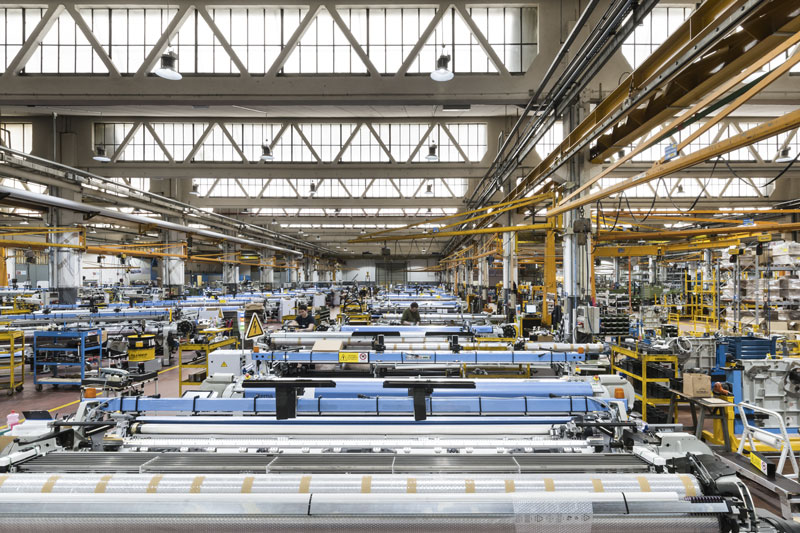
Itema has a manufacturing site for its weaving machines at its headquarters in Italy.
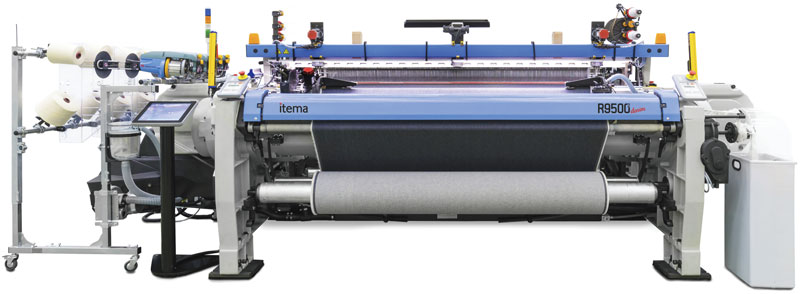
Itema has introduced the second-generation R95002denim rapier weaving machine designed to enable denim weavers to meet the needs of the fast-changing denim market.
TW Special Report
A living fabric and an icon of style, denim is part of million people’s lives. In all forms — torn, scraped, washed-out, aged and distressed — denim has been the king of fashion for more than five centuries and continues to evolve. At first used to produce workwear, denim has now become the undeniable heart of the most prestigious fashion brands’ collections, which are changing faster and more frequently than ever before.
These frantic evolutions certainly impact production of the fabric itself, forcing denim weaving mills to quickly adapt to market’s demand. In fact, denim mills are increasingly facing not only constantly evolving fashion trends, but also more demanding customers and shorter lead times to fill orders. Technology — agile and adaptive — is key when it comes to enabling denim mills to react and counteract the fast pace of today’s world and, at the same time, stay abreast of their customers’ requirements. In the amazing world of weaving, indigo fabric remains one of the most demanding and challenging fabrics to produce.
Italy-based Itema S.p.A. developed a rapier weaving machine tailored exclusively to denim weaving. Now in its second generation, the Itema R95002denim has been improved and further fine-tuned to enable denim weavers to meet fast-changing and constantly evolving market requirements.
Key factors when it comes to denim weaving machines are production speed and fabric quality. Higher machine revolutions per minute (rpms) lead to greater production capacity and superior fabric quality — which in denim weaving means no fabric defects such as starting marks and irregular fabric appearance — guaranteeing superior attractiveness for buyers and brands.
A further important universally valid factor in weaving is user-friendliness, and in this field the new Itema R95002denim features many advances.
The R95002denim was recently launched during the ITM 2018 exhibition in Istanbul, Turkey. According to the company the new denim-dedicated Itema weaving machine excels due to unparalleled cost savings, superior fabric quality and outstanding user-experience.
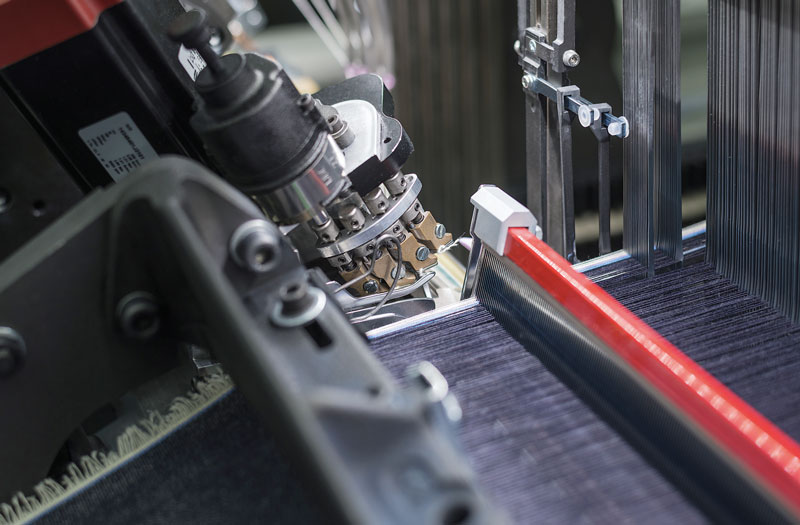
The iSAVER™ eliminates waste selvage on the left-hand side of the fabric to offer cost savings and sustainable weaving.
Cost Savings
Savings are one crucial feature of the R95002denim. Optimization of the main mechanical components allows a considerable energy consumption reduction, and the machine is also equipped with iSAVER™ — a new device that eliminates the waste selvage on the left-hand side of the fabric thus leading to savings. Designed and developed by ItemaLab – the Itema advanced innovation department — iSAVER™ combines innovative mechatronic principles to reduce weaving costs. Working up to four weft colors and ensuring maximum user-friendliness, the device allows weavers to save 2,000 euros ($2350) per machine per year as a minimum savings — variations in savings are a result of different yarn cost. Saving raw materials, such as cotton, reduces wasted resources and results in a reduced need to process waste.
The redesigned and optimized tape-hook system on the R95002denim completes the savings picture by significantly extending the components’ lifetime. The new Itema tapes developed by Lamiflex, an Itema Group company specializing in composite materials, feature an innovative configuration with a triple layer of carbon fiber leading to maximum reliability. The tapes represent the first result of the research and development cooperation between the two companies after the Itema acquired Italy-based Lamiflex S.p.A.
Superior Fabric Quality
Specifically considering denim fabrics, uniform fabric appearance and softer hand-feel are the seals of Itema-woven indigo fabrics. With the R95002denim Itema makes a further step toward denim perfection by combining the Itema Shed Geometry and the new rapier weft transfer. The new SK UltraLight Rapiers, specially designed to meet specific indigo fabric needs, feature a design that ensures their reduced dimensions and maximum lightness. Streamlined and lightweight, the SK UltraLight rapiers further enhance the Itema Shed Geometry allowing an even smaller shed opening for improved fabric quality.
Itema’s R95002denim weaving machine
Outstanding User-Experience
Great strides also have been made to guarantee an outstanding user-experience including optimized machine ergonomics with a lowered front frame to facilitate loom accessibility and the new ergonomic rapier opener with knob. Additionally, the new Itema Textile Help dedicated to denim fabrics is a troubleshooting software that when loaded directly on the machine console provides real-time support to the weaver to quickly overcome the most common textile difficulties that may occur during the weaving cycle.
Brand-new, advanced devices now available with the new-generation R95002denim loom are specifically designed to deliver tangible benefits to denim mills running the new Itema machine, guaranteeing a competitive advantage in the market.
Whether a weaver is looking for fabric quality, reliability, waste minimization, sustainability, user-friendliness, or all of the above when producing denim fabrics, there is now a new, high-performance weaving machine that delivers all of these benefits and more.
Greenboro, N.C.-based Unifi Inc. reports its operating subsidiary Unifi Manufacturing Inc. entered into an agreement to acquire the dyed yarn business and other assets of Washington, N.C.-based National Spinning Co. Inc. The transaction adds acrylic and wool products to Unifi’s dyed yarn portfolio, and is expected to close in May. Unifi reports it will transition the dyed yarn business from Burlington, N.C., to Unifi’s dye house in Reidsville, N.C., and expects to run the dye house on a seven-day schedule. National Spinning employees will be offered positions at Unifi including those in key sales, technical and operations positions.
“This acquisition will better position Unifi for growth in key market segments such as sweaters, hosiery and apparel, as our expanded dyed yarn portfolio will help strengthen our relationship with existing customers and brings opportunities to attract new customers as we become an even greater solutions provider,” said Tom Caudle, president and COO, Unifi. “Additionally, our customers continue to focus on shortening product development and production lead times, and thus we expect that these new capabilities will allow us to provide flexible and responsive dyed yarn solutions to meet this demand. Expanding our product portfolio will also bring additional innovation to the dyed yarn supply chain, and will provide more sourcing flexibility for customers while assuring continued capability and expertise.”
“We believe this transaction best serves the long-term interests of both our employees and our customers,” said Jim Booterbaugh, president and COO, National Spinning. “Customers will receive world-class innovation and technical support from Unifi, and employees that join Unifi will benefit from the career opportunities provided by a larger portfolio of products, services and solutions.
According to the European Committee of Textile Machinery Manufacturers (CEMATEX), owner of the ITMA exhibition, the floor space for ITMA 2019 is fully booked. More than 1,500 companies from 45 companies have applied to participate in the show, which will be held in Barcelona June 20-26, 2019. Organizers now are working to expand the net 110,000 square-meter exhibit space to accommodate additional exhibitors.
“We are grateful for the vote of confidence from the industry,” said Fritz P. Mayer, president, CEMATEX. “It shows ITMA is the launch pad of choice for the latest technologies from around the world. Interest in ITMA 2019 is extremely strong, and we have received more applications at an earlier date compared with previous editions. We continue to welcome new applicants, especially manufacturers who are launching new products, as they will help to make ITMA 2019 an even more vibrant sourcing platform for our visitors.”
Fruit of the Loom Inc., Bowling Green, Ky., recently was honored with the Offsite Renewable Energy Award for its Merendon Power Plant during the 2018 Smart Energy Decisions Innovation Summit. The awards recognize creative technologies and forward-thinking practices by large electric power users. Recognizing a need for a renewable energy source at its manufacturing facilities in Honduras, Fruit of the Loom established the Merendon plant, which operates as part of the Fruit of the Loom corporation. The plant helped the company reduce its carbon footprint by more than 51,500 metric tons each year, which is the equivalent to removing 11,028 passenger cars from the road for one year, according to the Environmental Protection Agency.
Fruit of the Loom is committed to socially responsible efforts and also recently joined The Sustainability Consortium. The company also received the Corporate Social Responsibility Seal from FUNDAHRSE in 2017.
Winston-Salem, N.C.-based HanesBrands reports it has earned its ninth consecutive U.S. Environmental Protection Agency (EPA) Energy Star Partner of the Year award for sustained excellence in energy conservation, carbon emissions reduction and environmental sustainability.
In 2017, the company’s accomplishments included lowering year-over-year energy use per pound of production by 6 percent, saving more than $4 million; implementing environmental stewardship initiatives such as the startup of a heat and power biomass plant in El Salvador; using programs to encourage employees to engage in the company’s energy management culture; and partnerships with multiple universities to educate future business leaders about the importance of environmental stewarship in business.
“HanesBrands is incredibly honored to earn our ninth consecutive Energy Star Partner of the Year award and will accept it on behalf of our approximately 70,000 worldwide employees who are committed to energy management and environmental responsibility,” said Javier Chacon, chief global manufacturing officer for HanesBrands. “Thanks to our employees’ steadfast commitment, Hanes is the only apparel company to be honored for sustained excellence by the EPA Energy Star program in its 26-year history and continues to demonstrate that companies from all industries can make a difference in energy conservation, carbon emissions reduction and environmental sustainability.”
Stony Brook, N.Y.-based Applied DNA Sciences Inc. reports it has signed a multi-year license with WestPoint Home LLC. The deal grants WestPoint Home the exclusive right to use Applied DNA’s CertainT® platform for its blended duvets, towels, sheets, pillow cases, bed skirts, shams and decorative pillows sold for hospitality in Canada, Mexico and the United States. The agreement also gives WestPoint non-exclusive CertainT platform rights for various hospitaility opportunities.
Applied DNA’s molecular tags embedded into the source materials will certify that any of WestPoint’s hospitality textile products featuring polyester (PET) or recycled PET contain the original source raw materials to ensure origin and authenticity.
“Our partnership with Applied DNA adds to our already extensive assortment of environmentally sustainable products and processes,” said Normand Savaria, president and CEO, WestPoint Home.
“As leaders in supply chain transparency and accuracy we are excited to be adding the CertainT platform and technology to our product offerings.”

 SYFA conference tackled the marine debris challenge and cyber security among other topics.