NCTO Council Roundtable: Challenges & Opportunities For The U.S. Textile Industry

CouncilsTW Special Report

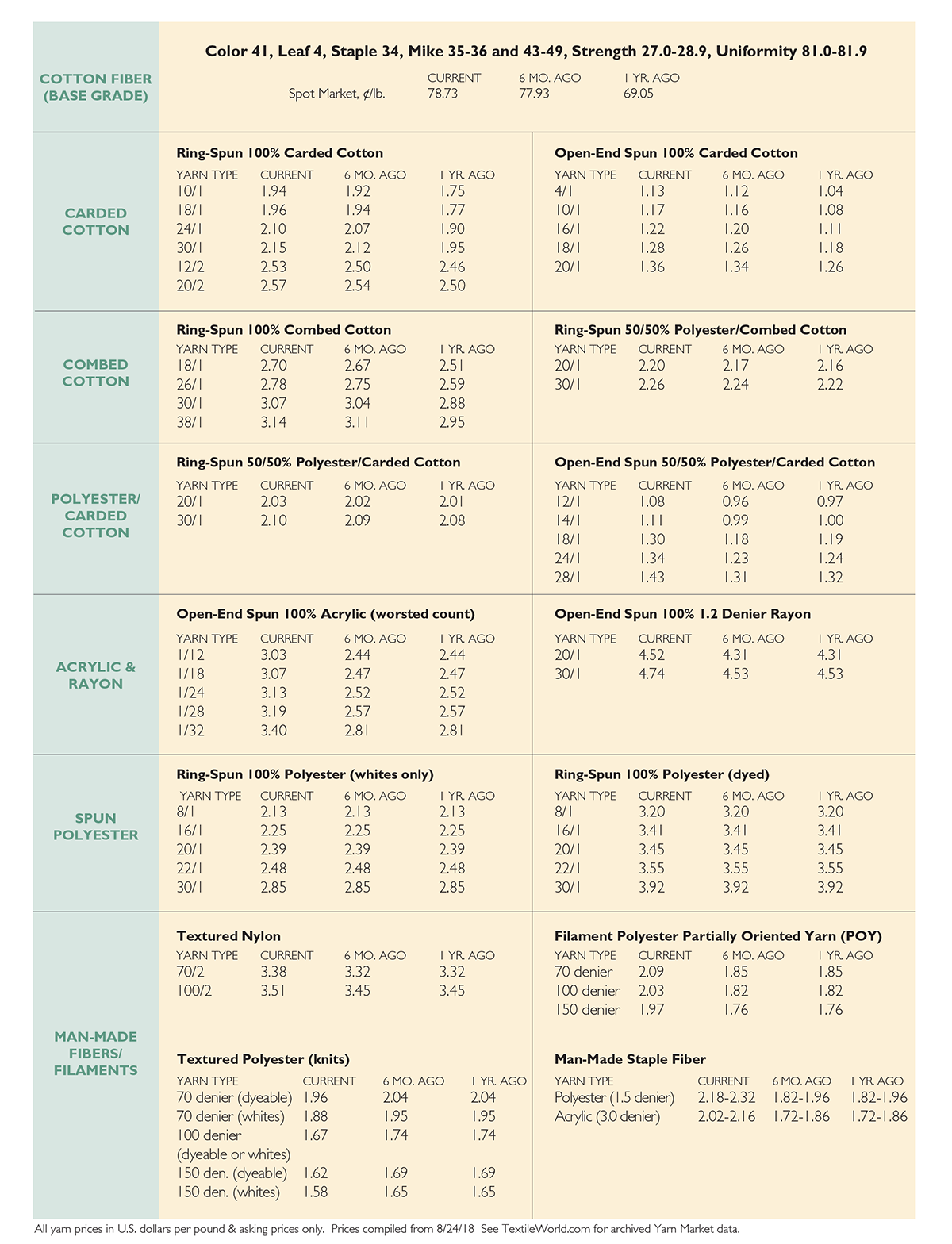
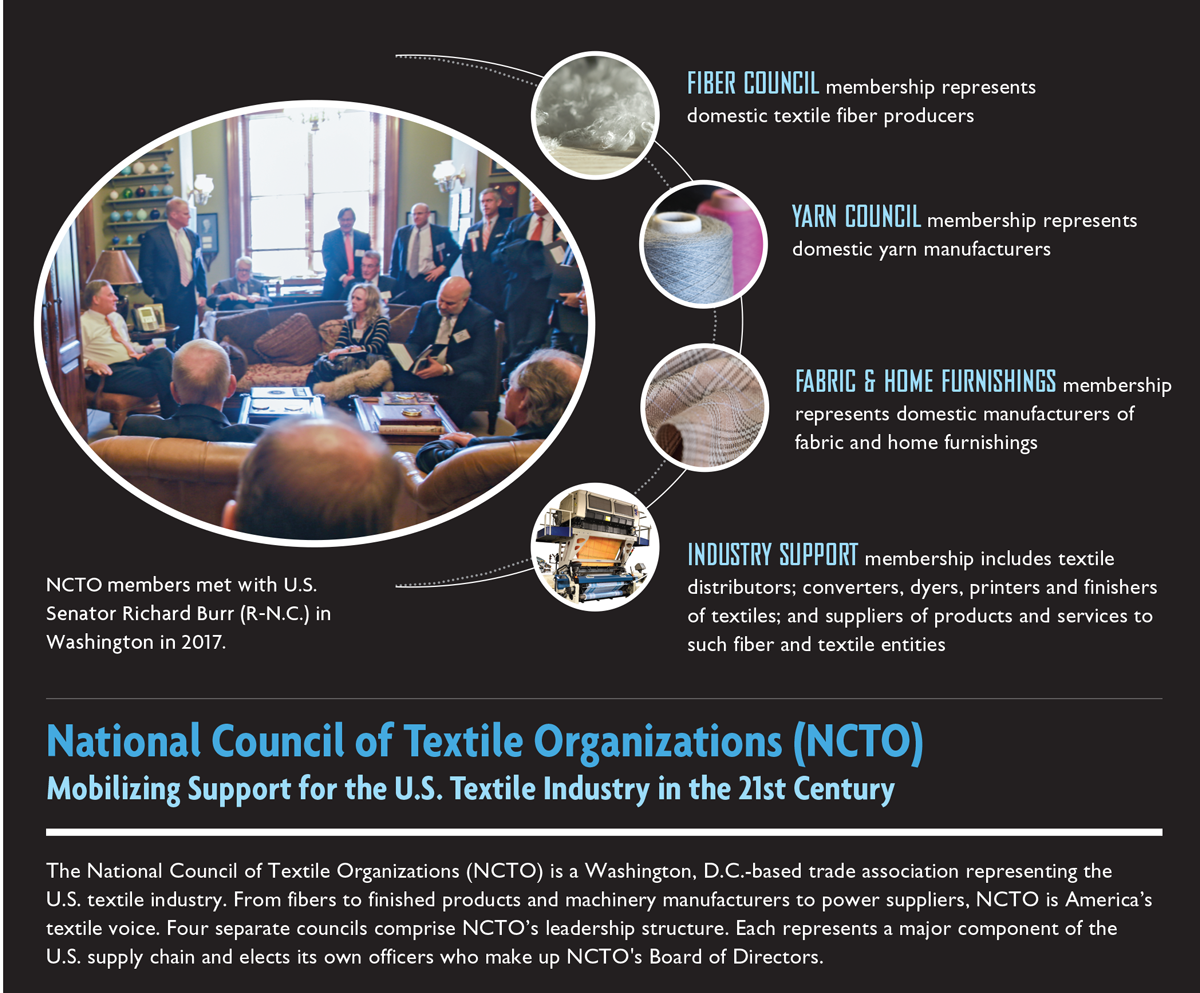
The National Council of Textile Organizations (NCTO) represents the breadth and depth of the U.S. textile industry through a council-based structure that provides a voice to the diverse interests of the industry.

There are four separate councils that comprise the NCTO leadership structure. Each council represents a major component of the U.S. textile supply chain and elects its own officers who make up NCTO’s Board of Directors.

CouncilsBockoven
Bockoven

Council Leadership

The Fiber Council represents domestic textile fiber producers and is currently chaired by Don Bockoven, president, Wellford, S.C.-based Leigh Fibers Inc. Every year, Leigh Fibers purchases approximately 300 million pounds of textile waste from a wide range of suppliers. Once sorted, the fiber is used to create both branded and customer-specific fiber blends.

The United States will continue to be advantaged in the cost of natural gas, a primary feedstock for many synthetic fibers.
— Don Bockoven, NCTO Fiber Council Chairman; President, Leigh Fibers Inc.

The Yarn Council represents domestic yarn manufacturers with Frontier Spinning Mills Inc.’s CEO Robin Perkins currently serving as chairman.

Founded in 1996 and based in Sanford, N.C, Frontier is one of the largest producers of 100-percent cotton and cotton-blend yarns in the world. The company operates state-of-the-art manufacturing facilities in multiple states and employs more than 1,100 people.

The Fabric & Home Furnishings Council represents domestic manufacturers of fabric, including woven, knitted, nonwoven, tufted, braided or other, and home furnishings. The council is chaired by Greenwood Mills Inc.’s President Jay Self. Headquartered in its namesake city of Greenwood, S.C., the company manufactures textiles from fiber through finished fabrics, and its subsidiary SingleSource Apparel (SSA) is one of the largest non-branded apparel manufacturers in the Americas.

The fourth council is the Industry Support Council, which includes textile distributors; converters, dyers, printers and finishers of textiles; and suppliers of products and services to such fiber and textile entities. Greenville, S.C.-based Picanol of America Inc.’s President Cyril Guerin currently serves as chairman. Picanol develops, produces and markets high-tech air-jet and rapier weaving machines. Today, approximately 2,600 weaving mills around the world use Picanol machinery, totaling more than 175,000 weaving machines.

CouncilsSelf
Self

Industry Challenges, Advantages

An upswing in investment by domestic and foreign firms in U.S. textile manufacturing has led many to posit that the industry is making a comeback after surviving exceedingly difficult times.

Beyond fundamental market factors, future investment is also dependent on sound government policy. Competitive tax and regulatory structures are vital.

— Jay Self, NCTO Fabric & Home Furnishings Council Chairman; President, Greenwood Mills Inc.

“I believe we will continue to see this investment trend in the near future as a result of continuing pressure on reducing supply chain cycle times and global competitiveness,” said Fiber Council Chairman Bockoven. The United States will continue to be advantaged in the cost of natural gas, a primary feedstock for many synthetic fibers.”

Fabric & Home Furnishings Chair Self stated: “I think the majority of the investments have been predominately in open-end spinning. The low labor content and competitive electrical rates have made this a good investment. We are starting to see some investment in weaving with some of the new speeds out there. This is primarily replacement and not new capacity.

Self continued, “Beyond fundamental market factors, future investment is also dependent on sound government policy. Competitive tax and regulatory structures are vital. In addition, we need to have logical trade policies, such as the yarn forward origin rules that are included in most of our international trade agreements. Policies like these are imperative to meet challenges from low-cost suppliers like Vietnam, who continue to grow market share with double-digit increases without any beneficial duty treatment thanks to generous state-sponsored subsidies.”

From a spinning perspective, “We will continue to invest responsibly in our plants to stay on top of technology,” Yarn Chair Perkins said. “Operating in a free marketplace is a privilege, but we continue to face labor challenges. One of the benefits the United States has had over foreign manufacturing is the lower cost of dependable and uninterruptible power.”

Speaking on behalf of his sector, Industry Support Chair Guerin said, “Those businesses who want to be prepared for the future now need to invest into new equipment.”

Guerin added that one of the strengths in the United States is a closeness to the market. “Proximity,” Guerin said. “We are a Belgium-based company with more than 50 years of presence in the United States. We established our company in Greenville in 1970 to serve our customers. What was true then is still valid today, even more so with the rapid pace at which the end users change their needs.”

Technology, Labor Challenges

As technology, including automation, continues to become more advanced, U.S. textile companies are faced with opportunities as well as challenges.

“Innovation, technology and automation are critical to driving global competitiveness,” Fiber Chair Bockoven said. “In addition, automation has been used to improve operator safety in areas like ergonomics where repetitive motion typically done by humans is now being done through automation.”

Finding skilled employees for the industry is a challenge according to Bockoven. “At the end of 2017, there were almost 6 million jobs in the United States unfilled. The textile industry is no different than the rest of the country in the challenges with attracting and retaining employees. We have been working to develop a strong succession plan and have promoted several millennials into critical positions because of what they’ve accomplished and the potential they’ve shown.”

“The most effective innovations increase flexibility and speed to market,” Fabric Chair Self said. “Also they allow us to take advantage of new fibers and their properties. We have become more proactive in training our workforce and have started apprenticeship programs with the school districts to promote workforce training.”

CouncilsPerkins
Perkins

“Innovation offers less dependency on labor resulting in the need for fewer employees; however, a good company will have to pay those employees more,” Yarn Chair Perkins said. “Managing a 24/7 operation in today’s workforce environment is very challenging. Finding quality candidates who want to work shift work and weekends has become extremely difficult. At Frontier, we try to focus on automating when possible and providing a good, clean, safe workplace for our employees with competitive benefits and wages.”

We will continue to invest responsibly in our plants to stay on top of technology.

— Robin Perkins, NCTO Yarn Council Chairman; CEO, Frontier Spinning Mills Inc.

“We offer innovation to one of the oldest industries in the world,” Industry Support Chair Guerin said. “Weaving is a process that has not changed much in 5,000 years! But with highly-advanced looms, we take weaving to an all new level of performance. And there is definitely more to come. Our machines are already Industry 4.0 enabled — as in are capable of capturing and processing huge amounts of sensoric data — and these data will be used ever more to further optimize the weaving process.”

Drivers Affecting Change In The U.S. Textile Industry

“Our customers continue to ask us for quicker turnarounds from point of sale to delivery,” Yarn Chair Perkins said. “We have to specialize in quick response for customer satisfaction. E-commerce is having a material impact on shopping today. The retail industry needs to adjust to the millennial purchasing habits as baby boomers age and purchase less.

“The CAFTA region needs to broaden its offerings to become more of a one-stop shop for retail buyers. U.S. textile suppliers are logistically positioned to better serve the U.S. retail sector than anyone else. We need to expand our product offerings to match products that are currently supplied from Asia,” Perkins added.

CouncilsGuerin
Guerin

Those businesses who want to be prepared for the future now need to invest into new equipment.

— Cyril Guerin, NCTO Industry Support Council Chairman; President, Picanol of America Inc.

“As the world grows smaller every day, it is critical to bring a significant level of differentiation to the table,” Industry Support Chair Guerin said as he discussed changes and drivers in the industry. “Picanol’s U.S. customers are very well equipped to develop new products, new solutions and new services. The performance, versatility and frugality of modern looms helps them to be more competitive, not only at home, but also on the world market.”

According to Fiber Chair Bockoven: “Continued efforts in automation, focus on circular economy and continued efforts in mass customization will all have some impact that will shape the industry of the future. I would foresee continued investments in automation particularly as the workforce challenges continue. The jury is still out as to how the circular economy thinking will play out in the industry where there have been considerable efforts in recycling for the past 20 or so years. Things like UNIFI®’s REPREVE®, regenerated polyester, for example — there has been considerable effort with yet a lot more to come.”

The Council System Benefits NCTO’s Message

“NCTO membership brings industry connectivity, camaraderie and leverage,” Bockoven said. “The relationship with industry is critical as evidenced by NCTO providing a unified voice in regulatory affairs and trade negotiations. While the Trans-Pacific Partnership is no longer on the table, the industry partnership during the negotiations was second to none. The relationship with the community is critical in demonstrating to employees the commitment to the area where we all live and work.

“Not only does NCTO give us a united front to present to our legislators, but they research the problems facing our industry and provide us with solutions and/or recommendations that are beneficial to us individually and to the industry as a whole,” added Yarn Chair Perkins. Regarding the relationship between industry, company and community, Perkins said: “It’s the reason we exist. We need local government to support us as corporate citizens so we can maintain a successful workforce that in turn supports our community and local businesses. Supporting our local schools and community colleges is key to growing a strong community that produces hard working citizens and leaders.”

The Council System Works To Support NCTO Members

It is clear in speaking with the NCTO council chairmen, although their views vary slightly due to their industry sector challenges, in the end the message comes down to one achievement by NCTO — a shared voice where the U.S. textile industry can speak in unison and affect positive change.
Councilsgraphic


Editor’s Note: This article appears in Textile World courtesy of the National Council of Textile Organizations (NCTO) as part of the “American Textiles: We Make Amazing™” campaign. NCTO is a trade association representing U.S. textile manufacturing. Please visit ncto.org to learn more about NCTO, the industry and the campaign.


September/October 2018
U.S. Textiles Expand, Trade Questions Loom

By James M. Borneman, Editor In Chief

The recent report from the Tempe, Ariz.-based Institute for Supply Management® (ISM®) presents good news on textiles, U.S. manufacturing and a growing economy.

“Economic activity in the manufacturing sector expanded in August, and the overall economy grew for the 112th consecutive month,” said the nation’s supply executives in the latest Manufacturing ISM® Report On Business®.

The report stated: “The August Purchasing Managers’ Index, or PMI®, registered 61.3 percent, an increase of 3.2 percentage points from July.”

“This indicates strong growth in manufacturing for the 24th consecutive month, led by continued expansion in all subindexes that make up the PMI,” said Timothy R. Fiore, CPSM, C.P.M., chair of the ISM.

“The PMI reached its highest level since May 2004, when it registered 61.4 percent.” A reading above 50 percent points to an expanding manufacturing economy.

In addition, 16 out of 18 manufacturing industries surveyed showed positive growth, and of the 16, two categories — apparel, leather & allied industries; and textile mills — led the charge behind only computer and electronic products. The only laggards were wood products and primary metals.

On the downside, apparel, leather & allied industries, and textile mills also led the way in reporting increased prices for raw materials in August.

It’s reassuring there is data to backup the gut feeling many textile executives have been expressing. However, there is some looming uncertainty in regard to international trade. Notably, with the North American Free Trade agreement (NAFTA), the trilateral trade agreement that links Canada, the United States and Mexico into a unified trading block, as well as the confrontation with China over trade policies.

There is no lack of opinion on these matters. The president’s blunt approach to taking issue with NAFTA and China trade policy is serious, but will it be effective?

As of TW’s press time, a framework agreement between the United States and Mexico has been made, and with Canada stepping back from the table, it would appear to some that Mexico achieved an advantage that makes a Canadian agreement challenging.

NAFTA has, since prior to its inception, enjoyed a divisive range of opinion regarding fairness and effectiveness. And the president’s approach of imposing tariffs to achieve reductions or outright elimination of tariffs and non-tariff trade barriers is a difficult process of negotiation for many to swallow.

Is a trilateral agreement necessary, or should the United States have bilateral agreements? — a view asserted by the president. Bilateral agreements — one between the United States and Mexico, as well as one between the United States and Canada, definitely has pro and cons and can address problem areas directly.

However, opinions vary. Recent headlines said the following: “[Consumer Technology Association] Says New NAFTA Agreement Must Include Three Countries And Focus On Key Issues;” “Hoffa: U.S.-Mexico Agreement Is First Step Towards Better North American Trade;” “U.S. And Canadian Manufacturers: We Must Have A Trilateral Agreement;” and “VF Testifies In Support Of NAFTA.”

So the drama continues. Will U.S. Trade Representative Robert Lighthizer and his team achieve the the desired free trade result? Only time will tell.

September/October 2018


September/October 2018: Textile Activity At A Glance

By Robert S. Reichard, Economics Editor

BFChart

September/October 2018

Business Strong, Investment Growing

Jim-Phillips-colorBy Jim Phillips, Yarn Market Editor

Business remained strong across the board for many spinners heading into the final week of August. Ring-spun yarn, as has been the case for the past few years, is in very high demand.

The industry has undergone a radical and welcome change over the past few years. Except for a few down months in 2017, business has been steady in the industry for quite some time — a tremendous relief from the roller coaster rides from the 1980s to the early 2000s when hundreds of plants were closing their doors, leaving thousands of people unemployed.

Those were the years when a number of experts around the world were predicting the complete collapse of the U.S. textile/ fiber/apparel complex.

But, thankfully, not all predictions come true. Over time, the industry’s production capacity began to align with customer demand, ushering in a new age of stability. And then, against all odds, and contrary to all of those doomsday projections, the U.S. textile industry began once again to grow. As it became more technologically advanced, more productive and efficient, the U.S. industry began once again to acquire the ability to go toe-to-toe against the competition — regardless of where that competition might be. In fact, companies from other nations began investing in U.S. yarn and fiber operations.

Among those companies is Lenzing, an Austrian company that supplies the global textile and nonwovens industry with high-quality, botanic cellulose fibers. Lenzing has one plant in Alabama and is building a new facility in the Mobile area. The facility will bring 163 new jobs to the area and will significantly increase production of one of the company’s flagship products, TENCEL™ fiber, when it comes on line in 2019.

And just recently, Lenzing announced that Tencel Luxe branded lyocell filament yarns will be included in designer Mara Hoffman’s 2018 ready-to-wear collection as well as in designs for Fall 2018. Hoffman has been consciously and progressively increasing the sustainability profile of her apparel designs for the past several years, especially with her selections of more sustainable fibers and fabrics, according to Lenzing.

Incorporating more recycled raw materials is another way Hoffman reduces her carbon footprint and the impact her products have on the environment, Lenzing notes in a release. She also will feature fabrics made with Tencel Lyocell with Refibra™ technology in the Fall 2018 collection. Tencel x Refibra is the only commercially available fiber made from a combination of cotton scraps and renewable wood, and produced using the environmentally friendly closed-loop production process, Lenzing reports.

“Clothing places an intense burden on the environment,” Hoffman said. “Through intentional fabric selection and design choices, we create collections that look and feel good and that have a significantly lower impact on our planet. Our customers are starting to understand our sustainability efforts, to learn about them, and to look for them in other brands too.”

NAFTA Nearing Completion?

At the time of this writing, NAFTA negotiations were coming down to the wire. During the last week in August, the United States and Mexico hammered out a tentative agreement, with Canada on the sidelines. From the The Hill website: “For the past month, Canadian officials stood back, stating repeatedly that they would return to Washington only after the U.S. and Mexico had wrapped up purely bilateral issues. But it turned out that the U.S. and Mexico actually negotiated a completely updated NAFTA and presented this tentative pact to Canada as a virtual fait accompli.” The Canadian trade representative then rushed to Washington to provide Canada’s input on the treaty talks the United States and Mexico had agreed to conclude by August 31. At the end of August, specific details of the agreement were not available.

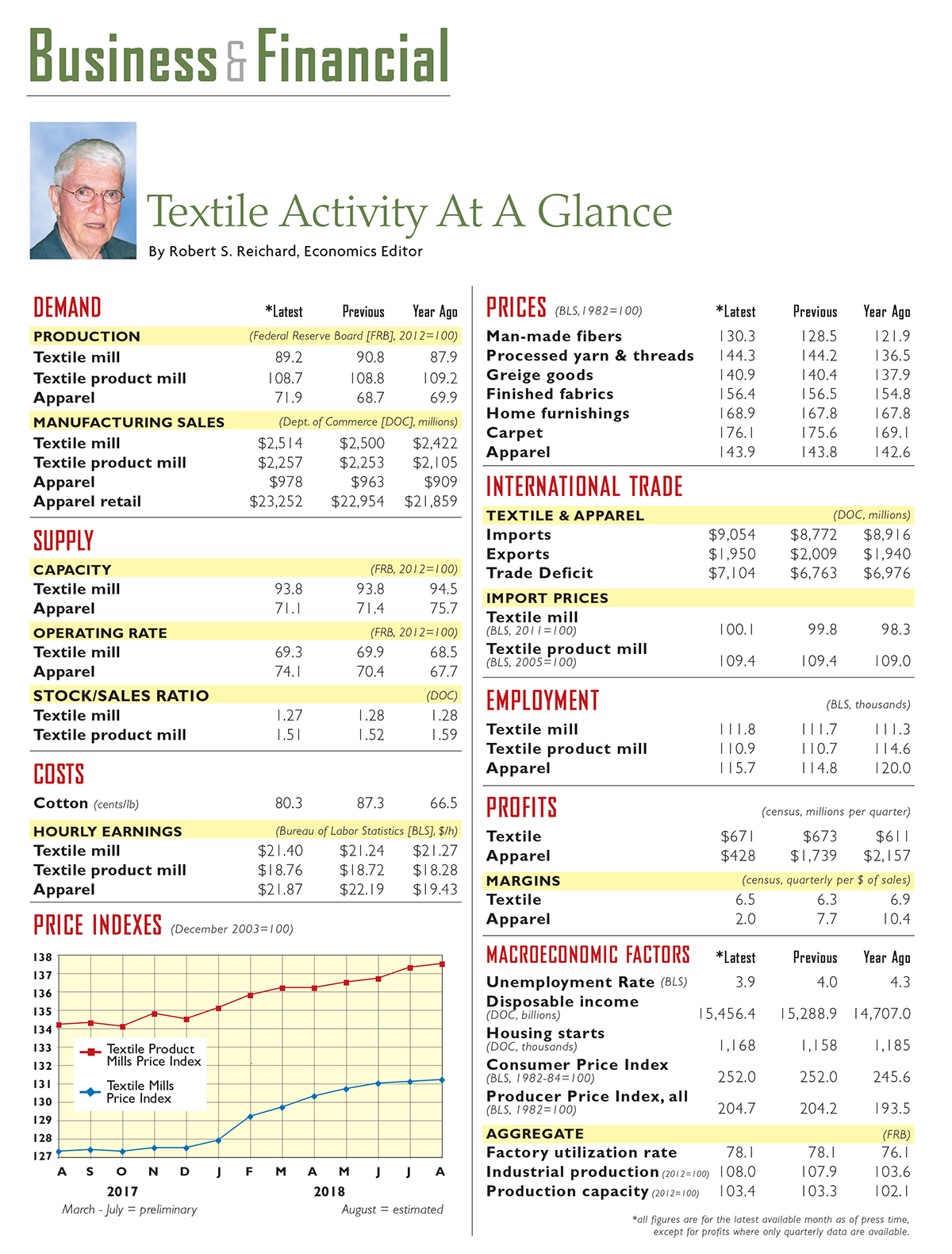
Spot quotations for the base quality of cotton (color 41, leaf 4, staple 34, mike 35-36 and 43-49, strength 27.0-28.9, and uniformity 81.0-81.9) in the seven designated markets measured by the USDA averaged 78.73 cents per pound for the week ending Thursday, August 23, 2018. The weekly average was down from 79.34 the previous week, but up from 67.01 cents reported for the same period a year ago.

SO18YarnChart

September/October 2018

IVL To Acquire Plastics Recycler Sorepla

Bangkok-based Indorama Ventures Public Co. Ltd. (IVL) has entered into an agreement to acquire France-based plastics recycler Sorepla Industrie S.A. Sorepla, with a capacity of 52,000 metric tons per year, produces recycled polyethylene terephthalate (rPET), recycled high density polyethylene (rHDPE) as well as food grade pellets. IVL reports the“acquisition is strategically in line with the company’s objectives of long-term sustainability.”

“Indorama Ventures plays a key role in promoting the circular economy and environmental sustainability globally,” said Aloke Lohia, Group CEO, Indorama Ventures. “We believe that the recycling of PET packaging is one of the most responsible solutions for the preservation of resources and the reduction of PET containers in landfills. Indorama Ventures is playing its part and investing in recycling solutions globally. With a comprehensive European network for bottle sourcing and good supply chain efficiencies, we feel that this acquisition will contribute as an attractive platform for strong future growth in the sustainable recycling business with the potential to expand globally.”

September/October 2018

Spinnova Receives Financing, New Investors

Finland-based Spinnova reports it has secured financing totaling 7.5 million euros ($8.7 million) from OP Bank and public funding agency Business Finland to help ramp up production at its sustainable textile fiber pilot facility.

In related company news, VTT Ventures, an early investor in the company, has given up its ownership share according to an exit strategy. VTT was replaced by two new investors — venture capital firm Maki.vc and Beata Domus. Spinnova’s majority shareholder remains Brazil-based Fibria.

“Thanks to our financers, starting the pilot factory and the product development work are moving full speed ahead,” said Janne Poranen, CEO, Spinnova. “Licensing the technology now being developed in Finland is our most likely future business model, so piloting the technology concept on an industrial scale is now our main priority.”

September/October 2018

Invista To Construct ADN Plant In China

Wichita, Kan.-based Invista has announced it will invest more than $1 billion in a 300,000-ton adiponitrile (ADN) facility in China to meet the local demand for the nylon 6,6 intermediate chemical. Construction will begin in 2020 and production is expected to come online in 2023.

“We are pleased by the feedback we have received in the market and are confident we will reach agreements with selected partners over the next few months; so our shareholders have agreed to proceed with the project,” said Bill Greenfield, president, Invista Intermediates. “Combined with the significant investments being made in our existing ADN plants, this decision further demonstrates Invista’s commitment to the global industry.”

“Invista supplies more of the merchant market than any other ADN producer, so we want to ensure those customers have the best technology available,” said Kyle Redinger, vice president of Invista Intermediates, Asia Pacific, and 2017 Magnolia Silver Award Winner. “The last world-scale plant was constructed more than 35 years ago, so this is a special time for the industry, and I am extremely proud to lead Invista’s efforts to deliver this new facility.”

September/October 2018

Unifi Unveils New Branding, Ends Guatemala JV Discussion

Greensboro, N.C.-based Unifi Inc. recently unveiled new branding and positioning for its products. According to the company, the “True Innovation Starts in the Fiber” branding highlights its “commitment to the development of innovative and sustainable performance fibers backed by a flexible, global supply chain.” In addition, the new PROFIBER™ brand offers options for integrating multiple performance “Tru-technologies” into polyester and nylon yarns to deliver increased fabric comfort, performance and functionality. The Tru-technologies — which offer a wide range of performance attributes including wicking, thermal comfort, full coverage, bounce, stretch, sun protection and water resistance — include TruTemp365™, TruDry™, TruCover™, TruFlexx™, TruCool™ and TruTouch™.

“By offering a wide range of products focused on benefits, we can help our customers create innovative fabrics that solve everyday problems and meet and exceed their consumers’ expectations,” said Jay Hertwig, group vice president of global brand sales.

In other Unifi news, the company has ended previously announced negotiations with Complast S.A. and Technologia Textil Avanzada for a joint venture in Guatemala. “Our commitment to the Central American region remains unchanged and we continue to see growth opportunities for REPREVE® and our branded portfolio both in the region and across the globe,” said Tom Caudle, president and COO, Unifi. “We will continue to seek future strategic growth opportunities across the Americas that leverage our assets and deliver shareholder value.”

September/October 2018

HP, Stahl Partner For Durable Printing Solutions

The Netherlands-based Stahl has announced a partnership with Palo Alto, Calif.-based Hewlett-Packard (HP) to increase the durability of printed man-made materials.  Water-based HP Latex Inks preserve the flexibility of the material, while the Stahl’s EVO® coatings enhance the durability of the printed apparel, upholstery, bags or shoes.

“The partnership with Stahl enables us to reach new markets and help our customers to quickly adapt to new market trends while reducing costly stocks,” said François Tanière, worldwide marketing business developer at HP Inc. Large Format Printing Division.

September/October 2018

Monforts Introduces Easy Compact Range For Knits

Germany-based A. Monforts  Textilmaschinen GmbH & Co. KG has introduced to all global markets the Easy Compact range for advanced compacting of open-width knitted fabrics. A vertical chain return and 100-percent Nomex® durable twin felts in the stretching field offer controlled shrinkage and the lowest possible shrinkage values, according to the company. A sturdy pinning-in unit, motorized selvage uncurling device, and stainless steel tandem supporting bar for mark-free center support are other notable features of the Easy Compact reported by Monforts. In addition, a non-stop winder at the end of the range may be fitted with a fabric cooling device on the adjustable speed conveyor belt. Easy Compact is equipped with Monforts’ Qualitex PLC system.

September/October 2018

Sponsors