Leib Oehmig: New NCTO Chairman

StateoftheIndustryOehmig
Leib Oehmig, president and CEO, Glen Raven Inc., was recently named chairman of the National Council of Textile Organizations.

Glen Raven CEO brings global textile business experience, hands-on approach to NCTO leadership.

TW Special Report

With a vibrant 30-year career at Glen Raven, N.C.-based Glen Raven Inc., Leib Oehmig is known for a leadership style that “… ensures a culture of integrity and innovation while maintaining the high standards of quality and service for which Glen Raven is known.”

Oehmig joined Glen Raven in 1989. During his career, he oversaw the construction and management of Glen Raven’s 1-million-square-foot Sunbrella® fabrics manufacturing center, served as president of Glen Raven Custom Fabrics LLC, and was named president and COO of Glen Raven Inc. In 2017, Oehmig was appointed president and CEO of Glen Raven upon Allen Gant’s retirement. Oehmig is the first non-family member to serve as CEO of the company.

At the 16th annual meeting of the National Council of Textile Organizations (NCTO) in Washington, Oehmig was elected NCTO chairman. Textile World recently had the opportunity to talk to Oehmig about the state of the U.S. textile industry, and the role NCTO plays in the industry’s future.

Textile World: Congratulations on the NCTO chairmanship. Your words during your acceptance speech were characterized by many as heartfelt. You called for continued support of NCTO during its time of transition, as well as support for incoming NCTO President and CEO Kim Glas. Can you comment on your remarks for TW readers?

Leib Oehmig: Auggie Tantillo and his NCTO team, working hand-in-hand with industry leaders, have changed the perception of the U.S. textile industry, gained credibility as thought leaders in global trade, and earned our industry a seat at the table during trade negotiations. Therefore, we must remain fully engaged as we transition the leadership of many of our member companies and the organization that represents our interests in Washington, D.C. We are incredibly fortunate to have Kim Glas leading this team of talented associates and I look forward to building on the momentum that our industry has gained through active participation and strong financial support. Regardless of your position in the value chain, if your company benefits from a strong U.S. textile industry, then membership in NCTO is among the most important investments you can make.

TW: Glen Raven leadership and associates have served the industry through commitment to NCTO lending both time and financial support. How do you see the role of NCTO, and what does the organization mean to the U.S. textile industry?

Oehmig: My predecessor as CEO of Glen Raven, Allen Gant, along with other iconic leaders in our industry, understood very well the benefits of strong advocacy in the executive and legislative branches of government. In addition, they recognized that our industry must align around common goals and approach advocacy with “unity in purpose and vision,” to quote Gant from a 2005 article that was published in Textile World. Since 2004, NCTO has served as the voice of the U.S. textile industry in Washington, D.C., representing all sectors from fiber through fabric formation and finishing. Fifteen years later, with rapidly changing industry dynamics and globalization, there has never been a more important time for our industry to advocate with clear purpose and vision.

TW: As the leader of a global textile business, how do you see the current state of the industry, including current and/or future challenges and opportunities?

Oehmig: Although I am certainly not naïve to the global economic and geopolitical challenges that confront our industry, I am very optimistic about the future of the U.S. textile industry. Innovation, creativity and courageous leadership are alive and well. Therefore, I am excited to work with NCTO and industry leaders to produce a positive influence on key policy matters that affect our industry. That means developing strategies to proactively engage in the Trump administration’s trade agenda. Negotiations with China, Japan and the European Union will require diligence as we work to create opportunity, while defending against adverse legislative proposals.

TW: Trade has been a significant issue for the current administration. What are your thoughts as NCTO chairman as well as a CEO of a company with global business interests?

Oehmig: In my view, accelerated globalization will continue to shape strategies for both governments and the businesses who operate within their borders. Therefore, it is no longer a question of how to slow this momentum, but how does the U.S. textile industry further engage the Trump administration in the process of developing business-friendly trade policies? Further, how do we anticipate U.S. textile policy needs prior to a crisis so that we can best position the industry to take advantage of opportunities that may be available?

TW: What are your thoughts on the NCTO leadership transition as Augustine D. “Auggie” Tantillo retires and Kimberly Glas joins the organization as president and CEO?

Oehmig: The U.S. textile industry owes a tremendous debt of gratitude to Auggie Tantillo for investing so much of himself into pushing our industry forward. In addition to his exemplary technical knowledge, the thing you hear most about Auggie are compliments regarding his character and integrity. Our industry has benefited greatly from the immense respect Auggie has earned from his peers, members of Congress and their staffs.

Kim Glas is bringing her own experiences, perspective and ideas to NCTO. Throughout the interview process, Kim clearly demonstrated her desire to lead an organization that is willing to embrace change and affect policy decisions as opposed to reacting.

I feel that NCTO has a history of adapting to the rapidly changing dynamics in global trade and will be receptive to new ideas and strategies from Kim and her team. We are excited for both Auggie and Kim, and very optimistic regarding the future of NCTO.

TW: Imagine it’s April 2020 and you are looking back on your year as chairman. Where is NCTO, and what contributions did you make to the organization?

Oehmig: I am confident that, throughout this next year, NCTO members will actively engage in policy debate and offer strong support to this NCTO team who is investing so much of themselves in the overall betterment of the domestic textile industry. From what I have read in Glas’ plan for her first 100 days, NCTO is going to have an incredibly productive year. When we look back on this year, I am confident that we will conclude that NCTO is well on its way to becoming the most effective and impactful trade association in Washington. For me, I just want to do all that I can to support NCTO, its leadership and its members in reaching our industry goals.

May/June 2019

Quality Fabric Of The Month: Thinly-Veiled Protection

QFOMLydallLydall Performance Materials’ TechniMat is suitable for high-conductivity substrate applications, among other applications.

By Rachael S. Davis, Executive Editor

Imagine a nonwoven fabric lighter than a piece of paper that can help protect a composite airplane wing from a lightning strike. Sounds incredible maybe, but such products exist and Rochester, N.H.-based Lydall Performance Materials Inc. specializes in such nonwoven veils as well as filtration and insulation technical nonwoven, membrane and composite products.

Nonwoven veils are used in composites manufacturing to improve surface aesthetics and impart properties to the finished product. Lydall’s TechniMat nonwoven veil helps to conduct the approximately 1 billion joules of energy generated by a lightning strike over the skin of the aircraft acting like a faraday cage to protect the plane’s occupants and sensitive electronic equipment contained inside. The veil is designed to impart a resin-rich surface that creates a smooth, paintable finish that masks the weave pattern of the underlaying carbon fiber that makes up the structural components used in the wings and fuselage of a plane. According to the company, TechniMat also offers excellent electromagnetic interference (EFI)/radio frequency interference (RFI) shielding when incorporated into advanced composites.

TechniMat is a PAN or pitch-based carbon fiber nonwoven currently offered in versions ranging from 8.5 grams per square meter (gsm) up to 102 gsm. The company also is launching versions of TechniMat made using other fiber types including glass, polyester and aramids.

Each veil Lydall makes is customizable depending on the customer’s requirements. Specialty fillers, sizing or binder components that are compatible with epoxy resins all are available.

“For example, one customer may be looking for something that is lightweight and strong, whereas a different customer may be looking for a product that offers lightning strike diffusion,” said Michael O’Laughlin, vice president, Advanced Solutions, Lydall Performance Materials. “Customers can also specify the type of carbon fiber used to make the nonwoven veil depending on the desired end product properties.”

According to Lydall, TechniMat has excellent random fiber dispersion, uniformity and strength that ensure the veil is easy to process in pre-preg operations.

TechniMat is made using a controlled porosity process. “We have the ability to control porosity and other specifications during production through the use of online controls,” O’Laughlin said. “This ensures the porosity of the product is consistent. Controlled porosity can have various benefits depending on the application and can be used as an indication of uniformity of the sheet, or to predict the flow of air or liquid.”

“Lydall has invested in capabilities that allow us to produce materials with weights ranging from 6 gsm up to 2,500 gsm across the global network of production assets,” O’Laughlin added. “Lydall Performance Materials’ Advanced Solutions business unit offers small batch, superior quality and flexible manufacturing options. TechniMat is a great example of the company’s capabilities!”

May/June 2019

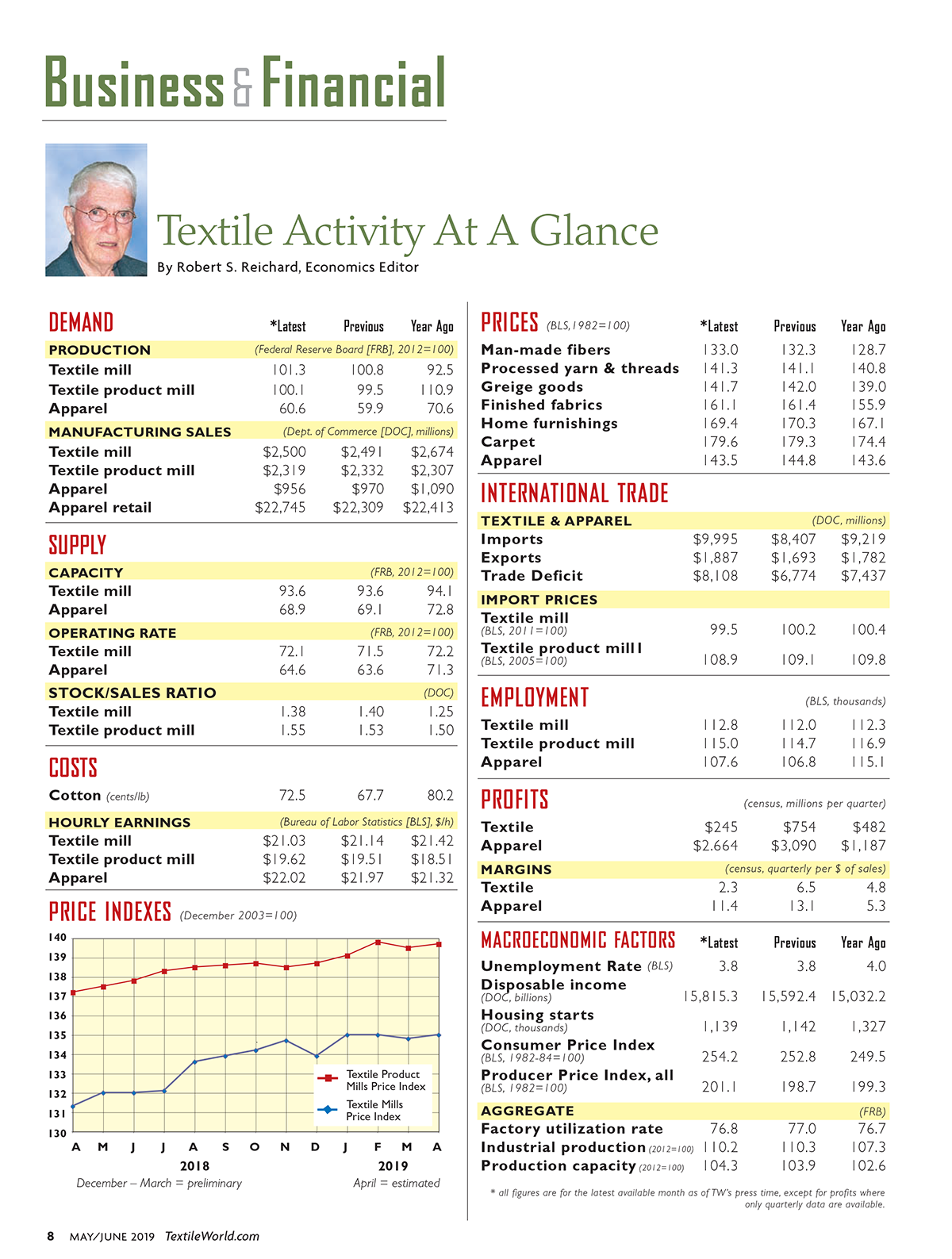
Textile Activity At A Glance: May/June 2019

BFMJ19

May/June 2019

Spinners Report Solid First Quarter

Jim-Phillips-colorBy Jim Phillips, Yarn Market Editor

Many spinners reported excellent results for the first quarter of the year. “We have some limited capacity in some areas, but, overall, things have been very good,” said one spinner. “We have a healthy backlog, so we don’t anticipate slowing any time soon.”

Other spinners also said they had a solid first quarter. “This has been the best start of the year we’ve had in some time,” noted one diversified spinner. “With the continued growth of the economy, at least for the short term, we expect the positive results will continue.”

Indeed, according to the Consumer Confidence Index, published by The Conference Board, consumers expect the economy to continue growing in the near term. “Consumers’ assessment of current conditions improved in April,” the board reported. “Those stating business conditions are “good” increased from 34.7 percent to 37.3 percent, while those saying business conditions are “bad” decreased from 12.4 percent to 11.7 percent. Consumers’ assessment of the labor market was also more upbeat. Those stating jobs are “plentiful” increased from 42.5 percent to 46.8 percent, while those claiming jobs are “hard to get” decreased from 13.8 percent to 13.3 percent. Consumers’ short-term outlook also improved in April. The percentage of consumers expecting business conditions will be better six months from now increased from 17.2 percent to 19.9 percent, while those expecting business conditions will worsen declined from 10.0 percent to 9.1 percent.”

USMCA Deal Still Has A Long Way To Go

Advocates of the United States-Mexico-Canada Agreement (USMCA) are hoping that Congress will take action on the trade deal in the next three months. “I think the timeline for the vote is that the bill is going to come to the Congress pretty soon,” Senator Roy Blunt, R-Mo., said in a recent interview. Once there, however, USMCA is likely to face lively debate.

“Passing trade legislation is often difficult, but the U.S.-Mexico-Canada Agreement, as the updated NAFTA is now known, faces an especially uncertain path,” according to a recent report by Minnesota Public Radio’s Marketplace.

“The dynamic has typically been, presidents [from either party] negotiate agreements, Republicans overwhelmingly support it, and enough Democrats get dragged along to make it possible,” said Senator Pat Toomey, R-Pa., in an interview. Toomey is a member of the Senate Finance Committee, which has jurisdiction over trade agreements. “Now we’re in a dynamic where it’s very different. We have a president who’s much less pro-trade than the Republican consensus has been historically, and Democrats do not appear as enthusiastic about working with this president as they might have been with others.”

While the current U.S. administration has touted USMCA as landmark agreement that will have a tremendous impact on U.S. exports and imports, impartial observers are uncertain whether it will generate significant results. Recently, the International Trade Commission issued its view of the cumulative impact of the agreement. The commission’s conclusion is that the overall positive impact to the U.S. economy will be in the neighborhood of 0.35 percent.

Sustainability Efforts Continue

Sustainability will be the featured topic at the Techtextil and Texprocess trade fairs, which will be explicitly turning their focus for the first time onto their exhibitors’ approaches to sustainability. From fibers, to garments, to technical textiles, companies are working to conserve water and using little or no solvents in their manufacturing processes, according to news sources.

Indeed, sustainability has been hot topic across the industry. One of the pioneers in sustainable manufacturing, American & Efird, recently released its ninth annual Corporate Sustainability Report. Just a few highlights, according to the report, are: Recycled and reused more than 2 billion liters of wastewater at global operations since 2013; 41-percent reduction in global water consumption (liters per kg of thread) since 2006; 100 percent Zero-Waste-to-Landfill status at 16 global manufacturing operations and support facilities in 2018, with five other operations recycling more than 90 percent; and 45 percent of A&E’s global energy portfolio for steam production consisted of renewable fuels in 2018.

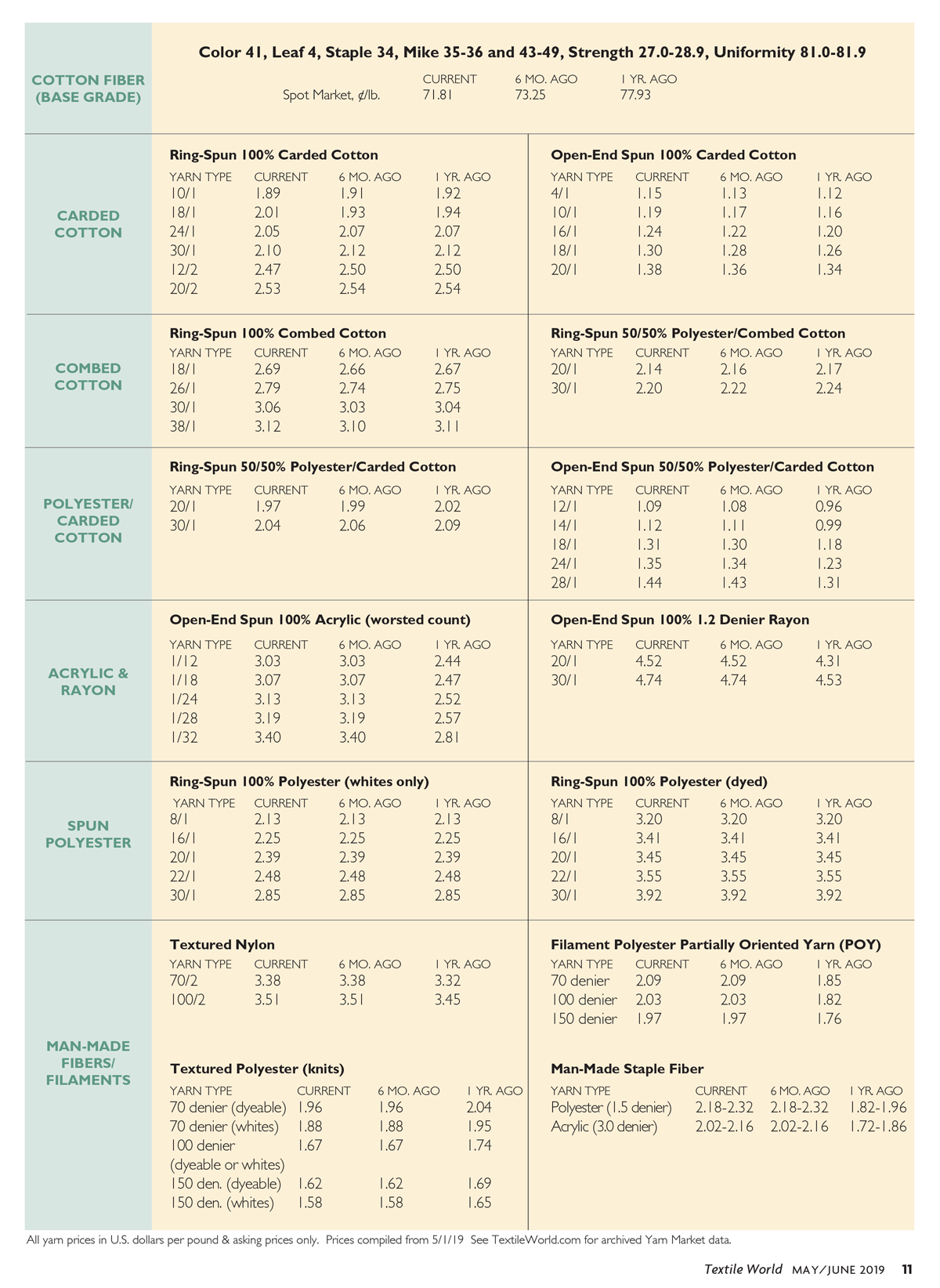
YMpricesMJ19

May/June 2019

May/June 2019

Kristi Ellis is the new vice president of communications for the Washington-based National Council of Textile Organizations (NCTO). Don Vavala was also named director of regulatory and technical affairs. Vavala replaces Hardy Poole who has retired.

Charles Jolly has joined the team at Fi-Tech Inc., Midlothian, Va. He will support the company’s field technical services resources in support of Fi-Tech principal Mayer & Cie., a Germany-based manufacturing of knitting machinery.

Rochester, N.H.-based Albany International Corp. has appointed Stephen M. Nolan
CEO and treasurer.

Saxena
Saxena

Pittsburgh-based PPG named Devashish Saxena vice president and chief digital officer. Saxena is tasked with leading the company’s digital transformation, creating a sustainable digital organization to unlock customer value.

Greensboro, N.C.-based Unifi Inc.’s board of directors has elected Albert P. “Al” Carey executive chairman and named Thomas H. Caudle Jr. principal executive officer. Caudle will also continue in his roles as a director and president and COO of the company.

Kasey Jarvis was named chief design officer for Baltimore-based Under Armour Inc. He reports directly to Chief Product Officer Kevin Eskridge.

Witkowski
Witkowski

The Netherlands-based Royal DSM has appointed John Witkowski president of DSM Biomedical where he will oversee the strategic development and execution of DSM Biomedical’s global activities.

The board of the Bureau of International Recycling (BIR) Textiles Division has named Martin Böschen divisional president. Böschen is the CEO of Texaid AG, a Switzerland-based charity-private partnership focused on collecting, sorting and recycling used textiles.

Elevate Textiles, the newly formed company that integrates the International Textile Group and American & Efird under the leadership of Platinum Equity — has named Per-Olof Loof president and CEO.

The board of directors at Montreal-based Gildan Activewear Inc. approved the appointment of Donald C. Berg as chairman of the board. He succeeds William D. Anderson who is retiring, but was reelected to the board to support a seamless transition.

Stephen Nigro was named a strategic advisor to Israel-based Kornit Digital Ltd. and its board of directors. Nigro will be nominated for election to the board at the company’s August 2019 Shareholder Meeting.

Glenda E. Hood has joined the board of directors at Delta Apparel Inc., Greenville, S.C.

Witlock
Whitlock

Gelest Inc., Morrisville, Pa., named Jim Whitlock to the newly created position of COO.

Israel-based My Size Inc. has announced the following executive level personnel changes: Billy Pardo was approved by the board of directors as COO; and Eli Turchinsky was named chief technology officer. Emily Tene also joined the company as sales manager, U.S., for the west coast.

Bridget Ryan Berman has joined the board of directors that oversees expansion and development for Atlanta-based Tegra, an apparel manufacturer and supply chain provider.

Baucom
Baucom

Dalton, Ga.-based Shaw Industries Group Inc. has promoted Tim Baucom to president.

Denver-based Johns Manville has named John Vasuta president of the company’s engineered products business.

At its recent international conference, the Research Triangle Park, N.C.-based American Association of Textile Chemists and Colorists (AATCC) presented Dr. Patrick Gruber the Henry E. Millson award for invention. He was recognized for his development of polylactic acid (PLA) fibers. AATCC also honored the following people with Future Leaders Awards: Meredith L. McQuerry; Ryan Stanley; Apurba Banerjee; Klarash Arangdad; Krystle Moody; and Heather Shields.

Eriez, Erie, Pa., promoted Ezio Viti to regional sales director for the Asia-Pacific Region.

NSF International, Ann Arbor, Mich., named Christine York program manager for its textile sustainability program.

May/June 2019

May/June 2019

Germany-based Georg Sahm GmbH & Co. KG, a member of the Starlinger Group, has launched a new website located at sahmwinder.com.

Sweden-based Coloreel has added Pals Print & Screen to its family of distributors. The distributor will be responsible for sales, service and installation for all Coloreel customers in the Netherlands and Belgium.

The Cary, N.C.-based Association of the Nonwoven Fabrics Industry (INDA) recently released the sixth annual edition of its North American Nonwovens Supply Report. Available to INDA members, the 65-page report provides a view of the North American nonwovens industry including capacity, production, operating rates and regional trade.

The FilamentFactory (TFF), Germany, recently introduced the 710UV product range featuring permanently ultraviolet (UV)-stabilized high-strength polyester yarns. The UV properties are achieved using a tailor-made masterbatch that is incorporated during
the extrusion process so the additive becomes physically-mechanically bonded to the polymer.

The Netherlands-based Ampacet has won Product Technology Innovation of the Year award from the Plastics Recycling Awards Europe 2019 for its REC-NIR-BLACK carbon-black free masterbatch.

Lexington, Ky.-based Tempur-Pedic recently unveiled the TEMPUR-breeze® mattress line, which features technology that helps keep the body up to 8 degrees cooler through the night. The product innovation is the result of more than 10 years and 2.6 million research and development hours by Tempur-Pedic’s thermal, material and textile scientists.

Houston-based Ascend Performance Materials reports a wildlife sanctuary maintained at its Pensacola, Fla., location recently received the Wildlife Habitat Council Conservation Certification® from the Wildlife Habitat Council. The Ascend Pensacola Plant Wildlife sanctuary comprises 2,000 acres, 1,300 of which are primarily undisturbed land managed by employee volunteers.

Greensboro, N.C.-based Cone Denim recently launched eco-friendly Distilled Indigo™ denims, the latest product in its Sustainblue™ collection. Cone is using Dystar’s Cadira® Denim dyeing process for the fabrics, which is a salt-free dye that completely eliminates hydrosulphite from the process.

BulletinUntuckit
UNTUCKit’s new MLB Signature Series shirts feature MLB team logos on the shirt sail.

New York City-based UNTUCKit announced a collaboration with Major League Baseball. The UNTUCKit MLB Signature Series features the logo of one of eight individual MLB teams — New York Yankees, New York Mets, Boston Red Sox, Los Angeles Dodgers, San Francisco Giants, Chicago Cubs, St. Louis Cardinals or Atlanta Braves — stitched into the sail of a classic UNTUCKit wrinkle-free shirt.

Barcoâ Uniforms, Los Angeles, has introduced the Grey’s Anatomy™ EDGE medical scrubs line featuring its patented Nylex™ fabric.

Austria-based Zimmer Maschinenbau GmbH recently delivered its 500th MAGNOROLL Coating Machine. The machine was installed at Scotland-based Eclipse Blinds.

Trivantage®, Glen Raven, N.C., has expanded its Sunbrella® awning and marine 60-inch fabric line adding six textured Sunbrella Silica styles — Charcoal, Dune, Gravel, Sesame, Silve and Stone — to bring the total collection to 80 styles.

Birmingham, Ala.-based Kamber Narrow Fabric Machinery LLC has announced a Hot Swap program for textile manufacturers. The program allows a customer to have narrow fabric needle looms completely refurbished with a full one-year warranty with no machine downtime. Kamber will “loan” a customer a temporary machine — built to the customers specifications — while the existing machine is being refurbished.

São Paulo-based Braskem recently announced a polypropylene distribution partnership with PolyQuest Inc., Wilmington, N.C.

France-based CARBIOS reports it was granted a patent from the United States Patent and
Trademark Office for its proprietary process used to recycle polyethylene terephthalate from plastic waste using enzymatic technology.

Fong’s Europe GmbH, Germany, a member of CHTC Fong’s International Group, is celebrating the 100th anniversary of its flagship THEN brand. The company will host a reception for customers and agents during ITMA 2019 in Barcelona.

May/June 2019

U.S. Economic Growth Continues: Textile Mills Lead ISM Report

BornemanBy James M. Borneman, Editor In Chief

As of early May, the news could hardly be better for the U.S. economy, and textiles are participating in the growth story.

With politics flying, and the news spinners spinning, the contrasting interpretations of the economic data couldn’t be more divergent. But all told, it is darn good data.

The U.S. economy added 263,000 jobs in April surpassing the 190,000 forecast, and pushed down unemployment to 3.6 percent compared to the 3.8 percent expectation — posting the lowest figure since December 1969.Wage growth in the form of average hourly earnings held at 3.2 percent bringing the average pay to $27.77 an hour.

But the growth story continues with the gross domestic product (GDP), which increased 3.2 percent in the first quarter. Productivity also was up 3.6 percent — the largest gain in five years and achieved in an environment of fairly low inflation.

According to the latest Manufacturing ISM® Report On Business® published by the Tempe, Ariz.-based Institute for Supply Management® (ISM®): “Economic activity in the manufacturing sector expanded in April, and the overall economy grew for the 120th consecutive month, say the nation’s supply executives.”

Again the textile mill sector is performing well, coming in first out of 13 growing manufacturing sectors. Growth is one of the most misunderstood and underrated factors in play in an economy. It acts like steroids and amplifies many outcomes —not to be feared, but closely monitored.

So why the long faces beyond the political spinning? … the global economy. On the world stage, the U.S. economy is a stand-out. But most Americans don’t feel the contrast with the global economy.

Check out this headline from International Monetary Fund World Economic Outlook, “April 2019 — Growth Slowdown, Precarious Recovery.” According to the report: “After strong growth in 2017 and early 2018, global economic activity slowed notably in the second half of last year, reflecting a confluence of factors affecting major economies. China’s growth declined following a combination of needed regulatory tightening to rein in shadow banking and an increase in trade tensions with the United States.

“The euro area economy lost more momentum than expected as consumer and business confidence weakened and car production in Germany was disrupted by the introduction of new emission standards; investment dropped in Italy as sovereign spreads widened; and external demand, especially from emerging Asia, softened.

“Elsewhere, natural disasters hurt activity in Japan. Trade tensions increasingly took a toll on business confidence and, so, financial market sentiment worsened, with financial conditions tightening for vulnerable emerging markets in the spring of 2018 and then in advanced economies later in the year, weighing on global demand.

Conditions have eased in 2019 as the U.S. Federal Reserve signaled a more accommodative monetary policy stance and markets became more optimistic about a U.S.–China trade deal, but they remain slightly more restrictive than in the fall.”

What a nasty picture, certainly in highcontrast to the domestic economic outlook. If we could get a decent trade deal — sparks might just fly.

May/June 2019

Indorama Ventures Announces The Launch Of DEJA™, A 100-percent rPET Brand

BANGKOK, Thailand — May 14, 2019 — Indorama Ventures Public Co. Ltd. (IVL), a global chemical producer, offers new 100-percent rPET (recycled PET) brand DEJA™ as part of its continuous commitment to deliver responsible and sustainable growth.

IVL’s new 100-percent rPET fiber brand DEJA is available in various forms such as recycled flake, pellet, fiber and filament for use in multiple applications. Headquartered in Bangkok, Thailand, IVL has operating sites in 31 countries on five continents and a global manufacturing footprint across Africa, Asia, Europe and North America.

IVL continues to build durable competitive advantages through its diversified portfolio, supported by a responsible approach to sustainable business, people and the environment; creating value for society and for customers. DEJA,100-percent rPET products are derived by recycling 140 kilo tonne of plastic bottles yearly and transforming them into extra-ordinary, innovative, product ingredients. The DEJA brand enables forward-thinking companies to make a decision based on performance and innovative future-proofed materials. IVL have been at the forefront of the process in developing the technology to convert rPET bottles into highly usable products for over 40 years. IVL’s heritage in pioneering recycling technology for global applications has ensured consistent delivery and innovation in changing and challenging environments.

The investment in and introduction of 100-percent rPET brand DEJA is IVL’s response to global concern around the world on environmental impact, particularly in relation to plastic. Trade customers and end consumers are increasingly demanding transparency in how the businesses that they buy from are managing their environmental responsibilities.100% rPET brand DEJA addresses environmental responsibilities and concerns all along the value chain by offering both education and leadership; providing clear evidence that what is available for purchase and use has been produced sustainably. DEJA gives converters credibility, retailers accreditation and end consumers the assurance of sustainability with high performance as standard. DEJA gives a clear, ingredient brand guarantee of excellence which matches IVL’s performance led and sustainable ethos, using the synergy of IVL’s global expertise to educate, to innovate and to circulate a sustainability message across its entire brand platform.

Uday Gill, CEO Fibers at IVL explains the rationale and the aims for the DEJA™ brand: “IVL’s heritage in pioneering recycling technology across 100% rPET flake, pellet, fiber and filament applications has enabled our performance-led product ingredients to achieve a global reputation as a quality, industry benchmark. It follows that a progressive product needs a progressive brand. We celebrate our products’ performance and proudly acknowledge their sustainability with our new premium brand DEJA whose sustainable messaging will resonate with both our converters and their customers. We are confident that IVL’s DEJA brand will enable conscientious converters to differentiate and to increase their margin along the supply chain, giving consumers the confidence they need to select sustainable, purposeful products”.

IVL continues to focus on providing new performance-led solutions and materials with added functionalities. By offering DEJA as a new global, sustainable, ingredient brand, IVL gives customers a performance led, 100-percent rPET brand that will help distinguish them from their competitors.  Strong on performance, easy on the environment, DEJA the new 100% rPET brand will enable converters to communicate a clear, sustainable message with a view to increasing their margin along the supply chain.

With unique access to IVL’s global recycling sources DEJA has complete traceability from source to supply. Recognising plastic as a valuable resource; DEJA ingredients are made from recycling PET bottles and save millions of bottles from landfills each year. DEJA transforms plastic bottles into innovative ingredient products to protect the future with a low carbon footprint and a strong geographical imprint. DEJA is remade to be remade again.

Posted May 14, 2019

Source: IVL

Latest Tariff List Is ‘Far Too Great A Gamble For The U.S. Economy,’ Says NRF

WASHINGTON — May 13, 2019 — The National Retail Federation issued the following statement from President and CEO Matthew Shay after the Trump administration released a list of $300 billion of Chinese goods that will be targeted by additional tariffs of 25 percent.

“We support the administration’s efforts to deliver a meaningful trade agreement that levels the playing field for American businesses and workers. But the latest tariff escalation is far too great a gamble for the U.S. economy. Slapping tariffs on everything U.S. companies import from China – goods that support U.S. manufacturing and provide consumers with affordable products – will jeopardize American jobs and increase costs for consumers.

“Taxing Americans on everyday products like clothes and shoes is not the answer for holding China accountable. Working with our allies who share the same concerns and immediately rejoining TPP are more effective ways to put pressure on China without hurting hardworking Americans. We urge the U.S. and China to get these critical negotiations back on track. Both sides will lose in a full-blown trade war, and the global economy will suffer.”

A study commissioned by Tariffs Hurt the Heartland and prepared by Trade Partnership estimated that imposing tariffs of 25 percent on all remaining imports from China, combined with the impact of retaliation, would jeopardize more than 2 million American jobs, cost the average U.S. family of four $2,300 each year and reduce the value of U.S. GDP by 1 percent.

Posted May 14, 2019

Source: The National Retail Federation (NRF)

USFIA Speaks Out Against Trump Administration Decision To Initiate Process To Impose 301 Tariffs On Clothing, Home Textiles And Footwear

WASHINGTON, D.C. — May 14, 2019 — After months of anxiety and carefully watching the latest Twitter attacks, this week the Trump Administration declared war on American consumers.  Until now the Administration has argued that the tariffs on China were just a tool to keep the pressure on during trade talks that were going to cover everything from stopping counterfeits to revising the entire economic system in China.   There might be some tough times for certain industries, and definitely tough times for American farmers, but – so the story went – there was the promise of substantial growth in exports and more regulation of forced technology transfers and IPR violations.

But that all changed yesterday with the announcement that the Trump Administration is planning to put 25% tariffs on ALL imports from China.  In the notice released by the Office of the U.S. Trade Representative there are 135 pages of tariff lines that are now threatened with additional tariffs up to 25 percent.  These tariffs are a tax that will be paid by American companies and ultimately by American consumers.   A recent study commissioned by Tariffs Hurt the Heartland estimates that imposing tariffs of 25 percent on these imports from China, combined with the impact of retaliation, cost the average U.S. family of four nearly $2,300 each year.  Plus the economic impact would jeopardize more than 2 million American jobs,

What policy-makers seem to be forgetting is that many of these products are already highly taxed. Clothing and shoes for American families are currently taxed more than $15 billion per year.  And these tariffs already are extremely high — tariffs on clothing can be as high as 32 percent.  Tariffs are a direct tax on the American consumer—and will affect consumers at all income levels, from the single parent struggling to make ends meet as they purchase back-to-school necessities for their kids, to the consumer of high-end fashion manufactured in the United States, and every American family in between.

These tariffs on imports of clothing, home textiles and footwear will do little to punish China for its intellectual property and technology transfer practices but do a lot to harm American fashion brands and retailers as well as consumers of their products. Let’s work together to find a solution that does not use American companies and American families as the hostages to a trade deal.

Posted May 14, 2019

Source: the United States Fashion Industry Association (USFIA)

Sponsors