As part of its annual “5 in 5” predictions, IBM Research predicts “five innovations that will change our lives within five years.” The majority of the predictions focus on — in its words — “creating a simpler, safer and less wasteful food supply chain.” But the fifth prediction, stands out as an innovation that could really impact textiles.
According to IBM: “In five years, the disposal of trash and the creation of new plastics will be completely transformed. Everything from milk cartons and cookie containers to grocery bags and clothing will be recyclable, and polyester manufacturing companies will be able to take in refuse and turn it into something useful again.”
Current systems for recycling polyester are complicated because mechanical recycling only works for clear, clean containers. And to become useable material, the recycled content needs to be combined with new polyester (PET). Not to mention the challenges of blended products like polyester/cotton fabrics.
The IBM solution relies on the development of Volatile Catalyst (VolCat) technology:
“IBM researchers have discovered a catalytic chemical process that digests certain plastics (called polyesters) into a substance which can be fed directly back into plastic manufacturing machines in order to make new products. VolCat begins by heating PET and ethylene glycol in a reactor with the catalyst. After depolymerization is complete, the catalyst is recovered by distillation from the reactor using the heat of reaction. The solution is filtered, purified, and then cooled, and the solid monomer product is recovered by filtration. The recovered liquid, along with the catalyst, is then reintroduced into the depolymerization reactor in an energy-efficient cycle.”
Feeding the VolCat process is much less complicated. Bottles and containers — clear and colored, and dirty or clean — can all be used as feedstock with no preprocessing. VolCat technology separates the contaminants including food residue, glue, dirt, dyes and pigments, from material that is useable for new PET.
Because the feedstock can be mixed, the recycling process for consumers also is simplified. Waste goes in one bin and out to the curb for pick up. And since the dyes and pigments are treated as waste, colored PET now can be processed.
Plastics Today referenced this as “molecular sorting.” The brilliance of VolCat technology is that even with all the mixed chemistries and trash in the feedstock, the process isolates the polyester ignoring everything else.
The process handles the sorting on the molecular level replacing sorting and washing on the feedstock side. IBM Researchers behind VolCat technology foresee polyester plants and recycling facilities deploying the technology around the world to reduce petroleum usage, while reducing landfill and ocean contamination — a topic of growing interest.
There is no doubt that there is an appetite for sustainable, green solutions in the man-made fiber industry.
Just look at the success of Unifi’s REPREVE® — it’s a story worth telling.
Many spinners have been delighted by the smooth transition from 2018 to 2019. “A lot of times, depending on how the holiday season went, you see a relatively significant drop-off at the beginning of the year as retailers take inventory and see what they need,” said one spinner. “If apparel and home fashions sales were not up to par, for example, you would see a period of inventory adjustment before a lot of new orders came in. But not this year.”
“A strong economy and confident consumers resulted in holiday sales growth that was the highest in six years,” noted one industry analyst. “Retail sales rose by more than 5 percent from the start of November until Christmas Eve,” she said.
Such solid holiday sales translated into immediate good news for spinners. “We’ve had a really good start to 2019,” said one North Carolina spinner. “We have some limited capacity at the moment, but not a lot. We have a solid block of business booked. We’re not the only one. Things are pretty tight everywhere. We are delighted with the way the year has begun and anticipate continued success.”
Industry Endorses U.S.-Mexico-Canada Agreement (USMCA)
NCTO has said it fully endorses the new USMCA trade pact. In a recent release, NCTO Chairman Marty Moran, CEO of Jefferson, Ga.-based Buhler Quality Yarns Corp., said: “On behalf of the U.S. textile industry, thank you to President Trump, Ambassador Lighthizer and the entire U.S. negotiating team for your hard work in getting USMCA done. The new deal is better than NAFTA for the U.S. textile industry in many aspects, and NCTO is pleased to endorse it. NCTO was in continuous communication with U.S. negotiators during USMCA talks, urging them to preserve and enhance the North American textile supply chain, and the deal reflects many of NCTO’s priorities.”
In 2017, U.S. textile-related trade exports to Canada and Mexico totaled a combined $11.8 billion, according to NCTO.
The organization noted that USMCA was a better deal for U.S. textile companies as a result of:
A standalone chapter for textile and apparel; NAFTA does not have a separate chapter covering textile and apparel rules of origin;
Stronger rules of origin for sewing thread, pocketing, narrow elastics and certain coated fabrics; and
Stronger rules for customs enforcement.
Despite being signed by all three nations, the new agreement is likely to have a rocky road to Congressional ratification. According to McClatchy, an owner of multiple news media in the United States: “Corporate leaders across America watching President Donald Trump fight with Democrats fear their chances of securing the newly revised trade agreement with Mexico and Canada is slipping away.”
The media company’s DC bureau reported the recent extraordinary 17-minute argument between Trump and senior Democrats Nancy Pelosi and Chuck Schumer revealed the challenges Trump faces in trying to reach any consensus in Congress. “Those concerns are real,” said John Murphy, senior vice president for international policy at the U.S. Chamber of Commerce in a McClatchy interview. “It arises from the reality that Canadian and Mexican markets are incredibly important to U.S. business and agriculture. They’re not just our two largest export markets. They buy more U.S.-made manufactured goods than the next 10 countries on the list. It’s supremely important.”
It is well known that multiple members of Congress have opposed certain sections of the new agreement since its inception. Trump has threatened to cancel NAFTA to try to ensure its replacement is ratified.
Unifi Recognizes “Champions Of Sustainability”
One of the leaders in sustainability in the industry is Unifi Inc., manufacturer of REPREVE® sustainable fibers. According to a recent Unifi release, “Now in its second year, Unifi Inc.’s Champions of Sustainability awards continue to recognize brands, retailers and textile partners that demonstrate the shared goal of making our planet a better place to live. This year, a total of 68 companies are being recognized as Champions of Sustainability — a 36 percent increase from last year’s total. Thanks to help from partners like these, Unifi has now recycled more than 14 billion bottles that are used to make its Repreve performance fiber.”
In February of 2018, The Sewn Products Equipment & Suppliers of the Americas (SPESA) Board of Directors named Michael McDonald SPESA executive director. McDonald worked alongside then president, Benton Gardner, and managing director, Dave Gardner, until their retirement at the end of last year. McDonald then assumed full management of SPESA at the beginning of January 2019 as president.
McDonald has lots of experience in the textile industry. He served as an adjunct professor, teaching assistant and guest lecturer at North Carolina State University (NC State) while studying for his doctoral degree in Textile Technology Management, and also served as an advisor on the Textile Apparel Technology Management Student Advisory Board. In addition, McDonald was manager of Government Relations for the D.C.-based American Apparel & Footwear Association (AAFA). He was staff liaison for AAFA’s Product Safety Council, Government Contracts Committee, Brand Protection Committee, Financial Management Committee, and Labeling and Transportation Mailing Lists. McDonald also oversaw an array of issues as lead lobbyist including product safety, intellectual property, military contracting, domestic sourcing, environment & chemical management, corporate tax reform, transportation & infrastructure, patent reform, labor, state chemical regulations, international trade, and internet sales tax.
TW: Congratulations on your new position, what are your initial impressions of your new role at SPESA?
Michael McDonald: First, thank you for this opportunity. I couldn’t be more excited to join SPESA and am honored that Dave and Benton Gardner, alongside the board of directors, brought me on to lead SPESA into its next chapter.
Every day of my short tenure has brought with it a better understanding of the pivotal role SPESA plays and the opportunities that our members have through SPESA to better their businesses and better the industry.
I’ve dedicated my education and career to understanding the challenges and opportunities of the sewn products industry, and I’m eager to explore these further with my team, the board, and members.
TW: Can you highlight the mission of SPESA and the largest issues facing the sewn products industry today?
McDonald: We want our members to grow and thrive. We want them to be educated and prepared for inevitable industry change. We want them to be connected. And we want them to have a voice. Our mission is to make those things a reality.
SPESA provides resources, education, and networking opportunities specific to suppliers in the sewn products industry.
Some of the major issues for SPESA members right now include understanding new and growing markets and dealing with the uncertainty surrounding the tariff discussions between the United States and China.
But one of the biggest challenges facing the industry today — and one that I’m particularly passionate about — is that of workforce development. Many companies face hurdles when it comes to finding niche talent, and our industry is no different. For instance, we represent members struggling to sell equipment because they have no one to maintain it or fix it. This is due, in some regard, to a generational gap in talent. During the 1980s and ‘90s, as the industry began to move overseas, we saw a substantial decline in job opportunities. Even as the industry has seen a resurgence in the last decade, those positions remain unfilled, leaving suppliers — our members — without the proper talent they need. One of my goals is to fill some of these job gaps by helping the next generation understand that there are viable jobs and that our industry is thriving.
TW: In the same context, what is your perception of the current health of the industry and the changes it is facing?
McDonald: This industry has deep roots, both domestically and globally. That established groundwork positions the industry for success, especially as we’re seeing more domestic manufacturers reemerge. What I love is that this new resurgence is accompanied by a significant change in industry mentality. Over the past decade, we’ve seen our members embrace innovation and change, giving traditionally forward-thinking industries like IT and electronics a run for their money.
TW: How will your background as manager of Government Relations for the American Apparel & Footwear Association (AAFA) influence your leadership of SPESA?
McDonald: I’ve always believed that understanding our industry starts by understanding the intersection between Main Street, Wall Street, and K Street. It allows you to answer questions like how will the supply chain be impacted by business decisions at the top, or through policy changes made on Capitol Hill?
As a lobbyist, I operated at this intersection, which gave me a unique perspective to the intricate challenges the industry faced every day. I’ve been able to translate that expertise to my new role with SPESA. One example is the current conversations on tariffs. Everyone in the industry is impacted by the increased tariffs on China, including SPESA members. Non-automatic sewing machines from China, for instance, are now hit with a 10 percent tariff increase, whereas automatic sewing machines are not. Guiding SPESA members through that quagmire of tariff classifications and codes was something
I wouldn’t have been able to do without the experience I gained at AAFA.
TW: Many TW readers are used to seeing a SPESA booth at major industry events, but please expand on the upcoming events that are central to SPESA’s mission.
McDonald: SPESA embodies the global perspective of the industry with members from all over the world who recognize the potential in the North, Central, and South American markets. It has always been important for SPESA to be involved in the industry as a whole, which means having a presence at global events and a seat at the table during international association meetings. This will not change under my leadership. Our team was in Medellín, Colombia, for Colombiatex 2019, we will be hosting our Advancements in Manufacturing Technologies Conference alongside Techtextil North America 2019 in Raleigh, N.C., and we will be there to support our members at many more global events this year.
TW: Having completed your first Annual Executive Conference as a SPESA leader, what were your impressions?
McDonald: First and foremost, I have very big shoes to fill. Having attended several industry events in my career, I can confidently say the annual SPESA Executive Conference puts on the best programs and offers the best networking opportunities. Dare I say it is also the most fun conference I’ve attended. Dave and Benton played a huge role in, not only organizing great events, but in establishing SPESA as a leader in the industry. I am grateful to follow in their footsteps. A big part of their legacy was identifying the biggest trends, forecasting industry changes, and sharing these insights during the annual conference.
TW: What are your goals and expectations at the upcoming Advancements in Manufacturing Technologies Conference in Raleigh?
McDonald: The main goal is to enable attendees to have a meaningful and in-depth conversation about the major trends impacting the sewn products industry today. We will be expanding on the topics and trends discussed during our Executive Conference, such as automation, on-demand manufacturing and software connectivity. We’re trying something new this year and introducing an open-forum platform that will hopefully provoke a thoughtful dialogue among both speakers and attendees. Plus, by partnering with Techtextil North America, we are able to include a larger segment of the industry and give our attendees a two-for-one deal to attend both events.
TW: Automation is a huge topic in manufacturing in general, but how is automation currently impacting the sewn products industry, and how do you see it affecting the industry in the future?
McDonald: That is a great question — you should come to the 2019 Advancements in Manufacturing Technologies Conference to find out! As you stated, automation is an important issue for manufacturers across every industry segment. Manufacturers will likely have to navigate re-educating their workforce and restructuring their supply chains as new technologies are implemented, while at the same time, manage increasing demands and expectations from their customers. The sewn products industry specifically has several unique challenges and opportunities ahead for automation. Currently we are seeing automation develop at much different rates across the manufacturing process. Printing and cutting, for example, are already able to be highly automated, and are currently in the phase of improving efficiency and reducing costs. Sewing, on the other hand, is still in the early stages of developing the automation capabilities necessary to meet the growing demands of production flexibility.
Another issue facing automation is equipment connectivity. Even if you have a factory full of completely automated equipment, if all of the equipment is not speaking the same language at the same speed it results in bottlenecks and reduced efficiency. Many SPESA members are working collaboratively to solve this issue.
This also ties back to what I mentioned previously about workforce development. We sometimes joke about whether robots are coming to take our jobs, but the truth is, even as companies introduce new and innovative technology, they still need skilled workers who are able to understand and operate that technology. Automation can be a great tool for our industry when implemented correctly.
TW: Where do you see the industry, say five years out?
McDonald: For much of the late 1980s and well into the 2000s you saw an industry that was chasing the cheapest needle. During my time at AAFA, companies started understanding they couldn’t get much cheaper. In order to improve, they had to focus more on their supply chains and the equipment they were using. This started the era of innovation that we see in the industry today. Over the last several years, we have seen the leaders in the industry take up this mantle of innovation and blaze a trail for the rest of the industry.
The next five years will be huge in determining the direction the industry is heading. We have already seen companies like Nike and Adidas begin to implement in-store manufacturing that can go from design to finished good in a matter of hours, rather than months. I see this trend of microfactories and “manufacturing close to market” continue to grow.
I see consumers wanting to be more involved in the process, whether that is designing their own custom products of their favorite brands or seeking more transparency in the supply chain of the products they buy. All of these trends are pointing toward the equipment, technology, and software providers of the sewn products industry continuing to grow their impact on the entire supply chain by connecting the end consumer directly to the manufacturing floor in a way that hasn’t been possible before.
Editor’s Note: Anyone interested in attending the Advancements in Manufacturing Technologies Conference may register online at www.spesaadvancements.eventbrite.com
The triennial IDEA show focused on the nonwovens and engineered fabrics industry is returning to the newly renovated Miami Beach Convention Center.
TW Special Report
The Association of the Nonwoven Fabrics Industry (INDA), Cary, N.C., is gearing up for its upcoming triennial IDEA show, to be held March 25-28, 2019, at the Miami Beach Convention Center in Miami Beach, Fla.
IDEA — a show catering to the nonwovens and engineered fabrics segment of the technical textile industry — is held every three years in a rotation schedule with the INDEX show in Europe and ANEX, which is held in Asia.
“This is an extremely fragmented industry with numerous and varied end-uses using a variety of fibers and polymers delivered in multiple constructs,” said Dave Rousse, president, INDA. “This is also a growing industry with continuous innovation and numerous growth drivers offering steady revenue. IDEA brings this all together in one place, once every three years.”
INDA anticipates more than 550 exhibitors and 7,000 visitors from more than 70 countries at the event. IDEA visitors come from all sectors of the market including wipes, apparel, geosynthetics, transportation, absorbent hygiene, home and office furnishings, building construction, filtration, and medical and surgical, among other sectors. Job titles run the gamut from senior leadership to research and development to purchasing.
IDEA2019 kicks off with a welcome reception and INDA’s 50th anniversary celebration to be held in the Grand Ballroom of the Miami Beach Convention Center, Monday, March 25, from 8 to 10 p.m.
IDEA®2016 was a well-attended event, and INDA is looking forward to hosting the nonwovens and engineered fabrics industry back in Miami Beach in 2019.
Educational Opportunities
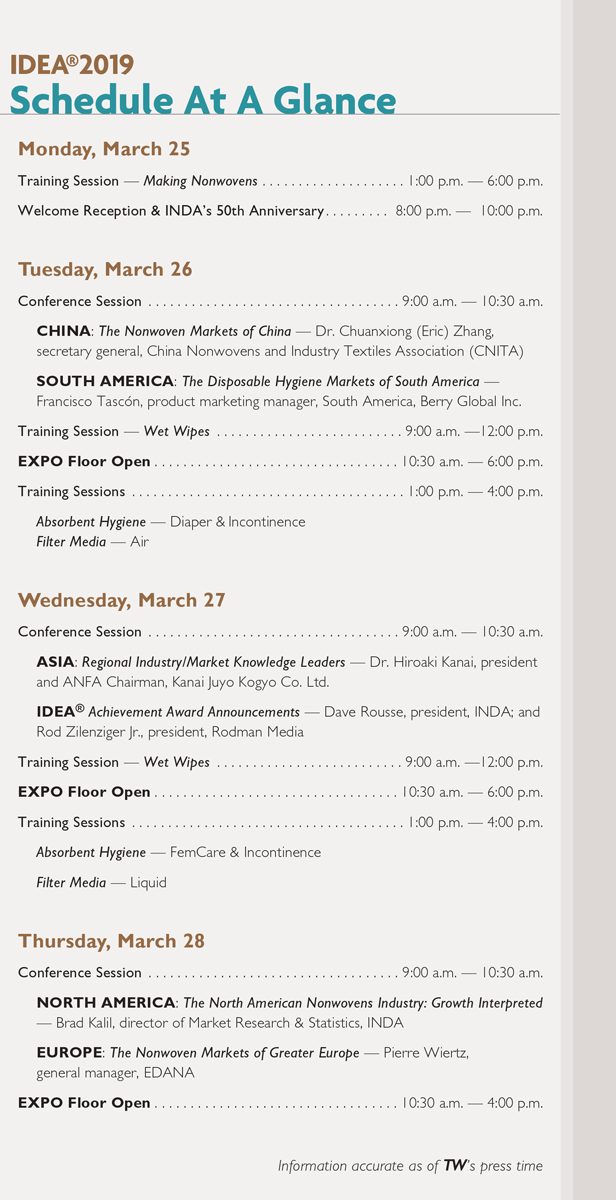
The IDEA2019 conference will feature outlooks of select nonwoven industries at the regional level presented by industry experts (See IDEA2019 Schedule At A Glance). Each day, conference sessions will be held from 9 a.m. until 10:30 a.m. prior to the exhibit halls opening.
INDA has added some training courses to the educational line up in Miami. Six “short courses” will be offered under the “The Essentials in Nonwovens: Basics in Key Areas” umbrella. All three recommended tracks begin with a five-hour Making Nonwovens course. Then the Absorbent Hygiene track continues with a diapers and incontinence course followed by a course on femcare and hygiene. The Filter Media track offers courses in air filter media and liquid filter media. Lastly, the Wet Wipes track includes a three-hour course on wet wipes.
Attendees can sign up for all individual courses or may choose one of the three tracks depending on budget and learning needs.
“All of these courses are led by experienced industry instructors, including Terry Young, former Proctor & Gamble Research Fellow in Hygiene products, and Dr. Behnam Pourdeyhimi of North Carolina State University and the Nonwovens Institute,” Rousse said. “These educational opportunities are great add-ons to the value attendees get from IDEA.”
IDEA® Achievement Awards
Presented by INDA in partnership with Nonwovens Industry magazine, the IDEA Achievement Awards are presented every three years in conjunction with the IDEA event.
The awards recognize leading companies, individuals and new products in the global nonwovens and engineered fabrics industry. The following five awards will be presented:
IDEA Equipment Achievement Award;
IDEA Roll Goods Achievement Award;
IDEA Raw Material Achievement Award;
IDEA Short-Life Product Achievement Award; and
IDEA Long-Life Product Achievement Award.
“The IDEA2019 Achievement Award presentations recognize the best new product introductions in five categories since the last IDEA in 2016,” Rousse noted. “We have a great slate of candidates, narrowed to three finalists in each category from a list of more than 50 submissions. We will also provide awards for Lifetime Achievement in the Nonwovens Industry, and the Entrepreneur Achievement Award. “
Winners will be announced Wednesday, March 27, at 9:30 a.m. after the first conference presentation.
“The nonwovens industry is a continuously evolving, dynamic and diverse industry,” Rousse said. “I am encouraged to see the continuing usage of nonwovens in novel ways and in the expanding universe of companies involved in the nonwovens industry. INDA is pleased and proud to host this wonderful industry at this year’s IDEA event, and look forward to many more.”
For more information about IDEA® and to view a full event schedule or register, visit idea2019.com.
Fira de Barcelona Gran Via, Barcelona, Spain, will host ITMA 2019.
ITMA 2019 returns to the heart of the Spanish textile industry for its 18th edition this June.
TW Special Report
ITMA 2019, the quadrennial textile industry event generally regarded as the largest textile machinery show, is rapidly approaching. “Innovating the World of Textiles” is the theme for the 18th edition of ITMA. The event will be held June 20-26, 2019, at the Fira de Barcelona Gran Via, Barcelona, Spain, and will showcase fibers, yarns and fabrics as well as the latest technologies for the entire textile and garment manufacturing value chain.
Owned by The European Committee of Textile Machinery Manufacturers (CEMATEX), the 2019 show is organized by Brussels-based ITMA Services.
Fira de Barcelona Gran Via is located in a new business development area close to the Barcelona airport and connected to the public transportation network. The venue was designed by the Japanese architect Toyo Ito and is known for its functionality and sustainable features including a large rooftop photovoltaic installation.
“Innovation is vital for the industry’s success as Industry 4.0 gains momentum in the manufacturing world,” said Fritz Mayer, CEMATEX president. “The shift towards open innovation has resulted in increased exchange of knowledge and new types of cooperation among education institutions, research organizations and business. ITMA has been a catalyst and showcase of ground-breaking innovation since 1951. We hope participants will be able to share new developments, discuss industry trends and spur creative efforts, thus ensuring a vibrant innovation culture in a global context.”
Exhibitor Space Fully Booked
The exhibit space was completely sold out by the application deadline, and the show will occupy all nine halls of the Fira de Barcelona Gran Via venue. More than 1,600 exhibitors are expected to fill the gross exhibition area of 220,000 square meters. Organizers also predict some 120,000 visitors from 147 countries.
“The response for ITMA 2019 is so overwhelming that we have not been able to meet the demand for space despite adding two more exhibition halls,” Mayer said. “We are grateful for the vote of confidence from the industry. It shows that ITMA is the launch pad of choice for the latest technologies from around the world.”
Exhibitor categories showing the largest growth include the garment making, and printing and inks sectors. Garment making counts a number of first-time exhibitors eager to demonstrate their robotic, vision system and artificial intelligence solutions; and the number of exhibitors showcasing their technologies in the printing and inks sector has grown 30 percent since ITMA 2015.
“Digitalization is having a tremendous impact in the textile and garment industry, and the true extent of its influence can be seen not only in textile printing companies, but throughout the value chain,” said Dick Joustra, CEO, SPGPrints Group. “Brand owners and designers are able to use opportunities, like ITMA 2019, to see how the versatility of digital printing can transform their operations. As a total supplier in conventional and digital textile printing, we see ITMA as an important marketplace to show our latest technologies.”
All exhibits at ITMA 2019 will be indexed into 19 categtories called chapters (see Table 1).
Table 1
What’s New?
The Innovation Lab recently was launched for the 2019 edition of ITMA to emphasize the innovation theme. The Innovation Lab concept features:
A Research and Innovation (R&I) Pavilion showcasing the research and development work of 27 participating organizations to encourage collaboration between industry and academia;
ITMA Speakers Platform where participating R&I institutes can present research projects and developments;
Innovation Video Showcase featuring selected videos about the exhibits to be shown at the Speakers Platform;
ITMA Sustainable Innovation Award, which was created in 2015 to “recognize the collaborative efforts by the global textile industry to advance business sustainability through innovative solutions, and promote outstanding industry related research” in two categories — Industry Excellence and Research & Innovation Excellence.
“By launching the ITMA Innovation Lab feature, we hope to better drive industry focus on the important message of technological innovation and cultivate an inventive spirit,” said Charles Beauduin, chairman of ITMA Services. “We hope to encourage greater participation by introducing new components, such as the video showcase to highlight our exhibitors’ innovation.”
The official ITMA 2019 app also is new for 2019. The app, which may be downloaded free of charge from the Apple App Store or Google Play, offers key information on the exhibition to help attendees plan their visit. Maps and searchable exhibitor lists, as well as general show information are all available in the app.
“As ITMA is a huge exhibition, the app will be a useful tool to help exhibitors and visitors maximize their time and resources on site,” said Sylvia Phua, managing director of ITMA Services “An appointment scheduler will allow visitors to request meetings with exhibitors before they arrive at the show. The scheduler and online floorplan will be available from late April 2019.”
Conferences, Education
Outside of the bustling exhibit floor, attendees also have the opportunity to participate in a variety of educational and networking events. Associated and collocated events include the ITMA-EDANA Nonwovens Forum, Planet Textiles, Textile Colourant & Chemical Leaders Forum, Digitl Textile Conference, Better Cotton Initiative Seminar and the SAC & ZDHC Manfacturer Forum. See TW’s March/April 2019 issue for more information about the educational opportunities.
Visitor Incentive
Organizers are offering an early-bird registration discount. Anyone who registers online before May 15, 2019, may purchase a one-day pass for 40 euros or a seven-day badge for 80 euros — which is up to 50-percent lower than the onsite rates. Attendees may also purchase conference and forum passes online, as well as request an invitation letter for a visa while ordering a badge.
“We expect interest from visitors to be very strong,” Mayer said. “Hence, visitors are advised to book their accommodation and buy their badge early.”
The Santa Maria de Montserrat Monastery offers panoramic views of Catalonia’s landscape.
About Barcelona
Located on Spain’s northeast Mediterranean coast, Barcelona is capital of the autonomous community of Catalonia, and — with a population of more than 1.7 million people in the city proper and a metropolitan area population of more than 5 million — Spain’s second-most populous city after Madrid and Europe’s largest Mediterranean coastal metropolitan area.
Textile production was an important component of industrialization in the late 18th century, and it continues to be important today — indeed, the vast majority of members of the Spanish Association of Manufacturers of Textile and Garment Machinery (AMEC AMTEX) are located in Barcelona province, and AMEC AMTEX has its headquarters in the city of Barcelona a couple of miles up the road from Fira de Barcelona. In addition, the city has attempted more recently to become a major fashion center.
The Catalan region has long fostered a strong separatist identity and today still values its regional language and culture. Although Spanish is spoken by virtually everyone in Barcelona, Catalan is understood by about 95 percent of the population and spoken by about 75 percent.
Barcelona’s Roman origins are evident in several locations within the Barri Gòtic, the historical center of the city. The Museu d’Història de la Ciutat de Barcelona provides access to excavated remains of Barcino underneath the center of present-day Barcelona, and parts of the old Roman wall are visible in newer structures including the Gothic-era Catedral de la Seu.
Antoni Gaudí’s Casa Batlló masterpiece in the center of Barcelona
The strange, fanciful buildings and structures designed by turn-of-the-century architect Antoni Gaudí, found in numerous locations around Barcelona, are major attractions for visitors to the city. Several of them together comprise a UNESCO World Heritage Site under the designation “Works of Antoni Gaudí” — including the Façade of the Nativity and the Crypt at the Basílica de la Sagrada Família, Parque Güell, Palacio Güell, Casa Milà, Casa Batlló and Casa Vicens. The site also includes the Crypt at the Colònia Güell, an industrial estate established in nearby Santa Coloma de Cervelló by Eusebi Güell, a textile business owner who moved his manufacturing business there from the Barcelona area in 1890, setting up a state-of-the-art vertical textile operation and providing living quarters and cultural and religious amenities for the workers. The mill closed in 1973.
Barcelona as seen from the Fundació Joan Miró modern art museum located on the Montjuïc hill.
Barcelona was also home at one time or another to 20th-century artists Joan Miró, a lifelong resident, as well as Pablo Picasso and Salvador Dalí. There are museums devoted to the works of Miró and Picasso, and the Reial Cercle Artístic de Barcelona houses a private collection of works by Dalí.
The Museu Nacional d’Art de Catalunya, located in the Parc de Montjuïc near Fira de Barcelona, has a major collection of Romanesque art and other collections of Catalan art spanning the ages.
Barcelona also has a textile museum, the Museu Tèxtil i d’Indumentària, which offers a collection of garments dating from the 16th century to the present; Coptic, Hispano-Arab, Gothic and Renaissance fabrics; and collections of embroidery, lacework and printed fabrics.
Those wanting to get a taste of life in Barcelona may want to join the locals in the evening for a stroll through the streets of the city, and sample the local cuisine and nightlife. Just remember that dinner is served late — restaurants generally serve between 9 and 11 p.m. — and partying goes on very late into the night.
There are several options for getting around Barcelona. Public transportation services include a metro with nine lines, buses, both modern and historic tram lines, funiculars and aerial cable cars.
For more information about ITMA 2019, please visit itma.com.
Expo Producción will return to Mexico City’s World Trade Center in March for its fifth edition.
TW Special Report
The fifth edition of the biennial Expo Producción — co-organized by Atlanta-based Exposition Development Co. and Mexico City-based Tarsus México — will take place at the World Trade Center in Mexico City, March 26-28, 2019.
According to organizers, “Expo Producción 2019 is the only event in Mexico that brings together all sectors for the production of apparel, home textiles and technical textiles.” Organizers promote the show as a professional platform for manufacturers, brands, retailers and suppliers to connect, network and learn new tools to grown and improve their businesses.
Exhibition Profile
Exhibitors will offer products and services from the fashion, home and technical textiles industries including: computer software and information technology; full package and private label contract manufacturing; cutting and sewing equipment; distributors and wholesalers; fabrics; fibers and yarns; findings and trims; nonwovens; research and development; services and logistics; supplies; textile machinery; and associations, academia and publications.
In 2017, Expo Producción hosted more than 124 exhibitors and brands from 11 countries including Canada, China, Germany, Guatemala, India, Italy, Japan, Mexico, Pakistan, Turkey and the United States.
Job titles for attendees cover the gamut and include designers; engineers; educators; plant, purchasing, quality control, production and sourcing managers; and research and development personnel. The visitors come from all facets of the textile industry including aerospace, automotive/ transportation interiors, garment manufacturing, government manufacturing, home textiles, leather and footwear, medical, military and pet products.
More than 4,200 visitors attended Expo Producción 2017 traveling from countries such as Austria, Chile, China, Colombia, El Salvador, Guatemala, Italy, Peru, Turkey Venezuela, the United States, and of course, Mexico.
Organizers have crafted a lineup of educational seminars that will run during the three-day event (See Table 1). All registered visitors may participate in the seminars at no additional charge. Conference sessions begin at 12:30 each day, and the exhibition show floor will be open from noon until 6 p.m.
This year, we have more than 35 Chinese fabric companies participating,” said Lorie Gross, show director for Exposition Development Co. “Since we launched the show in 2013, the number one request from attendees was to bring more exhibitors that are showcasing fabrics. This year, we have been able to do that by increasing those types of exhibitors by 40 percent.
“Expo Producción is a must for companies currently doing business in Mexico and Central America, as well as those who would like to expand their business into the region,” Gross said.
Attendance is free of charge to qualified industry visitors. Preregister to save time during the event, or register on site. All visitors must be over the age of 21.
For more information about Expo Producción 2019, please visit expoproduccion.mx.
InPrint USA will collocate with ICE USA 2019 in Louisville, Ky.
TW Special Report
The second edition of InPrint USA, the exhibition of print technology for manufacturing, will take place April 9-11, 2019, at the Kentucky International Convention Center (KICC), Louisville, Ky. The show is targeted to the print community looking for “customized industrial print solutions to generate new market opportunities and revenue across functional, decorative and packaging printing applications.”
Organized by Mack Brooks Inc., a subsidiary of the England-based Mack Brooks Exhibition Group, the exhibition gathers industrial printing technology suppliers “who understand industry challenges and have the products to keep businesses competitive.” Specialty, screen, digital and inkjet technologies for printing on metal, plastics, foils, textiles, glass ceramics, wood and other substrates are all represented at the show.
Exhibitor product categories include:
• Machinery and printing systems;
• Printheads, screens and other special parts;
• Ink, fluids and chemicals;
• Materials and substrates;
• Hardware and software solutions;
• Prepress devices; and
• Equipment for processing and finishing such as cutting, pressing and molding equipment.
Exhibitors will host live demonstrations of industrial printing products on the show floor.
“Attendees from all facets of manufacturing have the opportunity to learn about new print capabilities, see the equipment in action, and network with the experts that want to take print to the next level” said Christina Molina, exhibition manger, InPrint USA.
InPrint USA 2019 will again collocate with ICE USA 2019 — the international converting exhibition targeting the paper, film, foil, nonwovens and other flexible web-materials segments. Now in its fifth edition, the trade show brings together attendees from around the globe to see the latest in machinery, technology and manufacturing solutions first-hand. Registered InPrint USA visitors have free access to ICE USA
Ask The Experts
A new feature at the 2019 edition of the show is an “Ask the Experts” pavilion where visitors can arrange complimentary, one-on-one meetings with accomplished industry professionals to discuss business challenges. Three experts — Craig T. Reid, founder of CTR Resources LLC; Deborah Corn, who has more than 25 years working in advertising as a print producer; and John Sillies, executive vice president, Graphic Systems Services — have already been confirmed. Appointments may be scheduled at the InPrint USA website.
Educational sessions will be available at the concurrent InPrint conference, which will focus on solutions and new industry developments in packaging, decorative and functional applications. The keynote presentation and all InPrint Theater programs are complimentary. Attendees and exhibitors may also sign up for additional paid programs during registration. Conference details can be found at the InPrint USA website.
Attendees who register before March 15 qualify for an early-bird discount and will pay $40 for a three-day ticket. After March 15, the fee increases to $60 including for on-site registration.
The show floor is open Tuesday and Wednesday from 10 a.m. until 5 p.m. On Thursday, the show is open from 10 a.m. until 3 p.m.
“Industrial printing is the most demanding of all printing,” said Marcus Timson, Co-Founder, InPrint show. “From functional smart technology to décor and packaging, the demands placed upon inkjet are considerable. It is, however, meeting this challenge and the technical barriers to great adoption are beginning to diminish.”
Come view the latest the industrial printing sector has to offer at InPrint USA 2019 in Louisville.
For more information about InPrint USA 2019, please visit inprintshow.com/usa.
AAPN’s recent Apparel Summit of the Americas was designed to showcase new investments taking place in Honduras.
By Rachael S. Davis, Executive Editor
The Atlanta-based Americas Apparel Producers’ Network (AAPN) is always open to new ideas for events. If it hasn’t been done before, no matter. AAPN urges its members to think outside of the box and submit event ideas. The association considers three criteria when planning events — Is it unique? Would it be fun and make a difference? Is it possible?
That encouragement was behind the idea for one recent AAPN event. Jesus Canahuati, Elcatex; Joe Cuervo, Kohls; Juan Zighelboim, TexOps; and AAPN’s Executive Director Sue Strickland got together to discuss an event that could showcase new investments taking place in Honduras, and the Apparel Summit of the Americas 2018 was born. According to AAPN’s Managing Director Mike Todaro, the event involved more planning, logistics and people than any previous event in AAPN’s 37-year history. But the event was considered a success, so much so that AAPN plans to make it a biennial event.
The 2018 event featured a combination of conference speakers and tours of local production facilities. One tour highlight was UTEXA (United Textiles of America), a brand new man-made fiber spinning plant (See sidebar).
“It was very meaningful for us in Honduras that AAPN chose San Pedro Sula to hold the Apparel Summit of the Americas,” said Mario Canahuati, president, Asociación Hondureña de Maquiladores (AHM), the Honduras Manufacturers Association. “It was a remarkable success for AAPN and an opportunity to showcase the progress, the investment and diversification that is taking place in the industry in Honduras, which — as well as other countries in the region — has a history of solid partnership with many of the companies that participated in the event.”
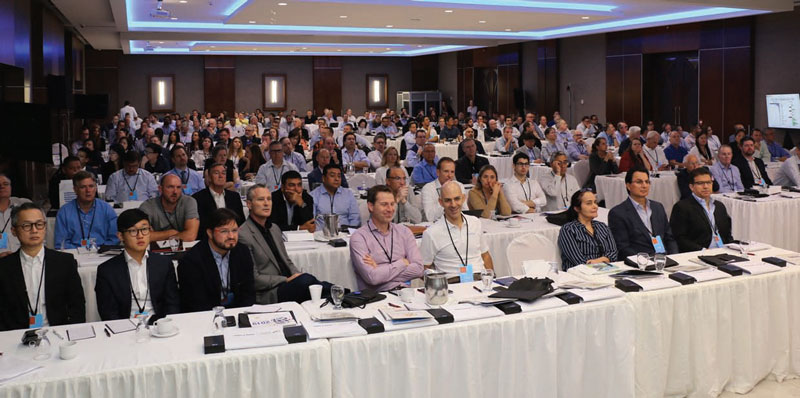
The summit attracted 250 AAPN members and prospective members from 125 organizations. Executives from 18 brands and retailers participated in the event to see firsthand the investments taking place in the Honduran textile industry. In addition, more than 40 volunteers from AAPN member companies and local organizations contributed to the event’s success.
The Apparel Summit of the Americas kicked off with an opening night reception at the Intercontinental Hotel.
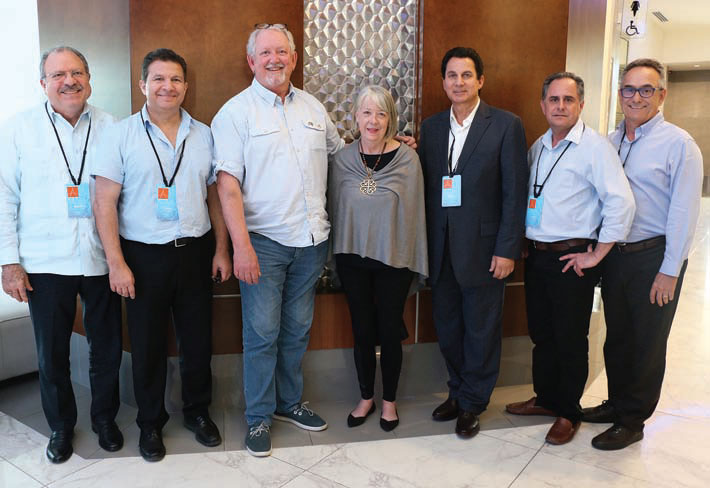
Key people responsible for organizing the Apparel Summit of the Americas 2018 (left to right): Jacobo Kattan, PROTEXSA; Jesus Canahuati, Elcatex; Mike Todaro and Sue Strickland, AAPN; Mario Canahuati, Honduras Manufacturers Association; Joe Cuervo, Kohl’s; and Juan Zighelboim, TexOps.
On the first full day of activities, Jesus Canahuati, president of Elcatex, opened the conference held at the Copantl Convention Center. Canahuati touted Honduras as the number-one global destination for U.S. yarn exports, which amount to $1 billion annually. The country also is the number one country of origin for U.S. imports of cotton T-shirts and sweatshirts. Current strategic investments in the Honduran textile industry focus on man-made knits and other activewear.
Other speakers on the first morning included Mike Todaro, AAPN managing director; Tony Anzovino, AAPN president and chief sourcing and merchandising officer for Haggar Clothing Co.; and Honduran President Juan Orlando Hernández who participated in the conference via a video. In addition, a panel discussion — featuring Steve Cochran, CEO, Tegra Global; Ricardo Pettenati, CEO, Pettenati Industrias Textil; and David Ha, CEO, TexOps — focused on investment and innovation in the Americas as told through first-hand experiences. The panel was moderated by Walter Wilhelm, CEO, WWA Advisors.
Simon Mainwaring, founder of We First, a brand and leadership consulting firm, gave the keynote speech. His engaging presentation focused on purpose-based branding.
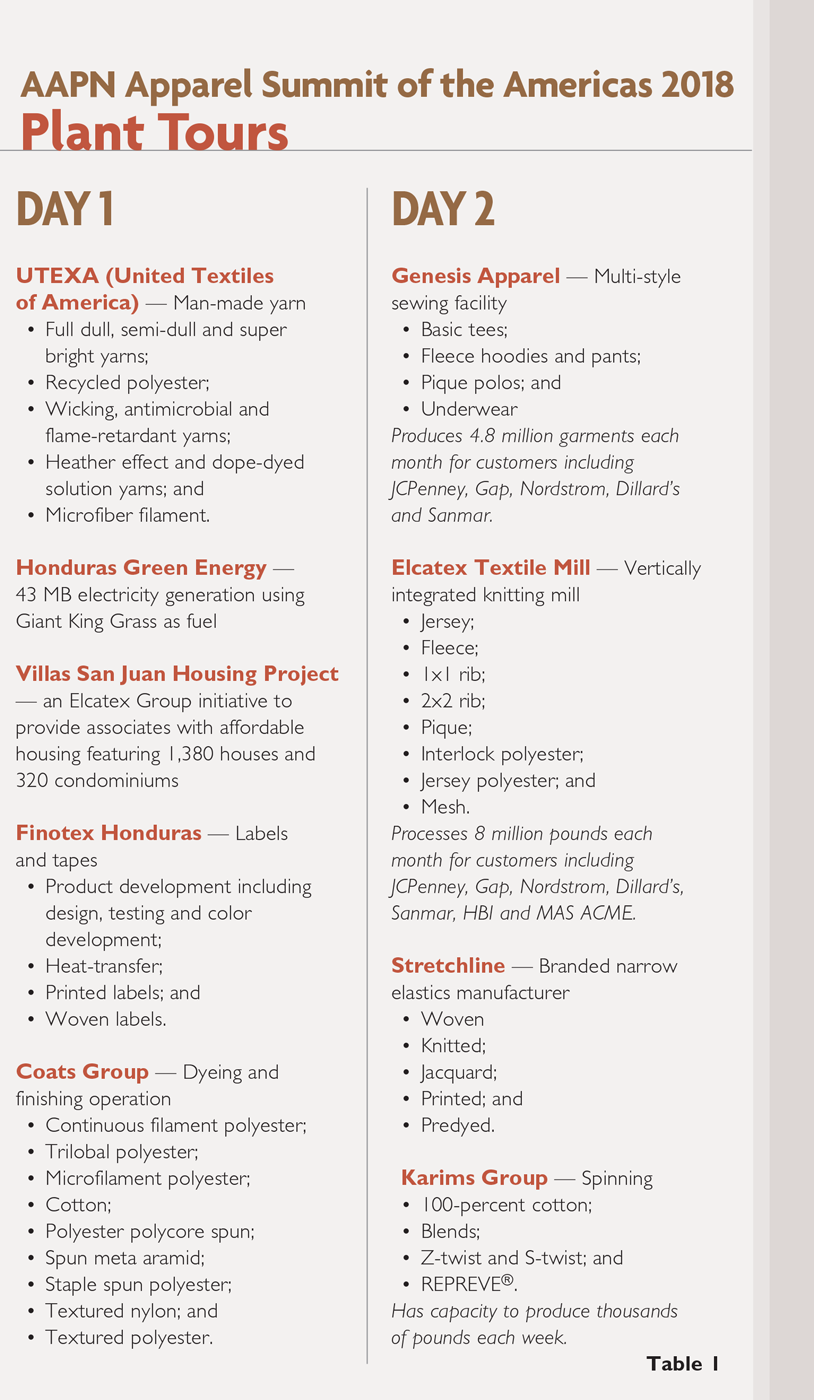
Following lunch, summit attendees boarded buses to tour local textile production facilities (See Table 1). One tour took participants to UTEXA, Honduras Green Energy and the Villas San Juan Housing project; while a second tour featured Finotex Honduras and Coats Group’s finishing and dyeing facilities.
In the evening, attendees were treated to a cocktail reception sponsored by UTEXA; a fashion show featuring activewear produced by AAPN members based in the region; and dinner sponsored by FICOHSA at the Club Hondureño Arabe.
The second full day of activities began with more organized plant tours. Attendees chose from visits to Genesis Apparel S.A., Elcatex’s textile mill and Stretchline Central America S.A.; or a trip to Grupo Karim’s spinning facility.
The conference program picked back up that afternoon. Prior to the first presentation, Todaro presented the AAPN Apparel Industry Leadership Award — created to recognize AAPN members who have contributed exceptional leadership to the organization — to two individuals.
Jesus Canahuati, general manager, Elcatex, was recognized because “… [he] presented Honduras2020 to the AAPN Annual Conference. This led directly to a joint venture of the UTEXA spinning operation and the 2018 Apparel Summit of the Americas. [He] has distinguished himself as a true leader of the Americas.”
Industry veteran Joe Cuervo was the recipient of the second award. According to AAPN, “Joe began work in 2017 with AAPN on the 2018 Apparel Summit of the Americas during his time on staff at Honduras2020. Joe helped put together the agendas, tours, target lists, hotels, logistics and hundreds of other details. The summit success was virtually from his leadership.”
Ed Gribbin, CEO, Gribbin Strategic LLC, and senior advisor to Alvanon, focused on trends and changing consumer values leading to changes in the fashion industry in his “Leveraging the Americas … it’s more than just geography,” presentation. Kurt Cavano, founder and president, GT Nexus (an Infor Co.), followed with his presentation entitled, “Disruptopia: An Overview of the Speed of Technology.” In closing, attendees were given a chance to talk about the event and voice their impressions.
“The 20/20 summit was an eye-opening event,” said one participant. “It’s exciting to see the heavy investment that companies are pumping into Honduras. The tour of the energy park and housing projects, Utexa’s state of the art facility gave us more confidence to continue focusing our presence in Central America.”
“I was excited to be part of the AAPN Honduras events which highlighted how companies are investing in region and looking toward the future,” said Greg Dorf, director of Global Sales, Indiana Knitwear. “What made this event different for me was having the opportunity to tour Utexa and the energy plant. I gained some great insights into the Utexa facility and how the spinning process works. It was also nice to learn about how the energy plant generates it power to support the manufacturing process.”
“This was the hardest event that AAPN has done, and hopefully, people will be talking about it for years,” Todaro said. At least until 2020 anyway, when AAPN hosts its next Apparel Summit of the Americas and gives the apparel industry another unique event to talk about.
UTEXA — Man-Made Yarn Investment
Honduras-based UTEXA is a new $73 million man-made yarn company that began operations in 2018. Founded with the goal of bringing enhanced competitiveness to the Central America Free Trade Agreement (CAFTA-DR) region, UTEXA was made possible through the combined vision and efforts of its investors, market opportunities and the Honduras 2020 country development program — a private sector initiative complemented by the public sector that was developed to grow the country both socially and economically.
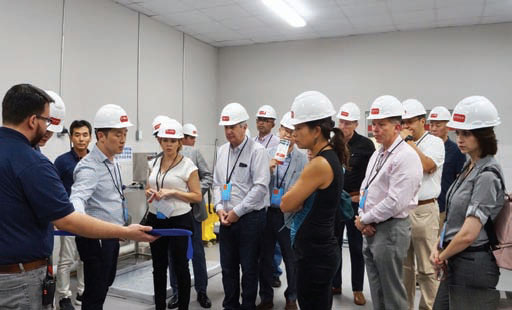
Apparel Summit of the Americas 2018 attendees had the opportunity to tour the new UXTEXA facility and learn about the plant’s capabilities.
The CAFTA-DR region is again experiencing tremendous growth and opportunity in the textile and apparel sector, much like the initial growth that was experienced following CAFTA-DR’s passage in 2005. However, unlike the initial boom, current now is largely driven not by low-cost production, but by speed-to-market and the availability of value-added products.
UTEXA is one of the most advanced man-made yarn production facilities in the world, featuring all new modern manufacturing equipment designed for highly efficient and flexible production. By expanding the available product range and lowering raw material input costs for the region, UTEXA has given additional incentive to enhance sourcing and near shore strategies within the CAFTA-DR region.
UTEXA tours were a highlight of the Apparel Summit of the Americas. AAPN and Honduras Manufacturers Association came together to maximize synergies and gave UTEXA a tremendous opportunity to showcase a world class yarn operation to some of the most important textile executives in the CAFTA region.
(left to right): Apurba Banerjee, Brrr°; Keir High, Teijin Aramid USA Inc.; Lynn L. Bergeson, Bergeson & Campbell; Roger Tutterow, Kennesaw State University; Laura Murphy, PCI Wood Mackenzie; Alasdair Carmichael; and Anna Lucea, Bozzetto Group
TW Special Report
The Arlington-Va.-based Synthetic Yarn and Fabric Association (SYFA) recently held its annual Fall conference at the Sheraton Charlotte Airport Hotel in Charlotte, N.C. Titled “The Strong Economy And Advances In Technology,” the conference featured a wide variety of helpful and interesting presentations.
Presenters covered a wide range of topics and came from such companies as Brrr°, Bergson & Campbell, Milliken & Company, the National Council of Textile Organizations (NCTO), Kennesaw State University, Bozzetto Group, Algiknit Inc., Salem Leasing, Teijin Aramid USA Inc. and PCI Wood Mackenzie.
Dan Garrison, Milliken & Company
Long-term friend of the industry Kennesaw State University Professor of Economics Roger Tutterow presented “On the Economic, Political and Business Climate” offering an overall positive forecast regarding the economy.
Aaron Nesser, AlgiKnit Inc.
Presentations of note included Brrr° Chief Scientist Apurba Banerjee’s talk titled “Chill Out, How Synthetics Can Revolutionize Cooling Fabrics,” which detailed the introduction of certain minerals into an extruded fiber that causes a cooling effect when exposed to the skin via an endothermic reaction.
Machell Apple, SYFA president
AlgiKnit Co-Founder and CEO Aron Nesser presented “Transforming Fashion with Kelp-derived Yarn”. He explained that his company has a goal to transform the industry with a highly sustainable, low environmental impact algae-based fiber technology that utilizes the textile industry’s existing manufacturing systems.
SYFA president Machell Apple, of Grand Rapids, Mich.-based True Textiles, lead the sessions and facilitated the conference.
Dennis Giff, Salem Leasing
Sponsors for the fall conference included Gold Sponsors Premiere Fibers Inc. and Jomar Softcorp International, Inc.; Silver Sponsors Pulcra Chemicals LLC and Bozzetto Inc.; Bronze Sponsors Burlington, DAK Americas LLC, and Goulston Technologies Inc.; and Patrons and Exhibitors Sponsors Clariant Corp., Expo Producción, Industrial Laboratory Equipment, Milliken & Company, National Council of Textile Organizations, Polyspintex Inc., Staubli Corp., Techtextil North America, Textile World and Unifi Manufacturing Inc.
SYFA will hold its spring conference April 25-26, 2019, at the Sheraton Charlotte Airport Hotel.

 By Jim Borneman, Editor In Chief