PARIS — May 26, 2020 — Lacoste has appointed Robert Aldrich as CEO of the North America Region and Pedro Zannoni as CEO of the Latin America Region. They will report to Jean-Louis Delamarre, executive vice-president, Global Markets & Distribution.
“We are delighted to announce today the appointment of Robert Aldrich and Pedro Zannoni. These two arrivals illustrate the brand’s ambition to strengthen and accelerate our Brand penetration and equity in these regions. We are counting on their in-depth knowledge of Latin America and North America as well as their commercial dynamism to continue the premiumization and desirability of the brand. These appointments come in a particularly challenging time. Yet I am confident that Robert and Pedro will demonstrate their leadership, commitment and solidarity to help Lacoste come out of this crisis stronger” said Jean Louis Delamarre.
Aldrich started his career with Giorgio Armani where he held various commercial positions. He then joined the Ermenegildo Zegna Group in 2006, where he was executive vice president Wholesale, CEO of the North America region, and then CEO of the Americas region. Aldrich began his position as CEO of the North America region — Canada, United States, Mexico, Caribbean — on May 18, 2020.
Zannoni has held various commercial positions within the AMER SPORT, BABOLAT and PUMA groups, before joining the ADIDAS Group in 2013, where he was successively senior commercial director for Brazil and then vice president Reebok for the Latin America zone. Since 2018, he has been president of the Latin American zone for ASICS. Zannoni began his position as CEO of the Latin America region on May 1, 2020.
Unifi Inc., Greensboro, N.C., reports it sold its 34-percent interest in Parkdale America LLC (PAL) to majority partner Parkdale Inc. for $60 million in cash. The proceeds from the sale will be used to lower Net Debt and reduce leverage during the fourth quarter of fiscal 2020, according to Unifi. The company recorded a $45.2 million impairment charge in the third quarter of fiscal 2020 in connection with the sale.
“Parkdale has been the driver of the business and operational decisions of PAL since its inception, and this transaction is a natural evolution of our joint venture relationship,” said Tom Caudle, president and COO, Unifi. “We thank Parkdale for being such a great business partner and look forward to continued business activities in the future, even with Parkdale becoming the single owner of PAL. For Unifi, this transaction will allow us to focus our efforts on expanding our global leadership in recycled and synthetic fibers while strengthening our balance sheet and improving our leverage profile.”
Unifi notes that the company has suspended its fiscal 2020 outlook due to the uncertainty of the duration and severity of the COVID-19 pandemic.
“The first ten weeks of our fiscal third quarter were strong and consistent with our expectations as our trade actions and overall strategy were generating significant momentum,” Caudle said. “However, the impacts of the pandemic on global demand began materializing at the end of the March 2020 quarter, which have placed pressure on many of our customers and the pipeline.”
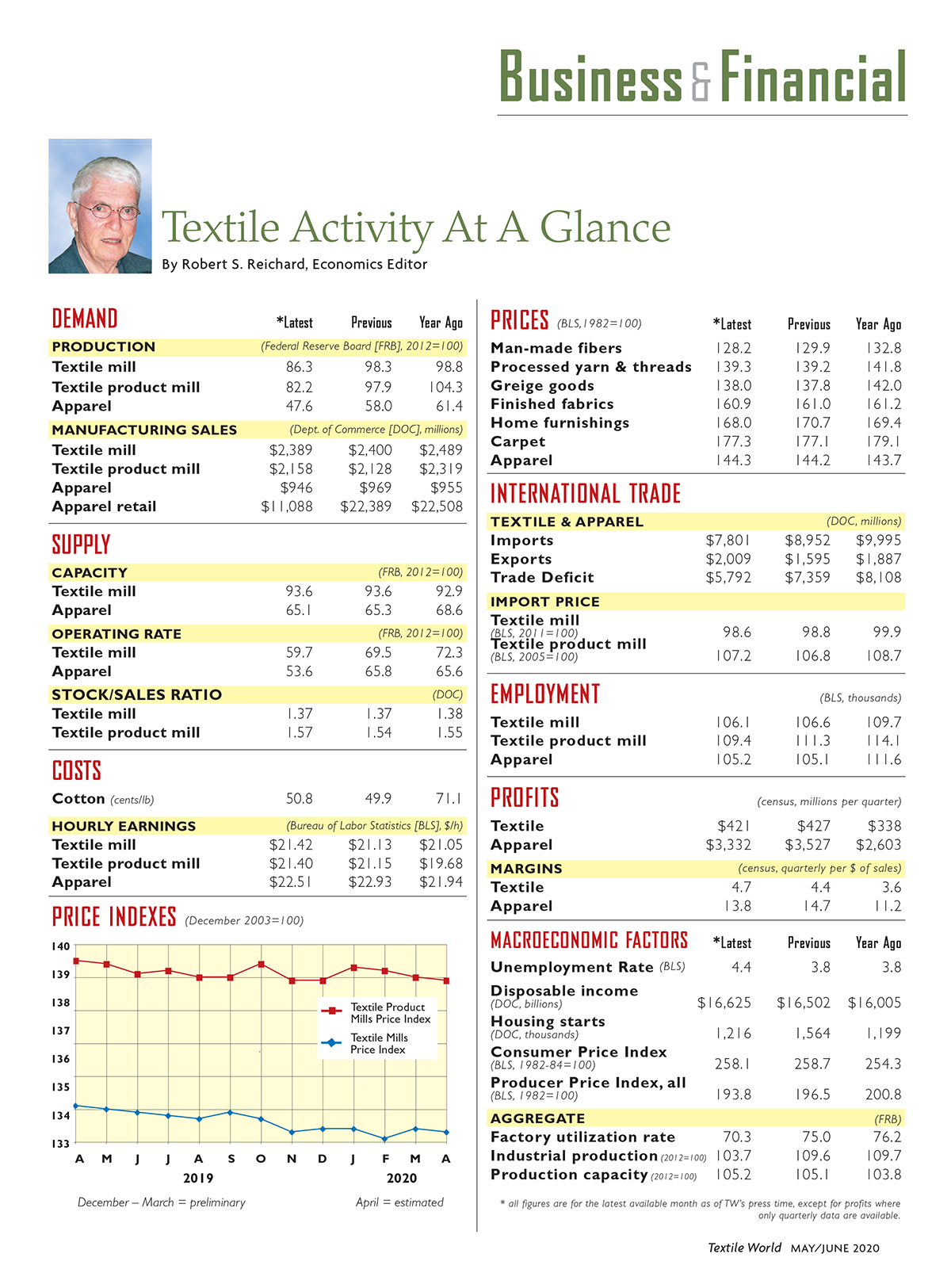
Zurich-based International Textile Manufacturers Federation (ITMF) has released the results of a survey it conducted among ITMF members, and affiliated companies and associations about the impact of the coronavirus pandemic on the global textile value chain. Some 600 companies took part in the survey. In short, current orders of textiles have dropped 41 percent on average globally; and expected global turnover in 2020 is down by 33 percent compared to 2019.
Challenges reported include “securing enough liquidity, supply chain disruption and uncertainty.” Noted opportunities include: “increasingly thinking about diversification, currently focusing on medical textiles; streamlining organization and production processes; accelerating the reassessment of existing supply chains; and accelerating digitalization and investing in sustainable production.”
ITMF also reports that companies would like to see more government support; and the greatest relief is achieved when retailers and brands consider adapting
during the pandemic instead of unilaterally cancelling orders.
It wasn’t that long ago that U.S. manufacturers — including textile — were declared a thing-of-the-past. Their decline was brought about by ignorance of the true spirit of globalism, a lack of understanding of the new rules of
outsourcing and the growing dominance of the service sector as the true way forward for the U.S. economy.
In November of 2016, economist and New York Times columnist Paul Krugman proclaimed in a series of tweets: “The story of U.S. manufacturing is basically one of high productivity growth allowing demand to be met with ever fewer workers … Nothing policy can do will bring back those lost jobs. The service sector is the future of work; but nobody wants to hear it.”
However, this isn’t the first time manufacturing or textiles was swept aside — virtually every trade deal — including CBI, CBTPA, NAFTA, CAFTA-DR — asked U.S. textiles to take one for the team. Don’t you know we have planes and soybeans to sell? Cheap apparel — regardless of its source or the conditions in which it is made is none of your business or concern. It’s anti-inflationary, and good for retailers and consumers alike, don’t you know?
Maybe that rhetoric is a little heavy, but after years spent in the industry it’s clear that U.S. textiles has fought the good fight, overcome obstacles, and invested in technology and innovation all to get to where the industry sits today.
The COVID-19 response mounted by the U.S. textile industry has been overwhelming. The way manufacturers big and small, some fierce competitors, and industry associations joined together for a common cause is nothing short of amazing.
In this issue, TW Executive Editor Rachael Davis was tasked with shining a light on the various aspects of the industry’s pandemic response. It’s still an evolving story and virtually an impossible task to highlight everything the industry is working on. (See “COVID-19: The Textile Industry Responds To PPE Shortage,” TW, this issue).
There also is a challenge with the genericization of the term PPE — personal protective equipment — which actually has a very specific meaning. Much the way Kleenex came to mean any facial tissue or Xerox came to represent making a copy regardless of the copy machine brand in use — PPE has quickly entered the lexicon to mean just about anything from a homemade face covering to an N95 mask.
“Textiles & The Coronavirus (SARS-CoV-2),” in this issue tries to shed some light on the subject. It’s not a criticism, rather a clarification of PPE including some thoughts on handmade face coverings.
Just two of many interesting takeaways from this issue include using reusable cloth face coverings in conjunction with an N95 mask can improve the longevity of the N95 mask. Under certain conditions, face coverings also can be laundered and reused.
Secondly, why did U.S. Cotton need to jump through hoops to convert swab manufacturing from cotton to polyester for COVID-19 testing? It seems that cotton has DNA, and cotton DNA can interfere with COVID-19 tests leading to inaccurate results.
This pandemic is a disaster on many levels. But it has clearly demonstrated the necessity for a vibrant U.S. manufacturing environment, an evaluation of international trade dependencies and investment in near shoring to strengthen U.S. supply chains.
SINGAPORE — May 27, 2020 — Huntsman Textile Effects and Bao Minh Textile, a woven fabric producer in Vietnam, are collaborating to produce fabric that meets the stringent performance standards required of isolation gowns. High-quality medical gowns are essential protective wear for healthcare workers combatting the global COVID-19 pandemic, but these are in short supply worldwide.
Bao Minh Textile will initially treat 760,000 meters of woven fabric with a carefully curated combination of Huntsman Textile Effects barrier effect solutions and auxiliaries. This fabric is sufficient to produce 345,000 high-grade isolation gowns.
“To help meet extraordinary global need for hospital gowns, we had to be able to deliver a high-performance fabric of consistent high quality while maintaining our commitment to good manufacturing practice and sustainability. The technical teams from Bao Minh Textile and Huntsman Textile Effects worked hand in hand to make this possible at speed,” said Tran Dang Tuong, CEO, Bao Minh Textile.
Manfred Albrecht, chief representative for Huntsman Textile Effects Vietnam, said: “We are pleased to support an industry innovator and sustainability champion like Bao Minh Textile to help in the fight against COVID-19. It takes deep operational know-how and knowledge of the chemical composition and mechanical properties of finishing effects and fibers to manufacture Personal Protective Equipment (PPE) to the required standard. Huntsman Textile Effects and Bao Minh Textile have an excellent collaborative relationship and we look forward to continuing to help the team refine production amid COVID-19 and beyond.”
Bao Minh Textile’s isolation gown fabric relies on a range of Huntsman pretreatment, dyeing and finishing solutions. These include CLARITE® ONE, an all-in-one pretreatment for peroxide bleaching; NOVACRON® and TERASIL® dyes; PHOBOL® CP-C, an excellent oil-, water- and stain-repellent finish; and PHOBOTEX® RSY, a non-fluorinated durable water repellent with extremely high washing resistance. PHOBOL EXTENDER XAN is also applied to further increase wash durability.
Huntsman Textile Effects has a comprehensive range of barrier effects for both nonwoven and woven medical applications, including facemasks and PPE such as isolation gowns.
USTER, Switzerland — May 26, 2020 — Ten years ago, it seemed like a ground-breaking innovation in yarn clearing technology. But that was only the start, and USTER’s ambitions for its QUANTUM 3 series have never stopped growing. Spinners have been presented with a whole series of impressive developments — each one a big step in expanding the possibilities, from quality control at winding to smart clearing, contamination control, mill optimization and even preventing faults from occurring at source.
“USTER® QUANTUM 3 featuring Smart Clearing Technology” was the headline in 2010 when Uster launched its third generation of yarn clearers. “It was an exciting time for me, introducing the first yarn clearer with automatic clearing limit proposals based on the Yarn Body concept,” said Sivakumar Narayanan, at that time the Uster product manager for yarn clearing.
Powerful processing electronics made it possible for the system to display the full yarn body — an outline of the ‘normal’ yarn with its expected and tolerable natural variations. Since then, the term Yarn Body has become a well-recognized and easily understood descriptor in the industry. Today, spinning professionals readily envisage the familiar green arrowhead symbol within a varying dark green frame as an essential element of the classification matrix.
Continuous development
This year, it’s worth celebrating the 10th anniversary of Uster Quantum 3 — but not only as the ground-breaking third generation of a best-selling clearer system. What’s even more notable is its continuous further development during the past decade. Trailblazing progress in quality assurance technology now allows textile manufacturers to optimize production efficiency and reduce costs continuously, taking advantage of several beneficial extras with Uster Quantum 3. The development of Smart Clearing Technology, for example has been a massive leap, providing an indispensable tool for quality-oriented spinning plants.
The new yarn clearer was a game-changer in many ways: it ‘learns’ everything needed about the running yarn in just two minutes, then — using built-in Uster know-how — it proposes suitable clearing limits to achieve the required quality level. That means the same reliable quality level is achieved with contamination control for vegetable matter or polypropylene. Each issue is solved with a dependable clearing solution — even for severe problems such as periodic faults.
Once these highly sophisticated ‘basics’ were in place, Uster Quantum 3 development focused on challenges with trend-related quality control, introducing two unique features in 2015. Irregularities in shade could now be detected and cleared in mélange and colored yarns, for better fabric quality. And the Core Yarn Clearing feature effectively eliminated the risk of fabric rejects through defective sections of these yarns — where the inner elastane component was either missing or off-center.
A ‘grown-up’ partner
As grown-up technology, Uster Quantum 3 was ready to play a major part in all-round production optimizing. Yarn clearer data enables quality and cost to be balanced for best-possible profitability — and this is combined with data from USTER JOSSI VISION SHIELD to achieve Total Contamination Control, with precisely-controlled contamination levels. “Our customers value the integrated solution to manage remaining contaminants in yarns at minimum possible cost,” said Sivakumar Narayanan — in the meantime also himself grown-up into the position of executive vice president for marketing and business development at Uster.
Extending the partnering of systems still further, the yarn clearers connect with data from USTER SENTINEL to create the Ring Spinning Optimization Value Module. This offers optimization potential at the most costly stage in yarn manufacturing. For the first time, mills can intelligently correlate ring quality data and winding quality data in a single system. Smart alerts report deviations in ring spinning machines or changes in essential conditions such as relative humidity and temperature.
Smart, smarter … preventive
Still not satisfied, Uster product developers wanted to transform ‘smart’ yarn clearing into ‘preventive’ yarn clearing. The combination of Uster Quantum 3 and Uster Sentinel creates a quality security tool, which stops off-standard quality yarn being produced at source, when the ring spinning optimization system is equipped with the Roving Stop feature. USTER ROVING STOP effectively becomes a function of the ring spinning machine, just as the yarn clearer does in winding.
The appropriately-named USTER RSO 3D adds a further third dimension — by providing individual cop quality data for each spindle position. Quality mapping along the ring spinning frame maximizes the optimization potential, while preventive measurements are in place at spinning and winding. Waste of raw material and costly clearer cuts can both be managed preventively and automatically, thanks to a bi-directional exchange and analysis of data between Uster Quantum 3 and Uster Sentinel. This benefit is enabled using Uster Quantum Expert and Muratec QPRO EX/FPRO EX with Spin Inspector. Thus, the Uster RSO 3D system achieves the ultimate goals of process optimization and traceability.
An impressive history over its first decade, but even more can be expected from the Uster yarn clearer and ’friends’ in future …
The latest controversy surrounding the COVID-19 pandemic is based on differing views of how quickly to reopen the U.S. economy and the likelihood of a resurgence of infections.
The White House maintains the COVID-19 crisis is on the wane, setting up a safe reopening of the economy. Meanwhile, the Centers for Disease Control and Prevention warns that opening too quickly and without proper procedures could produce a deadly new wave of outbreaks.
There is a vaccine almost ready for mass distribution, or there isn’t. An effective treatment either exists or it doesn’t — all depending upon the source.Regardless of which side is right, one fact is certain: U.S. spinners have played a significant role in helping fight the epidemic. Instead of closing up shop and waiting until either the disease goes away or their resources deplete, more than a few spinners have turned their attention to helping protect the doctors, nurses and other personnel on the front lines of combatting the spread and symptoms of the SARS-CoV-2 virus.
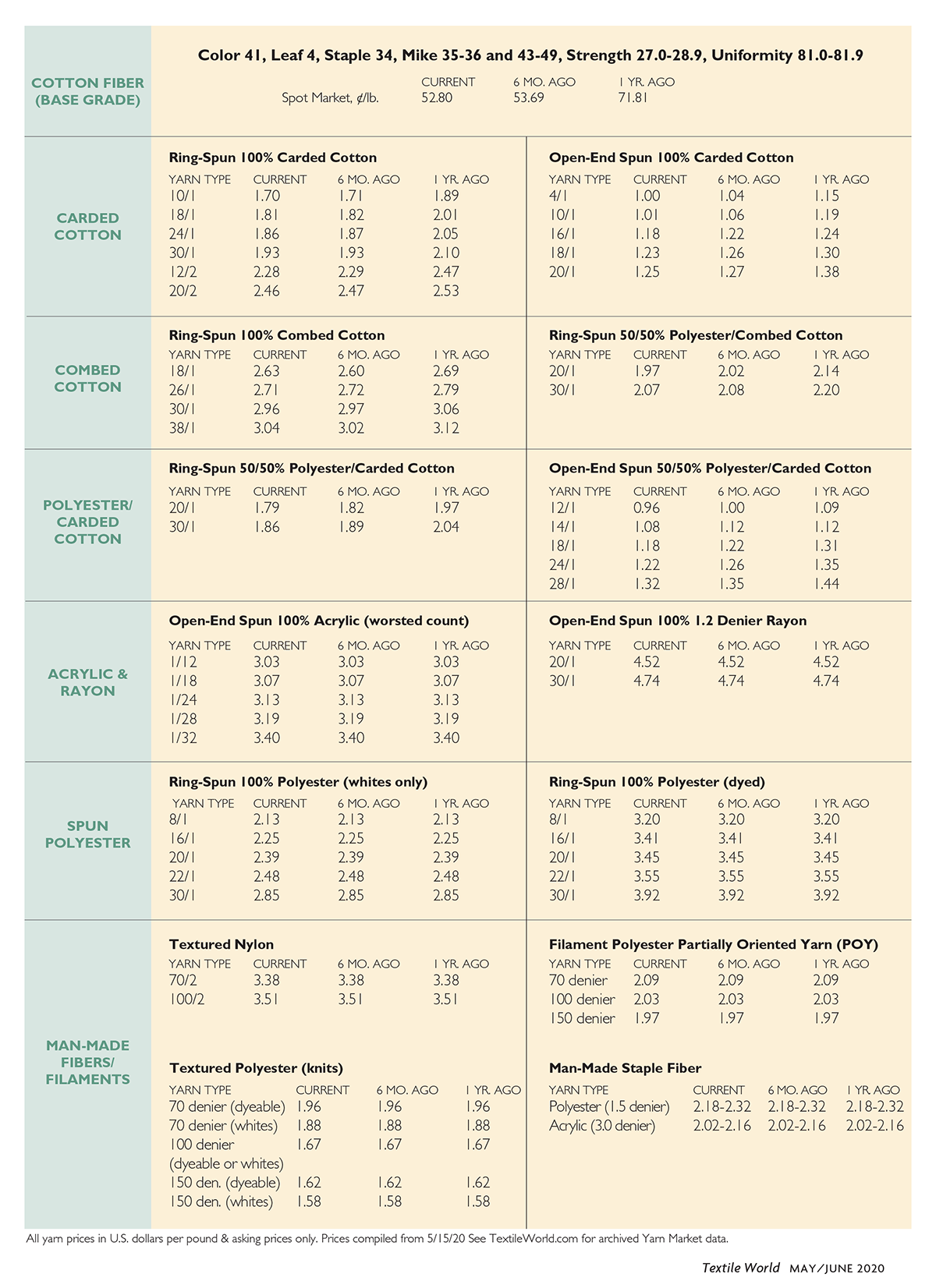
For example, Unifi Inc. is supplying yarns and fibers to more than 100 companies that are producing masks, gowns, and other personal protective equipment needed by first responders, and medical and military personnel, according to the company. Unifi’s fiber is an essential ingredient in the production of hundreds of critical components and products. One Unifi customer, Lumberton N.C.-based Contempora Fabrics Inc., normally supplies fabric for baseball uniforms this time of year, but this season’s fabric is shifting to the production of medical masks and gowns. The factory using Contempora’s fabric is owned by sports gear producer Fanatics. The repurposed fabric is 100-percent polyester sourced from Unifi’s operations in Yadkinville, N.C.
“We’re honored that our fabric is able to help the medical staff, first responders, and military personnel who are putting their lives on the line every day to combat the COVID-19 outbreak,” said Contempora’s President Ron Roach said. “Only in the American textile industry will you find the ingenuity to solve a mask shortage with baseball uniform fabric.”
Another Unifi customer, Landrum, S.C.-based Phenix Engineered Textiles Inc., uses Unifi fiber and yarn to make elastic strapping for face masks. The yarn for the familiar yellow straps is dyed in Unifi’s
dyehouse in Reidsville, N.C.
Even companies that aren’t currently operating because of the virus are contributing. Gildan Yarns, Eden, N.C., has donated
a supply of N95 masks to
a North Carolina county health and human services department to help shore up depleting inventories. Because of the nature of
its business, Gildan also provides N95 masks to employees during normal operations. With production currently suspended, the supply the company had on hand exceeded its needs, leaving 320 masks available to donate to health care professionals.
Ideal Yarns And Fabrics For Home Masks
Demand for medical textile products is likely to remain steady until there is a noticeable decline in new cases. A preliminary study by University of Chicago and Argonne National Laboratory researchers suggests that a combination of masks made of high-thread-count cotton with natural silk fabric or a chiffon weave can effectively filter out aerosol particles — if the fit is good.
“There is a huge interest and need for homemade cloth masks, but we found little data on how good various fabrics are as filters for masks,” said senior author Supratik Guha, professor with the University of Chicago’s Pritzker School of Molecular Engineering and a scientist at Argonne. “According to these results, it’s possible to get very good filtering with commonly available fabrics, but the wearer only gets maximum protection if the fit is very close to your face.”
Their tests revealed that one layer of a tightly woven cotton sheet, combined with two layers of polyester-based chiffon — a sheer fabric often used in evening gowns — filtered out the most aerosol particles — from 80 percent to 99 percent, depending on particle size. Substituting the chiffon with natural silk or a polyester-cotton flannel, or simply using a cotton quilt with cotton-polyester batting, produced similar results.
GASTONIA, N.C. — May 27, 2020 — Beverly Knits has announced a donation of industrial sewing machines from Brother International Corp. This donation will allow Creative Ticking, the cut and sew division of Beverly Knits, to support the need for face masks during the COVID-19 pandemic. The face masks will be supplied directly to the U.S. Department of Health and Human Services (HHS).
The donated machines include five Brother S7250A-403 single needle lockstitch industrial sewing machines. The donation will allow Beverly Knits to significantly increase its current face mask production numbers.
“Brother remains committed to aiding our communities during these challenging times,” said Don Cummins, president, Brother International Corp. USA. “Given the severe and growing shortage of personal protective equipment, Brother is proud to donate our products to support these stalwart manufacturers with their efforts in making masks for our frontline workers.”
Beverly Knits partnered with 30 other companies in the textile industry across the United States to produce face masks for HHS. The goal is to produce up to 2 million masks per week.
“Continued support and collaboration within the textile industry is key to flattening the COVID-19 curve,” said Ron Sytz, CEO of Beverly Knits. “We appreciate this generous donation from Brother that will help the industry advance the cause at a more rapid pace.”
Anyone that wants to participate can email USAfacemask@beverlyknits.com to get involved on flattening the curve.
Greensboro, N.C.-based Unifi Inc. has appointed Edmund “Eddie” Ingle CEO, effective July 1, 2020. Ingle, a long-time Unifi employee, is returning to Unifi after a brief time as an executive with Indorama Ventures. Current Unifi President and COO Thomas H. “Tom” Caudle Jr. announced he will retire June 27, 2020. Caudle spent more than 40 years at Unifi.
Dr. Mennicke
Switzerland-based Loepfe Brothers Ltd. has appointed Dr. Ralph Mennicke CEO. He replaces Maurizio Wermelinger who retired.
Delta Apparel Inc., Greenville, S.C., has extended the employment contract for Chairman and CEO Robert W. Humphreys for two additional years. Humphreys joined the company as CEO in 1998. He was named chairman of the board of directors in 2009.
Brian Lehr and Doug Venuti have joined American Textile Co., Duquesne, Pa., as vice president of eCommerce and vice president of information technology, respectively. The new hires will help support the company’s capabilities needed to thrive in the ever-changing retail market.
Higg Co. — a company spun out of the Sustainable Apparel Coalition last year that supports apparel, footwear and textile industries to scale digitalization of sustainability data
across supply chains — has hired Del Hudson as vice president of marketing
and communications.
Charles “Nubert” McDaniel recently retired from his role as plant manager at Weavetec Inc., a jacquard fabric weaving company in Blacksburg, S.C. McDaniel was a long-time employee, and Weavetec renamed its Plant #2 the Charles N. McDaniel Plant in his honor.
Guenthardt
Lukas Guenthardt was named president and CEO of Eriez®, Erie, Pa. He replaces Timothy Shuttleworth who recently retired.
Delos Rugs Inc., Calhoun, Ga., has hired Kate Cave as design consultant to supports its growing custom hospitality business.
Sujata “Suji” Sullivan has joined The Davlyn Group, Spring City, Pa., as vice president of sales.
Under Armour, Baltimore, has appointed Lisa Collier chief product officer. She reports directly to CEO Patrik Frisk.
Chuck
The Industrial Fabrics Association International (IFAI), Roseville, Minn., has appointed Fred Chuck executive director of its Geosynthetics Materials Association. Chuck brings more than 38 years of experience in the geosynthetics industry with him to his new IFAI role.
Molly Langenstein was promoted to CEO and president of Fort Myers, Fla.-based Chico FAS. She will also join the board of directors. Current CEO and President Bonnie Brooks will transition into a new role as executive chair of the board of directors, continuing to oversee the company’s strategic direction. Board member William “Bill” Simon will take on a role as lead independent director. David Walker will remain on the board. All appointments are effective June 24, 2020.
Norway-based Hexagon Composites ASA has named Karen Romer senior vice president, communications.
Ann Hebert, vice president of global sales at Nike Inc., Beaverton, Ore., was named vice president, general manager of North American Geography. She succeeds Tom Peddie who is retiring from Nike.
Buck
Matt Buck was named vice president of sales and business development for the Jones Family of Companies, Humboldt, Tenn.
The European Committee of Textile Machinery Manufacturers (CEMATEX), Belgium, has named Cornelia Buchwalder secretary general. She replaces Maria Avery who retired.
Switzerland-based Uster Technologies has named Oswald Baldischwieler head of its Textile Technology department. He was also added to Uster’s executive committee.
St. Louis-based knitting company Evolution St. Louis has hired knit programmer Kristen Barnes. She will help the company produce a wide-range of products including fully fashioned knits, complex shapes, footwear and smart textiles.
Dr. O’Dwyer
Dr. Jonathan O’Dwyer was named vice president, commercial operations, of MFG Chemical, Dalton, Ga. Dr. O’Dwyer is responsible for marketing, sales and product management.
Organic Dyes and Pigments LLC, Lincoln, R.I., has hired Vince Hankins as vice president of sales.