TRSA Launches Self-Study Opportunity For Its Certified Professional Laundry Manager (CPLM) Designation

ALEXANDRIA, Va. — April 27, 2020 — TRSA’s Certified Professional Laundry Manager (CPLM) training program will be available as the latest self-study professional development offering by TRSA. Starting Monday, May 4, laundry managers from around the world should take advantage of this opportunity to enhance managerial proficiency and gain immediate and long-term returns through the skills learned in this self-contained program. Available for purchase through the TRSA store (www.trsa.org/store), the self-study training materials are offered in either digital or hard copy format.

With the disruption in the workforce caused by the COVID-19 pandemic, recognizing and retaining top talent continues to be a top priority of the industry. The continuous need for flexibility in professional development extends to the earning of this certification through a self-study program, which is a great fit for many managers who will find the program more adaptable to their current responsibilities and lifestyles. “The laundry industry is constantly evolving,” stated Joseph Ricci, TRSA president and CEO. “To protect its integrity and advance the professionalism of its plant and production management, the CPLM ensures individuals pursue professional development and continuing education to steadily improve their skills and credibility as the industry’s technology and associated productivity requirements become more complex.”

The content of the CPLM Self-Study program is built on the findings of TRSA’s recent Production Management Job Analysis. The analysis was the result of peer-directed focus groups of TRSA operator members who compiled surveys from more than 100 operators. The results, reviewed by a third-party consulting firm that generated the analysis, further defined the role of production managers, including the tasks, skills and knowledge required to be successful in that position.

Managers achieving the CPLM designation will realize immediate and long-term returns based on improved operations and management performance. Former CPLM designation holders who may have let their certification lapse and require reinstatement of their credentials may also use this program for that purpose.

The CPLM Self-Study package includes materials that will help you prepare to take TRSA’s CPLM Exam (the exam is also administered online and is purchased separately). Packages are available in digital or in hard copy format and contain the following:

  • 
Laundry Operations and Management – Review this 200+ page text that provides a solid understanding of the best practices and fundamentals of supplying, laundering and maintaining processing linens, uniform and other reusable textiles for the industrial, healthcare, F&B and hospitality sectors from soil sort through delivery. Laundry Operations and Management has been edited and revised for a global audience.
  • 
Professional Management Institute (PMI) Study Guides – Presentations from lectures and discussions at PMI are provided in two separate PDFs for Production and Management topics. TRSA’s PMI professional development program provides interactive classroom training on fundamental laundry production and operations, emphasizing key principles of productivity, quality, safety and sustainability, as well as opportunities to develop an industry peer-to-peer network.
  • 
Production Training Videos – These videos (20 total) depict the five fundamental laundry processes (sorting, washing, drying, finishing and pack-out) for producing reusable textiles for each production segment – industrial, healthcare, F&B and hospitality. These industry-specific training videos highlight best management, operations and safety practices using in-plant video of employees operating laundry machinery safely and efficiently.  Narration and depiction of steps in the overall plant flow before and after the process are also highlighted.
  • 
Webinar Recordings – The CPLM Self-Study materials also include 10 self-paced, pre-recorded webinar presentations that cover important management soft skills such as communications, conflict resolution, ethics, leadership and safety.

Once attained, the CPLM designation can be kept in good standing through regular participation in TRSA professional development programs, live webinars and the library of more than 100 webinars in TRSA’s On Demand Learning Center (www.trsa.org/ondemand), all of which offer Continuing Education Credits (CEs) toward CPLM recertification. For more information about the CPLM program, visit www.trsa.org/cplm or contact Kristin Mudd, TRSA’s manager of education, at kmudd@trsa.org.

Posted April 27, 2020

Source: TRSA
Toray’s New Kudos XT Sets New Standards For Durable Water Repellent Durability — Available In C6 And PFC-Free Versions

TOKYO — April 27, 2020 — Toray Industries Inc. has announced Kudos XT, a new durable waterproof treatment delivering higher levels of durability for both abrasion and machine washing.

The breakdown of DWR treatment and subsequent “wetting out” of a garment’s outer layer has been a top consumer complaint since the advent of waterproof/breathable fabrics. DWR treatments improved over time, but consumers objected to the new levels of toxicity, culminating with C8 DWR, which has been banned in many markets.

Toray has solved both problems with Kudos XT.

Kudos XT is available in a perfluorocarbon (PFC)-Free version, as well as C6, a level far less toxic than C8. Each version prevents an outer layer from wetting out, even under heavy rain conditions. Both treatments have excelled under real-world testing for both rain and abrasion resistance.

  • After 50 wash cycles, Kudos XT maintains over 80 points in the
    JIS L 1092 Bundesmann Rain Test.
  • After 100 wash cycles, it exceeds 80 points in the JIS L 1092 Spray Test.
  • 50 wash cycles is enough to completely degrade most DWR treatments, (see photos below),  but water still beads up and runs off fabrics treated with Kudos XT.

After a successful debut at ISPO 2020, Kudos XT is targeting diverse markets like outdoor, snowsports, athleisure, sportswear, and work uniforms.

Kudos XT was developed in accordance with Toray’s Green Innovation Business Expansion Project, through which Toray is building its position in energy conservation, biomass, recycling, and diverse other fields to deliver lasting environmental, resources, and energy solutions. Toray will continue to leverage innovative, advanced materials to help the world overcome its challenges and progress sustainably for generations to come.

Posted April 27, 2020

Source: Toray Group

U.S. Cotton Trust Protocol Added To Textile Exchange’s List Of Preferred Fibers And Materials

MEMPHIS, Tenn. — April 27, 2020 — The U.S. Cotton Trust Protocol has been added to Textile Exchange’s list of preferred fibers and materials. The Trust Protocol will now be one of 36 fibers and materials that over 170 participating brands and retailers can select from as part of Textile Exchange’s Material Change Index program.

Textile Exchange defines a preferred fiber or material as one which results in improved environmental and/or social sustainability outcomes and impacts in comparison to conventional production. The Trust Protocol will join a portfolio of more sustainable cotton production initiatives including the Better Cotton Initiative (BCI), Cotton Made in Africa (CmiA), Fairtrade Cotton, Organic Cotton, REEL, ISCC, and Recycled Cotton as a preferred cotton fiber.

The master list of preferred fibers and materials evolves over time as sustainability innovations prove themselves. Textile Exchange consults widely with its members and NGO partners to ensure the categories are always reflective of the latest thinking.

“We are pleased to see the U.S. Cotton Trust Protocol recognized on Textile Exchange’s list of preferred fibers and materials,” said Ken Burton, executive director of the U.S. Cotton Trust Protocol. “The U.S. Cotton Trust Protocol is an industry-wide system that will guide U.S. cotton growers to continuously improve and reduce their environmental footprint. We will provide brands and retailers with aggregate data that track the efforts of U.S. cotton growers to improve water and soil conservation and reduce greenhouse gases. These data will support the fashion and retail industries in their efforts to demonstrate progress toward sustainability goals.”

Textile Exchange encourages companies to accelerate their use of preferred fibers, and acknowledges and honors companies that recognize the importance of integrating a preferred fiber and materials strategy into their business practices.

“At Textile Exchange, our mission is to inspire and equip people to accelerate sustainable practices in the textile value chain,” said La Rhea Pepper, managing director of Textile Exchange. “We’re pleased to add Trust Protocol cotton to our list of preferred fiber and materials, which will give brands and retailers another option to source sustainable cotton as they integrate preferred fibers into their business strategy.”

In a period of ever greater supply chain scrutiny and a growing demand for transparency, the U.S. Cotton Trust Protocol will set a standard for more sustainably grown cotton. It brings quantifiable and verifiable goals and measurement to the issue of sustainable cotton production and drives continuous improvement in key sustainability metrics.

The Trust Protocol underpins and verifies U.S. cotton’s progress through sophisticated data collection and independent third-party verification. Becoming a member of the Trust Protocol will give brands and retailers the data that provide critical assurances they need that the cotton fiber element of their supply chain is more sustainable, and free from both environmental and social risk. Brands and retailers will gain access to U.S. cotton with sustainability credentials proven via data tools from Field to Market: The Alliance for Sustainable Agriculture, measured via the Field Calculator and verified with Control Union Certifications.

The U.S. Cotton Trust Protocol is overseen by a multi-stakeholder Board of Directors comprised of representatives from brands and retailers, civil society and independent sustainability experts as well as the cotton-growing industry, including growers, ginners, merchants, wholesalers and cooperatives, mills and cottonseed handlers.

Posted April 27, 2020

Source: U.S. Cotton Trust Protocol

Ross Stores Donates $1.5 Million To COVID-19 Relief Efforts

DUBLIN, Calif. — April 24, 2020 — Ross Stores Inc. announced today that the company and the Ross Stores Foundation have jointly pledged $1.5 million of donations to local and national organizations providing essential COVID-19 relief services, and additional support to our associates during these challenging times. Donations to the company’s nonprofit partners, including the Boys & Girls Clubs of America and First Book, will help address critical needs, provide educational resources to students, and expand support services for families of first responders. Additional donations will fund food banks in New York City, Northern California, and Southern California, and another donation to a humanitarian aid organization will fund the distribution of personal protective equipment to healthcare workers.

CEO Barbara Rentler commented: “During these unprecedented times, Ross Stores is committed to supporting our associates and neighbors in the communities where we operate. These funds will assist those in critical need of relief due to the COVID-19 pandemic. Our heartfelt thoughts and condolences go out to all those who have been impacted by this global health crisis.”

Posted April 24, 2020

Source: Ross Stores Inc.

Bed Bath & Beyond Provides Further Response To COVID-19

UNION, N.J. — April 24, 2020 — Bed Bath & Beyond Inc. today announced a further update to its COVID-19 response.

On April 2, 2020, the company extended the temporary closure of all its retail banner stores across the United States and Canada, other than buybuy BABY and Harmon Face Values stores, until May 2, 2020.  Based on the latest guidance from federal, state and local government and health authorities, and in the interest of the health and safety of its customers and associates, Bed Bath & Beyond is further extending the temporary closure of these stores until at least May 16, 2020.  At the same time, the company is expanding the network of locations customers can Buy-Online-Pick-Up-In-Store (BOPIS), or enjoy contactless, curbside pick-up.

Bed Bath & Beyond is rapidly evolving to meet the changing needs of its customers during this time. The company has converted approximately 25 percent of its stores across the United States and Canada into regional fulfillment centers, almost doubling its digital fulfillment capacity, to support a significant rise in online sales. It has also commenced curbside pick-up at its Harmon stores, and introduced BOPIS and curbside pick-up at all buybuy BABY stores and Bed Bath & Beyond stores in Canada.  In line with changing guidance, the company will now extend BOPIS and contactless, curbside delivery services to customers at certain Bed Bath & Beyond stores in the US, starting with a number of stores across Florida and Texas, subject to state and local regulations.

To support the enhanced regional fulfilment network and accelerate the introduction of new services for customers, the company has been able to bring several hundred associates back from furlough. In addition, hundreds more new positions have been created in the company’s e-commerce distribution centers to meet the increased demand across digital channels, where sales have grown by more than 85 percent for the month of April to-date.

Mark Tritton, president and CEO, said: “We’re prioritizing the health and safety of our people, customers and communities by extending the temporary closure of most of our stores at this moment. This is a fluid situation, so as well as serving our loyal customers online in their homes, we will also expand the number of locations where customers can buy online and pick up at store, or simply drive up and enjoy contactless, curbside pick-up, in line with local, state and federal guidance.

“I want to thank our team for their dedication and service as we do what we can to make it easy for our customers to feel at home during this difficult time.”

In conjunction with the decision to further extend temporary store closures, Bed Bath & Beyond will also extend the furlough of the majority of store associates and a portion of corporate associates until at least May 16, 2020.  The company will continue to pay 100 percent of the cost of healthcare premiums for all furloughed associates who currently participate in the company’s health plan, until further notice.  The company will also continue to temporarily reduce salaries by 30 percent across the executive team, including the president and CEO.  At the same time, as previously announced, the Chairman of the Board and all other independent directors will continue to forgo 30 percent of their quarterly cash compensation.

Posted April 24, 2020

Source: Bed Bath & Beyond Inc.

The Masks Now Coalition Announces First Fully CDC Compliant Facemask Design For The Public

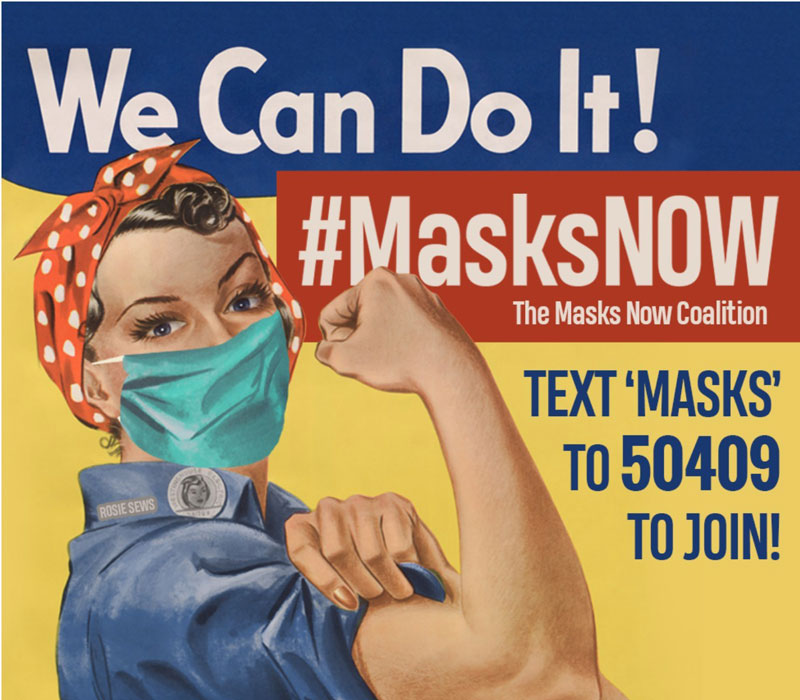
WASHINGTON — April 24, 2020 — The Masks Now Coalition is pleased to announce the first mask design that is fully compliant with all Centers for Disease Control (CDC) guidelines for people who can sew, and those who can’t. Their free pattern is available to the public by texting masks to 50409, which is also how volunteers can join the coalition.

The CDC says every person in America should wear a cloth mask or face-covering in public to combat the spread of COVID-19. The Masks Now Coalition’s standard, three-layer design mask has met all CDC facemask guidelines and FDA enforcement regulations for non-medical masks.

The Masks Now Coalition is an unprecedented grassroots effort to recruit sewists and non-sewists alike to make masks and distribute them to the facilities who need them —retirement homes, prisons, hospitals, banks, grocery stores, and other essential businesses.

More than 1,000 facilities including 220 hospitals have already requested over 300,000 handmade masks from the Masks Now Coalition. The Coalition’s strength is its 10,000+ volunteers and over 100 lead organizers in all 50 states and the District of Columbia and Puerto Rico who are supported by the state and regional leads. A steering committee manages the bottom-up effort. Francey Lim Youngberg, a former senior Obama appointee, is the national lead organizer.

Through the widespread use of cloth masks by the patients, essential workers, public servants, and the general public, our precious medical-grade N95 and surgical masks can be freed up for the doctors, nurses, and other irreplaceable healthcare professionals. A recent study by a group of Yale University economists and public health experts estimates the “benefits of each additional cloth mask worn by the public are conservatively in the $3,000-$6,000 range,” due to the impact in decreasing the spread of infection. (Source: bit.ly/YaleMaskStudy)

“Our country’s doctors and nurses are fighting on the frontlines against the coronavirus pandemic and each American can support their effort,” says Youngberg. “The more masks we make, the more we protect them. That’s why we need to mask up to protect us all.”

Anyone can join The Masks Now Coalition volunteer sewist or distributor or download a personal pattern for free by texting the word ‘masks’ to 50409.

Posted April 24, 2020

Source: Masks Now Coalition

Faultless Healthcare Linen Qualifies For Hygienically Clean Healthcare Recertification

ALEXANDRIA, Va. — April 24, 2020 — Faultless Healthcare Linen of Kanas City, Mo. has recently qualified for renewal of the Hygienically Clean Healthcare certification. The recertification reflects their continued commitment to best management practices (BMPs) in laundering as verified by on-site inspection and its capability to produce hygienically clean textiles as quantified by ongoing microbial testing.

The Hygienically Clean Healthcare certification confirms the organization’s continuing dedication to infection prevention, compliance with recognized industry standards and processing healthcare textiles using BMPs as described in its quality assurance documentation, a focal point for Hygienically Clean inspectors’ evaluation. The independent, third-party inspection must also confirm essential evidence that:

  • Employees are properly trained and protected;
  • Managers understand regulatory requirements;
  • OSHA-compliant; and
  • Physical plant operates effectively.

To achieve certification initially, laundries pass three rounds of outcome-based microbial testing, indicating that their processes are producing Hygienically Clean Healthcare textiles and diminished presence of yeast, mold and harmful bacteria. They also must pass a facility inspection. To maintain their certification, they must pass quarterly testing to ensure that as laundry conditions change, such as water quality, textile fabric composition and wash chemistry, laundered product quality is consistently maintained. Re-inspection occurs every two to three years.

This process eliminates subjectivity by focusing on outcomes and results that verify textiles cleaned in these facilities meet appropriate hygienically clean standards and BMPs for hospitals, surgery centers, medical offices, nursing homes and other medical facilities.

Hygienically Clean Healthcare certification acknowledges laundries’ effectiveness in protecting healthcare operations by verifying quality control procedures in linen, uniform and facility services operations related to the handling of textiles containing blood and other potentially infectious materials.

Certified laundries use processes, chemicals and BMPs acknowledged by the federal Centers for Disease Control and Prevention (CDC), Centers for Medicare and Medicaid Services, Association for the Advancement of Medical Instrumentation, American National Standards Institute and others. Introduced in 2012, Hygienically Clean Healthcare brought to North America the international cleanliness standards for healthcare linens and garments used worldwide by the Certification Association for Professional Textile Services and the European Committee for Standardization.

Objective experts in epidemiology, infection control, nursing and other healthcare professions work with Hygienically Clean launderers to ensure the certification continues to enforce the highest standards for producing clean healthcare textiles.

“Congratulations to Faultless Healthcare Linen on their recertification,” said Joseph Ricci, TRSA president and CEO. “This achievement proves their commitment to infection prevention and that their laundry takes every step possible to prevent human illness.”

Faultless also holds the TRSA Clean Green Certification, certifying the company’s commitment to practicing environmental stewardship on a companywide basis.

Posted April 24, 2020

Source: TRSA

SHIMA SEIKI Releases Data For Several More Knitted Masks

WAKAYAMA, Japan — April 24, 2020 — In light of the worldwide shortage of surgical masks due to the continuing spread of the COVID-19 coronavirus infection, flat knitting solutions provider Shima Seiki Mfg. Ltd., Wakayama, Japan has released knitting data for nine more versions of knitted masks to be produced on a variety of its computerized knitting machines. These are in addition to the various mask data the company has been releasing by the company since March 19, bringing the total number of versions of the masks to 19.

Data released this time consists of cotton masks to be produced on both WHoLEGARMEnT® knitting machines as well as conventional shaping machines. one type of WHoLEGARMEnT® mask data is meant for production on SWG041n2, SWG061n2 and SWG091n2, as well as on the rest of Shima Seiki’s compact WHoLEGARMEnT® knitting machines also known as “WHoLEGARMEnT® Mini” machines that are suited to production of small accessory items, in 15 gauge. Another type of WHoLEGARMEnT® mask data is meant for production on the MACH2XS series flagship WHoLEGARMEnT® knitting machines featuring four needle beds, in 15L. Shaped knit mask data is meant for production on SVR093SP as well as the rest of Shima Seiki’s computerized knitting machine lineup equipped with the moveable sinker system, in 14 gauge. Users with machines that match the above criteria can download the mask data from the Shima Seiki Users’ Site, an archive featuring more than 10,000 knit samples for use by Shima Seiki customers. By releasing mask data for a range of different machines, the company aims to alleviate the shortage of masks as much as it can by allowing production of masks by as many of its customers as possible. With this release smaller sizes for children have now become available as well, in three sizes.

Each of the masks whose data is released this time is a 3D form-fitted mask providing superior fit and comfort. Integral ear straps that are knitted along with the mask portion reduces stress on the ears, and require no further sewing for quick response production. A filter-pouch is knitted-in for inserting commercially available virus filters and other filtration fabrics. Holes are also knitted-in for insertion of wires that provide further adjustment for improved fit.

Knitted cotton masks can be washed and reused repeatedly. It should be noted however that unlike common nonwoven surgical masks, knit masks do not have virus- and pollen-filtration functionality. Their main use is for prevention of spray from coughing and sneezing, and for reducing exposure to allergens.

Download location: SHIMA SEIKI Users’ Site www.shimaseiki.com/user/samplesearch/

Posted April 24, 2020

Source: Shima Seiki Mfg. Ltd.

COVID-19 Disrupts Spinners, Manufacturing

By Jim Phillips, Yarn Market Editor

Many spinners are still working at least part-time schedules, despite the social distancing and shelter-in-place regulations mandated by some states and municipalities.

The level of business these spinners are experiencing depends largely on the types of yarns they are producing. “Obviously, there is tremendous demand for products that support the medical community and essential workers,” said one industry expert. “Those who have a presence in supplying the fabricators that make these types of products tend to be busier than others. Those who still dabble in commodity products are not likely quite so busy.”

Parkdale is one of those companies that has the resources to weather the current economic environment. The company has turned its considerable resources toward helping front-line medical worker stay safe while combatting the virus.

A Parkdale Mills subsidiary, U.S. Cotton has joined in an effort with the Food & Drug Administration (FDA), the Gates Foundation, UnitedHealth Group and Quantigen to ramp up production of spun synthetic swabs to help the country’s frontline health care workers who administer COVID-19 tests. U.S. Cotton has developed a fully synthetic, polyester-based Q-tip-type swab that can be used in coronavirus diagnostic testing. The U.S. Food and Drug Administration just announced that these synthetic swabs — with a design similar to Q-tips — could be used to test patients for the coronavirus.

A company release details how U.S. Cotton plans to leverage its large-scale manufacturing capacity to rapidly increase production of large quantities of the polyester swabs, which are in short supply for testing kits across the country.

The FDA has determined that spun synthetic swabs can be used in COVID-19 testing based on the results from a clinical investigation. John Nims, president of U.S. Cotton, said: “We stand ready to serve in this important fight and want to do all we can to help deploy these testing kit swabs for the American people. We greatly appreciate the collaborative efforts with the UnitedHealth Group, Quantigen, and the Gates Foundation to help support these necessary clinical studies to help advance this critically needed product to market.”

Companies Anticipate Post-Pandemic Boom

With few exceptions, the faces of the industry are turned hopefully to the post-pandemic future. “It seems almost certain that there will be a production boom,” said one executive. “With many manufacturers closed and others working reduced schedules, we anticipate there is going be very high demand for products after this is over.”

Added a business analyst who follows manufacturing: “From textiles to automotive, companies expect to have to scramble to keep pace with the demands of a newly invigorated economy — whenever that happens.” For some companies, however, the longer consumers are cautioned to stay at home, the poorer the prospects become for their long-term survival.

“Large companies — especially those that are multinational — have the resources to remain viable during this crisis and resume operations with only minimal-to-moderate damage to their businesses,” said a manufacturing consultant. “Smaller companies are likely to struggle much more, and many of them may not survive. This is not currently playing out to a large degree in the manufacturing sector, but many small companies in service industries — take Mom & Pop restaurants, for instance — are shutting doors forever. It becomes more and more obvious that, if we don’t get back to a stable economy relatively quickly, we are going to see the same thing happen to other sectors of the economy, especially manufacturing.”

Insights about the expected impact of COVID-19 on manufacturers have been derived from a number of recent studies. For example, a survey by the Institute for Supply Management (ISM) reveals that more than 80 percent of manufacturers say they believe their organizations will experience some impact because of COVID-19 disruptions. Of those, 16 percent have indicated they are adjusting revenue targets downward by an average of 5.6 percent.

“The story the data tells is that companies are faced with a lengthy recovery to normal operations in the wake of the virus outbreak,” Thomas W. Derry, CEO of ISM, said in a recent news release. “For a majority of U.S. businesses, lead times have doubled, and that shortage is compounded by the shortage of air and ocean freight options to move product — even if they can get orders filled.”

And, according to a recent survey by the National Association of Manufacturers, the COVID-19 pandemic has already impacted many manufacturers. About 80 percent of manufacturers who responded to that survey said they expect the pandemic to financially impact their businesses.

Manufacturers are vulnerable for two primary reasons: Many manufacturing jobs are on-site and cannot be carried out remotely, and the slowing economy is likely to reduce demand for industrial products. As a result, some manufacturers have temporarily suspended operations, and many are mulling through layoff strategies.

“Layoffs are sometimes necessary just to remain financially viable,” said one spinner. “But they are also something we have to consider very carefully. We already have some difficulty in attracting qualified job applicants, and the last thing we want to do is to lose skilled talent to other industries.”

As one analyst put it: “All-in-all, the sooner this is over, the better it will be for everyone. Just keep your fingers crossed.”

Raw material costs decline

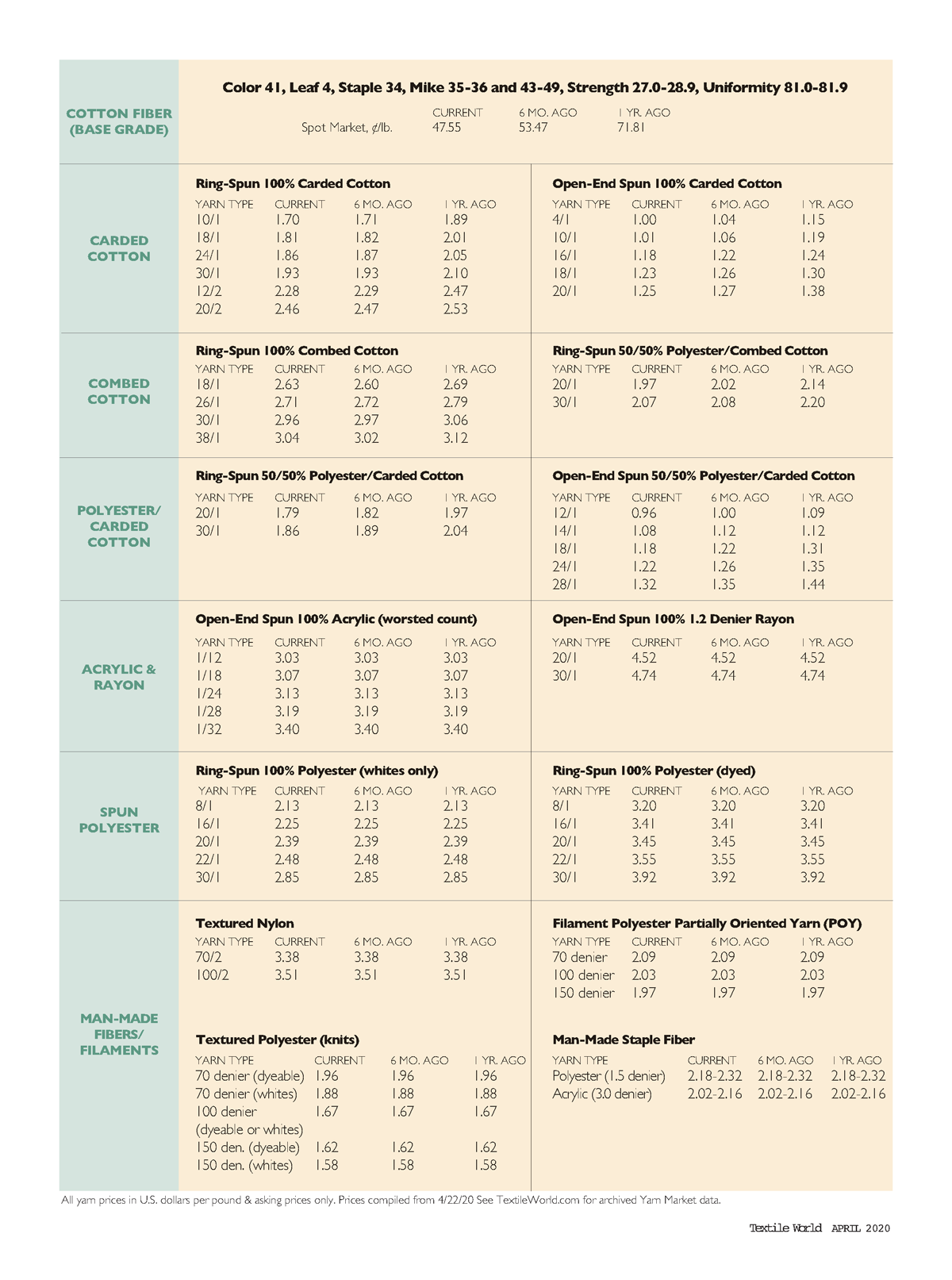
As spinners struggle to manage in such a difficult environment, they are finding at least some financial respite from drastically reduced raw materials costs. The bottom has fallen out of the oil market, and the price of cotton has dropped precipitously over the past few weeks. For example, the price of Brent crude oil dropped to a two-decade low of $15.98 a barrel in trading on April 22. Compare that to the $46.92 price per barrel for the same oil in July 2016. Also, the price of base-quality cotton in the seven designated markets measured by the USDA fell to 47.55 cents for the week ended April 16. This compares to 72.61 cents for the same period a year ago. Demand for cotton was moderately lower from the same period a year ago, dropping from 27,298 spot transactions in late April 2018 to 22,698 this year.

April 2020

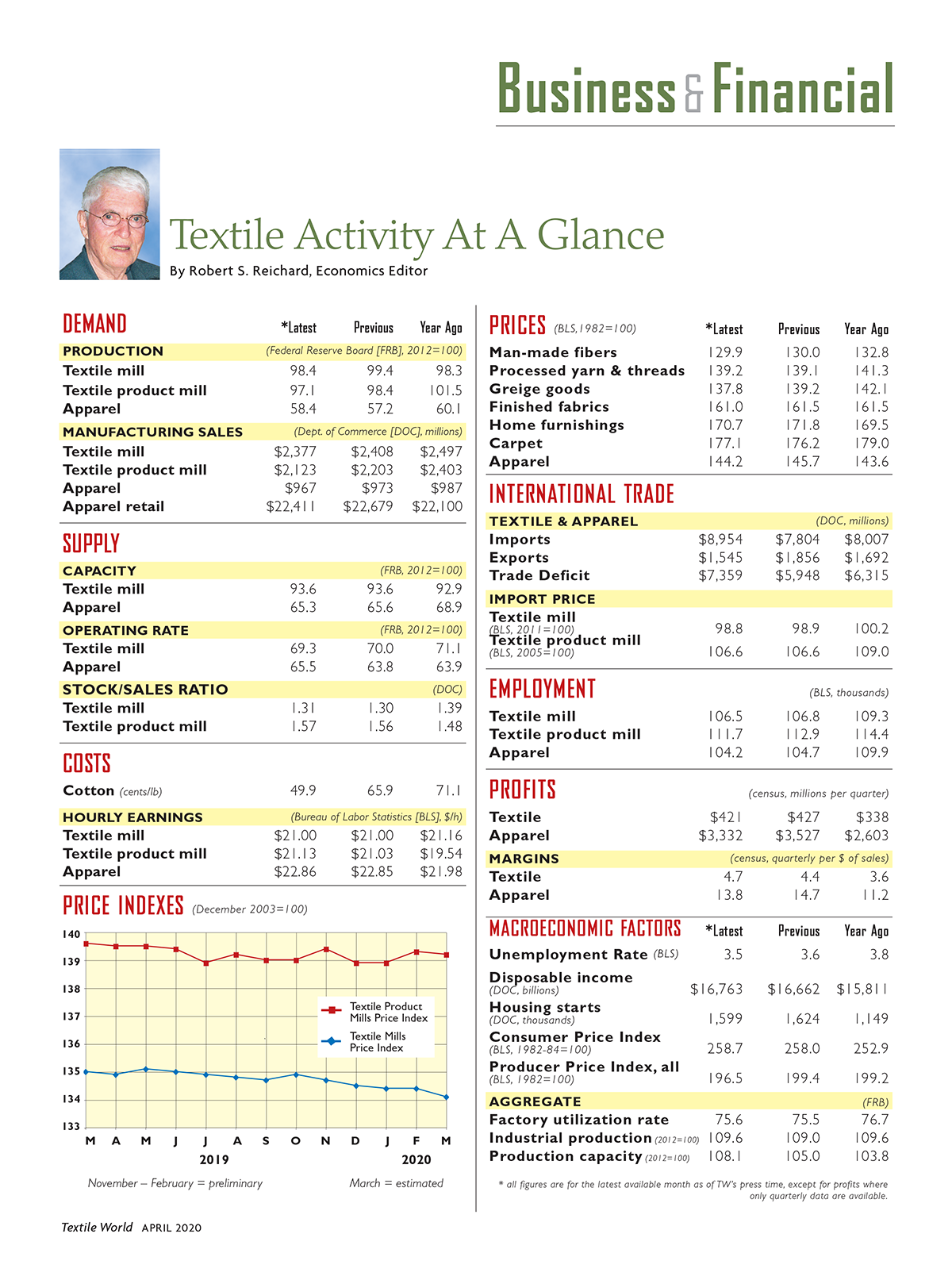
Textile Activity At A Glance: April 2020

April 2020

Sponsors