MILAN — May 6, 2020 — In the first quarter of 2020, the orders intake of Italian textile machinery registered a sharp drop. The Covid-19 pandemic impacts heavily on the sector. The consequences on the orders will be more negative in the second quarter.
The index of orders intake for textile machines drawn up by ACIMIT, the Association of Italian Textile Machinery Manufacturers, for the period from January to March 2020 fell by 31% compared to the same period of 2019. The index value stood at 72.2 basis points (2015 = 100).
Orders intake was negative both on foreign markets and in Italy. In the foreign markets orders were down 26%, while on the domestic market they marked -57% compared to the first quarter of 2019.
“The orders index sank compared to 2019, a year already negative, Alessandro Zucchi, president of ACIMIT says. Indeed in 2019 the Italian textile machinery industry observed a decrease both in production (-13%) and in exports (-14%) compared to the previous year”.
Following a difficult year, the Italian textile machinery had to face Covid-19 pandemic, which led, as a first consequence, to the slowdown of the main markets in the sector, China, Turkey and India, in the first month of 2020
WETZIKON, Switzerland — May 5, 2020 — Loepfe announced today the appointment of Dr. Ralph Mennicke as CEO of Loepfe Brothers Ltd., effective April 14, 2020. Ralph Mennicke takes over from Maurizio Wermelinger who, having joined Loepfe in 2007, became CEO in 2009, and is now retiring.
The Loepfe board of directors appointed Mennicke as CEO to lead the company and its subsidiaries. Loepfe is a manufacturer and solution partner for online quality assurance systems in the textile sector. Machine manufacturers, as well as spinning mills and weaving mills, around the globe use and rely on Loepfe technology from Switzerland.
Mennicke is a graduate of Technical University of Munich, University of York, Mannheim and ESSEC Business Schools. He holds an M.Sc. and Ph.D. in physics and an executive MBA. Previously, Mennicke has held positions as CEO, deputy CEO, general manager and product manager, as well as interim head of technology, product management and marketing.
Since completing his Ph.D., Mennicke has contributed to technology, product and market expansion and acquisitions, as well as providing inspired and effective leadership during times of crisis in his previous company. In his quest to set industry benchmarks and deliver quality improvement for customers, Mennicke has also been heavily involved in global standardization activities within the sensor and measurement fields.
“Despite the current difficult business environment as I begin my role as CEO of Loepfe, my commitment to taking our business and our people on a journey where we will seek to grow and grasp future upsides has never been greater,” Mennicke said. “As in my previous roles, at Loepfe my strategy will continue to focus on leveraging committed talents, superior technology and unique market knowledge to gain and maintain a competitive edge in the markets.
“It is my very good fortune to be joining Loepfe from a company now experiencing a dynamic growth environment, and also to follow Maurizio Wermelinger who led Loepfe for more than a decade and established the company’s reputation in the textile industry with some world-leading product brands. As well as Maurizio, I also thank the Loepfe board of directors and the Loepfe team for placing their trust in me to lead them through this tough period.”
Loepfe Executive Chairman Alexander Zschokke commented: “The Loepfe Group extends a big thank-you to Maurizio for his long, loyal and successful lead of the company, as well as a very warm welcome to Ralph. We are delighted to have Ralph on board to steer Loepfe through the challenging phase arising from the COVID-19 pandemic, and beyond. Furthermore, we are confident that Loepfe is in a strong position to emerge from this time with renewed vigor and sustained growth.”
RALEIGH, N.C. — May 6, 2020 — The Nonwovens Institute (NWI) has announced a webinar series featuring six discussions on the role of nonwovens in medical textiles. Titled “Nonwovens Technology: On the Frontlines of a Global Pandemic,” the webinars are designed to provide critical technical information and insight on the value and importance nonwovens technology has on products developed and used for infection prevention.
All webinars are free for NWI members, $50 for non-members.
The first webinar — The Anatomy of N95 and Surgical Masks — will take place May 20, from 11 a.m. until noon, and will be presented by NWI’s Executive Director Dr. Behnam Pourdeyhimi and moderated by NWI’s Director of Industry Engagement Dave Nelson.
Dr. Pourdeyhimi will examine the specific materials, construction, and performance of various face masks in light of the current COVID-19 pandemic. He will discuss the key attributes of nonwovens technology — including fiber structure and size — and the effect those variables have on filtration efficiency and user protection. The webinar will also set the stage for the later webinars on meltblown and spunbond processes, filtration science and other PPE products including wipes and gowns. Register for the first webinar here.
The webinars will be held weekly on Wednesdays at 11 a.m. Topics for the other sessions are as follows:
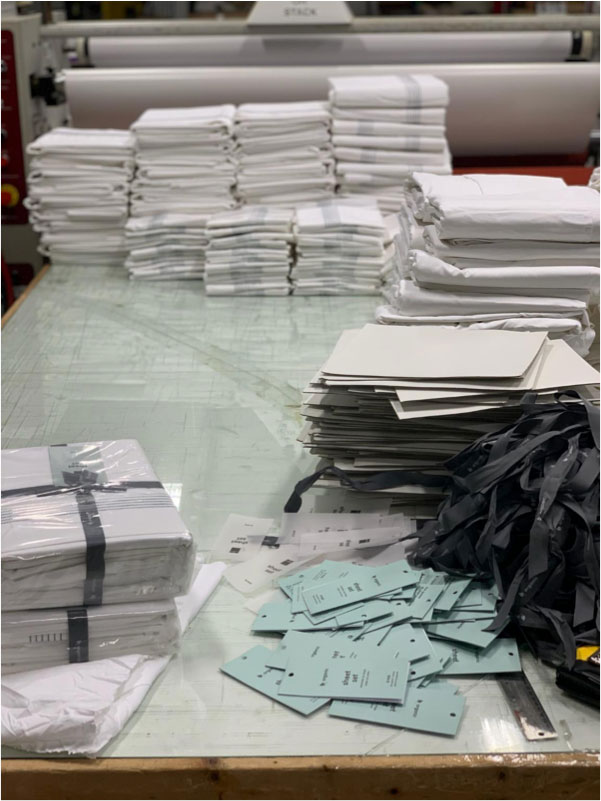
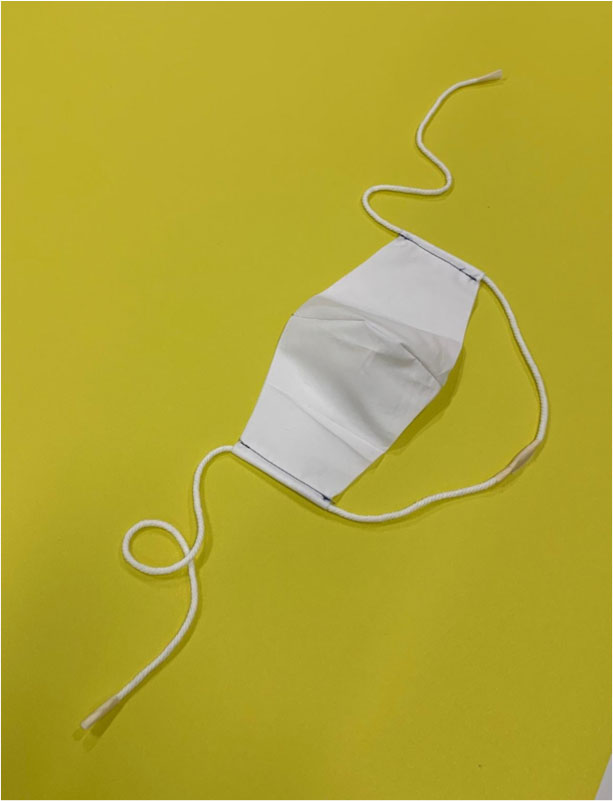
NEW YORK CITY — May 5, 2020 — Designtex is proud to announce its partnership with West Elm in the design, manufacturing, and production of 13,000 cotton face masks to support COVID-19 pandemic efforts in its state-of-the-art Surface Imaging facility in Portland, Maine. Protecting the health and safety of essential workers and community members remains atop priority as the COVID-19 pandemic continues to evolve. After a generous donation of 400 thread-count organic cotton sheets from West Elm, Designtex has been able to prototype cotton face masks with materials on hand in its Portland manufacturing facilities.
Designtex West Elm face masks are highly launderable and breathable. After unpacking 120 sheet sets from West Elm, the cotton fabric is trimmed for manufacturing. Each mask is made using two layers of 400-thread count organic cotton. With rotary style cutting on Designtex’s Zund G3 platform, production is quick, cutting close to 60 half-mask pieces in four minutes. Half mask shapes are seamed to become full masks,and a sliding cord allows for fastening and an adjustable fit. When cord procurement presented an obstacle, Designtex slit our own strong and soft microfiber tie for safe and reliable fastening.
From unpacking sheets, uploading patterns and cutting, to sewing and cord threading, Designtex is capable of producing 300 masks per shift for a total of 13,000 cotton masks. The first 500 Designtex West Elm cotton face masks have already left to production line to reach those most in need, and the partnership is confident in its ability to supply to remainder to the non-profits to whom they have pledged support.
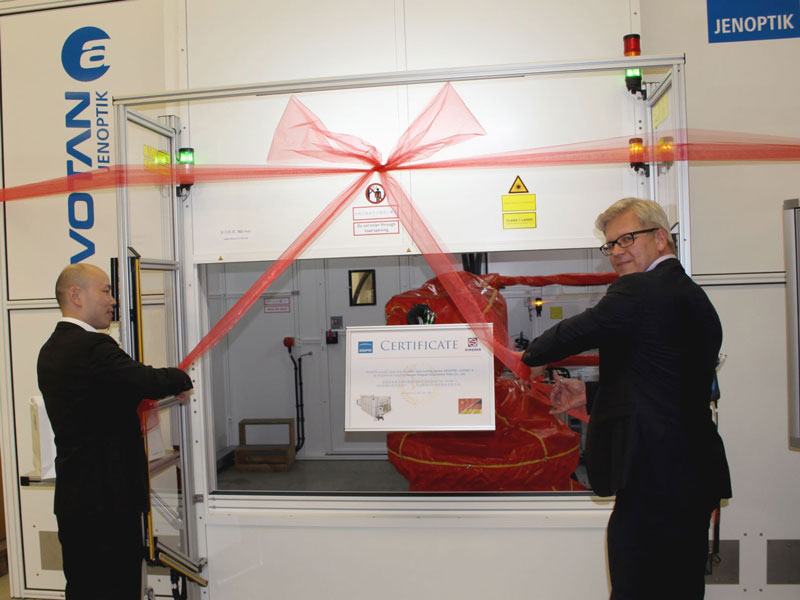
JENA, Germany — April 29, 2020 — A Chinese automotive supplier has ordered an additional laser-scoring machine for precision airbag perforation, investing in industry leading technology for processing automotive interiors.
Long-term customer Jiangsu Xinquan Automotive Trim Co. Ltd., located near Shanghai, has ordered an additional airbag laser perforation system from Jenoptik, after a recent delivery of an identical system to the same customer just a few weeks earlier. The new JENOPTIK-VOTAN A Scan system is currently being set up and commissioned in Jena, Germany. Delivery will take place shortly before summer.
Jenoptik President and CEO Stefan Traeger, said: “We are particularly pleased that Xinquan placed the order only a few days after resuming their daily business after a multi-week shutdown. As manufacturing activity in China actively increases, Chinese car models will continue to be equipped with lasered airbag solutions from Jenoptik in the future.”
JENOPTIK-VOTAN A Scan is the latest member of the product family that enables more efficient processing of safety system related materials in the automotive market. Using a fast-moving laser beam on a stationary component, the VOTAN A fires sensor-controlled light pulses too precisely cut predetermined breaking points in airbag covers. This results in simplified instrument panel air bag integration, improved esthetics and increased safety. Additionally, the technology can be adapted for processing sensitive materials such as leather, foam foils, as well as single- and multi-layer materials commonly used for vehicle interiors.
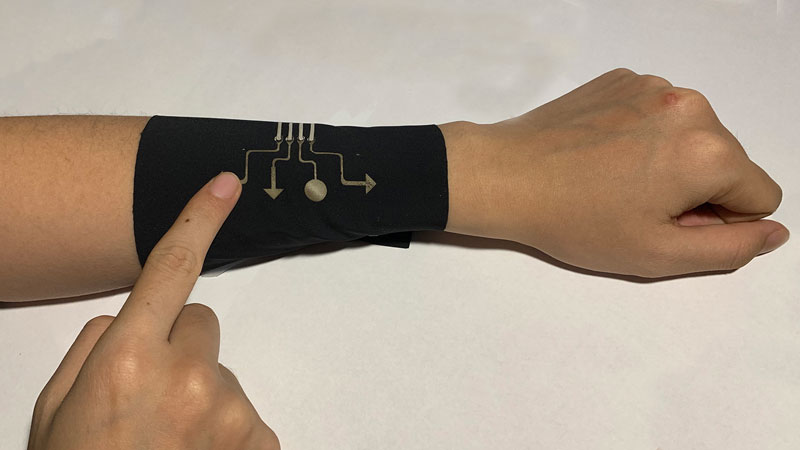
This sleeve incorporates the new electronic material, allowing it to function as a video game controller.
RALEIGH, N.C. — April 30, 2020 — Engineering researchers have created ultrathin, stretchable electronic material that is gas permeable, allowing the material to “breathe.” The material was designed specifically for use in biomedical or wearable technologies, since the gas permeability allows sweat and volatile organic compounds to evaporate away from the skin, making it more comfortable for users — especially for long-term wear.
“The gas permeability is the big advance over earlier stretchable electronics,” said Yong Zhu, co-corresponding author of a paper on the work and a professor of mechanical and aerospace engineering at North Carolina State University. “But the method we used for creating the material is also important because it’s a simple process that would be easy to scale up.”
Specifically, the researchers used a technique called the breath figure method to create a stretchable polymer film featuring an even distribution of holes. The film is coated by dipping it in a solution that contains silver nanowires. The researchers then heat-press the material to seal the nanowires in place.
“The resulting film shows an excellent combination of electric conductivity, optical transmittance and water-vapor permeability,” Zhu said. “And because the silver nanowires are embedded just below the surface of the polymer, the material also exhibits excellent stability in the presence of sweat and after long-term wear.”
“The end result is extremely thin — only a few micrometers thick,” said Shanshan Yao, co-author of the paper and a former postdoctoral researcher at NC State who is now on faculty at Stony Brook University. “This allows for better contact with the skin, giving the electronics a better signal-to-noise ratio.
“And gas permeability of wearable electronics is important for more than just comfort,” Yao said. “If a wearable device is not gas permeable, it can also cause skin irritation.”
To demonstrate the material’s potential for use in wearable electronics, the researchers developed and tested prototypes for two representative applications.
The first prototype consisted of skin-mountable, dry electrodes for use as electrophysiologic sensors. These have multiple potential applications, such as measuring electrocardiography (ECG) and electromyography (EMG) signals.
“These sensors were able to record signals with excellent quality, on par with commercially available electrodes,” Zhu added.
The second prototype demonstrated textile-integrated touch sensing for human-machine interfaces. The authors used a wearable textile sleeve integrated with the porous electrodes to play computer games such as Tetris.
“If we want to develop wearable sensors or user interfaces that can be worn for a significant period of time, we need gas-permeable electronic materials,” Zhu said. “So this is a significant step forward.”
The paper, “Gas-Permeable, Ultrathin, Stretchable Epidermal Electronics with Porous Electrodes,” is published in the journal ACS Nano. First author of the paper is Weixin Zhou, a Ph.D. student at Nanjing University of Posts and Telecommunications (NUPT) who worked on the project while a visiting scholar at NC State. The paper was co-authored by Hongyu Wang, a Ph.D. student at NC State, and by Qingchuan Du of NUPT. Co-corresponding author of the paper is Yanwen Ma, a professor at NUPT.
The work was done with support from the National Science Foundation, under grant number CMMI-1728370.
LAWRENCEVILLE, N.J. — May 5, 2020 — Datacolor is offering a weeklyseriesof freewebinars every Tuesday at 10:00 a.m. ET through May 19. Through these webinars, participants will have the chance to expand their knowledge of colorimetry and color management. Participants will also learn how to speak the language of color and find the answers to their questions about light sources, communication, tolerances and more. See below for a full list of webinar topics:
Datacolor is also offering an on-demand webinar series to fit with any schedule. Topics for this on-demand series include spectrophotometer accuracy, successful color evaluation, sample management dos and don’ts and more. Datacolor will be expanding their webinar library often with new topics. Learn more and access these on-demand webinars here.
CAMBRIDGE, England — May 5, 2020: Global Inkjet Systems (GIS), a developer and supplier of industrial inkjet solutions, today announces a new collaboration with Esko, a producer hardware and software solutions for brands and suppliers in packaging.
GIS develops and supplies datapath electronics, ink delivery systems and print system control software to builders of industrial inkjet machines, including leading vendors of digital presses for packaging. In addition to scanning and direct-to-shape systems, GIS has expertise in high performance single pass inkjet systems offering a choice of real-time workflow, RIP and image processing engines — with support for continuous quality control managing colour stability and reproduction, print uniformity, defect compensation and more.
The collaboration between GIS and Esko enables machine builders to develop and deploy tailored solutions to meet the needs of their customers. End user productivity is enhanced through streamlined, integrated and automated workflows harnessing technologies, products and services from both parties. Combining the Esko digital front end (DFE) technology with the GIS Atlas® software enables press manufacturers to design and deliver optimized solutions for each customer. These systems can then be enhanced or modified to meet changing production needs.
The Esko DFE is a turnkey solution for digital print in packaging, including brand colour management and RIPping. For more than 10 years, Esko has supplied the DFE to several leading manufacturers of digital presses, where it is included with the press as an essential part of the workflow. With the announced collaboration, the two companies can together now offer a complete solution from print job creation to the optimization of print quality through precise printhead control. Additional user interface (UI) capability is now available through the integration of both companies’ components into a combined UI that meets the end users’ requirements. Press vendors introducing new devices will benefit from reduced development time by using a ready integrated system for faster market readiness. Printers and converters will benefit by having more standardised and robust on-press solutions for workflow, colour and device compensation.
Nick Geddes, managing director of GIS, said: “Combining the packaging management, prepress automation and DFE expertise of Esko with the industrial inkjet capabilities of GIS creates a unique ecosystem for packaging and label digital printing, not seen elsewhere. Our high-speed single pass inkjet systems, offering very fast screening technologies and closed loop image quality control for missing nozzle compensation and printhead density correction, fit seamlessly into the Esko workflow creating a powerful advantage for the digital print sector.”
Chuck Ravetto, vice president/general manager, Suppliers Business of Esko, added: “By using this integrated solution resulting from our partnership with GIS, they will get innovations to market faster. At the same time, packaging converters investing in digital press capacity will benefit by having more standardized and robust on press solutions for workflow, color management and device compensation. The combined capabilities of Esko and GIS create a level of integration that extends beyond the digital press and reduces complexity for everyone involved, driving efficiency and productivity when it’s needed most.”
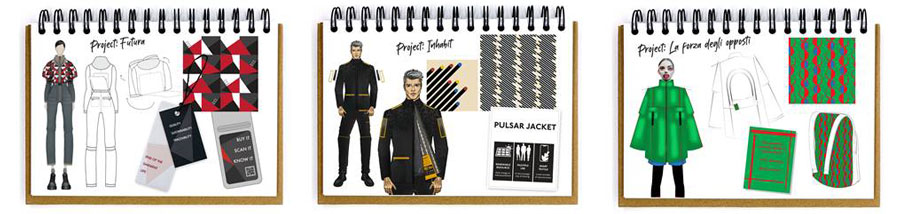
Italy — May 5, 2020 — EUROJERSEY continues its partnership with Polytechnic University of Milan by assigning a new workshop topic based on the concept YOURHOMEINADRESS (L’ABITODAABITARE).
This particular project draws inspiration from the centenary celebration of the Bauhaus, the architectural and artistic movement founded in Weimar in 1919 which placed function before form and laid the foundations of modern architecture with its minimalism and linearity.
The workshop has invited students from the university degree course in Fashion Design to probe the topic of YOURHOMEINADRESS, while attempting to create a link between the innovative features of Sensitive® Fabrics and the design of future clothes envisaged as a habitat for our bodies. Stylistic research has focused on technical outerwear, enhanced by the exclusive performing features and fit of these fabrics, combined with manufacturing techniques such as heat-welded taping and bonding. Each student has created an innovative packaging solution which, in addition to garment functionality, contributes to a shared value of sustainability. The project has led to the creation of practical outfits which may be machine washed at a low temperature and, since they are crease-resistant thanks to the properties of Sensitive Fabrics, require no ironing.
Ten finalists recount their experience in the form of a look book packed with images and complete with a fashion shoot involving the project designers themselves. A video also illustrates the individual experience of each participant while highlighting the factors determining the selection of the three prizewinners: FUTURA by Beatrice Mannucci Benincasa, INHABIT by Giangastone Vassanelliand LA FORZA DEGLI OPPOSTI by Petra De Paoli.
(left to right): FUTURA by Beatrice Mannucci Benincasa; INHABIT by Giangastone Vassanelli; and LA FORZA DEGLI OPPOSTI by Petra De Paoli
AACHEN, Germany — May4, 2020 — Digitization, Industry 4.0 and the expertise in this field should make us fit for the working world of tomorrow. Nevertheless, these important topics are pushed into the background in times of coronavirus. But can we afford to waive the necessary trainings?
Praß
“No”, says ITA Academy Managing Director Nicolina Praß. “We convey this expertise in our online remote training “Digital Transformation” and offer our customers the opportunity to participate from their home office in times of Corona.”
Other important training courses such as the “Textile Summer School” and “Basics of Textile Technology” are now also offered remotely online.
“There is much more to textiles than you think,” Praß said. “Medical textiles such as stents help us in health care, textiles such as airbags secure and protect us in the car and make life at home comfortable with carpets, sofas and much more. Textile concrete is used in architecture and reduces carbon dioxide pollution. Therefore, knowledge about textiles is important for almost all branches of industry.
“Because textiles are in demand locally and around the world, it is a national and international business at the same time. Therefore, we offer some training courses in German and other training courses in English.”
We will impart knowledge about textile value creation from May 13-15 in “Textile Summer School” or from July 28-30 in our training course “Basics of textile technology.” They will impart expertise about the entire textile process chain. Starting with fiber science, through yarn and surface production to finishing and textile testing methods, all essential topics are covered.
Both training courses are therefore suitable for interested employees and trainees from all areas of the company along the textile chain who wish to acquire or refresh specialist knowledge. This also gives lateral entrants and specialists with training from outside the industry the opportunity to enter the world of textiles more easily.
With the “Textile Summer School” we want to address both international and national customers. A good knowledge of English is required for participation. The course “Basics of Textile Technology” will be held in German.

 MILAN — May 6, 2020 — In the first quarter of 2020, the orders intake of Italian textile machinery registered a sharp drop. The Covid-19 pandemic impacts heavily on the sector. The consequences on the orders will be more negative in the second quarter.