PRINTING United Alliance Announces 2020 InterTech Technology Award Recipients

FAIRFAX, Va. — September 17, 2020 — PRINTING United Alliance today announces that eleven game-changing technologies have been selected to receive an industry-renowned 2020 InterTech™ Technology Award. The technologies entered for consideration were judged on their innovativeness and likelihood of having a significant impact on the printing industry. Those eleven solutions ultimately chosen will be highlighted during the Printing United Digital Experience in October.

2020 InterTech Technology Award Winners

An independent panel of judges deliberated over an outstanding selection of technology nominations that highlight the dynamic nature of the industry. More than half of the awarded technologies were digital presses and associated systems, including the first ever award for a textile press. Judges also recognized innovations in sheetfed offset press technology, web-to-print software, and solutions that streamline packaging print production.

The 11 technologies selected to receive a 2020 InterTech Technology Award are as follows (*listed alphabetically by company, with the technology named first):

  • Customer’s Canvas – Aurigma;
  • EFI Reggiani BOLT – EFI;
  • Esko Trapper – Esko;
  • GMG ColorCard – GMG;
  • HP Indigo 100K Digital Press – HP Inc.;
  • H&B ExcelCoat ZRW Web Coater inline with HP PageWide Web Press T240 HD – HP Inc.;
  • KODAK PROSPER QD Packaging Inks and Film Optimizer Agent – Kodak;
  • Komori GLX40RP Double-Sided Press – Komori America Corp.;
  • Uteco Sapphire EVO M Press – Uteco and Kodak;
  • Xerox™ Baltoro™ HF Inkjet Press – Xerox Corp.; and
  • Navigator DFE – Xitron LLC.

“Our goal each year is to spotlight technologies which shape the future,” says James Workman, vice president, Center for Technology and Research, Printing United Alliance. “Each summer, the panel of judges and I scrutinize each submitted technology to evaluate its degree of innovation and potential for impacting our industry. It is a challenging process to select the recipients since all of the technologies are impressive.”

Posted September 17, 2020

Source: PRINTING United Alliance

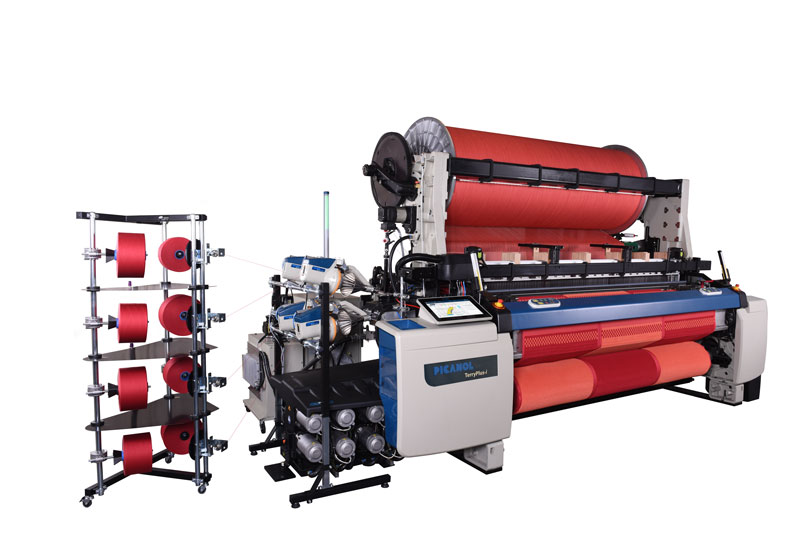
Picanol Introduces The TerryPlus-i — A New Benchmark In Terry Weaving

TerryPlus-i SmartShed

IEPER, Belgium — September 17, 2020 — The new TerryPlus-i is an airjet machine that is based on the OmniPlus-i which was introduced at ITMA Barcelona in 2019. Therefore, it has all the benefits of this state-of-the-art airjet weaving machine. This TerryPlus-i airjet machine was developed with our four design principles in mind: smart performance, sustainability inside, driven by data, and intuitive control. This means that it guarantees the highest level of fabric quality in combination with a higher performance.

“The latest terry technology makes the new TerryPlus-i the most performant and versatile terry machine on the market,” explained Johan Verstraete, vice president, Weaving Machines. “It doesn’t matter if it is high pile, low pile, high density, low density, complex styles, or simple styles — this machine can handle any challenge. In order to realize this versatility we have developed a completely new pile formation system where the user can program any pile height between zero and twelve millimeters, regardless of whether it is plain terry, wave patterns, or any other pattern and this is done on a pick-by-pick basis.”

Furthermore, thanks to the unique pile motor set-up directly driving the cloth and backrest movement simultaneously, accurate pile formation is assured at the highest speeds. The unique pneumatical pile backrest ensures optimum loop formation regardless of fabric design. The rigid yet extremely light construction ensures a highly dynamic behavior, guaranteeing perfect loop formation for even the most complicated terry designs – be it very light towels or heavy bathmats. Put simply, this is by far the best pile compensation system ever!

Special attention was given to ease of use thanks to a completely new human-machine interface. The new display measures 15.6 inches and it is equipped with all of the functionalities you are familiar with from your smartphone: touch, swipe, and the latest connection possibilities: ethernet, USB, Wi-Fi, Bluetooth, and Near Field communication (NFC – this is the technology we use when making contactless payments).

The TerryPlus-i comes with two possible prewinders: the Blue 22 and the Blue 11 (the one with separate windings). Both are equipped with the easy set function which manages all settings electronically through the display. Consequently, there is no longer any need for tools or special keys to tune the prewinders. And all of this can be done without having to stop the machine, which enables you to optimize and reduce the waste length to an absolute minimum.

An additional groundbreaking novelty is PosiJet, which comes in a four channel version and positions each main nozzle exactly in line with the reed on insertion. This means that there is only one setting for all four nozzles and no need for a reed with a conical entrance. The result is savings in terms of both time and costs, because these conical reeds are quite expensive.

The range of possible shedding motions — dobby and jacquard — has been completed with SmartShed for independent and individual shedding motion. SmartShed has been developed for those weavers who want to maximize digitization and flexibility in their weaving processes. The movement and the crossing of the harness frames is actuated individually for each frame by a separate motor and it is set fully electronically. This will facilitate the optimal setting whenever you are weaving a simple three pick terry or a more complex seven or nine pick terry.

Posted September 17, 2020

Source: Picanol

NCTO Sends Letter To Lead House And Senate Committee Members In Support Of Congressional Action Addressing Forced Labor In China

WASHINGTON — September 17, 2020 — The National Council of Textile Organizations (NCTO), representing the full spectrum of U.S. textiles, from fiber though finished sewn products, sent a letter to the chairs and ranking members of the House Ways and Means Committee and Senate Finance Committee today, in support of congressional efforts to address China’s use of forced labor.

The House Ways and Means Committee’s Subcommittee on Trade is holding a hearing today at noon on this important issue.

NCTO sent the letter to House Ways and Means Chairman Richard Neal (D-Mass.) and Ranking member Kevin Brady (R-Texas), Senate Finance Chairman Charles Grassley (R-Iowa) and Ranking Member Ron Wyden (D-Ore.)

See the full letter here.

Posted September 17, 2020

Source: The National Council of Textile Organizations (NCTO)

Mask Made In America: California-Based Salus Supply Purchases Mask-Making Machine, Starts West Coast Supply Chain For Face Masks

California-based Salus Supply purchased a mask-making machine

CHICO, Calif. — September 16, 2020 — A Northern California-based start-up is now in the mask making business, producing non-medical, 3-ply nonwoven face masks. Salus Supply, a veteran-owned company, and the first and only nonwoven mask manufacturer on the West Coast, guarantees low prices and same-day shipping.

“We bought a machine so that we could make masks in America, put local people to work and help to reestablish a critically important supply chain for personal protective equipment (PPE),” said Tovey Giezentanner, owner and founder of Salus Supply.

Salus masks are made from three layers of lightweight, breathable, nonwoven material, including a middle layer of melt blown fabric which provides an improved level of protection from tiny airborne particles and helps to reduce exposure to COVID-19 and bad air quality from wildfires.

The movement towards wearing masks during pandemics is well documented in history and why Giezentanner, along with two investors, took to the internet to buy a mask-making machine in March 2020. After finding a company based in China with a facility in California that made and sold mask making machines, Giezentanner secured a warehouse and ordered a machine and the necessary materials to start make the masks.

“Unfortunately, no one in America builds mask-making machines. Likewise, securing the nonwoven fabrics to make masks in America is almost impossible,” Giezentanner continued. “For the past 25 years, it’s been cheaper to import masks from China or other far east countries and as a result the PPE supply chain disappeared.”

In July, Giezentanner hired a San Francisco-based electrician to help communicate in Chinese and calibrate his new machine. By late-August, the mask materials arrived, and Salus Supply was in business. The mask machine can produce up to 40,000 masks a day and 1 million masks per month.

“We’re thrilled to be part of a national effort to re-establish the PPE supply chain in America,” Giezentanner continued. “It’s also been extremely rewarding to create local jobs, start a California-based supply chain in my hometown and make something positive happen in 2020.”

Salus non-medical, source control face masks are authorized by the FDA under an Emergency Use Authorization for use as source control by members of the general public as well as health care professionals in healthcare settings to help prevent the spread of infection or illness during the COVID-19 pandemic.

Posted September 16, 2020

Source: Salus Supply

New Loepfe Product Boosts Weaving Productivity — WeftMaster SFB

Loepfe’s WeftMaster SFB

WETZIKON, Switzerland — September 16, 2020 — Loepfe Brothers Ltd. has announced today the launch of its new WeftMaster SFB — the first of several of planned launches featuring latest technology products aimed at maximizing productivity in weaving mills.

The WeftMaster® brand carries with it a long heritage of international success and reputation for Swiss engineering quality. The WeftMaster SFB weft thread brake has now been upgraded with new electronics to control up to four brakes.

Designed for fitting to projectile and rapier looms, the WeftMaster SFB controls the tension for all yarn types, thus minimizing weft thread breaks. Braking start is optimized through precise projectile detection allowing increased loom speeds and promoting higher output. The WeftMaster SFB brakes also feature reduced yarn abrasion and higher wear resistance.

Loepfe’s Head of Products & Solutions Guido Wieland commented: “Today, it’s all about productivity and maximizing return on investment. The WeftMaster SFB helps our customers in the technical textile business to increase production while, effectively, prolonging the life of their original equipment. We know there are still many owners of mechanically-braked weaving looms out there, so would urge them to contact us — there’s never been a better time to adopt a well-proven and reliable electronically-controlled solution!”

Loepfe CEO Dr. Ralph Mennicke added: “Despite the continuing Covid-19 crisis, a few months ago we announced our intent to transform the company and bring new products to the market. While our transformation is already well-advanced, many congratulations to the whole Loepfe team for their excellent work to facilitate the launch of the new WeftMaster SFB product today. We are all very excited about this and other upcoming product launches. Our customers can soon expect more new best-in-class products to support them as economic recovery gets underway.”

Posted September 16, 2020

Source: Loepfe Brothers Ltd.

Commission President State Of The Union — From Promise To Practice: How Will The European Commission Deliver On Its Ambitious Promises?

BRUSSELS — September 16, 2020 — EURATEX, on behalf of its 160,000 textile and clothing companies, has followed President von der Leyen’s state of the union, presented today in the European Parliament. The Commission President has touched upon a vast range of topics and shown great ambition for a forward-looking Europe. The question remains how to ensure effective implementation of those plans; EURATEX calls for a strong public-private partnership to build a competitive and sustainable future.

EURATEX welcomes an ambitious commission, in particular when it calls to strengthen the Internal Market, to invest in digitalization, to ensure free but fair trade, to enhance our industrial strategy and build up resilience, to insist on the level playing field in relations with United Kingdom, China or the United States.

Such ambitions will help to sustain a competitive European textiles and clothing industry, including 160,000 companies and offering 1.5 mln quality jobs. But the question remains how such intentions will be implemented effectively.

Director General Dirk Vantyghem commented: “In today’s health and economic crisis, we need a strong European Union, which supports our SMEs to survive, to innovate, to become more sustainable, to grow international. That requires effective measures implemented today, not tomorrow. We have put our ideas on the table, and look forward to discuss how to make them happen.”

EURATEX presented its “Recovery Strategy” in June; it includes both short term and long term measures, and concrete “flagship proposals” (e.g. building recycling hubs for waste textiles). Effective implementation will depend on a close dialogue between the EU, its member states and the private sector, and quick decision making.

Posted September 16, 2020

Source: EURATEX

T. Henderson Wise Promoted To The Position Of President And COO Of A. B. Carter Inc.

Wise

GASTONIA, N.C. — September 15, 2020 — The Board of Directors of A. B. Carter Inc. recently announced the promotion of T. Henderson Wise to the position of president and COO. Wise joined the company in 1994 and has served in sales and most recently as vice president, Textile Sales. Wise received his Bachelor of Science degree in textile engineering from Auburn University. He is married to Suzanne Wise and they have two children, Griffin and Whittner.

Founded in 1922, A. B. Carter Inc. is universally recognized as a global supplier of spinning solutions for the fiber and yarn manufacturing sectors of the textile industry. Core products include steel and nylon travelers, rings, bobbins, tapes and belts, air splicers/knotting equipment, and laboratory testing equipment. Stainless steel belts, counterbands, pressure rolls, and other accessories supplied to the carpet industry. Headquartered in Gastonia, N.C., A. B. Carter has offices in five countries and agents in 44 countries.

Posted September 16, 2020

Source: A. B. Carter Inc.

Ecofibre Completes The Acquisition Of TexInnovate; Announces Jeff Bruner As President Of Hemp Black 

GEORGETOWN, Ky. — September 15, 2020 — Ecofibre Ltd. is pleased to announce that it has completed the acquisition of the portfolio of businesses and assets of its key manufacturing partner in North Carolina. The portfolio includes five businesses that have deep technical expertise across a broad range of high-performance textile disciplines — TexInnovate.

Jeff Bruner has been named president of Hemp Black effective immediately. Bruner is the founder of TexInnovate.

In order to focus his efforts on Hemp Black, Bruner has resigned as vice chairman from Quantum Materials, Colfax, N.C.  Bruner founded Quantum more than 30 years ago.

Ecofibre CEO Eric Wang, stated: “This is an incredibly important strategic move for Ecofibre. For the past two years we have worked to develop a platform of intellectual property that allows us to sustainably deliver the natural anti-microbial and conductive properties of hemp into existing manufacturing supply chains for textiles, composites, coatings, paints and other industries.”

“Through this period Jeff Bruner and the team at TexInnovate has been a very close partner in co-developing IP, building processes to deliver Hemp Black capabilities at industrial scale, designing, engineering and acquiring specialized equipment and developing / manufacturing the recently launched Hemp Black face mask to market.”

Bruner stated: “Two years ago when I was introduced to the concept, research and patents being developed by Hemp Black, I quickly became a significant shareholder. Since 2018, I continue to see the very strong commercial potential for this technology to not only solve problems that our customers find today, but more importantly advance the quality and technical aspects of a very wide array of products.”

“I am very excited to lead Hemp Black with Eric and his team and help innovate the high-performance textile industry to another level,” Bruner continued. “During my career there have been several innovations that led to step function shifts in our industry. I believe Hemp Black has the technology to underpin another step function shift in how textiles can enable and perform across a wide range of industries.”

Posted September 15, 2020

Source: Ecofibre Ltd.

The Woolmark Company Launches Industry-Wide Digital Education Platform: Woolmark Learning Center

NEW YORK CITY — September 11, 2020 — The Woolmark Company has launched its free online learning portal to educate along the global textile supply chain. The Woolmark Learning Centre offers an unprecedented level of transparency within the industry, designed for students studying fashion, agriculture, science and textile engineering; designers, brands and retailers; and manufacturers of yarn, textiles and garments.

The platform is an intuitive digital solution hosting in-depth knowledge on specific areas of the supply chain. Developed by industry experts, the coursework covers on-farm learnings and the science of the wool fiber; the manufacturing supply chain from early-stage processing through to textile and garment production; textile innovations and in-depth design coursework. The platform is structured to facilitate both fundamental and masters-level education.

Established and emerging industry leaders have contributed to the development of the platform, with The Woolmark Company utilizing its wide network of experts to share exclusive insight and experience of the industry.

Featured alongside the in-depth coursework, the platform hosts the video-format Insight Series, launching with leading fashion designers Roland Mouret, Edward Crutchley and Colovos duo Michael and Nicole Colovos along with iconic fashion writer and curator Colin McDowell sharing never before aired in-depth conversations about their inspiration, education and future-forward businesses.

Developed in response to the global shift in education towards agile, self-paced, digital learning, the platform will work to unify the global textile supply chain.

“Technology has revolutionized teaching and learning,” explains The Woolmark Company’s General Manager for Education and Innovation Julie Davies. “Studies show that online learning increases retention rates by 25 percent to 60 percent1 and by providing free, expert-led digital education, the Woolmark Learning Centre allows knowledge transfer along the global textile supply chain to bridge knowledge gaps within the industry.”

To ensure that the platform will service the needs of users, two learning pathways have been integrated into the site. Traditional front-to-end learning supports users who want an immersive learning experience, whilst the searchable learning function services users who need specific information and will allow users to find coursework of relevance to them. Courses can be completed in the user’s own time. All coursework is accredited independently by Credly, an internationally recognized issuer and moderator of digital badges. Once accreditation has been gained, users can elect to share their badge on digital media or demonstrate it on digital portfolios.

Teachers and facilitators will have further access to resources including in-depth facilitator guides and presentation slides, videos, practical demonstrations and materials and resources to support the integration of the Woolmark Learning Centre into their teaching.

Education is a key strategic pillar of The Woolmark Company business model. The company works to educate across the global wool supply chain to build awareness of wool’s benefits, provide resources to educate the supply chain and encourage expertise in wool use to discover new opportunities for wool applications.

1 Research Institute of America.

Posted September 15, 2020

Source: The Woolmark Company

Stratasys Takes Another Leap Forward For Fashion And Direct-to-Textile 3D Printing

NEW YORK CITY — September 10, 2020 — Since its unveiling at New York Fashion Week last fall, the ability to 3D print directly onto fabric has drawn significant interest from the world of high-end fashion. Exemplified by the works of fashion designers threeASFOUR and Travis Fitch on NYFW’s catwalk, this technological milestone gave the world a preview of what fashion design could look like when combining the geometric and aesthetic freedom of 3D printing with the comfort of fabric.

Since then, 3D printing company Stratasys has been working closely with a number of household fashion brands to optimize its novel PolyJet Technology™ to meet the needs of modern-day apparel fabrication and make customized fashion design commercially viable.

As the company works towards this goal, Stratasys is proud to reveal today two collaborative works with esteemed fashion designers Julia Koerner and Ganit Goldstein. The works form part of Re-FREAM, a collaborative research project funded by the European Union bringing together artists, designers, engineers and scientists to co-explore the use of technology and 3D printing for the future of fashion.

ARID Collection – Julia Koerner

At today’s virtual ARS Electronica Festival, Koerner unveiled her latest collection: ARID. The works are built on research focusing on digital processes from 2D to 3D for nature-inspired geometries and the connectivity and adaptability of textiles with multi-color 3D-printed parts — with an underlying focus on material efficiency and sustainability.

ARID amalgamates this research into a collection of 38 3D-printed parts that can be combined to form a full-dress, or cascade into a number of different looks and combinations. Using Stratasys’ PolyJet Technology, the digital designs were 3D printed directly onto sustainable fabrics in vivid colors, creating an enigmatic shimmer effect when the garment is in motion, while maintaining the comfort and wearability of fabric garments.

The collection also allows for the easy adaption of personalized sizes through modified 3D printed connectors, which are derived from 3D scans of the wearer. There is no sewing involved in the final assembly of the parts. Instead, all seams are connected with 3D printed joinery, which is the first time 3D printed connectors have ever been used in the assembly of textiles.

Customized Design – Ganit Goldstein

Goldstein teamed up with Stratasys to achieve her mission of customized fashion design by combining craft methods with direct-to-textile 3D printing to produce a Japanese-style dress.

“Looking at the fashion world today, I want to introduce a new way of manufacturing — moving away from mass production to customized design,” says Goldstein. “3D printing has always offered the potential to personalize design in ways not possible before, but to truly create a new way to manufacture requires a new kind of textile. My goal is to create a new hybrid world of crafts and multi-color 3D printing – connecting past, new and future techniques to evolve fashion design.”

Goldstein spent a year in Japan to learn interweaving and was inspired by Asian craft embroidery and textile painting. Her kimono design follows the Japanese ‘ikat’ coloring method. While Japanese embroidery is the soul of the project, direct-to-textile multi-color 3D printing is at the heart of it. The kimono follows an algorithm that is composed on the 3D body scan and translated to the print surface during the printing process.

For the first time in 3D printed fashion, textiles can be leveraged as the skeleton of the garment. This allows for extra movement within the fabric, but also enables full gain between the capacity and material thickness that is printed on top of the fabric. This enables designers to bring unique designs to market that are not possible in any other way. It also challenges Stratasys to take the technology to places it’s not been before to support the emerging demand for direct-to-textile printing.

“In fashion, it’s important that we continually optimize and evolve to introduce new design forms,” says Goldstein. “During the past year, I experimented with numerous different fabrics and technologies to incorporate 3D printing within textiles. Achieving this milestone takes us away from 2D design and opens up a world of wearable 3D garments.”

Koerner and Goldstein leveraging Stratasys’ direct-to-textile printing technology exemplifies Re-FREAM’s goal of fully digitizing design workflows — from design through to production. In doing so, it demonstrates the possibility for localized manufacturing and mass customization — regarded by many as the future of fashion.

As Goldstein attests, direct-to-textile 3D printing has the potential to be a game-changer for the fashion industry. With the commercial interest in this innovative technique already at an advanced stage and pilot-testing underway, it may not be long before potential becomes reality.

Posted September 15, 2020

Source: Stratasys

Sponsors