NEW YORK CITY — October 15, 2020 — AFM Distribution, a successful, Albanian workwear company, is leveraging Gerber Technology’s integrated solution to reduce costs, labor and material waste so it can expand its business. As a company who prides itself on quality manufacturing, its ability to meet deadlines and a commitment to treating people as an asset, AFM knew the only choice to help them was Gerber Technology. Since implementing Gerber’s solutions, AFM has improved its profitability by approximately 25 percent which has enabled them to invest in more staff training and specialization.
“Many people believe that technology is going to replace their employees, but as we’ve seen with AFM, that’s not the case at all,” said Richard Jessup of Gerber Technology. “By correctly leveraging technology, AFM was actually able to improve the livelihood of their employees by adding to their skillset and giving them opportunities to grow. We are proud to help AFM not only streamline their production but also empower them to create jobs.”
Over the last several years, AFM Distribution has experienced tremendous growth and is looking to enter the competitive export market. In order for AFM to successfully expand their company and ensure they are offering the best quality and price for each of the 60,000 garments they develop per month, they needed a solution that was able to increase efficiency, reduce time to market and cut costs.
AFM’s manufacturing site in Vora is equipped with the GERBERspreader™ XLs50, the Gerber Paragon® HX, and Gerber’s industry-leading software solutions: AccuMark®, AccuNest™ and AccuPlan™. Since AFM uses expensive fabrics and materials, it’s critical they maximize material usage and cut with absolute precision. With the powerful combination of AccuPlan and AccuNest, AFM is able to digitally send Cut Plan solutions, which include multiple markers, fabrics, colors and corresponding spreads and ply count, to quickly produce and track down the cutting efficiency of thousands of garments. Since implementing Gerber’s powerful design and production tools, AFM has been able to deliver as many as 1,800 parts per shift, assuring quality from the first layer of fabric to the last while saving money and improving material utilization.
“The GERBERcutter® provides maximum precision, especially when cutting notches and holes,” said Ardiana Karakashi, AFM’s finance director. “This is particularly critical as the company manufactures workwear which can have as many as 200 notches. By leveraging Gerber, the cutting quality is assured from the first layer of fabric to the last. Moreover, we can rely on the first-rate technical support provided by Gerber Italia.”
BRUSSELS — October 15, 2020 — EURATEX responded to the E.U. consultation on the trade policy review, offering 60 specific points, which will help to develop an open but sustainable trade system, which guarantees the level playing field for European industry. The E.U. should invest in an ambitious regional agenda, focusing on important partners such as EUROMED and United States, and in multilateral efforts, in particular within the World Trade Organization (WTO).
In this rapidly changing and multi-polar world, facing an unprecedented health and economic crisis, European businesses need a stable and transparent global framework. EURATEX therefore welcomes the review of the E.U.’s trade policy. It is an opportunity to shape a modern strategy which supports our companies in prospering at global level.
The European textiles and clothing (T&C) industry is globalized, with complex value chains and inter-dependencies with many other sectors. T&C companies annual exports exceed 60 billion euros and imports well over 100 billion euros. Thirty-eight percent of the industry’s turnover is sold on global markets, whereby SMEs are particularly active (covering more than 50 percent of those global sales).
On that basis, EURATEX emphasizes the following points:
We need open and “efficient” markets, but combined with effective controls where necessary, thus ensuring level playing field for European companies;
We need complementarity between the EU’s Trade and Industrial strategy, leading to increased resilience, e.g. through better access to raw materials and stockpiling of strategic goods;
We need an ambitious regional agenda, focusing on important partners such as United States, Turkey, Switzerland and the EUROMED region, but also open to new partnerships in Africa;
We need to invest in multilateral efforts, thus supporting WTO efforts to work on subsidies, public procurement, IPR, etc.;
We need to act “beyond” the conclusion of an FTA: ratification must be faster, and implementation of an agreement must come with information efforts and support to European SMEs, as part of a genuine European Economic Diplomacy strategy;
We need a more sustainable and fair trading system, based on rules, global environmental and social standards, which are effectively respected by all; and
We need a modern trade policy, setting rules for new forms of trade such as e-commerce, and embracing the digital opportunities.
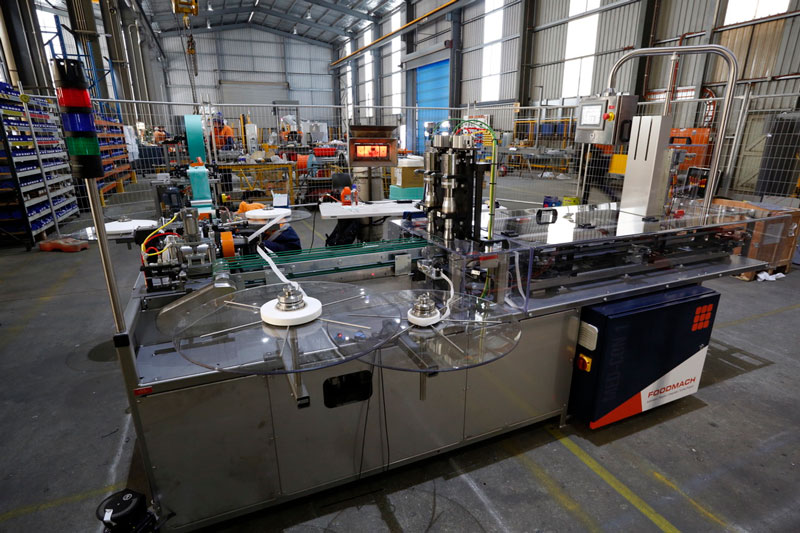
A new automated mask-production machine takes shape. Eight of these machines are helping MedCon, an Australia-based maker of medical apparel and supplies, to produce 58 million Level 3 surgical masks in response to the COVID-19 emergency.
TW Special Report
Faced with the COVID-19 emergency in March 2020, Australia’s Department of Defence (ADF) sought out domestic suppliers to produce 58 million Level 3 surgical masks by November 2020. The ADF offered a contract to MedCon, a Melbourne-based supplier of medical apparel and supplies, which was Australia’s only current domestic producer of Level 3 masks. However, due to the continued influx of low-cost masks from Asian producers, MedCon’s annual production of Level 3 surgical masks had fallen to just 2 million.
MedCon execs told ADF officials that meeting the goal — a 29-fold increase over current annual production to be accomplished in just eight months — would require a major engineering, machine building and implementation effort. The effort would involve revamping three aging mask-making machines and building five new machines. Because no original blueprints were available, components for the five new machines would have to be reverse engineered based on disassembly and analysis of the older equipment, then fabricated and assembled with available engineering know-how.
Citing national urgency, ADF officials issued the production contract to MedCon and stepped in with resources to help. First, they assigned a team of 27 military engineers to provide any necessary assistance to the project. Then, they promised to help MedCon fast-track procurement of components and technology essential to completing the new equipment and ramping up its production to meet the national goal.
As the military engineering team worked with MedCon experts to analyze the mask-production process and begin disassembly of one of the existing machines, one of Australia’s premier machine builders, Foodmach, was contracted to lead the machine-modernization and -building project. Foodmach faced a dual task and a tight timeline. First, it was required to modernize the three older mask-making machines and deliver them within an eight-week period. Second, it had to reverse engineer, build, test and deliver five new machines in a subsequent six-week period. Normally, the job to build a single new machine would take 16 to 20 weeks with drawings, but Foodmach and its supply chain partners had to complete the entire job in a total of 18 weeks from start to finish.
One technology critical to all of the mask-making machinery was ultrasonic welding. Basically, ultrasonic welders convert electrical energy to high-frequency mechanical vibration, which is transmitted through tooling into thermoplastic nonwoven material. The vibration creates frictional heat that melts the material, an operation that can be focused and utilized to:
Cut or slit a large roll of nonwoven fabric into narrower strips — cut edges are simultaneously seamed/sealed by the heat;
“Quilt” multiple layers of nonwoven material into a laminated product such as a multilayer face mask; or
Bond multiple layers of nonwoven fabric into a finished seam — the edge of a face mask — or attach a nonwoven tie strap or stretchable nonwoven ear loop to the edge of a mask.
Project managers requested Branson™ ultrasonic welding technology for the task and contacted Emerson through its regional representative, Consonic Pty. In all, they sought 34 Branson welding units, enough to outfit the eight mask-making machines with four welding stations each, plus two spares. Each ultrasonic welding station would require a 20 Hz Branson DCX power supply, a matched converter and booster, plus an application-specific sonotrode, locally developed and fabricated by Consonic.
At the time the emergency welder procurement order was being developed, Australia’s Department of Defence and project leaders feared that the global surge in demand for medical and personal protective equipment (PPE) — and a secondary demand spike for nonwovens production equipment like ultrasonic welders — could delay welder procurement and delay machinery production. Nevertheless, they proceeded with the order, pressing Emerson and Consonic for the fastest possible delivery.
Emerson responded quickly to the Australian request, ensuring that an initial installment of the welders would be available to ship in 14 days. In response to three orders by Australia’s Department of Defence officials, Emerson’s U.S.-based manufacturing facility assembled, tested and completed 34 units, with each of the three orders staged and ready to ship in about 10 days.
Then, following each overnight shipment to Australia, the Consonic team stepped in, providing Branson technical support for the Foodmach machine builders, who had to integrate the Branson equipment into four welding stations on each of the mask-making machines. When the mask-making machines are in operation, two Branson welders continuously “stitch weld” multiple layers of nonwoven fabric into mask laminates trimmed with fabric tape. The third welder bonds nonwoven tie straps to each side, while the fourth embosses a MedCon logo.
Helped by Emerson’s prompt delivery of the critical ultrasonic welders, Foodmach completed all mask-making machines on or ahead of the tight 18-week schedule. Following delivery of mask-making machines to MedCon, Consonic’s specialists completed welder training for machine operators, putting MedCon on track to meet its ambitious mask-production goal of 58 million by November 2020.
PORTLAND, Ore. — October 14, 2020 — Today, Columbia Sportswear launched its new Omni-Heat Black Dot technology, an external thermal shield built to protect from the cold. This new textile acts as a heat magnet, featuring thousands of multilayered black dots that capture solar heat and trap warmth to keep people warmer in cold weather. Combined with Columbia’s Omni-Heat 3D thermal-reflective lining, the new collection of men’s and women’s Omni-Heat Black Dot jackets is Columbia’s most advanced solution for fighting the cold this winter. These cutting-edge jackets are available at https://www.columbia.com/tech-reflective/ and select retail locations.
The patent-pending Omni-Heat Black Dot technology features thousands of black dots on the exterior designed to help people warm smarter. Each multilayered dot is made of aluminum and covered with a black coating to enhance heat absorption from scattered or direct sunlight. Extensive laboratory and field testing shows that the jacket heats up quickly and holds that heat longer than jackets without this new technology.
Columbia’s Omni-Heat Black Dot material represents a culmination of warming innovations that began with the introduction of Omni-Heat Reflective lining, a revolutionary approach to lightweight insulation that is celebrating its 10-year anniversary. The reflective qualities of Omni-Heat aluminum dots bounce back the body’s radiant heat, similar to a breathable space blanket. In 2018, Columbia introduced its enhanced Omni-Heat 3D technology, which features small pods of vertically oriented fuzzy fibers on top of the reflective material to add more heat retention properties. Today’s launch of the Omni-Heat Black Dot technology is yet another technical leap forward and incorporates a new approach to fighting the cold.
“To maximize a shell fabric’s heat retention, we looked closely at low-emissivity windows that rely on a thin layer of metal on the glass,” said Dr. Haskell Beckham, Columbia’s senior director of Apparel Innovation. “We’d never seen insulation placed on the outer layer of a jacket before, and we’ve been extremely impressed with the heat absorption and retention performance throughout our testing in the laboratory and in frigid climates around the world.”
In its inaugural season, Columbia is offering three cutting edge Omni-Heat Black Dot jacket styles, for a total of six models across men’s and women’s collections. Combined with Columbia’s award-winning Omni-Heat 3D lining and high performance insulation, these Omni-Heat Black Dot jackets represent Columbia’s most advanced system for cold weather:
Dawn Watch Black Dot Jacket — The Dawn Watch Black Dot Jacket has a trio of Columbia technologies designed for ultimate warmth, including an Omni-Heat Black Dot outer layer, advanced thermal-reflective Omni-Heat 3D lining, and Omni-Heat Stretch Insulation. It’s built for mother nature’s coldest days and retails for $350.
Barrett Spur Black Dot Parka — Columbia’s most luxe Black Dot style offers 700 fill-power responsibly sourced down and a plush faux fur trim. The Barrett Spur features a full suite of Columbia technologies including an Omni-Heat Black Dot, advanced thermal-reflective Omni-Heat 3D lining, and Omni-Heat Stretch Insulation. It’s a premium parka designed for maximum warmth and protection and retails for $600.
Three Forks Black Dot Jacket — The Three Forks Black Dot Jacket features a combination of cold-defeating technologies, including a heat-capturing Omni-Heat Black Dot exterior, advanced thermal-reflective Omni-Heat 3D lining, and the enhanced warmth and flexible comfort of Omni-Heat Stretch Insulation. Available later this fall, it will retail for $280.
For more information on Omni-Heat Black Dot technology, visit Columbia.com and join the conversation by following @columbia1938 on Twitter and Instagram, and @ColumbiaSportswear on Facebook.
PHOENIX — October 9, 2020 — As global demand for innovative and effective antimicrobial and antiviral wearable materials increases in the wake of the current pandemic, ION Manufacturing is proud to debut ZnTech™ — a proprietary and patented zinc fiber matrix capable of generating microcurrent that is lethal to coronavirus and other virulent pathogens. Designed for broad-spectrum textile usage, ZnTech has significant potential for various applications, including its use in personal protective equipment (PPE) and both medical and consumer grade electroceutical fabrics.
ION Manufacturing is among the first U.S.-based companies to come to market with scientifically-verified zinc-based antiviral technology. ZnTech fully destroys viral pathogens, while most currently available antiviral technology employs chemicals that only retard or repel viral particles. Further, Zinc is a proven safe and non-toxic element, making it most suitable for application in materials that are placed directly on the skin and over the mouth.
This ground-breaking zinc fiber matrix interacts with exhaled moisture and oxygen, or oxygen from the skin’s surface, to generate the microcurrent. The sustainable electric field is created without wires or an external battery source and maintains its current, despite repeated washings. The antiviral properties of ZnTech facemask technology greatly decrease transmission of exhaled infectious droplets to the surrounding environment while offering protection to those who are wearing the fiber. In addition to its antiviral applications, microcurrents have many positive and well documented health benefits including increased blood flow, enhanced ATP production in the mitochondria, pain relief, collagen production, and nerve stimulation.
ION Manufacturing Founding Partner and ZnTech Co-Inventor Dr. Scott Sheftel, M.D., board-certified dermatologist explained: “Our research into microcurrent stimulation has been focused on interactive antimicrobial compression clothing for pain relief and sports recovery. The recent coronavirus outbreak presented a critical need for antiviral innovation so testing of our technology was made a top priority. Results immediately showed that it was extremely effective in killing coronavirus, H1N1 (swine flu) and H3N2 (seasonal flu), presenting exciting and promising opportunities for the future of wearable personal protective equipment (PPE). We are honored to offer ZnTech as a resource in the fight against COVID-19 and other dangerous pathogens, and it is our hope that its usage as an antiviral tool will ultimately save lives and create a safer environment for our communities and our children.”
ZnTech fabric was rigorously lab tested by the award-winning Integrated Pharma Services, a leading pre-clinical and clinical research organization. ZnTech consistently demonstrated antiviral properties against various respiratory viruses including Influenza and human Coronavirus with a 99.7-percent success rate. The antiviral efficacy testing was conducted based on ISO Standard 18184:2019- Determination of Antiviral Activity of Textile Products. This standard is a stringent methodology for demonstrating antiviral efficacy of textiles.
DENVER — October 13, 2020 — VF Corp. today announced organizational changes in support of its ongoing business model transformation and to ensure greater alignment in the management of its Core and Emerging Brands portfolio.
With these changes, the leaders of VF’s three Core Brands (Vans®, The North Face® and Timberland®) and its Emerging Brands (all other brands in its portfolio) now report directly to Chairman, President and CEO, Steve Rendle.
Reporting to Rendle is the following brand leadership team:
Doug Palladini, global brand president, Vans.
Steve Murray, global brand president, The North Face. Previously VF’s president of the Americas Region, Murray replaces Arne Arens who has stepped down to pursue other opportunities outside of VF. In line with the company’s transformation initiative, VF has eliminated the role of president of the Americas.
Martino Scabbia Guerrini, president of the EMEA Region and interim global brand president for Timberland. Scabbia Guerrini continues to lead the Timberland brand while the company seeks a permanent Global Brand President.
Kevin Bailey, president of the Asia Pacific Region and Emerging Brands.
“As we work to become a more integrated brand-building company, we must operate differently and manage our Core and Emerging Brands in differentiated ways in order to help each of them achieve their full potential,” Rendle said. “As we do this, it’s critical that we place our strongest talent on our most important opportunities to drive long-term, sustainable growth across our portfolio and in all geographies.”
In appointing Murray to global brand president of The North Face, VF is tapping into Murray’s extensive experience built over a successful 30-year career leading several global apparel and footwear brands. Murray served as president of Vans following VF’s acquisition of the brand in 2004 and was later appointed as president of VF’s Action Sports Coalition in 2009. He has also held leadership roles with iconic youth brands, including serving as CEO of Airwair International (Dr. Martens), global brand president of Urban Outfitters, and EMEA President for Deckers Brands. Earlier in his career, Murray was the global head of Apparel for Reebok International.
Rendle concluded, “Steve is an incredibly strong and well-respected leader who knows our industry inside and out. I look forward to working even more closely with him, Doug, Martino and Kevin to accelerate our business model transformation and pursue the many opportunities ahead for all brands in the VF portfolio.”
In addition to VF’s brand leadership, the company’s enterprise function leaders also continue reporting to Rendle as members of VF’s Executive Leadership Team.
MONTREAL — October 14, 2020 — Gildan Activewear Inc. announces that it has ranked 32nd overall among The Wall Street Journal’s new ranking of the Top 100 Most Sustainably Managed Companies in the world. The company also claimed the 6th spot among the top 10 companies in the world in the business model/innovation sub-ranking. This recognition underscores the effectiveness of the company’s vertically-integrated operating model and supply chain from a sustainability standpoint. This has been a founding principle of the company’s business strategy which is fully aligned with the increasing expectations of our customers, investors, employees and other stakeholders. Gildan was second among only three apparel companies included in the top 100 ranking and was also the only North American apparel company.
“We are proud of our inclusion in this new Environmental, Social, and Governance (ESG) ranking and acknowledgment as a top global performer,” said Glenn Chamandy, president and CEO at Gildan. “This recognition is a direct result of our unique business model of owning and operating our manufacturing facilities and reflects the continued commitment and progress we have made towards our vision of Making Apparel Better®. Over the last thirty-five years, we have built a company known as much for the quality of our products as how they are made under our Genuine Responsibility® program which allows us to manufacture clothes responsibly and ethically,” he added.
The Wall Street Journal’s inaugural ranking of the World’s Most Sustainably Managed Companies was produced based on a review of more than 5,500 publicly traded companies around the world that met disclosure standards for data showing what programs, policies and performance metrics they have in place for several key sustainability dimensions, including environment, human capital, social capital, and business model/innovation. The scores take a broad view of sustainability that assesses a company’s ability to create value over the long term, using criteria considered most financially relevant as defined by the Sustainability Accounting Standards Board (SASB), a nonprofit organization that works with companies and investors to create a framework for reporting on sustainability.
COLUMBIA, S.C. — October 8, 2020 — Governor Henry McMaster was joined today by representatives from Inman-based Lakota Medical to announce the company’s $500,000 donation of 200,000 masks to the state of South Carolina. The donated masks will initially be transferred to the state’s stockpile, which is used during an emergency to supplement PPE supplies at schools, long-term care facilities, healthcare facilities, for first responders and other organizations or agencies if their own supplies become critically low.
“Lakota Medical’s generosity is a shining example of an innovative business stepping up and providing for their communities during a time of need,” said Gov. Henry McMaster. “This donation will help fight the spread of COVID-19 and get protective equipment to the South Carolinians who need it most.”
“Since March, we have utilized our resources and experience to help with the personal protective equipment shortage our medical workers are facing,” said Lakota Medical CEO Rusty Sellars. “We are proud to now donate 200,000 masks to be used across South Carolina.”
Lakota medical designs, develops, and manufactures products for medical practitioners and national retailers. In response to the COVID-19 pandemic, Lakota medical has supplied over 2,000 locations with more than 30 million pieces of personal protective equipment.
RALEIGH, N.C. — October 2, 2020 — Triple Aught Design, an adventure gear company, will create 70 new jobs in McDowell County, Governor Roy Cooper announced today. The manufacturer will invest $1 million to build and operate a cutting-edge apparel and gear production facility and experience center in Old Fort, N.C.
“Today, the second largest industry in our state, manufacturing, is continuing to grow with Triple Aught choosing North Carolina for their East Coast operations,” said Governor Cooper. “Companies like Triple Aught Design are drawn to our strong manufacturing workforce and premier quality of life to support their company’s growth.”
An employee-owned, American company, Triple Aught designs, engineers, produces and retails high-quality adventure apparel and equipment. Founded in 2010, the San Francisco-based manufacturer sells its products directly to consumers online, in their flagship retail store and with a select group of international retailers. In addition to manufacturing, Triple Aught also plans to open a new retail shop and community gathering space adjacent to the factory. The company will begin accepting applications on its website at TripleAughtDesign.com.
“We considered locations across the entire U.S., and are thrilled to have found a perfect location in Old Fort,” said Brett Eisenberg, CEO of Triple Aught Design. “Western North Carolina’s talented manufacturing base, proximity to our key textile partners, and inspiring wilderness areas make it an ideal location for our East Coast expansion.”
“Innovation drives companies of all sizes and industry segments to North Carolina,” said North Carolina Commerce Secretary Anthony M. Copeland. “Triple Aught Design is the newest addition to our state’s impressive list of growing manufacturers, and we welcome the energy, values and vision that has led to their success.”
The North Carolina Department of Commerce led a team of partners in supporting Triple Aught Design’s decision establish its first manufacturing facility in North Carolina. The new positions include designers, sewing operators, retail staff, operations and administrative personnel. Salaries for the new jobs will vary by position, but the average annual wage will exceed McDowell County’s overall average annual wage of $36,753 and create a payroll impact of more than $2.5 million per year.
A performance-based grant of $210,000 from the One North Carolina Fund will help facilitate Triple Aught Design’s expansion to North Carolina. The One NC Fund provides financial assistance to local governments to help attract economic investment and to create jobs. Companies receive no money upfront and must meet job creation and capital investment targets to qualify for payment. All One NC grants require a matching grant from local governments and any award is contingent upon that condition being met.
Earlier this week, Governor Cooper proclaimed this week North Carolina Manufacturing Week. With more than 475,000 manufacturing employees across the state, North Carolina has the largest manufacturing workforce in the Southeast and ninth largest in the nation. At $100.1 billion, manufacturing accounts for 17 percent of North Carolina’s economic output. Manufacturing Week also celebrated an additional 339 manufacturing jobs with announcements in Beaufort County on Tuesday and 300 jobs in Rockingham County on Wednesday.
In addition to the North Carolina Department of Commerce and the Economic Development Partnership of North Carolina, other key partners in the project include the North Carolina Community College System, McDowell Technical Community College, McDowell County, McDowell Economic Development Association Inc., and the Town of Old Fort.
EASTON, Pa. — October 14, 2020 — Polykote is pleased to announce the expansion of its coating capabilities for wovens and nonwovens. Having coated these materials for years, the COVID-19 pandemic has brought this capability to the forefront and demand has increased.
Utilizing a new 62-inch-wide coating line, Polykote is able to achieve a higher efficiency than in the past. Additionally, increased tension control and drying capacity has allowed the company to coat a wider variety of substrates.
President John Guzzo said: “Polykote is in a great position to meet the increasing coating requests for woven and nonwoven materials. We’ve increased our throughput and are pursuing larger volume opportunities. This positions Polykote as an excellent partner for coating and laminating wovens and nonwovens.”

 NEW YORK CITY — October 15, 2020 — AFM Distribution, a successful, Albanian workwear company, is leveraging Gerber Technology’s integrated solution to reduce costs, labor and material waste so it can expand its business. As a company who prides itself on quality manufacturing, its ability to meet deadlines and a commitment to treating people as an asset, AFM knew the only choice to help them was Gerber Technology. Since implementing Gerber’s solutions, AFM has improved its profitability by approximately 25 percent which has enabled them to invest in more staff training and specialization.