SEOUL, South Korea — July 29, 2026 — To further strengthen its global production network and reinforcing its commitment to providing reliable, localized supply for customers around the world, Hyosung TNC, a producer of spandex for the personal hygiene industry, announces the expansion of spandex production for personal hygiene products at its manufacturing facility in Brazil. Production is expected to commence by early fourth quarter of 2027 with an expanded capacity of up to 3,000 tons per year.
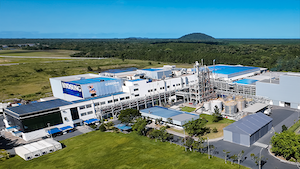
Hyosung Brazil Facility.
The expansion establishes a global manufacturing footprint for Hyosung’s personal hygiene spandex business, with production that will now span South Korea, China, India, Turkey and Brazil. Together, these facilities enable Hyosung to better serve both global and regional customers with greater manufacturing flexibility, improved supply chain resilience, and localized support.
The Brazil expansion brings production closer to customers throughout the Americas, providing shorter lead times, faster response times, and potential savings through reduced logistics, duties, and taxes. In addition, the Hyosung’s local manufacturing and technical teams will collaborate more closely with customers to accelerate product innovation, enhance quality, and respond more quickly to evolving market needs.
“The expansion of our Brazil facility marks another important milestone in building a global manufacturing network for our personal hygiene spandex business,” said Scott Blackadar, global leader, personal hygiene at Hyosung TNC. “By adding production in the Americas, we’re bringing manufacturing closer to our customers, enabling faster response times, greater supply chain resilience, and stronger collaboration to support innovation and meet the growing demand for high-quality personal hygiene products worldwide.”
As global supply chains continue to evolve amid geopolitical uncertainty, Hyosung’s diversified manufacturing network provides customers with greater security of supply and risk mitigation while ensuring consistent access to high-quality personal hygiene spandex.
With five personal hygiene spandex manufacturing facilities worldwide, Hyosung is well positioned to support future market growth through continued capacity investments, ensuring customers have access to reliable, high-quality supply as demand for personal hygiene products continues to increase.
REMSCHEID, Germany — July 30, 2026 — With the new type 6020 ceramic oiler, Barmag is introducing a powerful addition to its product portfolio for processing PA6 and PA6.6 yarns. The solution is specifically designed for low-titer applications in the range of 5 to 100 denier.
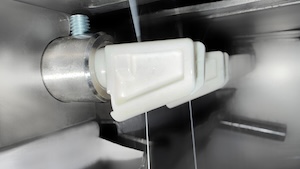
Designed specifically for PA6 and PA6.6 applications: The new Barmag Type 6020 ceramic oiler.
Technological advancement for stable processes
A key feature of the new model is the particularly filament-friendly yarn inlet area, where the yarn is saturated with oil before it comes into contact with the ceramic — a prerequisite for fluff-free processing. The three-waves geometry also ensures minimal yarn contact.
The integrated ceramic shaft completes the design — unlike other solutions, where metal shafts are glued in place — and eliminates typical sources of error such as clogged oil lines or ceramic parts falling out. In combination with optimized thread guidance, the geometry of the 6020 ceramic oiler ensures uniform and efficient spinfinish application with minimal spray-off and very high application uniformity (low OCV).
Significant quality and efficiency advantages
The new ceramic oiler was specifically developed for demanding production environments and offers significant practical advantages. It ensures consistently high yarn quality through stable process parameters such as high spinfinish application rate (OPU) and a good distribution uniformity (OCV), while also enabling filament-friendly processing without yarn breaks or loop formations. Thanks to the significantly reduced spray-off — especially in the sensitive low-titer range — material losses are minimized, oil contamination of the quench and winding areas are reduced to a minimum, and process reliability is increased. Furthermore, the solution stands out for its ease of use: A clearly visible and easily accessible thread guide facilitates threading, while precise adjustment options allow for quick and reliable setup during operation.
Successfully tested in practice
Initial applications at international customers demonstrate the performance of the new oiler. In tests with PA6 / PA6.6 POY yarns, completely spray-off-free processing and significantly more uniform yarn tension were achieved. Furthermore, an increase in the spinfinish application rate of approximately 23% was achieved compared to standard solutions. Its performance was also confirmed in applications with PET POY fulldull and very critical flatyarn: In a direct comparison of various suppliers, the 6020 nozzle was the only solution to deliver a stable performance without any loops or BF. With the 6020 spinfinish nozzle, Barmag offers a forward-looking solution for low-titer applications in filament production. The integrated ceramic shaft, combined with optimized yarn guidance and excellent process parameters, enables a sustainable improvement in yarn quality, process reliability, and production efficiency
KINGSTON UPON HULL, UK— July 30, 2026 — Luxinar has expanded its femtosecond laser production to meet growing demands for reliable supply. With Pulsecore® femtosecond lasers, this means stable, predictable delivery within 3-4 months, even as volumes increase. This helps system integrators and machine builders to reduce project risk, maintain production schedules, and secure long-term availability for critical projects.
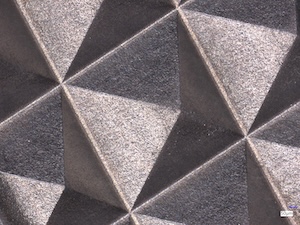
Low material loss with diamond laser cutting
“For many system integrators, delivery reliability has become a critical part of project success,” said Stefan Hackl, CEO of Luxinar. “Our investments in manufacturing capacity, application support, and continuous product development enable customers to access high-performance femtosecond laser technology with the predictable lead times they need to keep projects on track.”
To support increasing demand, Luxinar continues to invest in both femtosecond technology development and production capacity. Backed by decades of industrial laser manufacturing experience, these investments help ensure long-term availability, application support, and a reliable supply of high-performance femtosecond lasers. Following the recent launch of the Aionis ultrafast laser, ongoing validation has demonstrated even stronger real-world performance than originally specified, achieving more than 100 W of output power and pulse durations below 350 fs. Combined with a predictable 3–4 months delivery time, this gives customers access to a high-performance industrial femtosecond laser platform without extended lead times.
Fast validation backed by application expertise
Reliable femtosecond integration starts with fast, proven application validation. That’s why Luxinar has strengthened its application capabilities – expanding its femtosecond expertise with additional testing capacity in Europe, including established labs in Germany and a dedicated smart lab in the UK equipped with cameras that provide live-streamed laser processing, instant feedback from applications engineers and real-time adjustments.
This gives faster access to sample testing and process validation, helping them confirm feasibility earlier, reduce integration risk, and accelerate the path to production. With stable and repeatable performance, Pulsecore® femtosecond lasers ensure future customers move from testing to production with confidence.
Industrial femtosecond processing for demanding applications
Pulsecore® femtosecond lasers are available at 515 nm, 1030 nm, and the unique 1950 nm wavelength. By selecting the appropriate wavelength, material interactions can be tailored for surface processing, sub-surface features, or processing through transparent materials – ablation, cutting, drilling or material modifications. The distinctive 1950 nm wavelength opens new possibilities for advanced applications that are difficult to achieve with conventional ultrafast laser wavelengths.
Delivering high-precision results across multiple industries
Aionis femtosecond lasers have been engineered for demanding industrial applications that require exceptional precision, reliability, and around-the-clock operation. They enable high-quality micromachining and material processing across a broad range of applications, including:
Semiconductor manufacturing
Microelectronics processing
Glass & ceramics processing
Diamond processing
SiC processing
Thin foil cutting
Photovoltaic production
Medical device and biotechnology applications
These represent some of the most common femtosecond laser applications, with many additional opportunities supported through Luxinar’s application development expertise.
Designed for continuous industrial operation
Built specifically for 24/7 industrial use, Aionis combines advanced functionality with robust reliability. Key features include:
Reliable continuous operation in industrial environments
Tunable pulse duration down to < 350 fs and up to picoseconds
Excellent pulse-to-pulse and power stability
Laser power up to 100 W
Advanced operating modes such as pulse on demand and bursts
This unique combination of performance, flexibility and reliability makes Aionis an ideal solution for manufacturers seeking the highest levels of precision and productivity in ultrafast laser processing applications.
A partner built for continuity and flexibility
For many system integrators, relying on a single femtosecond laser supplier has become an increasing risk – especially when project timelines depend on stable availability. Evaluating a second, reliable source is therefore a logical step to secure long-term continuity.
With Pulsecore® femtosecond lasers, Luxinar offers a proven laser platform backed by expanding production capacity, strong European support, and growing application expertise. In addition to femtosecond lasers, Luxinar supports manufacturers with nanosecond and CO₂ laser technologies, enabling broader application coverage and future technology flexibility within a single supplier relationship.
This allows manufacturers to validate applications earlier, reduce dependency on a single supplier, and increase supply-chain resilience. The result: more flexibility in sourcing decisions, lower delivery risk, and greater confidence to keep projects on track.
WEINHEIM,, Germany— July 31, 2026 — Effective July 31, 2026, Freudenberg Performance Materials (Freudenberg), a leading global manufacturer of technical textiles, has acquired Foshan United Medical Ltd. (UMT).
The sellers are UMT founder Dr Xiaodong Wang and a private Chinese founding partner. UMT is a leading full-service supplier of advanced wound care products. The company with headquarters and state-of-the-art production facilities in Foshan, China, has a workforce of some 200. The parties have agreed not to disclose the purchase price.
Dr. Andreas Raps
“Freudenberg Performance Materials and Foshan United Medical are a perfect strategic match. Going forward, the merger will enable us to offer a unique portfolio of technologies and products as an innovative full-service supplier in the market for advanced wound care”, Dr. Andreas Raps, CEO of Freudenberg Performance Materials, commented.
Dr. Xiadong Wang, CEO and founder of UMT, underscored: “The innovative strength and high level of customer orientation characteristic of both our companies make for an ideal fit, they are the cornerstone for expanding our success.”
State-of-the-art technologies and regulatory know-how
UMT has state-of-the-art technologies at its disposal. Core competencies range from fiber manufacturing or functionalization to nonwoven production and final packaging, sterilization and marketing authorization.
UMT’s regulatory know-how, successful international first approvals for products as well as patents granted in China, Europe and the USA are another key element for expanding the healthcare business of Freudenberg Performance Materials.
With the UMT takeover, Freudenberg Performance Materials can cover all important steps in the value chain in-house, and thus offer one of the broadest technology platforms in the market for advanced wound care. In future, the company will provide a wide range of solutions for different applications: dressings made of polyurethane foam, with silicone coatings or antimicrobial agents such as silver. Alginate-based absorbent fiber solutions, chitosan- and CMC-based wound dressings supplement the portfolio. The broad technological foundation unlocks comprehensive options for individual adaptation and enables tailormade solutions for customers all over the world.
FRANKFURT AM MAIN, Germany — July 30, 2026 — Messe Frankfurt is expanding its international textile network with the launch of Prefab, a new boutique-style sourcing event dedicated exclusively to high-quality fabrics. Taking place January 19-20 2027 at the Altman Building in New York City, the event will bring selected Supima member fabric mills together with senior designers, fabric directors, product developers and sourcing decision-makers from premium and luxury brands.
With a carefully curated exhibitor line-up and a targeted visitor approach, Prefab is designed to create a focused business setting in which material quality, expertise and meaningful exchange take priority over scale.
Prefab introduces a compact format for the North American market. Instead of a conventional trade show, it places fabrics and expertise at the center. A uniform, design-led presentation gives each mill equal visibility and supports focused discussion, comparison and relationship-building.
A dedicated platform for one of the world’s finest cottons
Supima is the association representing producers and manufacturers of SUPIMA®, the premium cotton brand made from extra-long staple Pima cotton grown in the United States. SUPIMA® is internationally recognised for exceptional fibre quality, durability, softness and colour retention. Through its network of member mills and global brand partnerships, Supima has become one of the textile industry’s leading quality initiatives.
Prefab will demonstrate how Supima member mills transform these exceptional fibre qualities into premium fabrics for luxury apparel – from shirting and tailoring to denim, knits and innovative textile constructions.
“New York is one of the world’s most important fashion markets and the right place for a deliberately selective format,” says Jennifer Bacon, VP Fashion and Apparel of Messe Frankfurt, Inc. “Prefab brings outstanding Supima member mills together with the people making material decisions for leading brands – in a focused setting for expertise and long-term partnerships. It is the best-of-the-best approach”
Exhibiting reserved exclusively for Supima member mills
Only Supima member fabric mills will be eligible to exhibit at Prefab. The premiere will feature approximately 40 selected exhibitors. Participation will be curated for consistent quality and relevance, while the visitor campaign will target senior professionals responsible for design, fabric development, sourcing and purchasing.
The collaboration combines SUPIMA’s member network with Messe Frankfurt’s international textile expertise, market reach and event competence. It aims to create productive connections between mills and brands and support business opportunities based on quality, innovation and responsible product development.
“Supima is built on the expertise of its member mills and partnerships with brands that value exceptional cotton,” says, Buxton Midyette, VP Marketing & Promotions, Supima. “Prefab gives this community a dedicated platform to present craftsmanship and innovation and connect directly with the decision-makers shaping future collections.”
A design-led environment at the Altman Building
The Altman Building will host the premiere of Prefab. Its distinctive setting supports the compact, design-led concept, enabling focused presentations and undisturbed conversations. Exhibitors will be presented on equal footing: quality, not stand size, will define their presence. Being located in the heart of New York City’s garment industry will make the show conveniently located for most brands, retailers and designers.
New York and Milan: two distinct formats, one strategy
Prefab forms part of Messe Frankfurt’s development of curated formats for the high-end apparel textile market. In Europe, Value Milan will debut from February 3-5, 2027, at The Mall in Porta Nuova, connecting selected international manufacturers with the European fashion market. Prefab takes a focused North American approach, dedicated entirely to SUPIMA cotton and reserved for Supima member mills.
“With Value Milan and Prefab in New York, we are strategically expanding our global textile portfolio with highly focused formats that complement our established trade fairs,” says Olaf Schmidt, Vice President Textiles & Textile Technologies at Messe Frankfurt. “At the same time, we are strengthening the international Texpertise Network, creating new business opportunities and bringing together the right market players in the right environment.”
MÖNCHENGLADBACH, Germany— July 30, 2026 — Since its market launch, the CL-X has firmly established itself in blowroom lines worldwide. Hundreds of installations confirm its ability to deliver superior cleaning efficiency, lower waste, higher productivity and significant energy savings. Now, new customer applications show that the CL-X not only continues to excel in spinning preparation – it is also entering a completely new field of application: ginning.
Opening up new potential in ginning
The CL-X enables significantly more effective fiber recovery.
Cotton gins perform the very first industrial processing step of cotton. Seed cotton arrives directly from the field and must be dried, cleaned and separated into three components: cotton fibers, cotton seeds and waste. While the cotton fibers are pressed into bales for spinning mills, the waste fraction is sold separately – often still containing a considerable share of usable fibers.
In conventional ginning processes, this waste can contain up to around 0,8% good cotton fibers. These fibers still have value, but they are transported and sold in mixtures with trash, resulting in lower prices and unnecessary logistics costs. This is where the CL-X comes into play.
Installed directly downstream of the ginning machine, the CL-X enables significantly more effective fiber recovery. Thanks to its precise cleaning action, usable fibers are separated more efficiently from trash before shipment. The result: higher fiber yield, less waste volume – and greater economic value from the same amount of raw cotton.
Success story from Brazil
A Brazilian customer has now successfully implemented this concept. In a ginning operation processing around 500,000 tons of cotton per year, approximately 65% – or 65,000 tons – is typically separated as cotton seeds and waste during the cleaning process. Within this portion, approximately 4,000 metric tons (or 0.8%) of the waste consists, among other things, of high-quality fibers that should be separated, as they would otherwise be lost at this stage of the process.
By integrating the CL-X into the ginning process, the customer was able to further separate the ginning waste, splitting it into real waste and usable fibers that can be recovered at this early stage. This resulted in a significantly higher share of high-quality, marketable fibers, which in turn reduced the amount of waste that needed to be transported. In addition to lower logistics costs, the customer benefits from substantially better prices for the recovered fibers.
Convinced by the results, the Brazilian ginnery has already placed follow-up orders for four additional CL-X machines for its ginning operations – a strong endorsement of the concept’s economic and technological potential. This application clearly demonstrates how CL-X performance can create added value well beyond the spinning mill.
Confirmed excellence in spinning preparation
The CL-X creates value beyond the spinning mill.
While the ginning application highlights the CL-X’s versatility, new results from spinning mills further confirm its leadership in established use cases.
In Vietnam, a customer compared the CL-X with the previous pre-cleaning solution under identical production conditions. The CL-X reduced waste by approximately 0.5% to 0.8% in total while simultaneously improving yarn quality. These improvements led to enhanced efficiency on the customer’s rotor spinning operations, reduced material loss and a more consistent yarn output. At the same time, power consumption dropped by around 40%, resulting in substantial energy savings, lower operating costs and a clear sustainability benefit. The customer reports high satisfaction, particularly with the machine’s operational stability and output quality.
Equally impressive results were achieved at a Turkish spinning mill processing 100% cotton at 1,100 kg/h. Replacing a competitor machine with the CL-X led to 80% less waste, around 30% lower energy consumption and noticeably higher yarn quality downstream. In addition, the blowroom operation became more stable and efficient. Where two machines had previously been required, one CL-X now handles the cleaning task alone, setting a new benchmark for both productivity and simplicity. Encouraged by these results, the customer has already decided to upgrade its blowroom line with further CL-X machines.
Smart technology, strong cleaning performance
Pre-Cleaner CL-X: Delivering outstanding cleaning efficiency across diverse applications.
The technological foundation for these results in spinning preparation and ginning is the CL-X’s advanced cleaning concept. At its core is the proven WASTECONTROL system, which continuously monitors trash content and raw material quality by using real-time data. When too many good fibers are detected in the waste, the system automatically suggests an optimized setting to minimize fiber loss – ensuring consistently high cleaning performance and maximum fiber yield across varying conditions.
One machine, multiple opportunities
From spinning preparation to ginning, the CL-X once again proves why it has become a benchmark in cotton cleaning. Its ability to deliver measurable economic, quality and sustainability benefits – even in entirely new applications – demonstrates the strength of its underlying concept and how smart pre-cleaning technology continues to unlock new potential along the entire cotton value chain.
ZÜRICH, Switzerland — July 28, 2026 — In 2025, global shipments of new short-staple spindles and open-end rotors increased by +3.3% and 3.5%, respectively (year-on-year). Deliveries of long-staple spindles decreased by -42%. The number of draw-texturing spindles delivered dropped by -23% and shuttle-less looms shipped by -28%. Shipments of large circular knitting machines deteriorated by -13% and shipped flat knitting machines registered a -22%-decrease. The sum of all deliveries in the finishing segment slightly rose by +8%.
These are the main results of the 48th annual International Textile Machinery Shipment Statistics (ITMSS) just released by the International Textile Manufacturers Federation (ITMF). The report covers six segments of textile machinery, namely spinning, draw-texturing, weaving, large circular knitting, flat knitting, and finishing. A summary of the findings for each category is presented below. The 2025 survey has been compiled in cooperation with more than 200 textile machinery manufacturers representing a comprehensive measure of world production.
Spinning Machinery
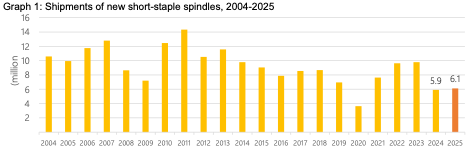
The total number of shipped short-staple spindles increased by 195K units in 2025 to a level of 6.11 million (see Graph 1). Most of the new shipments went to Asia & Oceania (95%) where deliveries grew by 8.5% compared to 2024. Shipment to Africa, Europe (incl. Türkiye), and South America decreased by -46%, -33%, and -19%, respectively. Deliveries only increased for destinations in North and Central America (+264% to 77K). The six largest investors in the short-staple segment were China, India, Bangladesh, Indonesia, Uzbekistan, and Pakistan.
645K open-end rotors were shipped worldwide in 20254. This represents about 50K units more than recorded in 2024. 94% of global shipments went to Asia & Oceania where deliveries increased by +9% to 607K. China, India, and Vietnam were the world’s 3 largest investors in rotors and saw increased investments of +4%, +12% and +17%, respectively. Deliveries increased in all major destination countries except for Türkiye and Bangladesh, the 6th and 7th largest destinations in 2025, where shipment dropped by -78% and -55% compared to 2024.
Global shipments of long-staple (wool) spindles decreased to 90K units in 2025 (-31%). This negative effect was driven by suppressed deliveries to Asia and Oceania where 76K units were shipped, about 55% of 2023’s deliveries. 46% of total deliveries were shipped to China, 19% to India, and 16% to Iran.
Texturing Machinery
Global shipments of single heater draw-texturing spindles (mainly used for polyamide filaments) decreased by -21% from nearly 83K units in 2024 to 65K units in 2025. With a share of 97.6%, Asia & Oceania remained the strongest destination for single heater draw-texturing spindles in 2025. China, Indonesia, and Chinese Taipei were the 3 main investors in this segment with shares of global deliveries of 92%, 2%, and 1.4%, respectively.
In the category of double heater draw-texturing spindles (mainly used for polyester filaments), global shipments decreased by -22% to a level of 743K units. Asia’s share of worldwide shipments remained at 98% and China continued to be the world’s largest investor, accounting for 93% of global shipments.
Weaving Machinery
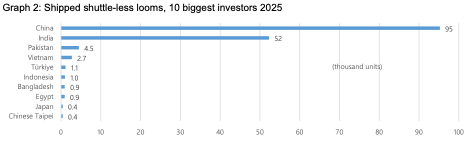
In 2025, global shipments of shuttle-less looms decreased by -27.5% to 164K units. Deliveries in all categories decreased. Air-jet looms dropped by -6%, rapier and projectile looms by -18%, and water-jet looms by -38% to 54.6K, 20.5K and 88.5K, respectively. The main destination for shuttle-less looms was Asia & Oceania with 95% of worldwide deliveries. 98%, 89%, and 98% of global air-jet, rapier/projectile, and water-jet looms were shipped to the region, respectively. The main investor in air-jet and water-jet looms was China (see Graph 2), where shipment decreased by -32% (air-jet) and -57% (water-jet). The main investor in Rapier and projectile looms was India, with a 21% increase in deliveries in 2025.
Circular & Flat Knitting Machinery
Global shipments of large circular knitting machines decreased by -13% to 24.5K units in 2025. Asia & Oceania was the world’s leading investor in this category with 86% of global shipments. China was the favoured destination with 53% of all deliveries (11.7K units), an increase of +9% compared to 2024. India and Vietnam ranked second and third destinations with 4.1K and 1.8K shipped units, respectively.
The number of shipped electronic flat knitting machines decreased by -21% to 106K machines in 2025. The fall was driven by Asia & Oceania, which received 93% of world shipments, despite ordering 24% less machines compared to 2024. Deliveries to all other regions increased. China remained the world’s largest investor with an 66%-share of total shipments.
Finishing Machinery
In the “fabrics continuous” segment, the number of shipped stenters increased by +3% from 2.2K units in 2024 to 2.3K units in 2025. This number includes an estimate for the total number of stenters shipped by companies which have not participated to the ITMF survey. Participating companies reported mixed results for all other machines in this category (decrease of -75% for Singeing lines and an increase of +24% for Mercerizing lines). In the “fabrics discontinuous” segment, the number of “Overflow Dyeing” shipped in 2025 increased by -30% to 2.9K units. Deliveries of “air jet dyeing” and “Jigger Dyeing / Beam Dyeing” dropped by -0.6% to 902 units and 28% to 269 units, respectively.
Posted: July 28, 2026
Source: International Textile Manufacturers Federation (ITMF)
SINGAPORE— July 28, 2026 — Niber Technologies, Southeast Asia’s first industrial-scale manufacturer of PFAS-free electrospun nanofiber membranes, today announced the appointment of Jochen Lagemann as Chief Commercial Officer (CCO), effective 1 August.
Jochen Lagemann
Following the recent announcement of its strategic ingredient branding initiative, Niber is now taking the next step in executing that vision. Lagemann’s appointment strengthens the company’s commercial leadership as it prepares to scale global adoption of its ingredient brand.
He brings more than 25 years of international experience building and scaling ingredient brands across the performance apparel and textile industry, with deep expertise spanning apparel brands, garment manufacturing, advanced materials, and global commercial development.
“Earlier this month, we shared our vision of building a structured ingredient brand around our electrospinning platform,” said Jaemin Park, Co-founder of Niber Technologies. “Bringing Jochen on board is the next logical step in turning that vision into commercial reality. His experience in scaling ingredient brands will help us build lasting partnerships and establish Niber as the preferred technology platform for the world’s leading performance brands.”
“With the strategic foundation for our ingredient brand now established, the next priority is execution,” added Richard Beck, President of Niber Technologies. “Jochen’s appointment brings exactly the commercial leadership we need to translate our technology platform and brand strategy into long-term partnerships with the world’s leading performance brands. This is the natural next step in building the market presence and industry trust we set out to create.”
As part of the appointment, Niber is establishing its first European presence in Munich, Germany, where Lagemann will be based to lead engagement with brand, manufacturing, and value-chain partners globally.
Strategic commercial leadership
Jochen Lagemann brings a rare combination of experience across performance textiles, advanced materials, and ingredient branding, complemented by first-hand expertise on both the garment manufacturing and brand sides of the value chain. Building on a proven track record of scaling ingredient brands through strategic partnerships, he will own Niber’s global commercial growth, defining and executing commercial strategy, sharpening product positioning, and leading go-to-market execution. Through strategic account development and the build-out of the sales organization across priority international markets, Lagemann will drive Niber’s establishment as a leading ingredient brand in its category.
Commenting on his appointment, Jochen Lagemann said: “What attracted me to Niber is that the company is thinking beyond developing an exceptional material — it is building the foundations of a true ingredient brand. That requires more than great technology; it requires trust, strong partnerships, and a clear value proposition across the entire value chain. My role is to translate Niber’s electrospinning platform into lasting commercial relationships with global brands and establish it as a recognized benchmark for next-generation PFAS-free performance materials.”
OBERTSHAUSEN, Germany — July 28, 2026 — Stylish, functional, and efficient to produce – spacer fabrics are the all-arounders among textile materials. These versatile fabrics are particularly in demand in the sports and casual footwear sector, as they combine comfort, breathability, and design freedom. At the same time, this industry is trend-driven, dynamic, and price-sensitive like few others. Innovations are therefore a decisive factor for success.
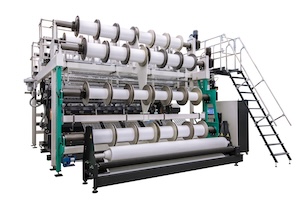
With the RDJ 7/3, KARL MAYER offers a solution specifically tailored to these requirements. The particular strength of the new double raschel machine: its exceptional flexibility, thanks to its three jacquard bars.
Three Jacquard bars for unique design options
At the heart of the RDJ 7/3 are three split Jacquard bars with the option for working counter-lapping – a configuration that offers significantly greater design potential. The main new features are:
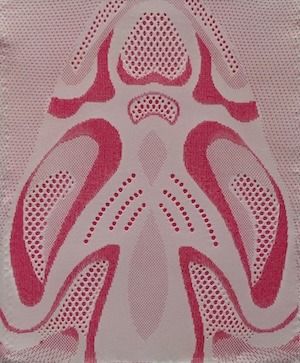
Mesh designs with nearly perfectly round and even larger holes
Integrated patterns and functional zones that can be realized with significantly more varied contours and variations.
As before, the mesh structures continue to be manufactured on one or both sides of the fabric.
More Color, More Dynamism, More Attention
The RDJ 7/3 also sets new standards in coloring. Equipped with three Jacquard bars, it enables freely designed Jacquard patterns with two-color effects and creatively colored pattern variations. Up to six different colors in a wide variety of combinations and design areas ensure maximum versatility and exciting visual effects.
Multidimensionality and Embossing Effects Directly into the Fabric Faces
Another highlight of the machine is the ability to integrate subtle raised and recessed structures and embossing directly into the surface. To create these innovative 4D effects, the third Jacquard bar incorporates an extra yarn into the pile area in accordance with the pattern, in addition to the monofilament. The additional yarn provides as a core variant with elastane fibers stretch, or thanks to its special structure greater shrinkage. Wherever it is placed, the high between the fabric sides is reduced, creating a variety of multi-layer designs that open up new applications for the fabric.
A total of eight bars for pile formation ensure a high degree of structural and material flexibility in the creation of the spacing area.
Versatile Applications – From Shoe Uppers to Mattresses
Thanks to its wide product range, the RDJ 7/3 is ideal for producing spacer fabrics for shoe uppers and mattress covers. The machine truly shines wherever comfort, breathability, different mesh structures on the face and back, or attractive embossed effects are required.
Technical Specifications and Practice-Oriented Features
The RDJ 7/3 is available with a working width of 138″ and a gauge of E 24. The trick plate distance can be easily and flexibly adjusted between 2 and 5 mm, enabling the production of fabric thicknesses for a wide range of applications.
The wireless Jacquard system provides additional ease of use. It simplifies handling, improves visibility, and contributes to efficient machine operation. High ease of use – and thus reduced labor requirements – along with a long service life are key selling points of the RDJ 7/3 in the market.
The most important performance highlight, however, is the machine‘s unbeatable design flexibility.
Thanks to its high production speed and fabric quality, it is ideally suited for high-volume business.
SEATTLE, WA — July 28, 2026 — The Biomimicry Institute recently released the completed case studies from its Nature of Fashion: Design for Transformation initiative, a multi-year program that asked a single question: what would it take for the fashion industry to handle its own waste the way nature handles decomposition?
Every year, biological systems on Earth build and break down an estimated 100 billion tonnes of cellulose1, the essential structural material of plant life, as a routine part of how ecosystems function. The global fashion industry, by comparison, produces around 110 million tonnes of textile fiber a year and discards almost the exact same amount – most of it destined for landfill, incineration, or informal dumping grounds far from where it is made. Nature treats breakdown as the start of a new cycle; fashion treats it as the end of the line.
These three case studies map a different path, one the initiative calls a shift from take-make-waste to break-down to build-up.
In Ghana, The Or Foundation’s work centers on environmental justice and ecological accountability at Kantamanto Market, one of the world’s largest secondhand clothing hubs. Their documentation of the Korle Lagoon ecosystem offers a community-grounded account of what happens when the fashion industry’s discards concentrate in a single place, and what the lagoon’s own biological systems are already revealing about the limits of the current model.
In the Netherlands, Circle Economy has coordinated a hub of innovators, including BioFashionTech, EV Biotech, TNO, and ErdoTex, around a staged pathway that routes hard-to-recycle textile waste through enzymatic hydrolysis, fermentation, and gasification, producing usable outputs including biodegradable PHA bioplastics.
In Germany, the Beneficial Design Institute has developed processes that transform mixed textile waste into biocompatible materials, including PHB via bacterial fermentation, designed to break down safely in soil, water, human body and beyond.
“Decomposition is the piece missing from the circular economy conversation,” said Asha Singhal, Director of Nature of Fashion at the Biomimicry Institute. “In nature, decomposition is what actually closes the loop, turning one process’s discards into the next process’s raw material. Fashion doesn’t have an equivalent step yet. These pilots are early, real attempts to build one in, not as a fallback once recycling hits its limits, but as a parallel strategy from the start.”
Amanda Sturgeon, CEO, The Biomimicry Institute
“Nature has been refining decomposition for 3.8 billion years, and it treats breakdown as the beginning of the next cycle, not the end of the last one. What these three pilots show is that fashion can do the same. The technology exists, the biology exists, and our job now is to make sure the industry designs for transformation from the start.”
Katia Osei, Head of Environmental Justice, The Or Foundation
“At the heart of Accra lies Kantamanto Market, one of the world’s largest hubs for secondhand clothing remanufacturing and recirculation. The market provides a critical service of giving clothing a second life within a broken fashion industry built on overproduction, planned obsolescence, and exploitative trade flows. The compounded crisis of overflowing textiles in a city with an under-resourced linear waste management system makes it clear that nature pays the ultimate price, however, the area’s microbial communities are evolving to metabolize synthetic polymers once thought indestructible, turning a site of crisis into an unprecedented Living Lab.”
Pro. Friederike von Wedel-Parlow, Founder and Director, Beneficial Design Institute
“The Nature of Fashion: Design for Transformation initiative embodies the Beneficial Design Institutes vision of positive fashion,” said Prof. Friederike von Wedel-Parlow, Founder and Director of the Beneficial Design Institute. “Germany, Europe’s largest fashion market with a 64% textile collection rate, provides ideal conditions for this transformation. 250 biotechnology firms, deep circular economy expertise, and established textile infrastructure position the region to uniquely pioneer Europe’s future.”

 SEOUL, South Korea — July 29, 2026 — To further strengthen its global production network and reinforcing its commitment to providing reliable, localized supply for customers around the world, Hyosung TNC, a producer of spandex for the personal hygiene industry, announces the expansion of spandex production for personal hygiene products at its manufacturing facility in Brazil. Production is expected to commence by early fourth quarter of 2027 with an expanded capacity of up to 3,000 tons per year.