BRUSSELS — January 21, 2021 — The world’s largest textile and garment technology showcase, ITMA will continue to present and share innovative manufacturing technology and materials with the industry at its 19th edition in Milan. ITMA 2023 will feature the theme, “Transforming the World of Textiles.” It is supported by four sub-themes: advanced materials, automation and digital future, innovative technologies, and sustainability and circularity.
Ernesto Maurer, president of CEMATEX, the European Committee of Textile Machinery Manufacturers, which owns the ITMA exhibition, elaborated: “ITMA 2023 will highlight innovations and new approaches that serve as catalysts to inspire and help textile and garment manufacturers grow their business, scale and sustain their transformation journey.”
“We are in the midst of the 4th Industrial Revolution that is filled with business and technological advances, hence, transformation is even more critical for the continued success of the textile and garment industry. Speed and agility are also of the essence to effectively tackle the ecological and medical challenges that we face today.”
Charles Beauduin, chairman of ITMA Services, which organizes ITMA, added: “As the world’s leading exhibition, ITMA offers the industry an unrivalled platform to present and share industry innovation and to collaborate with other stakeholders. As the Covid-19 pandemic has adversely affected the business environment, we will be monitoring the situation closely, mindful about the importance of health and safety of all participants and staff. At the same time, we will be launching several initiatives to create additional opportunities to help our exhibitors better connect and do business with potential customers. We will be announcing the new initiatives and enhancements to ITMA 2023 very soon.”
He continued, “ITMA was successfully held in Milan in 2015 and strong response is expected when the exhibition returns to Milan. We welcome all to visit the new ITMA 2023 website to get the latest updates on the exhibition. Please mark your calendar to join us for the ITMA 2023 virtual launch which will be held live on Facebook and YouTube on 28 January 2021.”
ITMA 2023 will be held from 8 to 14 June at Fiera Milano Rho, Milan. Space application will open on 3 March 2021. Interested participants can visit www.itma.com to get details. For participation inquiries, please email: application@itma.com.
The last ITMA exhibition, held in Barcelona in 2019, featured exhibits from the entire textile and garment making value-chain, including raw materials and fabrics. It drew a record-breaking participation of 1,717 exhibitors from 45 countries and visitorship of almost 105,000 from 136 countries.
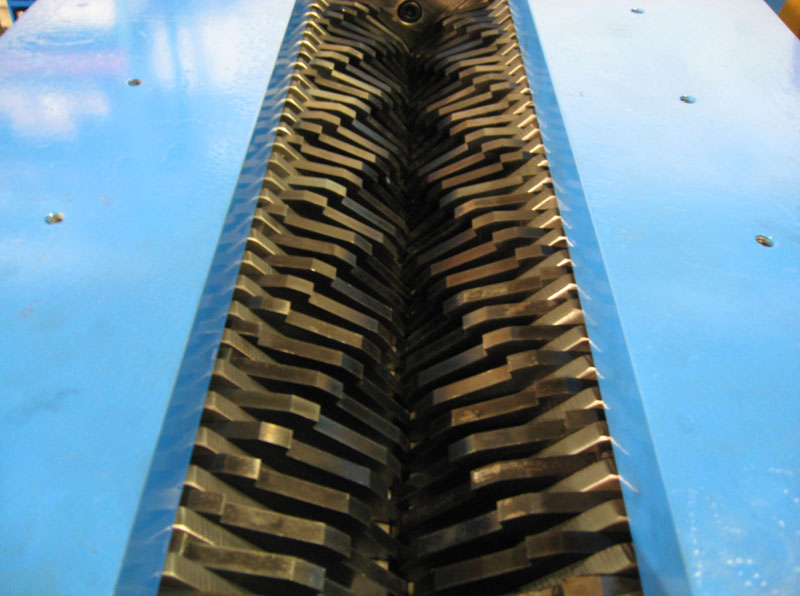
A new shredder technology from BCA Industries is enabling recyclers to simultaneously shred, chip and size on-site, speeding production and reducing manufacturing input and processing costs.
A new shredder technology is enabling recyclers to simultaneously shred, chip, and size on-site, speeding production and reducing processing costs
By Del Williams
Traditionally, recyclers have shredded paper, fibers, textiles, carpet, mattress, and plastic products, followed by granulating them to a size suitable for further processing and use as a recovered manufacturing input.
However, the cumbersome process of shredding, screening, and grinding such materials to size with different equipment in separate processes has not only been inefficient but also a bottleneck to processing.
Now, for the recyclers of a wide range of paper, fiber, textiles, carpet, mattress, and plastic products, industry innovation has developed a much more efficient alternative: A shredder knife technology that can cut, screen, and size in a single pass with one machine on-site.
Because the sizing of reduced scrap can be specified, uniform, and even tailored to suit the manufacturing process, more material can be successfully processed by recyclers with less labor, boosting profits. Shipping costs are also reduced for scrap transported off-site to buyers since any voids — empty spaces — within the container are minimized.
In addition to these materials, the knife system design effectively shreds and sizes a wide variety of others including rubber, wood, copper wire, aluminum, fiberglass, and even garbage and batteries.
Since the knife technology simultaneously does the work of both a typical shredder and granulator, it is also more energy efficient and takes less space on the production floor. The technology is flexible enough to be incorporated into the smallest to largest recycling, shearing and grinding equipment.
Conventional Equipment Limitations
For decades in recycling, the reduction of large paper, fiber, textile, carpet, and mattress scrap or unusable product has usually involved shearing equipment such as dual or quad shaft shredders. To further decrease size, this is typically followed by the use of grinding machinery such as granulators, stone mills, tub grinders, or chippers.
Screeners are often used at various points, which decreases processing speed. As an example, a standard dual shaft shredder typically turns shredder material into strips and requires the use of a re-screening device to reduce the material to a specific size, says Doug Bartelt, president of Milwaukee, Wis.-based BCA Industries, a developer and manufacturer of industrial shredding and recycling equipment.
According to Bartelt, conventional shredders like this are usually used in conjunction with granulators. A single shaft granulator is a simple device consisting of a knife, or multiple knives, attached to a shaft which mates with a stationary bed knife. Material is randomly chopped and continues to be cut until small enough to fit through a sizing screen in the bottom of the machine.
“Both the shredder and granulator create various sized material,” Bartelt said. “Usually, this is determined by a random event in how the material is fed into the system in terms of speed, timing, etc., which results in about 40 to 50 percent incorrectly sized material. So, efficiency on either of these systems only approaches around 50 percent.”
Efficiently Reducing Scrap to Size
Seeking a better way to size scrap material like paper, fiber, textiles, carpet, and mattresses, Bartelt and his brother discovered a more efficient way to size without a screen. The insight was developed into BCA’s patented Triplus knife system technology, which changes a standard shredder to a hybrid between a dual shaft rotary shear shredder and a single shaft granulator.
The approach uses the precision grabbing action of the high torque, dual shaft shredder to cut the width of the material, while the bed knife design of the shredder sizes the length. This is accomplished in one operation, which produces accurately sized material in one pass without a screen. The end-product size is based on the size and geometry of the knives.
Unlike traditional equipment, the knife system is capable of shredding, chipping, and sizing any kind or size of material in a single pass without utilizing a screen. A shredder utilizing this design can produce over 85 percent correctly sized material in one pass with less than 10 percent oversized material, according to Bartelt.
With the knife system, a recycling operator just specifies the chip size needed, and it produces chips in the specified size. The design works with wet or difficult to screen materials, and clean cuts those that normally create fines and dust. With a traditional system, fines and dust must be air vacuumed away, and are considered undesirable for many reasons.
Functionally, for recyclers looking to streamline paper, fiber, textiles, carpet, and mattress scrap processing, the knife system increases efficiency and throughput that surpasses the typical granulators, hammer mills, chippers, and quad shaft shredders used in the industry.
By eliminating separate equipment and steps to shred, screen, and grind scrap to size — and combining this into a single function — the manufacturing process is expedited.
Another factor increases production output for recyclers: The revolutions per minute (rpms) of the knives can be adjusted to the load needed for optimal production efficiency. Unlike typical shredders that tend to operate at low speed and high torque, BCA shredders using the knife design can be operated at high speed and low torque for higher production speeds. When more torque is required for anything tougher to grind like large mattresses, the system automatically provides the rpms necessary; it then readjusts to the higher speed, lower torque setting for faster production within seconds.
Additionally, the knife system can reduce scrap to the appropriate size with much less energy than typical shearing and grinding equipment. Power efficiency approaches 150 percent over any standard shredder or granulator.
As an example, with this technology, a 50-horsepower single pass shredder can produce the same amount of recyclable product per hour as a standard 100-150 horsepower conventional system. This can reduce recycler energy costs by $1,500-$5,000 per month while producing a more consistently sized product, ready for cost-effective transport to a purchaser.
The technology is flexible enough to be installed in any size shredder that BCA builds, from 10 HP to 800 HP, from 15” x 12” cutting chamber to 48” x 72” cutting chamber, in both stationary and portable units.
Recyclers needing to reduce the size of paper, fiber, textile, carpet, and mattress scrap, plus a wide variety of other materials, have long resorted to overly complex in-house shredding, screening, and grinding processes as well as costly shipping to customers.
With industry innovation, however, recyclers now have the ability to quickly and efficiently cut these scrap materials to size onsite. This has the potential to both simplify production and reduce shipping costs to boost the bottom line.
Editor’s Note: Del Williams is a technical writer based in Torrance, Calif. For more information about BCA’s shredder knife technology, contact 414-353-1002; 414-353-1003 fax; john@bca-industries.com; www.bca-industries.com.
TOKYO — January 21, 2021 — Teijin Ltd. announced today that it has established the European Sustainable Technology Innovation Center (ESTIC) in Arnhem, Netherlands, as a research and development facility tasked with developing technologies for a more sustainable world.
As a research and development hub for Teijin’s environmental-value solutions, ESTIC will facilitate collaboration among researchers across borders to strengthen development initiatives in Teijin’s various business units. ESTIC will also undertake the challenge of developing all-new businesses that leverage the lifecycle capabilities of Teijin’s core materials and the development of green materials to support the global circular economy. This includes efforts to reduce CO2 emissions and to stimulate the hydrogen economy.
ESTIC will also establish a satellite office at Brightlands Chemelot Campus, an international open-innovation community active in performance materials, sustainable processes and biomedical solutions in Sittard-Geleen, Netherlands, to further activate communication with external innovation communities and research institutes.
Teijin, aiming to be a company that supports the society of the future as well as the United Nations Sustainable Development Goals (SDGs), looks forward to ESTIC contributing to the development of sustainable products and technologies that help to lower environmental impact.
Since the signing of the Paris Agreement, the world has come to recognize decarbonization as an urgent global task, based on which the agreement’s signatory nations have declared their respective national goals to realize carbon neutrality. Teijin declared its long-term goals for reducing environmental impact in the company’s 2020-2022 management plan, entitled ALWAYS EVOLVING, that was announced in February 2020. The company is now pursuing growth and development in line with these goals. Teijin also supports the United Nations Global Compact as well as the SDGs through measures such as developing environmental solutions for a more sustainable world.
Under Teijin’s medium-term management plan to continuously create accurate business opportunities and accelerate market development, the company is prioritizing initiatives to strengthen internal and external collaboration, further diversity and inclusion, and fast-track innovation, ultimately to support the company’s development of innovative products and services.
NEW YORK CITY — January 20, 2021 — Fit for Life announces it has added adidas and Reebok to its world-class portfolio of brands. adidas and Reebok join Fit for Life’s already impressive portfolio of active brands including Gaiam, SPRI and Tommie Copper.
Fit for Life is the market leader in small, at-home fitness gear at popular retailers including Dick’s, Amazon, Target, Walmart and Kohl’s. Its brands and product lines continue to experience strong growth and resonate with consumers as they increase their practice of at-home health and wellness routines. RFE Sporting Goods recognizes Fit for Life’s success and credibility among top-tier active brands and is proud to partner on distribution for adidas and Reebok fitness equipment.
“RFE is excited to partner with Fit for Life, a proven company, with deep relationship across the US market,” said Dean Jackson, CEO of RFE Sporting Goods. “The Fit for Life expertise along with RFE products and brands is a strong recipe for success.”
Fit for Life is eager to begin innovating with adidas and Reebok brands, creating new products to meet the growing demand for at-home fitness and wellness.
“Adding adidas and Reebok to our portfolio of brands will be a powerful way to continue to penetrate the market and expand into new categories,” said Joey Shamah, co-founder and CEO of Fit for Life. “RFE’s trust and partnership is a true testament to our market knowledge and respected position in the industry.”
The distribution deal between RFE Sporting Goods and Fit for Life kicked off on January 1, 2021 and will quickly bring real value to consumers across the United States.
NEW YORK CITY — January 20, 2021 — S&S Activewear and Clayton, Dubilier & Rice (CD&R) announced a new partnership in which CD&R-managed funds will invest alongside current owners and management to acquire S&S, a North American distributor of imprintable apparel and accessories. The terms of the transaction were not disclosed.
With approximately four million square feet of warehouse space and more than 2,000 employees, S&S specializes in distributing blank sportswear, corporate apparel, and accessories, including T-shirts, fleece & sweatshirts, headwear, athletics and outerwear from more than 100 leading brands such as adidas, Champion, Columbia, Bella+Canvas, Next Level Apparel and Gildan. The company stocks more than 80,000 products and serves a broad range of customers, including screen printers & embroiderers, promotional product distributors, e-decorators, and team dealers.
Founded in 1988, S&S has grown under the current management team and owners from a successful midwestern T-shirt and fleece distributor into an industry leader with approximately $1.5 billion in sales. S&S emphasizes speed and quality of service, having made significant investments in national distribution capacity and technology and established the largest one & two-day distribution footprint in the industry. The company has also expanded geographically with three acquisitions since 2010, including the acquisition of the largest wholesale apparel distributor in Canada, Technosport, in 2020. Today, S&S products can reach 99 percent of the U.S. and Canada population within two days, and 44 states in just one day.
The transaction is expected to close in the first quarter of 2021, at which point S&S President Jim Shannon will assume the role of Chief Executive Officer and CD&R Operating Partner John Compton, former president of Pepsico, will become chairman of the board.
“This transaction is an important milestone for S&S and a validation of our continued success; as successful as we have been over the last two decades, we believe our growth story is just beginning,” Shannon said. “CD&R has a deep understanding of our business, from sourcing, freight, and distribution center scaling to technology and sales and marketing.”
“We are delighted to partner with a talented, entrepreneurial S&S team that shares our core values in a business we know and understand,” said Ken Giuriceo, CD&R Partner. “We look forward to working together to achieve our vision for continued strong growth that creates exciting opportunities for employees, vendors and customers, as well as the local communities where they operate.”
Barclays, Deutsche Bank Securities Inc., BMO Capital Markets Corp. and Credit Suisse Securities (USA) LLC acted as financial advisors and Debevoise & Plimpton LLP acted as legal advisor to CD&R in connection with the transaction. Baird served as the exclusive financial advisor and McDermott Will & Emery LLP acted as legal advisor to S&S.
MUMBAI — January 19, 2021 — The new hybrid edition of Techtextil India poised to be held from September 1-3, 2021, at Hall 4, Bombay Exhibition Centre, Mumbai, will connect technical textile players from across the globe through its multimodal platform. The combination of physical and digital platforms will enable exhibitors to connect with wider audiences, increase their market presence and expand their business alliances significantly.
The demand for medical textiles, particularly spun bond nonwovens have skyrocketed ever since the onset of the pandemic. Geotextile products in India have also experienced a strong leap in demand supported by government’s continual investments in the development of highways and roadways. With a manifold of opportunities lying ahead for the technical textile segment, it is crucial for the players to increase their market presence and build networks to effectively leverage imminent demands.
Over the years, the editions of Techtextil India have been instrumental in uniting the technical textile fraternity and creating an atmosphere of collaboration through its physical platform. However, the new hybrid edition that is set to be held from 1 – 3 September 2021 will not only physically, but also digitally unite exhibitors from the technical textile industry with key buyers and suppliers PAN India and worldwide.
While the physical fair offers the benefit of face-to-face interaction under strict observance of safety protocols, the digital platform will help exhibitors increase their brand exposure and interact with potential buyers from across the globe via features such as live streaming, video calls, live chats and more. Live product demonstration on dual platforms will further enable exhibitors to showcase their products and new emerging technologies to a vast array of business attendees.
The hybrid fair will also make collaborative engagements extremely simple through its AI assisted platform. Potential suppliers will be automatically matched when buyers launch product or service queries, following which virtual appointments can be set-up at a mutually agreed upon time.
Organizer of the fair, Messe Frankfurt India, is also looking forward to incorporate online panel discussions and knowledge programs to impart erudite market insights and rejuvenate confidence among players across the 12 application areas of technical textiles.
Currently the Indian technical textile industry is pegged at USD 19 billion (growing at a CAGR of 12 percent since the past five years) and accounts to approximately 13 percent of India’s total textile and apparel market*. With new demands arising in the segment, the hybrid edition of Techtextil India 2021 will enable technical textile players to engage with businesses beyond geographical constraints, forge new alliances and gain specialised insights to strategically equip themselves for the new normal.
HAYWARD, Calif. — January 19, 2021 — AMETEK Surface Vision now offers remote training courses to provide safe, convenient instructions on how to get the best performance from its industry-leading online surface inspection solutions.
The online training sessions allow customers to discover all the features and benefits of the SmartView defect detection and identification system, building technical proficiency, increasing operational productivity, and maximizing system uptime.
Conducted by highly skilled, experienced professionals, the training is divided into sections for specific job functions or system components. It uses a “live” training system to reinforce the material and focus on particular customer tasks.
Each course typically consists of four-hour sessions held over three consecutive days; they are available for both US and central European office hours.
The subjects covered in the next four months are:
SmartView Fundamentals
SmartView Advanced
SmartView Maintenance and Troubleshooting
These training programs will enable those attending to achieve added benefits from their SmartView system. All that is required is a PC, an internet connection, the Microsoft Teams application, a headset, a large screen, and a webcam for class interaction.
Paul Stuyt, Global Manager of Projects from AMETEK Surface Vision said: “Our expert training courses are designed with the customer in mind, answering any questions that may arise and providing a deeper understanding of our products, systems, and applications.
“With online tuition, customers can learn how to set up their system, inspect live production, display, and report on defects and process conditions, and maintain system health. All of this without the inconvenience and safety risks associated with travel during the current COVID-19 global pandemic.
“For those staff members working from home, there’s no reason for their training and development to stop. We continue to provide everything they need to achieve optimum SmartView performance for their processes.”
RIJEKA, Croatia — January 20, 2021 — An award-winning developer and provider of Biocrystal® technology, BC Tech company launches Biocrystal fabric layer, a multipurpose stress-relief layer, as much needed product upgrade for all bedding and furniture manufacturers.
Performance fabric from Biocrystal® confirmed to relieve stress
With scientifically tested and confirmed properties coming from Biocrystal powder already implemented into the fabric, the Biocrystal fabric layer announces a new era of performance fabric layers.
Being easily implemented into bedding and/or furniture products, the Biocrystal fabric layer provides to an end-customer reduced level of stress, faster relaxation, reduced muscle tension, and increased oxygen level as measured effectiveness.
The Biocrystal fabric is a multipurpose stress-relief layer produced on polyethersulfone (PES) base composition with Biocrystal Powder implemented by printing process with 176g/m2 weight and it is washable.
Minimum effort to implement
Whit its super-easy implementation, Biocrystal fabric requires minimum effort by manufacturer, requiring only to be inserted as the inner sewn layer, placed together with other layers of the end-product.
“Deciding to implement Biocrystal fabric layer into your product, you decide to offer your customers a much-needed stress-relief experience. This was our idea when creating Biocrystal fabric — to offer an easy yet provenly efficient way for manufacturers to upgrade their products, and respond to the most common problem of customers today — stress,” said Vesna Pavletic, CEO at BC Tech.
A webinar on new expectations from Bedding and Furniture industry
BC Tech is organizing a webinar on Wednesday, January 27 to discuss the new demands put in front of the bedding and furniture industry, considering increased stress problems and stress-relief demands coming from the customers. Register https://bit.ly/2LHxhSx and find out how you can easily yet cost-effectively provide an anti-stress treatment through your products using Biocrystal solutions.
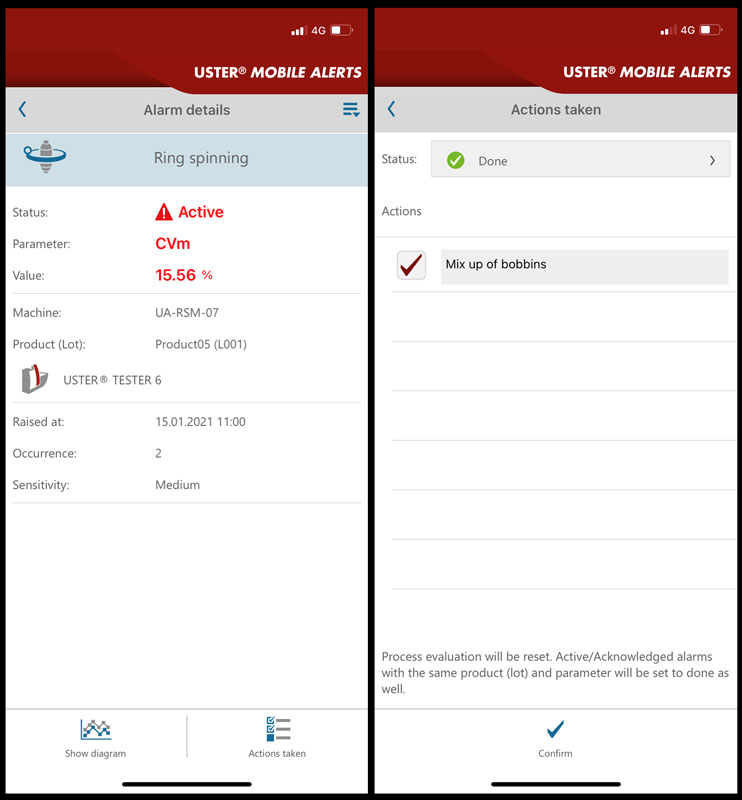
USTER, Switzerland — January 20, 2021 — A push notification appears on Muhammad Ashraf’s mobile phone. It reports that there is a variation in the CVm level at his mill. Ashraf calls his foreman to inform him, so he can take immediate action. The problem is quickly identified and fixed — thanks to the Alarm Center function with Uster Quality Expert. It gives round-the-clock monitoring of vital processes in the mill, and keeps management constantly informed of any issues.
In the case outlined here, the fault was rapidly pinpointed to a mix-up of bobbins at the Sangzor spinning mills in Uzbekistan, where Ashraf is general manager. Ashraf has been using the Uster Mobile Alerts app for three months. Sangzor exports yarns to Pakistan, Turkey, Russia and China, and all its customers naturally expect to receive exactly the quality they specified. Ashraf knows the value of quality in keeping customers satisfied. It’s a top priority, so he likes to be informed of any deviations — whether at his desktop in the mill or on his mobile phone when he’s out.
The value of staying connected
Spinners around the world share a combination of requirements: controlling quality through immediate actions, while improving productivity and minimizing waste. Uster understands this need — and has responded with the Alarm Center, one of five Value Modules included with Uster Quality Expert. The Alarm Center prompts early intervention in quality issues. Key processes are monitored, and performance is displayed on a dashboard. It allows spinners to recognize problems at a glance, enabling immediate reactions.
Smart algorithms and in-built Uster Application Intelligence ensure reliable alerting. The Application Intelligence embedded in Assistant Q can immediately recognize issues, with no need for configuration by the spinner. Users receive problem-solving suggestions, and can also expand the knowledge base with actions they enter themselves. The learning system grows according to customer needs and ensures that relevant know-how is retained in mills.
The Alarm Center is also available on a mobile app, for quality management that is independent of time and location. There is no limit to the number of app users with one Quality Expert system. Mobile Alerts can be used by as many staff as required, to suit the mill’s organization of processes and responsibilities. Since the launch of the standalone version of Uster Quality Expert, the community of Uster Mobile Alert app users has grown more rapidly. Uster Quality Expert Standalone connects Uster quality testing and monitoring instruments and leverages their value towards significant profitability gains. With the new standalone version, a relatively small investment means cotton spinners can quickly optimize quality and profitability at the same time.
Alerts – negative, positive and customized
Mobile Alerts shows critical issues and the Alarm Center provides negative alarms as well as positive ones. That means it points out quality issues but also suggests potential improvements. Ashraf says: “I very much appreciate the positive information, as improvement is part of the game. If you don’t improve you will stay behind.” With the latest release of Uster Quality Expert, alarms and improvements are listed separately for fast focus on serious issues — and for making quality managers easily aware of so far unnoticed improvement possibilities.
The mill for which Ashraf is responsible started operation 14 months ago with almost all new machines. He’s sure that the Mobile Alerts app will become even more important to him over time, as parts begin to show the first signs of wear. But he is already feeling the benefit of the app, especially for its performance, design and user-friendliness.
The facility to preselect which alarms to receive is another well-appreciated feature of Quality Expert. Users can customize and activate or deactivate the kind of alarms, or the area of events, they want to get as push messages.
Make it a better life for spinners
Before the introduction of Uster Mobile Alerts, it was more difficult for spinners to see alarms. Now, quality management has become both safer and easier, as issues can be identified and located immediately. Problem-solving guidance is also another popular feature, as the app proves its worth across different staff groups, such as lab personnel, maintenance managers and all who share responsibility for professional quality supervision.
“Thanks to Uster quality assurance systems, textile spinning gradually becomes easier,” Ashraf says. “I enjoy Uster Quality Expert. It gathers and analyzes our online and offline results and keeps sending quality alerts and exceptions with possible root causes displayed graphically on my mobile phone 24/7 — and it’s good news that Uster Quality Expert expands its insightful analytics with valuable intelligence as each additional instrument is connected.”
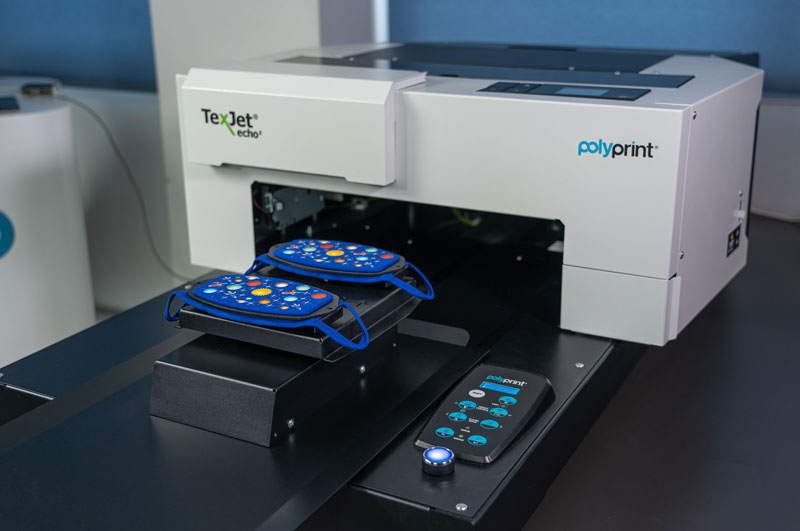
THESSALONIKI, Greece — January 14, 2021 — Polyprint, a specialized direct-to-garment printer manufacturer, announced the creation of a new addition to its product portfolio — the 2-IN-1 ‘Fit & Flat’ Snap-On, face mask platen.
Garment decorators can now broaden their printing portfolio with personalized face masks. Polyprint’s 2-IN-1 face mask platen allows TexJet users to print on both Fit and Flat type masks. Dtg printers can now use one main platen with two different set-up options: The Fit type for triangular masks and the Flat type for flat masks. It’s also simple to swap from Fit to Flat upon their production needs.
“It’s snap-on design allows easy placement and quick runs. Created due to popular customer demand, Polyprint aims to improve the dtg printing market by pushing forward with new products that help DTG businesses stay at the top of their game.” said George Benglopoulos, CEO of Polyprint.
The new face mask platen is compatible with TexJet® echo2, shortee2 and echo. Users will require to perform a Firmware upgrade, as well as a Software update in order to obtain the new Cadlink face mask templates.
Snap-on Face Mask Platen
1 main platen
2 Flat type plates for flat masks
2 Fit type plates for triangular masks
Easy to swap between the two
Simple to replace, due to its snap-on design
Compatible with TexJet® echo2, TexJet® shortee2, TexJet echo