Gerald Vogt Becomes New CEO Of The Stäubli Group

Gerald Vogt

PFÄFFIKON, Switzerland — December 10, 2020 — Stäubli, a global supplier of industrial and mechatronic solutions, is starting the new year with a new CEO. Gerald Vogt, previously responsible for the global business of the Robotics Division, will take over as CEO from Rolf Strebel on January 1, 2021.

With Vogt, an experienced manager from within the company’s own ranks will take over the management of the diversified and growing family-owned company. The 50-year-old Franco-German engineer and business economist has been responsible for the global Robotics business as group division manager since mid-2016 and is already a member of the Group Management.

When he joined Stäubli almost 20 years ago, Gerald Vogt initially moved from the development and production site in Faverges, France, to the United States for several years. As division manager he significantly expanded business for Stäubli Robotics North America. Afterwards he returned to Faverges as head of development before taking over responsibility for the German business as head of Stäubli Robotics in Bayreuth.

To ensure a smooth transition and prepare for his future tasks as CEO, the Stäubli Board of Directors nominated Vogt as the designated successor to Rolf Strebel at the beginning of 2020. Since then, Vogt has accompanied the current CEO and is responsible for the introduction and implementation of the new business strategy for Stäubli until 2030.

“We are delighted to have found in Gerald Vogt a forward-looking manager with an extensive international experience and a clear entrepreneurial spirit who is already very well connected within the Group. He has our full confidence to further advance the business of the entire Stäubli Group worldwide,” said Yves Serra, chairman of the board of directors.

“On behalf of the entire board of Ddirectors and the Stäubli family, I would like to take this opportunity to thank Rolf Strebel for more than 40 years of dedication to Stäubli and his outstanding work as CEO of the Stäubli Group over the past 14 years. We wish him all the best for the time ahead,” Serra added.

Christophe Coulongeat will assume the global responsibility for the Robotics Division on January 1, 2021. The French manager has been Deputy Division Manager since 2018 and previously gathered extensive experience in the packaging and automation industry in France, Austria, the United Arab Emirates and Switzerland.

With this succession in management, Stäubli is setting the course to consistently pursue its growth and further expand its market position worldwide, especially in North America and Asia.

Posted December 10, 2020

Source: Stäubli International AG

National Council of Textile Organizations (NCTO) Welcomes Expected Nomination Of Katherine Tai As New U.S. Trade Representative

WASHINGTON — December 10, 2020 — National Council of Textile Organizations (NCTO) President and CEO Kim Glas issued a statement today welcoming the reported selection of the House Ways and Means Committee’s Chief Trade Counsel, Katherine Tai, as the next U.S. Trade Representative (USTR).

“We applaud President-elect Joe Biden’s expected nomination of the House Ways and Means Committee’s Chief Trade Counsel, Katherine Tai, as the next U.S. Trade Representative. This selection is welcome news to the U.S. textile industry, which has worked closely with Katherine on several critical trade issues over the years.  She is an exceptional candidate to serve as the next USTR, having dedicated her career to enforcing our trade laws, and, most recently, serving as a key lead negotiator in the House securing key improvements in the USMCA agreement.

She will be a powerful and thoughtful advocate on behalf of American workers and our environment.  The U.S. textile industry looks forward to working with her on our top trade priorities.”

Posted December 10, 2020

Source: National Council of Textile Organizations (NCTO)

GE Renewable Energy Announces US Blade Recycling Contract With Veolia

SCHENECTADY, N.Y./BOSTON — December 8, 2020 — GE Renewable Energy announced today that it has signed a multi-year agreement with Veolia North America (VNA) to recycle blades removed from its U.S.-based onshore turbines during upgrades and repowering efforts. Through this agreement, GE plans to recycle the majority of blades that are replaced during repowering efforts.

Veolia will process the blades for use as a raw material for cement, utilizing a cement kiln co-processing technology. VNA has a successful history of supplying repurposed engineered materials to the cement industry. Similar recycling processes in Europe have been proven to be effective at a commercial scale.

As a part of the agreement, blades that have been removed from turbines will be shredded at VNA’s processing facility in Missouri and then used as a replacement for coal, sand and clay at cement manufacturing facilities across the US. On average, nearly 90 percent of the blade material, by weight, will be reused as a repurposed engineered material for cement production. More than 65 percent of the blade weight replaces raw materials that would otherwise be added to the kiln to create the cement, and about 28 percent of the blade weight provides energy for the chemical reaction that takes place in the kiln.

Anne McEntee, CEO of GE Renewable Energy’s Digital Services business, said “Sustainable disposal of composites such as wind turbine blades has been a challenge, not only for the wind turbine industry, but also for aerospace, maritime, automotive and construction industries. VNA’s unique offering provides the opportunity to scale up and deploy quickly in North America, with minimum disruption to customers and significant benefit to the environment. We look forward to working with them on this effort to create a circular economy for composite materials.”

Wind turbine blades may be replaced through turbine improvement or ‘repowering’ efforts, when specific elements of the turbine are upgraded to improve the efficiency and lifespan of the turbine, without replacing the entire machine. Longer, lighter blades help the turbine to generate more energy every year, providing even more renewable energy to their end customers.

Bob Cappadona, COO for VNA’s Environmental Solutions and Services division, said “By adding wind turbine blades — which are primarily made of fiberglass — to replace raw materials for cement manufacturing, we are reducing the amount of coal, sand and minerals that are needed to produce the cement, ultimately resulting in greener cement that can be used for a variety of products. Last summer we completed a trial using a GE blade, and we were very happy with the results. This fall we have processed more than 100 blades so far, and our customers have been very pleased with the product. Wind turbine blade repurposing is another example of Veolia’s commitment to a circular economy and ecological transformation in which sustainability and economic growth go hand in hand.”

VNA employs 20 people from the area at the Missouri processing facility, which is located about 70 miles northwest of St. Louis.

An environmental impact analysis conducted by Quantis U.S. found that the net effect of blade recycling through cement kiln co-processing is positive in all categories. Compared to traditional cement manufacturing, blade recycling enables a 27 percent net reduction in CO2 emissions from cement production and a 13 percent net reduced water consumption. In addition, a single wind turbine blade that weighs 7 US tons recycled through this process enables the cement kiln to avoid consuming nearly 5 tons of coal, 2.7 tons of silica, 1.9 tons of limestone, and nearly a ton of additional mineral-based raw materials. Largely due to the avoided coal consumption, this type of blade recycling also has a net-positive environmental impact in the categories of human health, ecosystem quality, and resource consumption. The resulting cement has the same properties and performance as cement manufactured using traditional means, meeting all applicable ASTM standards.

Recycling decommissioned wind turbine blades into cement production will aid the cement industry in its efforts to decarbonize. Likewise, GE Renewable Energy is committed to reducing environmental impacts throughout the life cycle of its products, including by announcing an ambitious pledge in 2019 to decarbonize its operations and achieve carbon neutrality by the end of 2020. GE Renewable Energy’s businesses are regularly partnering up with other leaders across the value chain to drive innovation for improved sustainability.

Posted December 9, 2020

Source: GE Renewable Energy/Veolia North America

Toray Advanced Composites And Joby Aviation Finalize A Long-Term Supply Agreement

MORGAN HILL, Calif. — December 9, 2020 — Toray Advanced Composites announces that it has completed a long-term supply agreement with Joby Aviation for the composite material used for its aircraft. The California-based aircraft company will use Toray’s carbon fiber composite materials to bring fast, affordable, and zero-emissions aerial ridesharing to global communities.

Electric aircraft require proven materials that have high-strength and are very lightweight. Carbon fiber composite materials provide the strength-to-weight ratio needed for electric aerospace applications in order to maximize the range and speed of the aircraft. Every aspect of Joby’s aircraft is being optimized for maximum utilization for urban transport and high-quality carbon fiber materials are a key component of achieving their goals. Joby selected Toray Advanced Composite materials due to their proven heritage of meeting mechanical and safety requirements in aerospace and high-performance automotive applications.

JoeBen Bevirt, Founder and CEO, Joby Aviation, said: “Toray’s prepreg carbon fiber systems provide unparalleled specific strength and toughness, which have enabled Joby to develop aircraft with unprecedented capabilities. We are incredibly proud to be working with Toray as we certify this aircraft, and look forward to building a long-lasting partnership.”

Joby will operate an affordable, quiet, and clean transportation service, using the revolutionary all-electric, vertical take-off and landing aircraft it has spent the last decade developing. With a range of up to 150 miles and a top speed of 200 mph, the vehicle and the service has the potential to make a significant difference to the lives of travelers. Carbon fiber materials are used throughout the vehicle structure, propulsion systems, and interior components.

“We are very pleased to have finalized this important supply agreement with Joby Aviation, a pioneer in the development of the eVTOL,” said Toshiyuki Kondo, CEO, Toray Advanced Composites. “As children, we dreamed of being able to fly to a destination in a fraction of the time it would take to drive. That is no longer a fantasy. The electric air taxi is becoming a reality and we at Toray are perfectly positioned to meet the industry’s needs today and in the future. It’s a very exciting time.”

Joby Aviation has spent more than a decade developing its aircraft and plans to bring it into commercial operation as early as 2023. By combining years of development with a world-class team and now a leading carbon fiber composite supplier, Joby is well-positioned to deliver on the promise of aerial ridesharing.

Posted December 9, 2020

Source: Toray Advanced Composites

Avery Dennison Advances Significant Sustainability Actions In 2020

GLENDALE, Calif. — December 9, 2020 — Avery Dennison Corp. today announced a series of recent actions that further acknowledge its accelerated sustainability efforts, ending the year with continued progress against its 2025 sustainability goals and re-committing to its role as a sustainability leader within the global value chain.

This week, the company received markedly improved scores on its transparency and actions on climate change, water, and forests by the Carbon Disclosure Project (CDP), the gold standard in environmental reporting. CDP operates a global disclosure system for investors, companies, cities, states and regions to manage their environmental impacts. Avery Dennison earned an A- on Forests and scored a B for Climate Change and for Water Security.

This achievement follows decisive positions taken in 2020 on transparency, human rights, and climate change, affirming how Avery Dennison plans to lead on these and other issues of growing importance to global communities. The company’s actions include:

  • Defining Environmental, Social, and Governance (ESG) policies and metrics as part of its ESG Download to clearly link sustainability to the company’s business strategy.
  • Publishing a policy on Human Rights, upholding the fundamental principles and requirements of basic human rights in the workplace.
  • Publishing a policy on Climate that acknowledges the imminent threat posed by climate change and the company’’s strategy to move toward a lower carbon future, aligned with the Paris agreement and the recommendations of climate scientists. The company has already achieved significant progress to realize its climate goal, reducing absolute greenhouse gas emissions by more than 44% through the third quarter of 2020 against its 2015 baseline, which exceeds the initially set target of a 26% reduction by 2025.
  • Publishing a policy paper on Water that acknowledges the strategic value of water as a vital resource to ensure the health of communities, businesses, and supply chains.
  • Updating commitments to Responsible Paper Procurement reflective of the company’s role as a significant stakeholder in the supply chain of pulp and paper products and its role in promoting and providing sustainable and socially responsible paper products.

Significantly, in 2020, Avery Dennison also took steps to align with the United Nations’ blueprint for a more sustainable future. In November, Avery Dennison joined leading companies and stakeholders globally as a signer of the U.N. Global Compact, the world’s largest voluntary corporate citizenship initiative. The company’s responsible business practices, values, and commitments are embodiments of the Compact’s ten universal principles in the areas of human rights, labor, environment and anti-corruption.

In addition, Avery Dennison aligned its own eight 2025 sustainability goals more strategically against the UN Sustainable Development Goals adopted by 193 countries as a plan for ending extreme poverty, reducing inequality, and protecting the planet by 2030.

“The global challenges of 2020 have shown unequivocally the importance of pursuing—and delivering — sustainable business practices and corporate actions that will lead to more resilient communities and business enterprises,” said Deon Stander, vice president and general manager, Retail Branding and Information Solutions, and global corporate sustainability lead. “As we head into 2021, our strategies take on even more significance and we will double down on innovation, collaboration, and continuous improvement throughout our supply chain to make a meaningful difference for people and the planet.”

Posted December 9, 2020

Source: Avery Dennison Corporation

United Way & Business Leaders Launch Effort To Get Masks To Under-Resourced Schools — HanesBrands First Company To Join The Challenge

ALEXANDRIA, Va. — December 9, 2020 — United Way Worldwide is partnering with the Business Roundtable and the CDC Foundation to launch America’s Mask Challenge, an effort to underwrite and deliver 200 million washable face masks to every student, teacher and staff member in America’s most under-resourced schools.

The goal of the challenge is to get cloth masks to 40 million students, teachers and staff members at schools receiving federal Title I funding. That translates roughly to five washable masks per person. The challenge launches in mid-December, to expedite mask delivery for the second half of the school year. President-elect Joe Biden vowed yesterday to safely reopen most schools in his first 100 days.

While in-person instruction varies across the country, one thing is certain: masks matter. According to the Centers for Disease Control and Prevention (CDC), cloth masks in schools can help slow the spread of the coronavirus, along with other mitigation strategies like hand-washing, social distancing and regular cleansing and disinfecting of frequently-touched surfaces in schools and buses.

Keeping students, teachers and staff safe requires adequate resources. A typical school district with about 3,700 students needed about $1.8 million to reopen this fall, according to some estimates. That covers cleaning, extra staff and masks. But many schools serving high percentages of children from low-wage families have had to scramble for essential supplies. Schools in high-poverty districts are historically underfunded, and low-wage families can’t make up the difference. Too often, teachers use their own resources to provide basics for America’s most vulnerable children.

“America’s Mask Challenge is an opportunity to help protect the 37 million students, 4 million teachers and school staff at 56,000 schools receiving federal Title I funding,” said United Way Worldwide President and CEO Brian Gallagher. “We have to do right by students, teachers and staff working hard to maintain critical learning during these difficult times,” he said. “Making sure they have reusable masks is part of our effort to help create equitable, safe and healthier communities for all.”

“It’s important for America’s business community to support the Mask Challenge,” said Joshua Bolten, president & CEO of the Business Roundtable. “We know that one of the most effective things we can do to protect American lives and to ensure a safe and rapid economic recovery is to wear face coverings,” Bolten said.

“Business Roundtable is proud to support this effort to protect students, teachers and staff members at America’s most under-resourced schools. Safely reopening schools is critical to protecting the mental and physical well-being of our kids. Failure to do so will widen the education gap and hurt economic livelihoods of millions of struggling families across the country.”

HanesBrands, a global marketer of branded everyday basic apparel, is the first company to join the Challenge. Hanes will produce the masks and coordinate with United Way on delivery. Hanes will also donate 25 million masks to the Challenge. “HanesBrands is a long-time partner of United Way, and we’re proud to support the Mask Challenge, with its goal of keeping America’s students, teachers and school staff members healthy,” said Steve Bratspies, CEO of HanesBrands.

“We know that safe classrooms are crucial to keeping kids from falling behind and helping our economy recover from this pandemic, yet many schools and students are struggling to get the supplies they need,” Bratspies said. “United Way is helping to make sure that schools across the country have the masks they need in 2021.” Hanes has followed CDC guidance to ensure that the masks meet appropriate safety standards.

Today’s announcement builds on contributions by other leading American companies. Ford Motor Company is targeting production of 100 million medical-grade masks through 2021 to donate across the U.S., with a focus on underserved communities. Jim Hackett, former CEO of Ford and Business Roundtable member, helped develop the Roundtable’s policy calling for nationwide use of masks earlier this year.

The CDC recommends that people, including teachers, staff, and students, wear masks in public settings as able when around people who live outside of their household, especially when other social distancing measures are difficult to maintain.

“Right now, masks are one important way, among a variety of mitigation efforts, to protect ourselves and others from COVID-19,” said Dr. Judy Monroe, president and CEO of the CDC Foundation. “And ensuring students, teachers and school workers have the masks they need is an essential element in protecting our communities. We’re pleased to join with this incredible group of corporate and nonprofit partners who are taking an important stand to Crush COVID.”

Posted December 9, 2020

Source: United Way Worldwide

Cone Denim Joins U.S. Cotton Trust Protocol Furthering Its Commitment To A More Sustainable And Transparent Cotton Supply

GREENSBORO, NC — December 9, 2020 — Cone Denim®, a global provider of denim authenticity and sustainable innovation, is proud to announce its membership with the U.S. Cotton Trust Protocol. Cone Denim joins as one of the first denim partners and a global provider of denim fabrics made from an ethically sourced and verifiable cotton supply.

Cone Denim’s participation in the U.S. Cotton Trust Protocol furthers its commitment to sustainability and transparency with continued investment in a verifiable supply chain, including Cone’s recently announced partnership with Oritain whose global technology combines forensic science and statistics to detect naturally occurring elements in the cotton itself to verify growth origin.

“As a leader in the global denim supply chain we are more committed than ever to promoting greater transparency and offering assurance to our customers and brands that Cone Denim fabrics are made with the greatest of integrity starting with cotton that is sustainably grown with lower environmental impact and greater social responsibility,” said Cone Denim President Steve Maggard. “The values and accountability of the U.S. Cotton Trust Protocol align with and complement Cone Denim’s ongoing sustainability initiatives including our pledge to the U.N.’s Sustainable Development Goals and commitment to source 80 percent verifiably sustainable cotton by 2025.”

Maggard continued: “Cone has used more than 261 million pounds of U.S. grown cotton over the last five years across our global manufacturing platform. The U.S. remains a key supply source for our cotton and the efforts and leadership of the Trust Protocol further increase the importance of cotton from this region in our journey as a responsible manufacturer and supply partner.”

As a Trust Protocol member, Cone Denim will be sourcing from participating growers and helping to drive continuous improvement among six key elements of sustainability including land use, soil carbon, water management, soil loss, greenhouse gas emissions and energy efficiency.

Mills and manufacturers who become members have access to the Trust Protocol credit system to validate consumption of cotton and associated credit. The Trust Protocol uses a combination of a unique credit accounting system and the Permanent Bale Identification (PBI) system that enables full transparency throughout the supply chain from cotton to finished product.

U.S. Cotton Trust Protocol President Dr. Gary Adams added: “One of our goals is to give brands and retailers greater confidence when including U.S. cotton in their sourcing mix. The Trust Protocol’s emphasis on measurement and independent verification can provide confidence and trust that a brand is using responsibly grown cotton and producing a product that consumers can believe in. We are delighted that Cone Denim has joined the Trust Protocol as that supports the much sought after supply chain transparency and helps us in our ambition of traceability.”

Posted December 9, 2020

Source: Cone Denim

Polyprint Establishes Polyprint USA — Its New Subsidiary In The United States

THESSALONIKI, Greece — December 9, 2020 — Polyprint, Direct-to-Garment printer manufacturer, announces the creation of its subsidiary in America, Polyprint USA Inc. on December 9, 2020.

Aiming to address the constantly growing demand for TexJet® printers in the US, the largest dtg market worldwide, the company is increasing its global footprint with Polyprint USA, based in Charlotte, N.C. This new entity will be operating fully staffed and stocked to better serve Polyprint’s current and future equipment users, generating a closer bond with its U.S.-customer base.

“We are devoted to creating a local supply chain of Polyprint products to help apparel decorators grow by offering state-of-the-art, yet affordable DTG products. Polyprint USA will be our direct link to clients by providing full access to our products, support system and ongoing educational services.” states George Benglopoulos, Polyprint’s CEO.

This expansion represents the company’s intent to continue putting customers first by extending its reach. Polyprint’s strategic growth throughout the USA with carefully selected dealers will contribute to streamlining its efficiency by delivering leading local customer support and producing business opportunities for all parties included. The company will continue its valued partnership with Ryonet, an established US textile print solution provider. Ryonet will keep on selling TexJet DTG printers throughout America.

Newly appointed CEO, Luke Ryerkerk will be heading the U.S. team. Ryerkerk is a visionary with extensive experience in both Direct-to-Garment and screen-printing technology. His mission is to strategically position Polyprint USA in a continually growing DTG market by bringing real value to clients. Polyprint USA will be selling TexJet printers, supplies and will be providing direct support to all US customers.

CEO Ryerkerk commented: “I am looking forward to helping the dtg community improve by educating passionate people. We’re here to help anyone interested in DTG technology and to support them in reaching their business goals. There is nothing more satisfying than witnessing business owners start and grow their company successfully.”

Polyprint continuous to move forward by focusing on empowering entrepreneurs to start a custom apparel business.

Posted December 9, 2020

Source: POLYPRINT S.A.

Dilo Group: Hydroentanglement Technology Cooperation With SICAM

EBERBACH
, Germany— December 9, 2020 — Dilo Group is a supplier of complete lines for nonwoven fabric production, traditionally specialized in all types of needling lines for staple fibre products as well as high speed needlelooms for spunbonds.

Another strong pillar of our sales program over decades has been fiber preparation and high speed web-forming equipment for other nonwoven technologies. During these years, there has been a shift to higher throughput rates, and in some cases in Asia, a requirement for improved MD/CD strength ratios of hydroentangled products. In addition, our further development of the high-speed layering principle “Hyperlayer” made considerable progress for better CD strength through a combination of inline cards and crossline card with crosslapper. Particularly, carding machines in a working width above 3.5 meters up to 5.1 meters have been supplied by DiloSpinnbau as complete high speed carding systems, comprising two or even three cards in a line to directly feed the hydroentangling units of various suppliers. Together with DiloTemafa not only have high throughput rates been achieved in the fibre preparation section of the line but also dedusting filtering and air-conditioning systems have been successfully engineered and integrated.

Until recently, Dilo did not supply complete lines including water-jet units, ovens and end-of-line equipment to the important hydroentanglement market segment. This has changed during the summer and Dilo is glad to confirm our partnership with Sicam, Italy. Together with Sicam, we have combined know-how for hydroentangling technology and therefore can provide complete lines as general contractor including equipment for cutting, winding and packaging.

We have been recently successful with the sale of a complete line for hydroentangled products in Portugal. The market for medical and hygiene lightweight products is booming and will require more hydroentangling capacity. On the basis of our considerable fibre preparation and web-forming know-how we are looking forward to a successful cooperation with Sicam covering the market with our related activities. Please do not hesitate to contact us for further technical details.

Posted December 9, 2020

Source: DiloGroup

Precision Textiles Launches Direct Mail Campaign Aimed At Creating A Personalized & Tactile Experience For Its Customers

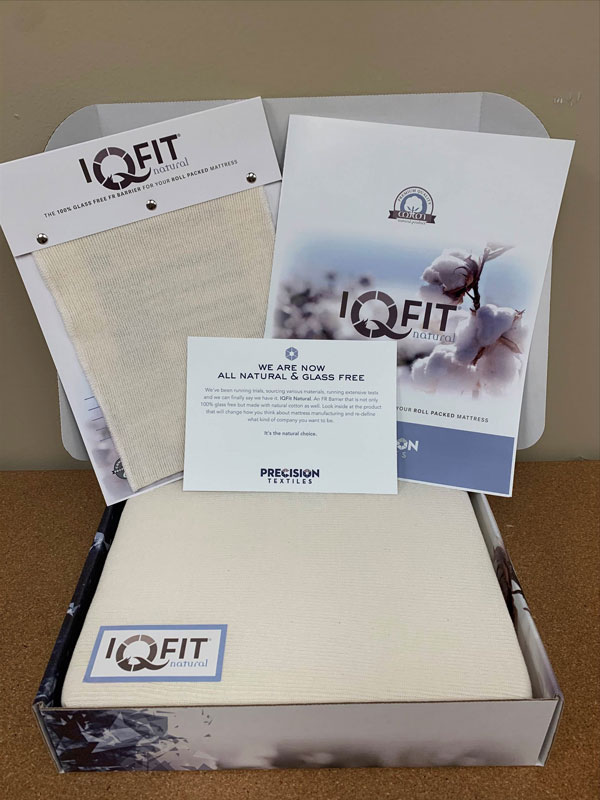
TOTOWA, N.J.— December 9, 2020 — In an increasingly digital world where our inboxes are overwhelmed with promotional offers and solicitations, Precision Textiles, a supplier of coated fabrics, nonwovens and laminations for the bedding, automotive and healthcare industries, is taking a more traditional route to its marketing communications. Developed to promote its recently launched IQFit Natural line — a 100-percent glass-free FR barrier — the classic direct mail campaign provides its partners with a tactile element, a benefit that cannot be delivered electronically. The initiative provides a hands-on resource for bedding manufacturers to utilize when specifying an FR barrier for mattress production.

Shipped in a convenient mailer with a bold visual that makes a striking comparison between fiberglass and cotton to tout IQFit Natural’s product benefits, the company anticipates the new strategy will help its partners make better-informed FR barrier sourcing decisions in an industry that is first and foremost driven by the touch and feel of the materials used.

“While a mailer may seem like a dated tactic to some, we believe that in today’s technology-driven world that people are becoming numb to the myriad of digital approaches that are delivered to their inboxes daily,” said Keith Martin, vice president of Precision Textiles. “In our business, the tactile nature of the product is incredibly significant, making this tangible medium the perfect solution. Of course, we haven’t abandoned our digital efforts. Rather, we are weaving together a combination of marketing tactics to maximize our communication efforts.”

The mailer includes a product brochure, a swatch card with product samples and a mini foam bun with an IQFit Natural FR sock applied to mimic how the product would fit around a mattress. Additional information about the dangers of using fiberglass in FR socks is also included.

IQ FIT Natural is a UL GREENGUARD Gold certified, 100 percent glass-free natural FR barrier made with sustainable, renewable cotton. The cotton delivers breathability and superb moisture wicking, is hypoallergenic and durable and its long-lasting fibers stay strong after years of use. The glass-free sock also eliminates the breakdown of fiberglass and provides bedding manufacturers with a safer FR solution that biodegrades when composted.

Each component within the sock was chosen not only for the safety of consumers but also for the safety of the environment. The sock is also free of para-aramid and antimony — both of which offer fire resistance but can cause respiratory and skin irritation — to ensure consumers receive an all-natural sleep experience.

The mailers will ship in early December. Customers interested in receiving a mailer can contact their sales representative or email info@precisiontextiles-usa.com.

Posted December 9, 2020

Source: Precision Textiles

Sponsors