We aRe Spin Dye Signs Collaboration Agreement With Hugo Boss

STOCKHOLM — May 26, 2021 — Today, We aRe Spin Dye (WRSD) AB entered into a collaboration agreement with the international premium brand Hugo Boss.

“It feels fantastic to finally be able to communicate this collaboration with Hugo Boss, one of the world’s largest fashion houses with an obvious position in high end fashion,” said Andreas Andrén, CEO of We aRe SpinDye.

Hugo Boss has a clear agenda for how they will gradually become even more sustainable. One of the company’s intermediate goals is to have reduced total water consumption by 40 percent by 2025 — where WRSD is expected to be involved and contribute with competence and technology. The long term goal for Hugo Boss is to be completely climate neutral by 2050.

Andrén continued: “We are really looking forward to starting a collaboration with an iconic brand of Hugo Boss size that has also incorporated sustainability into its core values on such a broad level.”

In November, Hugo Boss Ag entered the Dow Jones Sustainability Index (DJSI) World for the fourth year in a row. Hugo Boss is thus one of the four companies in the textile, clothing and luxury segment that have qualified for the index this year. Hugo Boss is also listed in the Dow Jones Sustainability Index (DJSI) Europe for the first time. In the assessment carried out by S&P Global, HUGO BOSS improved significantly compared with the previous year and received, among other things, the assessment “best in class” in several categories.

Posted May 26, 2021

Source: We aRe Spin Dye

Partially Bio-Based Raw Materials From Covestro For Notebooks From Moleskine®

LEVERKUSEN, Germany — May 26, 2021 — Moleskine® notebooks are replicas of the legendary notebook used by such notable people as Vincent Van Gogh, Pablo Picasso, Ernest Hemingway and Bruce Chatwin. ‪Moleskine places great emphasis on more sustainable products and manufacturing processes and has already been certified by the Forest Stewardship Council (FSC). For the covers of its ‪classic notebooks, the company relies on ‪Covestro’s advanced INSQIN® waterborne polyurethane (PU) technology for textile coating with partially bio-based raw materials. This will increase the use of alternative raw materials in the production of the PU synthetics covers.

This application focuses on waterborne PU dispersions with up to 50 percent biomass-based carbon content, reducing the CO2 footprint accordingly but offering the same good quality as fossil-based raw materials. The coating also features a premium look and feel — as befits the characteristic quality of these notebooks. Using INSQIN technology, Moleskine and Chinese PU synthetics material specialist ‪Hexin are now able to produce partially bio-based coatings for hardcover and softcover notebooks.

On the path to more circularity

“We are partnering with Covestro to perfect these high-quality, low-solvent coatings for our classic Moleskine notebook covers,” said Daniela Riccardi, the company’s CEO. “Covestro’s partially bio-based coating technology enables us to reduce our impact on the environment and improve our sustainability.”

“Working with innovative partners like Moleskine allows us to develop more sustainable materials,” explained Dr. Torsten Pohl, global head of Textile Coating at Covestro. “With our new partially bio-based raw material, Covestro allows for a total of approximately 23 percent renewable carbon in this coating, which is in line with our vision to become fully circular.”

The project is part of a global strategic program with which Covestro is fully committed to the circular economy. That’s why the company is focusing on the use of alternative raw materials and renewable energy, the development of innovative recycling technologies, and collaboration with partners along the value chains.

Posted May 26, 2021

Source: Covestro Deutschland AG

Coterie Introduces Sustainable Baby Wipes To Us Market Made Of Compostable VEOCEL™ Branded Lyocell

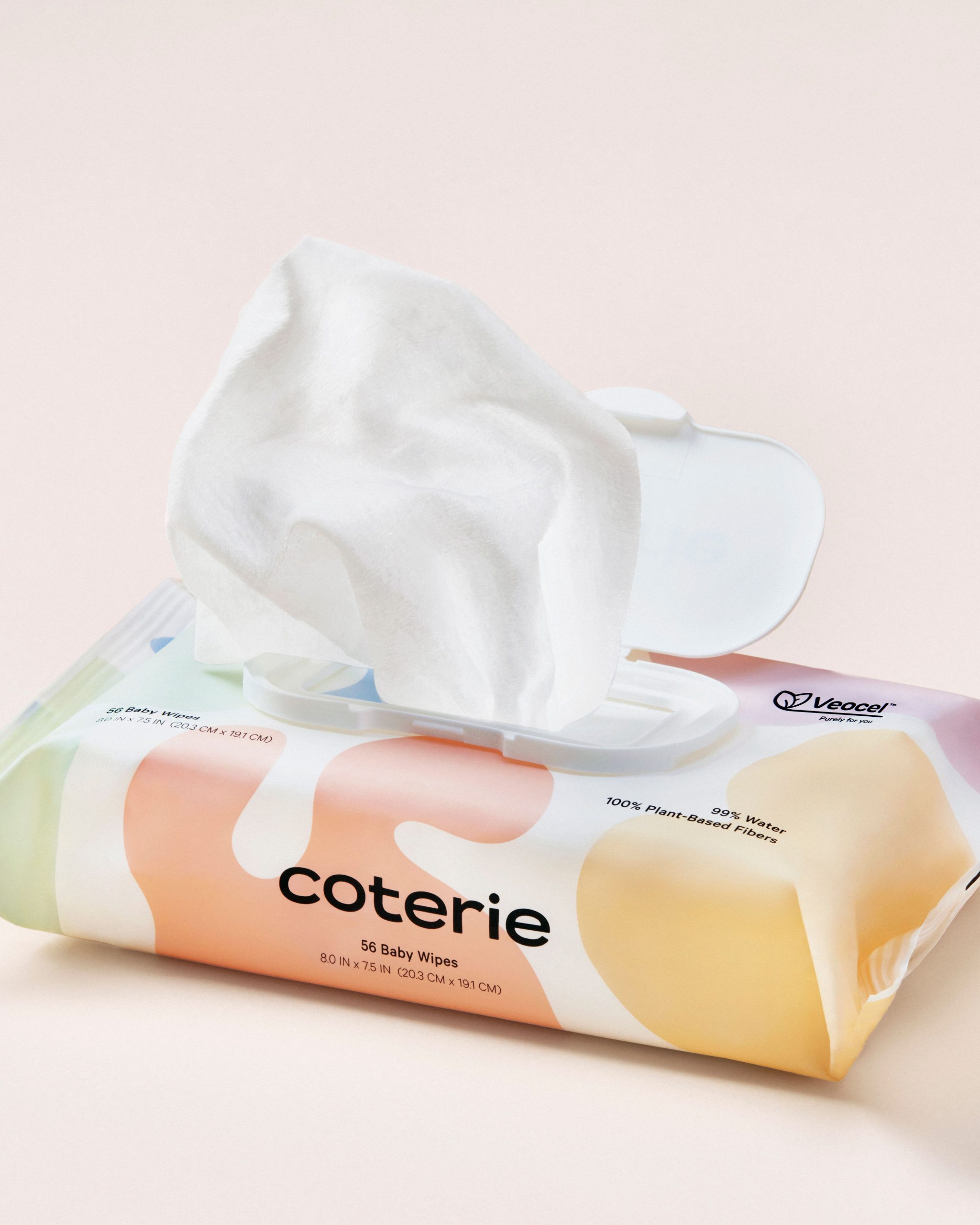
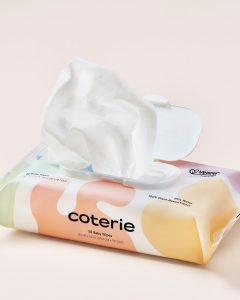
NEW YORK CITY — May 26, 2021 — Coterie, a baby care brand for the modern parent, today announced the launch of its new Wipe made from 100-percent plant-based biodegradable and compostable materials*. Designed in partnership with the VEOCEL™ brand, the Coterie Wipes, consisting of 99 percent water, are the most sustainable and the largest — up to 30 percent bigger — baby wipes on the US market.**

Following recent certification testing, they proved to be fully compostable after just a few weeks versus hundreds of years and decompose even under the toughest of conditions. By comparison, the acceptable standard for compostable products can take up to six months, and plastic-based products, like most competitive wipes, can take hundreds of years. Additionally, the new Wipes are the first-ever across the nation to be certified by the Environmental Working Group (EWG) for chemical safety, the National Eczema Association for gentleness, and TÜV-OK Compost HOME for sustainability. Coterie Wipes are available to purchase this summer, starting at $26 for a four-pack at www.coterie.com.

“Let’s face it, the process of changing diapers or cleaning up after your baby isn’t the most desirable task. Our new wipes make the process simple and efficient, all the while being gentle on babies, parents, and the planet,” said Frank Yu, founder, and CEO of Coterie. “We’re on a mission to revitalize the baby-care space while setting new industry standards for performance and sustainability. Our partnership with VEOCEL is a testament to our continued investment and dedication to sustainable innovation, and we’re proud to have designed another high-performing product that provides the perfect combination of effective cleaning, enhanced skin health, and efficiency for the environment.”

The Coterie wipes, made from environmentally responsible VEOCEL Lyocell fibers, are setting new industry standards for sustainable design. The features of VEOCEL Lyocell fibers include:

  • Natural and renewable raw material sourced from sustainably managed forests with FSC (FSC- C041246) certification.
  • A patented closed-loop production process offering precision and consistent quality combined with low environmental impact. Other materials used in wipes, such as bamboo fibers, require significant chemical processing to remove silicates and be transformed into a usable wipe substrate.
  • The cutting-edge cellulosic fibers — including natural absorbency, liquid distribution, biodegradability, and versatility — mean the fabrics show tremendous durability in both a dry and wet state.
  • VEOCEL lyocell fibers have been certified as biodegradable and compostable under industrial, home, soil, freshwater and marine conditions, thus can fully revert back to nature.

“To address adverse environmental impact brought about by the diapering industry, transparency around raw materials used in wipes is one of the key measures to ensure that consumers make informed choices about product ingredient and disposal,” said Jürgen Eizinger, vice president of Global Nonwovens Business at Lenzing AG. “We at VEOCEL are dedicated to empowering the industry with materials that can build a more environmentally friendly future together. We hope that our collaboration with Coterie will encourage consumers to take another step towards committing to a more sustainable world for our kids.”

The new wipes, made with the gentlest ingredients, effectively remove dirt and irritants while helping protect the skin’s barrier properties and natural pH balance. The wipes contain 99 percent purified water, nature’s most gentle cleanser, with 1 percent carefully selected ingredients including Vitamin E and glycerin to protect the baby’s skin further. Dermatologically tested for safety, even on sensitive or eczema-prone skin, these wipes have it all: they are safe, gentle, effective, and sustainable.

Coterie is the largest and most dense wipe on the US market. One wipe does the job of three wipes when compared to other brands. Each wipe can contain even the biggest messes, cleaning them up quickly and efficiently with one easy wipe. Their size and extra thickness mean each pack of wipes will last longer and reduce overall waste as there is less to be discarded.

Coterie has an auto-renew program where you can subscribe and save, order new wipes, change an order or ask questions via text message.

Coterie is currently the only baby wipes brand in the United States to include the esteemed VEOCEL brand logo in its packaging, an important indicator that the product is made from 100-percent cellulosic and biodegradable fiber materials. Both brands place high importance on transparency around materials and ingredients. The VEOCEL logo demonstrates Coterie as a brand which guarantees environmental consciousness, setting it apart from other baby wipes in the market. It also acts as a label of trust for eco-conscious consumers, creating an important benchmark for the industry as a whole.

* Raw Materials used in the Coterie Wipe are derived from renewable wood sources.

**considering fiber origin, process impact on the environment, close loop production cycle, compostability and waste reduction.

Posted May 26, 2021

Source: Coterie

Higgs Material Sustainability Index (MSI) Scores Validate Sustainability Performance Of Radianza™

BANGKOK — May 25, 2021 — Radianza™ — the flagship brand of gel-dyed acrylic fiber from Thai Acrylic Fibre Co. Ltd. — has received its Material Sustainability Index (MSI) scores. The results were arrived at after reviewing of the Life Cycle Assessment data of Radianza by Higg Co. and Sustainability Apparel Coalition. This makes Radianza, the first and only acrylic fiber to have MSI scores and Life Cycle Assessments.

The gel-dyeing technology behind Radianza is the key driver for its superior sustainability performance. Water pollution and water consumption are two of the biggest environmental problems facing the fashion industry and conventional dyeing processes contribute immensely towards these two problems. In gel-dyeing, the dye is absorbed in the fiber within 4 to 5 seconds with close to zero discharge of unused dye and minimum requirement of water. The LCA study of Radianza done by thinkstep shows that a sweater made with Radianza requires 30 liters less water, 25 MJ less energy and 1.45 kg CO2 equivalent lesser Global Warming potential than the one made with conventional acrylic and dyeing process.

An analysis shows that switching from conventional acrylic and dyeing process to Radianza:

  • Reduces the water scarcity potential of the fabric by 49 percent;
  • Reduces the chemistry impact of the fabric by 44 percent;
  • Reduces the global warming potential of the fabric by 7 percent;
  • Reduces the Eutrophication potential of the fabric by 19 percent; and
  • Reduces the Resource depletion potential of the fabric by 16 percent.

“We are proud to announce the Higgs MSI Scores of Radianza. This evaluation has re-assured our customers that the use of Radianza in their products will improve the acceptability among the environment conscious consumers, brands and retailers”, said Thomas Varghese – business head – Textiles business of Aditya Birla Group.

The results are expected to be officially published on Higgs Portal by July 2020.

Posted May 25, 2021

Source: Thai Acrylic Fibre Co. Ltd.

Freudenberg Shoe Components Certified To Global Recycled Standard (GRS)

WEINHEIM, Germany— May 20, 2021 — Freudenberg Performance Materials has completed the Global Recycled Standard (GRS) certification process for its shoe components manufactured in Asia. All Freudenberg Far Eastern Spunweb sites were certified by Control Union Certifications. The company is therefore an officially-confirmed supplier of sustainable shoe components. These include strobel insoles made of 100-percent recycled polyester. These insoles are lightweight and binder-free, and there is low waste from cutting.

The GRS certification recognizes the share of recycled materials in Freudenberg Far Eastern Spunweb´s eyelet reinforcements and lightweight strobels. This attestation enables the supplier to support its customers in calculating the total amount of recycled material in their shoes and in creating sustainable solutions. Freudenberg´s GRS-certified materials are widely used by leading global sport brands, especially in running and lifestyle shoes, to support functional strength.

In-house pre-consumer polyester recycling

Freudenberg Far Eastern Spunweb has been using recycled raw materials in its products since it was established in 1987. The manufacturer is one of the very few technical textile suppliers in the market to recycle polyester waste from its own production processes as pre-consumer recycled polyester, thus ensuring correct recycling records and material quality. Today, all of its materials are made from post-consumer and pre-consumer recycled polyester.

GRS certified products

Freudenberg Far Eastern Spunweb currently offers certified eyelet reinforcements and strobel insoles made from 100 percent recycled polyester and 87 percent recycled and 13 percent conventional polyester. The company plans to exclusively produce materials made from 100-percent recycled raw materials by 2023. Freudenberg mainly markets the GRS-certified shoe components in South East Asia, but Freudenberg’s global organization enables all customers worldwide to purchase these materials, regardless of the country in which they produce.

Global Recycled Standard (GRS)

GRS is an international and voluntary standard developed by Textile Exchange and managed by the non-profit organization. The standard sets the requirements for third-party certification of recycled materials and the chain of custody. GRS aims to unify the definitions of recycled materials across multiple applications, to verify the contents of recycled materials in textile products, and to provide brand manufacturers and end consumers with a tool to make informed decisions that lower environmental impact.

Control Union Certifications

With its foundation in agriculture, Control Union Certifications has focused its efforts in developing services around the sustainability of the industry’s supply chains which feed into the food, feed, forestry, biomass, bioenergy, social compliance and textiles markets. Control Union Certifications has ‘boots on the ground’ in more than 70 countries.

Freudenberg Far Eastern Spunweb

Freudenberg Far Eastern Spunweb is part of Freudenberg Performance Materials, the leading global manufacturer of technical textiles, and was established in 1987 as a joint venture between the Freudenberg Group, the Far Eastern Group and Japan Vilene Company to serve the Asia Pacific region with high-quality spunlaid nonwovens for demanding technical applications. Today, the company operates a well-established sales network including offices in Japan and China and distributors in other Asia Pacific countries. At its production sites, the company manufactures spunbond nonwovens for the automotive, carpet, shoe, construction, filter and other industries.

Posted May 25, 2021

Source: Freudenberg Performance Materials Holding SE & Co. KG

Spinnova, ECCO Leather Partner KT Trading Create Respin — A New Circular Textile Made Using Leather Waste

JYVÄSKYLÄ, Finland — May 20, 2021 — Imagine a fiber made from leather waste. This is the result of a new partnership between the sustainable natural material company Spinnova and KT Trading – the leather partner to global premium-quality shoe brand ECCO. Possessing the natural durability of leather and the light weight and feel of a traditional textile, it introduces a new category of sustainable and circular textiles that can set new standards for the industry when pilot scale production starts at the end of 2021.
The textile industry is constantly searching for new, sustainable, and circular materials. Following thorough research and testing, Spinnova and KT Trading have succeeded in developing a natural leather fabric made from leather waste without harmful chemicals.

“Leather is an amazing high-quality material with unique properties,” said Kristian Geert Jensen, CEO of KT Trading, who now has a joint venture with Spinnova. “With this new textile, we have taken yet another step towards completing the circular economy for leather.”

Spinnova CEO: Sustainable innovation at its best

Together with KT Trading, ECCO’s key leather provider, Spinnova has established the Respin company — a new joint venture. The partners are already constructing a leather fibre production pilot plant in Finland.

“We are delighted to close the leather loop with our partners,” said Spinnova’s CEO and co-founder Janne Poranen. “This is not just about upcycling, but also creating a promising new material that the industry has been waiting for. This is also a concrete example of the fact that we have a technology that can use multiple different feedstocks”

ECCO’s Applied Research division and Spinnova have been in a R&D collaboration since 2018 and have made successful trials with spinning the protein biomass into fiber. Processing leather raw material does not require further technology development from Spinnova. The company already has proof of concept from using the method on wood-based raw material.

“We have a great collaboration with ECCO and KT Trading,” Poranen added. “They both have an innovative mindset, high expertise and sustainability ambitions like us. Together, we can turn leather waste into a circular material and set new industry standards.”

KT Trading: Respin can take leather to the next level

Headquartered in Switzerland, KT Trading is an international company responsible for sourcing the raw material for leather. KT Trading is amongst the largest entities in the industry, collaborating across a global network including acting as the primary leather partner and supplier to global shoe brand ECCO.

“Our partnership with Spinnova combined with the support from ECCO gives us a unique opportunity to be frontrunners in our industry,” Jensen added. “The pioneering spirit that characterises both KT Trading, Spinnova and ECCO, continues to fuel our passion for technological innovation, and with Respin, we have made a truly unique breakthrough in the way we bring leather making to the next level.”

Posted May 25, 2021

Source: Spinnova

Sustainability Tech Platform Higg Marks Two Years; Prepares To Expand Impact

SAN FRANCISCO — May 20, 2021 — Higg, a technology platform that enables consumer goods companies to measure, manage, and share the social and environmental impacts of their value chain, today celebrates its second year since forming as a public benefit company.

After quickly becoming the apparel industry go-to for sustainability measurement, Higg is rapidly moving into new verticals, with its network of primary impact data that helps businesses understand and improve the sustainability of their entire operations.

Following a spin out from the Sustainable Apparel Coalition in 2019 and a Series A funding round, Higg invested in on-platform analytics, began offering licensed API access, and announced partnerships offering complementary assessments and data. The company is focused on developing a comprehensive platform for sustainability insights for responsible consumer goods businesses, beginning with fashion.

These technology investments have helped Higg realize significant markers of success: since 2019, manufacturer environmental scores have improved nearly 20%; Higg has broadened its reach from 20,000+ users to more than 45,000, including tens of thousands of manufacturers; and more than 500 fashion brands have committed to using its brand and retail tool. Users are completing their assessments faster, and nearly half of users have shared their results with more than one value chain partner, effectively improving transparency within the value chain. Higg has also seen financial progress and team expansion, building out its leadership team with former executives from Nike Inc. and Microsoft, and growing from 20 employees in 2019 to 73 team members today.

“As a tech company we’re able to innovate, move fast, and scale quickly to help bring solutions to our urgent climate situation,” says Higg Chief Executive Officer, Jason Kibbey. “The clock is ticking and consumer goods industries need to make more than small, independent measures to reduce their overall impact. It is time to bring holistic insights to industries, and the kinds of tools that can identify data-driven solutions within the complexity of global value chains and add up to change at scale.”

Higg delivers deep data and analytics about the social and environmental impacts of businesses’ value chain operations. By utilizing its tools and services, companies can meet environmental goals faster, mitigate value chain risks, and deliver on customer expectations. “It took 10 years and significant external pressure for the fashion industry to get where it is today, finally using data to assess and address its footprint. All consumer goods industries need to move faster to address climate change and social impact,
using sustainability data that is comparable and contextualized,” says Kibbey.

The high-quality data and analytics within the Higg platform unlock a comprehensive view of a business’ social and environmental impacts in value chain operations, from materials to products, factories to stores, across energy, waste, water, and working conditions, and deliver tools, data reports, and analytics to consumer goods industries professionals and C-Suite leaders.

“We’re at the start of what’s possible,” says Kibbey. “We started with the apparel industry, but our platform can serve other industries effectively and demonstrate that sustainable improvements are good for business. Recognizing there is no single ‘silver bullet’ and businesses are at different points in their impact reduction journeys, we’re also progressively adding new integration capabilities and data sets.”

Higg’s Impact At-a-Glance on Its Second Anniversary
● Higg represents users in 120 countries.
● Higg has seen over 70% user growth since 2019.
● There are more than 45,000 Higg users today.
● More than 500 fashion brands are committed to using the brand & retail tool.
● Manufacturer environmental scores have improved nearly 20% since 2019.
● Nearly 60,000 performance reports shared between supply chain partners since 2019.
● Factories are completing assessments faster — from 250 to 115 days.
● Nearly half of users are sharing assessments with more than one supply chain partner.

Higg is also a signatory to America Is All In, a statement from communities, businesses, and institutions calling on the Biden Administration and the U.S. Congress to prioritize a climate change agenda.

Posted May 25, 2021

Source: Higg

Davlyn Group Announces Brand Relaunch, Debuts New Logo And Website

SPRING CITY, Pa. — May 24, 2021 — Davlyn Group, technical textile company, today announced the launch of its new corporate brand identity, logo, and website. These changes align with the company’s focus on growth and fully-integrated, industry-leading offering.

“Our new look speaks to who we are as a company, how we are transforming our businesses to become even more dynamic, and reflects the unification of all Davlyn Group companies, products, and services,” said Mauricio Zavatti, CEO. “We will be retaining our individual business brands — Amatex, Darco Southern, Davlyn Manufacturing, and Norfab and their rich heritage — while emphasizing the value that Davlyn Group delivers to our global customer base.”

With the recent acquisition of Amatex and Norfab, Davlyn Group is now a vertically-integrated manufacturer of technical textile yarns, broad woven fabrics, and knitted, braided, and woven narrow products. Core markets include home appliance, personal protective equipment (PPE), transportation, hose fabrication, energy, and metals and mining.

The newly-designed website features easy-to-navigate pages, updated messaging, and allows customers to find solutions by product type, industry, or application. The site has also been optimized to be faster and provide an enhanced mobile viewing experience.

“While our customers have been introduced to the Davlyn Group name over the past few years, these changes better represent our direction and the value we deliver to customers looking for an innovative and strategic partner,” commented Jeff Zola, vice president of Marketing. “Our new logo aligns with our core business of high temperature textiles and keeping heat in its place, and the visual identity has evolved as well.”

Posted May 25, 2021

Source: Davlyn

Epson Helps Advance Digital Industrial Printing With Availability Of OEM PrecisionCore Printheads

LOS ALAMITOS, Calif. — May 24, 2021 — Epson America today announced it is making its proven MEMs thin-film piezo inkjet printheads available to printer OEMs for integration into next-generation industrial printers. Epson has continued to lead the industry in innovation with its Si MEMs-based PrecisionCore® technology, setting new benchmarks for digital printing speed, quality and reliability. With options for aqueous, UV and solvent-based ink, in flexible design configurations, Epson PrecisionCore printheads provide advanced performance and scalability.

“Epson is a market leader in printhead technology, offering advanced solutions that deliver high productivity, durability and scalability,” said Rob Rogers, product manager, OEM Printheads, Epson America, Inc. “With these PrecisionCore printheads now available, OEMs have the opportunity to integrate some of the most advanced printhead technology into their industrial printers, helping expand the state of digital printing. We are looking forward to enabling our customers to make an impact in their industries.”

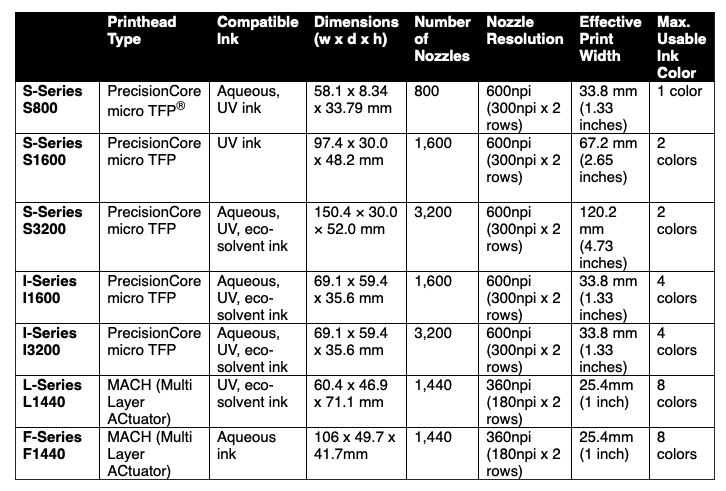
Epson’s OEM printheads deliver industry-leading productivity, reliability and high image quality, and are available in four series to meet various needs:

  • S-Series Printheads: Offers high productivity, high image quality and head expandability; maximum 4.73-inch-wide MEMs printhead series equipped with ink recirculation
  • I-Series Printheads: Cost-effective 1.33-inch-wide MEMs printheads provide high productivity and high image quality with 600dpi high-density resolution
  • L-Series and F-Series Printheads: MACH (Multi Layer ACtuator Head) technology is leveraged for high precision and high density; can be used for up to 8 colors

Additional specs include:

Posted May 25, 2021

Source: Epson

Arkema Acquires Agiplast

COLOMBES, France — May 25, 2021 — With the planned acquisition of Agiplast, a leader in the regeneration of high performance polymers, in particular specialty polyamides and fluoropolymers, Arkema will be able to offer a full service to customers in terms of materials circularity, addressing growing market expectations in this field. This project, which contributes to the sustainable development of the polymer industry, is perfectly in line with Arkema’s sustainable growth strategy.

Arkema plans to acquire Agiplast, a company specialized in the regeneration of high performance polymers and its historical partner in recycling operations. The company, with annual sales of around 15 million euros, operates a plant in Italy and has 32 employees. Agiplast’s strong know-how in mechanical recycling technologies will enable Arkema to offer high quality recycled polymers to its customers.

In October 2019, Arkema, the world leader in bio-based high performance polymers, had already launched Virtucycle®, an ambitious program with Agiplast aimed at developing loops for the collection and regeneration of high performance polymers while minimizing CO2 emissions.

With this acquisition, Arkema will be the first fully integrated high performance polymer manufacturer offering both bio-based and recycled materials in order to address the challenges of resource scarcity and end-of-life products. This bolt-on acquisition is thus in line with Arkema’s CSR and sustainable growth strategy, and in particular the transition to a circular economy.

The deal is expected to close in June 2021.

Posted May 25, 2021

Source: Arkema

Sponsors