ALBUQUERQUE, N.M. — June 18, 2021 — Green Theme Technologies (GTT), creator of sustainable solutions for the textile and fashion industries, is proud to announce the first close of its series B financing.
After a successful Series A round, GTT hit its goal of $3.5 million at the first close of series B. Funds raised will be used to grow GTT’s sustainable and performance-driven platform technologies (including the water-free EMPEL™ textile finishing process), hire new employees, and support licensing partners.
“We are pleased with our fundraising performance and will use the Series B funding to further develop and commercialize our platform technologies, including a durable water repellent (DWR) finish and our water-free dye (WFD) product,” said Jordan Clancy, CFO with GTT. “Within the next six months we will double our headcount in New Mexico, expanding our team to support commercialization, licensees, and accelerate revenue growth.”
Notable investors in the series B round include Phoenix Venture Partners and Safer Made, both of whom invest in sustainably focused inventions, platforms and companies taking an active role in creating a green future for our planet.
The textile and fashion industries are the second biggest water polluters on Earth and Green Theme’s business model intends to change that. By replacing traditional water-based wet finishing processes currently used to apply water repellents, dyes, and more with the clean, efficient, and water-free EMPEL process, GTT and their licensing partners are directly reducing the amount of water pollution in the world. The result is cleaner, better performing, and more sustainable textile products.
TEL AVIV, Israel — June 18, 2021 — adidas and Delta Galil Industries Ltd. — a global manufacturer and marketer of branded and private label apparel products for men, women and children — today announced a global licensing agreement that will see Delta Galil design, manufacture and distribute men’s and women’s underwear collections under adidas’ Badge of Sport and Originals labels. Launching for Spring 2022, the new men’s and women’s collections will be available in the APAC, EMEA, Europe and Latin America regions, with the women’s collections also launching in North America.
“We are honored to partner with adidas, a global leader in the sporting goods industry, to launch these new collections,” said Victoria Vandagriff, president of D2 Brands at Delta Galil. “Innovation is core to the DNA of both adidas and Delta Galil and we look forward to leveraging that shared strength and focus through this collaboration. This license marks a meaningful addition to Delta Galil’s portfolio of licensed and proprietary brands.”
The new collections will feature innovative fabrics and proprietary knitting technology that offer improved flexibility for the perfect fit. Both the men’s and women’s lines will be made with a unique blend of cotton and eco-friendly Tencel and incorporate Refibra™, a revolutionary textile solution for recycling cotton waste that was developed in partnership with Lenzing for go-anywhere, do-anything comfort.
The Badge of Sport collection will be sold through adidas’ DTC channels, department stores and sporting goods retailers. The Originals collection will be distributed through adidas’ DTC channels, premium department stores and select fashion retailers
NEW DELHI, India — June 18, 2021 — “The future of textile chemical segment looks promising. Year-on-year the application of textile chemicals have continued to evolve and expand into different textile sectors. The recent development in antimicrobials has played a key part in augmenting the durability of textiles, garments and providing stronger protection against contaminants,” said Raj Manek, executive director and board member, Messe Frankfurt Asia Holdings Ltd.
From pre-treatment of textiles to the finishing, chemicals are vital for fabricating textile materials for a vast variety of uses. Home furnishing and apparel textiles in particular, have been key contributors to demand for textile chemicals in India over the years. However, since the past few quarters there has been a dynamic shift in demand for textile chemicals due to the pandemic.
“The demand for apparel and home furnishing industry have been hard hit as consumers are buying less of these items. On the contrary there has been a vertical rise in the demand for oil & water repellents and anti-viral coatings for producing PPE kits, face masks and for various medical textiles,” shared Dr. Sanket Valia, senior general manager, Business Development, Sarex Chemicals Ltd.
Increasing attention towards health, safety and hygiene has brought a serious limelight on antimicrobial finishes. Much recently, Sarex has developed two antimicrobial agents, Saraguard-5700 and Saraguard-FL, which are applied on functional clothing like PPE kits as well as commonly used products such as surgical fabrics, drapes, bed linens in order to provide durability and protection from pathogens, viruses and bacteria.
Going forward, the treatment of antimicrobial finishes on other textile products including industrial, home textile and apparels will be instrumental in reducing the risk of infection and cross-contamination as we go about our daily lives. Apart from providing protection against contaminants, textiles treated with antimicrobial ingredients are also known to increase the shelf life of products by preventing bacterial colonization, thus further augmenting their significance.
“Year-on-year the application of textile chemicals have continued to evolve and expand into different textile sectors. The recent development in antimicrobials have played a key part in augmenting the durability of textiles and providing stronger protection against contaminants. The future of textile chemical segment looks promising and through the platform of Techtexil India, Messe Frankfurt India will aid industry players to explore new business opportunities and further expand their potential,” Manek shared.
Techtexil India, as a one-stop exhibition for technical textiles will continue to host businesses across its various application areas including med-tech, agri-tech, geo-tech, sports-tech, infra-tech, and home-tech.
With the first hybrid edition of Techtextil India slated on November 25-27, 2021, Messe Frankfurt India will aim at reuniting technical textile players to explore new opportunities and grow together as a unified segment.
Posted June 18, 2021
Source: Messe Frankfurt Trade Fairs India Pvt. Ltd.
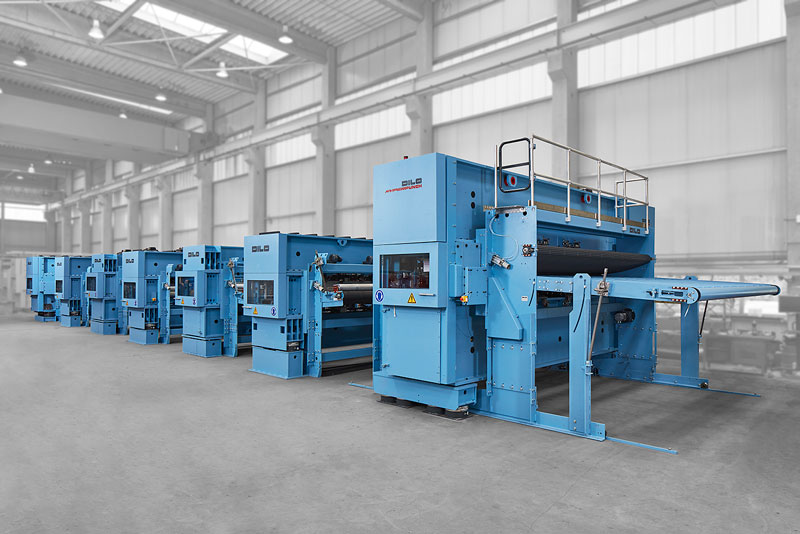
EBERBACH, Germany — June 18, 2021 — Huafon Microfiber Co. Ltd. has placed orders for three complete, state-of-the-art high capacity needling lines with DiloGroup for its new plant in Qidong, Jiangsu Province, China.
All these lines consist of DiloTemafa high capacity blending systems, DiloSpinnbau special card feeding systems and high capacity carding machines, DiloMachines high speed crosslappers with special air-guide system for the best layering performance, as well as numerous DiloMachines needlelooms with Hyperpunch technology. The Twinflow-system provides a homogeneous flock mat while “Webguide” and 3-apron-layering system result in an excellent web quality with precise web edges. All lines are equipped with CV1 system for the best end product uniformity.
The lines will be shipped to Huafon in 2021.
Huafon Microfiber was established in 2002 and is now one of the biggest producers of artificial leather made from sea-island fibre worldwide. The main applications of these high quality artificial leathers are shoe, automotive, glove, bag, sofa etc.
DiloGroup supplied the first complete needling line to Huafon in Jinshan, China, in 2003 and up to now Huafon has ordered more than twenty needling lines.
ALEXANDRIA, Va. — June 18, 2021 — Paris Healthcare Laundry Services, a division of NOVO Health Services, has again achieved Hygienically Clean Healthcare certification at its flagship Dubois, Pa., location. The designation reflects commitment to best management practices (BMPs) in laundering as verified by on-site inspection and capability to produce hygienically clean textiles as quantified by ongoing microbial testing.
Dubois is home to the Paris chain, which also includes facilities in Ravenna, Ohio, and Williamsport, Pa. The company is known for data sharing with customers that controls their costs by providing them with cost per adjusted patient day information, comprehensive performance data and real-time tracking. Service are provided to hospitals, non-acute care, surgical centers and long-term care. In January 2020, Paris merged with NOVO, Atlanta, Ga., bringing together two regional healthcare laundry leaders to form a strong and sustainable company that can continue to grow.
The Dubois laundry was last certified in 2017. Recertification confirms the organization’s continuing dedication to infection prevention, compliance with recognized industry standards and processing healthcare textiles using BMPs as described in its quality assurance documentation, a focal point for Hygienically Clean inspectors’ evaluation. The independent, third-party inspection must also confirm essential evidence that:
Employees are properly trained and protected;
Managers understand regulatory requirements;
OSHA-compliant; and
Physical plant operates effectively.
To achieve certification initially, laundries pass three rounds of outcome-based microbial testing, indicating that their processes are producing Hygienically Clean Healthcare textiles and zero presence of yeast, mold and harmful bacteria. They also must pass a facility inspection. To maintain their certification, they must pass quarterly testing to ensure that as laundry conditions change, such as water quality, textile fabric composition and wash chemistry, laundered product quality is consistently maintained. Re-inspection occurs every two to three years.
This process eliminates subjectivity by focusing on outcomes and results that verify textiles cleaned in these facilities meet appropriate hygienically clean standards and BMPs for hospitals, surgery centers, medical offices, nursing homes and other medical facilities.
Hygienically Clean Healthcare certification acknowledges laundries’ effectiveness in protecting healthcare operations by verifying quality control procedures in linen, uniform and facility services operations related to the handling of textiles containing blood and other potentially infectious materials.
Certified laundries use processes, chemicals and BMPs acknowledged by the federal Centers for Disease Control and Prevention (CDC), Centers for Medicare and Medicaid Services, Association for the Advancement of Medical Instrumentation, American National Standards Institute and others. Introduced in 2012, Hygienically Clean Healthcare brought to North America the international cleanliness standards for healthcare linens and garments used worldwide by the Certification Association for Professional Textile Services and the European Committee for Standardization.
Objective experts in epidemiology, infection control, nursing and other healthcare professions work with Hygienically Clean launderers to ensure the certification continues to enforce the highest standards for producing clean healthcare textiles.
“Congratulations to NOVO Paris on their recertification,” said Joseph Ricci, TRSA president and CEO. “This achievement proves their ongoing commitment to infection prevention and that their laundry facilities take every step possible to prevent human illness.”
SAN FRANCISCO — June 15, 2021 — The Sustainable Apparel Coalition (SAC), along with its technology partner Higg, announced the completion of a new tool that evaluates the comprehensive environmental impact of products. Brands and manufacturers can use the Higg Product Module (PM) to develop apparel, footwear, and other consumer goods products with lower sustainability impacts, from reduced water use to lower carbon emissions throughout the value chain. Companies can also use the new tool to credibly communicate their performance, demonstrate progress towards sustainability and circularity goals, and address anticipated regulation.
The Higg PM is one of five tools in the Higg Index suite of tools developed by the SAC for the standardized measurement of value chain sustainability. There are two product-specific tools in the suite: the Higg Materials Sustainability Index (MSI) and the Higg PM. While the Higg MSI assesses cradle to gate, the Higg PM will expand to measure cradle to grave impacts, including end-of-life, providing designers, developers, and sustainability experts directional guidance on how to improve the environmental footprint of a product they’re designing.
“We are moving beyond a ‘materials-only’ view of product impact. Now that the Higg Product Module is complete, the tool will consider design, manufacturing, packaging, logistics, excess production, product durability, care, and end of use, delivering a full view of a product’s comprehensive environmental impacts,” explained Jeremy Lardeau, vice president of Higg Index for the Sustainable Apparel Coalition.
More than 150 companies have already used the Higg PM to assess over 1,000 products. With this launch, the full Higg Index suite of tools is complete, which is central to the SAC’s mission to transform businesses for exponential impact. As companies commit to science-based corporate sustainability goals, the Higg PM will help them understand their holistic sustainability performance and enable progress towards circularity goals.
“PEARL iZUMi couldn’t be more pleased with the tools and data provided from the Higg Index,” said Aaron Kutzer, senior manager, Retail Division, Pearl iZUMi. “The Higg Product Module and the detailed data it delivers inspired our new Pedal to Zero program which allows our customers to do what they love — ride bikes for fun, fitness, transportation and arguably, sanity — and now, also to purposefully offset the environmental impacts of the products they use. By scaling the Higg PM, we can achieve our evolving corporate responsibility goals and even enlist our customers to help do the same.”
As corporate sustainability goals evolve, consumers and regulatory bodies expect the consumer goods industry to become more transparent. Brands need credible data that paints a full picture of their impact from the products they design to how those products are made. The product tool was developed with these expectations in mind and can help companies prepare for anticipated legislation. For organizations with an EU presence, the Higg product tool is designed to evolve and aims to align with future EU PEF Apparel & Footwear Methodology.
“The Product Module is a game changer for member companies and the industry at large. It gives the industry a credible tool to assess cradle-to-grave impacts of products, supporting ambitious sustainability goals and preparing users to fulfill future regulatory requirements. It also marks an important milestone for the SAC, completion of the Higg Index, and opens a new chapter in our sustainability journey towards collective action and industry transformation,” said Amina Razvi, executive director of the SAC.
In response to increasing expectations, companies continue to step up climate change commitments and initiatives and need tools to accurately and credibly report on their progress. Many focus on reducing carbon emissions as a starting point, in line with global efforts such as the Paris Agreement or the Science Based Targets Initiative. Brands can use the new Higg PM to assess their supply chain Scope 3 category emissions from purchased goods and services as well as the impacts from the use of sold products and the end-of-life treatment of sold products, for a comprehensive carbon footprint assessment that can be scaled across its products.
“For any company planning to track their Scope 3 emissions, Higg MSI and Higg PM would be the best starting point to obtain high-level sources of product level, material level or yarn level emission information. The new Higg PM, now equipped with the cradle to gate data, allows companies to estimate the downstream product use level impacts. MAS uses the Higg PM because of the standardized impact measurements. Standardization will enable direct and faster analysis and help to identify hotspots in products that need further Life Cycle Impact Analysis. With this data, we have started discussions with our customers and supply chain on how to collectively improve product criteria to mitigate climate risk and other environmental impacts. These discussions have enabled us to develop relationships with customers who seek solutions to improve the environmental performance of their product portfolio,” said Dhanujie Jayapala, environmental sustainability manager for MAS Holdings.
Following today’s announcement, consumer goods industries can move beyond simply measuring disparate environmental impacts of products, an important step towards meaningful consumer-facing sustainability claims, another area the SAC is focused on in partnership with Higg, as revealed by the rollout of Sustainability Profiles scorecards last month.
“We are seeing a dramatic rise in conscious consumerism and ESG investing, paired with expanding supply chain regulation. The SAC launched the first phase of our transparency program in May 2021 to help provide shoppers with unprecedented visibility into a product’s impact on the planet and its people. With the Product Module complete, we are one step closer to transforming the industry by helping companies develop more sustainable products, prepare for future regulations, and communicate their performance credibly to consumers to help them make more informed decisions,” said Amina Razvi.
MUNICH, Germany — June 17, 2021 — In April 2021, manufacturers of Textile Care, Fabric and Leather Technologies in Germany were able to increase their incoming orders by 69 percent in real terms compared to the previous year. Orders from Germany increased by 55 percent and from abroad by as much as 80 percent. In April, 158 percent more orders came from the euro countries, while the non-euro countries increased their orders by 22 percent. Turnover also increased by 9.5 per cent compared to the previous year.
“After pandemic-related sharp drops in orders and sales in 2020, the order books of many companies are gradually filling up again,” said Elgar Straub, managing director, VDMA Textile Care, Fabric and Leather Technologies. “However, international travel restrictions as well as a still difficult pandemic situation in many countries of the world continue to pose a major challenge. In addition, there are currently the exploding raw material prices with massive delivery delays for primary products, still severely restricted and very expensive transport conditions and a considerable shortage of packaging materials.”
Export markets down in 2020, improvement in sight
The manufacturers of Textile Care, Fabric and Leather Technologies were able to export machines worth 788 million euros ($939 million) in 2020, which was 9.5 percent less than in 2019 at 872 million euros ($1 billion). The most important export market in 2020 was Poland, followed by the United States and France. Exports to Poland increased by 69 per cent to 89 million euros ($106 million) in 2020, whereas exports to the United States decreased by 12 per cent to 77 million euros ($92 million). Likewise, exports to France fell by 8 per cent to 68 million euros ($81 million).
Poland remained the most important export market for the industry in the first quarter of 2021, followed by France and the US. In particular, exports within the European Union developed positively in the first quarter of 2021, increasing by 3 per cent to 90 million euros ($107 million).
The VDMA represents around 3,300 German and European companies in the mechanical engineering industry. The industry represents innovation, export orientation, medium-sized companies and employs around four million people in Europe, more than one million of them in Germany
ADLINGTON, England — June17, 2021— Carrington Textiles, a global workwear fabric manufacturer, has survived the ups and downs of the textile industry in the United Kingdom in the last 130 years by constantly adapting to market changes and responding to the needs of customers, wherever they are in the world.
The company’s research and development team has been instrumental in achieving this, by adopting new and innovative ways to approach fabric development.
Kirsty White, Carrington Textiles’ Research & Development manager, explained: “Carrington Textiles understands the importance of R&D in manufacturing and we constantly strive to be innovative so we are always at the forefront of fabric development, but we also want to make sure we get it right and we put the product through its paces to guarantee the best results.”
Collaboration is one of the biggest elements of the company’s research and development strategies, and over the years more and more partners have been added to the mix to make sure the development process is more efficient.
Carrington Textiles’ research & development processes have become much more collaborative in their approach over the years, by working closely with the whole supply chain involved, including fiber producers, spinners and weavers, their manufacturing sites and customers.
“Fiber producers have the technical expertise on their specific technology, spinners and weavers have the experience in textile construction and our manufacturing sites have know-how in terms of equipment and what’s feasible to process. Customer involvement is vital for us to guarantee that our fabric development is something the market needs and is looking for,” White added.
But R&D in manufacturing is not only important to be able to stay at the forefront of innovation, but also to use processes that are gentle with the environment and to develop fabrics that are sustainable.
Circular manufacturing is a topic the company is currently focusing on. Taking part in a number of projects collectively with universities, partners and competitors, Carrington Textiles is working to make sure the end product is reusable in some way, therefore reducing our impact on the environment.
The use of innovative fibers that reduce microplastic pollution in oceans and textile accumulation in landfills, as well as chemistry that is environmentally friendly, are some of the most recent technologies the company has been successfully trialing for their products.
Part of the textile manufacturer’s Balance Range of sustainable fabrics, Hawksbill and Orca — due to be launched in the coming months — incorporate CiCLO technology, a sustainable textiles ingredient in the form of an additive that is combined with polyester at the very beginning of the fibre making process. When CiCLO Polyester ends up in the environment either through washing or end of life of the garment, it behaves like natural fibers, in turn reducing microplastic pollution and textile accumulation.
The expansion of the company’s stretch range and the introduction of lighter, yet durable fabrics are also a key focus for Carrington Textiles’ research and development strategy.
AMSTERDAM — June17, 2021— Mimaki, a manufacturer of inkjet printers and cutting systems, held their global event Innovation Days June 2-4, 2021 to great success. The event brought together printers, journalists and experts from Mimaki Japan, USA and Europe, to nurture innovation in the sign graphics, industrial, textile and 3D markets and drive success within the industry. The global event also introduced the market to Mimaki’s recent product releases, the JFX550, JFX600 and SUJV-160.
In a week of webinars, workshops, demonstrations, and networking events, more than 1,300 attendees from all across the world logged in to participate, with the demonstration of UJV100 and JV100 printers, 3D printing workshop and car wrap workshop being the most popular events. As a first of its kind for Mimaki, visitors were able to speak with regional Mimaki representatives, gaining greater insight into the global printing industry as it recovers from the COVID-19 pandemic.
A stand-out attraction of the event was the recently released 100 Series, which is priced affordably to allow printers entry into different markets, as many look to expand their portfolio in these uncertain times. The new JFX600-2513 and JFX550-2513, which debuted a few weeks prior at virtual drupa, similarly are higher end but still affordable printers, when compared to other large format UV flatbed machines in its class. 3D full color print technology also featured heavily in the event, as Mimaki explored the exciting propositions it opens up in different markets and how the brand continues to extend the reach and accessibility of cutting-edge 3D technologies with its upcoming 3DUJ-2207 printer.
Kazuaki Ikeda, president of Mimaki Engineering, commented, “I’d like to extend my thanks to everyone who joined us during this exciting new virtual event. During the pandemic, carrying on innovating has been central to Mimaki’s objectives, with eight new products having been released since October, and even more scheduled to come out over the course of this year. I hope that we can soon all meet at in-person events, once it’s safe to do so, but until then I’m excited to see the results of the continued collaboration and innovation of print industry that we saw in our Innovation Days event.”
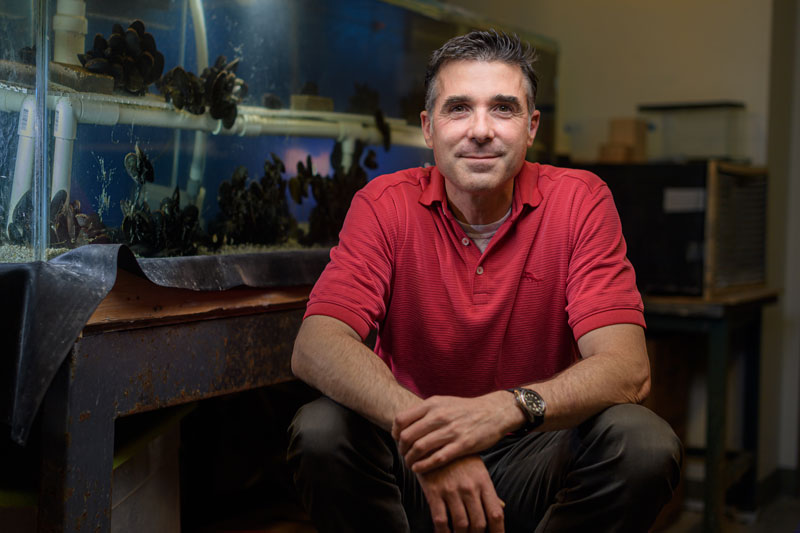
Jonathan Wilker, a Purdue professor of chemistry, studies shellfish to develop adhesives that are more sustainable and stronger, and work in a wider range of environments than current adhesives. Image courtesy of Purdue University/Rebecca McElhoe
By Brittany Steff
Don’t look now, but you’re surrounded. Really. Within arm’s reach – probably even touching you – are troublesome, sticky, potentially even toxic, substances. Bad for the planet, permanent, maybe even bad for your health. They’re in your shoes, in your phone, in your laptop, lurking in the folds of envelopes, on books, in the chair you’re sitting in, the flooring beneath your feet, and in uncountable other objects in your house, office and everyday world.
They are adhesives. Vital to daily life, nearly unnoticeable, but also deeply problematic. They can be toxic and are usually permanent. Purdue University chemists are studying shellfish to develop new, safer and more sustainable adhesives for uses ranging from bandages and medical applications to clothing, household items, electronics and more.
Humans have been trying to stick things to other things for millennia. But shellfish have been doing it for eons longer. And they are far better at it than humans. Which is why Purdue chemists got to wondering: Why don’t we just use whatever they’re using? Anyone who has ever tried to unstick a barnacle from a rock knows that it’s nearly impossible.
That success is something Jonathan Wilker, a Purdue professor of chemistry and materials engineering, and his lab are hoping to learn from — and build on.
Shellfish And Saltwater: Underwater Adhesion That Works
“We start by looking at animals that make adhesives,” Wilker said. “We’re still working to understand the fundamentals of how animals like mussels and oysters do what they do, how the chemistry and engineering work together. We are even seeing how the environment around them and the surface they’re sticking to influences what they do.”
Critters such as barnacles, mussels and oysters live in places where they are continually battered by waves and wind and pried at by potential predators. Their very lives depend on being able to cling to rocks and their neighboring shellfish.
Sutures, screws and staples are all widely used to close wounds, bind tissues and set bones, but they are all very damaging and extremely painful. If doctors had a chemical adhesive that they could use instead, healing would increase and collateral damage would decrease. The body, however, is a challenging environment for adhesives: wet and constantly in motion. A lot like the sea.
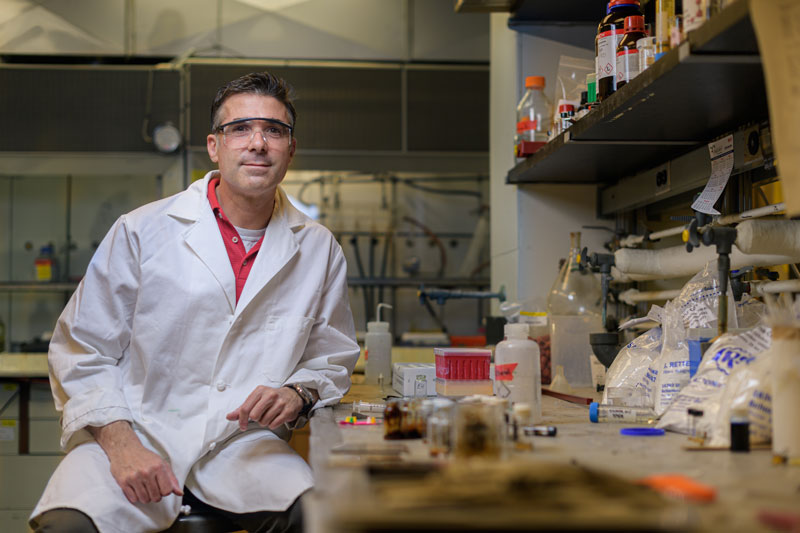
Jonathan Wilker’s lab at Purdue studies how shellfish create adhesives and what components of the adhesives perform active roles in bonding. Researchers in the lab test new synthetic and biomimetic adhesives to determine their efficacy, feasibility and performance. Image courtesy of Purdue University/Rebecca McElhoe
Scientists in Wilker’s lab — which includes two postdoctoral researchers, five graduate students, four undergraduate researchers and 1,000 shellfish — study how shellfish create materials, what components of the adhesives play active roles in bonding and test new synthetic and biomimetic glues to determine their efficacy, feasibility and performance. They are building on that understanding to develop adhesives that work underwater, are stronger, more sustainable, made from food products and that can be un-stuck when needed.
We’re making adhesives with new functionalities” Wilker said. “We can add in new chemical groups to target all sorts of properties, be that wet bonding, rubber-like flexibility or the ability to bond and then de-bond. One of our systems can even be stronger than what the animals make underwater. In that case, we are using chemistry that is inspired by the shellfish but, overall, our system is a simplification of what the animals produce.”
Gunning For New Glue: Making Adhesives Nontoxic, Reversible
Every product in the glue aisle at the hardware store has a downside. Many are toxic. Particle board, laminate flooring and hardwood plywood are all held together with formaldehyde-based resins, which can be carcinogenic. Additionally, many adhesives are permanent. There is no way to dissolve the bond when a product is at the end of its life, which often prevents the components from being recycled.
“Almost every common glue is petroleum-based and not degradable,” Wilker said. “When your laptops or cell phones, shoes or furniture are no longer needed, most of them go straight to a landfill. Even materials like cardboard often do not get recycled because of the adhesives.”
Many glues are nearly permanent, a factor many people have discovered when trying to remove the gumminess from a sticker or price tag from a product — or, more unfortunately, from a car window where a child sat. Being able to reverse stickiness at will would give humans more control over their environment.
Increasing the sustainability and the functionality of adhesives can improve human life in a myriad of ways: by limiting exposure to harmful chemicals, by making healing more comfortable, and by making products more sustainable and more recyclable to preserve resources and the planet. Wilker’s lab is working to make glues out of bio-based and even food-based compounds.
Adhesion is a rapidly evolving field with huge potential. It’s a field in which Wilker is a recognized expert, thanks to a stray thread of curiosity encountered in the ocean.
Jonathan Wilker notes that not everyone in his Purdue lab has a chemistry degree. Some lab members are shellfish – about 1,000 of them. The shellfish play a valuable role by demonstrating how they make adhesives so scientists can build upon their biological strategies. Image courtesy of Purdue University/Rebecca McElhoe
“The core ideas in our lab come from spending time underwater,” Wilker said. “I was SCUBA diving, saw shellfish sticking to rocks and thought, ‘I wonder how that works?’ When I got back into the lab, I was surprised to learn about what remained unknown. There are so many exciting possibilities and applications to pursue if we can figure it all out.”
As both a professor of chemistry in the College of Science and a professor of materials engineering, Wilker bridges the worlds of science and engineering in his efforts to tap the natural world for innovative solutions to adhesion problems. The Office of Naval Research and the National Science Foundation help fund his research.
Wilker has worked with the Purdue Research Foundation Office of Technology Commercialization to apply for patents on his adhesives from the U.S. Patent and Trademark Office. He is starting to make them commercially available through commercial ventures including a startup, Mussel Polymers Inc.
Editor’s Note: Brittany Staff is a science writer at Perdue University

 ALBUQUERQUE, N.M. — June 18, 2021 — Green Theme Technologies (GTT), creator of sustainable solutions for the textile and fashion industries, is proud to announce the first close of its series B financing.