New York City-based New York Embroidery Studio (NYES) has signed a lease for an 80,000-square-foot-space at the Brooklyn Army Terminal. The company plans to open a state-of-the-art personal protective equipment (PPE) manufacturing facility that will employ 500 associates. The project represents an estimated economic output for New York City of $73 million. The women-led business pivoted during the COVID-19 pandemic from making high fashion items for well-known brands to producing PPE. This endeavor set the wheels in motion for the recent expansion. NYES has a focus on sustainable and eco-friendly PPE production and plans to make biodegradable isolation gowns that it developed.
“New York Embroidery Studio has been manufacturing in the garment center for over 30 years,” said Michelle Feinberg, founder and owner, NYES. “I am totally committed to growing the apparel industrial base here in NYC. Additionally, we want to bring high fashion’s drive for innovation and quality to PPE manufacturing, by developing novel and sustainable products for our clients.”
“The local production of PPE is essential to our health care workers and our city, so we are always prepared,” said New York City Economic Development Corporation President and CEO Andrew Kimball. “We must be forward-thinking as we address our city’s future pandemic preparedness. NYCEDC is proud to support a local, women-led small business, like New York Embroidery Studio, with a new state-of-the-art space in the Brooklyn Army Terminal, to help them meet their PPE quotas and ensure the equipment is made in America.”
Ethisphere has named Spartanburg-based Milliken & Company one of the 2022 World’s Most Ethical Companies. This is the 16th year in a row Milliken has received this honor, making the company one of only six companies that have earned the honor each year since the award’s inception. In 2022, 136 companies were recognized. Milliken was one of seven industrial manufacturers on the list. Candidates are assessed based on answers to 200 questions related to culture, environmental and social practices, ethics and compliance activities, governance, diversity, and initiatives that support a strong value chain.
“Ethisphere and its World’s Most Ethical Companies program is a key benchmark for the way we do business,” said Halsey Cook, president and CEO, Milliken & Company. “Receiving this recognition for 16 straight years underscores the culture and commitment of Milliken team members globally. It’s who we are.”
Mafic USA, Shelby, N.C., has received a $3 million U.S. Department of Agriculture (USDA) Business and Industry Loan to purchase new equipment for its basalt —mafic volcanic rock — fiber manufacturing facility. The loan was announced by USDA Rural Development State Director Reginald Speight.
“Mafic USA is about to become to be the largest volume producer of basalt fiber once the plant reaches full capacity,” Speight noted. “This underscores the President’s desire for the United States to move away from foreign supply chains and make quality products here at home.”
In his recent State of the Union address, President Joe Biden said: “There’s something happening in America. The rebirth of the pride that comes from stamping products ‘Made in America.’ The revitalization of American manufacturing.”
Through the Massachusetts Manufacturing Innovation Initiative (M2I2), the Baker-Polito Administration recently awarded $2.8 million in grants to three Massachusetts-based textile manufacturers. 99Degrees Custom, a tech-integrated apparel company in Lawrence; Soliyarn, a smart textiles manufacturer in Belmont; and Human Systems Integration (H.S.I.), a wearable technology company in Walpole, received $1.1 million, $1.5 million and $250,000 respectively to fund specific projects. M2I2 is comanaged by the Center for Advanced Manufacturing at the MassTech Collaborative and the Executive Office of Housing and Development. The program helps to grow and foster cross-collaboration within industry sectors. The grant recipients also receive support from the Advance Functional Fabrics of America national manufacturing institute in Cambridge, Mass.
“These three grantees are developing technical apparel used in medical and military applications, ‘smart’ products that provide enhanced protection from the elements but also provide enhanced functionality,” said Massachusetts Governor Charlie Baker. “Through this support, they have the opportunity to enhance their ability to compete in markets across the U.S. and the globe.”
Recently, oil and oil prices have been center stage. For those old enough to remember the 1970’s oil crisis, it is a bit of an unwelcome familiarity.
The twist this time is the emergence of an anti-oil movement that blatantly wants the world free of oil and all fossil fuels.
This is central to the green movement that has entered U.S. policy and politics. Even President Biden, in CNN’s broadcast of the Democratic debate on March 15, 2020, stated: “Number one, no more subsidies for [the] fossil fuel industry. No more drilling on federal lands. No more drilling, including offshore. No ability for the oil industry to continue to drill, period ….”
Not exactly a steady, planned transition to a lower carbon world, but a clear message to the oil industry, and industry beyond gasoline.
Importantly, oil has become synonymous with gasoline. But what are the real ramifications for an “oil-free” world? And what really results from refining a 42-gallon barrel of oil?
The Petroleum Service Co. (PSC) offered some insight into the issue when it published “What’s in a Barrel of Oil? The 42-Gallon Breakdown” in March 2022.
The article details the make-up of crude and begs the question, “If gasoline accounts for 46 percent of our oil barrel, what’s happening to the other 54 percent?”
Aside from the 46-percent gasoline, 26 percent of the barrel becomes diesel and other fuels, 9 percent is turned into jet fuel, 3 percent is used in asphalt, 1 percent goes into lubricants, and finally — the remaining 15 percent forms the “bottom of the barrel” products. It is these “bottom of the barrel” products that are intriguing and share a ubiquitous nature similar to textile applications.
For years, the textile industry has been trying to highlight the breadth of textile applications associated with everyday life to highlight an industry beyond the obvious apparel sector. Whether it is home, automotive, filtration or medical, textiles are used everywhere in daily life.
A quick look at the “bottom of the barrel” products tells a similar tale. Take for instance everyday modern aspirin. PSC noted: “Benzene is one of the most widely used chemicals in the U.S. today. It is used predominately as a starting material in making other chemicals — including aspirin and other drugs. One way benzene is obtained is by distillation-refining petroleum.”
And the list goes on — food coloring, lipstick, synthetic rubber, styrofoam, toothbrushes, and even the thicker inks used in printing money use oils and extenders in the process.
And let’s not forget textiles themselves. Polyester fabrics are almost 100-percent petroleum based, and even bottle-based recycled polyester owes its root feed stocks to the 42-gallon barrel.
There is a lot of work that needs to go in to replacing the barrel — think new sunglasses, kayaks, mattresses, hair color, fishing rods, dog collars, hard hats, lotions, drums, artificial heart valves, artificial turf and porta-potties. These are just some of the items highlighted in PSC’s “Petroleum Product of the Week.”
Moving away from oil as fuel is one thing, but keep in mind the unintended (or intended) consequences.
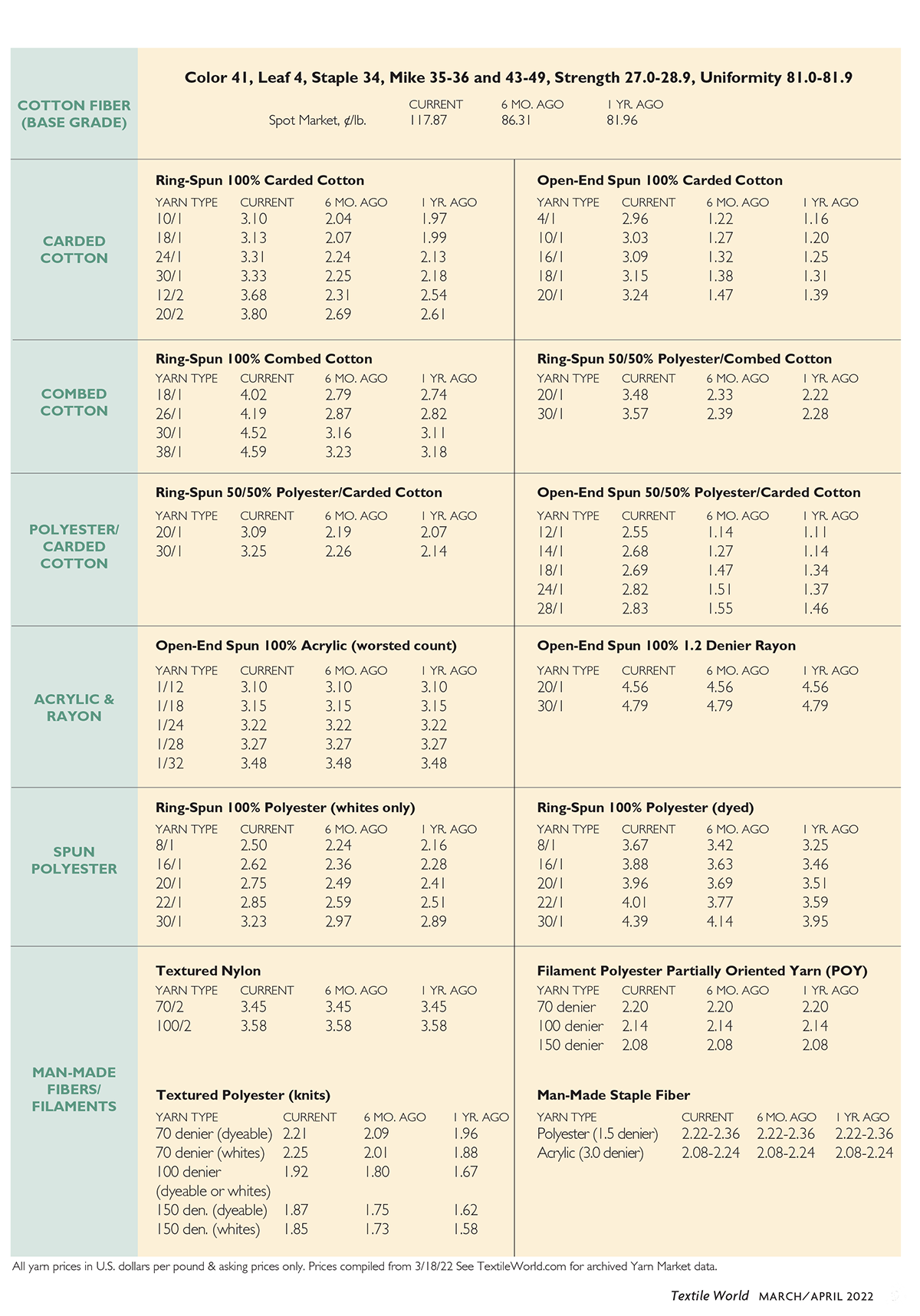
As the first quarter of 2022 comes to a close, demand for U.S-made ring-spun and open-end yarns remains strong.
“I can sell just about anything I can get my hands on,” said one industry source. “But I can’t get my hands on as much as I need.”
A yarn seller said the open-end market is particularly tight. “Frontier was already selling nearly half of its production to Gildan before it was acquired,” he said. Now the open-end market is very tight. I try to get some ring-spun for my customers when I can, but that is hard to come by, too.”
A Gildan subsidiary purchased Frontier in late 2021. “The market was tight even before the sale,” said a yarn broker. “Now it’s even harder. Everyone is waiting for product supply to loosen up a bit, but who knows when that will be.”
As has been the case for the past several years, multiple factors are contributing to the smaller-than-normal supply of product. The global pandemic caused a disruption in the U.S. workforce, the likes of which have been experienced no more than twice in the past century. It is estimated that some 47 million workers quit their jobs. Many of these people were in food service and other lower-wage positions. In manufacturing alone, the U.S. Chamber of Commerce estimates that about 1.4 million jobs were lost at the beginning of the pandemic. Spinners, fabricators and other manufacturers have since struggled to hire both entry-level and skilled workers.
The causes that resulted in many working forgoing manufacturing were multiple. First, for some lower-income families, the temporary Federal unemployment subsidy provided greater income than their normal wages. When people began rejoining the domestic workforce, they were seeking more flexibility, work/life balance, more money, and better working conditions.
People much prefer such endeavors as transportation, mining and construction, rather than in such areas as spinning, weaving, knitting or finishing, according to data from the U.S. Chamber of Commerce. In fact, the chamber says, there is a surplus of experienced workers in those industries.
Prices Remain High
The combination of high demand, diminished production and other factors have caused a precipitous increase in yarn prices over the past year. It’s not just demand; it is also the high cost for raw materials and energy, as well as a slug-gish global supply chain.
“The cost-per-pound for some yarns has almost doubled since the onset the pandemic,” said one yarn broker. “And until energy prices begin to diminish and supply comes more in line with demand, it’s likely to stay that way.”
As of the week ended March 17, for example, cotton prices remained substantially above 100 cents per pound, with the average for the base quality of cotton (color 41, leaf 4, staple 34, mike 35-36 and 43-49, strength 27.0-28.9, and uniformity 81.0-81.9) in the seven designated markets measured by the USDA coming it at 117.87 cents per pound. The weekly average was up from 81.98 cents reported during the corresponding week a year ago. Moreover, the price was up from 47.55 cents per pound in April 2020, shortly after the beginning of the pandemic.
The USDA reported multiple inquiries from spinners for later in the year but noted that most companies had already covered their raw cotton needs for the summer.
Supply Chain Issues Still Abound
As frequently reported over the past 18 months, the lack of a robust supply chain remains a major contributor to lack of domestic product availability. As a result, textile and apparel imports increased by more than 25 percent in 2021.
“I don’t see things improving on the supply-chain front this year — and maybe not until well into 2023,” said a logistics analyst. “I think what you are going to see, at least for the short-to-mid-term, is that suppliers will be moving closer to their customers. That should at least somewhat ease the pressure on manufacturers.”
The instability of the domestic supply chain is of some concern for domestic spinners, who count on partners in the West for a significant portion of orders. “The ability to get top-quality product to our Western Hemisphere customers faster than anyone else has always been a competitive advantage for U.S. companies,” said a source with multi-national contacts. “Our hope is that, when the world returns to normal, if there ever will be such a thing, so will the advantages the U.S. has enjoyed over the years.”
MAS Holdings’ Pilar Diaz and Thanuja Jayawardene discuss the company’s femtech innovations.
TW Special Report
Sri Lanka-based MAS Holdings began as a lingerie manufacturer in 1987. The company was started by three brothers —Mahesh, Ajay and Sharad Amalen — and today comprises a portfolio of businesses focused on manufacturing intimate apparel, shapewear, swimwear, activewear — training & performance — leisurewear and athleisurewear, wearable technology, health tech, adaptive apparel, and impact protection gear.
The company’s portfolio includes MAS Acme, established in 2017 following the acquisition of ACME-McCrary Corp., a hosiery manufacturer founded in 1909 in Asheboro, N.C. MAS also operates a sketch-to-scale technology company that creates next-to-skin apparel solutions in consumer technology, consumer health and connected clothing. Additionally, MAS owns industrial parks and provides partnered logistic services to customers.
MAS Holdings currently operates 52 facilities located in 15 different countries. The company employs more than 115,000 people, and more than 70 percent of its workforce is female. MAS is proud of its global reputation for an ethical and sustainable working environment. Part of its unique mission includes a commitment to women and an emphasis on women’s empowerment.
MAS began its foray into the feminine hygiene technology (femtech) space in 2014, as it researched urinary incontinence underwear products. MAS also made an investment in its customer, Thinx — a New York City-based brand that produces absorbent menstruation underwear. MAS reports it assisted the brand — one that was focused on using its products and marketing to break the taboo surrounding periods — to scale from a start-up to a market leader over the past eight years.
MAS has continued to develop products for the femtech market and now also offers cooling and temperature regulating clothing as a solution for menopause challenges under its own brand Become, as well as reusable nursing pads for new mothers, among other products.
With International Women’s Day in the spotlight, Textile World had the opportunity to speak with MAS Holdings’ Global Head of Femtech Pilar Diaz and General Manager of Women’s Empowerment Thanuja Jayawardene about the company’s innovation in the femtech sector. The company is on a mission to devise solutions to ease the physical symptoms and challenges faced by women at various stages of their lives, and has a vision for a new generation of fabrics that help empower women around the world.
TW: What originally led MAS to identify urinary incontinence products as a potential market for the company? Were there synergies with existing MAS product lines?
Pilar Diaz
Pilar Diaz: MAS started work in the urinary incontinence (UI) space in 2014. Our research at the time showed us that one in four women over the age of 18 experience episodes of urinary leakage. We also learned that UI is the fifth-largest health-related problem that has the greatest negative impact on the quality of life for women. Understanding the challenges and discomfort caused by UI, we wanted to help women live a normal life without having to wear a disposable pad every single day. Disposable pads are not only an expensive and unsustainable solution to UI, but are often a harsh reminder to women of their condition.
At MAS, we took it upon ourselves to apply our expertise in apparel, specifically within the intimates space, to innovate a more impactful solution than those disposable products. We created a product that looked and felt like regular underwear with absorbent function embedded in it.
TW: What other femtech products does MAS produce? Are there other femtech innovations in the works?
Diaz: MAS develops a number of solutions that improve women’s health and well-being as they go through the different life-stages, from the first menstruation to the last, and everything in between. Our range of solutions include products designed for period care, urinary incontinence, pregnancy, postpartum and menopause.
Today, our products have revolutionized the reusable absorbent underwear space. We have also been first in the market to launch a menopause specific clothing line, addressing the number one symptom of menopause — hot flashes.
Currently, we are researching new areas within the femtech space and are working towards developing innovative products that can bring normalcy to women’s lives. We are determined to find superior solutions for women’s health and well-being, including ones that have not been explored yet.
TW: Has MAS utilized any new textile innovations to elevate femtech performance?
Diaz: Apart from regular body fabric, lace and other fashion trims, MAS has invested in developing reusable, functional materials with a range of performance attributes such as quick-drying, high-absorbency, moisture-wicking and temperature-regulating technologies that truly elevate the effectiveness of our femtech products. These technologies are applied to address the multiple pain points of the female reproductive cycle.
To ease menopausal symptoms for example, our patented Anti Flush Technology for hot flashes keeps the wearer cool and comfortable by transferring heat, wicking moisture and reducing odor. Combining HydraDerma and Anti Flush technology reduces the loss of moisture while offering relief from itching and is meant to soothe irritated skin. Similarly, we apply these innovative technologies or combinations of them to bring the best benefit to women, at multiple stages of their life.
MAS Holdings’ femtech product portfolio includes menopause solutions such as T-shirts, vest tops and camisoles.
TW: What environmental benefits do the period underwear and incontinence products offer?
Diaz: On average, a woman will have around 450 periods in her lifetime, which equates to nearly 10 years of our lives bleeding! Naturally, the usage of menstrual products is high. What we don’t realize are the startling amount of waste created by conventional menstrual and urinary incontinence products and their impact on the environment. Tampons and pads — which include wrappers and applicators — constitute 7 percent of the world’s landfill. According to a 2015 research, half of women in the United Kingdom flush up to 2 billion sanitary items each year.
The washable and reusable period and UI underwear we make help to reduce the impact of menstrual and urinary incontinence products on landfills. Not only are these products sustainable alternatives that are better for the planet, but they also ease the economic burden resulting from the cost of purchasing disposables and help improve women’s well-being.
TW: How large are the product lines, and where are the products sold?
Diaz: Some of the femtech products in our current range include washable absorbent underwear for periods and UI; period pain solutions; reusable, absorbent nursing pads and bras; and diverse clothing products such as daywear, nightwear, shapewear and activewear for menopause.
We work with major brands both in the fashion industry as well as in the hygiene and health industry. Products made by MAS are sold around the world in both e-commerce and retail stores.
TW: Women comprise the majority of the company’s workforce. How do you support your female employees, and what opportunities and initiatives are available to women at the company?
Jayawardene
Jayawardene: Being an organization relying so heavily on the work and progress of women, we are in the best position to understand the need for gender parity and why female empowerment is essential for thriving and sustainable businesses, stronger economies and better nations.
Since we started, our work has been about enriching the lives of these women who make up the most significant part of our organization. But in 2003, our commitment to empowering women and breaking existing biases was translated into a strategic and result oriented program known as Women Go Beyond. Through this, we seek to improve and enrich the lives of our female associates as well as their families and communities.
In 2021 alone, MAS conducted 1,624 initiatives helping create 328,218 opportunities for people within the organization and in their communities, with 248,221 of these opportunities benefitting women across the group. While some areas covered by these projects were related to employment and financial empowerment such as skill development, career advancement and entrepreneurship, others went beyond these opportunities towards addressing gaps at the grass root level, creating awareness about women’s health and preventing gender-based violence. These are critical areas to address in the communities we operate.
The company has also set itself a goal to increase female representation in management and has launched multiple active interventions including family friendly policies, infrastructure support, unconscious bias reduction workshops, mentorship and sponsorship for women, strategies for recruitment and retention of women, flexible work arrangements and childcare support, and more.
It is encouraging to note that female representation on MAS Holding’s company boards also saw an increase from 13 percent in 2020 to 20 percent in 2021. Other indicators including rising female representation in senior management, the share of women recruited for roles above executive level and reduced turnover among female associates are a testament to the tangible results of MAS’ commitment to empowering women.
Cone Denim, in business since 1891, is using Oritain’s technology to verify the origin of its cotton.
Cone Denim President Steve Maggard discusses sustainability and traceability one year after the company partnered with Oritain.
TW Special Report
While the fashion and textile industries have made large strides within the realm of sustainability and supply chain traceability, there is still much progress to be made. From social responsibility to environmental and animal welfare, the many permutations of sustainability can provide as much confusion as they do clarity and direction. Regardless of where or how a company decides to act first, transparency and traceability are key. Transparency is essential as a measure of success. By opening up the operational processes, supply chain components and goals to the public, companies provide opportunities for feedback and review. They also help other brands and consumers see the process and understand that sustainability is a journey, not a destination. It is vital to pave the way and encourage others to be transparent as well, which also helps eliminate the accusation of inaction and concerns of greenwashing.
Our Reliance On Transparency Is Only As Good As Our Traceability
The ability to verify the origin of finished products and raw materials helps to verify measures of success on a company’s journey towards sustainability. Many companies have ethical sourcing policies in place to ensure responsible sourcing — environmental and manufacturing policies to protect worker rights and welfare and animal welfare guidelines that prohibit mistreatment — but until it can be verified that products or raw materials have come from locations that meet these requirements, it is very difficult to drive any level of sustained change. Traceability is, therefore, vital to accountability and, ultimately, long term change.
A key partner with New Zealand-based Oritain in the apparel and textile industry is Cone Denim, the Greensboro, N.C.-based iconic supplier of denim since 1891 with a rich history of sustainability and innovation. In 2020, Cone expanded upon its social responsibility practices by becoming the first denim mill in the world to use forensic science to verify the origin of the cotton used in its denim.
This partnership allows Cone to provide the utmost transparency to its customers and as a result, has strengthened the level of trust between Cone Denim and the brands it works with. “Our partnership with Oritain has been a significant success and was absolutely the right direction for Cone,” President Steve Maggard said, reflecting upon the company’s year in partnership with Oritain. “Being able to verify the growth origin of the cotton Cone uses and prove that our claims are valid was a major advantage for Cone and the brands and customers we service, ultimately driving a stronger more creditable business. However, the trust wasn’t solely business to business — Cone witnessed an increase in customers who were intrigued by the new technology and its benefits.
The Key To The Technology Is Oritain’s Scientific Traceability
Oritain works alongside Mother Nature, analyzing the unique elements that materials absorb from their environment. Everything that is grown, reared, or made, absorbs a unique ratio of these elements. Some environments are naturally high in elements, some are low. Some have lots of one type of nutrient and not so much of others and vice versa. This is what Oritain measures, using world leading forensic science and statistical models to analyze the data and create an “Origin Fingerprint” for each product.
Steve Maggard cited the accuracy of this technology as a key selling point. “We are very pleased to be able to provide scientific certainty of our commitment to responsible sourcing,” Maggard said. “The fact that Oritain’s unique process provides documentable transparency that is admissible in a court of law and passes the Daubert standard truly strengthens both our ethical and sustainable sourcing claims. This has allowed us to assure our customers that Cone Denim products do not contain any cotton from prohibited regions, offering an elevated level of confidence and peace of mind.”
And, because eliminating forced labor in the supply chain is a huge priority for the fashion industry, knowing that something does not come from a particular region is just as important as knowing where it does come from.
The move to more sustainable and transparent supply chains is undoubtedly gaining traction. The motivation is there, as well as the industry action. However, what’s been lacking until now is the ability for brands to measure their progress towards more sustainable and responsible practice, and pass on this progress to their consumers — improving their desirability as partners and consumer-facing brands, as well as helping to mitigate risk. Maggard was excited to work with Oritain because of this technological ability that sets them apart. He sees this type of origin verification testing and transparency being “industry standard inside of 5 years” and a mere requirement of doing business nowadays. “Cone Denim is very pleased with our decision to work with Oritain and would do it again in a moment,” Maggard said.
With Cone Denim now entering into the second year of its partnership with Oritain, the company is in a great position to tackle the future of the textile industry, and it is continuously working to continue leading sustainable practice into every part of its supply chain.
Techtextil North America and Texprocess Americas look forward to hosting the full spectrum of the industry at the GWCC May 17-19.
TW Special Report
Messe Frankfurt Inc.’s flagship Atlanta-based trade shows Techtextil North America and Texprocess Americas are returning to the Georgia World Congress Center (GWCC) following a 4-year break. After a COVID-19 pandemic-imposed hiatus in 2020, when the last show was originally scheduled, the show returns to its traditional even-year schedule for the 2022 edition.
The 16th edition of Techtextil will be joined by the fifth edition of Texprocess Americas May 17-19, 2022, where visitors have the chance to view the latest innovations for the technical textiles and sewn products industry and meet in a face-to-face fashion.
Techtextil North America is incorporated with ATME-I and Texprocess Americas is coproduced by SPESA — the industry association for suppliers to the sewn products industry.
“We are thrilled with the level of excitement we are receiving from our exhibitors and visitors for the return of Techtextil North America and Texpro-cess Americas,” said Kristy Meade, vice president – Technical Textile and Technology Shows. “We share that excitement and are looking forward to delivering an amazing event for all — from the exhibit hall to the symposiums to the after-hours networking opportunities. But most of all, we’re just excited to see everyone under one roof, experiencing these two shows together for the first time since 2018.”
Receptions
On Wednesday, May 18, 2022, a joint reception organized by Messe Frankfurt will be held for both Techtex-til North America and Texprocess Americas attendees. With the purchase of an add-on ticket, guests can mingle at Der Biergarten located adjacent to the GWCC in downtown Atlanta while eating German-inspired food and listening to a live Bavarian Oompah Band. The ticket price also includes an open bar and a karaoke party room.
SPESA is hosting an opening night reception open to both Texprocess Americas and Techtextil North America attendees on Tuesday, May 17, at the World of Coca-Cola building, which is just a short walk from the GWCC. Food and drinks will be provided, and tickets are available through SPESA.
Techtextil North America
As always, the event will assemble all vertical aspects of the technical textiles and nonwovens industries including research and development, raw materials, production processes, conversion, further treatment, and recycling.
Visitors will see a wide variety of product groups at Techtextil representing the entire value-added chain in the technical textiles and nonwovens sectors including fibers and yarns; woven fabrics; laid webs; braiding; knitted fabrics; nonwovens; coated textiles and canvas products; composites; adhesives and bonding technologies; functional apparel textiles; research and development; planning and consultation; and technology, machinery and accessories.
Techtextil North America exhibits are classified according to 12 applica-tion areas: Agrotech; Buildtech; Clothtech; Geotech; Hometech; Indutech; Medtech; Mobiltech; Oekotech; Packtech; Protech; and Sporttech.
Texprocess Americas
Texprocess Americas is promoted as the largest North American trade show displaying equipment and technology for the development, sourcing and production of sewn products.
Product groups and services covered include: design, product development and automation technology; contract manufacturing and sourcing; production preparation and organization; cutting room and automation technology; fabrics and materials; fusing, setting and manufacturing preparation; textile machinery; textile finishing; knitting technology; embroidery technology; stitching, joining and fastening technology and materials; product processing and finishing; energy, air conditioning, disposal and recycling; quality control; internal material flow; logistics; information technology; services, consultancy and training; and research and development.
The collocated events will feature three international pavilions in 2022 — from Germany, Italy and Turkey — as well as the SEAMS Supply Chain USA Pavilion.
Education
Visitors to Techtextil North America and Texprocess Americas also may take advantage of several educational opportunities through its symposium sessions, Graduate Student Poster Programs and The Academy.
Techtextil North America and Texprocess Americas each will host eight symposium sessions on various topics of interest (See Table 1). Visitors can chose a one-, two- or three-day pass to attend as many or as few sessions as they wish. The website for each show will list all of the topics and speakers as the event date gets closer and speakers are finalized. The 2022 symposium program for Techtexil North America was developed in partnership with the Georgia Institute of Technology’s School of Materials Science and Engineering.
Symposium topics for the Texprocess Americas sessions were designed in collaboration with The University of Georgia and various thought leaders in the sewn products industry.
As always, the collocated shows will feature a graduate student poster program highlighting research performed by students enrolled at some of the top textile engineering and manufacturing programs in the country. The students’ work will be on display throughout the event, and live presentations will give students the opportunity to engage attendees and share their research.
Don’t forget to check out The Academy, a new feature for the show floor that combines features of the previous Tech Talks and The Lab. Over the three show days, The Academy will offer presentations, demonstrations and discussions all related to technical advancements and the latest in textile testing.
Planning And Preparation
The GWCC is located in downtown Atlanta, which offers many hotels, restaurants and entertainment options in close proximity to the trade show. Show hours are from 10 a.m. until 5 p.m. Tuesday and Wednesday, and from 10 a.m. until 3 p.m. on Thursday.
Attendees are encouraged to reg-ister in advance to receive a discount. The last day to save on registration is April 15 before prices increase. Visitors need only purchase an exhibit hall badge for one of the shows to gain access to both Techtextil North America and Texprocess Americas. A complimentary three-day pass for the show floor is included with the purchase of a one-, two-, or three-day symposium pass. All pricing and deadlines, as well as hotel and trans-portation information, are available on the events’ respective websites.
Show organizers will follow all health and safety rules and regulations set forth by local authorities in regards to COVID-19. Check the websites for the most up-to-date information as the date approaches.
Future Events
To fall in sync with the Germany-based sister shows Techtextil and Texprocess, the U.S.-based events will occur in Atlanta again in 2023, and thereafter on a biennial schedule. This puts the shows on an odd year cycle in the United State and an even year cycle in Germany, flipping the traditional schedule.
“The shift in cycle for Techtextil North America and Texprocess Americas may take some getting used to,” Meade noted. “But given the changes being made in Frankfurt in response to the pandemic, we must act with the best interest of the industry in mind. As the premier events for the textile and sewn products industries, we know that many companies rely on a presence at our shows for global exposure; hosting the Frankfurt and North American events within the same calendar year would make it hard, if not impossible, for many companies to participate in both, and the last thing we want to do is limit our customers’ ability to do business.”
One thing the textile industry has proven time-and-time again is that flexibility is the order of the day, and no doubt the industry will adapt to the new show cycle with ease! But first, the industry can look forward to an amazing 2022 event that will reunite the industry under one roof for the first time since 2018!
To learn more about Techtextil North America and Texprocess Americas, visit techtexilna.com or texprocessamericas. com. Visit techtextil-texprocess.click/TW22 to register. To register for the opening night SPESA reception, visit eventbrite. com/e/spesa-opening-night-reception-tex process-americas-tickets-167772485019.