SAINT-HYACINTHE, QUEBEC — April 21, 2022 — The CTT Group, a college technology transfer centre specializing in technical textiles and advanced materials, will participate in the EVO2030 Program with the aim of reducing its environmental footprint and thereby contributing to the achievement of the 17 key Sustainable Development Goals established by the United Nations (UN).
“We are proud to take part in this initiative, through which we will analyze our overall activities and their impacts, conduct a review and define a vision and action plan focused on environmentally friendly solutions. The methods, tools and performance indicators developed as a result of this process will enable us to support the R&D projects of companies within the sector in a sustainable manner,” stated Valerio Izquierdo, vice-president, Business Development and Partnerships, CTT Group.
The CTT Group team, comprised of 50 researchers, engineers and textile material technicians, intends to proactively leverage its creativity and capacity for innovation in order to, for example, favor local procurement, promote bio-sourced raw materials, efficiently manage waste materials and reduce energy consumption.
“All the actions to be implemented will be part of a continuous improvement process that will enable us to better understand how to integrate the 17 Sustainable Development Goals within the industry and fully identify the issues faced by manufacturers on a daily basis, in order to better support their projects,” Izquierdo explained.
Stedfast, a global leader in the development of technical textile coating and lamination technologies for over 90 years, has already begun mobilizing its teams with a view to implementing the EVO2030 Program within the company. An ISO 14001 certification holder, Stedfast has taken part in a sustainable development initiative before. Earlier in 2021, it acquired a $3 million regenerative thermal system that enables it to heat its facilities, increase its energy efficiency and reduce its ecological footprint all at once.
“The timing is ideal. The industry is booming and undergoing a rapid transformation. Environmental, social and economic factors are among the core pillars on which leaders depend to maintain their companies’ growth. The adoption of eco-friendly practices and a clear vision with respect to sustainable development will help enhance the Quebec textile sector’s competitivity and promote its growth both domestically and internationally,” stated Dany Charest, General Manager, TechniTextile Québec, the Technical Textile Materials Cluster.
RALEIGH, N.C. — April 15, 2022 — The Nonwovens Institute (NWI) is pleased to announce a series of three 3-day practical and comprehensive “hands on” workshops relative to urgent industry needs and interest in Personal Protective Equipment (PPE). The workshops will focus on the importance of nonwoven fabrics, technology, and performance testing critical to the development and use as infection and personal protection products.
Each workshop will consist of one day of classroom discussion covering technical information on materials, processes, products, classification and testing, followed by a second day of hands-on construction and characterization of prototype products in a laboratory workshop setting. The workshops will feature NWI’s state-of-the-art laboratory facilities and staff expertise to deliver a unique experience for attendees. Due to the format of these workshops, attendance will be limited in order to provide the best environment for insight and learning.
Cost per session per attendee:
$1595 for non-NWI members
$1295 for NWI members (please contact us directly for your discount code)
Workshop #1: Respirators and Facemasks – June 7-9, 2022
Topics:
Nonwovens structures and fabric performance;
Basic nonwovens processes and materials – meltblown and spunbond fabrics;
Aerosol filtration basics;
Products and markets;
Product performance;
Classification and testing protocols; and
Workshop experience – prototyping and characterization.
SPARTANBURG, S.C. — April 22, 2022 — Today, diversified global manufacturer Milliken & Company published its fourth annual Sustainability Report, a key reporting component in the company’s progress toward its 2025 Sustainability Goals. In 2019, Milliken laid out 12 sustainability goals, focused on its people, its products and the planet, as a roadmap to achieving a healthier tomorrow. Guided by the United Nations Sustainable Development Goals, these 12 goals signal the company’s commitment to sustainability in all forms.
In 2021, Milliken eliminated coal as a primary fuel after investing $25 million into cogeneration, which combines steam and power generation. Notably, Milliken also increased the diversity of its U.S. management team by 8 percent and announced that its entire flooring portfolio is now carbon neutral.
“Our shared purpose and our material science expertise make us uniquely Milliken,” shared Halsey Cook, president and CEO of Milliken & Company. “We embrace not only our ability to make a positive impact on the world around us but also our responsibility to build a healthier future for this generation and generations to come.”
Completed in line with Global Reporting Initiative (GRI) Standards: Core, Milliken’s fourth report details the holistic sustainability progress made in 2021. These efforts include:
Recording zero lost time safety incidents from COVID-19;
Logging 27,000 volunteer hours—the greatest number in company history;
Partnering with groups including Accelerating Circularity, Polypropylene Coalition, PureCycle Technologies and the Alliance to End Plastic Waste to lend our expertise in solving product end-of-life challenges;
Upgrading lighting to LED lights at 13 manufacturing facilities, reducing GHG emissions by 3,000 metric tons and marking the halfway point in the goal to convert all manufacturing facility lighting to LED by the end of 2023; and
Increasing renewable energy use to 97,608 MWh/year, over 97% of the 2025 goal of 100,000 MWh/year.
“The cover of this year’s report is an image from the documentary, Everest, which details the dramatic true story of a team of four climbers who ascended the mountain,” says Kasel Knight, senior vice president and general counsel. “Milliken and Polartec are sponsoring the 25th anniversary re-release of this film. For us, this story of teamwork, hope and perseverance was a natural fit for our 2021 report. Our goals are lofty, but working together, we know that we can achieve a brighter, healthier tomorrow.”
To view the complete report, visit Milliken’s Sustainability Hub here: https://www.milliken.com/sustainability/reporting
MILAN — April 22, 2022 — The next edition of Techtextil, a trade fair for the technical and innovative textile sector, will take place in Frankfurt June 21-24, 2022. The return of Italian textile machinery manufacturers to such an important trade fair after the last edition in 2019 will once again see them in the spotlight. The Covid-19 pandemic has increased the demand for special-purpose textiles, especially in the medical and personal protective equipment sectors. So in 2021, the Italian textile machinery manufacturers registered a growth of their sales for the sector. Exports of machinery for the production of nonwovens have increased by 76 percent over 2019 and 85 percent over 2020.
As in past editions, Italian Trade Agency and ACIMIT, the Association of Italian textile machinery manufacturers, are organizing an exhibition space reserved for textile machinery manufacturers. There are 29 companies exhibiting in the Italian pavilion. Of these, the following are associated with ACIMIT: 4M Plants, A. Piovan, Aeris, Beschi, Bombi, Bonino, Color Service, Corino, Cubotex, Fadis, Ferraro, Gualchieri e Gualchieri, Kairos Engineering, Lawer, Loptex, MCS, Mesdan, Monti-Mac, Noseda, Salvadè, Sariel, Srs, Stalam, Testa, Toscana Spazzole, Zappa. Other ACIMIT member companies exhibit with their own booths outside the Italian Pavilion.
“Techtextil has always been a fair that Italian manufacturers look to with particular interest, commented Alessandro Zucchi, president of ACIMIT. The versatility of the Italian technological supply allows, in fact, Made in Italy machinery to be used in different application fields of technical textiles, meeting the different requests by the many visitors attending the event”.
In the 2022 edition, the focus of Techtextil will be on sustainability, which is another strong point of Italian textile machinery. “Italian manufacturers have been committed to designing sustainable machinery for years, both from an environmental and economic point of view, says Zucchi. Savings in raw materials, energy and chemicals are the basis of ACIMIT Sustainable Technologies project, and the Green Label, which a growing number of Italian textile machinery manufacturers boast, certifies the commitment of the Italian sector to contributing to the sustainability of the textile supply chain”.
Novel computer-assisted approach simultaneously derives the best macrostructure and locally optimized microscale fiber densities.
TW Special Report
Fiber reinforced composites (FRCs), which are engineering materials comprising stiff fibers embedded in a soft matrix, typically have a constant fiber radius that limits their performance. Now, researchers from the Gwangju Institute of Science and Technology in Korea have developed a scheme for AI-assisted design of FRC structures with spatially varying optimal fiber sizes, making FRCs more lightweight without compromising their mechanical strength and stiffness, which will reduce the energy consumption of cars, aircrafts, and other vehicles.
Fiber reinforced composites (FRCs) are a class of sophisticated engineering materials composed of stiff fibers embedded in a soft matrix. When properly designed, FRCs provide outstanding structural strength and stiffness for their weight, making them an attractive option for aircrafts, spacecrafts, and other vehicles where having a lightweight structure is essential.
Despite their usefulness, however, FRCs are limited by the fact that they are designed using fibers with a constant radius and a spatially-fixed fiber density, which compromises the trade-off between weight and mechanical strength. Simply put, currently available FRCs are, in fact, heavier than necessary to meet the application standards.
To tackle this issue, an international research team led by Professor Jaewook Lee of the Gwangju Institute of Science and Technology in Korea recently developed a new approach for the inverse design of FCRs with spatially-varying fiber size and orientation, also known as “functionally graded composites.” The proposed method is based on a “multiscale topology optimization,” which allows one to automatically find the best functionally graded composite structure given a set of design parameters and constraints.
“Topology optimization is an AI-based design technique that relies on computer simulation to generate an optimal structural shape instead of on the designer’s intuition and experience,” explains Prof. Lee, “On the other hand, a multiscale approach is a numerical method that combines the results of analyses conducted at different scales to derive structural characteristics.” Unlike similar existing approaches that are limited to two-dimensional functionally graded composites, the proposed methodology can simultaneously determine the optimal three-dimensional composite structure alongside its microscale fiber densities and fiber orientations.
The team demonstrated the potential of their method through several computer-assisted experiments where various functionally graded composite designs with constant or varying fiber sizes were compared. The experiments included designs for a bell crank, a displacement inverter mechanism, and a simple support beam. As expected, the results showed improved performances in the designs with locally tailored fiber sizes. This paper was made available online on October 9, 2021, and published in Volume 279 of Composite Structures on January 1, 2022.
Many applications for vehicles, aircrafts, and robotics benefit from lightweight structures, and the proposed approach can now assist engineers to this end. However, the benefits can extend well beyond the target applications themselves. As Prof. Lee explains: “Our methodology could help develop more energy-efficient vehicles and machinery by weight reduction, which would reduce their energy consumption and, in turn, contribute towards achieving carbon neutrality.”
The TC 19i card from Germany-based Trützschler offers high production and more constant quality with less waste compared to latest high-performance card from a competitor, reports Turkey-based yarn manufacturer Iskur. This is the final evaluation after several months of intensive head-to-head testing.
“We facilitated the comparison of TC 19i with the competitor card at our premises because we wanted to make an informed decision for our next project” said Hakan Karagöl, general manager, Iskur Group. The aim was to achieve the maximum possible production with best possible quality and operating costs. On the basis of a cost-comparison and quality analysis from yarn to fabric, Iskur is now in favor of Trützschler regarding the spinning preparation line.
After months of comparative testing during which TC 19i showed better performance and quality, while the competitor card had to be continuously overhauled and reconfigured, the final trials took place beginning of 2022. In the first trial both cards ran at 180 kilograms per hour (kg/h) in the production of a rotor yarn Ne 6.5 made of a cotton and cotton recycle blend. Both competitors achieved comparable quality (IPI) now, and the final fabrics both matched the customer’s expectation. However, TC 19i showed significantly less unnecessary fiber waste — more than 4 percent. The cost savings of operating TC 19i compared to the competitor amount to $160,000 per year, which include other aspects like energy consumption and maintenance expenses.
In the second trial, the production target was increased to 250 kg/h. After some adaptations the competitor card now ran at comparable waste levels like TC 19i. However, IPI results of TC 19i were about 30-percent lower, yarn breaks about 60-percent lower, and clearer cuts 45-percent lower. TC 19i produced about 850 kilograms more in the same time period. “We observed that IPI values and waste percentage of the competitor card varied more from day to day, while Trützschler TC 19i quality and waste values remained comparatively constant. The fabric from TC 19i fully met our expectation, both after the 180 kg/h and the 250 kg/h trial. In contrast, the fabric that stemmed from competitor card production at 250 kg/h did not match our reference fabric anymore,” concluded the customer.
The intelligence of TC 19i — including the permanent, automatic optimization of the carding gap during production and the automatic recognition and setting of waste removal — leads to better results. The TC 19i provides high production with best possible quality and waste removal, as well as lower energy consumption in direct comparison.
A customer-specific 3D anthropometric survey project using 3D body scanners has been underway at the German Armed Forces since January. The project aims to record the body measurements and body shapes of around 2,500 members of the Bundeswehr, ensuring even better-fitting clothing and equipment in the future. The project is scheduled to run until 2024.
The next few years will see around 2,500 soldiers of the Navy, Air Force, Army, Joint Support, Enabling Service and Medical Service measured at six locations throughout Germany. This project will establish a valid, comprehensive and up-to-date database of body measurements and shapes that will enable the development of target group-specific clothing and personal equipment that fits even better and the procurement of the items in the required quantities. The data collected from the customer-specific 3D anthropometric survey project is also used to create digital test persons (avatars). These can be incorporated into ergonomic analyses of vehicle interiors to adapt the vehicles as accurately as possible to the specific requirements of the armed forces. All personnel, whether short, tall, broad or slim, must be able to optimally work or be transported with their equipment in these vehicles.
The need for up-to-date data stems from people changing over the decades, with an average statistic growth of one centimeter per decade. For example, there is no up-to-date data on the body measurements and body shapes of Bundeswehr soldiers — data that could create accurate size tables for clothing and personal equipment. The current 3D anthropometric survey project is aimed at changing this situation. “For special target groups such as the Bundeswehr, up-to-date data is necessary because it can be used to address soldiers’ clothing and equipment requirements in the best possible way during product development, ensuring that the correct sizes are available for the soldiers. If their clothing and equipment does not fit properly, this can become a safety risk in an emergency,” said Michael Stöhr, managing director of Avalution.
“The 3D anthropometric survey is an essential element in the varied activities within the Bundeswehr scope of clothing management digitalization. “We can only provide the soldiers with the precisely-fitting clothing and personal equipment they need, punctually and in the correct quantities, if we have up-to-date and accurate data on body measurements and body shapes,” said Dr. Carsten Zimmermann, a scientist at the Bundeswehr Research Institute for Materials, Fuels and Lubricants (WIWeB) and project manager for the 3D anthropometric survey.
Soldiers from all branches of the armed forces — Navy, Air Force, Army — will be measured with a 3D body scanner at six locations over two years. This will ensure that the data is as representative as possible for all members of the Bundeswehr. More than 340 soldiers of the German Navy have already been measured at the Naval Technical School in Parow near Stralsund, the first site of the measurement campaign. The next site will be the Jürgen Schumann Kaserne, the Noncommissioned Officer Academy of the German Air Force, in Appen near Hamburg, where the project will continue from the end of April 2022. The fall of 2022 will see more surveys at the German Army HQ in Munster, and additional survey locations in 2023 will be Cologne/Bonn, Koblenz and Berlin.
The soldiers will be recorded and digitalized in four postures by a non-contact, 3D body scanner at each survey site. A digital questionnaire will also record socio-demographic data, including family background, position within the armed forces, sporting activities and clothing preferences. The entire process takes less than half an hour for each participant.
The 3D anthropometric survey of the Bundeswehr will continue until the end of 2023, after which the results will be evaluated, processed in a database and finally handed over to the Bundeswehr for further use in 2024.
Automated wastewater treatment systems help the industry remain in compliance with local standards, while significantly reducing the cost of treatment, labor and disposal
TW Special Report
Textile mills and the entire textile manufacturing industry, whether utilizing fabric, dyes, cloth, yarn, or thread,
In contrast to labor-intensive multiple step processes, automated wastewater treatment can help to streamline production, usually with a one-step process.
must meet local wastewater requirements for effluent. Environmental agencies have identified 65 pollutants and classes of pollutants as “toxic pollutants”, of which 126 specific substances have been designated “priority” toxic pollutants. Failing to do so can result in severe fines that quickly escalate.
Typically, the wastewater generated from textile operations has certain characteristics that set it apart from common municipal wastewater managed by public or private sewage treatment plants globally. In the textile industry, dyes used in the design of textiles generate wastewater that contain synthetic and natural dyestuff, gum thickener (guar) and various wetting agents, pH buffers, and dye retardants or accelerators.
An automated wastewater treatment system can eliminate the need to monitor equipment in person while complying with EPA and locally mandated requirements.
Manufacturing fabrics in the textile industry requires large volumes of water in the dying process. Because the water becomes contaminated in the dying process, manufacturers must remove the contamination in the water to meet local wastewater requirements for effluent.
For the textile manufacturing industry, this means installing a wastewater treatment system that effectively separates the contaminants from the water so it can be legally discharged into sewer systems or even re-used.
However, traditional wastewater treatment systems can be complex, often requiring multiple steps, a variety of chemicals and a considerable amount of labor. Even when the process is supposedly automated, too often technicians must still monitor the equipment in person. This usually requires oversight of mixing and separation, adding of chemicals, and other tasks required to keep the process moving. Even then, the water produced can still fall below mandated requirements.
Automated systems not only reliably meet regulatory wastewater requirements, but also significantly reduce the cost of treatment, labor and disposal.
Although paying to have textile industry wastewater hauled away is also an option, it is extraordinarily expensive. In contrast, it is much more cost effective to treat the industrial wastewater at its source, so treated effluent can go into a sewer and treated sludge passes a TCLP (Toxicity Characteristics Leaching Procedure) test and can be disposed of as non-hazardous waste in a local landfill.
Fortunately, complying with local wastewater regulation has become much easier with more fully automated, wastewater treatment systems. Such systems not only reliably meet regulatory wastewater requirements, but also significantly reduce the cost of treatment, labor and disposal when the proper Cleartreat® separating agents are also used.
Complying with EPA and local wastewater regulation has become much easier with more fully automated, wastewater treatment systems.
Cost-Effective, Automated Wastewater Treatment
In contrast to labor-intensive multiple step processes, automated wastewater treatment can help to streamline production, usually with a one-step process, while lowering costs at textile manufacturing facilities.
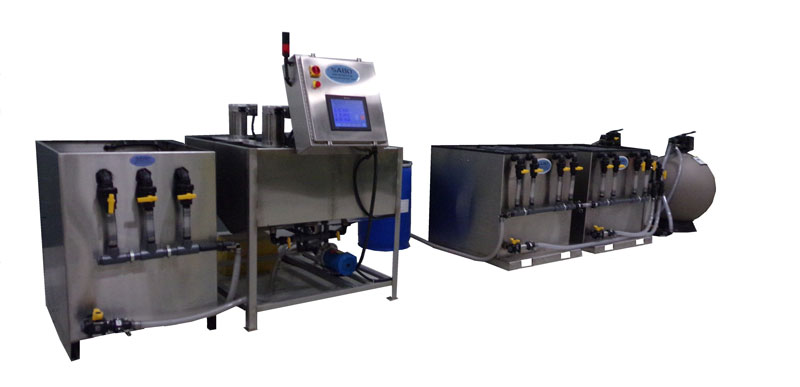
An automated wastewater treatment system can eliminate the need to monitor equipment in person while complying with mandated requirements. Such automated systems separate suspended solids, emulsified oil and heavy metals, and encapsulate the contaminants, producing an easily de-waterable sludge in minutes, according to textile industry consultants at Sabo Industrial Corp., a New York City-based manufacturer, distributor and integrator of industrial waste treatment equipment and solutions, including batch and fully automated systems, Cleartreat separating agents, bag filters, and accessories.
The water is typically then separated using a de-watering table or bag filters before it is discharged into sewer systems or further filtered for re-use as process water. Other options for de-watering include using a filter press or rotary drum vacuum. The resulting solids are non-leachable and are considered non-hazardous, so will pass all required testing.
These systems are available as manual batch processors, semi-automatic, automatic and can be designed as a closed loop system for water reuse or provide a legally dischargeable effluent suitable for the sewer system. A new, fully customized system is not always required. In many cases, it can be faster and more cost effective to add to or modify a facility’s current wastewater treatment systems when this is feasible.
Effective separating agents which agglomerate with the solids in the wastewater so the solids can be safely and effectively separated out are essential.
However, because every wastewater stream is unique to its industry and application, each wastewater treatment solution must be suited to or specifically tailored to the application. The first step in evaluating the potential cost savings and effectiveness of a new system is to sample the wastewater to determine its chemical make-up followed by a full review of local water authority requirements, report textile industry consultants at Sabo Industrial.
The volume of wastewater that will be treated is also analyzed, to determine if a batch unit or flow-through system is required. Other considerations include the size restrictions, so the system fits within the facility’s available footprint.
Treated industrial wastewater
Separating Agents
Despite all the advances in automating wastewater treatment equipment any such system requires effective separating agents which agglomerate with the solids in the wastewater so the solids can be safely and effectively separated out.
Because of the importance of separating agents for wastewater treatment, Sabo Industrial uses a special type of bentonite clay in a line of wastewater treatment chemicals called ClearTreat. This line of wastewater treatment chemicals is formulated to break oil and water emulsion, provide heavy metals removal, and promote flocculation, agglomeration and suspended solids removal.
Bentonite has a large specific surface area with a net negative charge that makes it a particularly effective adsorbent and ion exchange for wastewater treatment applications to remove organic pollutants, heavy metals, nutrients, etc. As such, bentonite is essential to effectively encapsulate the materials. This can usually be achieved in one-step treatment, which lowers process and disposal costs.
In contrast, polymer-based products do not encapsulate the toxins, so systems that use that type of separating agent are more prone to having waste products leach back out over time or upon further agitation.
Today’s automated systems along with the most effective Cleartreat separating agents can provide textile industry facilities with an easy, cost-effective alternative so they remain compliant with local ordinances. Although there is a cost to these systems, they do not require much attention and can easily be more economical than paying fines or hauling.
NEW YORK CITY — April 21, 2022 — Chargeurs*PCC Fashion Technologies today announced that it has expanded its leadership team with three new executive appointments. The company has named Fabrizio Vincenzi as COO, Nico Dapoto as chief supply chain officer and Giorgio Marcarino as general manager, EMEA.
Vincenzi brings decades of operational, sourcing and product development expertise to Chargeurs. His most recent corporate role was as chief product engineer and director of sourcing for Brooks Brothers, where he led development and sourcing, including cost management, through the company’s offices in New York, Hong Kong and Milan. He also previously served as product manager for Turkey-based Karaca and, for 15 years, as general manager of his own garment manufacturing company in Italy. Reporting directly to Gianluca Tanzi, CEO of Chargeurs*PCC Fashion Technologies and Chargeurs Luxury Materials, Vincenzi will focus on implementing efficient, sustainable and innovative solutions in the company’s eight manufacturing facilities around the world.
Dapoto is a leader in supply chain transformation in the fashion and apparel industry who most recently served as senior supply chain manager for UAE-based Chalhoub Group. Prior to that, he spent nearly five years in New York at Brooks Brothers in a series of planning roles, most recently serving as director, Demand Planning, Financial Planning and Analytics. He previously served as Global Demand planner for Luxottica Group. He holds both a bachelor’s and a master’s degree in Industrial Engineering from Università degli Studi di Modena e Reggio Emilia. Reporting directly to Tanzi, Dapoto will oversee global demand planning, procurement, warehouse management and logistics, as well as order management, fulfillment and delivery.
Marcarino, who brings more than three decades of fashion and textile sales, marketing and operational experience to the role, rejoins Chargeurs-PCC after having served as the group’s sales director for Italy in the 1990s. In his new position, he will oversee all sales and operations in the EMEA region, reporting directly to Tanzi. Marcarino previously spent more than 20 years in a series of leadership roles at Marzotto Group, most recently serving as sales and marketing director of Fratelli Tallia di Delfino, the luxury brand of the Italian textile group.
“Fabrizio, Nico and Giorgio bring decades of rich experience to Chargeurs in their respective areas of expertise—operations, global supply chain management and international sales,” said Gianluca Tanzi, CEO of Chargeurs*PCC Fashion Technologies and Chargeurs Luxury Materials. “We’re extremely pleased to welcome Giorgio back to the company and to add Fabrizio and Nico to the team as we continue to execute our global growth strategy, take advantage of our global manufacturing footprint, and focus on driving sustainability and digital innovation.”