Upholstery Fabrics Spring 2022 Consumer Trend Overview

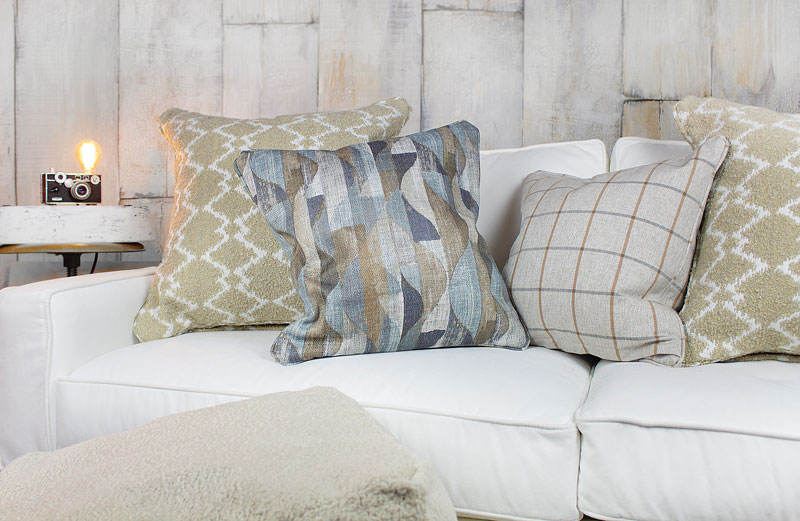
Fabrics featured in Culp’s Waterways LiveSmart® Spring fabric collection were designed to inspire a sense of renewal, restoration and healing.

Staying up-to-date with predicted home furnishings trends allows Culp to make products that will be successful in the marketplace.

TW Special Report

Successful home furnishings textile companies understand that they are in a fashion-driven industry. It’s an industry where designers must know what’s trending in the world of fabric and décor. Additionally, they must also understand factors influencing the ways that homeowners utilize their living spaces. In business for 50 years, Culp Inc., High Point, N.C., is one such successful textile company.

Tammy Buckner, Culp Upholstery Fabrics senior vice-president of Marketing & Design for Residential Fabrics, and Donna Morrison, vice president and creative director, are closely involved with following trends to help inform the company’s product decisions.

“We always stay up-to-date on the latest trends that are influencing consumer buying decisions and those are the catalyst for our innovation and product development strategy and direction,” Buckner stated.

What follows is a look at spring 2022 trends.

Social Media Trend Predictions

With travel still limited, consumers are looking to social media for trend direction. Pinterest, Houzz, and even Tik Tok have become important sources for consumers looking to find new trends and styles.

With more than 400 million users, one of the biggest drivers of trends is Pinterest. Each season, Pinterest releases its design trend predictions. In 2020 and 2021, 8 out of 10 of Pinterest’s predictions came true. Pinterest isn’t just ahead of trends, it’s also where trends grow the fastest and stick the longest. Pinterest trends increased about 56 percent in their first six months, while trends spotted elsewhere only grew about 38 percent during that same time.

Some of the trends Pinterest is predicting for 2022 include:

  • Curved Furniture — organic, flowing architecture with 360° views. It’s not just the front of the piece of furniture that needs to be considered, but also the back and sides. Culp is working on fabric designs that feature one type of fabric on the inside and a second on the outside. This is in line with what consumers are buying right now.
  • Barkitecture — furniture for pets. This trend goes much further than pet beds. With people working from home during COVID, pets were in laps, in home office spaces, or beside their owners if they were working on the sofa. So, as consumers are redesigning their homes and buying new furniture, they are keeping this in mind. They want to make sure their furniture is pet friendly.
  • Biophilic Design — making the space inside the home feel like a retreat, an escape. This brings in everything from floral ceilings to live and artificial plants.
  • Lake it Till You Make It — nearby lakes are becoming more popular. People are choosing lake homes as second homes/vacation homes instead of beach homes because of the cost. In an effort to better manage their time, people are opting to travel closer to home for vacations and are choosing the lake instead of a long beach vacation. This is something Culp has kept in mind as it designs novelty and specialty fabrics. It’s not all coastal, it’s more vacation and escape oriented.
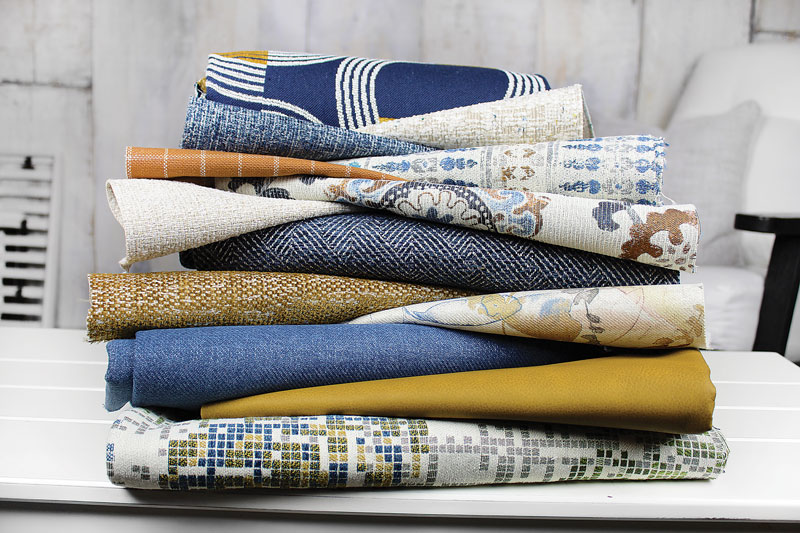
Culp’s Cobalt collection is part of its LiveSmart® Evolve fabric line. Cobalt features unique colors and textures in patterns that are both crisp and carefree.

Approximately 40 million people per month use Houzz to search for renovation ideas. Some 90 percent of Houzz users are homeowners, and 72 percent are between 25-54 years old. Houzz is predicting three main trends for 2022:

  • Multiple window banks — people want to be able to see the outdoors. They want to let in natural light, and this goes along with the biophilic design trend noted by Pinterest.
  • Cozy outdoor areas — during the pandemic, people looked to make the most of their outdoor living spaces such as decks, patios and balconies.
  • Practical storage solutions — people are tired of seeing clutter at home and are looking for ways to hide the clutter. There is a surge in consumer demand for furniture with hidden storage solutions.

Tik Tok is a major predictor of trends, and the platform is growing at a fast rate. Whether or not someone is a Tik Tok user, the platform still has influence. Many how-to videos such as how to refinish a piece of furniture or a cooking demonstration, and many posts seen on Instagram — perhaps a showroom or home walk-through — are made on Tik Tok and released on other social media platforms, so much so, that it does influence how consumers are buying today. Tik Tok is predicting that it will reach 755 million users in 2022, with 60-percent growth in 2020 and 40-percent growth in 2021.

Tik Tok predictions for home furnishings include:

  • Sustainability — Users are discussing ways to reduce, reuse and recycle in many ways. Everything from buying used furniture at thrift stores, to buying items that are made from sustainable materials, and finding ways to reduce their carbon footprint.
  • Botanical — Similar to biophilic design, this trend pairs houseplants with soft textures in the home, incorporates natural woods and brings the outside in.
  • Grand Millennial — This term is a combination of grandmother and millennial. The trend focuses on younger people furnishing their first home who may have a collection of furniture that was given to them that they mix with more modern pieces of their own. Anthropology is a company that offers lots of spin on this style of decorating.
  • Cottagecore — Cottage style has not been seen much since the late 1990s, but the trend is reviving. Floral wallpaper, vintage furniture and natural wood are all becoming popular again.
  • Electric Nostalgia — A fun, upbeat trend where designers are using iconic textures and patterns from the 70s, 80s, and 90s.

A Trend Towards Casual

Home furnishings trends right now are going very casual. Instead of a lot of pattern, consumers are seeking more textures and mix-and-match in soft, relaxed, comfortable fabrics. There also is a desire that fabrics accent the natural elements brought into the home.

Some of the most important trends Culp is currently focused on include:

  • Curve Appeal — This trend is a result of growing interest from customers. It brings back some of the nostalgia of the past because these types of frames historically were seen in the 1980s and 90s.
  • Cozy — Now, more than ever, when choosing a fabric for Culp’s line, it has to be soft and inviting. The hand has to be incredible. This trend is about naturals and layers of white-on-white, and bleached and natural woods for the pared-down home. It creates a modern and comfortable look that is growing. Much of Culp’s current line was created knowing that this is something people are looking for right now.
  • Technology — There is a big technology trend seen in motion furniture, which includes frames with integrated workstations, Wi-Fi, surround sound speakers, remote controls, wireless charging units and lights, for example. All of this is combined with a movement toward a sleeker, more modern look in motion furniture. It’s becoming more than just the over-stuffed recliners seen in the past. Hidden motion, where the frames don’t look like motion frames, also is increasing in popularity. There are hidden footrests, hidden headrests, lumbar support and massage features. All of this combines so consumers can relax and watch Netflix as long as they want to.
  • Leather Alternatives — Culp produces many faux and vegan leathers. Consumers want material that will hold up to modern-day life with pets and activity. Culp’s faux leathers are an ethical and sustainable option that performs better than leather. Faux leather also is much less expensive than real leather, making it a more affordable option for more consumers.
  • Pet Friendly Fabrics — Consumers are looking for upholstery fabric that can withstand pets, and also looks and feels good.
  • Performance Market Demand — Pre-COVID there was demand for performance fabrics, and the market was beginning to move toward that. But, COVID has exaggerated this whole movement. Culp has seen a lot of growth in this segment. Some consumers are remodeling, and some are buying furniture for the first time. There is demand for performance fabrics that are available at an affordable price. Previously, performance fabric was something obtained through a designer, or there was a $600 or $700 upcharge to obtain such fabrics. That’s not really the case anymore, and consumers expect fabrics to work for their families.
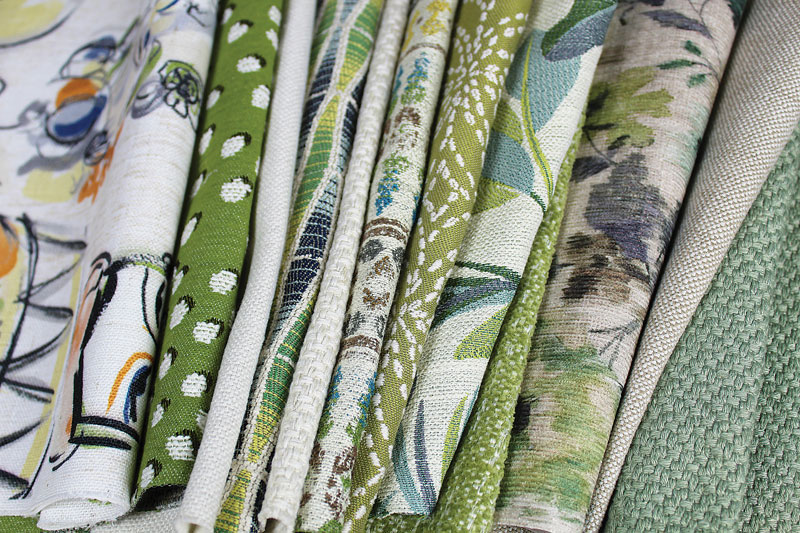
The calm embrace of healing green tones in Culp’s LiveSmart® Juniper collection creates rich layers of texture that aim to restore and comfort.

Fabric That Performs

The demand for performance fabrics is something that is driving a lot of innovations at Culp. The performance trend has given a huge boost to its LiveSmart® brand, which has been the company’s premium brand for about five years now. Since its launch, the company has expanded different areas where it sees demand for performance fabrics. LiveSmart is cleanable, stain-resistant, water-repellent, and now also is fluorine-free. LiveSmart technology combines a performance fiber with a performance finish, so it gives the fabrics inherent durability and longevity. It’s great for families with pets and children — people who use their furniture heavily every day.

The LiveSmart product line includes:

  • LiveSmart Washables — Keeping things clean became top-of-mind during the pandemic as most people stayed home. This is where the slipcover trend started taking off. Culp’s LiveSmart Washables embraced this trend and many retailers are now adding slipcovers to their product lineup.
  • LiveSmart Outdoor® — Culp’s LiveSmart Outdoor performance fabrics have become even more popular as outdoor living spaces become more important. The fabric can also be used indoors in areas such as dining rooms and children’s rooms.
  • LiveSmart Evolve® — This is Culp’s LiveSmart line with an added sustainability component. Fabrics are made using recycled water bottles. Sustainability is something Culp continues to focus on as a company, and the line continues to grow. The premise is to capture the water bottles before they enter landfills, before they enter waterways, and before they enter oceans.

Culp has offered LiveSmart Evolve fabric for more than three years now. Initially, there was some resistance. Some of retailers said it wasn’t for them, that their customers didn’t want to pay more for a “sustainable fabric” option. This attitude is something the company has seen a huge shift in lately. There is a bit of a disconnect going on between consumers and retailers. In the past, consumers liked the idea of sustainable fabrics, but they didn’t want to pay more. Attitudes have now changed. Consumers are asking for sustainable options and are definitely willing to pay more.

The fact that 75 percent of people value sustainability over brand name is another big change. A lot of small companies, especially e-commerce companies focused on sustainability, are making a huge impact on customers, and customers want to spend their money with those retailers. Today, Culp sees consumers pushing retailers to be more sustainable.

One of the important factors Culp considered when creating its LiveSmart Evolve brand of fabric was traceability. Greenwashing is common — where companies say they are sustainable, but upon examination, they really aren’t. Culp wanted to be sure it could trace the sustainability factor all the way through the supply chain. This traceability is something that Greensboro, N.C.-based Unifi Inc. offers with its Repreve® yarn. Each fiber is stamped with Unifi’s U-Trust branding, which gives consumers and retailers a certifiable way to trace the fabric and prove that it is made with sustainable materials. This fiber enables Culp to certify every fabric it introduces.

Additionally, retailers now can include a certification number with their frames and anything they produce using these sustainable fabrics that the consumer can punch into the Unifi portal, and actually see the number of recycled bottles that went into their piece of furniture. This is a big step for the industry, and the consumer can really see the impact of their purchasing choice.

Culp’s LiveSmart® Terra collection features a blend of various colors and textures to lend a multidimensional tone.

Making A Difference

To date, Culp has incorporated more than 86 million recycled plastic bottles into its LiveSmart Evolve fabric, which is an exciting innovation for the company and a step it is really proud of. Culp feels like this is a space where it can really make a difference and the company continues to grow its line.

Some Culp customers use exclusively recycled materials. They use recycled filling, biodegradable bags and recycled steel for the frames, for example. There are many manufacturers who focus on sustainability from beginning to end, from the process to the product they are making. Culp offers its LiveSmart Evolve fabrics in multiple price points to open up the marketplace and make its products available to consumers in all segments of the market.

“It has been a period of time in our business where there have not been many new products introduced at retail,” said President and CEO Iv Culp. “You can see from our designers’ perspectives that there is a lot of opportunity for us with new products. Sustainability and performance will drive the day, but what our designers can do with texture, color and merchandise packages there is a lot of upside to us as we look into some new roll-outs into retail. People have been so busy and so backlogged, that they haven’t been focused on launching new items, but there is a nice trend of that heading forward that we’re certainly motivated by.”

May/June 2022
Repurposing Textile Waste

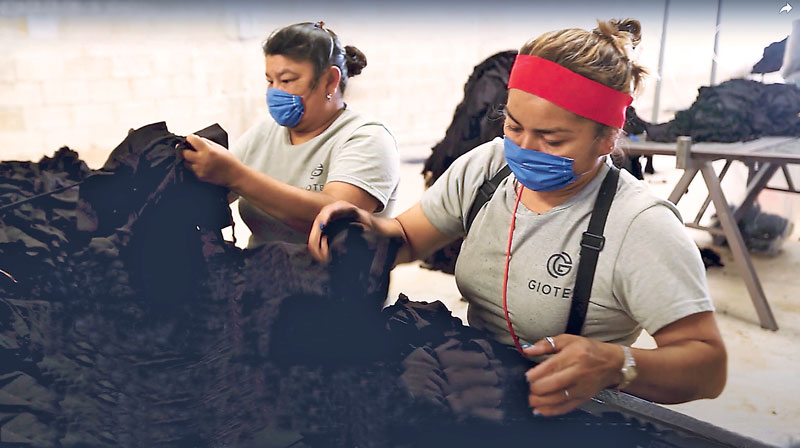
Giotex workers sorting textile waste

Accelerating Circularity is engaged in research and trials with the goal of making textile-to-textile recycling possible to reduce textile waste.

TW Special Report

Accelerating Circularity is a non-profit organization formed to transition textile supply chains from linear to circular to reduce textile waste and its detrimental impacts on the environment. The mission is to design and implement commercial systems where textile waste is repurposed as raw material through reuse and recycling and therefore no longer sent to landfills and incineration. Accelerating Circularity believes that spent textiles are too good to waste.

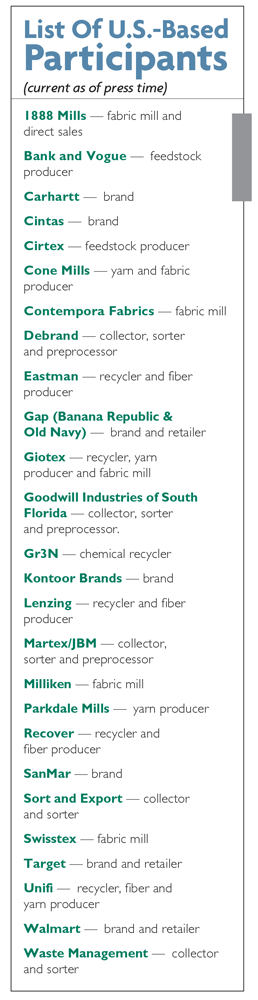
Accelerating Circularity Inc. was founded in 2019 by Karla Magruder with GAP Inc., Giotex, Gr3N, Lenzing, Target, Unifi Inc., and VF Corp. as founding members; and with funding from Gap, Target, VF Corp. and a grant from the Walmart Foundation. The Accelerating Circularity community believes it will take the cooperation of the entire industry to make meaningful change. The initiative is unique in its focus on developing the entire system required for textile-to-textile recycling. Investment in circular systems will be one of the tools allowing companies to meet their commitments on recycled inputs and greenhouse gas (GHG) reductions. In addition to founding partners, and trial team participants, Accelerating Circularity also convenes the Collaborating Organization’s Group which includes:

  • American Apparel & Footwear Association;
  • Fashion For Good;
  • United States Fashion Industry Association;
  • Apparel Impact Institute;
  • Fashion Takes Action;
  • Secondary Materials & Recycled Textiles;
  • Textile Exchange;
  • Outdoor Industry Association;
  • Retail Leaders Association; and
  • Circle Economy.

Accelerating Circularity’s vision is a world where textiles are in continuous use, the adoption of virgin materials is based on strategic limits and the industry has lowered environmental impacts.

Solving A Problem

Today, the textile industry generates enormous waste — the United States’ municipal solid waste stream alone contains 16.9 million tons of textiles annually.1 Clothing under-utilization and lack of recycling are responsible for annual global economic losses of $500 billion.2 Less than 1 percent of used clothing is recycled into new materials.3

To mitigate these issues, the textile industry must become circular. The need to eliminate waste and reduce the need for virgin raw materials is essential to reduce planetary impacts in the areas of energy, chemicals and water. Textile waste must become the industry’s new raw material.

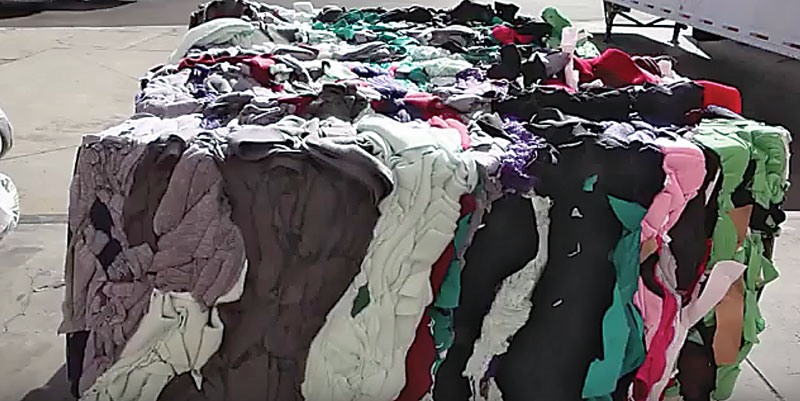
Bales of post-consumer textile waste

Focus And Process

Accelerating Circularity’s initial focus has been on developing trials in the United States as well as the manufacturing belt in Mexico and Central America targeting and engaging textile networks used by U.S. brands and retailers. There is a separate Accelerating Circularity project for Europe.

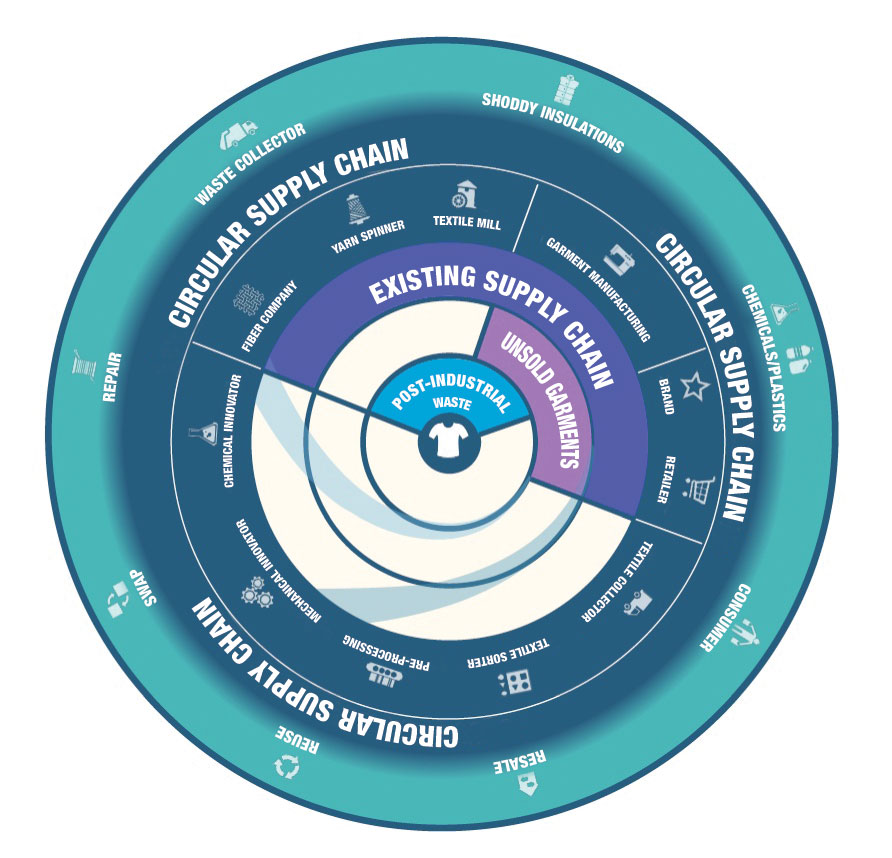
The organization’s process has been to:

  • RESEARCH existing systems for textile feedstock generation, collection, sorting, preprocessing, recycling, apparel & product development, and brands and retailer targeted circular products;
  • MAP existing systems and identify gaps;
  • MODEL new circular supply chain systems for textile-to-textile supply networks;
  • LINK the newly identified supply chain systems;
  • PILOT textile-to-textile supply networks at scale levels of approximately 10,000 units;
  • REPORT on all findings from research through piloting; and
  • DEVELOP TOOLS to facilitate future trials and expedite circular systems.

Research has revealed significant gaps and opportunities in the sorting and preprocessing of post-consumer textile waste in preparation for recycling. Post-industrial materials are typically sorted at the generating facilities.

Currently, a large part of post-consumer textiles in the United States is collected by the three largest thrift operators — Goodwill, Salvation Army and Savers/Value Village — along with collection bin operators.

Other collection channels include clothing drives, brand/retailer takeback programs, and online thrift operators using mail-in collections such as Thredup. Clothing not collected typically winds up in landfills through the municipal solid waste (MSW) stream. Because MSW collectors already handle so much of this material, they — along with the municipalities and local governments they serve — must play a future role in diverting it from incineration and landfill into our new textile recycling pathways.

The next step, sorting, has challenges that demonstrate a serious gap. Today, spent textiles are manually sorted into fractions tailored for reuse markets. Non-reusable items are sorted into grades for shoddy, wipers and mechanical recycling. Reduced sorting costs and increased accuracy of fiber detection are prerequisites to scaled circular supply chains for textile-to-textile recycling. This requires commercialized, automated sorting solutions as well as some workforce development opportunities.

The fiber content and volume of collected material vary by season and location. Since individual recycler processes are specific when it comes to fiber and volumes there is a need for aggregation to meet each recycler’s unique requirements. Because the capability for this step currently exists in some form by various actors already collecting and sorting spent post-consumer textiles, aggregation could scale quickly once there is sufficient demand.

Preprocessing of spent consumer textiles into recycling feedstocks includes hard part removal, print removal, sanitizing/laundering and right sizing. Today, little preprocessing is done for textile-to-textile recycling. It is a key gap and opportunity for development in order to scale spent textile recycling.

Studying The Issue

To focus on the social aspects of the circular economy, Accelerating Circularity commissioned research and prepared a white paper to define where more workers will be needed to collect, sort and process recyclables.

The Accelerating Circularity study indicates that the textile-to-textile recycling workstream may offer some longer terms strategic advantages that the reuse/resale marketing does not. For example, potential support for onshoring and growth of the existing workforce.4

Sorting is a critical function although today it is generally considered an entry-level, unskilled job with minimum compensation. At the same time, it is physically demanding. The reuse/resale market relies on intense sorting to generate income through the grading of reusable items. While some technologies are in development and can automate specific parts of the sorting process, they are not fully functioning. Many of those interviewed for the workforce study believe sorting will remain a combination of automated and manual labor.

Post-consumer textile collection has a workforce and an infrastructure development opportunity — to make the consumer donation of unwanted clothing more convenient and to maximize the diversion from landfills. Policy and legislation are critical to empowering job creation through the establishment of a circular economy. A 2020 study by the European Apparel and Textile Confederation (EURATEX) estimates that about 20 jobs can be created for every 1,000 metric tons of textiles collected, sorted and recycled in the European Union.5

Next Phase Of Trial Development

After extensive work mapping, modeling and linking potential circular value chains, Accelerating Circularity embarked on the next phase of trial development in the fourth quarter of 2021. The objective is to utilize post-consumer and post-industrial feedstocks for circular textile-to-textile processes available today at scale and in pre-commercial stages with output to fiber, yarn, fabric, and ultimately into products under the categories of fleece, towels, workwear, tees and denim. Targeted outcomes include the demonstration of the feasibility of circular textile-to-textile systems, collection of data on quality/aesthetic metrics and economic/environmental impact versus the production of virgin materials, and tool development to expedite the move to circular systems.

The scope and scale of the U.S.-based project trials include 12 unique recycled products in multiple yarn combinations and fabrics with the aim of manufacturing into a minimum of 10,000 product units per trial or through a combination of brand partners. Newly collected and presorted textiles, namely, post-consumer and post-industrial cotton and polyester feedstocks, have gone to recyclers and will be chemically and mechanically transformed into newly recycled fibers. These new recycled fibers will then be spun or extruded into cotton, polyester, poly/cotton, and Tencel™ Refibra™ blended yarns. Throughout, data will be collected on quality, aesthetics, and performance and detailed in future Accelerating Circularity reporting.

Moving Towards Circularity

These trials are at the forefront of the industry’s move to circularity. It is the first time for a group to develop circular products at scale. Having the entire value chain from collectors, sorters, pre-processors, recyclers through to brands and retailers is critical to success. Everyone is pulling together with the goal of making textile-to-textile recycling possible.

“We are constantly learning as we move ahead with each stage of these trials,” said founder and CEO Magruder. “Stay tuned for future Accelerating Circularity reporting as we intend to share the collected information and data from these scaled trials. The trial participants are essential to making this a successful endeavor. “


References:
1 U.S. Environmental Protection Agency. “Advancing Sustainable Materials Management: 2017 Fact Sheet.” EPA website, 2017, epa.gov/sites/production/files/2019-11/
documents/2017_facts_and_figures_fact_sheet_final.pdf. Accessed March 10, 2020.
2 Ellen MacArthur Foundation, 2017, A New Textiles Economy: Redesigning
Fashion’s Future, ellenmacarthurfoundation.org/assets/downloads/publications/
A-New-Textiles-Economy_Full-Report_Updated_1-12-17.pdf. Accessed 2020.
3 Ibid.
4 Organization for Economic Cooperation and Development (OECD),
Labor market consequences of a transition to a circular economy (2020)
5 EURATEX, ReHubs: A joint initiative for industrial upcycling of textile waste &
circular materials (2020)


May/June 2022

U.S. Textile Reshoring: Its Complicated

Intradeco Holdings announced more than $100 million of investment in Central America, part of which will be used to expand the company’s solar energy power.

The western hemisphere textile industry continues to hear the promise of reshoring, but exploring the practical, rational and non-monetary implications is complicated.

By Jim Borneman, Editor In Chief

Reshoring or near-shoring textile and apparel supply chains to the United States and Western Hemisphere really isn’t a new topic. For many years, Western Hemisphere groups have tried to make a case for sourcing close to where products will be sold. Even when exploring the total cost and speed-to-market issues, cost often worked against sourcing close to home and was maligned as protectionist as retailers and brands searched for the latest “cheap needle.”

Free Versus Fair Trade

In the past, promotion of Western Hemisphere-focused supply chains often devolved into trade law debates labeling Western Hemisphere promoters as protectionists — or fair-traders — and global sourcers as globalists — or free-traders — that wanted to let the market speak for itself.

For many years, these debates surfaced with every discussion of a new free-trade agreement (FTA), regional trade agreement — such as the Caribbean Basin Initiative (CBI), Caribbean Basin Trade Partnership Act (CBTPA), North American Free Trade Agreement (NAFTA), Dominican Republic-Central America Free Trade Agreement (CAFTA-DR) and United States–Mexico–Canada Agreement (USMCA) — and even the ascent of China into the World Trade Organization (WTO).

The apparently emotional argument that global sourcing would lead to supply chain vulnerabilities was only envisioned in the supply of goods to the U.S. Department of Defense (DoD).

The Berry Amendment was formed to insist that purchases to supply US military personnel would consist of 100-percent Made-in-America product, diminishing the DoD’s reliance on foreign supply chains.

Enter COVID-19: Vulnerabilities Exposed

When the COVID-19 pandemic took hold in 2020, it really didn’t take very long to to see how exposed Americans were because of the lack of domestic production and manufacturing of an array of goods.

Things most people rarely thought about were now essential items — N-95 masks and other personal protective equipment (PPE), swabs for tests, ventilators, and the list goes on.

As consumers moved through the pandemic, supply chain disruptions came into focus with shipping issues, component shortages and lockdowns crippling labor and even threatening Christmas.

Time For A New Discussion

With the supply chain challenges top of mind, maybe it is worth considering a look at the promise of re- or near-shoring. With a focus on exploring the practical and rational implications at play and acknowledging the world has truly changed, the economics of trade need to be reimagined. Energy prices, shipping expenses, time-on-the-water — or the cost of speed-to-market — investment in downstream supply and infrastructure all are under examination.

The Rise Of Non-Monetary Social Costs

If phrases like traceability, circularity, forced labor, slave cotton, green manufacturing, sustainability, carbon footprint, fair labor practices are entering a sourcing decision-making-process, then factoring them into the re- or near-shoring calculation is essential. The challenge of considering non-monetary factors in a costing model has always been an issue of the product’s total cost — even valuing the cost effect of sustainability in a pre-COVID sourcing world or time-on-the-water as a cost of speed-to-market.

Investments In Central America Are Happening

As previously reported by Textile World, significant investments are occurring in Central America in support of near-shoring.

Miami-based Intradeco Holdings announced investments of more than $100 million in three major projects in Central America to make the most of CAFTA-DR and nearshoring opportunities, advance full circularity, and expand solar power. Its first project is the Central American Spinning Works, a state-of-the-art ring spinning mill in Honduras that began operations earlier this year. The second project is the creation of a manufacturing plant in El Salvador that uses 100-percent recycled yarns — both cotton and man-made fibers. A third project will allow the company to expand its solar energy power to attain 30 megawatts by the third quarter of 2022.

Intradeco Holdings has invested in three major projects in Central America including a plant in El Salvador that uses recycled yarns for which the company selected recycling technology from France-based Laroche.

“[Our] announcement is consistent with our 40 years of innovation and service which comes with being an integral part of the textile, apparel, and retail industries,” said Intradeco Chairman Felix Siman. “With our comprehensive distribution channels and state-of-the-art supply chain, we can reach our customers in an efficient and cost-effective manner in the shortest time possible. Intradeco is a founding member in The HUGE (Honduras, USA, Guatemala, El Salvador) Business and Investment council. Through these investments, our company is helping to create more than 1,000 jobs in Central America, while contributing to the region´s environmental sustainability objectives.”

Also reported recently by TW: “Gastonia, N.C.-headquartered Parkdale Mills, one of the largest manufacturers of spun yarn and cotton consumer products in the world, will make a multi-million-dollar investment in a new yarn spinning facility in Honduras and make an additional substantial investment to support existing operations in Hillsville, Va. This investment will help customers shift 1 million pounds of yarn per week away from supply chains in Asia and China and enhance U.S. and CAFTA-DR co-production resilience and increase regional product offerings. Parkdale’s announced investment will create hundreds of jobs in Honduras and further support hundreds of employees in Parkdale’s Hillsville operations.”

“Parkdale’s investments will support good paying jobs in the United States and in the Central American region and significantly increase our extensive product offering and capacity, including the production of sustainable specialty yarns,” noted Parkdale’s Chairman and CEO Anderson Warlick.

Future Trade Differences Could Undermine Efforts

As previously stated, trade activity always seems to breed challenges and uncertainty to existing trade agreements. As consideration of nearshoring continues there is no doubt that the basic principles that underlie existing trade agreements will be reexamined and relitigated with all parties seeking an advantage. This can be destabilizing for those taking nearshoring and the investments necessary to perform at the highest levels and deliver a revitalized nearshoring supply chain seriously.

Look for the “yarn-forward” rule of the CAFTA-DR agreement to come under attack. Simply put, to ship a CAFTA-DR member country-made product into the United States duty free, it must be made from U.S.-made or indigenous yarn — yarn made in the CAFTA-DR member country of the product’s origin. This really disincentivizes importing Asian fabric — not made with U.S. or indigenous yarn — into CAFTA-DR countries to be made into garment for export to the United States because such products cannot enter duty free.

Herndon, Va.-based Werner International released a report in January 2022 titled, “The Economic and Societal Impact of the Yarn Forward Rule on CAFTA-DR Signatories.” The report is certainly worth the read if nearshoring or investment in the nearshoring supply chains is part of your business strategy.

Duty Free Matters

Access to the U.S. market “duty free” is the reward for most trade agreement compliance. But for most in the industry, it simply means a price advantage compared to competing imports. The Werner International report provides some interesting benchmarking data that illustrates the effect of duties on landed duty paid U.S. prices of several garments made in China compared versus the same garments made by CAFTA-DR members in Honduras.

Werner compared a men’s 100-percent cotton basic T-shirt, a men’s 100-percent polyester active T-shirt, men’s five pocket cotton jeans and women’s trousers with a fiber content of 96-polyester/4-percent lycra (See Table 1).

Table 1: Note: Landed Duty Paid includes duties, freight and insurance fees

According to the Werner evaluation, the “… table [located on page 17 of the report] shows the outcome in terms of the ex-factory price for each garment produced, the import duties paid into the U.S., and the final price, including duties paid, freight, and insurance costs.

“As the table … demonstrates, duty-free access to the U.S. market makes CAFTA-DR countries globally competitive for the U.S. market across the spectrum of apparel products. The duty-free access and close proximity to the U.S. market along with a strong, integrated coproduction chain are the inherent advantages of the US-CAFTA-DR trade relationship. The region is competitive on pricing because of this combination of factors.”

Werner goes on to state: “… China has a significant advantage in terms of raw material costs, particularly in synthetics. But the data also demonstrate that China’s pervasive price manipulation can be offset by the application of duty-free benefits for qualifying goods under the CAFTA-DR agreement.”

Keep in mind that China’s “price manipulation” is a longstanding point of contention between those identifying as free-traders versus fair-traders. But Werner also states that “[The] Central American polyester yarn industry has invested millions of dollars in the last two years and is projected to invest more in the next two to three years, which will improve the region’s competitiveness in regard to labor, energy, speed, and flexibility. These technology investments in polyester yarn production will yield significant cost improvements related to labor and energy and narrow the gap compared to China’s synthetic yarn costs.”

The duties imposed on the four product examples ranged from 24 to 39.5 percent and move each product from a more expensive Honduran ex-factory price, to a less expensive Honduran landed duty paid U.S. price, which illustrates the power of CAFTA-DR compliance.

Will The Promise Be Kept?

Only the future performance of the on- and near-shoring supply chain participants, or co-producers, in relationships with top brands and retailers will tell if the the promise of textile reshoring is real and a part of the future. Significant challenges lie in valuing the benefits provided by the region and the economics of global trade being reimagined. There will be challenges to the yarn forward rule, which could impact other existing regional trade agreements. There is a lot at stake — investments, jobs and supply chain vulnerabilities all will play a role in the outcome.

May/June 2022

Calida Acquires Cosabella

The Calida Group, Switzerland, recently acquired Miami-based lingerie and loungewear brand Cosabella for $80 million including earn out. The family-owned business, managed by the second-generation, employs 50 people and generated sales totaling $29 million in 2021. The Calida Group hopes the acquisition will help pave the way for its Calida and Aubade brands to enter the U.S. market, and also will unlock Cosabella’s growth potential in both the United States and Europe.

“With the acquisition of the strong e-commerce brand Cosabella, we continue focusing
the Calida Group on its core segment while simultaneously enhancing its online growth,” said Hans-Kristian Hoejsgaard, chairman of the board of directors of the Calida Group.

May/June 2022

Centric Buys Daytona Apparel’s Hosiery Division

Centric Brands LLC, New York City, reports it has acquired Daytona Apparel Group’s Hosiery Division. Daytona — a portfolio of retail brands owned by Windsong Brands — will continue to independently operate its other categories. According to Centric, the purchase expands its “retailer relationships and its private label and licensed businesses,” as well as adds license agreements with Stanley, Free Country, Real Tree and Umbro.

“Our scale and competitive edge in the accessories marketplace benefits from this transaction,” said Jason Rabin, CEO of Centric Brands.

May/June 2022

G-III Apparel Acquires 100-Percent Of Karl Lagerfeld

New York City-based G-III Apparel Group Ltd. — which currently owns 19 percent of the fashion brand Karl Lagerfeld — has entered into an agreement to purchase the remaining 81-percent interest in brand for 200 million euros (approximately $210 million) in cash from a group of private and public investors.

“This transaction marks yet another significant milestone for G-III,” said Morris Goldfarb, G-III’s chairman and CEO. “Since acquiring a stake in the brand in 2015, G-III has built Karl Lagerfeld into an important and rapidly growing part of our North American business. Fully owning this visionary brand is a continuation of our successful partnership with the Karl Lagerfeld management team.”

May/June 2022

TSG Begins Modernization

TSG Finishing LLC, Devon, Pa., has started phase one of a modernization project to update its primary finishing equipment, which includes seven tenter frames. The company cites newer technologies for improved quality, efficiencies and safety as reasons for the upgrades. Phase one includes a tenter from South Korea-based Ehwha for its synthetics plant in Hickory, N.C., which should be installed beginning late summer.

“We vetted almost every tenter manufacturer and decided that Ehwha was the best fit for the wide variety of textiles we process on a daily basis,” said Michael Goldman, president. “In recent years, TSG has had to design numerous textile coating and handling methods, all of which must be retrofitted to one of our exiting tenters. This new piece of equipment will allow us to further expand our technical abilities and entertain programs that we currently cannot handle.”

May/June 2022

Baldwin Supplies Graniteville, NC State’s ZTE

St. Louis-based Baldwin Technology Co. Inc. recently completed the installation of a TexCoat G4 finishing system at Graniteville Specialty Fabrics, Graniteville, S.C. The coated fabrics producer selected the TexCoat G4 as part of a major facility upgrade.

“Anytime you change from a traditional process like padding, it is human nature to be a little skeptical,” said Doug Johnson, executive vice president of Development and Technical Services, Graniteville Specialty Fabrics. “Baldwin organized production-scale trials for us at a nearby TexCoat-equipped factory. We took the finished fabric and scrutinized the look and feel, and performed a battery of tests in our lab to American Association of Textile Chemists and Colorists spray-rating and hydrostatic-head standards. The results were impressive.”

In other Baldwin news, the company recently partnered with the Zeis Textiles Extension (ZTE) at North Carolina State University’s Wilson College of Textiles, Raleigh, N.C. The university now houses a TexCoat G4 in its dyeing and finishing lab that can be used as a pilot lab to test processes and products at industry scale. ZTE’s labs employ student workers who also can use the equipment for their capstone and research projects.

May/June 2022

May/June 2022: People

Monique Buch was named vice president, Global Nonwovens Business, for Austria-based Lenzing Group.

Austria-based Borealis has appointed Mirjam Mayer vice president of Polyolefins Transformation. She is responsible for leading the Borealis Polyolefins, Innovation & Technology and Circular Economy Solutions initiatives.

Toronto-based Canada Goose Holdings Inc. named Carrie Baker president.

Jeff Tsacoumangos

Culp Inc., High Point, N.C., promoted Jeff Tsacoumangos to Divisional COO for the company’s mattress fabrics division Culp Home Fashions.

Mathieu St-Arnaud Lavoie was named executive director of Montreal-based mmode, the Metropolitan Fashion Cluster.

John S. Madej has joined Web Industries Inc., Marlborough, Mass., as president. He reports to CEO Mark Pihl.

Denim and sportswear brand True Religion named Scott McCabe senior vice president, Ecommerce.

Cocona Labs, Boulder, Colo., recently announced Wes Burgess as chief product officer.

Ari Gasner

Ari Gasner has joined Hudson, N.C.-based Sattler® Outdura®, a division of The
Sattler Group, in sales for Outdura Contract.

Putnam, Conn.-based Dimension-Polyant has hired Jonathan Mersereau as the sales manager for its X-Pac® waterproof laminates.

Dearborn, Mich.-based Carhartt has promoted Katrina Agusti to chief information officer.

Dwayne Miller was appointed CFO of Techmer PM LLC, Clinton, Tenn.

Greenville, S.C.-based Delta Apparel Inc. has added Sonya E. Medina to its board of directors.

England-based PPT Group UK has promoted Neil Pryke managing director. The new role covers PPT Group companies James Heal and Mecmesin.

HanesBrands, Winston-Salem, N.C., has appointed Vanessa LeFebvre president of Global Activewear. In this role, she will drive growth for the Champion brand.

The Institute for Advanced Composites Manufacturing® (IACMI), Knoxville, Tenn., has named Dale Brosius interim CEO.

Dr. Janpeter Horn, managing director of August Herzog Maschinenfabrik, was named the new chairperson of the Germany-based VDMA Textile Machinery Association. The group also elected Regina Brückner, managing associate of Brückner Trockentechnik, and Verena Thies, managing shareholder of Thies Textilmaschinen, vice chairpersons.

Tom Doerr was named executive vice president, general counsel and corporate secretary for Kontoor Brands Inc., Greensboro, N.C. The company also appointed Mame Annan-Brown global head of Environmental, Social and Governance (ESG).

Wise

Henderson T. Wise was promoted to president and CEO of A.B. Carter Inc., Gastonia, N.C.

Bedding manufacturer American Textile Co. (ATC), Duquesne, Pa., promoted Karen Rocco from vice president of finance to CFO. She is the company’s first female CFO and replaces John Riccio who retired after almost 30 years with ATC.

Chris Heard was promoted to president and CEO of Sage Automotive Interiors, Greenville, S.C. Former company president Dirk Pieper has transitioned to chairman of the board for Sage and a lead executive officer for Asahi Kasei, Sage’s parent company.

Russell E. Toney was elected to the board of directors at Albany International Corp., Rochester, N.H.

Boston-based BRUNT Workwear named Kevin Eskridge president.

Butler

Scott Butler has returned to Jones Family of Companies, Humboldt, Tenn., as COO. Butler is a third-generation employee who worked for the company from 1992 until 2018 before leaving for personal reasons.

Donna Anderson was promoted to vice president of finance for Nester Hosiery, Mt. Airy, N.C.

Under Armour Inc. CEO and member of the board Patrik Frisk will step down effective June 1. Company COO Colin Browne has been appointed interim president and CEO until the board identifies and names a successor. To support the transition, Frisk will remain with the company until September 1 in an advisory role.

May/June 2022

May/June 2022: Bulletin Board

Cone’s Mental Health Awareness Selvage Denim

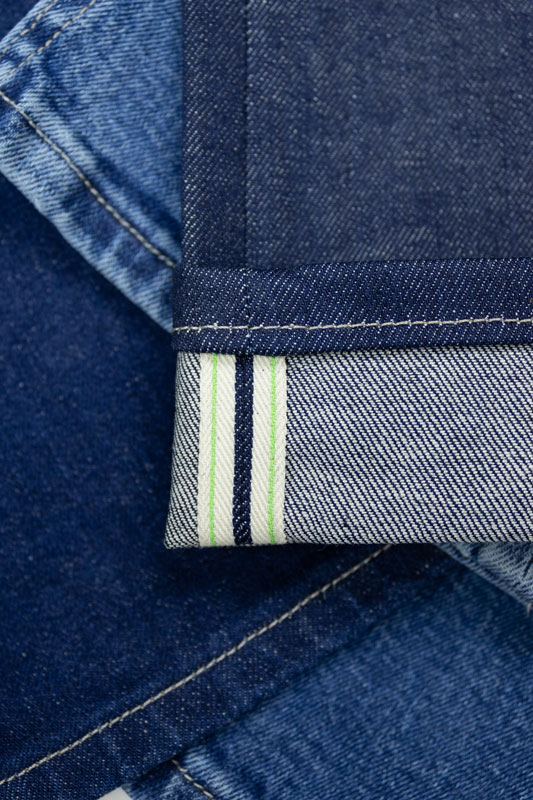
Cone Denim®, Greensboro, N.C., has added Mental Health Awareness Selvage Denim to its Cone® Community Collection. The fabric, supporting Mental Health Awareness Month, features a bright Distilled Indigo™ shade and a green selvage ID.

Heathcoat Fabrics, England, was recognized with the Queen’s Award for Enterprise for Innovation for its high-performance DecelAir Superlight parachute fabric that helped deliver NASA’s Perseverance Rover onto the surface of Mars.

TREW, Portland, Ore., has introduced a line of Nuyarn merino wool T-shirts.

DNA Technical Fabrics, Columbus, Ga., recently celebrated its 20th anniversary.

The Belgium-based European Committee Of Textile Machinery Manufacturers (CEMATEX) has introduced an online business platform for ITMA 2023 participants. ITMAconnect complements the 2023 exhibition to be held June 8-14, 2023, in Milan, and enables exhibitors and visitors to build connections and source technologies prior to the show.

Brenntag, Reading, Pa., is now a distributor for Archroma products in the United States and Canada.

weaveRIGHT® Technology has licensed its patented weaving process to Standard Fiber, which now has the rights to develop and distribute bath products made using the technology to home retail and hospitality markets.

Delta Galil Industries Ltd., Israel, and adidas have launched a full-range Spring/Summer 2022 collection of underwear for adidas Originals and Badge of Sport.

Milliken & Company, Spartanburg, S.C., was named to the Forbes Best Employers for Diversity list for 2022. The company also recently published its fourth annual Sustainability Report, which includes progress towards its 2025 Sustainability Goals.

Charlotte, N.C.-based Elevate Textiles — comprised of American & Efird, Burlington, Cone Denim, Gütermann and Safety Components — recently issued its 2022 Sustainability Report. The report includes actions to advance its commitments and updates to the company’s 2025 Sustainability Goals, as well as progress on its Ten Threads of Sustainability.

The Association of the Nonwoven Fabrics Industry (INDA), Cary, N.C., recently published the 9th edition of its North American Nonwovens Supply Report. The 75-page report, supplied to INDA member companies and associates, includes 36 figures and 11 tables.

Italy-based ACIMIT, the Association of Italian Textile Machinery Manufacturers, has unveiled a new corporate identity. The association’s logo, website and brand book all feature new designs.

England-based workwear textile manufacturer Carrington Textiles recently received Joint Supply Chain Accreditation Register (JOSCAR) accreditation. This compliance system for suppliers to the defense, aerospace and security industries acts as a single source for pre-qualification and compliance information to improve efficiency of both the supplier and buyer communities.

San Francisco-based GAP Inc. recently issued its 2021 Environmental, Social and Governance (ESG) Report. The report includes progress that the company and its brands — Gap, Old Navy, Banana Republic and Athleta — have made toward building a more sustainable and inclusive business.

Austria-based Zimmer Austria recently sold a Modus Loop Steamer to FlagSource, J.C. Schultz Enterprises in Batavia, Ill. FlagSource will use the steamer to finish digitally printed nylon flag material for its high-quality flag products.

England-based Sun Chemical has introduced ElvaJet Onyx SB sublimation ink for
digital textile printing.

Japan-based YKK Corp. has joined the Ellen MacArthur Foundation Network.

Glen Raven, N.C.-based Sunbrella® recently released its first ever Marine Trends Report. This insight tool for fabricators and manufacturers details influences defining new looks and feels in marine upholstery.

May/June 2022

Sponsors