Spectrophotometers paired with color management software help provide objectivity, ensuring consistency and reducing mistakes during production.
Digital color management programs simplify the color approval process and ensure accuracy in the supply chain.
By Lisa Beck
Brands must continue to keep up with production and react to trends despite ongoing global events causing shifts in the textile industry. Disruptions to the supply chain, material shortages, changing sourcing strategies, evolving job roles, shifting government policy, and public demand for sustainable practices are causing uncertainty across all industries, but color professionals can rely on digital color management technology to minimize at least some of the impact.
A well-implemented color management program not only reduces waste, but saves time on color submissions, assists with efficient communication across the supply chain, and keeps business moving while meeting the color quality expectations of consumers.
Ensuring Accurate Color
Because the apparel industry is, by nature, constantly in flux from the ebb and flow of trends — regardless of world events — designers and color managers will sometimes say a color is visually “close enough” to get a collection to market quickly. The downside of this tactic? Quality and color accuracy may be sacrificed and that can end up damaging the brand’s reputation.
Color can be tough when you don’t have the right tools. Human color perception is subjective — meaning we all see color differently — and therefore, relying on our eyes alone to assess color is a fallible process. Although using a lightbox to evaluate fabric can certainly be part of a color control program, a more objective means of color evaluation is needed to avoid the effects of colorimetric phenomena like metamerism.
For example, lab dips for a matching separates collection looked perfectly matched when compared to the fabrics in the lightbox, but when the finished collection arrives at the retail store — where the lighting differs from what was used to evaluate the samples — consumers may notice those “matching” separates are different by a shade or two.
Digital color management tools, like spectrophotometers paired with the right software, help bring objectivity to the color assessment and approval process. When color can be communicated digitally across the supply chain in seconds, consistently accurate color measurement is ensured, and that reduces instances of miscommunication and minimizes the occurrence of potentially avoidable — and costly — color mistakes.
Streamlining More Efficient Production
With a digital color management program in place, the process for color managers becomes simpler and more efficient. After the design or trend team chooses their color palette and fabric choices, it becomes the color manager’s job to decide if those choices are feasible in the desired combinations and to communicate the information to the textile mills, dye houses and other vendors.
Knowing that color is subjective, how does a color manager make sure suppliers are seeing, interpreting and understanding colors correctly?
To avoid miscommunication and delays caused by subjective color assessment and to speed up approval times, color should be communicated via QTX files containing reflectance measurements of the colors in a palette. Every color has its own unique reflectance curve so the chances of receiving the wrong color from a mill are extremely low if the staff is properly trained.
A color program assessment service can verify supplier color capabilities and their ability to meet quality expectations, as well as test the knowledgeability of staff. Such an assessment can expose areas where suppliers have room for improvement when it comes to color. Knowing what a supply chain is — or is not — capable of, allows color managers to make strategic partnership decisions, build trust with suppliers, and eventually empower their vendors, further streamlining movement through the supply chain.
In addition to better supplier relations and a higher percentage of first-shot matches, the use of digital color communication diminishes the need to ship physical lab dips — sometimes across the world — to gain approval, therefore saving companies time, money, and resources. For brands using only visual assessment, color approval could take months, but with digital color communication, the turn-around time for color approvals can be reduced to just a few weeks. If it turns out that adjustments do need to be made, that can be quickly achieved with very little back and forth.
Overall, digital color management creates a smoother color approval process that allows brands not only the agility to keep up with demand and evolving trends, but also stay ahead of their production cycle. Now, color managers can spend less time going in circles with color approvals and perhaps focus more on the new responsibilities that are starting to fall into their hands.
Datacolor’s SpectraVision benchtop spectrophotometer was designed for multi-colored, textured, small or irregularly shaped samples.
The Changing Role Of Color Managers
Demand from consumers and government bodies for higher sustainability standards and more sourcing transparency in the textile and apparel industry is a drum that is steadily beating louder. Generation Z tends to have strong preferences for brands that are outspoken and honest about their commitment to reducing waste, recycling, lowering their impact on the environment, and refusing to work with suppliers known for or suspected of using forced labor. In addition, bills have been introduced in the United States and Europe that would force some companies to map their supply chains and install verifiable sustainability measures.
For example, a state senator in New York recently introduced the Fashion Sustainability and Social Accountability Act that is pending in the state Senate, and brands are watching closely. This bill would require retailers and manufacturers who sell their products in New York state and do more than $100 million in business globally to disclose the environmental and social impact of their business activities. These companies would also have to provide supply chain mapping proving their use of ethically sourced labor and materials. If passed, this legislation would affect thousands of brands.
What new responsibilities will color managers potentially take on as a result of policies like this? Some are being tasked with sustainability targets in their departments, such as reducing overall waste, reducing the number of color approvals, and making sure the suppliers they contract with are using sustainable and ethical practices.
With a solid digital color management program in place and by working with suppliers that have been verified via an assessment service, color managers can easily work towards these goals.
The Future Of Textiles
It is undeniable that the future of apparel production is increasingly moving towards digitalization. World events, fashion trends, and government policy will continue to reshape the industry, and brands need to be agile enough to react and pivot. When you have a robust digital color management program in place to streamline the production cycle, you can insulate your brand from some of these disruptions and keep product moving from designer concept to final consumer.
Editor’s Note: Lisa Beck is product manager, Datacolor, Lawrenceville, N.J.
Designs featured at Kornit Fashion Week in Los Angeles, including this design by Julia Clancey, were created using on-demand, sustainable production methods. (Photo: Aviv Avramov)
Sustainable, on-demand production provides an opportunity for reshoring operations
By Jecka Glasman
A recent Bloomberg article, “American Factories Are Making Stuff Again as CEOs Take Production Out of China,” observes the trend of bringing major manufacturing operations back to the United States, briefly seen as a stopgap measure to mitigate complications arising from the pandemic economy. This now appears to be part of a broader strategy for long-term operational viability, resiliency and value.
Per the article, “… the construction of new manufacturing facilities in the U.S. has soared 116 percent over the past year,” while a survey suggests many U.S.-based corporate executives see fit to move production out of China, with many such operations expected to return to the United States or Mexico. While high labor costs have long been used to justify offshore production, volatile supply chains, shipping complications and costs, tariffs, perceived sociopolitical instability, and other factors — including the proliferation of automation technologies that necessitate fewer laborers to operate in general — have made reshoring to North America a practical, profitable, and safer proposition.
While this development may come as news to some, here in the fashion and textile worlds this trend has been witnessed up close and personal. Indeed, the economics of bringing production closer to the end consumer — immediately delivery that negates the need for vast and vulnerable supply chains, the ability to react to demand in real time, the eco-friendly aspect of a streamlined process, and the mitigation of troublesome external factors in general — underlies the KornitX Global Fulfillment Network, which effectively nearshores production for every market.
Designer Love Hero demonstrates the power of on-demand sustainable textile and fashion production at Kornit Fashion Week London. (Photo: Haydon Perrior)
Localized Operations Using On Demand Technologies
Many of Kornit’s partners and customers are founding or adapting their businesses on the basis of localizing their operations, even in highly regulated and high-cost regions that would not, on their face, appear to be logical production sites. Yet, efficient, on-demand production technologies make these models highly profitable.
Consider Charlotte, N.C.-based Printful, a successful practitioner of on-demand digital direct-to-garment (DTG) fulfillment this past decade, which has thrived by localizing its operations across many regions, including several locations within the United States — including high-cost Los Angeles.
Also consider FABRIC, a so-called “fashion incubator” based in Tempe, Ariz., created to empower independent fashion designers to bring their creations to life, without significant up-front investment or commitment. Using Kornit’s sustainable, versatile, on-demand direct-to-fabric production capabilities, it is working to make Arizona a hotbed of fashion production.
Consider countless small businesses like Little Cocalico, Reinholds, Pa., where proprietor Jon Boll invested in Kornit’s sustainable, on-demand Kornit Presto S direct-to-fabric system because “people are realizing it’s not more expensive, and you can get better quality giving fellow Americans jobs and bringing production back to the United States, and bring sustainability and quality to their businesses.”
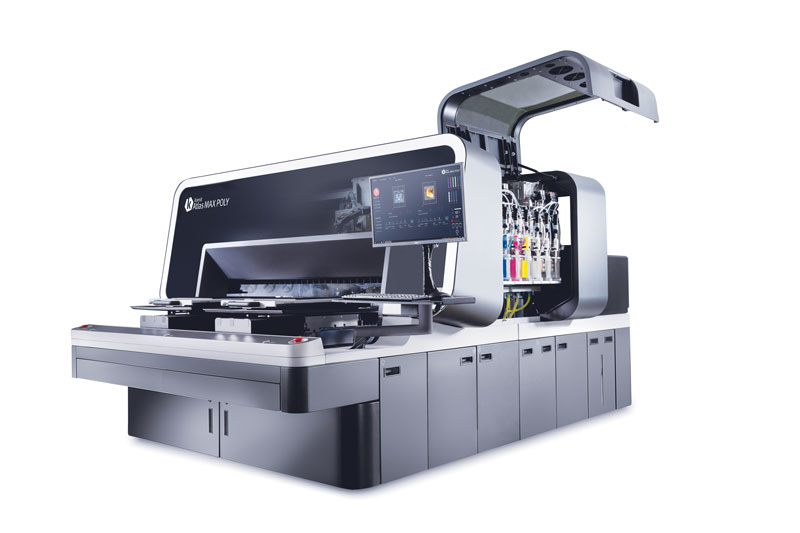
Kornit’s Atlas MAX Poly system is a direct-to-garment solution for vibrant designs on polyester and poly blends.
Modular Strategy
One of the greatest attributes of localized, on-demand fashion and textile production models is that the strategy is entirely modular; it can be replicated to mitigate risk, foster operational agility and versatility, and deliver profitability anywhere. Perhaps no Kornit partner exemplifies this proposition better than London-based Fashion-Enter, which employs both Kornit DTG and direct-to-fabric production systems to educate, empower, and fulfill the needs of aspiring fashion designers in the United Kingdom. That it can successfully do so within the city of London, the high-cost cradle of the Industrial Revolution itself, demonstrates how “Make It British” can also mean “make it sustainably, make it with superior quality, make it in any quantity, make it without limitations, make it brilliant — and make it cost-effectively every time.”
Regardless of the challenges we face, game-changing technologies have provided a solution in times of need. In the past 40 years, technological advancements have made considerable gains in areas of alleviating poverty, improving healthcare and wellness, revolutionizing the ways we communicate and shop, increasing our quality of life, and far more. Where simple economics once drove manufacturers to solve problems by simply moving operations to far-flung locations where both labor and space were cheap and plentiful, those committed to developing sustainable, efficient, highly automated, and versatile production technologies have made it more profitable than ever to bring those operations back home. What’s more, unpredictable global market dynamics, like any number of risks and complications we’ve seen these past few years, have compelled business leaders to embrace the wisdom of doing so.
In the Bloomberg piece, GE Appliances CEO Kevin Nolan summed up the situation succinctly: “I’ve always said, this is just economics, people are going to realize that the savings they thought they had (from offshoring operations) aren’t real, and it’s going to be better and cheaper to make them here.”
Editor’s Note: Jecka Glasman is chief commercial officer at Kornit Digital.
WILMINGTON, Del. — September 29, 2022 — The LYCRA Co., a developer of innovative fiber and technology solutions for the textile and apparel industry, today announced it has entered into an agreement with Qore® to enable the world’s first large-scale commercial production of bio-derived spandex using QIRA®, the next generation 1,4-butanediol (BDO), as one of its main ingredients. This will result in 70 percent of the LYCRA® fiber content being derived from annually renewable feedstock. This change could potentially reduce the carbon footprint of Lycra fiber by up to 44 percent* versus equivalent product made from fossil-based resources, while maintaining the same high-quality performance parameters of traditional Lycra fiber.
QIRA will be produced at Cargill’s biotechnology campus and corn refining operation in Eddyville, Iowa. The facility, which is currently being built, will commence operations in 2024. The first renewable Lycra fiber made with QIRA will be produced at The Lycra Company’s Tuas, Singapore manufacturing site in 2024. The Lycra Co. is currently seeking commitments with brand and retail customers who are pursuing bio-derived solutions for their apparel.
“As part of our sustainability goals, we are committed to delivering products that support a more circular economy while helping our apparel and personal care customers reduce their footprint,” said Julien Born, CEO of The Lycra Co. “We are especially pleased to collaborate with Qore, a company that shares our vision for innovative, sustainable solutions. Their expertise in operating fermentation processes and understanding of the chemical value chains makes them the ideal partner to help develop a bio-derived Lycra fiber at commercial scale.”
“We are proud to partner with The Lycra Co. on bringing this sustainable material solution to the market. This collaboration demonstrates that QIRA directly replaces conventional BDO and thus significantly improves the fiber’s sustainability profile,” said Jon Veldhouse, CEO of Qore. “QIRA is an innovative platform chemical that can be used in various applications across industries.”
The first generation of renewable Lycra fiber made with QIRA will use feedstock from field corn grown by Iowa farmers and will enable a significant reduction in CO2 footprint. In addition to replacing a finite resource with an annually renewable one, another benefit for mills, brands and retailers is that there is no change in fiber performance, eliminating the need for any re-engineering of fabrics, patterns, or processes. Equivalent performance was demonstrated in 2014 when the world’s first bio-derived spandex was launched under the Lycra brand. The Lycra Co.has since been granted a patent for the process used to make renewable elastane from bio-derived BDO.
*Estimate from Cradle-to-Gate Screening LCA for a representative LYCRA® fiber manufacturing facility, June 2022, prepared by Ramboll US Consulting, Inc.
Greensboro, N.C.-based Cone Denim® is expanding its partnership with hemp processor BastCore LLC. The two companies will continue to collaborate to offer sustainable denim offerings while supporting American agriculture.
Cone recently introduced its U.S. Hemp Collection featuring BastCore U.S.-grown hemp
as well as natural indigo and U.S. cotton. The fabric range includes classic 3×1 weaves, comfort stretch and modern workwear constructions.
BastCore manufactures hemp fiber in Montgomery, Ala., that is USDA biopreferred and OEKO-TEX® Standard 100 certified.
“Cone is extremely proud to work closely with an industry-recognized company like BastCore as we advance our commitment to provide more sustainable, alternative fiber options to our denim community,” said Cone Denim President Steve Maggard. “With a shared goal of pushing new sustainability levels, our partnership with BastCore is creating exciting opportunities that support U.S. agriculture and its use of world-class practices and responsibly sourced products.”
Apparel company Duluth Trading Co., Belleville, Wis., announced plans to locate a new distribution and fulfillment facility in Adairsville, Ga. The $53 million investment will create 300 new jobs.
“We are excited to welcome an iconic brand in Duluth Trading Company to the Peach State,” said Governor Brian Kemp. “We are confident this new facility will begin a prosperous relationship with the people of Bartow County as Duluth expands to meet the distribution needs of our modern economy. Georgia’s prime location and robust infrastructure allows companies to distribute products to 80 percent of the U.S. market in less than two days of drive time or two hours by plane.”
“We are thrilled to open Duluth Trading’s first-ever automated fulfillment center in Adairsville, Georgia,” said Sam Sato, president and CEO, Duluth Trading. “With an expanded fulfillment network and state-of- the-art robotics, this new facility positions us to better serve our customers nationwide all while adding hundreds of new jobs to the Bartow County community.”
Stockholm Essity reports it has finalized the purchases of Canada-based Knix Wear Inc. and Australia-based Modibodi. The two companies are providers of leakproof apparel for periods and incontinence — a fast growing segment in the intimate hygiene sector.
Knix has a strong presence in the United States and Canada; while Modibodi has a presence in Australia, New Zealand and the United Kingdom. Essity acquired 80 percent of Knix, while Founder and CEO Joanna Griffiths holds the remaining 20 percent share. She will remain as president of the company.
Fruit of the Loom, Bowling Green, Ky., has partnered with Recover Textile Systems S.L. to launch a collection of unisex T-shirts featuring Recover™ — a recycled cotton fiber. According to the company, Recover is one of the lowest-impact fibers available in the market, which reduces the carbon and water footprint of apparel produced using the fiber. Each T-shirt is made using 20-percent Recover, and the limited-edition collection is available in eight colors.
“This collection is the latest way Fruit of the Loom is producing more sustainable products across the entire business,” said Mercedes Lopez, vice president of Corporate Social Responsibility at Fruit of the Loom. “As one of the world’s largest manufacturers and marketers of casualwear, we are committed to reducing our environmental impact across the total value chain.”
DES MOINES, Iowa — September 29, 2022 — Kemin Industries, a global ingredient manufacturer that strives to sustainably transform the quality of life every day for 80 percent of the world with its products and services, has named Kimberly Nelson, a third-generation member of Kemin’s founding family, as president of Kemin Nutrisurance, the company’s pet food and rendering technologies business unit.
Kemin, a family-owned-and-operated company, was founded by Nelson’s grandparents, R.W. and Mary Nelson, 61 years ago. Nelson has been with Kemin for seven years, most recently serving as General Manager – North America for Kemin Nutrisurance. During her tenure, the global business unit saw double-digit sales growth despite the challenges of the COVID-19 pandemic and its stress on the supply chain.
“I’m thrilled to lead Kemin Nutrisurance and immensely proud to continue the important work my family has built over the last six decades,” said Nelson. “As a pet owner myself, I’m especially excited to be part of this business unit, and I am eager to continue our success and expand upon it to further cement our position as an industry leader.”
Prior to joining Kemin Nutrisurance, Nelson served as President of Kemin Textile Auxiliaries, operating under the brand Garmon Chemicals, which provides total chemical solutions for the denim and apparel industry. Nelson helped lead the acquisition of Garmon Chemicals in early 2018 and served as Business Development Manager, then General Manager – India, for Kemin Textile Auxiliaries.
“I am very pleased to promote Kimberly Nelson to President of Kemin Nutrisurance, as she has demonstrated the people-focused leadership and business savvy needed to guide our pet food and rendering business,” said David Raveyre, Worldwide Group President, Kemin Industries. “Kimberly has an excellent track record of driving innovation and has demonstrated her ability to effectively direct a global business unit. With the results she’s already delivered, I’m confident she will continue the impressive legacy of the Nelson family and Kemin.”
Nelson spent five years in marketing in Hong Kong before joining Kemin in 2017. She received her bachelor’s degree from Northwestern University and her master’s degree from Savannah College of Art and Design.
Nelson will begin her new role in October 2022, and Alberto Muñoz, currently Marketing Director for Kemin Nutrisurance, will fill her previous position as General Manager – North America for the business unit.
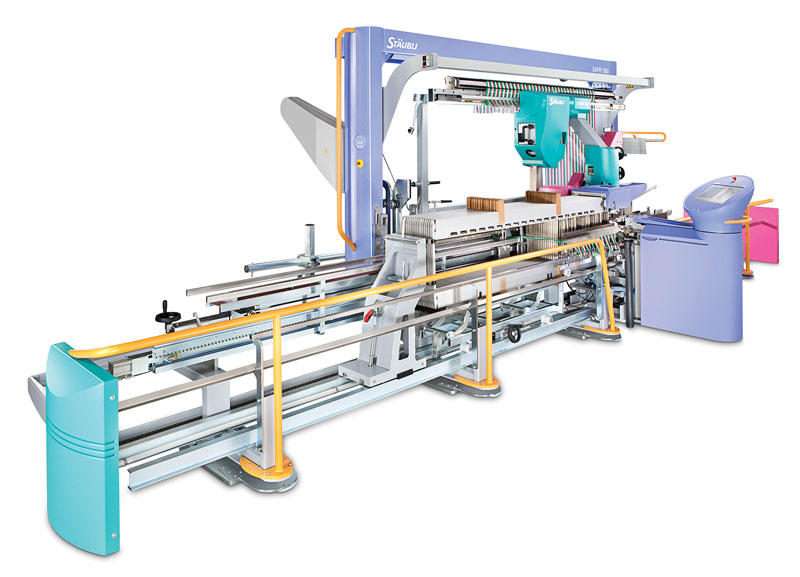
Stäubli Textile offers automation solutions for today’s modern weaving mills including the SAFIR automatic drawing-in machines.
TW Special Report
To succeed in today’s ever-more competitive textile industry, weaving mills must meet a challenging range of essential requirements, including optimized production workflow, high-quality output, cost-efficient operation and on-time delivery. Mills must examine every step of their production process to identify and exploit their optimization potential. Automation along the entire process chain is central in this effort. Switzerland-based Stäubli Group is a competent global partner for mills that want to increase their productivity, delivering automation solutions for weaving preparation, weaving all sorts of fabrics, and mastering new application challenges.
SAFIR automatic drawing-in machines enable the mill’s drawing-in department to supply the required amount of completely drawn-in warp beams to the weaving department. The weaving harness and reed are prepared to perfection, according to Stäubli, with no crossed threads, no multiple threads in heddle, and no drop-wire or repeat errors. This improves the ratio of weaving machines per operator. It also reduces downtime, thereby boosting the efficiency and productivity of each weaving machine. The use of automatic instead of manual drawing-in typically improves the mill’s overall weaving efficiency by 1 to 4 percent or more, which over a year can amount to several hundred thousand meters of fabric, depending on the size of the mill.
The trend toward higher-quality fabrics and the use of increasingly finer and more specific yarns increases the number and complexity of warp threads to be drawn in. If the mill relies on manual drawing in, more workers will be required. But finding and keeping suitable workers in this field is becoming increasingly difficult. The willingness to do such work is disappearing, and the organizational effort required for manual drawing in is significant. Another drawback of manual drawing in is that human error creeps in as the thousands of warp threads are drawn into the shafts, heddles, reed and drop wires pinned onto the weaving machine.
When it comes to warp changes, Stäubli Textile provides a complete range of warp-tying solutions that can handle the entire spectrum of fibers and filaments, from the finest silk to coarse polypropylene tape. These high-precision machines are reliable workhorses that can be easily integrated into the workflow of any weaving mill. They feature many state-of-the-art technologies like automatic docking to the warp and a unique auto-reverse function that repeats the yarn separation without operator intervention when a double end is detected.
Stäubli Textile division collaborates with the Stäubli Group’s Robotics division to develop new automation solutions for the textile industry. Synergies and intensive know-how exchange among the 600 research and development specialists and application engineers in the Stäubli Group have led to new automation examples like pick and pack bobbin handling, and solutions for loading yarn bobbins on preparation creels for both direct or sectional beaming. Stäubli robots can be designed for any application in any industry where speed, precision, and reliability are required. The comprehensive range of robots — including industrial, collaborative, mobile, and AGV — are all Industry 4.0 compliant to support industry transformation. Textile industrials can count on the Stäubli Group to support their efficient production with proven automation solutions today and new leading-edge solutions tomorrow.
Co-founder and CEO of Intrinsic Advanced Materials and Co-inventor of CiCLO technology Andrea Ferris (left) and Cheryl Smyre, director, Advanced Materials, Parkdale, are teammates leading the Intrinsic Advanced Materials joint venture.
Intrinsic Advanced Materials — a joint venture between Intrinsic Textiles Group and Parkdale Advanced Materials — offers a solution to man-made microfiber pollution with its CiCLO® technology.
TW Special Report
Microplastics — defined by the U.S. National Oceanic and Atmospheric Administration as any piece of plastic less than 5 millimeters in length — are harmful to marine and aquatic life, and, like it or not, textiles have been found to be a contributor to microplastics in the environment in the form of microfibers. Such particles are too small to feasibly recover and once in the environment, they persist because they do not biodegrade naturally. The full extent of the problem is still being studied, but between the millions of tons of apparel and other textile products sent to landfills each year, as well as fiber shedding from textiles during use and laundering, much work is to be done to reduce the impact of textile fibers in the environment.
Realistically, there is no “one-size-fits-all” solution and companies are tackling the problem in a variety of ways — from developing new recycling technologies that can handle mixed waste streams to recover and recycle plastic an almost infinite number of times, to encouraging circular economies and textile reuse.
Another strategy employed by Intrinsic Textiles Group LLC focused on making man-made textile fibers biodegradable. It is impossible to ensure that no microfibers end up in the environment, so what if such tiny fibers could biodegrade in nature and reduce their environmental impact? That was the question asked by Andrea Ferris and partner Alan McIntosh when they founded Intrinsic Textiles Group and set to developing a technology they named CiCLO®.
Ferris notes on the CiCLO website that, “CiCLO fibers were invented from a conviction that ‘built to last’ shouldn’t mean ‘here forever.’”
The pair’s business and burgeoning technology eventually caught the eye of Parkdale Advanced Materials — the fibers and yarns innovation division of Parkdale Inc., Gastonia, N.C. In 2018, the two companies decided to collaborate and a joint venture company — Intrinsic Advanced Materials — was formed.
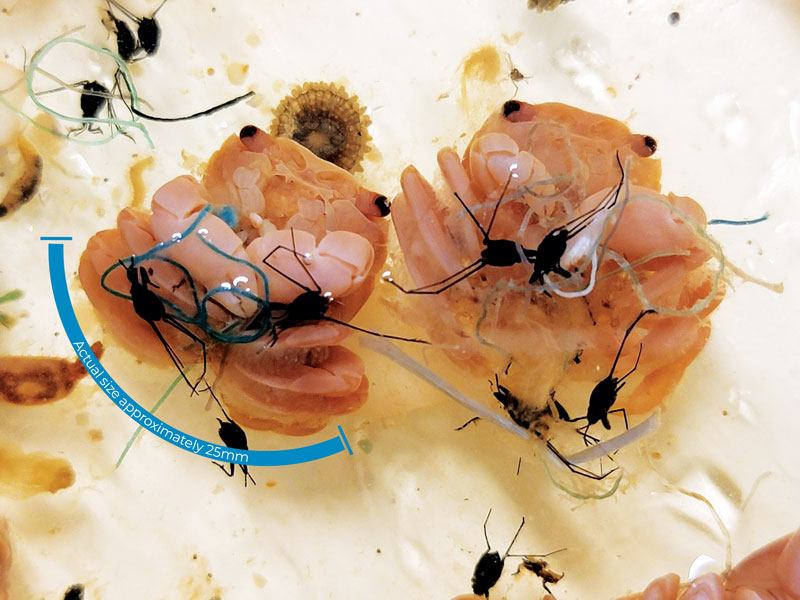
Tiny fibers can have big impact: Pelagic crabs are shown shackled by fugitive man-made microfibers in this image captured by the Moore Institute for Plastic Pollution Research.
Textile Worldrecently had the chance to discuss CiCLO’s progress with Ferris, co-founder and CEO of Intrinsic Advanced Materials and co-inventor of CiCLO technology, to learn more about the company’s beginnings, how the technology works and the product’s commercialization.
TW: Circling back to the beginning, it’s unusual for a textile technology to get its start in Silicon Valley! What was the drive behind the technology?
Ferris: CiCLO technology was the brainchild of Intrinsic Textiles Group, a textile technology start-up that spun out of a uniforms and branded merchandise agency in Silicon Valley serving hi-tech clients as well as fast casual restaurant chains. We initially invented the technology to solve our own problem. But, over years of research and development, we discovered that we’d created such an important solution to help reduce plastic pollution that it made sense to build an infrastructure to make it available to the rest of the world too.
TW: How was the concept initially conceived?
Ferris: The story goes like this. Way back in 2012, we had the realization that the large uniforms programs we were supplying were emitting massive amounts of microplastic pollution in the form of man-made fibers into the environment. We were already using recycled polyester (rPET) as a raw material, but had a crisis of conscience when considering the unavoidable pollution the products we supplied were causing. So, we set out to make a better polyester — one that would still be durable and high performance during the useful life of finished products, but one that would eventually biodegrade when it ends up in the environment as a pollutant. We knew that biodegradable plastics existed, so it sounded easy enough at the time!
More than 60 percent of the world’s textiles are made with man-mades like polyester and nylon, which fall into the category of plastics. “Plastics” have a bad rap, but polyester and nylon play an important role in our lives — delivering high performance characteristics — they comfort and protect us — durability — they last virtually forever so we can use longer and buy less — easy care — less washing and drying is required — and global availability at affordable costs. But almost all fabrics shed fibers during manufacture, use and care. The fibers, referred to as microfibers or fiber fragments, are so small that they leak into the environment. Once fugitive, they cannot be recaptured. It’s common knowledge that most plastics, including polyester and nylon, are not inherently biodegradable and persist indefinitely in the environment. Considering all this, it’s not shocking that research shows that man-made textiles are a contributor to microplastic pollution
While source reduction, 100-percent prevention of plastic pollution and completely closed loops are ideal goals, the idea for the CiCLO solution was grounded in current reality. The goal in developing CiCLO technology was to ensure that fiber fragments shed from man-made fabrics using the technology won’t persist in the environment forever the way other man-mades do.
TW: Parkdale is known for its cotton processing expertise. What about the CiCLO technology was attractive to Parkdale, and how does it complement Parkdale’s traditional business?
Ferris: As the largest spun yarn manufacturer in the Western Hemisphere, Parkdale’s production of polyester-containing yarns exceeds 500 million pounds per year. It has taken a leadership position in delivering sustainable solutions for the textile industry and CiCLO is the proven technology to mitigate microfiber pollution generated by man-made textiles. Parkdale is committed to being part of the solution by creating a path for a cleaner planet, and that is transformational for the textiles industry.
TW: What did the development process look like, and how did Parkdale’s involvement contribute to a commercial product?
Ferris: The development process was long and comprehensive, starting with an investigation into existing biodegradable technologies and biopolymers. We found that while there were some innovative materials in the market, there was nothing designed specifically for the requirements of high-performance textiles. By that, I mean we needed a technology with safe ingredients that could be blended homogeneously, spun efficiently with conventional and recycled polyester using existing equipment, dyed and finished conventionally, with no loss of mechanical characteristics or durability … but that also eventually biodegraded at greatly accelerated rates when fugitive as a pollutant in the environment. The technology didn’t exist, so we made it! It took four years of trial and error, relationship building, raw materials sourcing and evaluation, and a sizable — and ongoing — financial investment in third-party lab testing for performance and biodegradation.
The joint venture with Parkdale has been instrumental in scaling CiCLO technology, from contributing its expertise to optimizing the formulation for spinning to transforming the company from a startup with limited resources and reach to a meaningful textile technology business. Parkdale’s size, textile industry relationships and sincere commitment to innovative solutions that improve lives and sustain the planet make it the perfect company to help CiCLO polyester become the new industry standard globally.
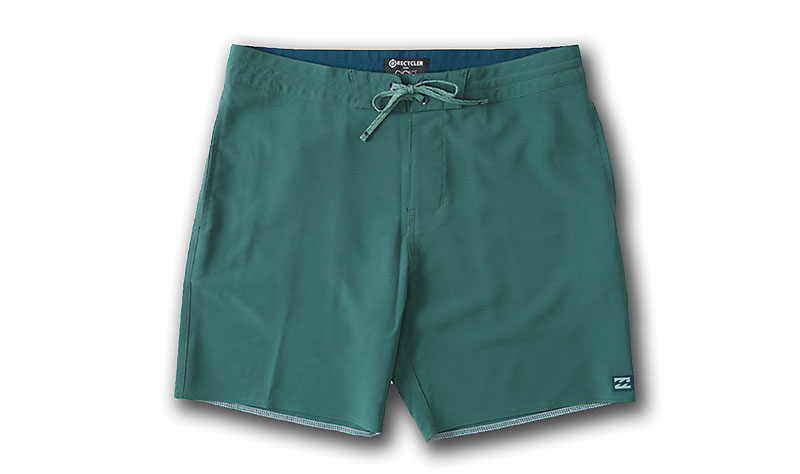
Australia-based lifestyle and technical clothing brand Billabong has adopted CiCLO® and currently offers boardshorts and wetsuits featuring the technology.
TW: For readers not familiar with CiCLO technology, what is it and how does it work? What types of man-made fibers are compatible with the technology?
Ferris: CiCLO technology gets blended with conventional or recycled polyester and nylon during melt extrusion at the very beginning of the fiber manufacturing process. It becomes permanently embedded in the fiber, so it never washes out. In the simplest of terms, it provides nutrients that attract and act as a food source for microbes, allowing microbes to breakdown and digest — or biodegrade — the active ingredients as well as the surrounding polymer.
The process can be likened to how other natural and inherently biodegradable materials break down in the natural uncontrolled environments. Just like a wool sweater won’t biodegrade during manufacturing, use, care, or in the closet, neither will CiCLO polyester or nylon. Biodegradation of any biodegradable materials requires the presence of moisture and microbes over extended periods of time.
TW: The technology is “scientifically proven.” How is the technology tested for biodegradation and what sort of data supports those claims?
Ferris: The efficacy of CiCLO technology has been scientifically proven by long term biodegradation studies conducted by third-party labs, including Intertek and Bureau Veritas among others, using internationally recognized ASTM Test Methods that simulate environments where man-made fibers are prolific pollutants — wastewater treatment plant sludge, natural soil, anaerobic digester landfill conditions and sea water.
Biodegradation is a complex topic, as is the testing. We often give long presentations on these topics alone. We share comparative long-term data to prove greatly accelerated biodegradation, but no claims can or should be made about “how fast” a biodegradable material will biodegrade in natural, uncontrolled environments. Think about it … every drop of seawater, square foot of landfill, and field of soil varies greatly — from nutrients to moisture to diversity and density of microbes, absence or presence of oxygen, temperature, among other factors.
If I could leave readers with two takeaways on the topic of biodegradation it would be that first the length of time it takes anything that is biodegradable — think wool, cotton or paper, for example — to biodegrade will vary based on many factors including the material properties and external factors; and second, years of third-party testing proves that CiCLO polyester and nylon biodegrade at greatly accelerated rates versus to comparable non-CiCLO polyester and nylon in wastewater treatment plant sludge, natural soil, anaerobic digester landfill conditions and sea water.
TW: During development, what were the challenges and were there any roadblocks?
Ferris: We had some bumps in the road along the way when it came to biodegradation testing.
We do not extrapolate data, and full biodegradation studies can take a few years. We went to market using one primary lab but quickly realized that brands and retailers wanted to see triangulated data from multiple labs. There aren’t a lot of labs that offer biodegradation testing, and the test environments can be challenging to manage because they are living systems. Even the most reputable labs sometimes have systems die and need to restart experiments, adding to the already long time frames. Over the past four years, we have invested heavily in building relationships with third-party lab resources and conducting additional long-term studies to corroborate data. Ongoing testing is a top priority. Our research and development team always has multiple studies in the works, and we’re committed to spot testing materials in the market.
TW: Have companies been quick to adopt the technology?
Ferris: My semi-joking answer is that “quick” and “textile development” seem to be competing concepts. CiCLO technology may break the world record for most highly vetted textile technology ever to be commercialized!
My serious answer is that we find it can take two to three years from the time a brand shows interest in CiCLO fibers to when its CiCLO-branded products stock shelves. Coming from a textile background, we understand this process and appreciate the due diligence on our clients’ part. We launched in 2017 and are now seeing new products coming to market every week from brands we have been working with for years. There’s truth to the statement that the day you plant the seed isn’t the day you eat the fruit.
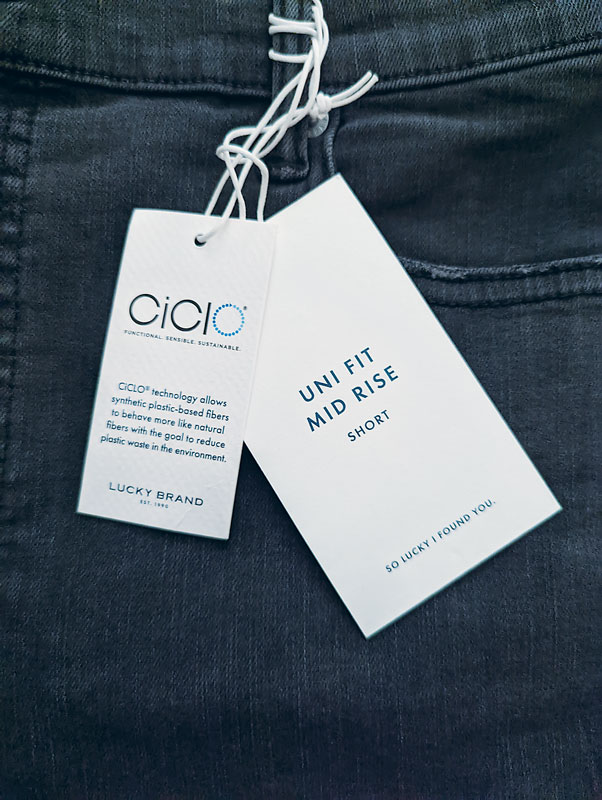
Lucky Brand is opting to use hangtags on its products featuring CiCLO® to educate consumers about the technology.
TW: Who has adopted and are any brands currently featuring the technology in consumer products? Is the product branded and marketed to consumers using hangtag programs?
Ferris: Products made with CiCLO fiber have been available at retail since early 2020. It’s used widely in apparel and home textiles like bedding. Some adopters include Girlfriend Collective, Billabong, Definite Articles, Oakley, Aeropostale, Junes Bags, Lucky Brand, Kindthread, DCK Boardshorts, Sheets & Giggles, Finisterre, and Nimble. CiCLO branded products can be found at Target, Macy’s, Bed Bath & Beyond, Urban Outfitters, Madewell, Free People, and many more retailers.
We offer CiCLO hangtags upon request, which is tied into our traceability program, that many brands utilize. Some choose to create tags using their brand voice and aesthetic, but that are also in line with CiCLO brand guidelines about how to communicate biodegradable plastics to consumers.
TW: Is it requested by brands or are textile manufacturers opting to use the technology to attract customers to their textile products?
Ferris: Both, and the source of interest has evolved over time. As a new company and technology, we initially had to prove ourselves and the product to fiber and fabric manufacturers. We couldn’t sell the product to brands until we were also able to offer CiCLO fiber availability globally. Then, we tirelessly presented the concept to brands and helped align them with our reputable fiber suppliers. Brand awareness of CiCLO technology has grown so significantly that today we get daily inquiries from both brands wanting to adopt and manufacturers wanting to supply.
TW: Is the product certified by any third-party organizations?
Ferris: The chemistry used to create CiCLO technology is ECO PASSPORT Certified by OEKO-TEX®. All components are also REACH compliant.
TW: Does CiCLO technology extend beyond textiles?
Ferris: We are solely focused on pollution caused by textiles today, and very intentionally avoid applications for unnecessary single-use plastics like straws. Our position is that biodegradation of plastics makes sense when the material unavoidably leaks into the environment and cannot be recovered or recycled.
In addition to designing with CiCLO polyester and nylon, we encourage brands and manufacturers to pursue ways to lessen shedding, filter fibers, recycle, reduce use of man-made fibers, utilize natural fibers and all the other ways the industry can work to mitigate pollution caused by textiles. CiCLO technology is just one arrow in the quiver!
TW: So, after 10 long years, you’ve proven the science, built a global infrastructure for traceability and availability, developed meaningful and responsible marketing, and adoptions are growing daily. What challenges do you face today and what keeps you up at night?
Ferris: Every business has challenges, and I’ll share our top two.
First, brands and retailers are facing real and difficult supply chain disruptions, which delays adoptions of any new technology. We’re patient, understand these issues and are here for the long haul, so this is temporary and we’re already overcoming this.
Second, there is understated confusion on the complex topic of biodegradation — how fast, in what environments and how does it work? Unfortunately, we’ve seen some bad actors doing things like having a very specific fiber, or fibers, certified compostable, then marketing a “biodegradable” yarn for textiles. BPI, a certifying body for compostability, will only certify products and materials related to food packaging and yard waste. Additionally, finished products — not just raw materials — need to be certified to qualify as compostable. Commercial compost is not an end-of-life solution for textiles.
We see it as our job to educate the industry, which we’re doing. It will continue to take time and becomes more challenging as other companies and manufacturers propose well branded — and I’d like to think well meaning — but irresponsible, unproven solutions to synthetic microfiber pollution. That’s what keeps me up at night!