NEW YORK — November 16, 2023 — Knix, intimate apparel brand and champion of living unapologetically free is excited to announce its new innovation in Leakproof technology: Leakproof Shapewear absorbing about 0.8 to 3 teaspoons of liquid, which is the equivalent of about 1 to 3 regular tampons or about 1 to 2 pantyliners.
Knix is the ultimate destination for Base Layers: Bras, Underwear, and Shapewear designing products for real bodies. The new Leakproof Shapewear offerings give people the freedom to wear what they want, when they want — combining form, fashion and function. These new innovations in Leakproof Shapewear provide an all-in-one solution giving people the option to go commando and achieve the seamless look they expect from shapewear with the added protection of leakproof technology.
Designed to make you feel comfortable in your own skin any day of the month, our Leakproof Shapewear enhances your natural shape — giving you the confidence to feel protected against life’s leaks.
The new Leakproof Shapewear is available in two different silhouettes: the Leakproof High Rise Shaper Short and the Leakproof High Rise Shaper Brief — both perfect base layers to wear under your favorite outfits for a seamless look and feel. The Knix Leakproof Shapewear is available in sizes XS to XXXXL. The Leakproof High Rise Shaper Short retails for $65 USD and the Leakproof High Rise Brief retails for $55 USD. The new Leakproof Shapewear is launching November 16th, 2023.
WILMINGTON, Del. — November 16, 2023 — Starting today, DuPont™ FilmTec™ Fortilife™ NF1000 membrane elements are now sold worldwide. The high-productivity nanofiltration elements help enable increased wastewater reuse and resource recovery in some of the most challenging applications—with reduced energy consumption—compared to earlier versions of the technology.
DuPont’s Fortilife NF1000 product is being honored this week with a 2023 R&D100 Award, which celebrates the 100 most innovative and revolutionary technologies launched in the past year. While now globally available, Fortilife NF1000 was first launched in the Asia Pacific region where Minimal Liquid Discharge (MLD) solutions have been more widely adopted to meet both wastewater management regulations and business goals for circularity.
“As the world strives to treat and reuse more wastewater—from municipal applications to the most challenging industrial waters — FilmTec Fortilife NF1000 helps enable our customers to refine wastewater into valuable fractions to optimize the reuse potential and minimize waste,” said Alan Chan, global vice president and general manager, DuPont Water Solutions. “Industrial wastewater management — from coal-to-chemical and textiles to petrochemical and power production — can benefit from the use of NF1000 to recover water, salts and other valuable resources for reuse.”
Fortilife NF1000, a spiral-wound nanofiltration membrane, yields high water flux with exceptional high-pH durability while accomplishing challenging separations in high-pressure industrial wastewater applications.
Industrial wastewater generators are often required to practice zero-liquid-discharge (ZLD) to comply with local regulations. Traditionally, wastewater, comprised of salts and organic compounds, is sent to large evaporators or crystallizers to separate water from the solid waste. This can be an extremely energy-intensive and costly process. DuPont’s approach is to utilize a minimum-liquid-discharge (MLD) strategy using reverse osmosis (RO) and nanofiltration (NF) elements to reduce the volume of water sent to final thermal treatment, helping reduce operational costs while simultaneously recovering water for reuse.
In MLD systems, Fortilife NF1000 can be used upstream of RO to remove divalent ions and organic compounds or downstream of RO in selective-ion separation for improved crystallization efficiency with a purer brine composition or valorization of salts. Fortilife NF1000 can help increase water recovery, reduce energy consumption, and provide opportunities for resource recovery or valorization.
“Our customers’ top needs in the industrial wastewater space are improved recovery and better reliability — with a focus on sustainability and lifetime costs,” said Verónica Garcia Molina, global market leader, Industrial Water & Energy, DuPont Water Solutions. “With NF1000’s high active area and durable construction, use of the element can help our customers reduce energy requirements and costs, extending the membranes’ lifetime and reducing capital expenditures.”
DuPont’s water technologies help purify more than 50 million gallons of water every minute around the world, enable water reuse and recycling, desalination, and the safe access of both ground and surface water. DuPont offers solutions to a variety of water and sustainability challenges faced by industrial water users and water treatment municipalities through a broad portfolio of membranes, resins and systems (including reverse osmosis (RO) membranes, ion exchange resins (IEX), ultrafiltration (UF), electrodeionization (EDI), nanofiltration (NF), membrane bioreactor systems (MBR), membrane aerated biofilm reactors (MABR), and closed-circuit reverse osmosis (CCRO) systems).
Milliken received a gold rating on its 2023 EcoVadis assessment.
SPARTANBURG, S.C. — November 16, 2023 — Milliken & Company, a diversified global manufacturer, received a gold rating on its 2023 EcoVadis assessment. EcoVadis provides trusted business sustainability ratings for more than 100,000 organizations representing more than 200 industries. Milliken’s 2023 EcoVadis score, assessed across its specialty chemical, textile, floor covering and healthcare operations, places the company in the top 2 percent of organizations rated.
“We are committed to making real, positive and tangible impacts on the world around us. Our EcoVadis rating helps translate our work across the value chain,” states Halsey Cook, president and CEO of Milliken & Company.
Last year, Milliken announced its path toward becoming net-zero by 2050. Using short- and long-term science-based net-zero targets, which were verified by the Science Based Targets initiative (SBTi), Milliken continues to develop reduction pathways for its scope 1, 2 and 3 emissions. As part of its broader sustainability work, these net-zero targets join Milliken’s existing 2025 People, Product and Planet Sustainability Goals.
“Milliken prioritizes sustainable performance and development for the benefit of our customers, our associates and our communities,” adds Kasel Knight, general counsel and head of sustainability at Milliken. “The EcoVadis rating is a third-party review of our work that helps us see how we’re doing and where we should focus.”
To explore Milliken’s sustainability initiatives, including its latest corporate sustainability report, visit sustainability.milliken.com.
PORTLAND, Ore. — November 16, 2023 — Columbia Sportswear Co. — a global company in designing, sourcing, marketing, and distributing outdoor, active and everyday lifestyle apparel, footwear, accessories, and equipment products — today announced that Cory Long will be joining the company as President of the SOREL brand.
Cory Long, President of the SOREL brand. Photo: Business Wire
Long is a veteran of the footwear and apparel industry, most recently serving as global general manager and chief global merchant of DC Shoes. He has leadership experience at an array of brands, including Mitchell & Ness, Asics, Supra, and Converse.
“We are delighted to have Cory join the SOREL family,” said Craig Zanon, senior vice president, Emerging Brands. “His strength of leadership and consumer-champion mindset will be key in fueling the next era of SOREL growth.“
WASHINGTON, D.C. — November 15, 2023 — U.S. Senators Ron Wyden, D-Ore., Bill Cassidy, R-La., Tim Kaine, D-Va., Thom Tillis, R-N.C., Mark Warner, D-Va., Lindsey Graham, R-S.C., Sherrod Brown, D-Ohio, and Tim Scott, R-S.C., called on U.S. Customs and Border Protection to ensure Chinese companies aren’t evading U.S. laws against forced labor and costing American jobs, by stepping up oversight and enforcement provisions in trade agreements with Central American and North American trading partners.
The senators urged Acting CBP Commissioner Troy Miller to enforce the Dominican Republic-Central American Free Trade Agreement and United States-Mexico-Canada Agreement, which allows the agency to conduct oversight of trading partners’ supply chains, including visits to and audits of apparel factories.
“Recent reports of textile and apparel mill closures in the United States raise serious concerns as the lack of effective customs enforcement has been cited repeatedly as a key factor contributing to declining demand,” the senators wrote. “Insufficient enforcement can create a pathway for banned Xinjiang cotton to infiltrate regional supply chains and undermine efforts to enforce the Uyghur Forced Labor Prevention Act. For this reason, robust and consistent enforcement of the origin and content rules in U.S. trade agreements, along with the longstanding U.S. ban on products made with forced labor, is essential to securing this supply chain and guaranteeing workers, businesses, and consumers the benefits bargained for in CAFTA-DR and USMCA.”
As a significant producer of cotton, it is critical that the United States take every step necessary to support domestic textile and apparel producers, the senators said, urging CBP to take actions that are quicker, tougher, and directly responsive to the trade cheating that happens before these products are sent to the United States and keep those textiles from entering our country. U.S. trade agreements can’t be undercut on foreign soil.
The Senators highlighted several significant steps that could be taken immediately and efficiently to improve enforcement:
Significantly increasing on-site and surprise verifications of textile facilities in the CAFTA-DR and USMCA regions.
Providing technical assistance and information sharing arrangements with customs authorities in the CAFTA-DR and USMCA region to root out materials made with forced labor or country of origin labeling concerns that may ultimately be bound to the United States.\
Improving targeting of illicit or fraudulent shipments by providing a Spanish language version of e-Allegation and asking governments, companies, and NGOs in the region to share information regarding this reporting portal.
Conducting a comprehensive review of existing enforcement authorities and penalties for textiles and apparel, and creating a strategic plan that outlines how CBP will maximize its existing tools and resources to ensure full compliance with CAFTA-DR, USMCA, and other relevant trade rules.
Read the full letter to Acting Commissioner Miller here.
LAS VEGAS — November 15, 2023 — Rimini Street Inc., a global provider of end-to-end enterprise software support, products and services, the leading third-party support provider for Oracle and SAP software, and a Salesforce and AWS partner, today announced that Pacific Textiles, a global leader in the textile manufacturing industry, has selected Rimini Support™ to support its highly customized, mission-critical S/4HANA implementation, the backbone of their manufacturing operations.
Rimini Street’s faster, more comprehensive software support has enabled Pacific Textiles to achieve significant reduction of IT costs, freeing resources to focus on projects and investments for competitive growth and advantage, including the move to a new data lake architecture.
Vendor Support Quickly Diminishes in Value and Experience After Implementation
Pacific Textiles is one of the world’s leading manufacturers of customized knitted fabric in the textile industry, and its products are used in the production of over a billion garments each year. The company collaborates closely with apparel brands to design fabrics that meet customized orders, delivering more than 3,000 new samples for its customers each month.
The company heavily relies on SAP software to run its business including sales order entry, production planning, material procurement and many other critical ERP functions.
“When we purchased SAP, the closest product we were offered to fit our needs was the Mill Products industry solution, traditionally used for paper products and steel manufacturing. Obviously, textiles didn’t fit quite well into that, so we required an extensive number of customizations,” said Hubert Tsang, chief information officer, Pacific Textiles.
“SAP support was helpful during our initial implementation. But the service quality deteriorated after that. It became a slow, cumbersome process. With standard SAP support, we’d submit a ticket, wait a while for them to process it, go back and forth, then wait endlessly for a resolution. Ultimately, we were only able to solve most of our problems by spending more on SAP professional services,” shared Tsang.
Rimini Street Cuts Support Response Time and Spend on Software Maintenance
Frustrated with the quality, speed and cost of vendor support for S/4HANA, Pacific Textiles began searching for a third-party support provider and quickly chose Rimini Street because of the company’s size, scalability and rich enterprise-grade capabilities. In addition, Rimini Street was the only option that offered Pacific Textiles the multi-language support they required as a global business.
With the move to Rimini Support, Pacific Textiles is benefitting from:
Maximum 10-minute response time instead of 4 hours with SAP, a 96% reduction in response time commitment
Direct access to a named, dedicated Primary Support Engineer (PSE)
Expert support for its highly-customized systems not covered by vendor support
Significant reduction in IT support costs
Freed resources to reallocate towards growth projects
“With the money that we’ve saved by moving to Rimini Street, Pacific Textiles is now able to work on key, strategic projects that we’ve been wanting to do for years,” said Tsang. “In manufacturing, we collect and analyze tons of data so we can understand and optimize the performance of our machines. We had wanted to move to a new data lake architecture, but too much budget was wrapped up in IT support. Rimini Street helped us free up the funds to take on this important project which will support our AI innovation roadmap.”
“At Rimini Street, we view ourselves as much more than just a support vendor,” said Craig Mackereth, executive vice president of global service delivery. “Rimini Street is a strategic partner that plays a critical role in the larger business success of organizations like Pacific Textiles. We’re not aiming for simple transactions — we’re fostering long-term collaborations.”
Learn more about how Pacific Textiles has benefited from Rimini Street here: https://www.riministreet.com/resources/video/pacific-textiles-experiences-better-faster-results-with-rimini-support/
Explore the full Rimini Street portfolio of ultra-responsive, trusted and proven support, managed services, security, integration, observability, professional services and Rimini ONE™ end-to-end outsourcing solutions for SAP, Oracle and Salesforce applications to support competitive advantage, profitability and growth.
ATLANTA, GA — November 16, 2023 — YKK announced the release of its new DynaPel™ water-repellant zipper featuring GTT EMPEL® technology. Designed to be compatible with garment recycling systems, DynaPel uses EMPEL technology instead of the standard PU film to achieve its water repellency. The lack of a PU film helps remove one of the barriers of textile-to-textile recycling of performance apparel by eliminating the urethane material, which presents challenges to garment recycling processes.1
“DynaPel™ is a valuable addition to our growing collection of fasteners designed for circular systems,” said Terry Tsukumo, vice president, Product Strategy Division, Global Sales Headquarters, YKK Corp. “By employing EMPEL technology, we can achieve the robust water protection expected from YKK products while eliminating the challenges that PU poses to recycling systems.”
Conventional chemical and mechanical garment recycling systems cannot process the polyurethane film commonly used on water-repellent zippers, necessitating the removal of zippers from garments before recycling. This additional processing step often deters recyclers from accepting garments with PU zippers, resulting in unnecessary waste.
EMPEL® technology uses advanced green chemistry devoid of PFAS and a specialized manufacturing process that allows the chemistry to penetrate the yarn and encapsulate it with a water-repellent layer through molecular cross-linking. The molecular cross-linking creates an extremely durable layer that is highly resistant to abrasion and invisible to the eye.
“DynaPel™ represents a new generation of sustainable, high-performance water-repellant zippers,” stated Tsukumo. “It is the future of water protection for zippers.”
DynaPel zippers were showcased at the Outdoor Retailer trade show in Salt Lake City and will be featured at the ISPO trade fair in Munich, Germany. Notably, DynaPel has been nominated for the Best New Product Award in the ISPO Textrends competition held at ISPO.
1 It is recommended to trial products in the targeted recycling system to fully assess its processability.
PARIS — November 16, 2023 — Less than four months to go before JEC World opens the doors to the 2024 edition. Well known globally as the main composites festival, a place where business meets inspiration and innovation, the show expects to gather the whole composites community and more. Appointment is settled from March 5-7, 2024 in Paris Nord Villepinte.
The conferences program unveils
Historically, composite parts have already shown their value in making many end sectors more sustainable thanks to their intrinsic properties. But the challenges that the composites industry needs to tackle to reach its sustainability goals are still high and will be at the centre of the conferences and panels this year. They will explore material solutions, such as natural fibers or recycled products, as well as processes, among which the use of automation and digitalization.
At JEC World 2023, end-users’ applications focuses attracted hundreds of participants looking to learn about the latest trends of their industry sector of interest. Gathering research reports, real industry case studies and forecasts, these JEC conferences will star Wind, Aerospace and Transportation as main topics.
Also in 2024, three Country on Stage are confirmed to take place on the Agora stage giving attendees the opportunity to get to know characteristics, trends and strategies in Italy, Michigan and in France.
Celebrating breakthrough projects
The JEC Composites Innovation Awards
For more than 25 years, these Awards have celebrated cutting-edge collaborative projects of the composites industry. All year long, they aim to identify, promote, and reward the most innovative solutions worldwide and enhance their public exposure while contributing, as one, to the evolution of the composite industry.
All companies, R&D centres and their partners can apply before November 26th. For the third year, the winners will be revealed during a ceremony a month prior to JEC World, on February 8th in Paris.
The jury of this year Innovation Awards:
Hüseyin ATES, CTO & Compounding BU Leader, Kordsa
Pr. Alan BANKS, Innovation & Industrial Engagement Supervisor, Ford Motor Company
Pr. Christophe BINETRUY, Professor, Centrale Nantes / Nantes Université
Tamara BLANCO, Composite Materials & Processes Engineer & Expert, Airbus
Dale BROSIUS, Executive VP/Chief Commercialization Officer, IACMI – The Composite Institute
Michel COGNET, Chairman of the Board, JEC
Dr. Karl-Heinz FÜLLER, Manager Future Exterior and Materials, Mercedes-Benz
Dr. Sung HA, Professor, Hanyang University
Guy LARNAC, Technical Domain Coordinator for Materials, Structures and Industrialization JTFR, Ariane Group
Pr. Véronique MICHAUD, Head of Laboratory for Processing of Advanced Composites (LPAC), EPFL
Pr. Kiyoshi UZAWA, Professor/Director, Innovative Composite Center, Kanazawa Institute of Technology
JEC Composites Innovation Awards partner – KORD SA
The JEC Composites Startup Booster
The leading startup competition in the world of composites and advanced materials gathers each year the boldest entrepreneurs, SMEs, startups and academic spinoffs working on avant-garde projects. At stake: international visibility and a chance to bring their business to the next level.
The call for entries is open until December 3rd. Following this, 20 startups will be selected by JEC and its partners Airbus, Owens Corning and Mercedes-Benz. Out of the 20 finalists, 3 winners will be selected during the pitching sessions of the show: one in a “Materials & Products” category, one in a “Process, Manufacturing & Equipment” category and a special “Sustainability” award.
The jury of this year Startup Booster contest:
Jelle Bloemhof, Head of Composites Manufacturing Technologies, Airbus
Dr. Karl-Heinz FÜLLER, Manager Future Exterior and Materials, Mercedes-Benz
Chris Skinner, VP Strategic Marketing, Composite, Owens Corning
JEC Composites Startup Booster Main Innovation Partners
AIRBUS
OWENS CORNING
JEC Composites Startup Booster Innovation Partner
Mercedes-Benz
Industry focuses on the floorplan
With 8 out of 10 participants visiting these highly inspiring areas in 2023, participants are now well aware of the JEC Innovation Planets where the most innovative applications are displayed “in the flesh”. In 2024, the Mobility planet will be back featuring ground transportation, aerospace or railway solutions, while the Building & Infrastructure Planet will make its debut, bringing insight into a growing composites market.
Other dedicated areas will be shedding a light on particular aspect of our industry with the Natural Fibres Village, the Campus Village , the Startup Booster Village, the SME Village and, as a novelty, the Live Demonstration Area.
The Discover Composites area, will cover the history of composites in the sports industry. A nod at this year main event in Paris …
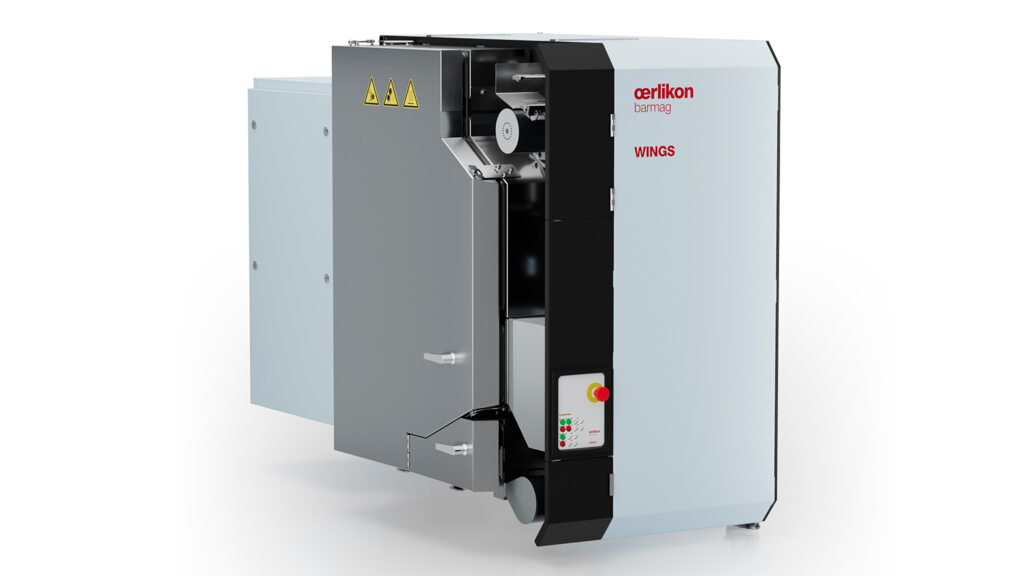
REMSCHEID, Germany/SHANGHAI, China — November 16, 2023 — One for all polyester yarns — this is the promise of WINGS FDY FLEX. Maximum flexibility with up to 32 ends for the yarn producer combined with all the advantages of the WINGS series: energy efficiency, user-friendliness, reduced waste rates, excellent yarn quality. And – as the first WINGS FDY take-up system — it can be used for a wide range of rPET applications.
WINGS FDY FLEX is the first WINGS FDY system that can process a wide range of rPET yarns.
WINGS FDY FLEX is the latest addition to the WINGS family for the FDY process. What is new is the increased flexibility: WINGS FDY FLEX scores above all with a variety of possible end products such as semi-dull, full-dull and trilobal bright yarns as well as cationic dyeable, dope dyed and rPET polymers.
Its large process window with a denier range from 30 to 150 den and single filament thickness from 0.8 to 3.0 dpf opens up numerous possibilities. The new high-end variant of the WINGS FDY series thus eliminates the need for an early commitment to the end product and offers maximum flexibility. This enables the yarn manufacturer to follow the ever faster changing market trends.
WINGS FDY FLEX will be displayed to the public at ITMA Asia and CITME in Shanghai from November 19th to 23rd, at the Oerlikon booth in hall 7, A55.
PARIS — November 16, 2023 — The adoption of composite parts based on flax fibers by the Marine Industry continues to grow, with major OEMs as well as smaller shipyards now aiming to take advantage of the reduced carbon impact and impressive mechanical properties they can provide.
“Over the last ten or fifteen years, several innovative flax fiber boats have been built and the fiber has started to gain significant traction,” said Julie Pariset, Innovation & CSR Director at the Alliance for European Flax-Linen and Hemp. “In addition to the environmental benefits, manufacturers are realizing significant technical and processing gains with flax fiber composites.”
“Flax is a very low-density fiber, with a high specific stiffness,” she explained. “It can be used to manufacture composite laminates with mechanical properties not dissimilar to typical E-glass composites and the coefficient of thermal expansion of a flax fiber epoxy part is also quite close to that of a carbon fiber part.”
This allows the materials to work well in combined assemblies with carbon fiber composites and the flax parts are also highly impact resistant.
Flax fibers also provide impressive acoustic and vibration damping in composite applications, as well as providing a warm and aesthetically pleasing appearance below decks.
“Flax yacht interiors can create a more pleasant environment for passengers with less noise and harshness than standard composites,” says Pariset.
ecoracer30
ecoRacer30
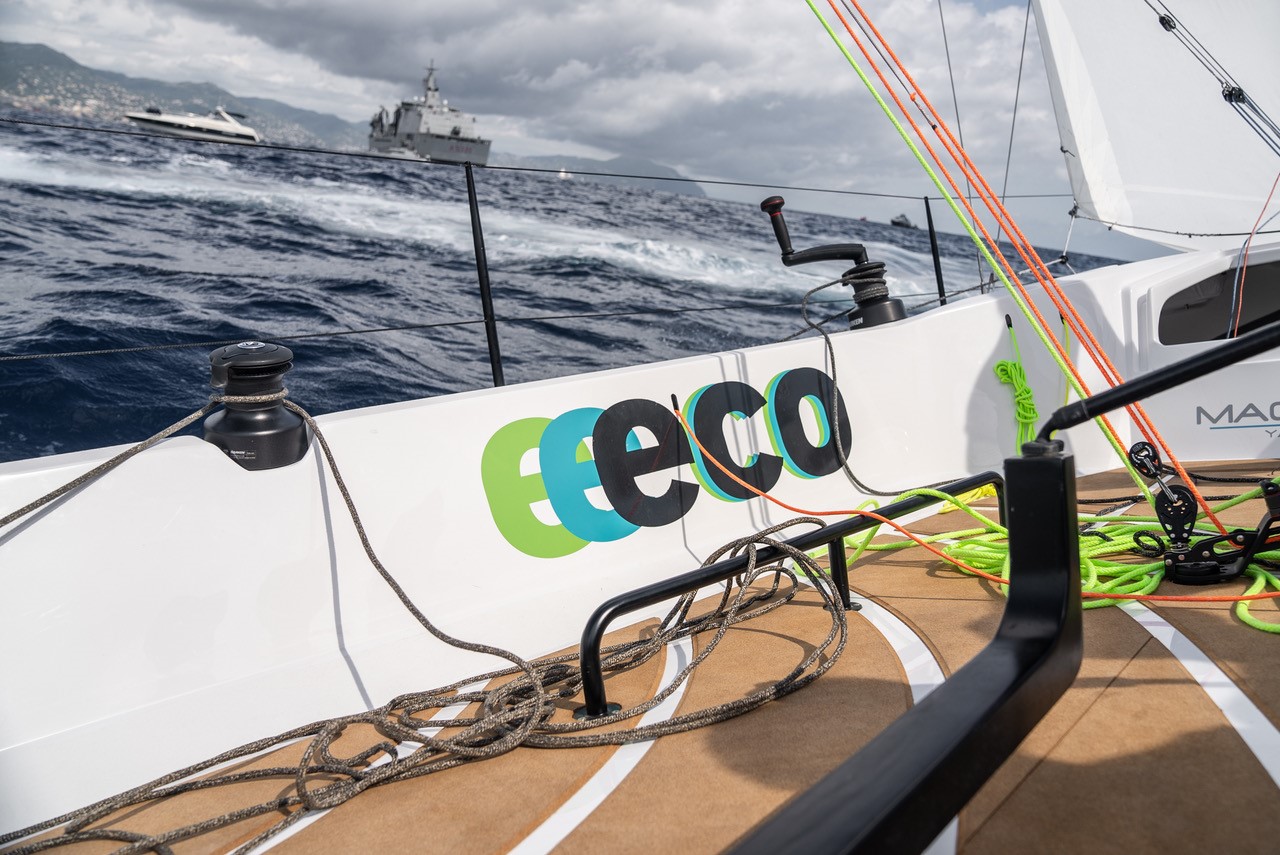
As a member of the Alliance for European Flax-Linen and Hemp, Bcomp, headquartered in Fribourg, Switzerland, has this year been working with Northern Light Composites (nlcomp), based in Monfalcone, northern Italy, on the creation of what is billed as the first fully recyclable nine-meter-long sailing boat — the ecoRacer30.
The boat is based on nlcomp’s proprietary rComposite technology — a combination of thermoplastic resins and BComp’s ampliTex high-performance natural fibre reinforcement fabrics and patented powerRibs technology.
It was built in a collaborative effort with the help of Barcelona-based Magnani Yachts, which took care of the composite manufacturing, and Sangiorgio Marine, which provided technical assistance as the boat was being assembled at its shipyard in Genova, Italy.
Magnani Yachts has subsequently become the first shipyard to hold an rComposite license and others are now being encouraged to adopt the technology.
“As the most commonly used material in boat building, fiberglass is not easily recyclable,” says Fabio Bignolini, CEO of nlcomp. “Consequently, many fiberglass boats end up being burned, sunk or abandoned. In the European Union, there are an estimated 80,000 abandoned boats with only one in twenty disposed of in an environmentally responsible manner.”
The second ecoracer30 is currently under construction and has already been sold and nlcomp is planning to build a fleet of eight of these boats in time to enter a series of regattas in the summer of 2025.
Flax 27 Daysailer
Flax27
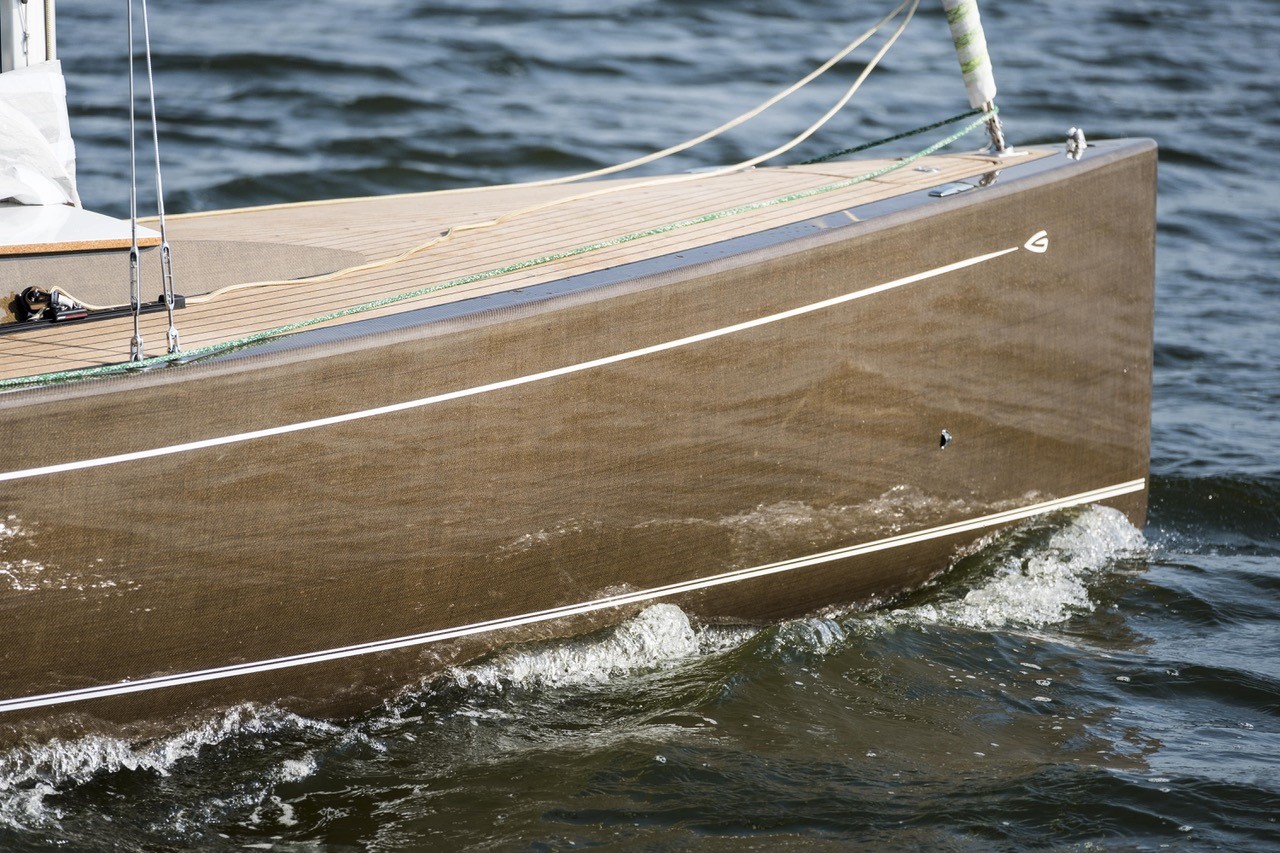
Greenboats, based in Bremen, Germany, is another specialist in building boats from natural fiber composites and has this year launched the Flax 27 daysailer.
The lower hull of this vessel is also made from Bcomp’s ampliTex technical fabrics in combination with a sandwich core of recycled PET bottles. Using a vacuum infusion process, the fibers were integrated with a plant-based epoxy resin in order to further reduce the CO2 footprint of the vessel.
The light structure and modern shapes of the lower hull of the boat result in very fast, sharp and agile handling on the water.
Greenboats has also recently announced significant new backing from alliance member Groupe Depestele, which manages 13,000 hectares of flax land in Normandy, France.
“We’re at a pivotal juncture in the evolution of natural fibre composites as a new product category,” said Jan Paul Schirmer, managing director of Greenboats. “Our clients believe in our technology but demand a more reliable and scalable supply chain. Our partnership with Groupe Depestele will go a good way to establishing this.”
Expectations
Different expectations for the performance of parts must be guaranteed, such as impact resistance, rigidity, surface appearance and resistance to hydrolysis, which is simpler with an established supply chain.
The Beneteau Group, based in Croix de Vie, France, for example, manufactures more than 30,000 composite parts per year to equip its boat decks and is looking to incorporate more natural fibers into them.
This year Beneteau Group has collaborated with Chomarat on the development of hybrid composites of glassfiber and hemp. The resulting Ter2a Mat was a finalist in this year’s JEC Innovation Awards.
Blue Nomad
A project in Switzerland has meanwhile proposed the use of flax fiber composites in solar-powered habitats designed for comfortable living on the oceans — as the world grapples with the frightening implications of climate change and rising sea levels.
As envisaged by students from Institut auf dem Rosenberg in St Gallen, Switzerland working with Denmark-based SAGA Space Architects, Blue Nomad structures would form modular blocks to establish large communities and oceanic farms.
It’s a striking vision of a future where the lines between land and water blur, and sustainability and community building lie at the heart of new human settlements.
The vision is not just theoretical however — plans are now being made for a maiden voyage of a Blue Nomad home across Europe to promote ocean sustainability and climatology.
The project’s scale models for the London exhibition, as well as the first Blue Nomad structure, are based on natural fiber composites again employing BComp’s ampliTex flax fibers in gradient designs, along with a natural bio-resin.
Monitoring the marine market as pioneers in new composite development, Alliance for European Flax-Linen and Hemp continues to be amazed at the innovation and pace of development. Whatever the future holds, it appears flax fibers and natural fiber composites will have an important role to play.
Posted: November 16, 2023
Source: The Alliance for European Flax-Linen and Hemp

 NEW YORK — November 16, 2023 — Knix, intimate apparel brand and champion of living unapologetically free is excited to announce its new innovation in Leakproof technology: Leakproof Shapewear absorbing about 0.8 to 3 teaspoons of liquid, which is the equivalent of about 1 to 3 regular tampons or about 1 to 2 pantyliners.